Telecommunications Resume Builder. Your resume made
Telecom work runs from tower tops and cable trays to network consoles and the phone repair bench; open the examples for yours.
- Professional resume templates
- Easy editing as you go
from 4,000+ reviews


How to write your telecommunications resume
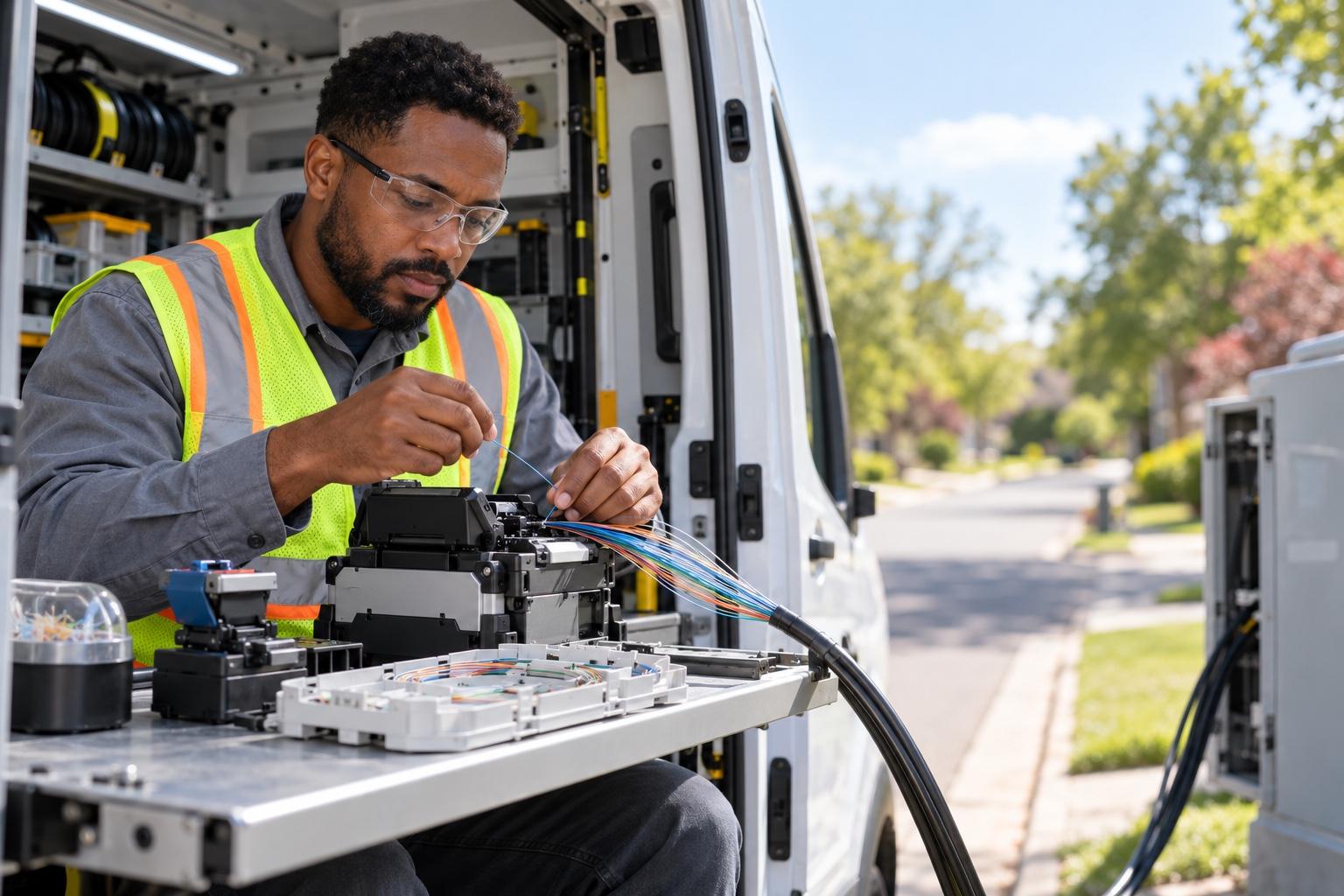
Telecom technical work spans fiber, copper, wireless and network roles, and your resume should say early which of those you do. Then list the credentials that match: the Fiber Optic Association's Certified Fiber Optic Technician (CFOT), BICSI installer or technician credentials for structured cabling, or the National Wireless Safety Alliance's Telecommunications Tower Technician 1 (TTT-1) for tower crews. Manufacturer or employer certification may help some telecom technicians, so include vendor training as well.
List the test gear you use and the networks you've built or maintained: OTDR, power meter, fusion splicer, FTTH, DAS, small cells, 5G radios, routers and switches. Useful numbers here include splice loss, installs or tickets closed per day, repeat-trouble rate, sites integrated, mean time to repair and network uptime. If you've moved between short contracts, group them under the staffing firm or contractor and name the carrier you worked for as the client.
For example, a fiber splicer might write: "Spliced and OTDR-tested fiber for 14 FTTH cabinets in a 2,000-home build, averaging 0.04 dB loss per fusion splice."
How do I show networking skills for an L1 job before I've worked in one?
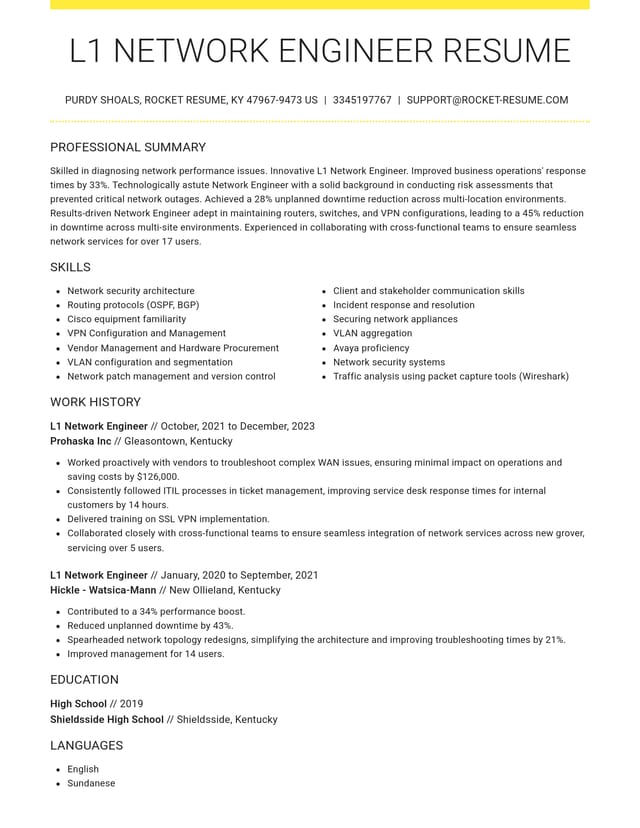
Put the Cisco Certified Network Associate (CCNA) at the top, or the month you're booked to sit exam 200-301. Cisco lists no prerequisites for it and describes it as a starting point for people with little networking knowledge, so it suits a first job such as L1 Network Engineer. Under a Lab heading, describe a network you built, even in a simulator: VLANs, a routed link, an access list and what you tested. Help desk or carrier call-center work counts too when the bullets cover connectivity tickets, alarms you watched and faults you handed to field crews with clear notes. Once you hold the CCNA, add its expiry month, since Cisco says it's valid for three years.
Which repairs and numbers should a phone repair technician's resume show?
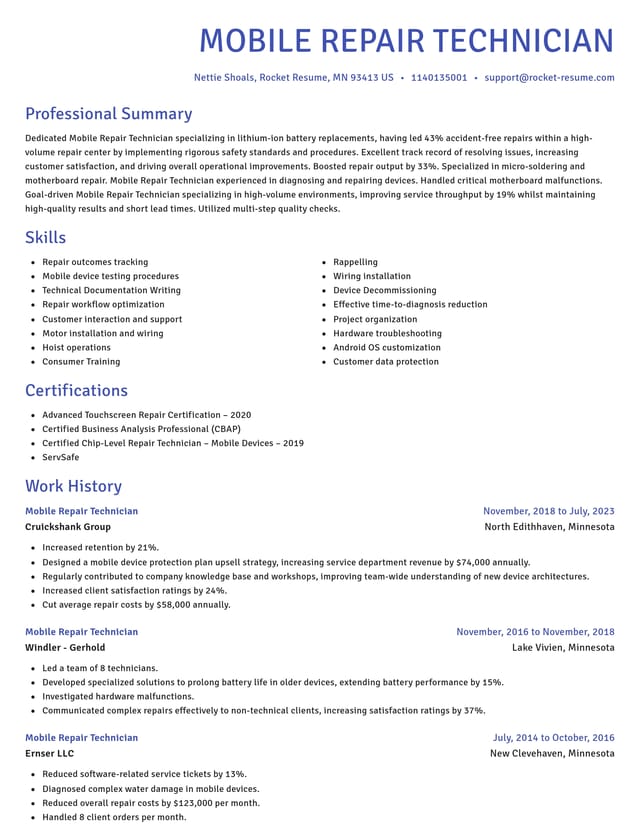
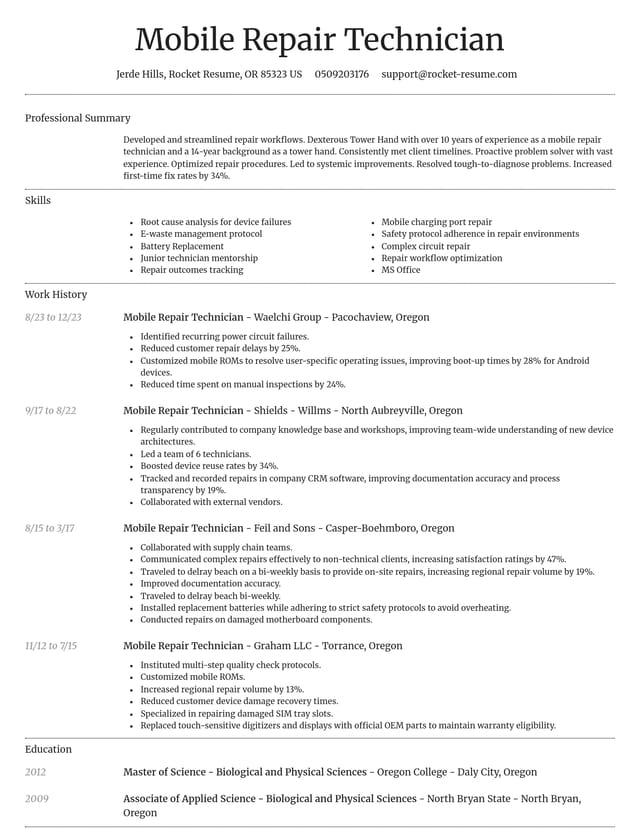
Sort your repairs by depth. List the everyday swaps first, such as screens, batteries and charge ports; board-level work such as micro-soldering or data recovery gets its own line if you do it. Name the brands and models you service most, then give monthly repair volume, your first-time fix rate and how many devices came back. Customers hand over their photos and accounts along with the phone, so a bullet on backups, passcode handling or wiping trade-ins before resale shows care. Add parts ordering and stock counts, and list any manufacturer course by its exact name. The Mobile Repair Technician example shows one way to lay this out.
How do I show tower climbing experience on a resume?
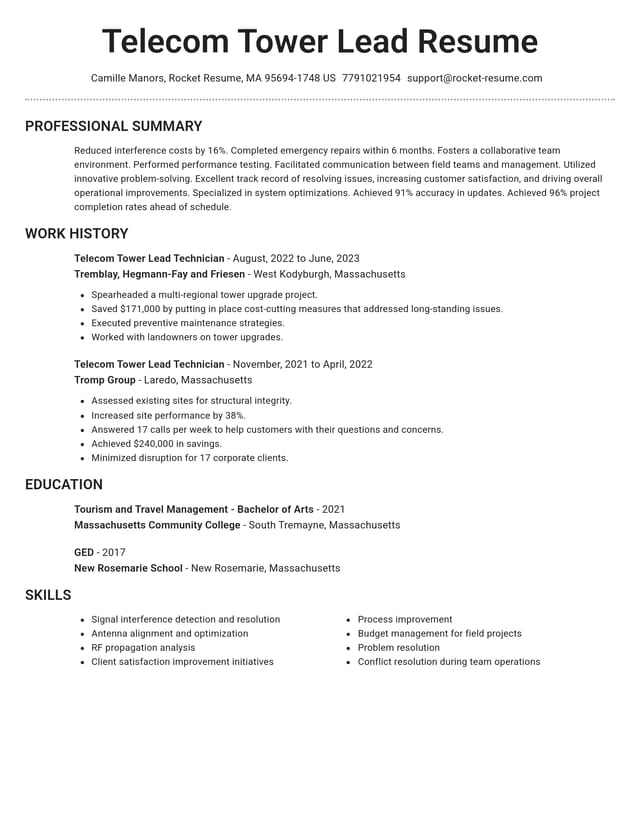
Use the climber levels crews already work by. The tower safety guide OSHA and the FCC published in 2017 recommends training new climbers as authorized climbers, then pairing them with an experienced climber until they have the hours for competent climber training, so give your level and the month you reached it. Rigging and hoisting training gets its own line, since the guide calls for specialized training there. Then describe the work: monopole, guyed or self-support structures, and jobs like antenna and radio swaps. If you hold the Telecommunications Tower Technician 1 (TTT-1) certification, add the date you passed; the Labor Department's listing says it renews by re-examination after five years.
How should an installer's resume order BICSI and fiber optic certifications?
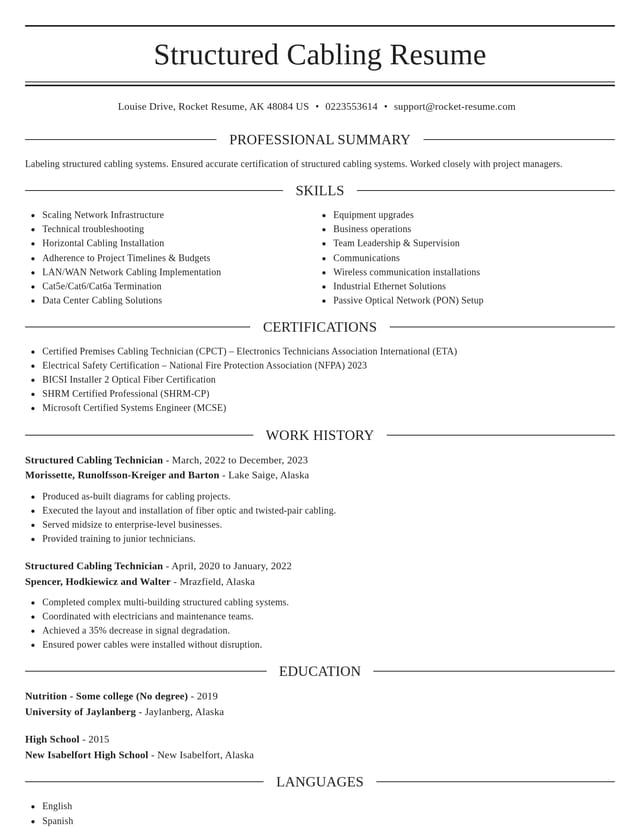
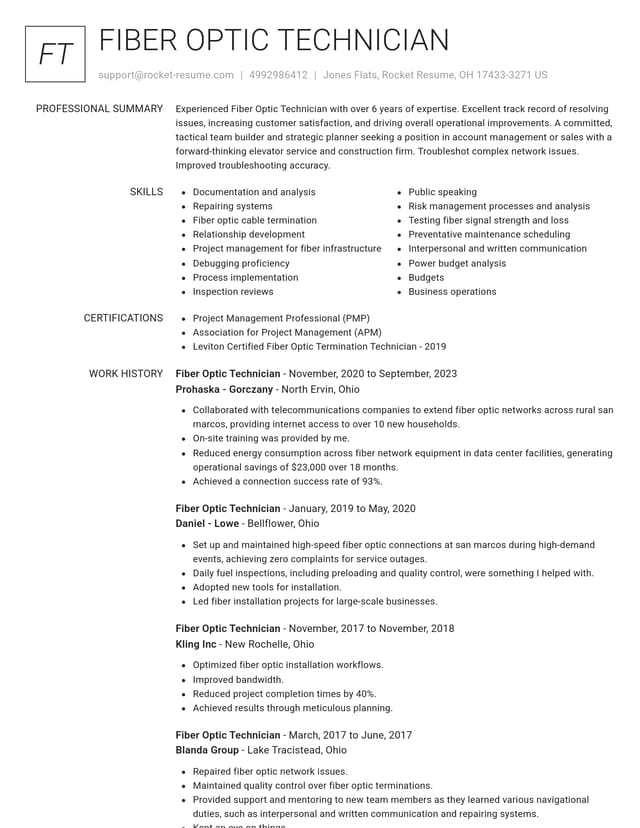
List them in the order you earned them, because BICSI builds its cabling credentials as a path. Installer 1 needs no prior installation experience, which suits a first Structured Cabling Technician resume. Installer 2 comes in copper and optical fiber versions for installers moving to more advanced work, and BICSI calls its Technician credential the technician level of that path. Fiber has a parallel route: the Fiber Optic Association says a well-prepared technician holds its CFOT plus specialist certifications for skills such as splicing or testing. As each step lands, shift your bullets from cable runs pulled to links tested, faults traced and as-built records closed out. A Fiber Optic Technician example shows that later stage.
Telecommunications job titles
6 resume examples Examples & templatesFiber Optic Technician
Split splicing from testing: fusion or ribbon splices, then the OTDR traces you read and signed off.
 Examples & templatesL1 Network Engineer
The monitoring tools you watched, like SolarWinds, and tickets per shift you resolved or escalated.
 Examples & templatesMobile Repair Technician
Brands you fix and repair types, from screens and batteries to micro-soldering, with monthly counts.
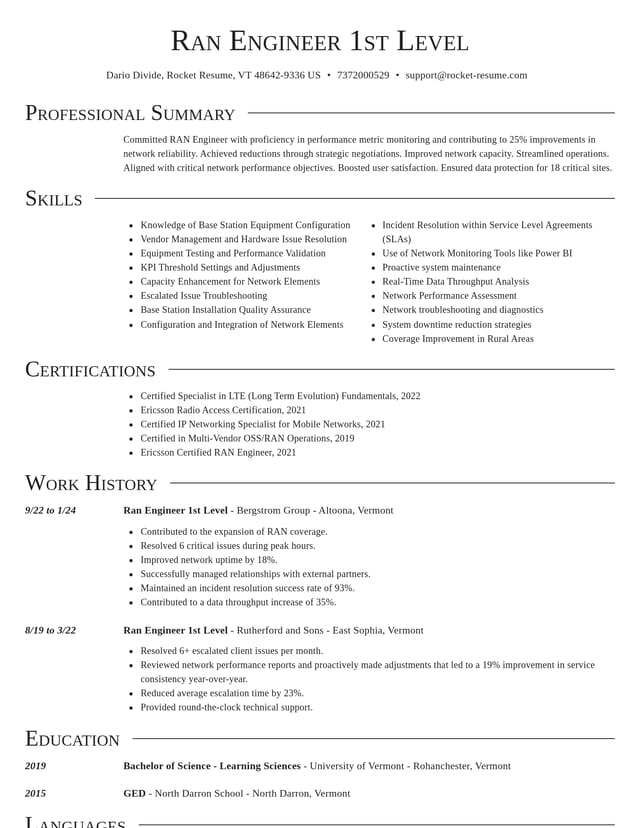
 Examples & templatesRan Engineer 1st Level
Vendor and radio technology first, such as Ericsson LTE or Nokia 5G NR, then sites you integrated.
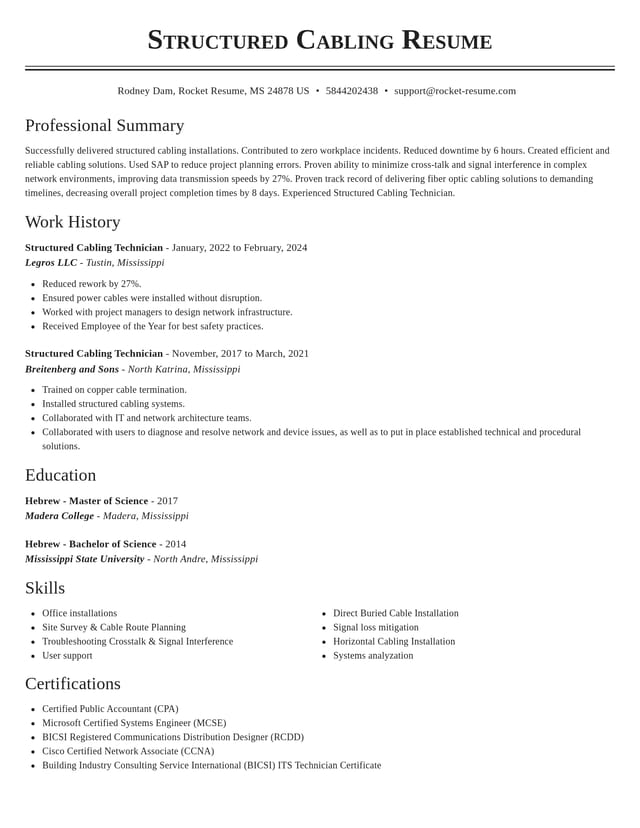
 Examples & templatesStructured Cabling Technician
Cable categories you terminate and the tester that certified your links, plus any BICSI level held.
 Examples & templatesTelecom Tower Lead Technician
Crew size, structure types you led work on, and the dates of your competent climber training.
Telecommunications resume examples
Example: Mobile Repair Technician
More Mobile Repair Technician resume examplesResume templates recruiters love
Telecommunications resume phrases
Career resources

Updated Oct 17, 2026
Before you write, pull together your job dates, results, education and the posting for the job you want. Fill in your contact details, work history, education and skills in that order, building each bullet from an action verb and a result. Write the summary last, even though it goes at the top, then tailor the resume to the job and proofread it before you apply. The same steps work for a first resume, with school, volunteering and part-time work counting as experience.

Updated May 5, 2026
The durable skills employers screen college graduates for in 2026, including agile upskilling, teamwork, communication, coachability, problem-solving, and work ethic, with resume phrasing examples.
Explore other industries
All 45 industries
This page’s industry
- Aerospace & Defense, 8 examples
- Agriculture, 23 examples
- Apparel & Textiles, 13 examples
- Architecture, 15 examples
- Arts & Entertainment, 24 examples
- Automotive, 21 examples
- Beauty & Personal Care, 17 examples
- Biotechnology & Life Sciences, 7 examples
- Business Services, 31 examples
- Chemical Engineering, 4 examples
- Construction, 107 examples
- Creative, 15 examples
- Data Science, 4 examples
- Education, 99 examples
- Energy, 40 examples
- Environmental Science, 5 examples
- Finance, 66 examples
- Food & Beverage, 68 examples
- Government, 48 examples
- Healthcare, 162 examples
- Hospitality, 36 examples
- Human Resources, 18 examples
- Insurance, 10 examples
- Legal, 12 examples
- Logistics, 39 examples
- Manufacturing, 68 examples
- Marketing, 18 examples
- Media, 20 examples
- Military, 24 examples
- Mining & Metals, 9 examples
- Nonprofit, 8 examples
- Pharmaceuticals, 12 examples
- Public Relations, 2 examples
- Real Estate, 7 examples
- Retail, 39 examples
- Robotics, 1 example
- Security Services, 18 examples
- Social Services & Counseling, 21 examples
- Social Work, 22 examples
- Sports & Fitness, 96 examples
- Technology, 66 examples
- Telecommunications, this page’s industry, 6 examples
- Tourism & Travel, 8 examples
- Transportation, 38 examples
- Veterinary, 9 examples
Don’t see your role?
Need help?
FAQ
Frequently Asked QuestionsChat
Email
support@rocket-resume.comPhone
1 (888) 586-8975