Apparel & Textiles resume examples from sewing to sourcing
Show the garments, fabrics and stages you worked on as a technical designer, pattern maker, sewing operator, sourcing assistant or quality inspector, from first sample to finished goods.
- Resume examples for 13 apparel & textiles jobs
- Professional resume templates
- Easy editing as you go
How to write a apparel & textiles resume
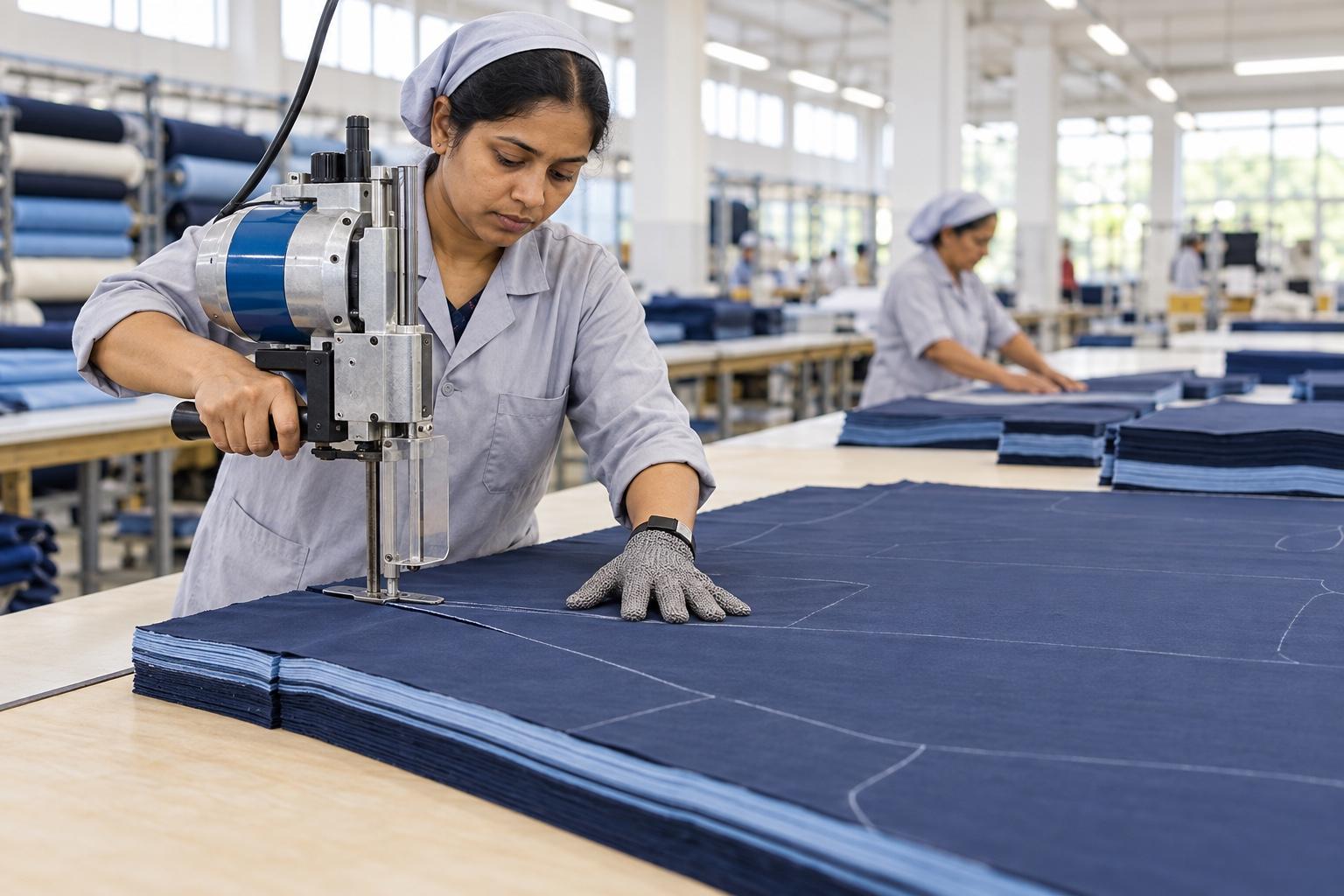
Apparel employers need to see where you touched the product, not just which title you held. Development, sourcing, cutting, sewing and quality work sit close together but involve different decisions. Describe the garments or materials you know and the handoffs you handled. That lets a hiring manager match your experience to the product and production stage they need help with. Sewing machine operators join, reinforce or decorate garments and other products, as the Department of Labor's occupation profile for sewing machine operators describes.
A product developer or plant manager can't place your experience when:
- Your job title doesn't say which products or steps you know.
- Technical skills appear without an example of a completed handoff.
- Portfolio projects do not explain which work you personally completed.
Place your role in the product process
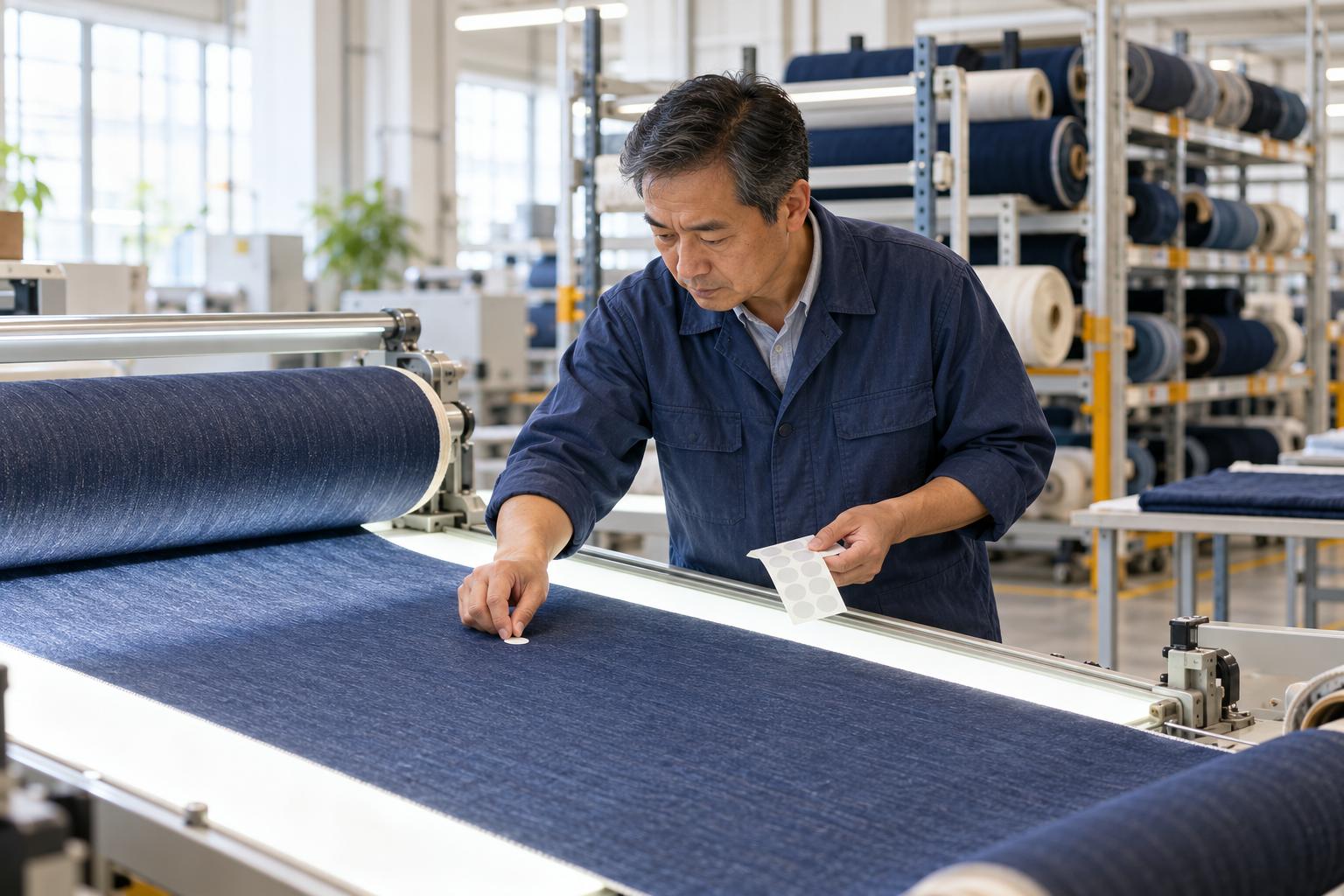
Begin with the product category and the stage you worked on. Designing knitwear, approving fabric, developing samples and overseeing garment production are different jobs, even when the titles sound alike. Browse apparel and textile resume examples and job titles in apparel and textiles to see how each stage is described.
Build My Apparel & Textiles ResumeList your apparel and textile jobs in the builder first. Then pick suggestions that fit and add the garment, the process and the part you personally played in each one.
Show a technical handoff
Describe a specific handoff you handled: a tech pack, fit review, supplier issue or production check. Name tools and materials where they matter, but tie them to the work rather than filling the skills section with an unexplained list. Rework the suggestions for fit, sampling and production checks with your own styles and suppliers.
From a technical designer's resume:
“Graded a women's knit top across six sizes and caught a sleeve-length error in the second sample before bulk cutting.”
Build My Apparel & Textiles ResumeTake one sampling or production issue into the builder's work history. Describe the spec, review or quality check you handled and what happened next, so an employer can see how your technical knowledge helped the order ship.
Explain ownership of portfolio work
Use a portfolio link for work you are allowed to show. New to the industry? A course collection, sewing project or internship works if you say which parts you made yourself. Experienced applicants can add how many suppliers, people or styles they handled. Portfolio tips and early fashion jobs are covered in our articles on apparel careers.
Say who made what in a collection or textile project. In the builder, note whether it was a class, internship or job, then describe your own design, material or production work before any team result.
Give product experience room to breathe
A short project entry can explain a collection or a fabric development assignment without a full project catalog. Work history, technical skills and portfolio details each need a spot that is easy to find, and some resume templates handle that better than others. Also weighing store or factory jobs? Browse retail, manufacturing and other fields.
Build My Apparel & Textiles ResumeProduct categories, dates and technical skills should stay easy to find as your apparel resume grows. Check them in the builder's live preview, and keep room for the sample or production work behind them.
How Rocket Resume helps
How to handle each one as you build:
- Products behind the title. Describe the garment category, material or production stage in the work entry so an unfamiliar title has context.
- Walk through one handoff. Adapt a suggestion to explain the specification, sample or quality check you prepared for the next production team.
- Your part of the collection. Edit each project description to name the pattern, sample or development task you completed within the wider collection.
Fill in your apparel resume section by section:
- Choose a template. Preview a few templates until one leaves room for a portfolio link and short project entries.
- Add work experience. List each sampling, sourcing or production job in work history with dates.
- Select relevant skills. Select skill suggestions for materials, specs and production handoffs.
- Write the summary. Write a summary of the garment and textile work your experience shows.
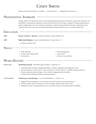
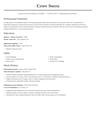
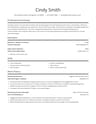
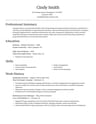
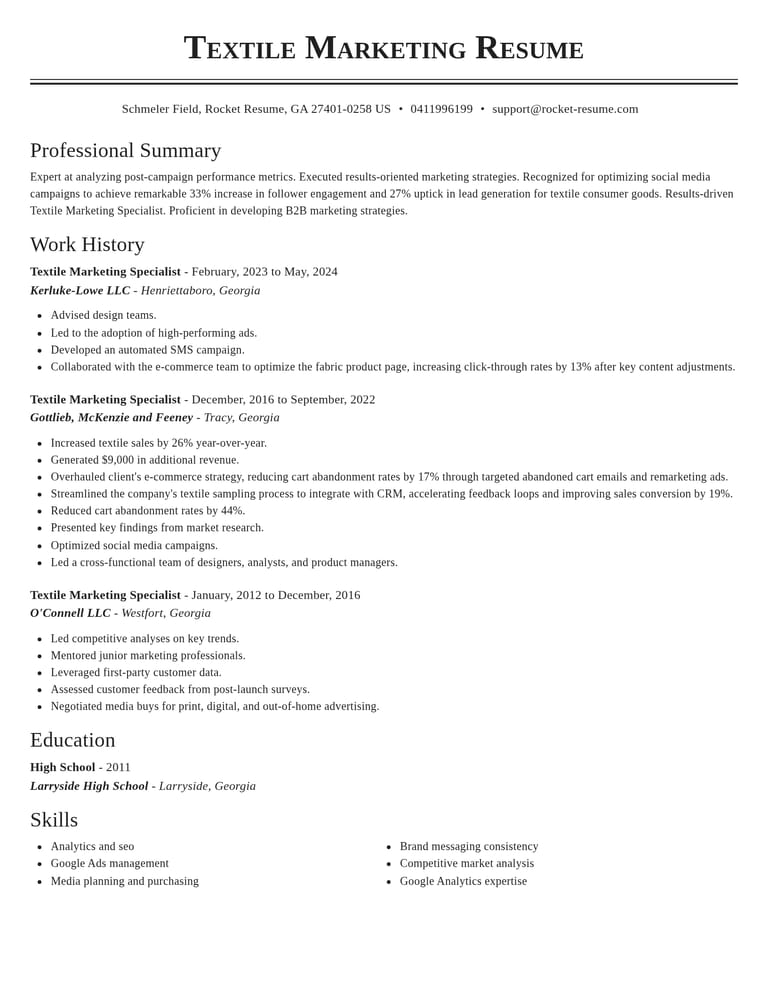
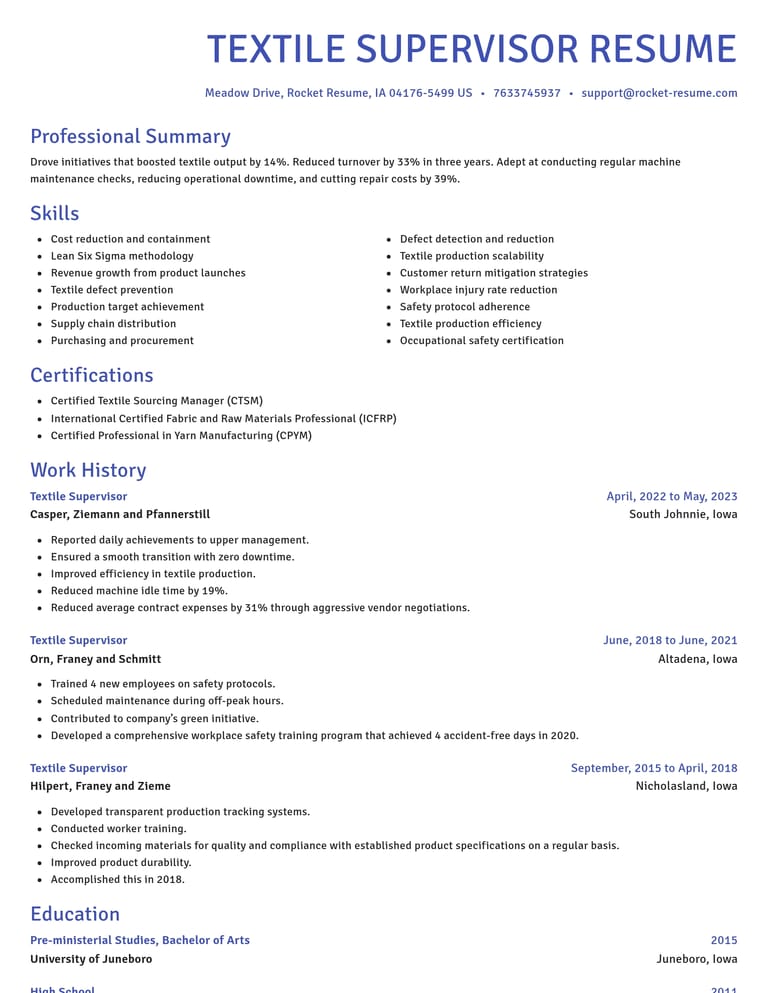
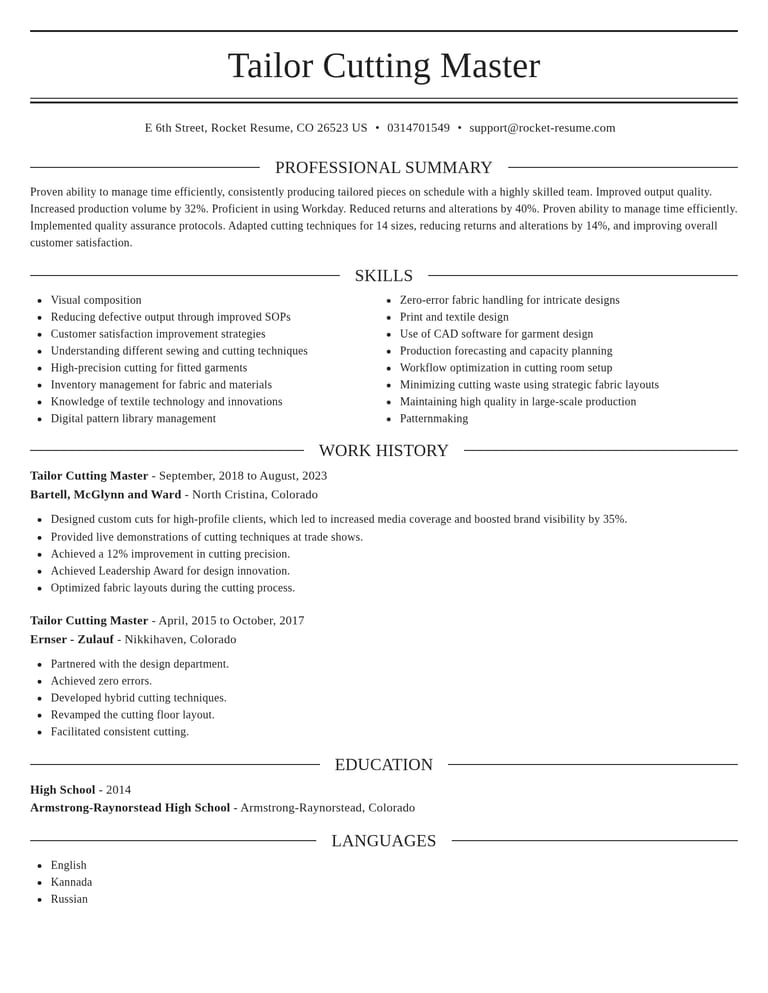
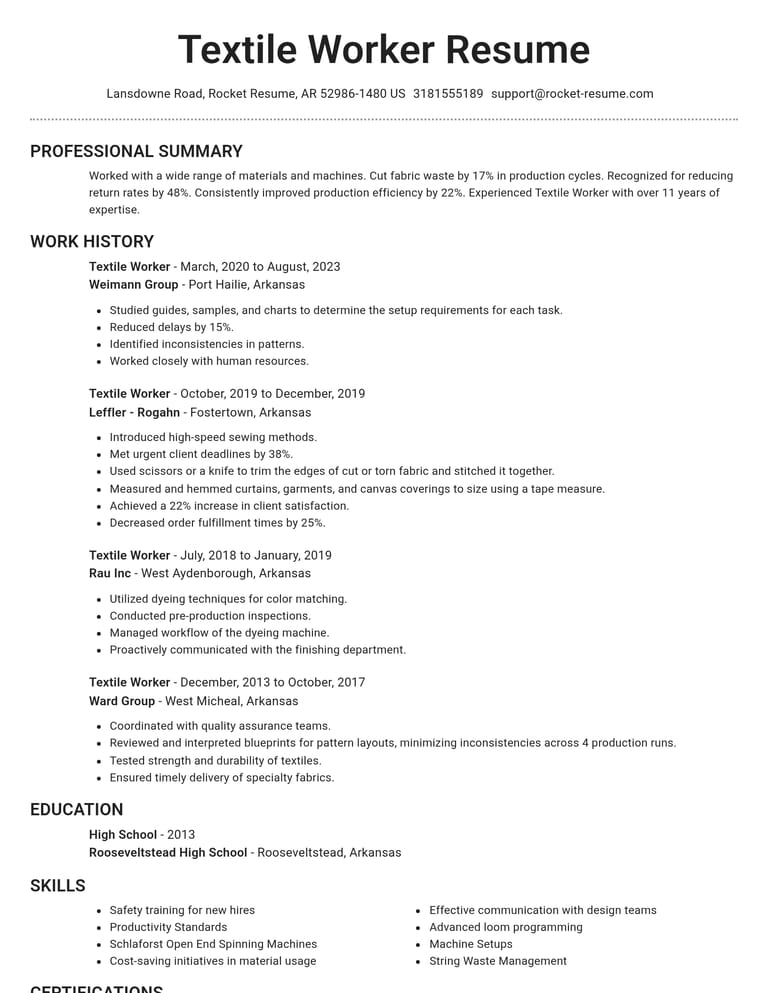
Apparel & Textiles resume examples
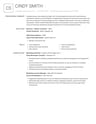
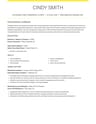
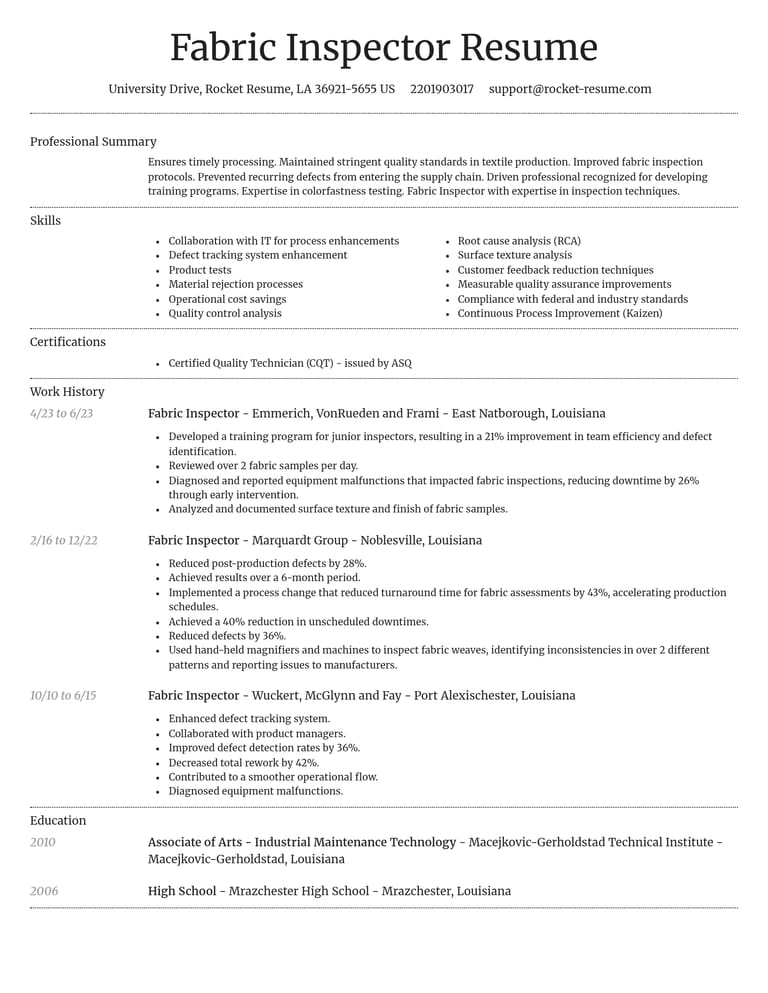
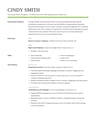
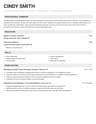
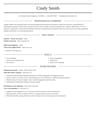
Fabric Inspector resume example
More Fabric Inspector resume examplesApparel & Textiles jobs: examples, templates and guides
13 jobs- Fashion Model
Guides
Agency name first, then runway shows, campaigns and the clients who booked you more than once.
- Textile Engineer
Tips
Processes you improved in spinning, weaving or finishing, and the test results that proved it.
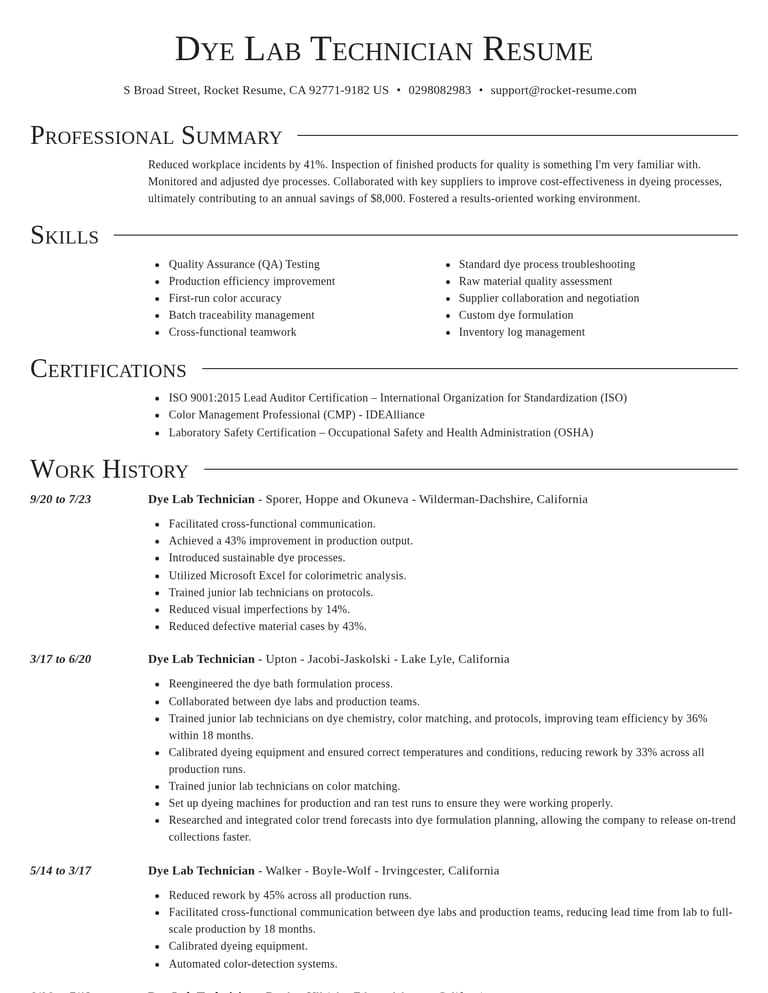
- Dye Lab Technician
Examples
Dye classes you match (reactive, disperse, acid) and the color-matching software you run.
- Dye Machine Operator
Guides
Machine types (jet, package, beam), batch sizes, and how often your shades pass first time.
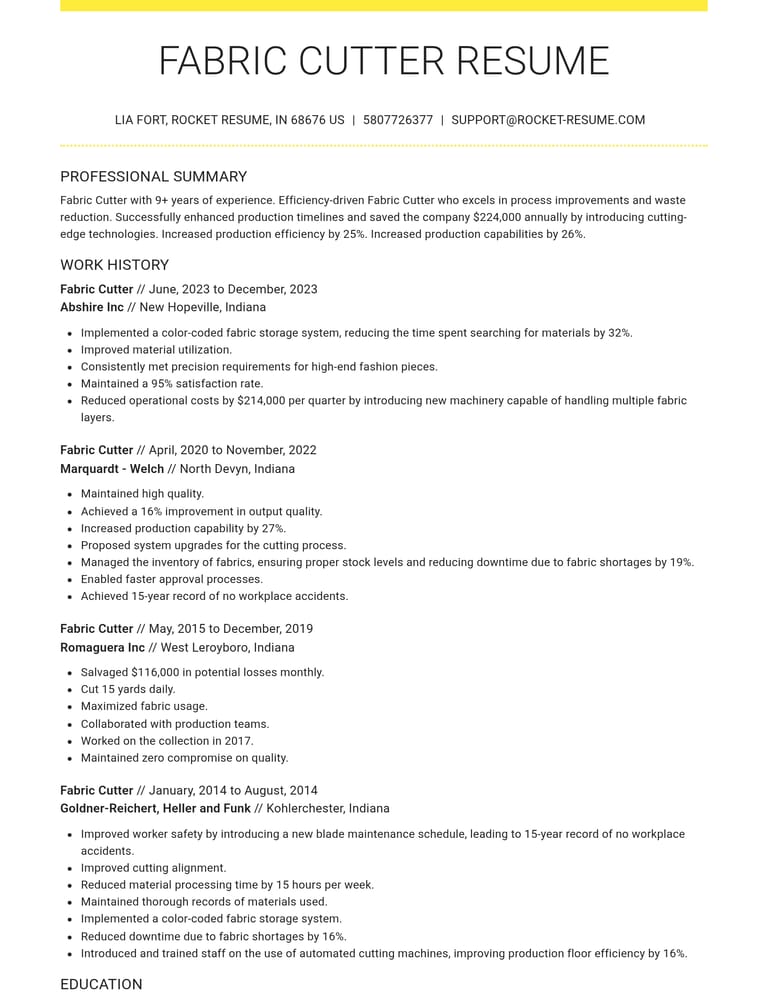
- Fabric Cutter
Resume
Cutting method (straight knife or automated cutter), ply heights and the marker efficiency you hit.
- Fabric Inspector
Examples
Rolls inspected per shift and the grading system, such as ASTM D5430 penalty points.
- Fabric Manager
Templates
Mills you buy from, fabric types, and lead times or costs you cut on orders.
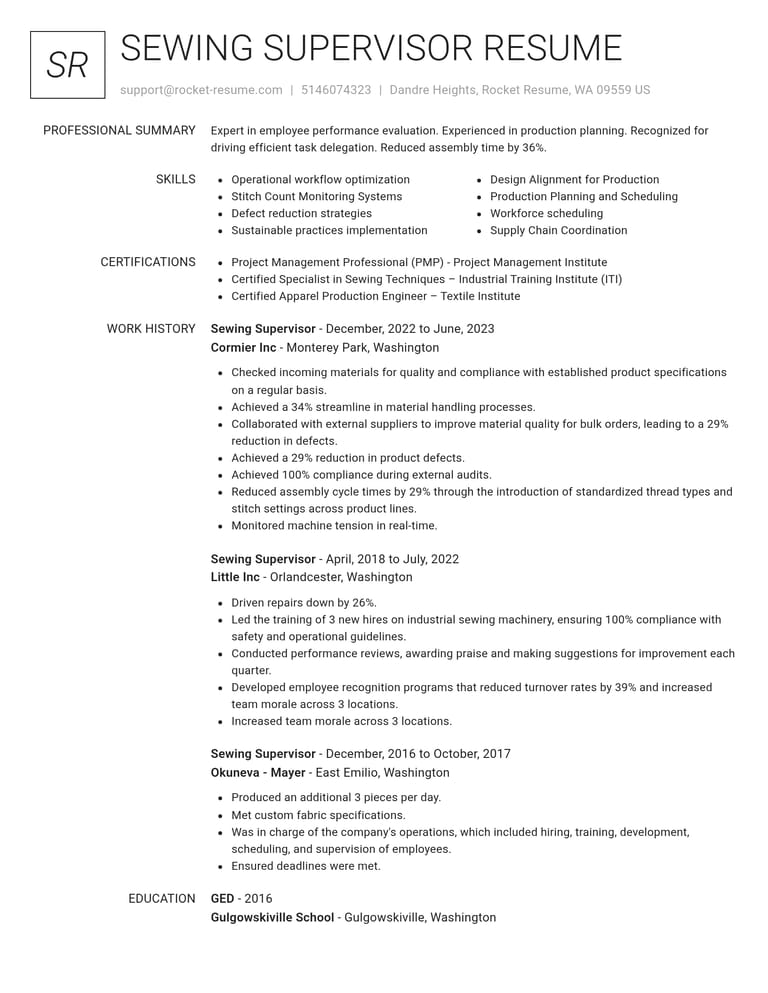
- Sewing Supervisor
Guides
Operators per line, the efficiency you ran at, and how you cut rework or defects.
- Tailor Cutting Master
Resume
- Textile Marketing Specialist
Examples
Fabric lines you launched, brands or buyers you pitch, and trade shows you've worked.
Departments and shifts you run, like spinning or finishing, and the audits your area passed.
Show all 13 apparel & textiles jobsShow fewer
Apparel & Textiles resume skills, summaries and work history suggestions
Save suggestions for your resume
Tap the bookmark next to any suggestion to save it.
Saved itemsThe examples, skills, job titles and industries you save, together in one place.
RecommendedPages, searches and examples you used but haven’t saved.
In the builderYour saved suggestions show up in the resume builder, ready to add as you write.
You’re in controlYour saved items are private. Remove any of them at any time.
Showing 12 of 40
Skills
High-quality pattern consistency
Assembly line safety management
Machine Monitoring
Summaries
Followed all directives, policies, and laws to protect the team.
Individual with exceptional attention to detail, as well as excellent multitasking and troubleshooting abilities.
Work experience
Analyzed post-dyeing fabric samples for uniformity, hue accuracy, and fiber integrity, reducing customer complaints by 67%.
Adjusted machine settings based on fabric thickness and material type, resulting in a 69% reduction of wastage.
Accomplishments
Coordinated closely with the chemical department to ensure precise dye compositions, reducing material waste by 39%.
Formulated mix adjustments for special fabric types, reducing bulk production issues by 17 per month.
Skills
Cost Analysis and Reduction
Summaries
Accomplished supervisor with a strong background in quality control, reducing garment defects by 84% through the implementation of efficient procedures.
Accomplished leader with a hands-on approach.
Work experience
Assessed customer feedback from post-launch surveys.
Achieved improvements in the span of 2015.
Accomplishments
Led promotional pricing negotiations with textile suppliers, saving the company $50,000 annually while maintaining product quality.
Leveraged customer behavior data to design targeted loyalty programs, improving retention rates by 69% for core fabric products.
Skills
Cost Cutting through Efficiency
Employee performance evaluation
Accomplishments
Decreased overall assembly cycle times by 41% through equipment upgrades and process standardization, resulting in a significant boost in productivity.
Negotiated with multiple fabric suppliers to secure materials at 22% lower costs, reducing overall monthly production costs by $8,000.
Fabric Cutter resume examples
Work experience
Collaborated with designers and pattern makers.
Assisted management in forecasting production needs.
Skills
Junior engineer mentorship and training
Inventory management for textile manufacturing
Accomplishments
Developed a quick-drying fabric blend that increased product demand by 85% across international markets in 2023.
Led a cross-departmental effort that resulted in the restructuring of purchasing agreements, reducing raw material lead time by 6 days.
Tailor Cutting Master resume examples
Work experience
Achieved a 36% increase in custom-tailored orders.
Achieved a 19% increase in bespoke orders.
Skills
Chemical Waste Management
Dye bath optimization
Accomplishments
Documented detailed research on dye reaction and material behavior, leading to 2 successful process improvements for the company.
Reduced dye inconsistencies by 36% by refining chemical addition sequences and adjusting temperature profiles during the dyeing process.
Fabric Manager resume examples
Work experience
Applied testing to new collections.
Captured a new market segment.
Fashion Model resume examples
Summaries
Talented Runway Model with a strong catwalk presence.
Have a nice smile, skin, and a'real person' appearance.
Fabric Inspector resume examples
Summaries
Collaborated effectively with suppliers and production teams.
Achieved a 28% reduction of defects.
Textile Supervisor resume examples
Summaries
Achieved 62% fewer issues.
Achieved 38% reduction in supply costs.
Apparel & Textiles resume questions
How do I make a modeling resume?
A Fashion Model resume fits on one page that can travel with your headshot or comp card. Put your name, agency and contact details at the top, then your stats exactly as your agency lists them: height, sizes, hair and eye color. Sort bookings by type, such as runway, print, commercial, showroom and fittings, giving the client, designer or photographer for each one. Under training, add runway coaching and acting or movement classes. A comp card already shows your photos and measurements, so the resume adds what the card leaves out: who booked you and how often they came back.
How do I put sewing on a resume?
Use the stitch and operation names a plant uses. ASTM D6193, the standard practice for stitches and seams, classifies stitch types, and Coats, the thread maker, uses the class numbers: 301 is the single-needle lockstitch and 504 the three-thread overedge used for serging. So "301 lockstitch and 504 overedge" tells a supervisor which machines you can run. Then add operations you've mastered as a Textile Worker, such as setting sleeves, attaching collars or hemming, and your pace against the plant's standard. If you learned at home or doing alterations, say so plainly and name garments you made start to finish.
How do I show textile lab testing on a resume?
Name each test method and what it told the customer, not just "performed testing." AATCC TM61, for example, roughly approximates five home launderings in one 45-minute test, and TM8 rubs a colored sample against white cloth to grade how much color transfers. A line like "Ran TM61 and TM8 on 40 lab dips a week; caught three shades that failed crocking before bulk dyeing" shows judgment as well as routine. A Dye Lab Technician or Textile Engineer can also name the instruments they calibrate, such as a spectrophotometer, and any buyer test manuals they work to.
How do I present promotions from sewing operator to supervisor?
Begin the story at the machine. As a Textile Worker, give the operations you ran and your output against the standard minutes set for each. A Sewing Supervisor entry shifts to the line: how many operators you led, how you rebalanced stations when a bottleneck formed, and your line's efficiency, defect and on-time figures. At the Textile Supervisor level, add the departments or shifts you oversee, training plans and audits passed. If you taught operators a new style or machine, give how many and how quickly they reached standard.
Resume guides and career advice
Start by deciding which document you need: a job CV for most jobs outside North America, an academic CV for faculty, research and grad school applications, or a resume for other jobs in the US and Canada. List everything newest first, keep most job CVs to two pages and let an academic CV run as long as your record needs. Show what you achieved in each role with numbers you can back up, tailor the CV to each application and send it as a PDF unless the employer wants a Word file.

What goes on a resume, how long it should be, and where photos, references, GPA, section order, education and certifications fit.

Explore other industries
Related to Apparel & Textiles
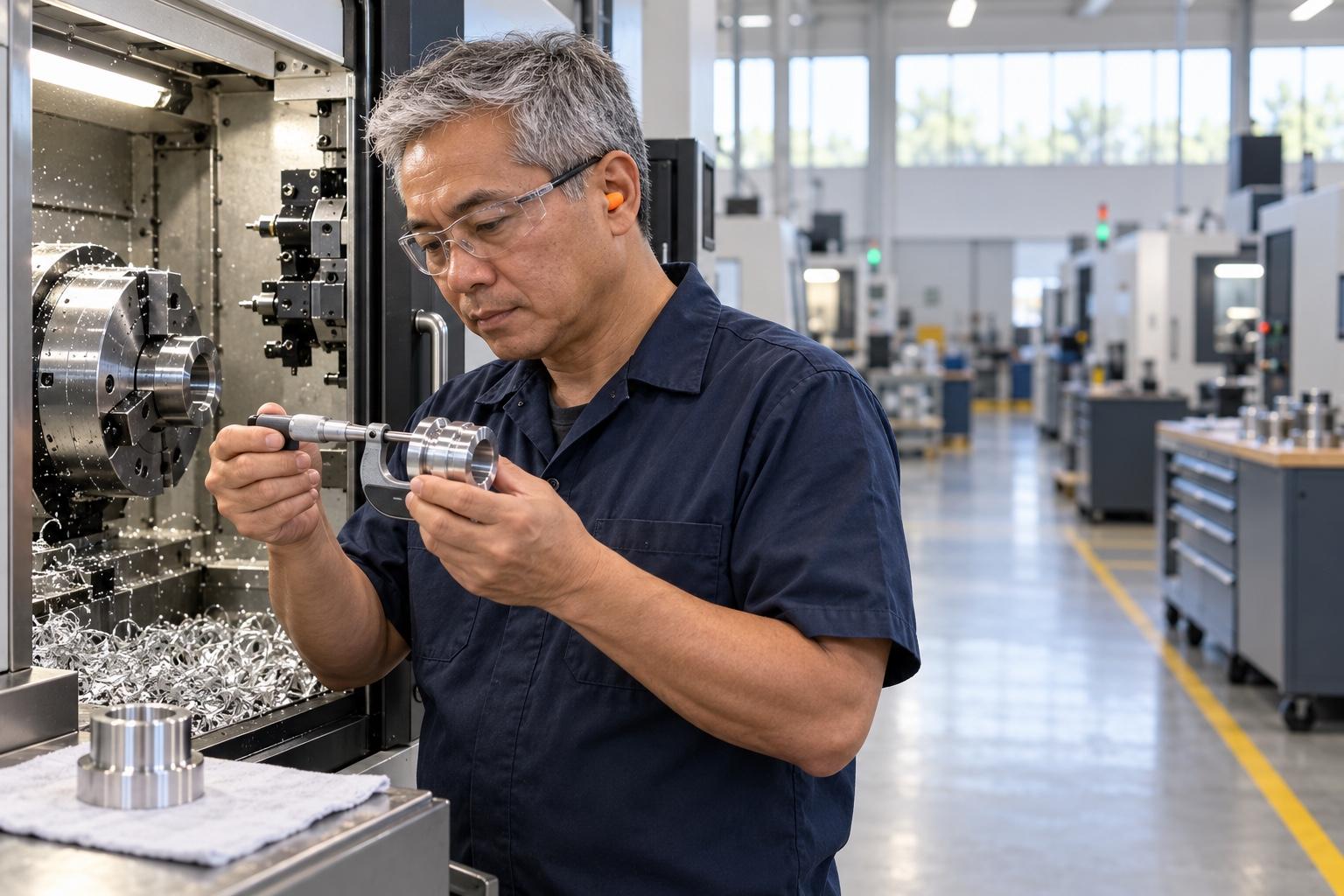 68 examples
CNC Machine Operator · Production Associate · Manufacturing Technician



All industries
This page’s industryRelated to Apparel & Textiles
- Aerospace & Defense, 8 examples
- Agriculture, 23 examples
- Apparel & Textiles, this page’s industry, 13 examples
- Architecture, related industry, 15 examples
- Artificial Intelligence, 6 examples
- Arts & Entertainment, 24 examples
- Automotive, 21 examples
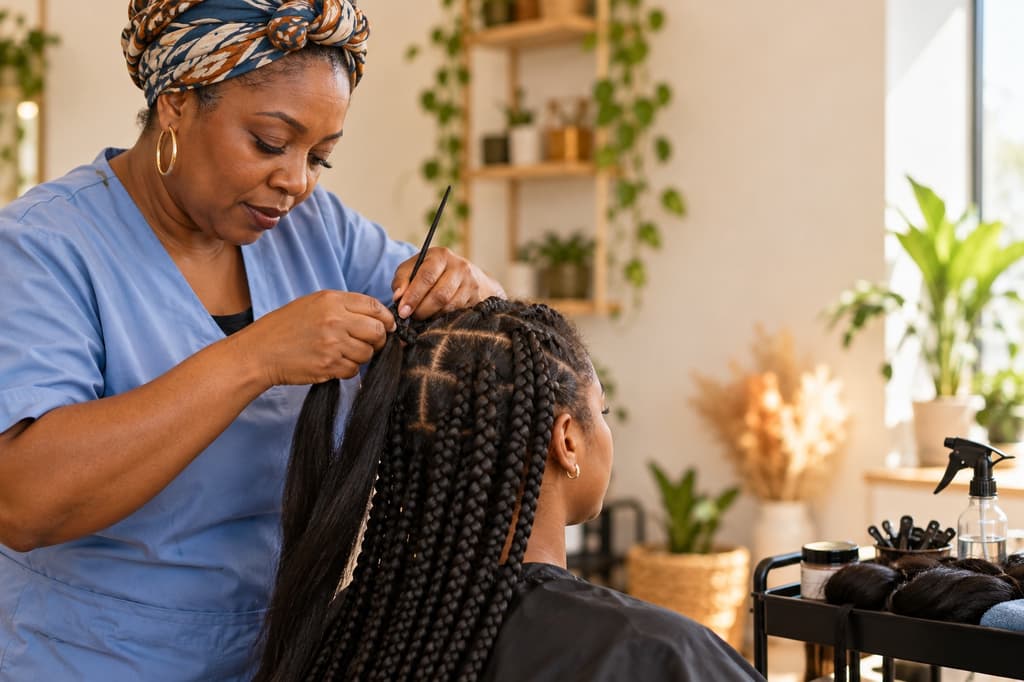
- Beauty & Personal Care, related industry, 17 examples
- Biotechnology & Life Sciences, 7 examples
- Business Services, 23 examples
- Chemical Engineering, 4 examples
- Childcare, 14 examples
- Construction, related industry, 106 examples
- Creative, related industry, 15 examples
- Customer Service, 17 examples
- Education, 94 examples
- Energy, 39 examples
- Environmental Science, 5 examples
- Finance, 63 examples
- Food & Beverage, 68 examples
- Government, 48 examples
- Healthcare, 160 examples
- Hospitality, 35 examples
- Human Resources, 18 examples
- Insurance, 10 examples
- Legal, 12 examples
- Logistics, 37 examples
- Manufacturing, related industry, 68 examples
- Marketing, 8 examples
- Media, 20 examples
- Military, 24 examples
- Mining & Metals, 9 examples
- Nonprofit, 8 examples
- Pharmaceuticals, 11 examples
- Public Relations, 10 examples
- Real Estate, 7 examples
- Retail, 38 examples
- Robotics, 11 examples
- Sales, 14 examples
- Security Services, 19 examples
- Social Services & Counseling, 21 examples
- Social Work, 14 examples
- Sports & Fitness, 96 examples
- Technology, 67 examples
- Telecommunications, 6 examples
- Tourism & Travel, 8 examples
- Transportation, 38 examples
- Veterinary, 9 examples