How to Write a CV for a Job, Grad School or an Academic Position
How to write a CV: decide whether you need a job CV, an academic CV or a resume, fill in each section and check the CV before you send it.


To write a CV, first figure out which kind the application calls for. Then lay out the sections in this order: contact details, a short personal statement, work experience, education and skills.
A CV (curriculum vitae) can mean two different documents. Outside North America, it's the standard document for job applications. In the US and Canada, it usually means an academic CV: a full record of your education, research, publications and teaching, used for faculty and research jobs, and for grad school applications that ask for one. This guide covers both.
Writing a CV in 7 steps
- Decide whether you need a job CV, an academic CV or, for most jobs in the US and Canada, a resume.
- Start with your name, town or city, phone number and email address.
- Add a short personal statement aimed at the job you want (it's easiest to write last).
- List your work experience newest first, with a result under each role.
- Add your education, with grades the reader will understand.
- List the skills the job asks for, plus any languages or certifications that help your case.
- Tailor the CV to the job, check it and send it, usually as a PDF.
An academic CV follows the same steps, but education comes first, the personal statement is usually left out, and research, publications, teaching and funding get sections of their own.
Decide which kind of CV you need
If you're applying for | You need |
A non-academic job outside North America | A job CV: a focused summary of what you offer, usually two pages at most |
An academic or research position (including postdocs, fellowships and grants), or a medical position in the US or Canada | An academic CV: the full record of your academic work |
A master's or PhD program that asks for a CV | A short academic CV built around your education and research |
Any other job in the US or Canada | Usually a resume |
If a US or Canadian job outside academia, research or medicine asks for a CV, a resume is usually the right document to send. If you're not sure which one the employer wants, ask. Our CV vs resume guide sets out the differences country by country, and our guide to writing a resume covers the US document.
What a good CV looks like
Here's a short job CV for Aisha, a made-up marketing graduate in Manchester who is applying for her first full-time job.
Section | What Aisha wrote |
Contact details | Aisha Mensah · Manchester, UK · 07700 900123 · aisha.mensah@example.com |
Personal statement | Marketing graduate with a year of part-time social media work for a local charity, where I grew Instagram followers from 800 to 3,100. Looking for a junior marketing role in the charity sector. |
Work experience | Social media assistant (part-time), local children's charity, Manchester, 2024–2025: planned and posted three updates a week and grew Instagram followers from 800 to 3,100. |
Work experience (earlier) | Customer adviser (part-time), utilities helpline, Manchester, 2022–2024: handled 60+ calls a day, resolving billing queries on the first call, and trained three new starters. |
Education | BA (Hons) Marketing, 2:1, Northbridge University, 2022–2025 |
Skills | Meta Business Suite, Hootsuite, Google Analytics, Excel · Languages: English (native), Spanish (B2) |
Why it works: every line gives evidence rather than adjectives. Her work experience comes before her degree because it's more relevant to the jobs she wants, and there's no photo, date of birth or list of references, for reasons covered below.
Our examples by job title are written as US resumes rather than CVs, but their bullet points can give you wording ideas for your field.
An academic CV outline
An academic CV usually follows this order, with the newest entries first in each section:
- Contact details
- Education, with your thesis title and advisor
- Research experience and interests
- Publications
- Presentations and conferences
- Teaching
- Grants, fellowships and awards
- Service and professional memberships
- References
How long should a CV be?
A job CV is usually two pages at most, and an academic CV can run longer. Here's how the usual limits compare:
Kind of CV | Usual length |
UK job CV | No more than two A4 pages (Prospects, quoting the University of Chester careers service) |
CV for a part-time student job | Can be shorter than two pages (Prospects) |
UK academic CV | About three pages, if you can manage it (Prospects' academic CV example) |
US academic CV | As long as it needs to be (Marquette University's career services center) |
For a grad school application, the length depends on how much you've done so far.
Which CV format should you use?
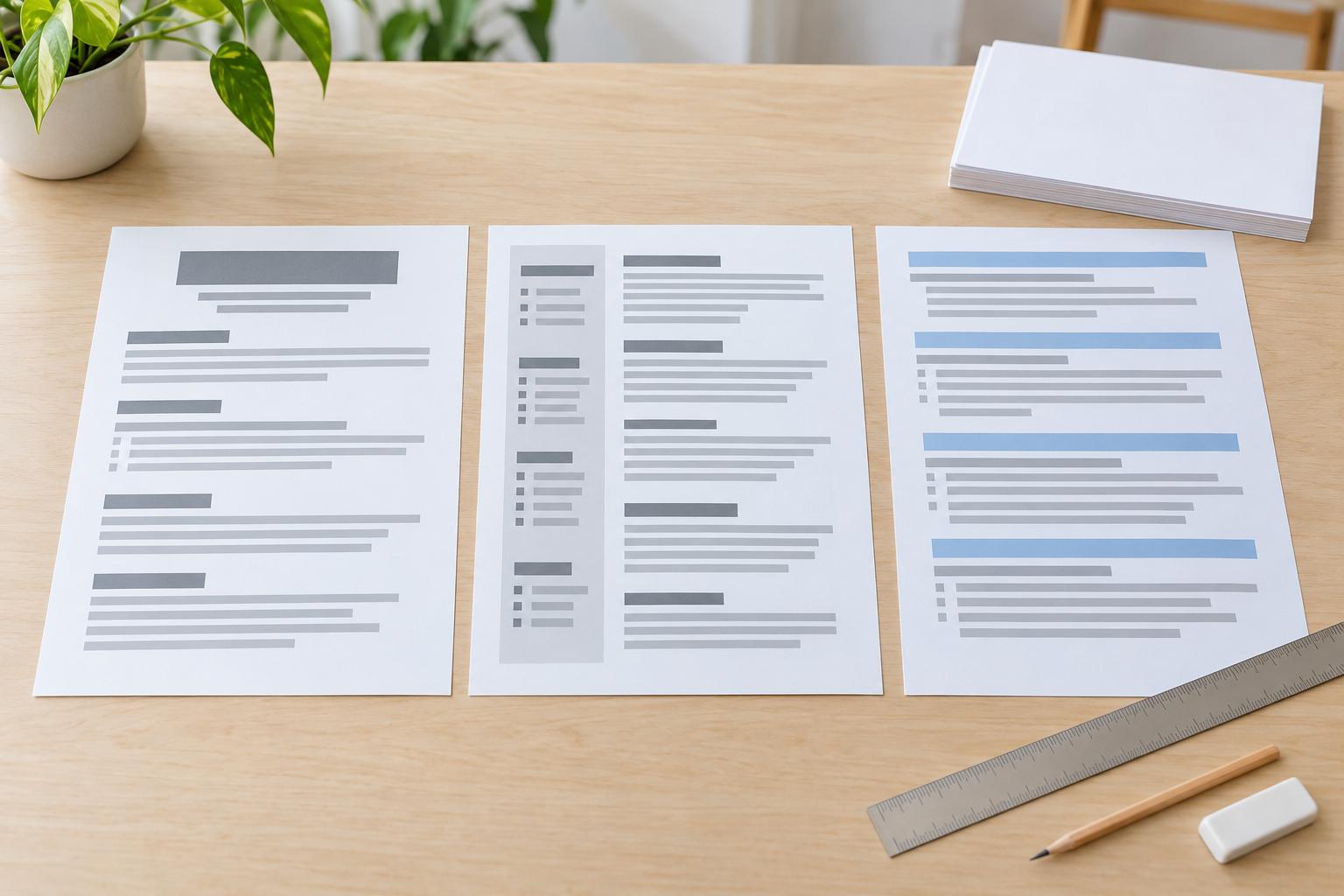
Use a reverse-chronological format: start with your most recent job or qualification and work backward, and keep the layout to a single column. Most guidance treats this as the default for both job and academic CVs. To see this format in finished designs, browse CV layouts.
Choose a plain, readable font. The UK's National Careers Service suggests one such as Arial, Calibri or Times New Roman at 11 point or above, along with headings and bullet points that make the CV easy to scan.
Reverse-chronological or skills-based?
A skills-based, or functional, CV groups your experience by skill rather than by job. It can help if you're changing careers, but it's harder for a reader to see what you did where. Use it only if a reverse-chronological CV would bury your strongest evidence.
Paper size, file type and file name
A4 is the standard paper size in the UK, Europe and India, while the US and Canada use Letter. If a posting names a paper size, use it.
Send a PDF so your layout looks the same on the employer's screen, and switch to a Word file only if the posting asks for one. Put your name in the file name, such as Aisha-Mensah-CV.pdf, so it's easy to find among other applications.
Word processor or online builder?
Word or Google Docs will do the job, and so will an online CV builder. A word processor lets you set the paper size and add any section you need, which matters for an academic CV. If you use a builder, check its paper sizes and section options before you start.
What to include in each section of a job CV
Write the sections in the order they appear, but save the personal statement for last: it's easier to sum up your case after you've written the evidence for it.
Contact details
Your name is the heading, so you don't need "Curriculum vitae" above it. Below it, give one phone number, a professional email address (firstname.lastname works well) and your town or city. Add a LinkedIn link only if your profile is current.
Guides disagree on home addresses: Prospects suggests including yours, while the National Careers Service leaves it out of its list of contact details. Your town or city is enough to tell an employer where you're based.
For UK applications, the National Careers Service also advises leaving out your age or date of birth, marital status and nationality. If you're applying from abroad and have the right to work in that country, say so in one line, such as "Eligible to work in the UK (Graduate visa)."
Personal statement
A personal statement, sometimes called a profile, is three or four lines under your contact details: who you are professionally, one piece of evidence and the job you want next.
A first draft often reads like this: "Motivated, hard-working graduate looking for an exciting opportunity to develop my skills." It could describe anyone. Aisha's version above names her field, gives a result with a number and says which job she wants. Leave out traits any candidate could claim, such as "passionate," unless a result backs them up.
Work experience
List your jobs newest first, each with your job title, the employer, the location and the dates, then a few bullet points.
For the bullet points, the National Careers Service suggests the STAR method: situation, task, action and result. Skip routine duties and describe what you changed, improved or delivered, with a number wherever you honestly have one, such as customers served, budgets managed or time saved.
"Responsible for answering customer calls" says what the job was, not what you did in it. Aisha's helpline entry gives the scale (60+ calls a day), the result (billing queries resolved on the first call) and something extra (training three new starters).
Older or less relevant jobs can shrink to a line or two. If you have a gap in your work history, one honest line is enough.
Education and grades
Start with your highest or most recent qualification and work backward, giving the institution, dates and grade for each. Use grading terms the reader will recognize: a degree classification such as 2:1 in the UK, A-level grades, a CGPA (cumulative grade point average) or percentage in India, or a GPA in the US. Add a converted grade for another country only if an official source gives you the conversion.
While you're studying or just after you graduate, you can put education above your work experience and add relevant courses, a dissertation or projects. Once you've worked for a few years, move it below your experience and keep each qualification to one line. For US applications, our article on when to include your GPA helps you decide whether to list it.
Skills, languages and interests
Choose skills from the posting that you genuinely have, with software and technical skills before general ones. Use the posting's wording where it's accurate, and back up the important skills in your work experience.
Before | After |
Skills: communication, teamwork, Microsoft Office. | Skills: Excel (pivot tables, XLOOKUP), Power BI, SQL basics, stakeholder reporting · Languages: English (native), Spanish (B2) |
What changed: named tools, a language with its level, and terms that match the posting. The line is made up.
Add a level to each language. Many European employers recognize the Common European Framework of Reference (CEFR) levels, from A1 to C2; elsewhere, plain terms such as "native," "fluent" or "working knowledge" are fine.
Prospects includes interests as an optional section. Add them only when they show something relevant to the job, such as running a club.
References
A job CV doesn't need your references' names. According to Prospects, most employers assume you can provide references, so you can leave out a "References available on request" line when space is tight.
Writing your first CV with little or no experience
Put education first, then anything that shows you can do the work: part-time jobs, volunteering, internships, projects, clubs or sports. Treat each one like a job entry: say what you did and what it led to.
Keep the personal statement specific: what you're studying or have just finished, one thing that shows you're ready, and the job you're looking for.
Our guide to writing a resume with no experience covers the same situation for a US resume, and our college student examples, also written as US resumes, can give you wording ideas.
If your first CV is for a master's or PhD program rather than a job, see the next section.
Writing a CV for grad school
If a master's or PhD program asks for a CV, send a short academic CV rather than a resume or a job CV. Lead with what shows you're ready for graduate study: your education and any research you've done. Under your contact details, use this order, leaving out any section you can't fill yet:
- Education, with your grades, honors and the title of any thesis or capstone project
- Research experience, such as lab work or a research assistant role, with what you did and what came of it
- Publications and presentations, including conference posters
- Teaching, tutoring or mentoring
- Awards, scholarships and grants
- Relevant work and volunteering
- Skills, such as lab techniques, software and languages
Before | After |
Helped in a biology lab. | Undergraduate research assistant, plant genetics lab, 2024–2025: ran weekly DNA tests on plant samples for a drought-tolerance study and presented a poster on the results at the department's research symposium. |
What changed: the role, the lab, the dates, what you did and what came of it. The entry is made up.
Don't stretch your CV to look like a professor's; empty headings and padded entries only draw attention to what's missing. If the program sets a page limit or asks for particular sections, follow its instructions over anything here.
Academic CVs for faculty and research jobs
For faculty, research and postdoc positions, fellowships and grants, send a full academic CV, following the outline above. After education, put the section the post cares about most: research for a research-focused job, teaching for a teaching-focused one.
Publications and talks
Use one citation style throughout, and list peer-reviewed articles, book chapters and work under review separately. For each talk, give the title, event, place and date. In co-authored work, put your own name in bold so readers can spot it.
Before | After |
Paper on soil microbes, published 2025. | Okafor, D., Lin, M. and Reyes, P. (2025) 'Soil microbial diversity under no-till farming', Journal of Field Soil Studies, 42(3), pp. 211-225. |
What changed: the full citation, with every author, the year, the article title, and the journal's name, volume, issue and pages. The authors and the journal are made up.
Jobs outside academia
Research and teaching jobs get their own sections, so give other work one line per job. Don't drop it entirely: the academic CV example from Prospects still includes an employment history.
Moving from academia into industry
For an industry or staff job, a shorter resume-style document usually works better than a full academic CV. The postdoctoral fellow example shows research experience presented that way.
Before you send your CV
Tailor the CV to each application. Reread the posting, move the experience it cares about most to the top of each section, and rewrite any personal statement to name the role.
Then check the details: dates in one style with no unexplained overlaps, numbers you could explain in an interview, and spelling that matches the country you're applying to, such as "organised" and "programme" for the UK but "organized" and "program" for the US. Reading the CV aloud helps you catch missing words and clumsy sentences.
If you're a student, recent graduate or researcher, ask your advisor or your university's career service to read your CV. Your department may also have a sample CV you can follow.
Final checklist
- It's the kind of CV the application asks for
- The length and paper size suit the country
- Your phone and email are up to date
- Any personal statement is written for this application
- Every role shows a result
- Grades are in terms the reader will recognize
- Spelling, tense and date formats are consistent
- On an academic CV: one citation style, your name in bold in co-authored work, and sections ordered for the post
- It's in the file type the application asks for (usually PDF), and the file name includes your name
Making your CV in Rocket Resume
If you'd rather use a guided tool, Rocket Resume's builder asks you to choose your experience level and a design, then takes you through your contact details, work history, education, skills and a summary (your personal statement), with optional sections at the end.
Before you start, check that the builder suits your application. Its PDFs are US Letter size only, with no A4 option, and it has no photo field or Word download. You can't upload an existing CV, and there are no publication, research or teaching sections, so it can't make an academic CV.
The builder's suggested lines use American spelling, so switch any you add to British spelling for a UK or Indian CV.
You can see how it works on the CV builder page.
For other job-search questions, short answers are in our resume and career FAQs.
Frequently Asked Questions
Should a CV have a photo?
Not for jobs in the UK or the US. Prospects says a UK CV doesn't need a photo unless the job is in acting or modeling. US guidance from the Equal Employment Opportunity Commission (EEOC) says employers shouldn't ask applicants for a photo, though they may request one for identification once a job offer has been made and accepted. Customs vary in other countries, so check what employers there expect.
What is the 7-second rule for a CV?
It's the often-quoted idea that a recruiter spends about seven seconds on a first look at a CV before deciding whether to read on. Whatever the exact figure, plan for a quick first read: put your name, your current or most recent role and your strongest result near the top of page one, and use headings a reader can find at a glance.
What are red flags on a CV?
Typical red flags are spelling mistakes, dates that don't add up, a personal statement that could describe anyone and claims you couldn't talk through in an interview. Sending the wrong kind of document stands out too, such as a long academic CV for a sales job. Each one is quick to fix before you apply.
Can ChatGPT write my CV?
It can help with parts of CV writing, such as drafting a bullet point or tightening a long sentence, but it doesn't know what you've actually done, so treat its output as a first draft. Check each fact, date and number, rewrite anything that doesn't sound like you, and keep your phone number, address and ID numbers out of the chat. On an academic CV, look up every reference it suggests in the original source, because AI tools can produce citations that don't exist.
Is it worth paying someone to write my CV?
It can save time, but a writer can only work with the facts you give them, so you'll still need to gather your dates and results and check every line. If you're a student or recent graduate, try your university's career service first. Before you pay anyone, ask to see examples of their work and find out what happens if you want changes. Whoever writes it, you're the one who'll be asked about it in an interview.
Should I use the Europass CV format?
You can, especially for jobs or study programs in the EU, where employers and educational institutions know the format. For most private-sector jobs, a clear reverse-chronological CV serves just as well.
Build your CV with our CV builder
Pick a template, then build a CV one section at a time.