10 Essential Tools for a Successful Career Change in 2026
Ten career-change tools compared by pivot stage, from My Next Move and O*NET for discovery to Coursera for upskilling and Rocket Resume for targeted resumes, plus each tool's free tier and limits.


The best career-change tool depends on where you are in the process. Some tools help you identify possible careers, while others help you research occupations, close skill gaps, or find open positions. For that first identification step, My Next Move's interest-based career explorer is a free place to begin. Rocket Resume is the choice for turning a possible career direction into a targeted résumé and organizing multiple versions as you explore different paths. If you're picking up this topic now, check out this career guide starter kit to put things in perspective. Rocket Resume Career Change Guide.
A successful career pivot is rarely a single event. It is a four-stage journey:
- Recognition & Assessment: Do I need a career change, and what are my core strengths?
- Discovery & Research: What roles exist, and where do my transferable skills fit?
- Preparation & Upskilling: What skill gaps must I close before applying?
- Execution & Application: How do I position my experience across tailored résumés and land interviews?
No single software handles every stage of this journey. To navigate a pivot successfully, you need a cohesive tool stack. Below is our transparent evaluation of the 10 best tools for changing careers, categorized by their specific role in your transition.
Quick Comparison: 10 Best Career Transition Tools
Tool | Best For | Career-Change Stage | Free Option | Main Limitation |
|---|---|---|---|---|
Rocket Resume | Building & organizing targeted résumés for multiple career paths | Execution & Application | Free tier available | Focused on document execution, not initial self-discovery assessment |
My Next Move | Interest-based career exploration & O*NET profiling | Recognition & Discovery | 100% Free | Interface feels dated; requires manual translation to modern job titles |
O*NET OnLine | Deep occupational task, skill, and keyword research | Discovery & Research | 100% Free | Highly academic and data-heavy; can overwhelm casual users |
CareerExplorer | Advanced psychometric assessment and career matching | Recognition & Discovery | Free basic report | Full trait analysis and personalized insights require paid upgrade |
Career path research, networking, and informational interviews | Discovery & Execution | Free standard account | High noise level; premium features required for advanced outreach | |
Coursera | Closing technical skill gaps with industry certificates | Preparation & Upskilling | Free audit mode | Professional certificates and graded assignments require paid subscription |
Lightcast Open Skills | Mapping skill overlaps between previous and target roles | Discovery & Preparation | Free public tools | Requires manual interpretation to apply insights to job hunting |
Glassdoor | Salary benchmark verification and workplace culture audits | Discovery & Research | Free with review submission | Salary data relies on user self-reporting and varies by region |
Indeed | Job description keyword harvesting and real-time market testing | Discovery & Execution | 100% Free | Job alerts can become noisy without precise boolean filters |
Big Interview | Practicing narrative framing for career transition interviews | Execution & Application | Free trial content | Full mock interview suite and AI feedback require paid access |
1. Rocket Resume — Best Career Change Résumé Builder
Overview
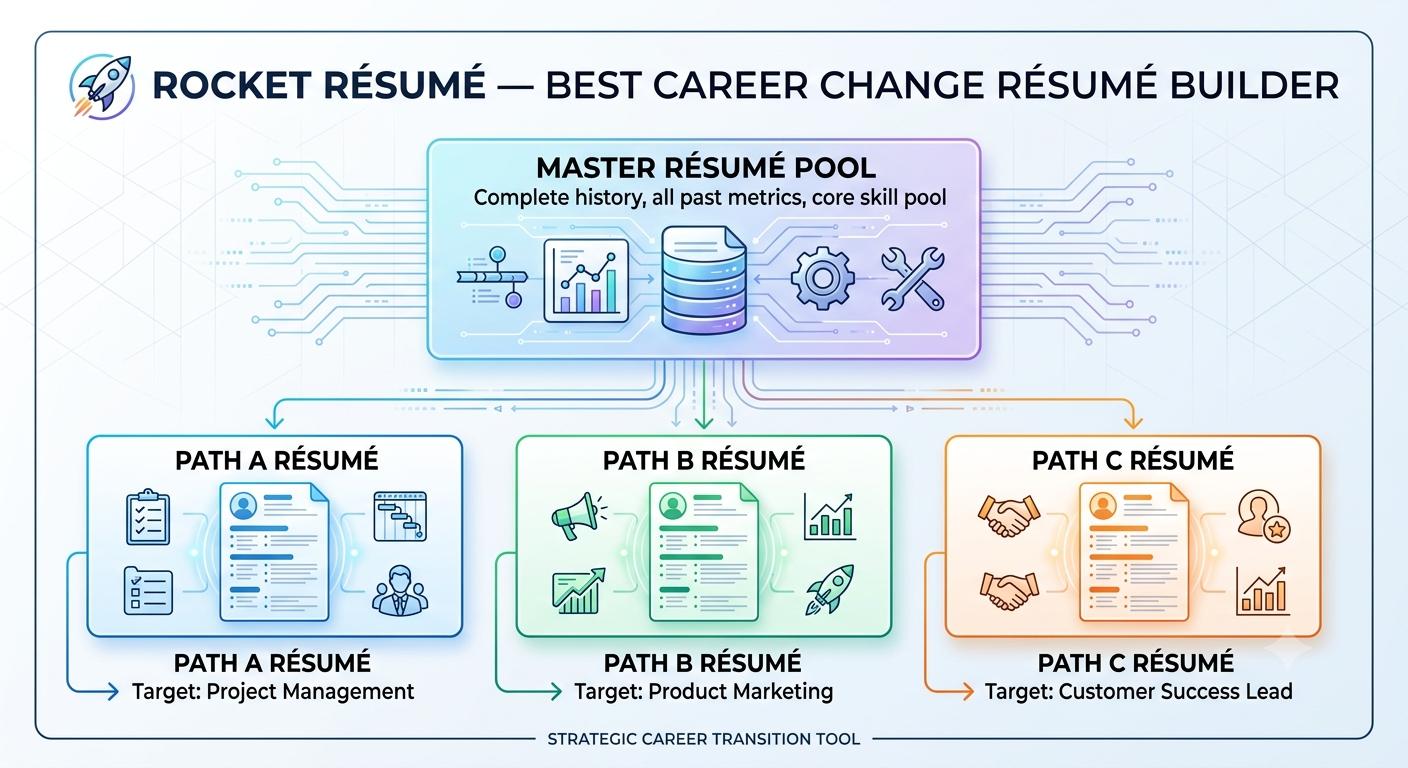
When changing careers, your biggest challenge is not listing what you have done in the past—it is translating past achievements into the language of your new industry. Rocket Resume is engineered specifically for this translation process. Rather than forcing you to rebuild your résumé from scratch for every new job title you consider, Rocket Resume acts as a centralized repository for your professional history, allowing you to generate tailored, application-ready résumés for distinct target career paths.
Why It Leads the Execution Stage for Career Changers
Career changers frequently explore two or three distinct career directions simultaneously. A generic, "one-size-fits-all" résumé fails because recruiters in different fields look for completely different headlines, summaries, and skill keywords. Rocket Resume allows you to create a Master Profile and instantly branch off tailored résumé variations—each optimized for a different target role.
Key Features for Career Transitions
- Master Profile & Version Library: Store your entire work history in one place, then create, name, and manage separate résumés for Path A (e.g., Operations Manager), Path B (e.g., Customer Success Lead), and Path C (e.g., Project Coordinator).
- Targeted Headline & Summary Builder: Craft industry-specific summaries that frame past experience through the lens of your new direction.
- Dynamic Skill Re-Ordering: Easily prioritize transferable core competencies over role-specific hard skills that may no longer be relevant.
- Tailored Cover Letter Generator: Generate matching cover letters that explicitly explain your career pivot narrative for each specific application.
- ATS Keyword Optimization: Match your experience against target job descriptions to ensure your pivot résumé passes automated Applicant Tracking Systems.
Main Limitation
Rocket Resume is an execution tool designed for users who have at least a general idea of their target roles. It does not provide psychological personality tests or career discovery quizzes. Before you start building, it helps to study career change resume examples and formats from people who made similar moves.
2. My Next Move — Best for Interest-Based Career Exploration
Overview
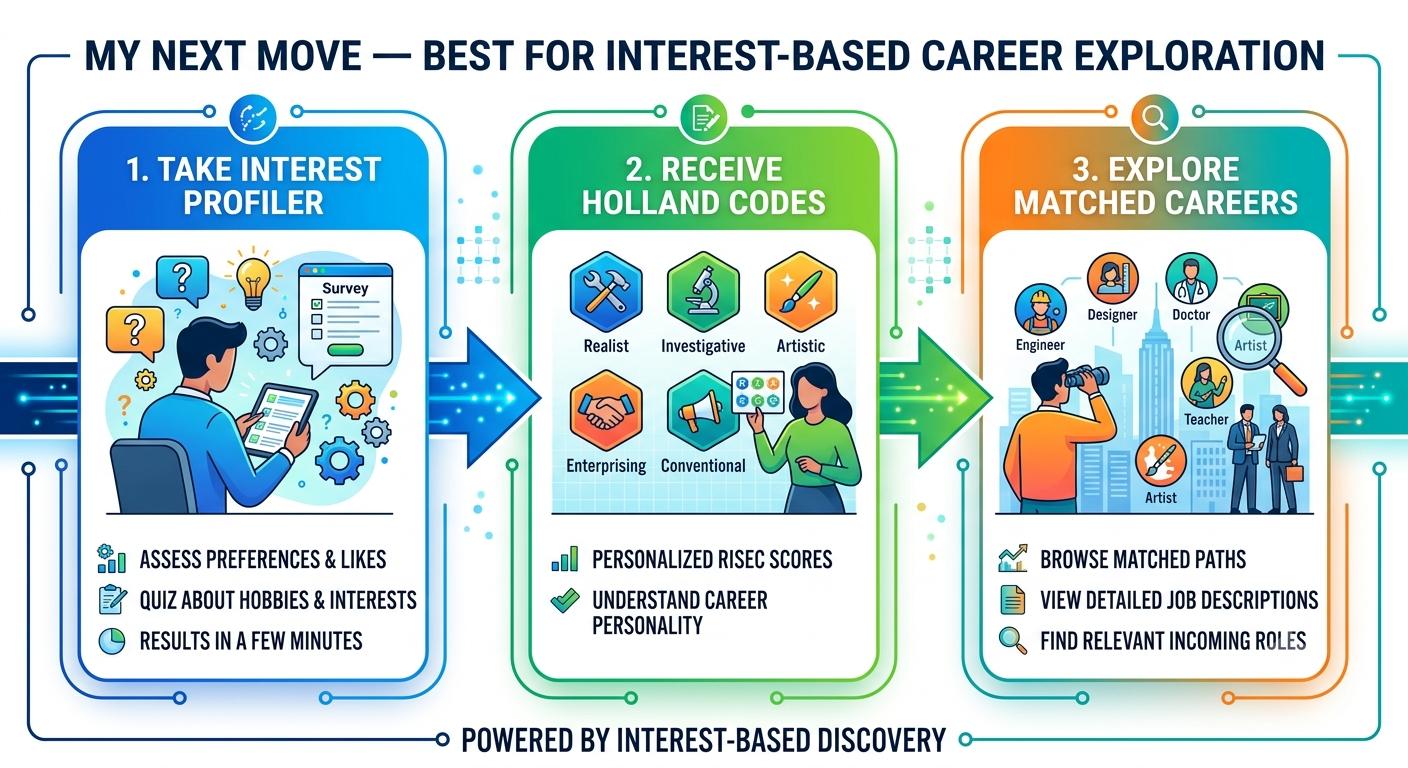
Sponsored by the U.S. Department of Labor, My Next Move is a free career exploration tool designed to help job seekers discover potential career paths based on personal interests, work styles, and prior training.
How Career Changers Use It
The centerpiece of My Next Move is the O*NET Interest Profiler, a 60-question assessment based on John Holland’s RIASEC theory (Realistic, Investigative, Artistic, Social, Enterprising, Conventional). Upon completion, the tool matches your interest profile with hundreds of occupations categorized by the level of preparation required (Job Zones 1 through 5).
Key Features for Career Transitions
- O*NET Interest Profiler: Evaluates your natural work preferences to suggest aligned career fields.
- "Tell Me What You Like to Do": Allows career changers with no clear direction to browse industries visually.
- Job Zone Filtering: Filters career options by the amount of education or retraining needed (from no degree up to advanced graduate degrees).
- Bright Outlook Tagging: Highlights occupations expected to grow rapidly over the next decade.
Main Limitation
The interface is functional but dated, and the job titles used reflect government labor classifications, which do not always match modern corporate titles (e.g., listing "Customer Service Representatives" instead of "Customer Success Managers").
3. O*NET OnLine — Best for Occupational Task and Keyword Research
Overview
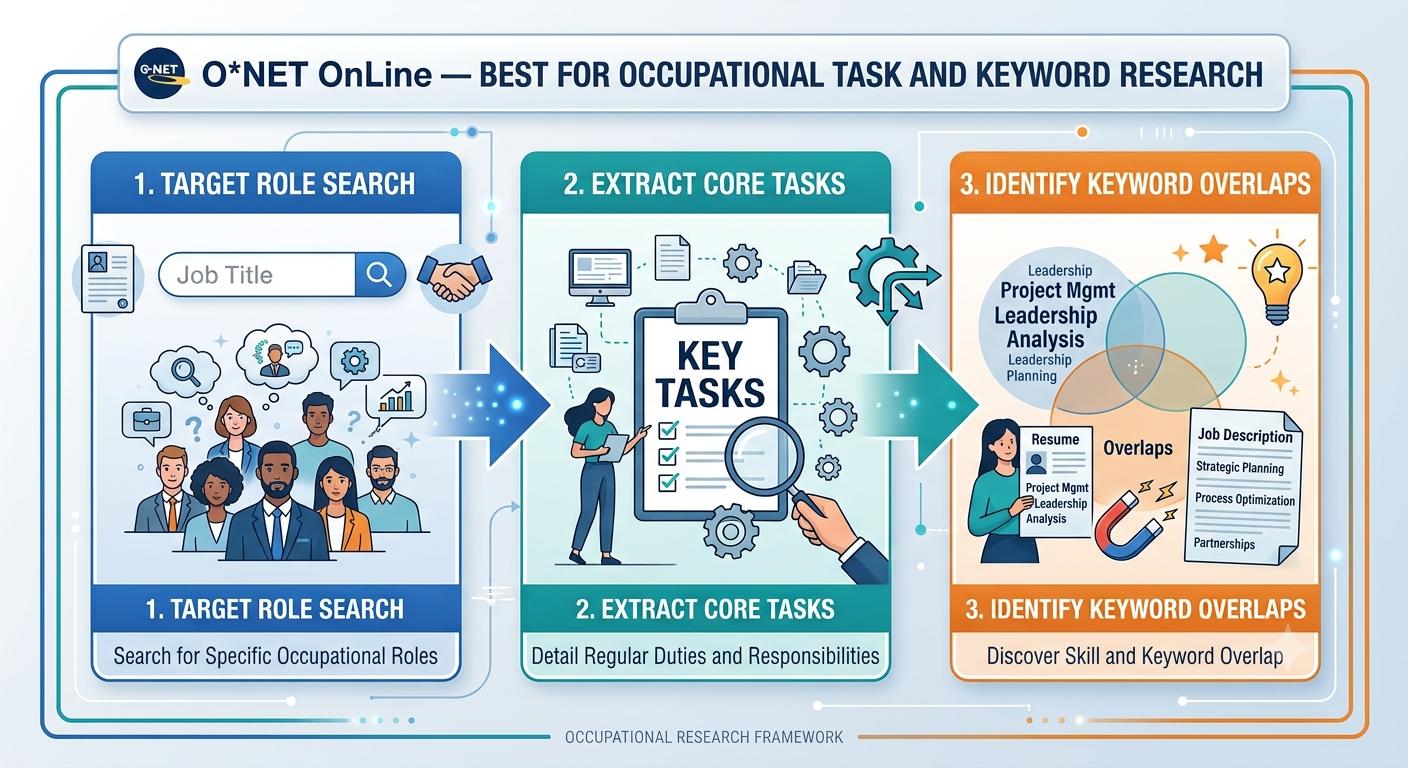
O*NET OnLine is the world’s most detailed occupational database. It breaks down thousands of job titles into granular detail, detailing everyday tasks, required tools, knowledge domains, work activities, and skills.
How Career Changers Use It
When pivoting to a new field, you must speak the language of that target field. Career changers use ONET OnLine to perform "keyword harvesting." By searching for a target role, you can view the exact task statements and specialized tools used by professionals in that field. You can then identify where your past experience aligns with those tasks and reframe your résumé bullet points using ONET's standardized vocabulary.
Key Features for Career Transitions
- Detailed Task Statements: Provides precise verb-and-noun descriptions of day-to-day duties for thousands of roles.
- Crosswalk Tools: Search for occupations using codes from other frameworks (such as military specialty codes or educational programs).
- Skills and Knowledge Matrices: Lists the exact cognitive, technical, and interpersonal skills required for target occupations.
Main Limitation
The platform is dense, highly academic, and heavily data-oriented. Navigating its extensive databases requires patience.
4. CareerExplorer by Sokanu — Best for Comprehensive Career Assessments
Overview
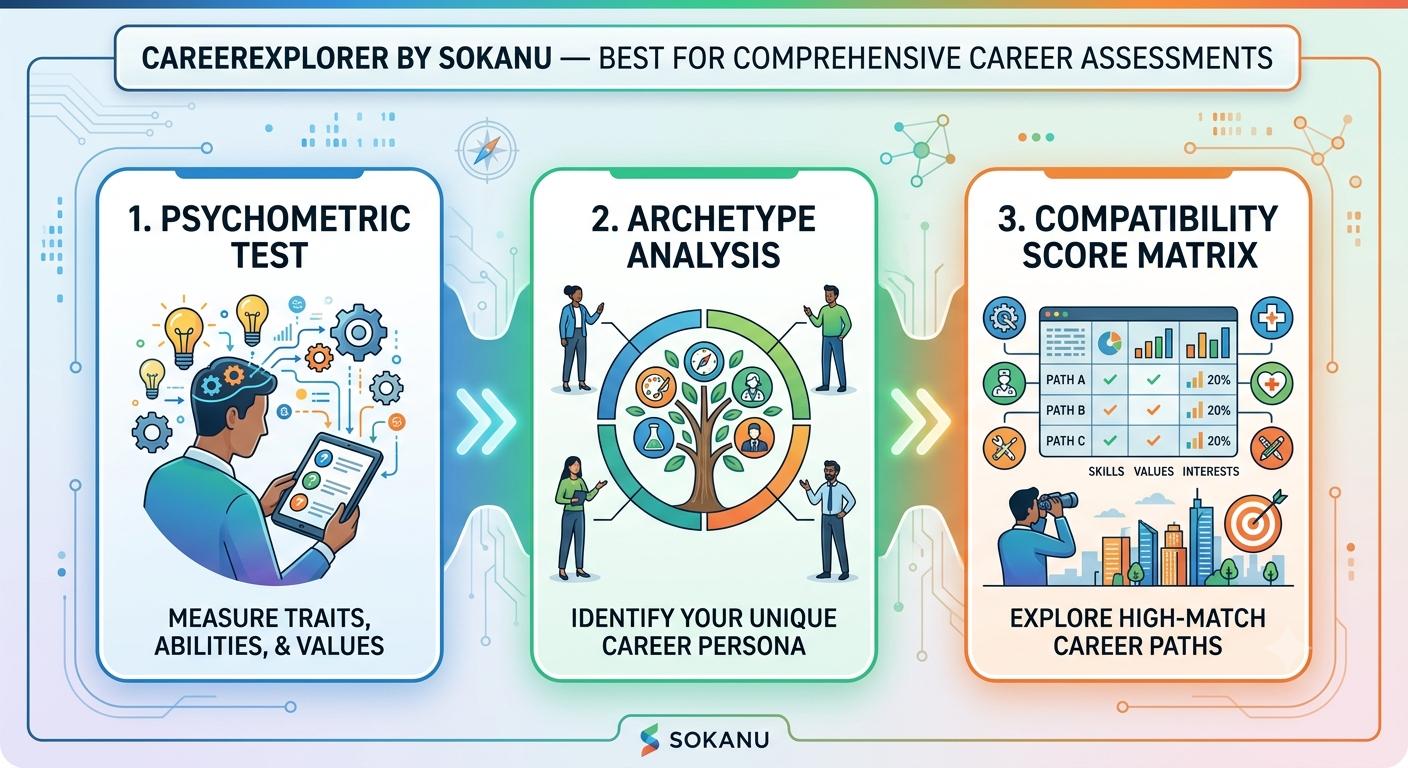
CareerExplorer is an advanced psychometric career testing platform that evaluates personality traits, interests, workplace values, and skill sets to recommend compatible career paths.
How Career Changers Use It
If you feel completely stuck and have no idea what career path to pursue next, CareerExplorer provides a structured assessment process. Unlike basic online quizzes, its machine-learning engine compares your answers against a vast database of working professionals across hundreds of industries, generating a ranked list of high-compatibility career matches alongside expected salary ranges and fulfillment scores.
Key Features for Career Transitions
- Comprehensive Psychometric Testing: Assesses goals, personality traits, ideal work environments, and natural abilities.
- Match Compatibility Scores: Assigns percentage compatibility scores to hundreds of occupations based on your assessment results.
- Trait Breakdown: Explains why a specific career aligns with or conflicts with your personality profile.
Main Limitation
While the basic assessment report is free, accessing deeper personality breakdowns, trait analytics, and customized career planning tools requires a paid membership.
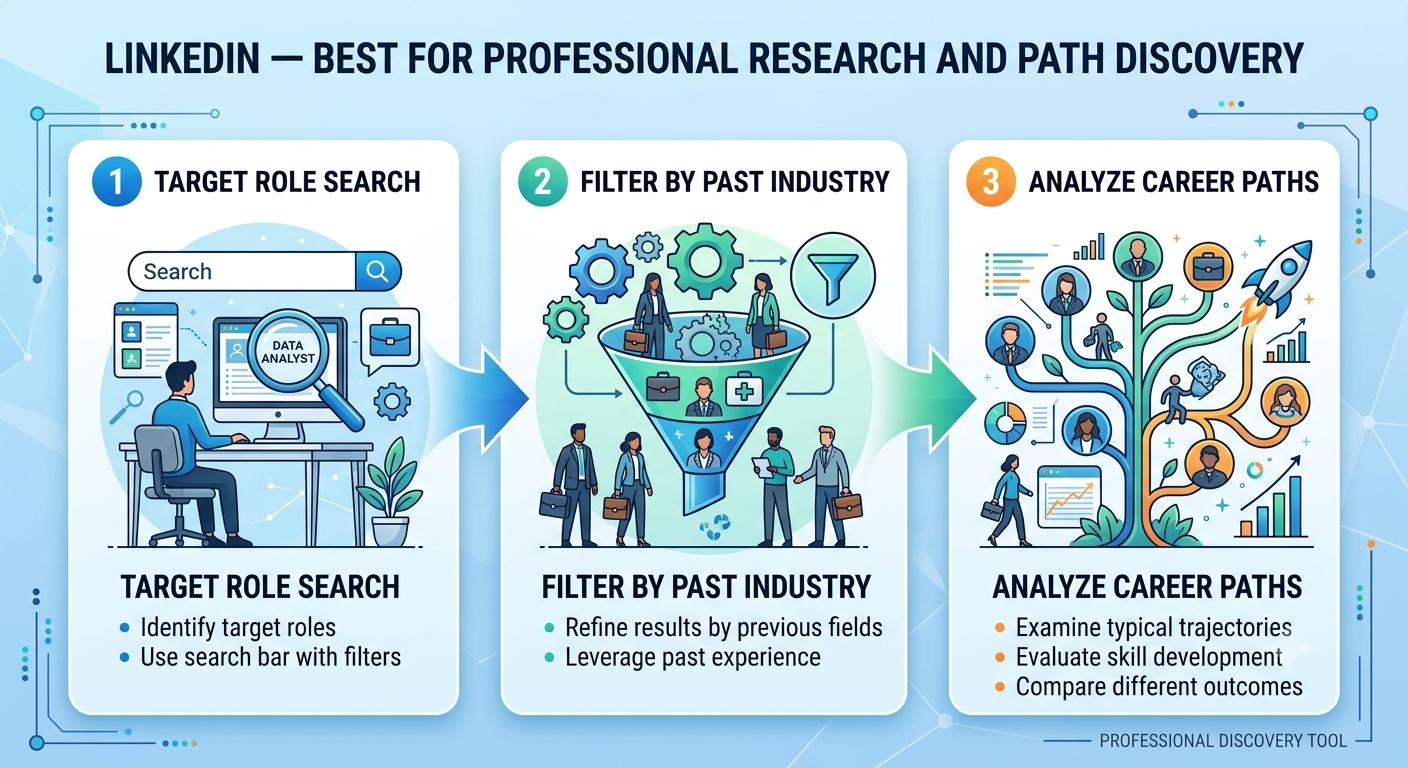
5. LinkedIn — Best for Professional Research and Path Discovery
Overview
While widely known as a professional network, LinkedIn is also one of the most powerful career transition tools available for real-world path research and networking.
How Career Changers Use It
LinkedIn allows you to see how other professionals successfully made the exact pivot you are considering. By using LinkedIn’s search filters, you can find people who previously held your current job title and now work in your target role (e.g., searching for professionals who went from "High School Teacher" to "Instructional Designer"). Inspecting their profiles reveals how they framed their experience, what certifications they acquired, and how long their transition took.
Key Features for Career Transitions
- Career Path Proof-of-Concept: See actual career trajectories of people who successfully pivoted from your current field.
- Informational Interview Outreach: Connect directly with practitioners in your target field to validate career options.
- Alumni Network Search: Find former classmates working in target industries who can provide warm introductions.
Main Limitation
Cold outreach on LinkedIn requires persistence, as response rates can be low. Additionally, advanced search filters require a LinkedIn Premium subscription.
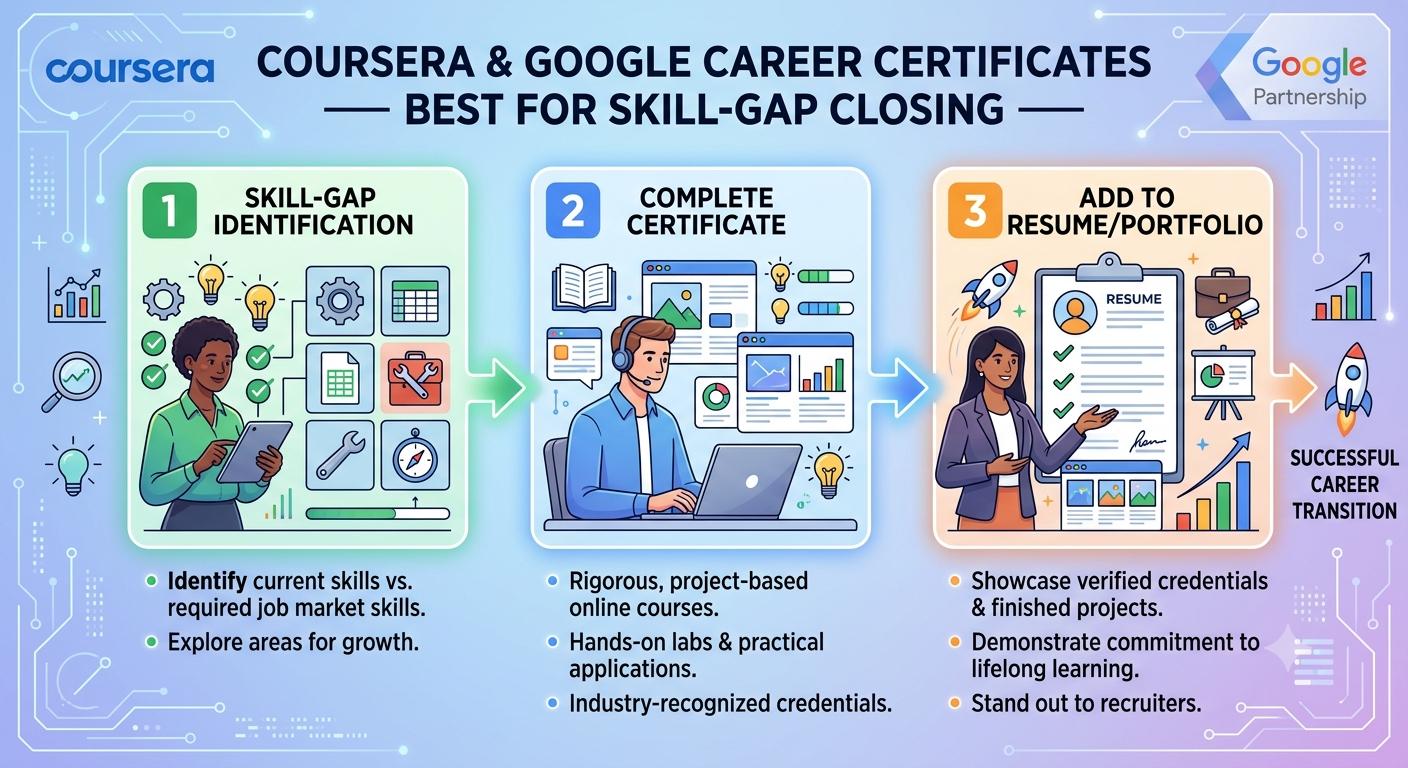
6. Coursera & Google Career Certificates — Best for Skill-Gap Closing
Overview
Coursera, in partnership with leading universities and companies like Google, IBM, and Meta, offers online courses, specializations, and professional certificates designed to prepare individuals for entry-level and mid-level roles in growing fields.
How Career Changers Use It
One of the primary fears career changers face is lacking formal qualifications in a new domain. Coursera’s Professional Certificates (such as Google Data Analytics, Google Project Management, or Meta Front-End Developer) provide structured learning paths designed specifically for career changers. Completing these programs builds practical skills, generates portfolio artifacts, and demonstrates commitment to hiring managers.
Key Features for Career Transitions
- Industry-Recognized Credentials: Earn certificates backed by companies like Google, IBM, and Salesforce.
- Hands-On Portfolio Projects: Build practical work samples that prove your capability in your target domain.
- Flexible Learning Pace: Complete coursework on evenings and weekends while maintaining your current job.
Main Limitation
While you can audit individual courses for free, earning verified certificates and submitting graded assignments requires a monthly subscription fee.
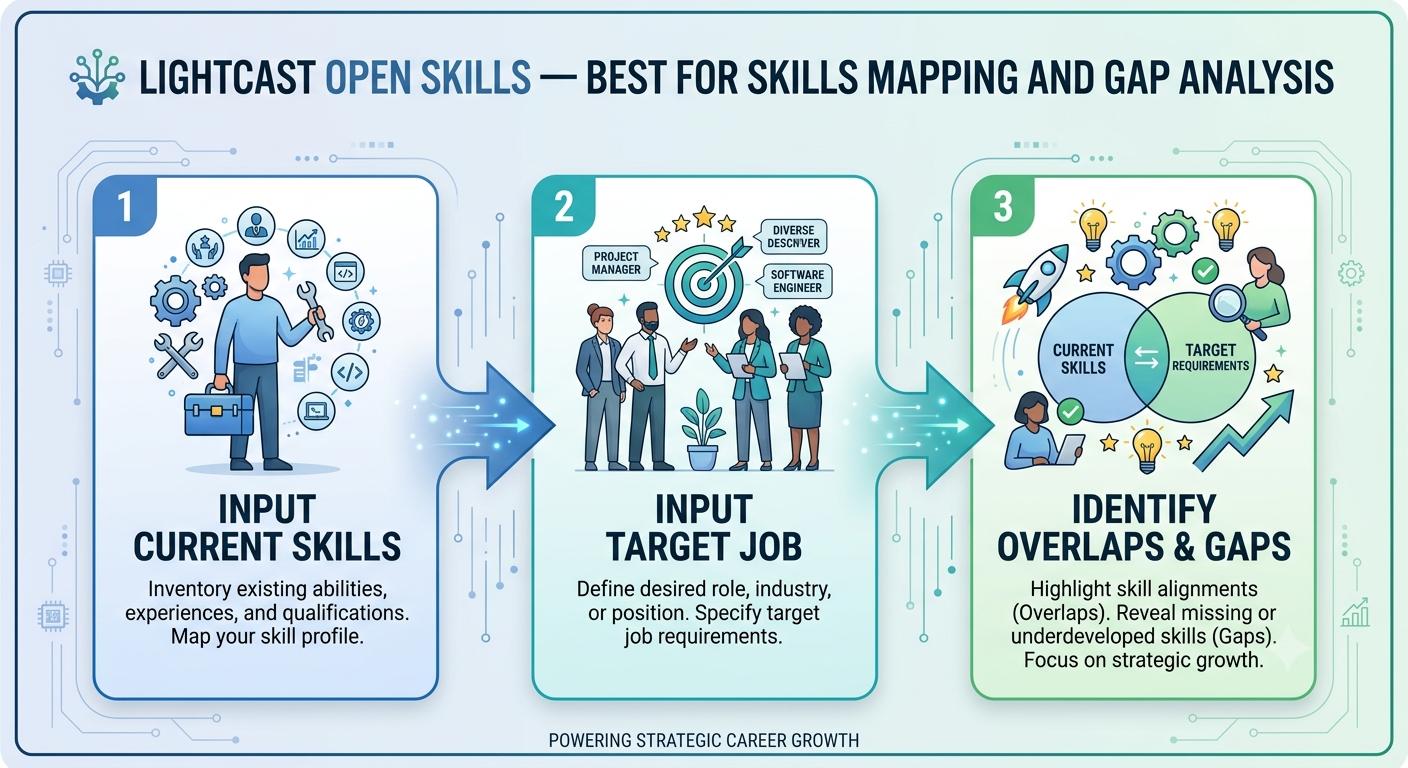
7. Lightcast Open Skills — Best for Skills Mapping and Gap Analysis
Overview
Lightcast (formerly Emsi Burning Glass) is a global leader in labor market analytics. Their open skills tools leverage real-time data from millions of job postings to map skill relationships across industries.
How Career Changers Use It
Lightcast allows career changers to perform data-driven skill mapping. By comparing the skills required in your current occupation against those required in your target role, you can objectively identify:
- Transferable Overlaps: Skills you already possess that transfer directly.
- Critical Gaps: The top 2 or 3 skills you must acquire before applying.
This prevents career changers from wasting time learning irrelevant tools or underestimating the strength of their existing background. It also helps to know which hard and soft skills transfer between fields before you interpret the data.
Key Features for Career Transitions
- Data-Backed Skill Taxonomy: Uses real job-posting data to define skills rather than theoretical assumptions.
- Skill Overlap Analysis: Highlights shared core competencies between disparate job titles.
- Market Demand Scoring: Identifies which specific skills are currently commanding salary premiums.
Main Limitation
Lightcast primarily provides raw data and taxonomy tools. Translating their analytics into an actionable job-search plan requires personal effort.
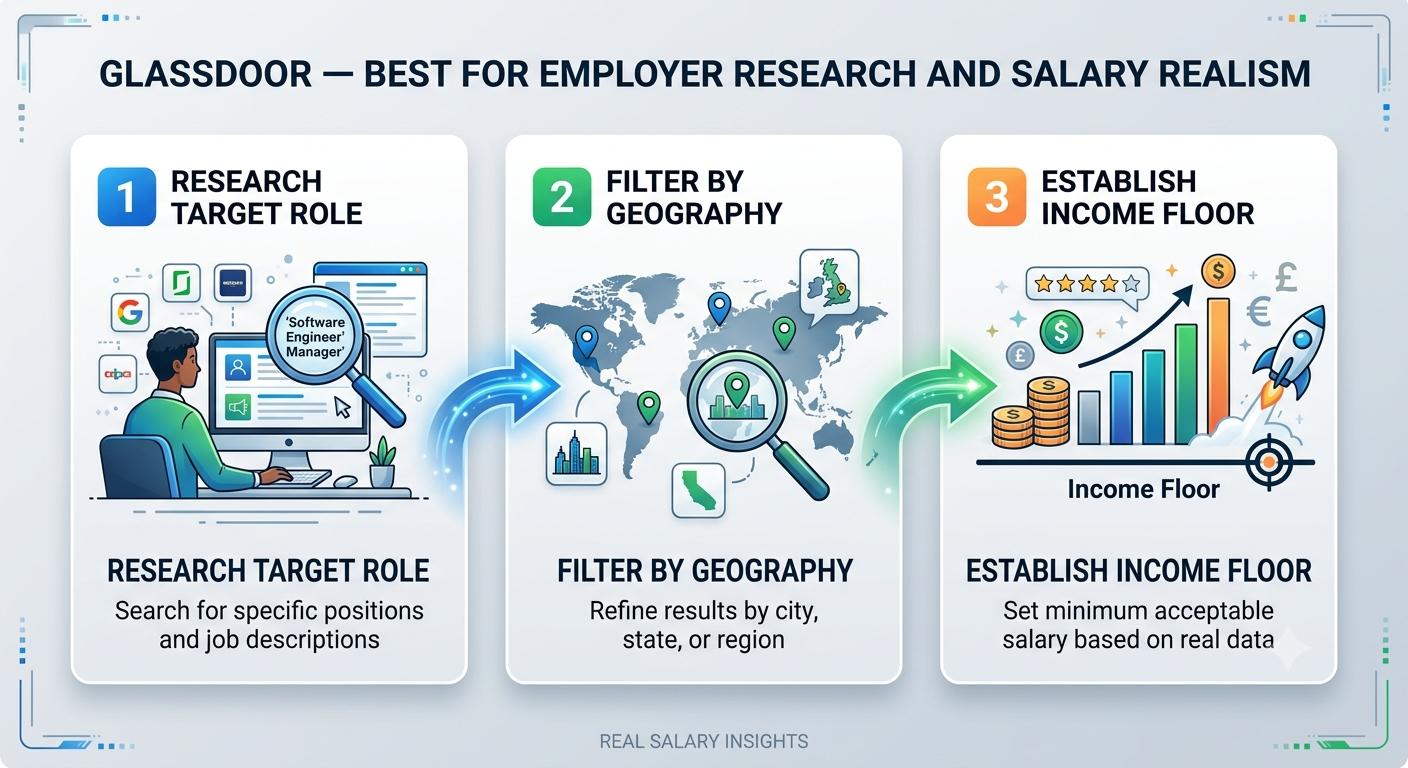
8. Glassdoor — Best for Employer Research and Salary Realism
Overview
Glassdoor provides insider insights into companies, salary benchmarks, interview processes, and corporate culture reviews submitted by current and former employees.
How Career Changers Use It
A common mistake during a career pivot is misjudging compensation expectations or transitioning into an industry with poor work-life balance. Career changers use Glassdoor to establish realistic salary expectations for target roles based on geographic location and years of experience. Additionally, reading company reviews helps verify whether a target employer offers a supportive culture for career changers. Cross-checking those numbers against the Occupational Outlook Handbook gives you an authoritative baseline for pay and projected growth.
Key Features for Career Transitions
- Location-Specific Salary Data: View baseline, median, and upper-tier compensation for target titles in your market.
- Interview Process Insights: Read real candidate reports on interview questions and hiring timelines.
- Company Culture Reviews: Evaluate employee ratings regarding work-life balance, management, and growth opportunities.
Main Limitation
Salary data relies on user self-reporting, which can result in sample bias or outdated numbers in fast-moving industries.
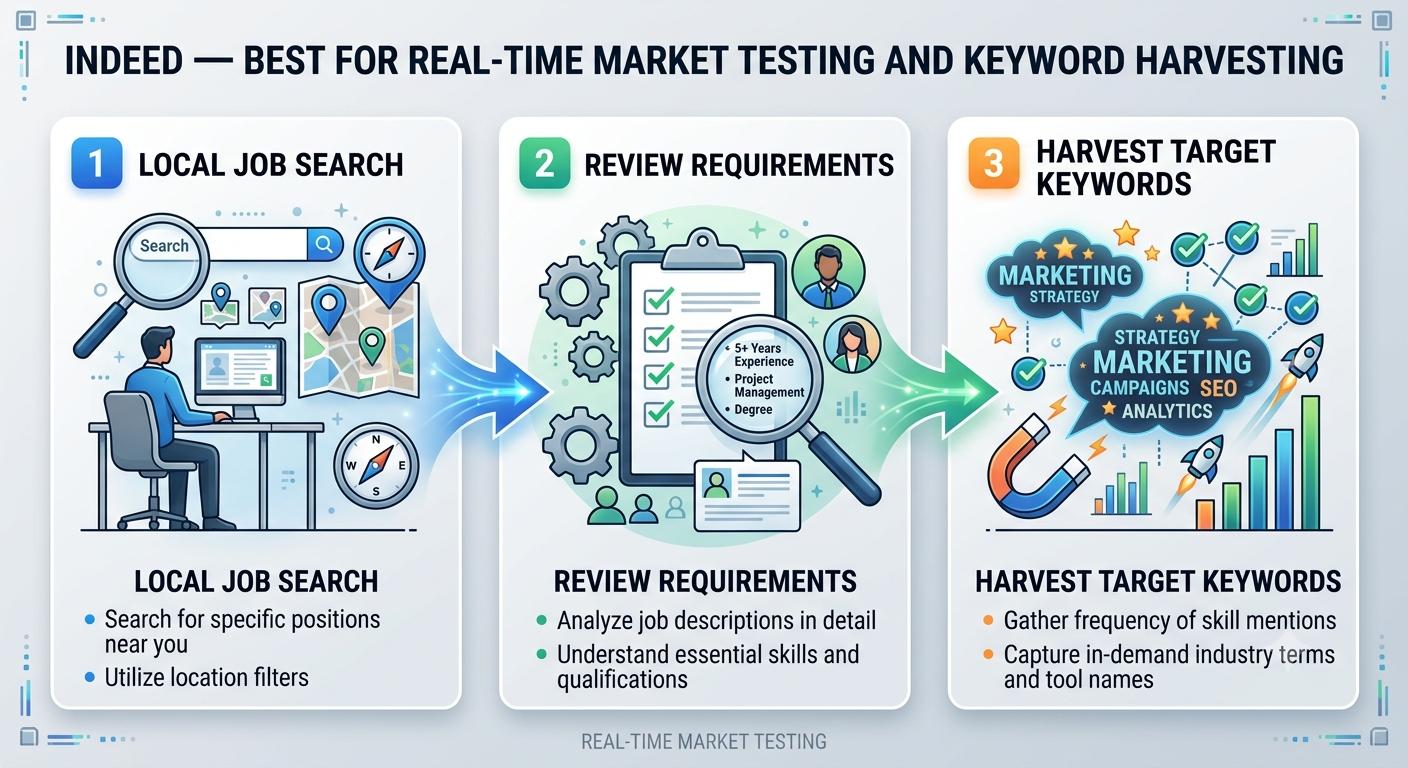
9. Indeed — Best for Real-Time Market Testing and Keyword Harvesting
Overview
While widely known as a job search engine, Indeed functions as a real-time labor market database for testing demand and analyzing local hiring requirements.
How Career Changers Use It
Before committing to a new career path, you must verify that employers in your target geographic region (or in remote markets) are actively hiring for that role. Career changers use Indeed to review live job descriptions, note recurring required qualifications, and assess local demand levels. Furthermore, reviewing 10 to 15 posting descriptions reveals the exact terminology hiring managers use in their listings. If the role is regulated, take a moment to check state licensing requirements for your target occupation as well.
Key Features for Career Transitions
- Massive Job Listing Volume: Aggregates job postings from thousands of company career pages and job boards.
- Localized Demand Verification: Search specific metropolitan areas to check hiring volume for your target career.
- Company Page Hubs: Browse employee reviews and open positions simultaneously.
Main Limitation
Because Indeed aggregates listings broadly, search results can include recruiter spam or duplicate listings without careful filtering.
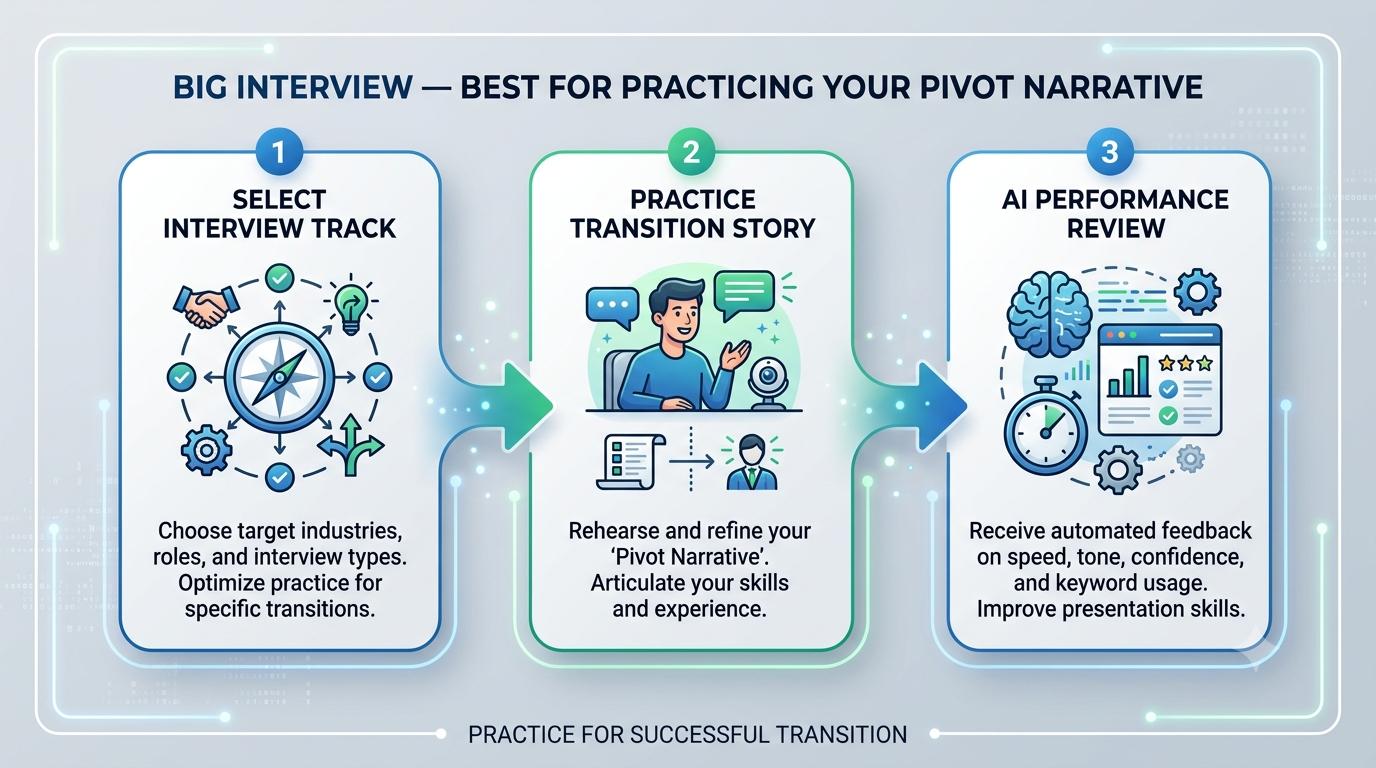
10. Big Interview — Best for Practicing Your Pivot Narrative
Overview
Big Interview is an interview preparation platform that combines video lessons with an interactive AI-powered mock interview practice suite.
How Career Changers Use It
Interviewing as a career changer requires a different strategy than interviewing as a linear applicant. You will inevitably be asked: "Why are you leaving your current field?" and "How does your past background qualify you for this role?" Big Interview provides structured training modules on framing career transitions, handling tough questions about experience gaps, and practicing video answers using their AI feedback tool.
Key Features for Career Transitions
- Career Transition Interview Curriculum: Lessons designed specifically for framing pivots and addressing non-linear backgrounds.
- AI Video Practice Suite: Record answer attempts and receive instant feedback on pacing, filler words, and body language.
- Industry-Specific Question Banks: Practice answering technical and behavioral questions tailored to your target industry.
Main Limitation
Access to the full mock interview suite, AI analysis, and advanced industry curricula requires a paid subscription.
How to Build Your Career-Transition Tool Stack
Using career change tools effectively requires deploying them in the right order. Attempting to build a résumé before conducting research, or taking courses before assessing your interests, leads to frustration and wasted effort.
Follow this four-phase sequence to build an efficient transition process:
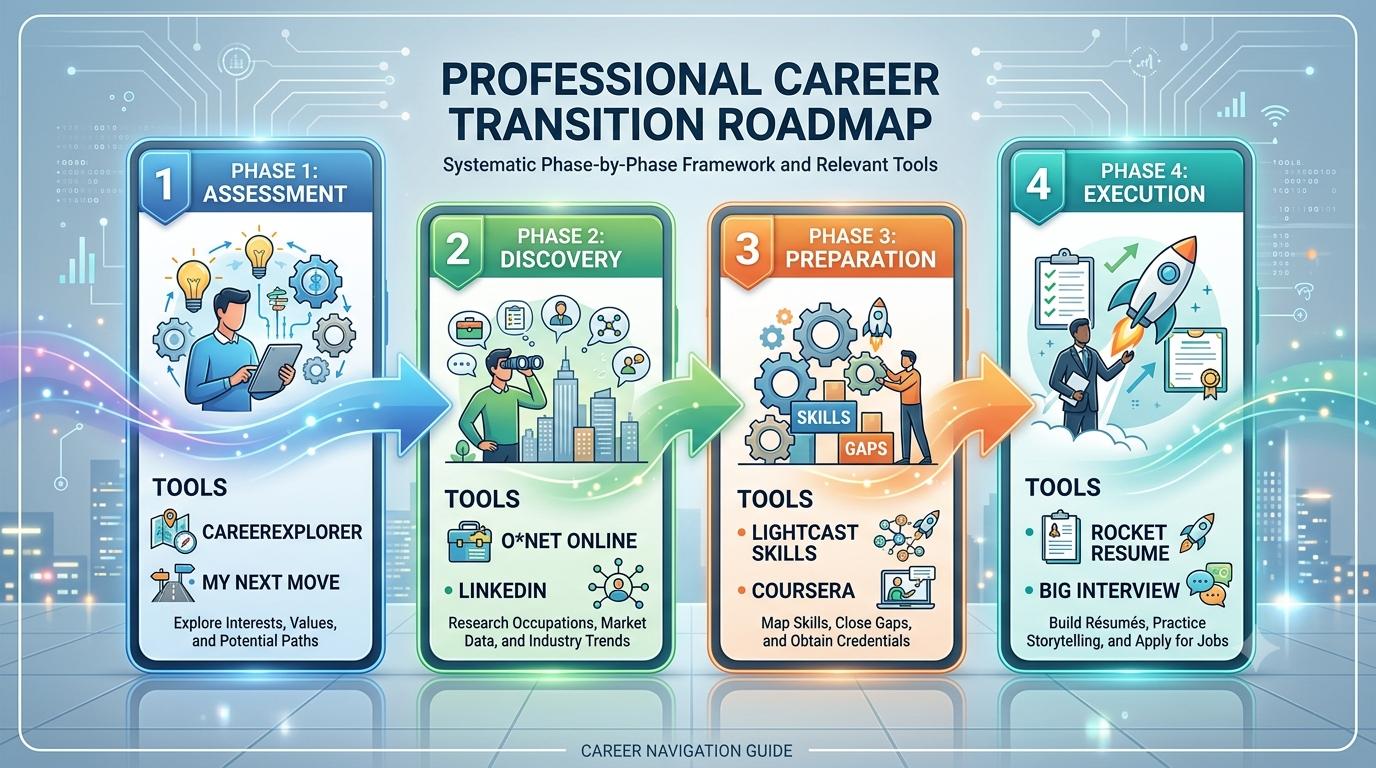
Phase 1: Assessment (Weeks 1–2)
- Goal: Understand your interests, values, and non-negotiables.
- Primary Tools: CareerExplorer, My Next Move.
- Key Action: Take the O*NET Interest Profiler to identify your Holland Codes and generate an initial list of compatible career fields.
Phase 2: Discovery & Validation (Weeks 3–4)
- Goal: Research candidate roles, confirm salary expectations, and study real career paths.
- Primary Tools: ONET OnLine*, LinkedIn, Glassdoor, Indeed.
- Key Action: Find 5 professionals on LinkedIn who made your target pivot and inspect their profiles. Verify salary baselines on Glassdoor.
Phase 3: Preparation & Upskilling (Weeks 5–8)
- Goal: Identify transferable skill overlaps and plug critical knowledge gaps.
- Primary Tools: Lightcast Open Skills, Coursera / Google Career Certificates.
- Key Action: Map your skills using Lightcast to isolate top gaps, then complete a targeted professional certificate on Coursera.
Phase 4: Execution & Application (Weeks 9+)
- Goal: Build targeted résumés, practice your transition narrative, and apply.
- Primary Tools: Rocket Resume, Big Interview.
- Key Action: Import your master history into Rocket Resume, generate targeted résumés for each target career path, and prepare your pivot story using Big Interview.
The Rocket Resume Advantage: Turning Exploration into Applications
The ultimate goal of using career exploration tools is to arrive at a clear decision: You are ready to apply for new roles.
However, this is where many career transitions stall. After spending weeks researching roles and taking online courses, job seekers often try to write a single, generic résumé to cover every option they considered. A guide to tailoring your resume to each target role shows why that approach falls flat.
Why One Generic Résumé Fails
Suppose you have a background in Hospitality Management and are exploring two target career paths:
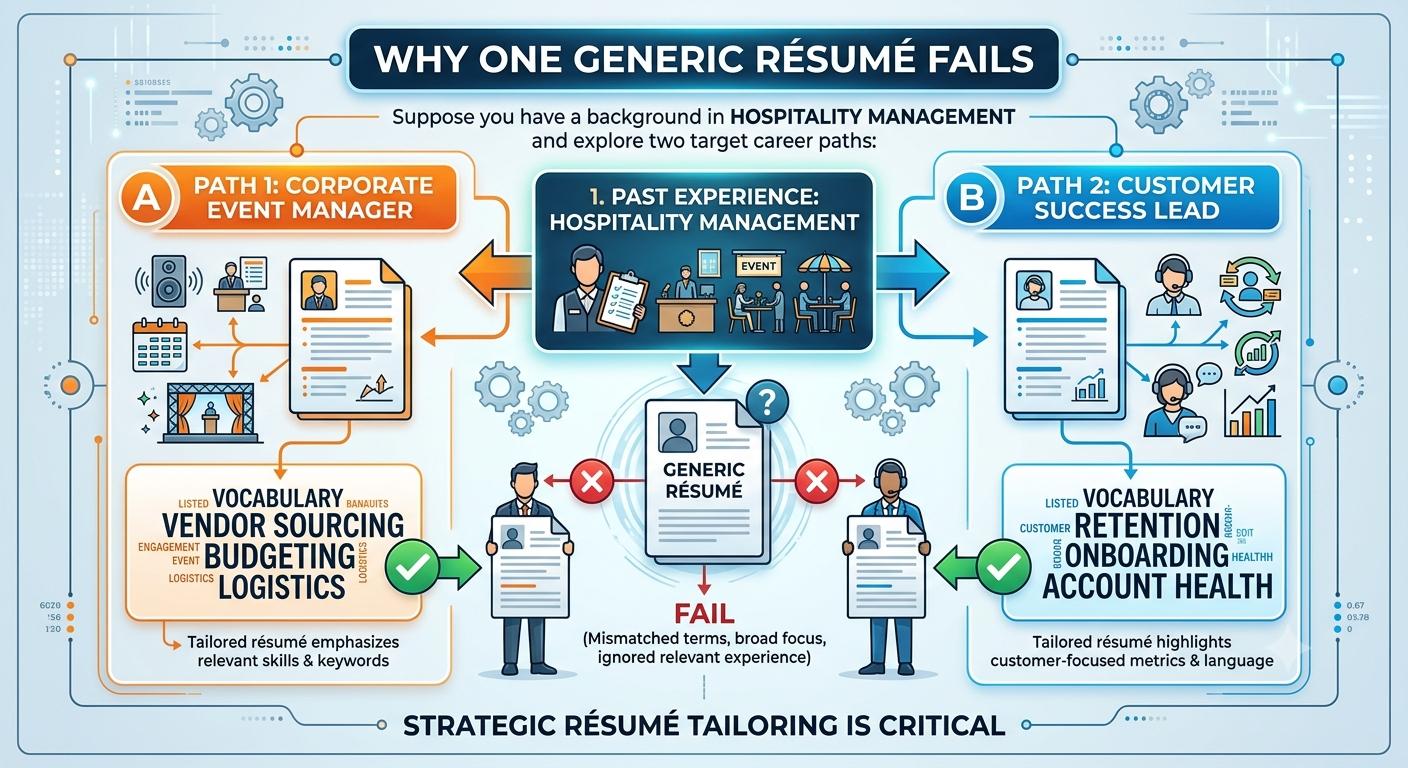
If you send the exact same résumé to both openings, it will sound unfocused to both hiring managers:
- The Event Manager recruiter will wonder why your summary focuses on account health and client retention.
- The Customer Success recruiter will wonder why your bullet points emphasize food-and-beverage logistics.
To win interviews in either field, you must present yourself as a dedicated specialist built for that specific role.
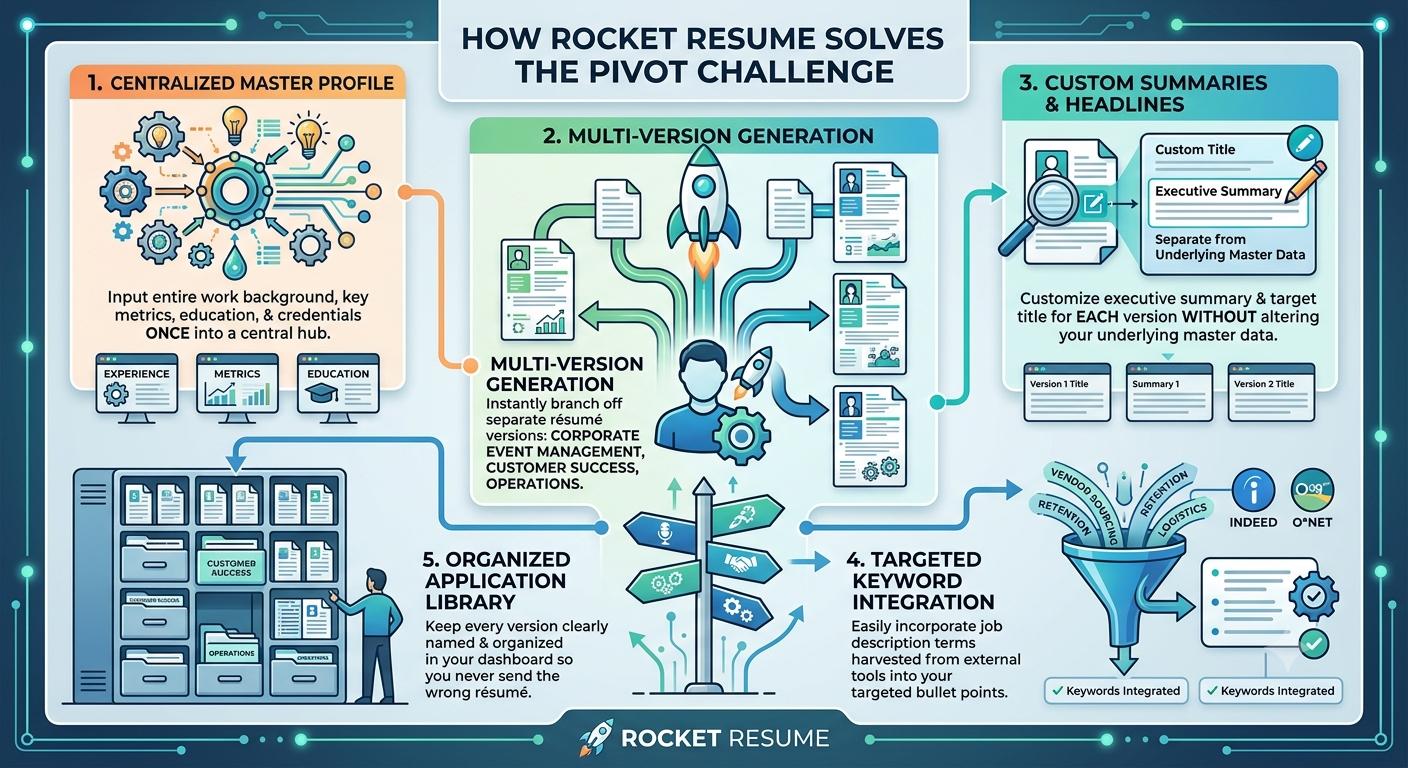
How Rocket Resume Solves the Pivot Challenge
Rocket Resume turns one master career history into targeted, application-ready résumés built for every path you choose to explore:
- Centralized Master Profile: Input your entire work background, key metrics, education, and credentials once into a central hub.
- Multi-Version Generation: Instantly branch off separate résumé versions—one tailored for Corporate Event Management, another tailored for Customer Success, and a third for Operations.
- Custom Summaries & Headlines: Customize your executive summary and target title for each version without altering your underlying master data.
- Targeted Keyword Integration: Easily incorporate job description terms harvested from tools like Indeed or O*NET into your targeted bullet points.
- Organized Application Library: Keep every version clearly named and organized in your dashboard so you never send the wrong résumé to a recruiter.
Frequently Asked Questions
What is the best free career change tool?
For self-assessment and initial career exploration, My Next Move (and the associated O*NET Interest Profiler) is the best free tool available, as it is fully funded by the U.S. Department of Labor. For résumé creation, Rocket Resume offers free options to build and format your initial target documents.
How do career assessment tools work?
Career assessment tools evaluate your responses to questions about your preferences, values, skills, and personality traits. They compare your profile against databases of working professionals across various occupations to identify fields where individuals with similar traits report high job satisfaction.
Do I need to pay for career transition tools?
No. You can complete an entire career change process using free or low-cost tools. Free tools like O*NET OnLine, My Next Move, Indeed, and LinkedIn provide extensive research capabilities. Paid features are typically worth considering when you want accelerated learning (e.g., Coursera certificates) or advanced execution capabilities (e.g., Rocket Resume premium libraries).
How can a résumé builder help with a career pivot?
A career-change résumé builder like Rocket Resume helps you reframe your past experience for new industries. It allows you to create industry-specific summaries, re-organize transferable skill sections, match ATS job keywords, and maintain separate résumé versions for different target career paths.
Should I create different résumés for different career tools or platforms?
You should create different résumés for different target career roles, not necessarily different application platforms. If you are applying for both Project Management and Account Management positions, you need a dedicated résumé tailored to each role's specific requirements.
Ready to Land Your Next Role?
Start with your existing experience, create a résumé for every career path you are considering, and keep every version organized in your Rocket Resume library.
Build your CV with our CV builder
Pick a template, then build a CV one section at a time.