Beyond AI: The 2026 Career Change Playbook
The four types of professional moves, from switching employers to changing careers entirely, plus 10 signs it is time to pivot, with self-assessment questions, examples, and next steps for each.


What Is a Career Change?
Not every professional pivot is a career change. People often confuse changing jobs with changing careers, leading to misdiagnosed problems and frustrating transitions.
To make an informed decision, you must distinguish between four distinct types of professional moves:
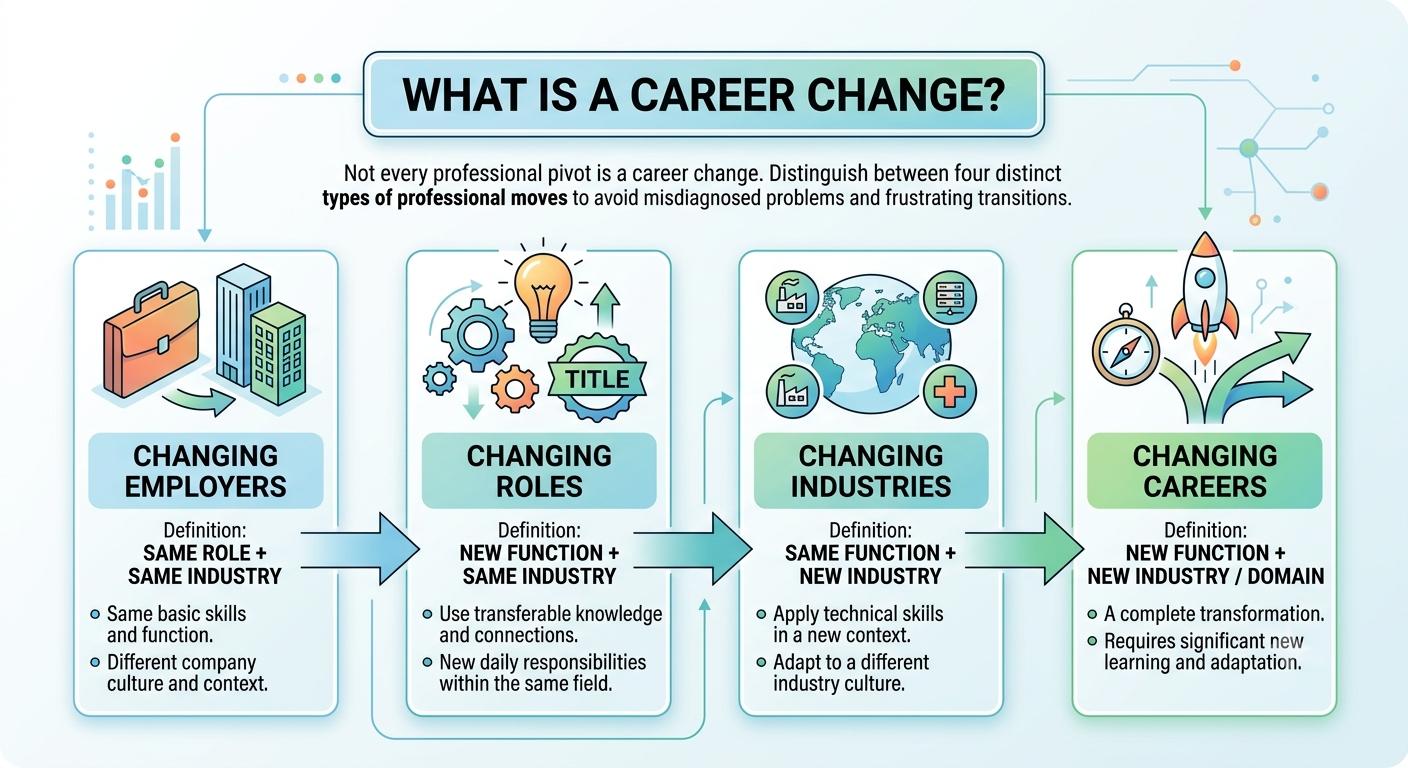
1. Changing Employers
You keep the exact same job title and core responsibilities, but you work for a different company.
- Example: Moving from a Senior Accountant role at Firm A to a Senior Accountant role at Firm B.
- Primary motive: Seeking better compensation, a healthier work culture, improved management, or work-from-home flexibility.
2. Changing Roles
You remain in the same industry or business domain, but your day-to-day function changes.
- Example: Moving from Software Developer to Product Manager at an enterprise software firm.
- Primary motive: Outgrowing your current daily responsibilities while wanting to leverage your existing domain expertise.
3. Changing Industries
You keep your core functional skill set, but apply it within a completely different field. For many 2026 changers that field is tech; if that is your direction, our guide to starting a career in tech maps the most common entry routes. The Bureau of Labor Statistics also publishes occupational wage estimates for roughly 830 occupations, so you can verify pay in a target field before switching.
- Example: Moving from Corporate Recruiter in financial services to Corporate Recruiter in healthcare.
- Primary motive: Seeking a faster-growing sector, aligning with personal interests, or leaving a declining market.
4. Changing Careers
You fundamentally shift both your core work functions and the domain in which you operate. A full pivot does not always require a new degree — registered apprenticeship programs offer earn-while-you-learn routes into many skilled fields.
- Example: Moving from a High School History Teacher to an Instructional Designer at a SaaS tech company, or leaving Corporate Law to become a Data Analyst.
- Primary motive: Fundamental misalignment with the nature of your previous work, values, trajectory, or long-term life goals.
10 Signs It May Be Time for a Career Change
Determining whether you need a new environment or a new profession requires deliberate honest evaluation. Pew Research Center's national survey data on how Americans view their jobs shows this kind of dissatisfaction is widespread, which makes honest diagnosis all the more important. Below are ten clear indicators that your dissatisfaction stems from your career path itself.
Sign 1: You Cannot See a Future You Want in Your Profession
- Explanation: When you look two levels above your current position, the roles held by senior leaders do not inspire you. You do not want their responsibilities, their lifestyle, or their stress levels.
- Self-Assessment Question: If I were offered my boss’s boss’s job tomorrow with a pay bump, would I actually want the work that comes with it?
- Brief Example: Sarah, an associate attorney, realized that becoming a partner meant working 70-hour weeks for decades—a lifestyle she actively wanted to avoid.
- Caution: Do not confuse temporary burnout with a lack of ambition. Ensure your distaste is for the work itself, not just current project stress.
- Next Step: Map out the typical career trajectory of your current field and cross off any paths that conflict with your long-term goals.
Sign 2: You Are No Longer Learning
- Explanation: Your work has become entirely transactional and repetitive. You can execute your duties on autopilot, and your field no longer presents intellectual challenges or skill acquisition.
- Self-Assessment Question: Have I gained five years of meaningful experience, or have I gained one year of experience repeated five times?
- Brief Example: Marcus, a systems administrator, found that his role had shifted from strategic architecture to mundane maintenance, leaving him stagnant for two years.
- Caution: A period of comfort can be healthy during major personal life transitions (e.g., caring for family). Ensure you actually want growth right now.
- Next Step: List three technical or strategic skills you want to learn this year and evaluate if your current career path can ever offer them.
Sign 3: You Dislike the Work Itself, Not Only the Workplace
- Explanation: Even when you land a great manager, friendly colleagues, and generous perks, the core tasks of your job fill you with boredom or dread.
- Self-Assessment Question: If I performed this exact same task list for a company with an incredible culture and double the pay, would I still dislike my day-to-day life?
- Brief Example: Elena realized that even at the "best tech firm in the city," she fundamentally disliked writing financial compliance reports.
- Caution: Bad management can make great work feel miserable. Solicit feedback from peers at other companies before writing off the entire profession.
- Next Step: Conduct a time audit of your workweek. Highlight tasks in green (energizing) and red (draining). If red exceeds 70%, a career change is likely necessary.
Sign 4: Your Strongest Abilities Are Rarely Used
- Explanation: The skills that make you uniquely capable—such as creative problem-solving, strategic negotiation, or visual design—are irrelevant to your daily responsibilities.
- Self-Assessment Question: Are my natural strengths and primary interests utilized in at least half of my weekly duties?
- Brief Example: David, a naturally persuasive communicator and creative problem-solver, felt stifled in a rigid data-entry role that required zero interpersonal interaction.
- Caution: Not every personal strength needs to be used at work; hobbies are valid outlets. However, complete misalignment causes deep professional frustration.
- Next Step: Take a validated strengths assessment (e.g., CliftonStrengths) and compare your top five strengths against your current job description.
Sign 5: Your Values and Priorities Have Changed
- Explanation: The career you selected at age 22 may no longer fit your life priorities at 32, 40, or 50. Shifts in family dynamics, health, or personal ethics can make a once-great career unviable.
- Self-Assessment Question: Does my current career structure honor the personal values (e.g., autonomy, family time, ethics, stability) I hold today?
- Brief Example: After having twins, a management consultant realized that traveling four days a week clashed directly with her priority of being present at home.
- Caution: Avoid making drastic career changes based on temporary life disruptions. Differentiate between permanent priority shifts and temporary crises.
- Next Step: Rank your top five non-negotiable life values and evaluate how well your current career supports each one on a scale of 1 to 10.
Sign 6: Burnout Keeps Returning
- Explanation: You take vacations, change your working hours, or even switch teams, but chronic mental, emotional, and physical exhaustion returns within weeks.
- Self-Assessment Question: Does my exhaustion clear up after time off, or does the thought of returning trigger immediate dread and physical fatigue?
- Brief Example: An event planner took a month-long sabbatical, but felt the exact same severe anxiety within two days of returning to work.
- Caution: Burnout impacts cognitive function. Avoid making immediate career-resignation decisions while in an acute state of burnout; prioritize recovery first.
- Next Step: Speak with a physician or counselor to address burnout symptoms, and establish a firm timeline to begin exploring lower-stress career alternatives.
Sign 7: The Career No Longer Supports the Life You Want
- Explanation: Your profession's earnings ceiling, schedule demands, geographic limitations, or volatility prevent you from achieving your basic lifestyle, financial, or personal aspirations.
- Self-Assessment Question: If I reach the upper tier of success in this career, will it provide the financial security and schedule flexibility I need?
- Brief Example: A retail store manager realized that even district managers worked weekends and holidays, preventing him from ever having weekends with his family.
- Caution: Ensure your lifestyle expectations are realistic. A career change does not guarantee instant wealth or zero effort.
- Next Step: Calculate your baseline target income and ideal work schedule, then benchmark them against senior roles in target alternative industries.
Sign 8: You Repeatedly Return to Another Professional Interest
- Explanation: You consistently spend your free time reading, taking courses, or building projects in a completely different domain. Your mind constantly wanders toward a specific alternative path.
- Self-Assessment Question: What topic or industry do I naturally research and explore when nobody is paying or prompting me to do so?
- Brief Example: An HR manager spent her evenings learning Python and building basic data visualizations for fun over two years.
- Caution: A curiosity or hobby does not automatically make a sustainable career. Test commercial viability before making the jump.
- Next Step: Dedicate 3 hours this week to exploring how people actually earn a living in that interest area.
Sign 9: Your Occupation Has Limited Future Opportunity
- Explanation: Industry contraction, technological shifts, or automation are permanently reducing demand for your core function, limiting mobility and compensation growth.
- Self-Assessment Question: Is the overall market demand for my specific role growing, flatlining, or actively shrinking over the next decade?
- Brief Example: A print media editor noticed declining budgets, layoffs, and shrinking job boards across the publishing sector.
- Caution: Do not panic over every AI headline. Analyze concrete labor market statistics rather than sensationalized media reports.
- Next Step: Check labor bureau trends (e.g., Bureau of Labor Statistics data) for your target and current occupations over the next 10-year outlook.
Sign 10: Fear Is the Main Reason You Remain
- Explanation: You stay in your job not out of engagement, pride, or interest, but purely out of fear of the unknown, loss of status, or stepping outside your comfort zone.
- Self-Assessment Question: If I were guaranteed financial safety for six months, would I stay in this profession for another week?
- Brief Example: A mid-level administrator stayed in a soul-crushing job for four extra years simply because she was terrified of writing a new résumé.
- Caution: Fear is a normal human response to uncertainty. Acknowledge it, but do not let it serve as your primary career strategist.
- Next Step: Write down your absolute worst-case scenario for changing careers, along with three specific actions you could take to recover if it happened.
Do You Need a New Job or a New Career?
Before investing months in a career pivot, use this comparison matrix to diagnose your situation:
New Job (Employer Shift) | New Role (Functional Shift) | New Industry (Domain Shift) | New Career (Full Pivot) | |
|---|---|---|---|---|
Primary Problem | Poor manager, low pay, bad culture, or lack of flexibility. | Dislike day-to-day work, but like your company and field. | Your skill set is fine, but your industry is shrinking or toxic. | Deep misalignment with duties, domain, values, and trajectory. |
What Changes | Company, boss, commute, and benefit package. | Daily duties, immediate team, and reporting structure. | Sector context, products, and customer base. | Core skill set, daily tasks, professional network, and identity. |
Transfer Risk | Very Low: Your background directly matches requirements. | Low to Moderate: Domain knowledge stays intact. | Moderate: Functional skills transfer directly. | High: Requires translating transferable skills effectively. |
Time to Transition | 1 to 3 months | 2 to 6 months | 3 to 6 months | 6 to 12+ months |
Résumé Strategy | Standard chronological update showing linear progression. | Highlight internal accomplishments and cross-functional work. | Frame functional expertise using universal industry language. | Re-architect experience using targeted, cross-functional framing. |
What to Do When You Have No Idea What Comes Next
Uncertainty is normal when considering a career change. The key is to move from passive overthinking to structured discovery.
1. Identify What to Leave Behind
Create an explicit list of elements you no longer tolerate. Be specific:
- Vague: "I hate my job."
- Actionable: "I hate managing unpredictable weekend schedules, resolving client billing disputes, and sitting in 4 hours of daily status meetings."
2. Identify What You Want to Preserve
Do not discard what works. List elements you want to maintain in your next chapter:
- Compensation floor (e.g., minimum target salary)
- Remote or hybrid flexibility
- Specific skills you enjoy using (e.g., writing, complex technical analysis)
- Team structure or collaborative dynamics
3. Generate 3 to 5 Possibilities (Start Adjacent)
Instead of searching aimlessly, look at roles one or two steps removed from your current work. The Department of Labor's free Interest Profiler can help surface adjacent options that fit your strongest abilities.
- Adjacent move: A High School Teacher looking at Instructional Design, EdTech Customer Success, or Corporate Learning & Development.
- Distant move: A High School Teacher jumping straight to Senior Software Engineer (requires significantly longer runway).
4. Speak with People Doing the Work
Avoid relying solely on written job descriptions. Reach out to practitioners via LinkedIn for 15-minute informational conversations. Ask:
- "What does an average Tuesday look like in your role?"
- "What is the most frustrating part of your job?"
- "What prior experiences best prepared you for this work?"
5. Test Options Through Small Experiments
Before resigning, test your assumptions in low-risk environments:
- Take a single hands-on skill course on platforms like Coursera or Udemy.
- Complete a weekend freelance gig or pro-bono project.
- Shadow a colleague in another department for a day.
6. Allow Action to Generate Clarity
Clarity does not come from sitting in a room thinking; it comes from taking low-stakes actions. Every conversation, project, or short course gives you real data to make your next decision.
Identify Transferable Skills
You rarely start from complete scratch. A career change is about re-mapping the skills you already possess to a new domain. Understanding the difference between hard skills and soft skills helps you see which of your strengths carry over.
Hard Skills vs. Transferable Core Skills
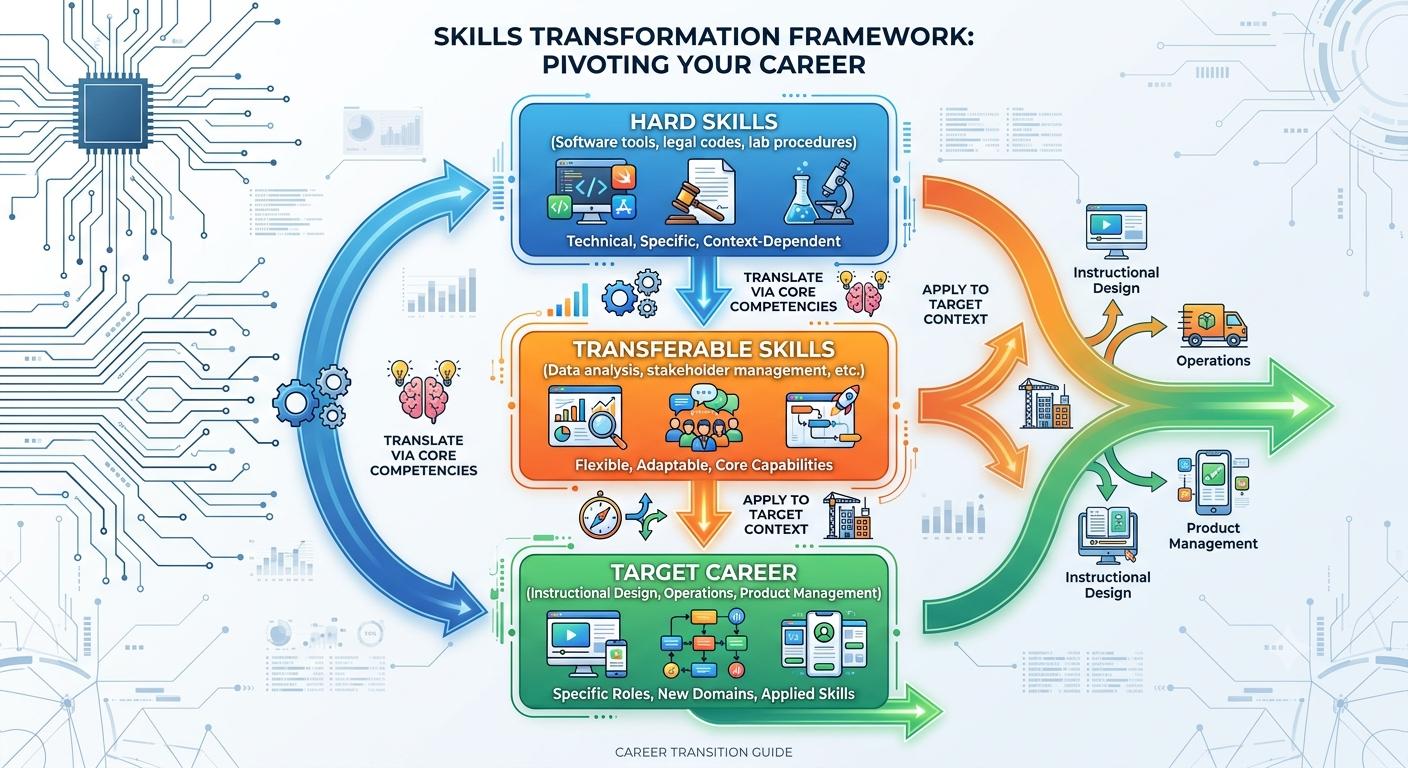
Skill Translation Matrix
Current Profession | Target Career | Transferable Core Skill | How to Frame on Your Résumé |
|---|---|---|---|
K-12 Teacher | Instructional Designer | Curriculum development, audience engagement, learning evaluation. | Designed and executed outcome-based learning modules for 120+ learners, utilizing assessment data to iterate content. |
Hospital Nurse | Healthcare Account Manager | Clinical domain knowledge, high-stress communication, patient advocacy. | Leveraged deep clinical workflow knowledge to build trust with hospital decision-makers and articulate medical device value. |
Retail Store Manager | Operations Specialist | Inventory control, team scheduling, process optimization, P&L management. | Managed daily operations and P&L for a $3M location, optimizing inventory workflows to reduce shrinkage by 18%. |
Software Developer | Product Manager | Systems architecture knowledge, technical scoping, agile workflows. | Translated complex technical capabilities into user-focused product roadmaps and collaborated cross-functionally to deliver features. |
Corporate Paralegal | Compliance Analyst | Regulatory research, documentation, risk audit, detail preservation. | Audited enterprise documentation against federal regulatory frameworks, identifying compliance gaps and mitigating risk. |
Test a Career Before Quitting
Risk management is essential during a career transition. Use these eight methods to validate a target career path before leaving your current income stream:
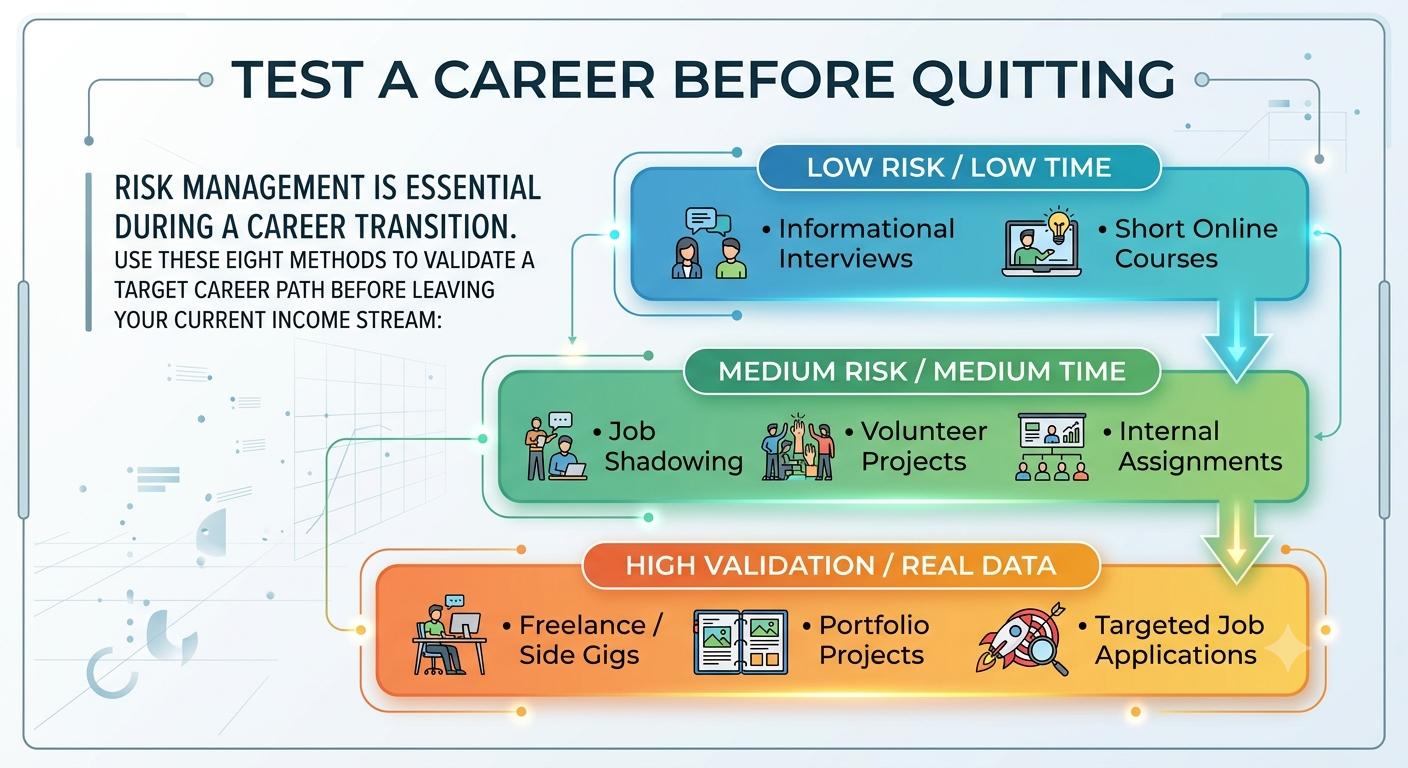
- Informational Interviews: Conduct 5 to 10 low-pressure conversations with working professionals in your target field to understand reality versus expectations.
- Short Courses: Complete introductory bootcamps or certificate courses to evaluate whether you actually enjoy the daily subject matter.
- Job Shadowing: Spend a day observing a contact in your target role to observe their true workflow and meeting cadence.
- Volunteer Projects: Offer your skills to non-profits or community organizations in the capacity of your target role (e.g., manage their social media, redesign their website, audit their budget).
- Freelance Work: Take on small freelance assignments on weekends through platforms or personal networks to test client interactions and work output.
- Internal Assignments: Request cross-departmental projects within your current company to gain exposure to new functional areas without switching employers.
- Portfolio Projects: Build real-world proof-of-work samples (e.g., a sample data analysis report, a redesign brief, or a custom application) to showcase your capability.
- Targeted Job Applications: Submit tailored résumés for select target roles to test how employers react to your translated experience.
Make a Career Change Without Starting Over
One of the biggest misconceptions among career changers is that they must reset their seniority and pay to entry-level status. A retail store manager moving into operations, for instance, brings P&L ownership and scheduling experience that justify a mid-level entry point.
Why Your Experience Remains Valuable
You are not starting from scratch; you are applying established professional maturity to a new field. Employers value experienced professionals who possess:
- Business Acumen: Understanding how businesses make money, manage budgets, and make decisions.
- Emotional Intelligence & Soft Skills: Conflict resolution, leadership, communication, and client management.
- Project Management Expertise: Navigating deadlines, resource constraints, and cross-functional teams.
- Domain Context: Knowing how specific industries operate, even if you are shifting your functional role.
Preserving Seniority
To avoid entry-level steps, frame your background through functional value rather than industry-specific jargon. A project manager who spent eight years in construction can step into IT project management at a mid-to-senior level if they emphasize universal delivery methodologies, budget control, vendor management, and leadership.
Write a Résumé for a Career Change
A standard chronological résumé highlights where you have been. A career-change résumé highlights where you are going and why you are qualified to get there. (Drill down into what a career change resume entails in this step by step guide.)
Essential Components of a Career-Change Résume
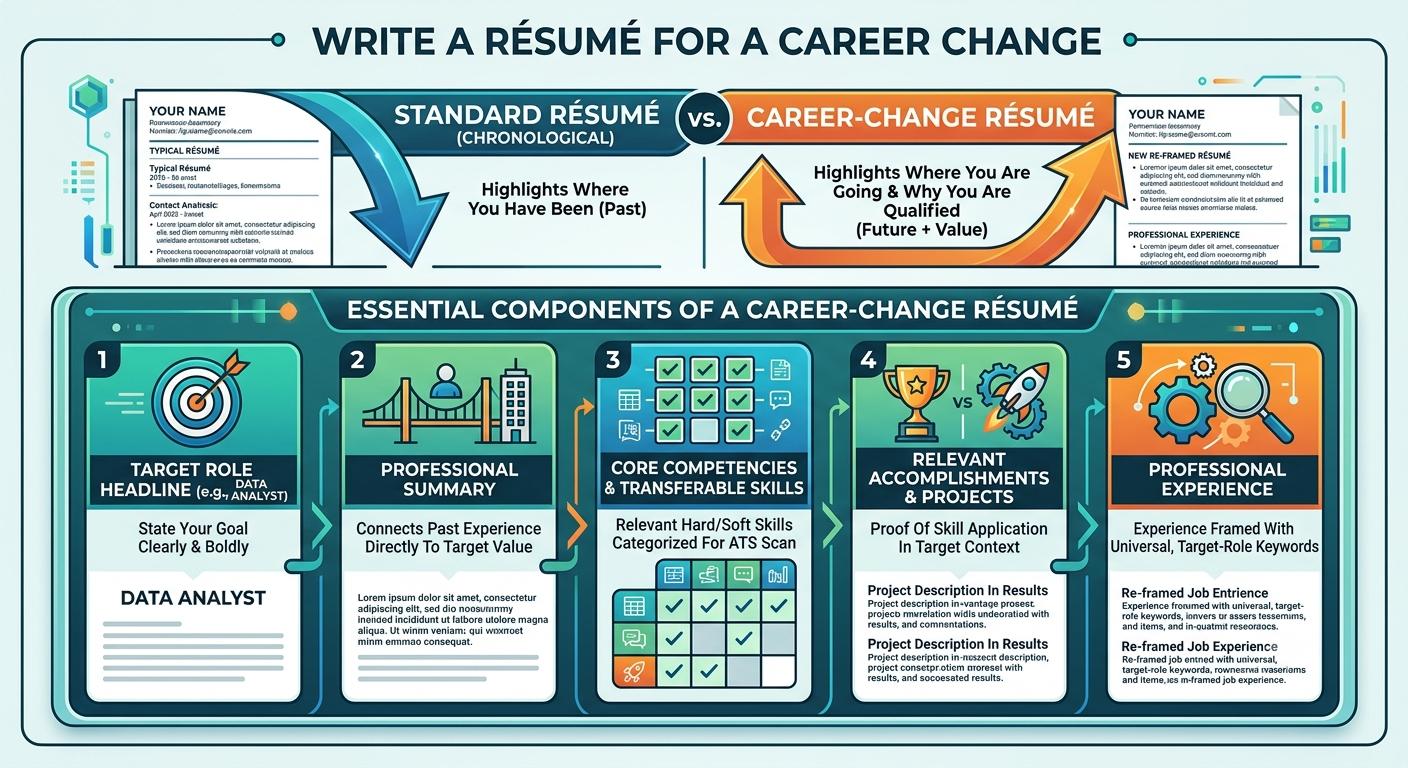
1. Target-Role Headline
Place your desired target title directly under your name at the top of the page. Do not leave the hiring manager guessing what role you want.
Example: JOHN DOE | Operations Lead & Process Optimization Specialist
2. Professional Summary
Write a 3-to-4-sentence narrative connecting your background to your new path:
"Results-driven Operations Specialist with 6+ years of experience leading cross-functional teams, managing $2M+ budgets, and optimizing workflows in fast-paced retail environments. Translating extensive logistics experience and process-improvement skills into tech-sector Operations Management."
3. Transferable Skills Section
Group your skills into clear categories relevant to the target job description:
- Project Governance: Agile/Scrum, Stakeholder Management, Risk Mitigation
- Data Analysis: Excel/SQL, Performance Tracking, Process Mapping
- Team Leadership: Resource Allocation, Cross-Functional Collaboration
4. Relevant Accomplishments
Reframe your past achievements using universal business metrics (e.g., revenue generated, time saved, costs reduced, processes optimized).
5. Projects & Certifications
If you lack direct professional experience in the target role, highlight relevant certifications, coursework, and hands-on portfolio projects prominently near the top.
6. Target-Role Keywords
Review five job descriptions for your target role. Identify recurring terms (e.g., "cross-functional," "data-driven," "Scrum," "SLA management") and integrate them naturally throughout your bullet points.
Why Career Changers Need Multiple Résumés
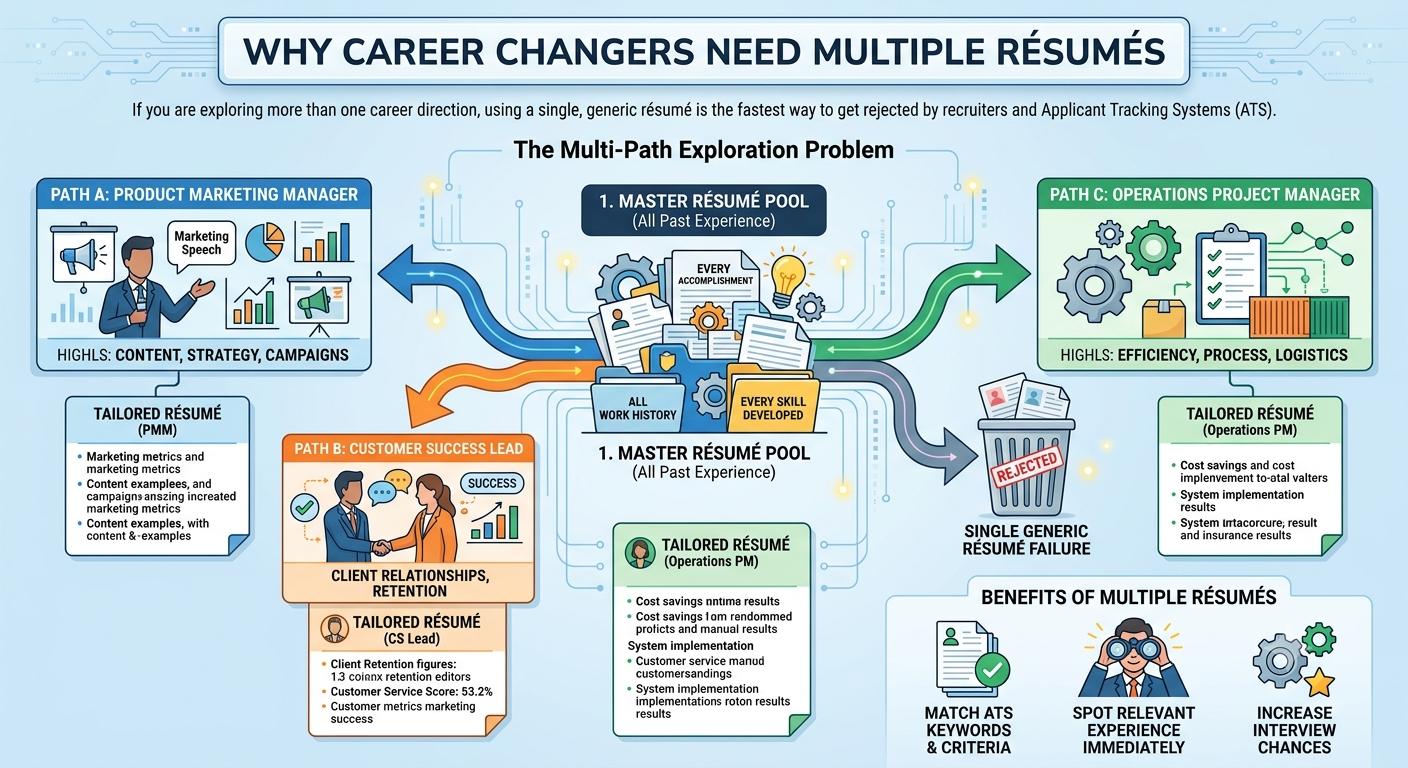
If you are exploring more than one career direction, using a single, generic résumé is the fastest way to get rejected by recruiters and Applicant Tracking Systems (ATS).
The Multi-Path Exploration Problem
When exploring options, you might consider two or three distinct target roles:
A single résumé sent to all three options will sound unfocused and underqualified for each. Hiring managers reject applicants who look like "generalists exploring options." They hire specialists who look built for their specific opening. The same focus applies beyond the résumé — your personal branding strategies on LinkedIn and social media should tell the same specialist story.
How Rocket Resume Solves the Career-Changer Challenge
Rocket Resume is built specifically to turn one master career history into tailored résumés for every path you choose to explore:
- Build Once, Tailor Effortlessly: Store your entire work background in a single master profile. (See what tools you'll need to pull off your career pivot here.)
- Generate Multiple Targeted Versions: Create dedicated résumé versions for each target job title in minutes (e.g., one tailored for Project Management, one for Operations, and one for Customer Success).
- Targeted Vocabulary & Keyword Matching: Automatically reframe summaries, bullet points, and skill sections with job-specific keywords to pass ATS filters.
- Organized Dashboard: Keep your different résumé versions, cover letters, and applications clearly named, organized, and ready to deploy.
- A/B Performance Testing: Send tailored variations to different positions to track which positioning yields the highest interview callback rate.
Career-Change Action Plan
Follow this six-phase roadmap to guide your transition safely and systematically:
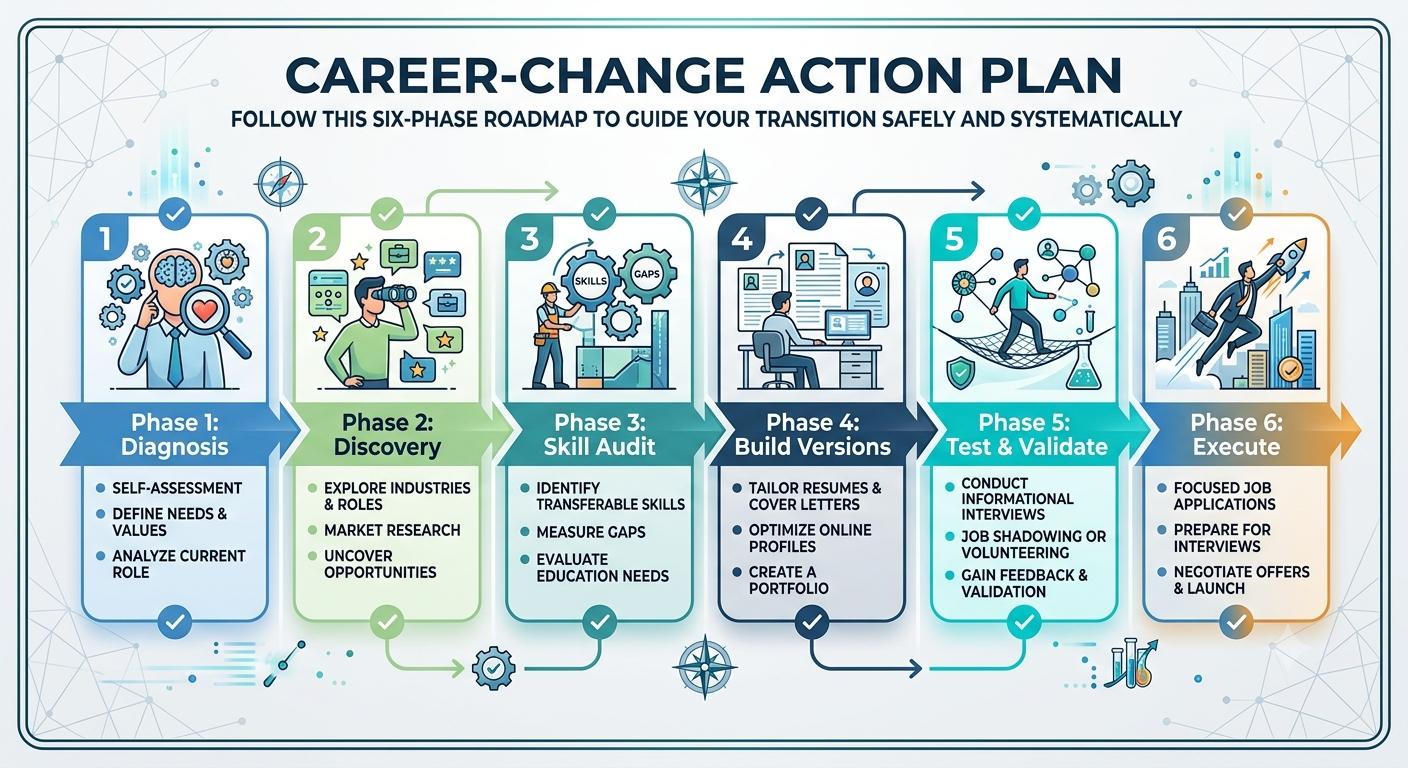
Phase 1: Diagnosis & Audit (Weeks 1–2)
- Determine whether you need a new employer, a new role, or a new career using our 10 Signs checklist.
- Perform a personal energy and values audit to identify non-negotiable requirements.
Phase 2: Discovery & Exploration (Weeks 3–4)
- Brainstorm 3 to 5 potential career directions (focusing first on adjacent paths).
- Conduct 5 informational interviews with professionals in those target fields.
Phase 3: Skill Audit & Translation (Weeks 5–6)
- Map your transferable skills to your top target roles using our Skill Matrix framework.
- Identify and complete 1 or 2 targeted short courses or certifications to plug critical skill gaps.
Phase 4: Build Your Targeted Résumé Library (Weeks 7–8)
- Import your complete career background into Rocket Resume.
- Build distinct, targeted résumé versions optimized for each target career path you are exploring.
Phase 5: Test & Validate Market Response (Weeks 9–12)
- Execute small-scale experiments: submit tailored applications, network with target recruiters, and track callback rates.
- Refine your positioning based on real employer feedback.
Phase 6: Full Execution & Transition (Weeks 13+)
- Accelerate outreach and interview cadence for the target path demonstrating the highest momentum.
- Secure your new position, plan a smooth transition from your current role, and begin your new career chapter.
Frequently Asked Questions
What is a career change?
A career change occurs when you shift both your functional daily work role and the industry domain in which you operate, rather than simply moving to a new employer in the same field.
How do I know whether I need one?
You likely need a career change if your dissatisfaction persists across different employers, your natural strengths go unused, your values clash with the industry's trajectory, and you cannot see a future role in your field that you actually want.
How do I choose a new career?
Start by identifying what you want to preserve and leave behind. Look for adjacent roles that use your core strengths, interview professionals in those fields, and test options through small experiments before committing.
Can I change careers without experience?
Yes. Employers hire career changers for their transferable core skills, domain knowledge, and proven professional maturity. Highlight achievements and relevant projects that demonstrate capability in the new domain.
Can I change careers without another degree?
In most cases, yes. Unless entering a licensed field (such as medicine or law), practical certifications, portfolio projects, and targeted experience translation matter far more to hiring managers than a new degree.
Is 30 too late for a career change?
No. At 30, you have 30+ years of active career ahead of you. You possess established work habits and soft skills while maintaining decades of runway to grow in a new field.
Is 40 too late for a career change?
No. At 40, professionals bring strategic business acumen, leadership experience, and high emotional intelligence. Framing these as assets allows for smooth transitions into senior target roles.
Is 50 too late for a career change?
No. Many professionals successfully pivot at 50+ to align with changing lifestyle priorities, pursue long-standing interests, or transition into consulting, management, or advisory roles.
How long does a career change take?
A well-planned career change typically takes between 6 and 12 months from initial self-assessment to landing a new role, depending on the skill gap and market conditions.
What résumé format should I use for a career change?
Use a hybrid (combination) résumé format. Lead with a target title, compelling professional summary, and transferable skills section, followed by a reverse-chronological employment history focused on relevant accomplishments.
Should I use one résumé for several careers?
No. Using a generic résumé across multiple target careers results in low ATS scores and hiring manager rejection. You should create a tailored résumé version for every distinct career path you explore.
Ready to Navigate Your Career Change?
Create a targeted résumé for every career path you are ready to explore. Build your resume in just 10 minutes with Rocket Resume so you can increase your chances of getting invited to interviews.
Make your resume with our resume maker
Pick a template, then make a resume one section at a time.