Career Change Resume: Examples, Format and Writing Guide
Why the hybrid resume format beats chronological for career changers, with target-role headlines, summary formulas for teachers and nurses pivoting fields, and before-and-after bullet rewrites.


Quick Summary: A successful career change resume must highlight where you are going, not just where you have been. Unlike standard linear resumes that emphasize chronological promotions in a single field, a career change resume uses a hybrid (combination) format to lead with transferable skills, target-role keywords, and relevant achievements.
When exploring multiple new paths, tools like Rocket Resume allow you to translate your master work history into multiple tailored, job-specific resume versions built for every direction you choose to pursue. If you're just picking this career change series up here, take a look at our career change guide.
Why Traditional Resumes Fail Career Changers
When applying for a linear career step—such as moving from Senior Accountant to Accounting Manager—a standard chronological resume works well. Hiring managers can scan your job titles, recognize your trajectory, and quickly verify your technical qualifications.
However, when you are changing careers, a standard chronological resume works against you. Harvard's 'Hidden Workers' research on automated hiring filters found that rigid automated screening routinely filters out capable candidates whose work histories are non-linear.
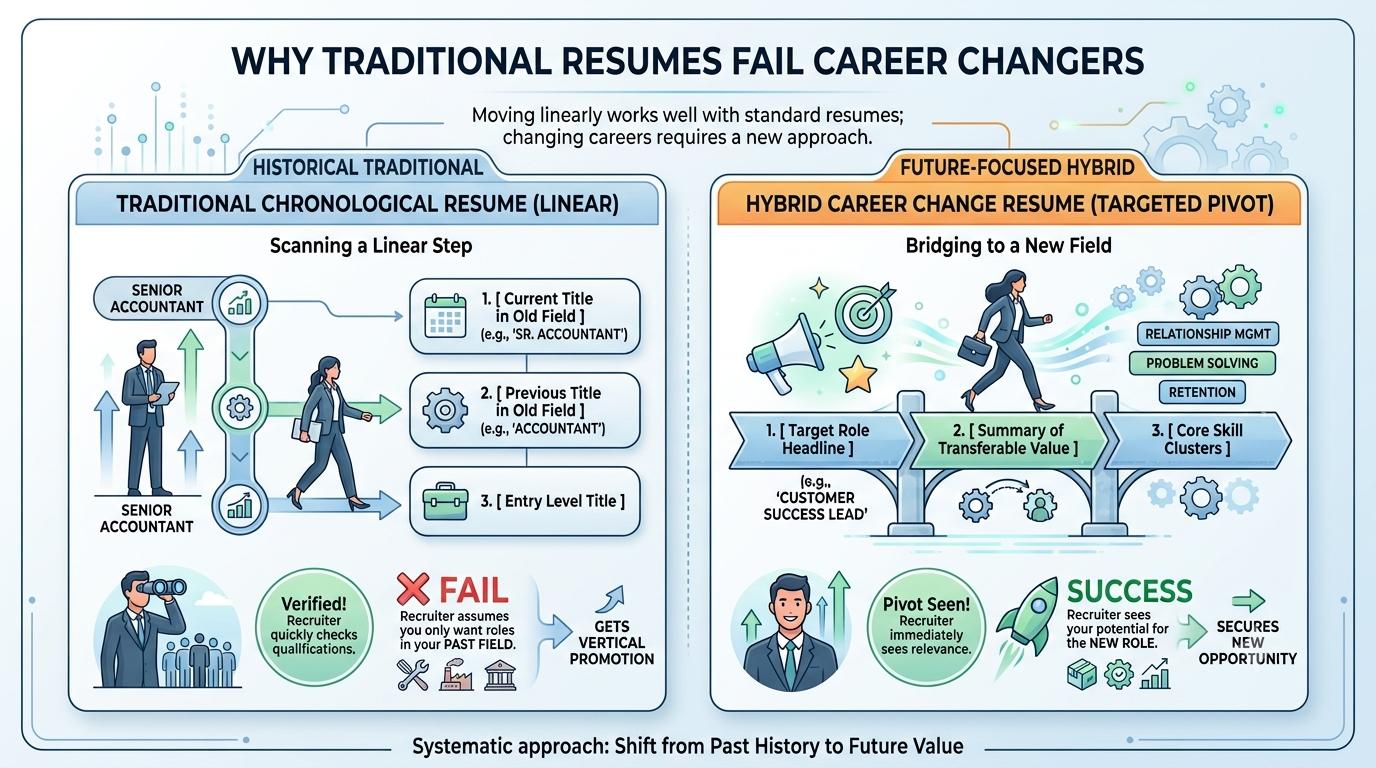
If a recruiter reviewing applications for a Product Manager position opens a traditional resume that leads with High School English Teacher or Restaurant General Manager, they will likely make three split-second assumptions:
- "They applied by mistake." The recruiter assumes you clicked "Easy Apply" without reading the requirements.
- "They lack fundamental skills." The recruiter focuses on your industry-specific tasks (e.g., grading essays, managing kitchen prep) rather than your transferable core competencies (e.g., stakeholder communication, vendor negotiation, process optimization).
- "They will require too much retraining." The recruiter assumes you are starting from zero because your past experience isn't framed in the vocabulary of the target industry.
To pass Applicant Tracking Systems (ATS) and convince hiring managers, your career change resume must re-architect your past experience using the vocabulary, metrics, and priorities of your target role.
The Best Resume Format for a Career Change
Choosing the right structure is the single most important decision when writing a career change resume. If the terminology is new to you, start with our explainer on what a hybrid resume is and when to use it. Resumes generally fall into three structural formats:
Format Type | Structural Focus | ATS Compatibility | Recommended for Career Changers? |
Chronological | Focuses strictly on timeline and job titles in reverse order. | High | No. Emphasizes irrelevant past titles over new target skills. |
Functional | Focuses entirely on skills while hiding dates and company names. | Very Low | No. Heavily penalized by ATS filters and distrusted by recruiters. |
Hybrid (Combination) | Leads with transferable skill clusters followed by chronological work history. | High | Yes (Gold Standard). Highlights relevant strengths while maintaining verifiable employment history. |
Why the Hybrid (Combination) Format Wins
The Hybrid Format provides the best of both worlds:
- The top half of the resume captures immediate attention by showcasing your target-role headline, professional summary, transferable core skills, and key projects.
- The bottom half of the resume satisfies recruiter expectations and ATS software by documenting your chronological employment history, showing career stability and progression.
Anatomy of a Hybrid Career Change Resume
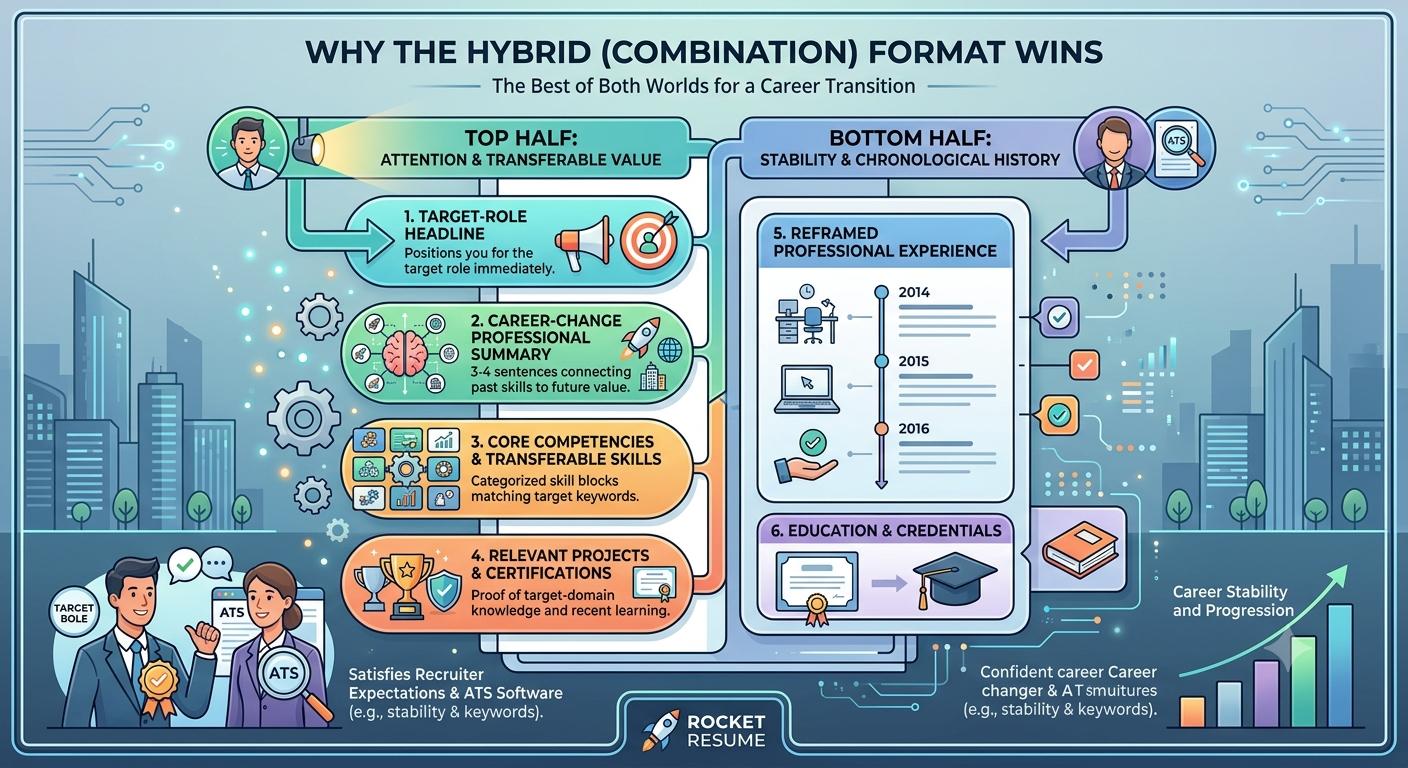
Essential Anatomy of a Career Change Resume
To write a compelling career change resume, you must execute every section with intent — starting with a clear grasp of hard skills and soft skills so you can sort your transferable strengths. Below is a detailed breakdown of how to write each component.
1. Target-Role Headline
Never leave a recruiter guessing what role you are applying for. Place your target job title directly underneath your name at the top of the header.
- Incorrect (Generic Header): JANE DOE | Experienced Professional | jane@email.com
- Correct (Targeted Career-Change Header): JANE DOE | Operations Lead & Process Optimization Specialist | jane@email.com
Pro Tip: If you do not have the exact job title yet, pair your target title with a descriptive core skill, such as Customer Success Manager | Client Onboarding & Retention.
2. Career-Change Professional Summary
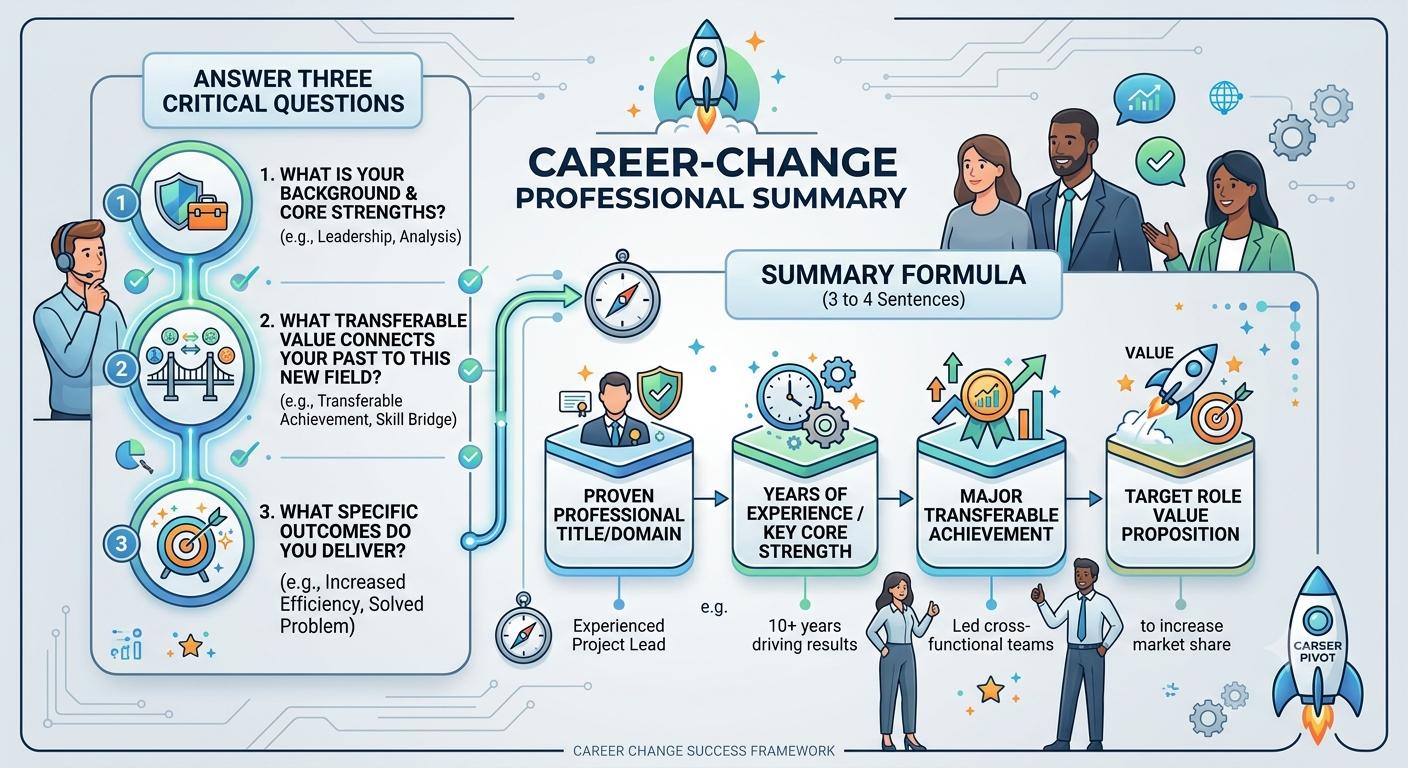
Your professional summary must answer three critical questions in 3 to 4 sentences:
- What is your background, and what core strengths do you bring?
- What transferable value connects your past experience to this new field?
- What specific outcomes do you deliver for the target employer?
Summary Formula:
Example 1: Teacher pivoting to Corporate Instructional Designer
"Results-driven Learning & Development Specialist with 7+ years of experience designing outcome-based curricula, evaluating learner performance, and managing large group dynamics. Leveraged data analytics to improve student engagement by 35% across district programs. Applying expertise in adult learning theories, instructional technology, and rapid content development to build scalable enterprise training solutions."
Example 2: Retail General Manager pivoting to Tech Operations Specialist
"Operations Specialist with 8+ years of experience directing fast-paced business operations, managing $4M+ P&Ls, and optimizing inventory logistics. Reduced operational shrinkage by 22% through automated inventory tracking and workflow redesign. Transitioning extensive process optimization, cross-functional leadership, and vendor management expertise into SaaS operations management."
Example 3: Healthcare Nurse pivoting to Medical Sales / Account Management
"Clinical Specialist and Healthcare Professional with 6+ years of acute care experience managing complex patient outcomes and cross-departmental communications. Recognized for translating complex clinical data into clear action plans for hospital decision-makers. Leveraging deep medical device familiarity, stakeholder management, and clinical credibility to drive client success in medical device account management."
3. Transferable Skills Section
Instead of listing a random bulleted list of soft skills (e.g., "hardworking," "team player"), group your skills into 3 or 4 strategic skill categories that directly match keywords found in your target job descriptions.
Example Skill Grouping for a Project Management Target Role:
- Project Governance & Delivery: Agile/Scrum Methodologies, Scope Management, Project Lifecycle Planning, Risk Mitigation, Resource Allocation.
- Process & Data Analysis: Workflow Automation, KPI Tracking, Process Mapping, Cost Reduction Analysis, Excel/SQL.
- Stakeholder & Team Leadership: Cross-Functional Collaboration, Vendor Management, Executive Presentations, Client Onboarding.
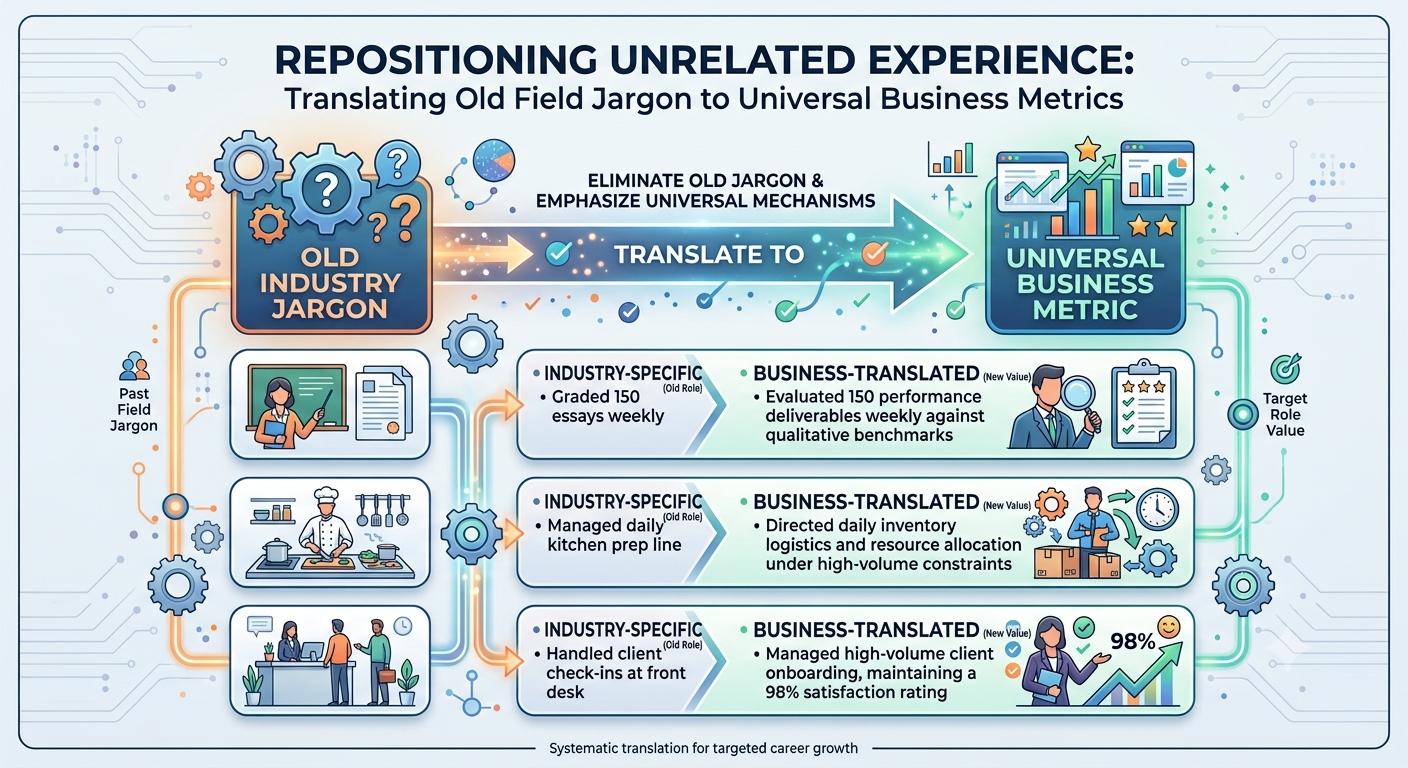
4. Repositioning Unrelated Experience
When writing bullet points under your past employment history, eliminate industry-specific jargon from your old field and emphasize universal business mechanisms:
Certifications
If you lack direct work experience in your target career, your Projects and Certifications sections prove that your knowledge is practical, not just theoretical.
- Certifications: List industry-recognized credentials prominently near the top of your resume (e.g., PMP, Google Data Analytics Professional Certificate, Certified ScrumMaster, Hubspot Content Marketing).
- Portfolio Projects: Include 1 or 2 real-world projects that demonstrate hands-on execution.
Portfolio Project Example:
Customer Churn Analysis Project | Independent Case Study
- Analyzed a public dataset of 5,000+ subscription accounts using Python and SQL to identify key indicators of customer churn.
- Built an interactive Tableau dashboard visualizing retention metrics, identifying a 14% revenue risk area and recommending three proactive onboarding interventions.
Before-and-After Resume Bullets: Skill Translation
The table below illustrates how professionals across various backgrounds can reframe their daily accomplishments to align with new target roles — a landmark resume audit study on callback rates demonstrated just how strongly resume wording alone shifts employer responses:
Current Profession & Target Role | Original Bullet (Old Field Focus) | Reframed Bullet (Target Role Focus) |
K-12 Teacher (Target: Instructional Designer) | Graded homework assignments and created daily lesson plans for 120 10th-grade students. | Designed and deployed outcome-based learning modules for 120+ learners, utilizing assessment analytics to continuously improve engagement and retention by 25%. |
Retail Store Manager (Target: Operations Analyst) | Managed store staff, scheduled shifts, and handled daily register closing and cash deposits. | Directed daily operations for a $3M retail facility, optimizing workforce scheduling and auditing P&L statements to reduce labor budget variances by 12%. |
Hospital Staff Nurse (Target: Healthcare Account Manager) | Administered medications, updated patient EHR records, and communicated with doctors during rounds. | Leveraged clinical domain expertise to manage patient care plans, build consensus among cross-functional medical teams, and ensure 100% compliance with healthcare regulations. |
Corporate Paralegal (Target: Compliance Analyst) | Reviewed legal contracts, organized case files, and conducted legal research for senior partners. | Audited enterprise documentation against federal regulatory frameworks, identifying compliance gaps, assessing risk exposure, and mitigating legal liability across corporate transactions. |
B2C Car Sales Representative (Target: B2B SaaS Account Executive) | Sold new and used vehicles to retail walk-in customers, meeting monthly sales quotas set by dealership. | Executed full-cycle consultative sales strategies, conducting client discovery sessions and pipeline management to achieve 115% of annual revenue targets ($1.2M total volume). |
Real-World Career Change Resume Examples
Below are two full text templates illustrating how a complete hybrid resume looks when transitioning into a new industry.
Example 1: Transitioning from Education to Corporate Learning & Development (L&D)
MARCUS VANCE
Chicago, IL | (555) 019-2834 | marcus.vance@email.com | linkedin.com/in/marcusvance
LEARNING & DEVELOPMENT SPECIALIST
Corporate Training | Instructional Design | Program Evaluation
PROFESSIONAL SUMMARY
Results-driven Learning & Development Specialist with 6+ years of experience designing scalable learning frameworks, facilitating interactive workshops, and evaluating program outcomes. Proven track record of improving learner engagement by 35% through blended learning strategies and technology integration. Translating extensive curriculum development, stakeholder alignment, and assessment analytics into enterprise employee development roles.
CORE COMPETENCIES & SKILLS
• Instructional Design: ADDIE Model, SAM, Blended Learning, Curriculum Development, Microlearning
• Technology & Tools: Articulate Storyline, Camtasia, LMS Administration (Canvas/Cornerstone), Google Suite
• Program Management: Workshop Facilitation, Needs Assessment, KPI Tracking, Learner Feedback Analysis
RELEVANT CERTIFICATIONS & PROJECTS
• Google Project Management Professional Certificate — Coursera (2025)
• Enterprise Onboarding Redesign Project (2026): Designed a 4-module digital onboarding prototype in Articulate Storyline, reducing initial time-to-productivity metrics by an estimated 20%.
PROFESSIONAL EXPERIENCE
LINCOLN PARK ACADEMY — Chicago, IL
Curriculum Lead & Senior Educator | 2020 – Present
• Designed and executed 12+ comprehensive learning programs annually, aligning educational objectives with state performance standards for 150+ participants per cycle.
• Administered LMS platform, digitizing 100% of course materials and training 15 team members on virtual instruction software.
• Analyzed quarterly performance data to identify learning gaps, iterating course content to increase overall mastery scores by 22%.
• Facilitated professional development workshops for 40+ faculty members on instructional technology adoption and modern learner engagement strategies.
OAK RIDGE COMMUNITY CENTER — Chicago, IL
Educational Program Coordinator | 2018 – 2020
• Managed end-to-end logistics, scheduling, and content delivery for adult education and community skill-building initiatives.
• Conducted needs analysis surveys across 200+ participants to identify high-demand skill areas and customize course offerings accordingly.
EDUCATION
Bachelor of Arts in English & Education | University of Illinois, Chicago, IL
Example 2: Transitioning from Hospitality Management to Tech Operations Specialist
ELENA ROSTOVA
Austin, TX | (555) 012-9876 | elena.rostova@email.com | linkedin.com/in/elenarostova
OPERATIONS SPECIALIST
Process Optimization | Vendor Management | Logistics & Resource Planning
PROFESSIONAL SUMMARY
Operations Specialist with 7+ years of experience managing complex daily operations, cross-functional teams, and multi-million dollar operating budgets in fast-paced environments. Expert in identifying operational bottlenecks, automating inventory workflows, and negotiating vendor contracts to increase profit margins. Applying proven expertise in resource allocation, data-driven planning, and process improvement to tech-sector operations management.
CORE COMPETENCIES
• Operational Strategy: Process Mapping, SLA Management, Workflow Automation, Risk Assessment
• Financial & Vendor Management: Budget Management ($2.5M+ P&L), Contract Negotiation, Cost Reduction
• Software & Systems: Excel (Advanced VLOOKUPs/Pivot Tables), Asana, Tableau, SQL (Basic), Jira
RELEVANT CERTIFICATIONS
• Certified Associate in Project Management (CAPM) — Project Management Institute (2025)
PROFESSIONAL EXPERIENCE
THE HARBOR RESTAURANT GROUP — Austin, TX
General Manager of Operations | 2021 – Present
• Managed daily business operations, financial performance ($3.2M annual revenue), and 35+ personnel across multiple shifts.
• Redesigned supply chain and inventory procurement processes, cutting food waste by 18% and saving $45K annually.
• Implemented a digital scheduling and labor-tracking platform, reducing weekly administrative overhead by 10 hours and eliminating overtime overages.
• Audited operational KPIs weekly, analyzing sales velocity and supply costs to adjust resource distribution dynamically.
AUSTIN BISTRO & LOUNGE — Austin, TX
Assistant Operations Manager | 2019 – 2021
• Supervised vendor deliveries, negotiated procurement contracts with 12 local suppliers, and maintained 100% compliance with health and safety standards.
• Onboarded and trained 25+ new team members using a standardized operating procedure (SOP) manual developed from scratch.
EDUCATION
Bachelor of Science in Business Administration | University of Texas at Austin
Repositioning Experience & Overcoming "Lack of Direct Experience"
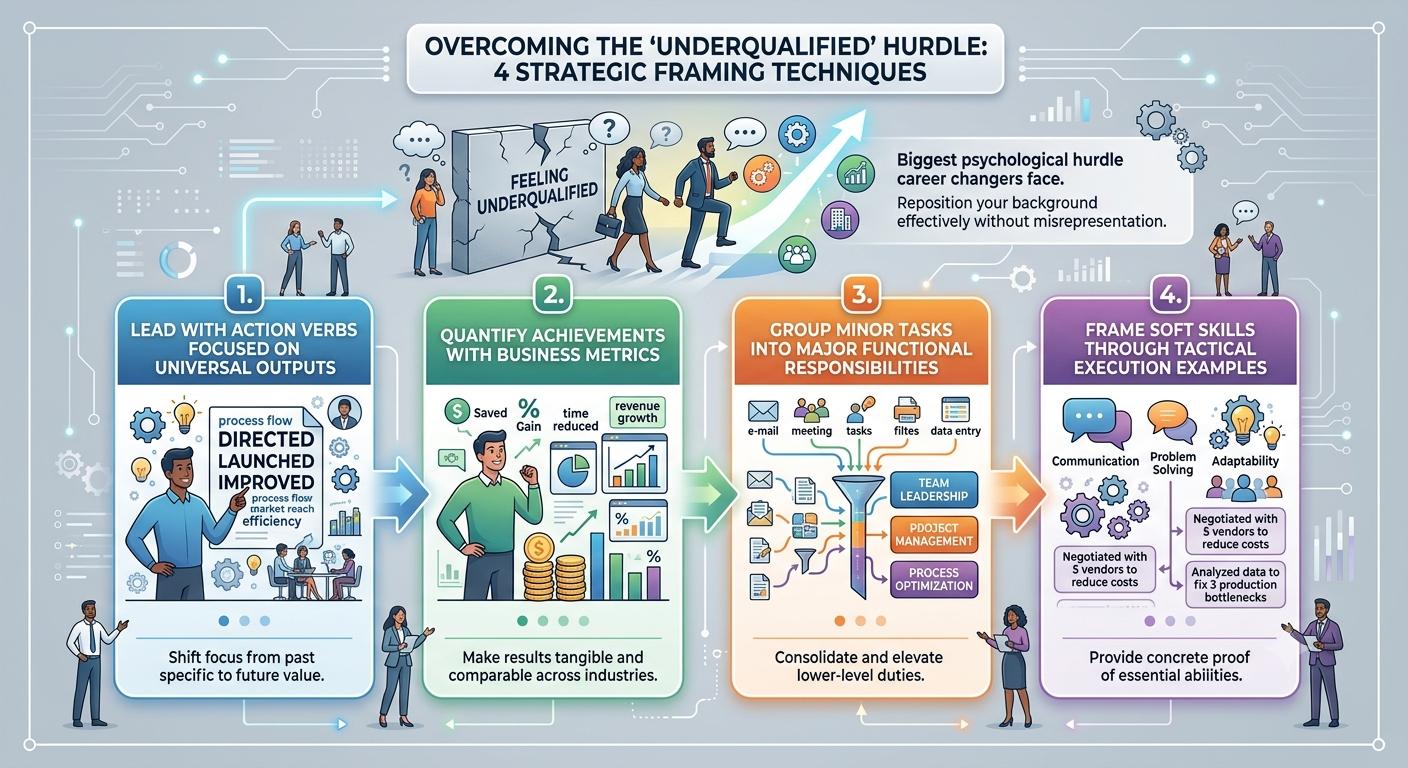
The biggest psychological hurdle career changers face is feeling underqualified. To reposition your background effectively without misrepresenting your history, apply these four framing techniques:
1. High-Impact Action Verbs for Career Pivots
Replace generic operational verbs (like "helped," "worked on," "was responsible for") with powerful strategic verbs that resonate across industries:
- For Process & Operations: Optimized, Streamlined, Automated, Restructured, Standardized, Audited, Redesigned.
- For Leadership & Project Management: Directed, Spearheaded, Orchestrated, Facilitated, Coordinated, Mobilized, Aligned.
- For Strategy & Analysis: Evaluated, Benchmarked, Forecasted, Formulated, Diagnosed, Quantified, Modeled.
2. Quantify Everything
Numbers are universal. A hiring manager in software operations might not understand high school grading scales, but they immediately understand:
- Efficiency Gains: "Reduced process completion time by 25%."
- Budget Accountability: "Managed a $150K annual departmental operating budget."
- Scale & Volume: "Onboarded and trained 45 personnel across 3 regional teams."
- Satisfaction & Engagement: "Maintained a 96% positive rating across quarterly customer surveys."
Why Career Changers Need Multiple Targeted Resumes
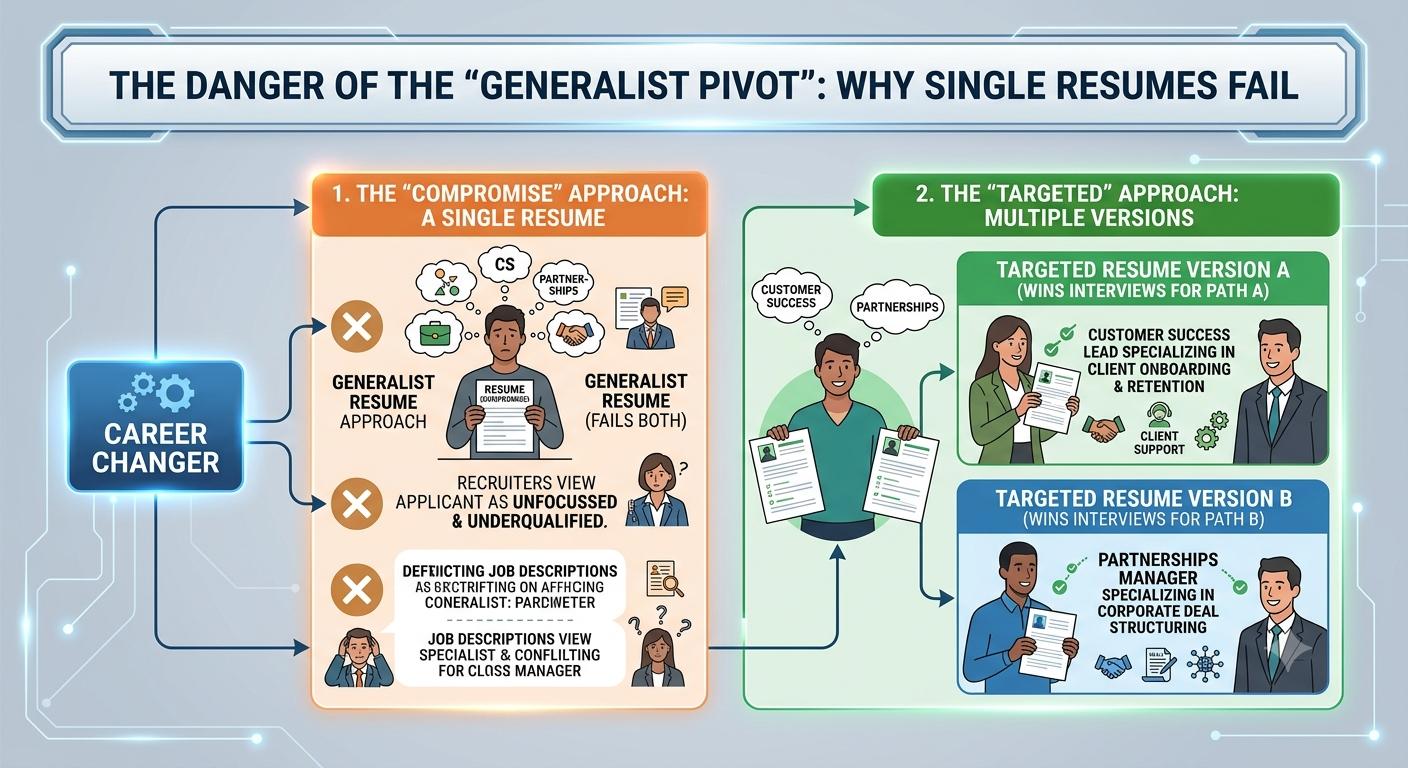
If you are exploring more than one career path, using a single generic resume is the single fastest way to get rejected.
The Danger of the "Generalist Pivot"
Suppose you are transitioning out of Corporate Sales and exploring two potential paths:
- Target Path A: Customer Success Lead (Emphasizes retention, onboarding, client advocacy)
- Target Path B: Corporate Partnerships Manager (Emphasizes deal structuring, prospecting, contract negotiation)
If you create a single "compromise" resume that attempts to cover both paths simultaneously, it will sound unfocused to recruiters in both fields:
How Rocket Resume Solves the Multi-Resume Challenge
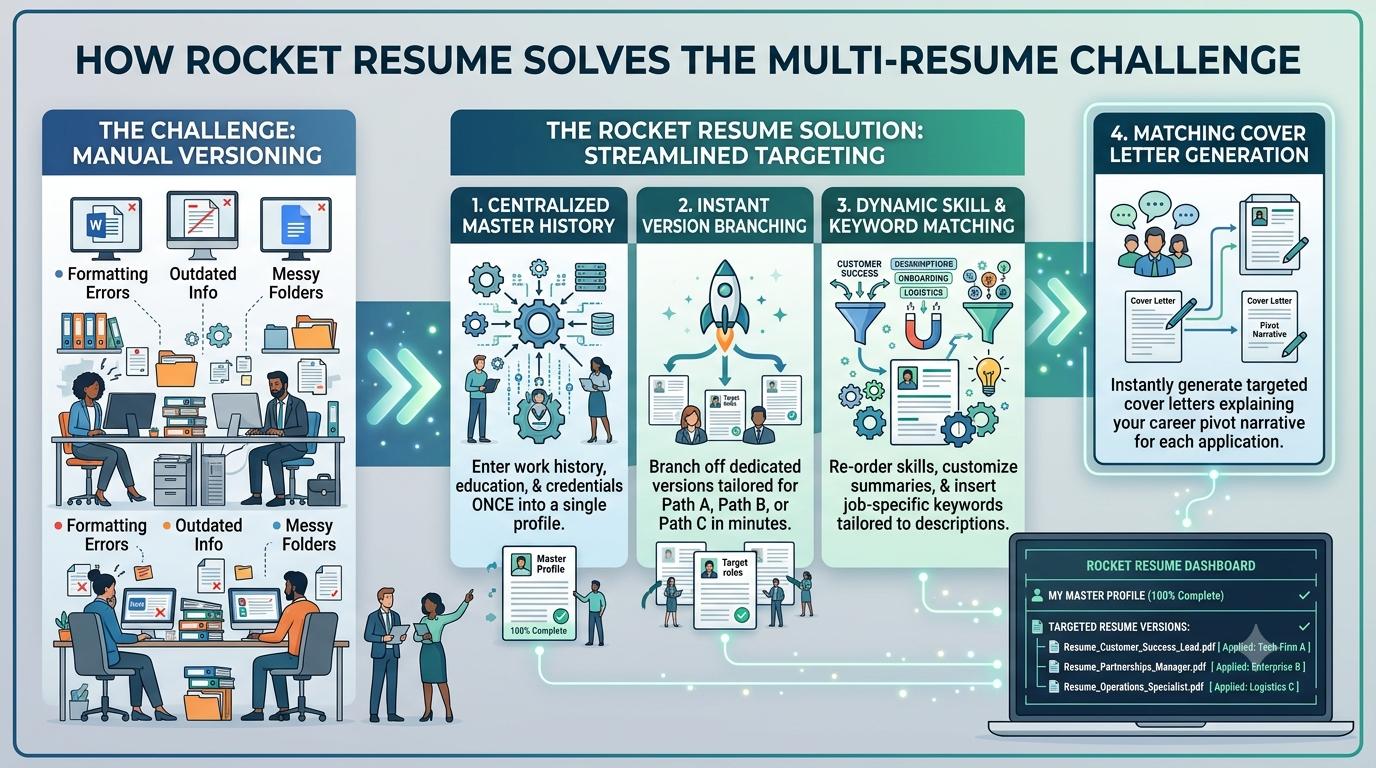
Creating multiple targeted resume versions manually in Word or Google Docs often leads to formatting errors, messy desktop folders, and outdated information across files.
Rocket Resume is built specifically to streamline the multi-version resume process for career changers:
- Centralized Master History: Enter your work history, education, and credentials once into a single master profile.
- Instant Version Branching: Branch off dedicated, pre-formatted resume versions tailored specifically for Path A, Path B, or Path C in minutes.
- Dynamic Skill & Keyword Matching: Re-order skills, customize professional summaries, and insert job-specific keywords tailored to each target job description.
- Matching Cover Letter Generation: Instantly generate targeted cover letters explaining your career pivot narrative for each specific application.
- Organized Asset Library: Keep all resume versions and cover letters clearly labeled, formatted, and accessible in your personal dashboard.
Learn how these 10 essential toolscan streamline your career change journey.
7 Costly Career Change Resume Mistakes to Avoid
Avoid these seven common traps that lead to automatic rejection by recruiters and ATS filters, and pair the fixes with resume layouts that get past ATS so your document's structure works in your favor:
1. Apologizing for Your Lack of Direct Experience
Never use weak, defensive phrases in your summary like "Looking for an entry-level opportunity to learn" or "While I lack direct industry experience..." Focus entirely on the valuable skills and perspectives you do bring.
2. Leaving Unconverted Old-Industry Jargon
If an external recruiter needs a dictionary or industry cheat-sheet to understand your bullet points, your resume will be set aside. Translate all internal codes, military acronyms, or industry jargon into plain business language — the ONET occupational database is the standard source for the vocabulary your target role actually uses.
3. Using a Pure Functional Resume
Pure functional resumes (which hide company names and employment dates completely) raise immediate red flags for recruiters. Modern ATS software is explicitly programmed to parse reverse-chronological work histories; functional resumes often fail ATS parsing entirely. Stick to the Hybrid (Combination) Format.
4. Hiding Your Previous Job Titles
Do not alter your official past job titles to fake experience (e.g., changing your title from "High School Teacher" to "Corporate Trainer" on your history line). This can cause you to fail background checks later. Instead, use your Target-Role Headline at the top of the resume to clarify your new direction, while keeping past official titles accurate.
5. Ignoring ATS Keyword Requirements
Over 90% of Fortune 500 companies use Applicant Tracking Systems to screen resumes before a human recruiter sees them. Paste your target job description into a text analyzer, identify recurring hard skills and technical requirements, and weave those exact terms into your resume summary and core skills sections.
6. Omitting Proof-of-Work Links
If you list portfolio projects, online certifications, or personal case studies on your resume, include hyperlinks to view them live (e.g., GitHub, Tableau Public, Medium, or a personal portfolio website). Proving your skill via visible work output eliminates employer hesitation.
7. Sending One Generic Resume to Every Target Path
Sending an untargeted resume to multiple career fields yields low response rates. Customize your summary, headline, and top bullet points for every distinct job title you pursue.
Frequently Asked Questions
What is the best resume format for a career change?
The Hybrid (Combination) Format is the best format for a career change. It leads with a target headline, professional summary, transferable skills, and relevant projects at the top, while maintaining a chronological employment history on the lower half to satisfy recruiters and pass ATS software.
How do I write a career change summary with no direct experience?
Focus your summary on your transferable core competencies, major achievements from your past career, relevant certifications, and how your unique perspective solves problems for the target employer. Use the formula: [Proven Background] + [Transferable Core Strength] + [Relevant Credentials/Projects] + [Value Offered to Target Role].
Should I list my old job titles on a career change resume?
Yes. Keep your official job titles accurate in your chronological work history to ensure you pass background checks. However, use a Target-Role Headline at the top of your resume (e.g., JOHN DOE | Operations Lead) so recruiters immediately understand the role you are targeting.
How far back should a career change resume go?
A career change resume should generally cover the last 10 to 15 years of work history. Focus most of your bullet space on recent roles where you developed transferable leadership, project management, or analytical skills, while keeping older, non-relevant roles brief.
How do I pass ATS filters as a career changer?
To pass ATS filters, use a hybrid format with standard headings (e.g., "Professional Experience," "Skills," "Education"), incorporate exact keywords from the target job posting into your summary and skills sections, and avoid using images, text boxes, or complex tables in your final document.
Is a functional resume better than a hybrid resume?
No. Pure functional resumes hide work dates and employment history, which causes recruiters to suspect you are hiding employment gaps. Furthermore, modern ATS software often fails to parse functional resumes correctly. The hybrid format is vastly superior.
Should I include a cover letter with a career change resume?
Yes. A cover letter gives you the space to explain the narrative behind your career pivot, articulate why you are making the transition, and connect your past achievements directly to the employer's current needs.
Ready to Build Your Career Change Resume?
Start with your existing experience, create a tailored résumé for every career path you are considering, and keep every version organized in your Rocket Resume library.
Build your resume with our free resume builder
Pick a template, then build a resume one section at a time.