3 Resume Layouts That Get You Past ATS in 2026
Which resume layouts survive LLM-powered ATS screening in 2026, the single-column structure parsers read correctly, and the tables, icons, and fonts that get applications auto-rejected.

Navigating the Modern Job Market: Mastering the AI-Driven Resume in 2026
Resumes remain the critical gateway documents that get you through a company’s digital front door, allowing you to land an interview and, ultimately, secure a job.
However, many applicants still fail to format and write their resumes correctly, often prioritizing aesthetics that look "nice" to the human eye over layouts and structures that function properly under algorithmic scrutiny. In 2026, the stakes are higher than ever. Even if you possess the most eye-catching resume, it will never make it to a recruiter or hiring manager’s screen if it is rejected by the advanced AI models running behind the scenes. For job seekers today, a resume must be built for dual citizenship: it must seamlessly satisfy automated intelligence while remaining compelling to human decision-makers.
Why Do I Still Need a Resume in 2026?
In 2026, your resume serves as a structured data anchor in an increasingly automated hiring ecosystem. While generative AI can instantly summarize your professional existence, human hiring managers still rely on the traditional resume or CV as a definitive, standardized source of truth to judge whether you are a strong cultural and technical fit. A resume offers a concise, easily accessible roadmap of your career progression that human eyes can scan in seconds during the final rounds of interviews. However, reaching that human stage only happens if your document successfully navigates the complex software guarding the entry point.
The job application landscape has transformed significantly over the last few years. With the ubiquity of AI-assisted job application bots that allow candidates to apply to hundreds of roles simultaneously, corporations are facing an unprecedented deluge of applicants. To cope with this volume, modern recruitment relies entirely on Next-Generation Applicant Tracking Systems (ATS) embedded with Large Language Models (LLMs). Every job board and corporate portal requires you to upload a resume because these AI screeners do not just read your information—they parse it, contextualize it, and grade it against thousands of peers.
- Why: AI-driven platforms use your resume as a standardized training dataset to evaluate your real-world readiness, competencies, and career trajectory against highly specific role models. Without a structured resume, the AI cannot accurately map your skills to the vacancy.
- How: You must treat your resume as a machine-readable data file. Ensure it features clean text categorization, chronological clarity, and contextual phrasing that an LLM can effortlessly analyze, categorize, and rank.
- Example: Instead of just listing passive duties like "Responsible for project management," write a context-rich, machine-optimizable sentence: "Led cross-functional engineering teams using Agile methodologies to deploy an AI-driven logistics platform, reducing operational latency by 22%."
- Key Takeaway: Resumes are more critical than ever in 2026 to act as a structured source of truth for AI-powered screeners; if your document cannot be accurately parsed by an LLM, your application will be instantly filtered out by the system.
Can I Use Any Resume Format I Like?
When selecting a resume format, you must strictly distinguish between what you personally find visually appealing and what will actually pass an AI-driven ATS scan. Job seekers frequently fall into the trap of wanting to stand out by using overly intricate, highly stylized pre-made templates. They choose layouts packed with complex tables, multi-column grids, graphic headers, and sidebars. While these documents may look impressive to a graphic designer, they are an algorithmic nightmare. Modern LLM parsers read text sequentially; complex columns and text boxes fracture the reading order, causing the AI to scramble your experience and misinterpret your career history.
The hiring process is bifurcated based on company size, but automation is the dominant force. If you are applying to a micro-business or a hyper-local storefront, you might still get away with emailing a styled PDF directly or dropping off a physical copy. However, mid-sized businesses, enterprise corporations, and global agencies rely entirely on advanced talent acquisition software to handle the immense volume of candidate data. While AI parsers have become smarter at understanding intent, they are still bound by formatting rules. A non-traditional layout introduces unnecessary risks of corrupted data ingestion, leading the system to score your application poorly.
- Why: Complex layouts slice text into fragmented zones, causing the parsing software to read your resume out of order (e.g., mixing your 2024 job description with your 2021 job title), destroying your chronological relevance.
- How: Use a clean, single-column, top-to-bottom layout. Rely on standard markdown-style structural hierarchies—such as clear, text-based headers for sections like "Professional Experience," "Education," and "Skills"—to guide the algorithm naturally.
- Example: Avoid a two-column template where your skills are in a left-hand sidebar parallel to your work history. Instead, use a linear layout where the "Skills" section sits cleanly below your professional summary or at the very bottom of the document.
- Key Takeaway: Creative, multi-column, or graphic-heavy layouts frequently break the sequential reading pattern of AI screeners; stick to strict, single-column, traditional structures to guarantee flawless parsing.
What Resume Layouts Should I Avoid?
To maximize your chances of surviving the automated screening phase, you must proactively eliminate design elements that cause algorithmic friction. The contemporary AI screener looks for clean data streams. When you introduce decorative elements, you introduce digital noise that can corrupt the text extraction process. By avoiding highly documented structural pitfalls, you insulate your resume against automatic system rejection. If you are weighing whether a two-column resume ever makes sense, the safe answer for most applications is to stay single-column.
In 2026, the list of formatting elements to avoid is definitive:
- Don’t use tables, charts, matrices, or graphs: Text embedded inside tables or visual infographics is frequently invisible to basic parsers or misread by AI.
- Avoid fancy, non-standard, or unusual fonts: Stick strictly to universally recognized, web-safe typography such as Calibri, Cambria, Arial, or Helvetica.
- Avoid unnecessary animations, symbols, icons, and embedded graphics: Images cannot be read by text parsers and waste valuable document space.
- Don’t use unauthorized abbreviations or misspell primary keywords: AI models match semantic concepts; a typo in a core skill means you don't possess that skill according to the machine.
- Mind the spacing between words: Micro-spacing tricks or text justification errors can fuse words together (e.g., "ProjectManager"), rendering them unrecognizable to keyword searches.
- Use both long-form and short-form versions of keywords: Modern AI looks for both variations to establish absolute context (e.g., write out both "Search Engine Optimization" and "SEO").
- Only use standard bullet points: Avoid custom icons, checkboxes, graphics, or stars, which can translate into unreadable junk characters (like "") in the parsed text file.
Adhering to a traditional, minimalist aesthetic ensures that the underlying code of your document is pristine, allowing the ATS to focus entirely on the quality of your credentials.
- Why: Decorative elements, non-standard symbols, and complex typography distort the raw text stream of your document, causing semantic mapping models to misinterpret or overlook your core qualifications.
- How: Strip away all icons, bars, and creative dividers. Format your text using standard bullet points and a single, consistent, highly legible font family across the entire document.
- Example: Instead of displaying your proficiency in Python with a visual 4 out of 5-star graphic, write out the text explicitly: "Technical Skills: Python (Advanced), SQL (Intermediate), Data Analysis."
- Key Takeaway: Eliminating visual fluff like tables, non-standard fonts, and graphic skill bars prevents processing corruption, making it easy for the AI to correctly extract your professional data.
How Can I Properly Format my Resume?
Properly formatting a resume requires a deliberate balance between machine compatibility and clean human readability. You can choose to build a compliant document from scratch, or you can drastically accelerate your job search by using highly optimized software. To save time and ensure absolute technical compliance, you can start a template with Rocket Resume. A perfectly formatted, modern resume centers on structural simplicity: highly visible and parsed contact details, crisp and intentional layout lines, standard formatting bullets, and a clean typography hierarchy. Labeling each part of your document with the resume section headers ATS systems expect helps the parser map your information correctly.
Whether you build it yourself or use an established tool, the absolute rule of 2026 is to avoid "flair" or hidden formatting tricks. Some job seekers attempt to hide keywords in white text or use complex CSS layering in their PDFs. Modern ATS engines easily detect these deceptive formatting tactics and will blackball the applicant for system manipulation. Trust the integrity of your actual experience and present it within an unembellished, highly structured template that lets your achievements speak clearly to the screening algorithms.
- Why: Modern ATS platforms are incredibly rigid regarding how data fields are mapped; utilizing a certified, professionally engineered template removes the risk of technical glitches.
- How: Deploy a verified template from an established platform, ensure your contact info is written in plain text, use clear bolding for structural headers, and export the file into a universally accepted format.
- Example: Use a dedicated template engine to generate a clean
.docxor standard PDF file that features distinct, un-nested headers like Work Experience followed immediately by chronologically stacked roles. - Key Takeaway: Utilizing clean, unembellished, structurally sound templates from platforms like Rocket Resume protects your hard work from being sabotaged by picky ATS data constraints.
Does the Content of My Resume Matter?
The content of your resume matters immensely—it is the ultimate decider of your competitive ranking. While formatting ensures your resume survives the initial system ingest, your actual content dictates whether the AI rates you as a top-tier candidate or pushes you to the bottom of the pile. In 2026, corporate recruiters do not manually read hundreds of resumes; they query their ATS using specific semantic prompts to surface the top 5% of candidates. The AI evaluates how closely your skills, metrics, and experience align with the core demands of the job description.
To succeed, you must radically customize your resume's content for every single role you pursue. Modern AI screeners are highly sophisticated contextual engines; they no longer just look for basic keyword counts. They analyze semantic intent, meaning they understand the context surrounding your achievements. If your resume contains generic text that fails to reflect the modern requirements of your industry, the software will rank you behind candidates who tailored their copy perfectly. Even structural choices like how many bullet points to use per job shape how the AI weighs your accomplishments.
Before uploading your document to a modern ATS, implement these strategic content enhancements:
- Analyze the job description thoroughly: Identify the core technical competencies and soft skills required, and integrate those exact phrases naturally into your career descriptions.
- Place contact details clearly outside of headers/footers: Some legacy and mid-tier software programs still drop data contained within deep header and footer zones; keep your phone number, email, and LinkedIn URL in the main body text at the top.
- Stick to clean, readable file formats: Never upload your resume as an image file (like a
.jpgor.png), which cannot be read by basic text parsers. Always use a clean.docxor standard, non-scanned PDF. - Avoid hyper-spamming applications: Do not apply to dozens of disparate roles within the same organization simultaneously. Modern enterprise systems track your application history and flags erratic behavior as a lack of focus.
- Be honest and target qualified positions: Only apply to roles where you meet the baseline requirements, and use precise industry terminology to define your expertise.
- Conduct strict quality checks: Triple-check for minor spelling mistakes, double spaces, or missing punctuation, as punctuation errors can accidentally concatenate words and blind keyword indexers.
- Use an explicit ATS-friendly framework: Ensure your writing focuses on action-oriented, quantifiable results.
Never try to "game" the system by copy-pasting the entire job description in invisible white font at the bottom of your page. Modern LLM-based screeners instantly extract all text regardless of color, exposing the manipulation to the recruiter and resulting in an immediate corporate ban. Focus instead on honest, high-impact semantic optimization.
- Why: Modern recruitment software relies on contextual AI ranking algorithms; your content must match the precise semantic expectations of the job posting to achieve a competitive score.
- How: Closely cross-reference your resume against target job postings. Replace generic phrasing with explicit, measurable metrics and direct industry terminology that mirror the employer's needs.
- Example: Instead of stating "Handled customer service issues successfully," write: "Managed high-volume customer escalations using Zendesk, maintaining a 96% Customer Satisfaction (CSAT) score against a 90% team benchmark."
- Key Takeaway: Your resume content must be contextually rich, metrics-driven, and highly tailored to the specific keywords of the target job description to achieve a high algorithmic ranking.
What Are the Best 3 Resume Layouts?
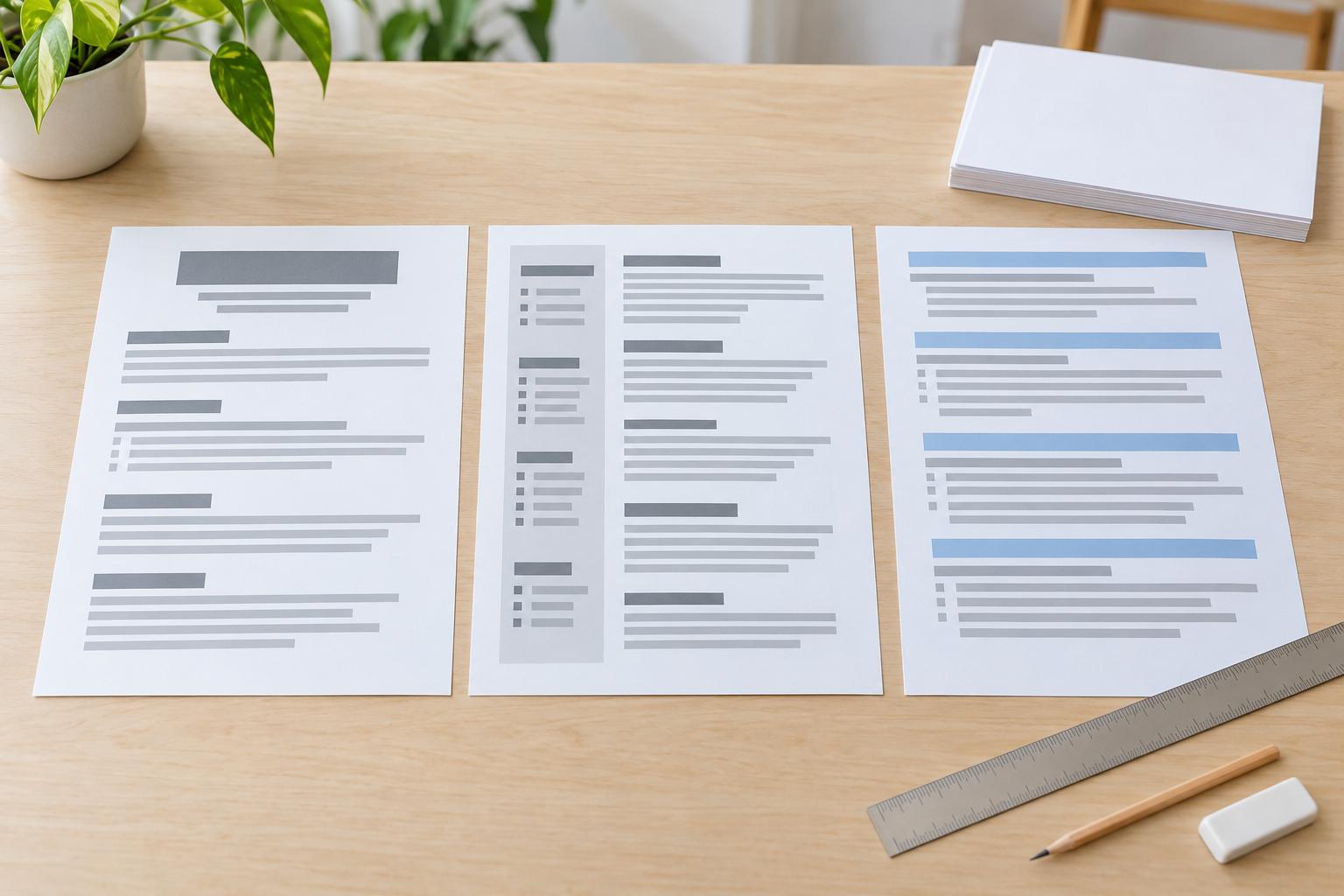
When selecting a structure that guarantees both maximum AI deliverability and premium visual appeal for human hiring managers, three primary layouts stand the test of time. Proven examples of layouts optimized for the 2026 job market include the Focal Point, Elegant, and Classic templates.
Focal Point: True to its name, the Focal Point Resume layout keeps your professional summary and core competencies at the absolute center of the reader's attention. Characterized by a clean, minimalist design, it removes unnecessary visual noise, ensuring that an AI engine can parse every text line sequentially without systemic friction. Headlines and core skills are presented in a larger font size, creating a natural reading hierarchy that emphasizes your highest-impact achievements and data points.
Elegant: This template balances professional style with clinical, machine-readable formatting, creating a polished, sophisticated document that stands out cleanly in a stack. It features a beautifully segmented, linear design that looks highly professional without breaking into dangerous multi-column territories. The Elegant layout highlights your name cleanly, positioning your contact data logically to ensure that screening software seamlessly indexes your contact details, phone number, and professional links without a hitch.
Classic: The Classic resume layout remains an industry gold standard, consistently ranking as one of the most reliable and highly converted formats globally. It uses a time-tested, traditional chronological layout that highlights your executive summary at the absolute top, flowing seamlessly down through your technical skills, work history, and educational background. Because of its predictable, standardized architecture, it is virtually impossible for an AI parser to misread a Classic template.
Regardless of your industry or career level, utilizing an authorized layout ensures full technical compatibility with modern ATS frameworks. By picking a proven structure and focusing entirely on high-quality content optimization, you can generate a beautifully compliant, high-ranking professional document in minutes.
- Why: These specific layouts are engineered around a linear, single-column framework that perfectly matches the sequential text-reading behavior of modern LLM and ATS parsers.
- How: Select one of these validated formats based on your industry norm, use chronological ordering for your work experience, and allow the system to handle the backend code generation.
- Example: A mid-career Software Engineer should deploy the Classic template to cleanly present a dense timeline of tech stacks and projects, while a Marketing Executive might use the Focal Point template to draw instant attention to their revenue metrics.
- Key Takeaway: Choosing verified, single-column frameworks like the Focal Point, Elegant, or Classic templates guarantees absolute ATS compliance while maintaining an elite presentation for human reviewers.
Conclusion
In 2026, the job market is deeply governed by advanced AI, machine learning parsers, and sophisticated automated tracking systems. For job seekers, trying to bypass or fight this technology is a losing battle; instead, success requires learning how to work smoothly alongside it. Standing out in a crowded job market requires a resume that addresses both audiences: clean, linear, unembellished formatting that flows flawlessly through automated systems, paired with highly customized, metrics-driven content that proves your value to a human hiring manager. By avoiding complex design traps, selecting verified frameworks like those offered by Rocket Resume, and strategically tailoring your keywords to match the role, you can confidently beat the algorithms and secure the face-to-face interviews you deserve.
Where Can I Find the Best Resume Layouts?
Rocket Resume’s templates and layouts remove the guesswork of building a resume and passing an ATS without problems. Instead of worrying about whether the formatting works or whether the embellishments limit your visibility chances, all you need is our intuitive guide. You choose the template and layout you like, answer a few questions to get started, and you’ll have a solid resume ready in minutes.
Rocket Resume layouts are high-quality, easy to read and take much less to create than starting from scratch. You have all the tools you need to build your resume in minutes without hassle.
Are you ready to create a resume layout that passes through ATS without issues?
Start your resume today with Rocket Resume and receive a discount when you sign up for the first time.
Build your resume with our resume builder
Tell us how much experience you have, pick a template, then build a resume one section at a time.