Chemical Engineering resume examples for process and plant roles
Whether you are a process engineer, a plant engineer or a co-op student, name the unit operation, the problem you worked on and the data, model or test behind your recommendation.
- Resume examples for 4 chemical engineering jobs
- Professional resume templates
- Easy editing as you go

How to write a chemical engineering resume
Chemical engineering experience is easier for a hiring manager to judge when it is tied to a process problem. Explain the product or operation, your engineering task and the evidence behind your recommendation or deliverable. Your strongest material may come from plant work, a co-op or internship, or a senior design project. Make the setting clear so an employer can see exactly what you handled and what the wider team did. Chemical engineers design processes, test production performance and troubleshoot manufacturing problems, as the Bureau of Labor Statistics occupational profile describes.
Plant and process hiring managers lose the thread when:
- The process or product behind your engineering work is missing.
- Calculations and tools are disconnected from a decision or deliverable.
- A design project appears without its academic or supervised setting.
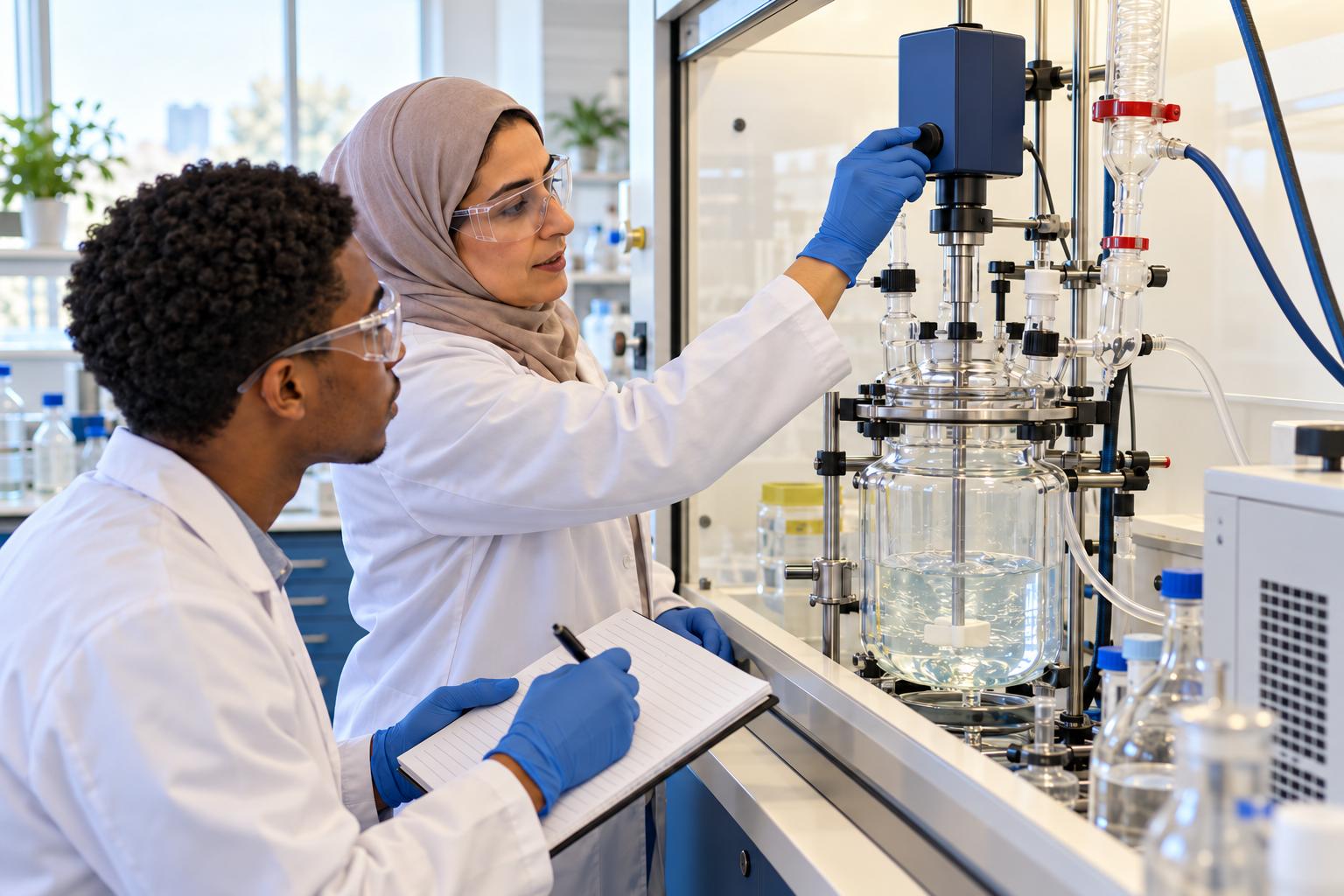
Name the process problem
Introduce the process or product you worked on, then explain the problem you helped solve. Design, troubleshooting, scale-up and day-to-day plant support carry different responsibilities, so state your part plainly. Our process and plant engineering resume examples show how others frame this, and the chemical engineering job titles help you aim at the right role.
Build My Chemical Engineering ResumeEnter each co-op, plant job and major project in the builder's work history. Then edit the suggestions so they name the unit operation, the analysis and the deliverable, keeping technical claims to ones you could defend in an interview.
Connect analysis to an engineering decision
Tie calculations, simulation tools and lab methods to an engineering decision or deliverable. Describe the data you analyzed, the change you evaluated and the result. Include a performance gain when you can back it up. The suggestions for process engineering work offer examples you can adapt to your own projects.
One way a process engineer might put it:
“Ran a heat balance on the reactor cooling loop and traced a recurring temperature swing to a fouled exchanger flagged for the next shutdown.”
Build My Chemical Engineering ResumeAn analysis means more when an employer can see the process behind it. In the builder, add the question, method and deliverable to the matching project or job, so the technical work ties to a responsibility you can explain.
Label co-op and design project work
Co-ops, internships, senior design and lab investigations are solid material for an entry-level engineer. Say which each one was and explain your own share of the work. List process safety training you've completed, not training you plan to take. The articles on engineering careers have more on presenting early experience.
A senior design project still shows engineering practice if you label it as coursework. In the builder, record the academic setting and explain the calculations, testing or design work you did, separating your part from the team report as a whole.
Balance technical skills with project context
A chemical engineering resume has three parts worth keeping apart: jobs, projects and technical skills. Trim software and methods to the ones this job description mentions, and give your strongest project enough room to explain what you did. Templates with room for projects and software skills keep the three separate. If energy or pharmaceutical plants interest you too, see the related industries.
Build My Chemical Engineering ResumeHold the target job description next to the builder's live preview. Give the most relevant project room to explain its purpose, and move software, methods and completed training to their own sections.
How Rocket Resume helps
With Rocket Resume, you can shape process engineering experience like this:
- Name the process. Identify the product, process stage or plant setting alongside your engineering responsibility in the experience section.
- Tie analysis to a decision. Build on a relevant suggestion by naming the calculation or tool and the design choice or report it informed.
- Say where projects happened. Describe coursework, co-ops and supervised design projects as what they were, using project or education sections to show their setting.
A practical order for an engineering resume:
- Choose a template. Pick a template that keeps projects and software skills in separate sections.
- Add plant and co-op jobs. Add plant, co-op and engineering jobs in the work history step.
- Pick engineering skills. Pick skill suggestions that match your calculations, simulations and test work.
- Lead with your process work. Open with the processes, plants or products you know and the engineering role you are aiming for.
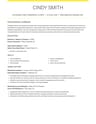
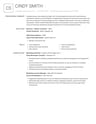
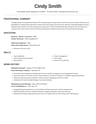
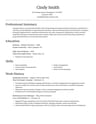
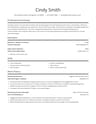
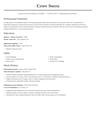
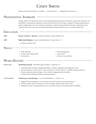
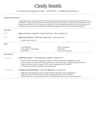
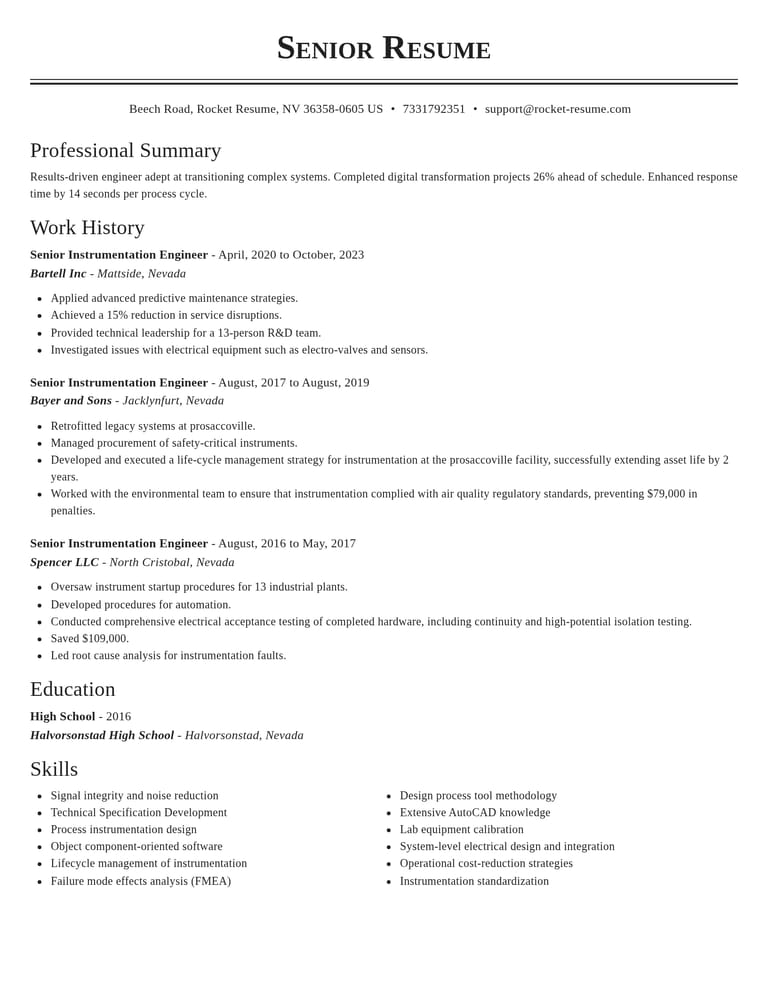
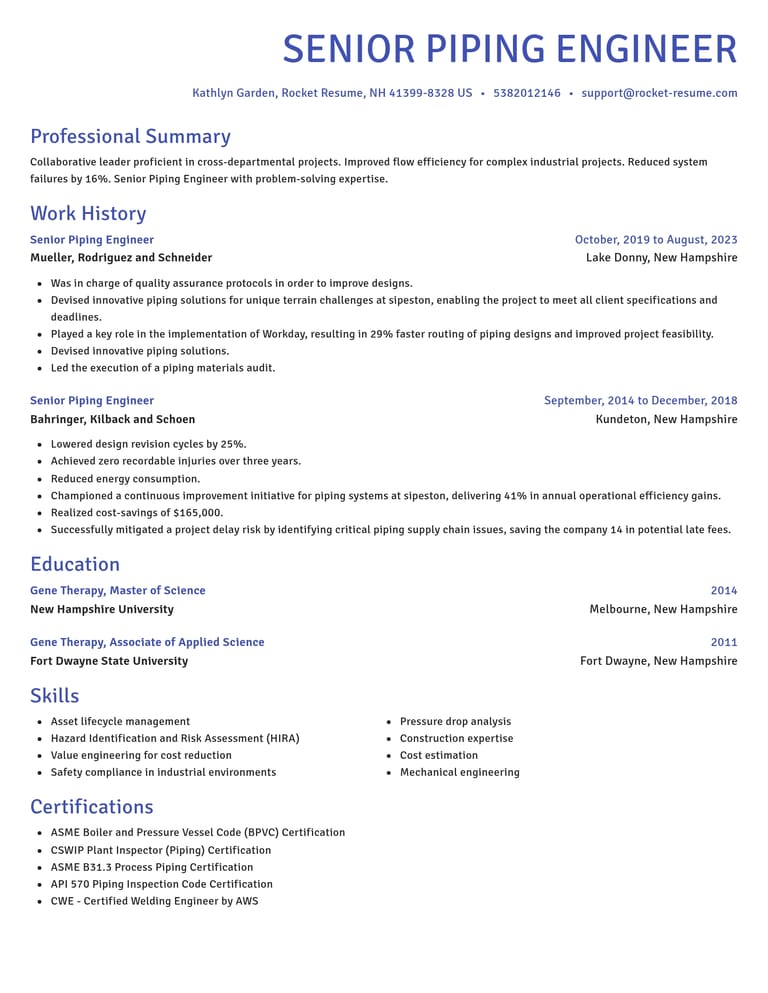
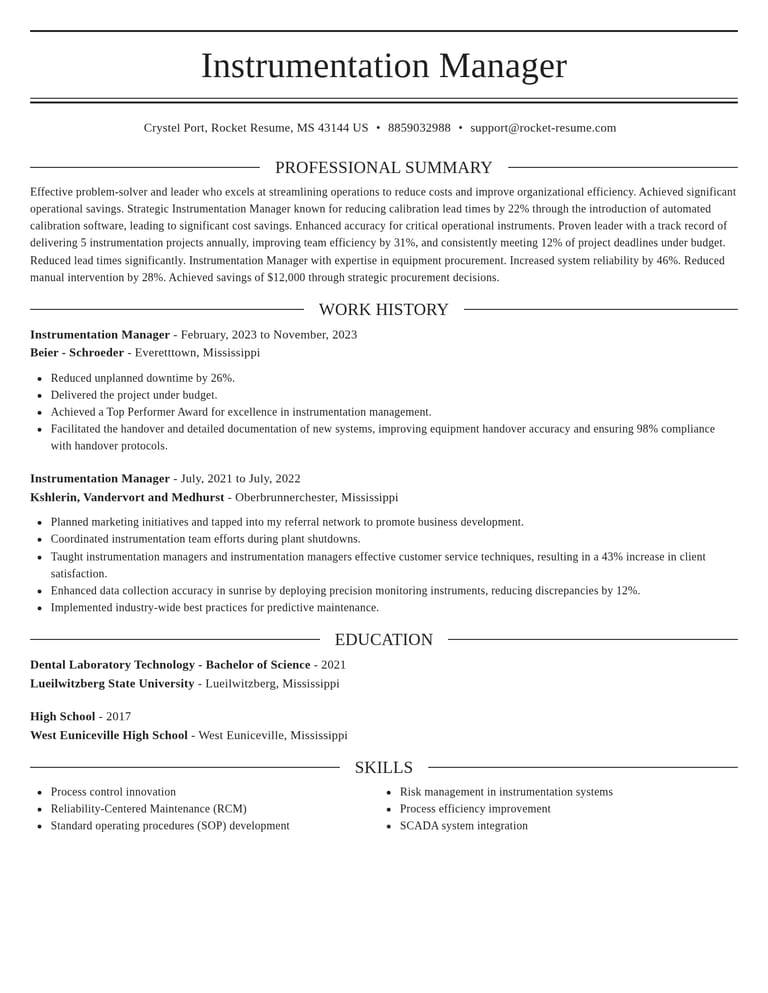
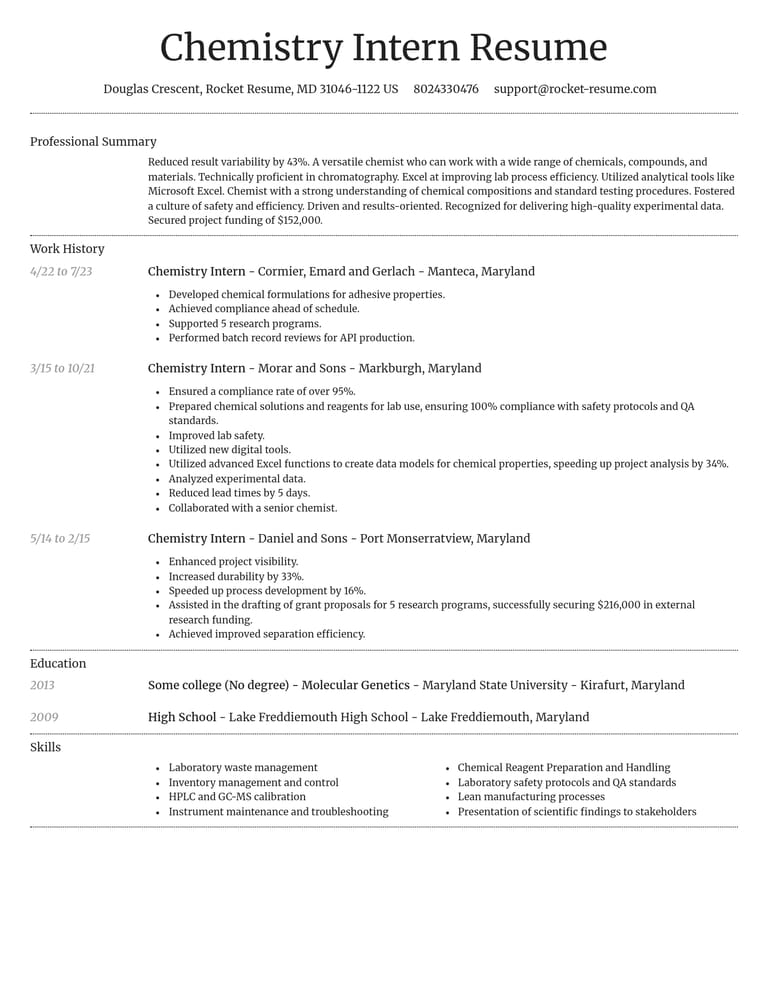
Chemical Engineering resume examples
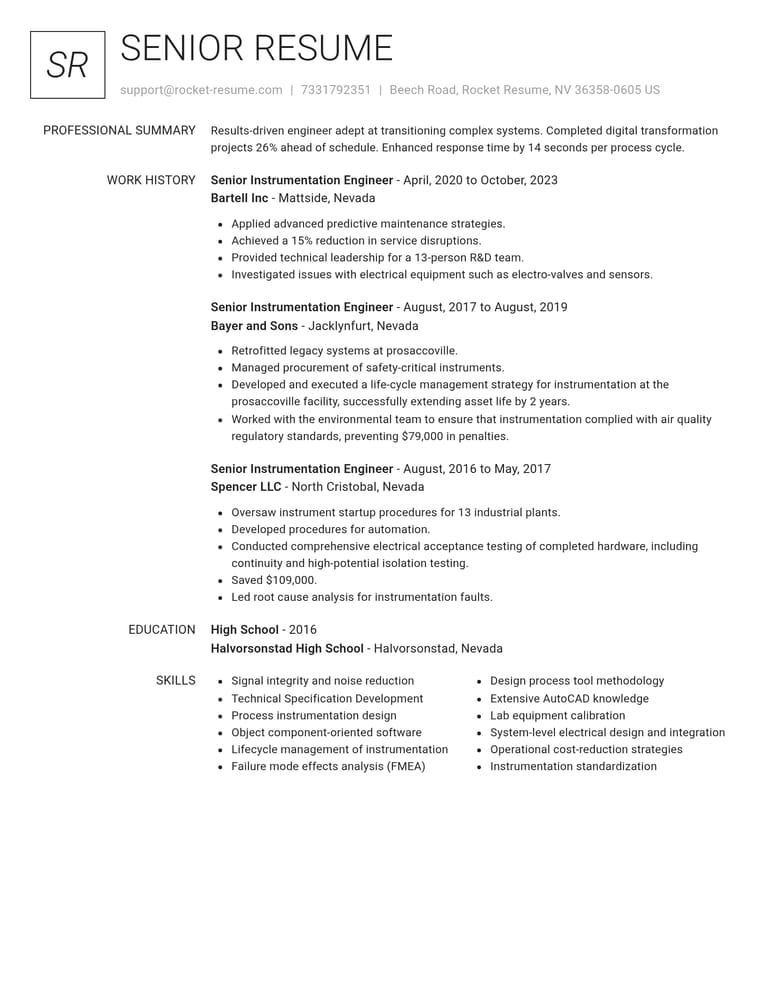
Senior Instrumentation Engineer resume example
More Senior Instrumentation Engineer resume examplesChemical Engineering jobs: examples, templates and guides
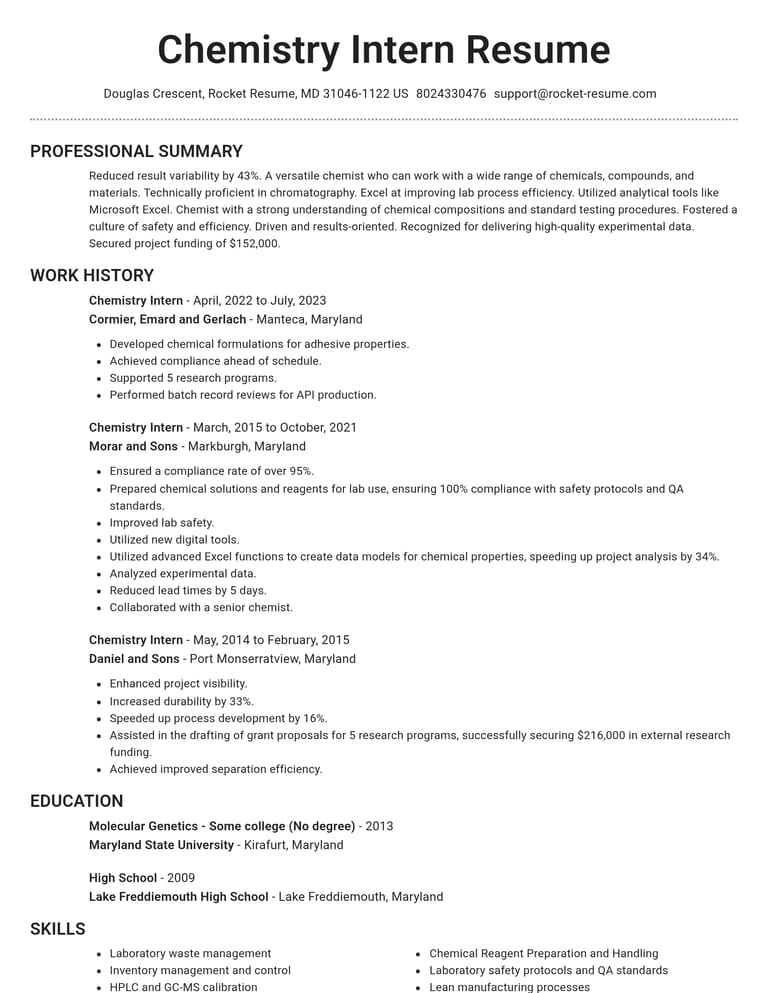
4 jobs- Chemistry Intern
Resume
Give your lab's purpose, like QC release or R&D, and how many samples or batches you tested weekly.
Name the site you cover, its control systems and the unplanned trips or outages your team reduced.
- Senior Instrumentation Engineer
Examples
List control platforms you've configured, loop counts, and ISA's CAP certification if you hold it.
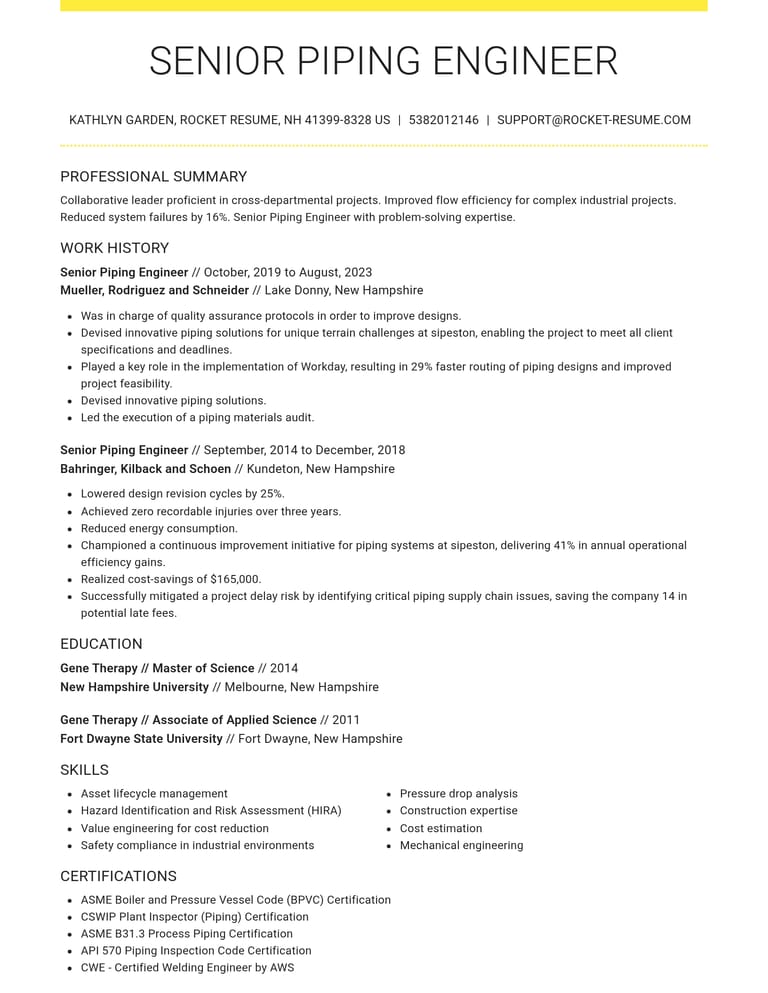
- Senior Piping Engineer
Guides
Give the line sizes and pressure classes you design, plus stress analysis software like CAESAR II.
Chemical Engineering resume skills, summaries and work history suggestions
Save suggestions for your resume
Tap the bookmark next to any suggestion to save it.
Saved itemsThe examples, skills, job titles and industries you save, together in one place.
RecommendedPages, searches and examples you used but haven’t saved.
In the builderYour saved suggestions show up in the resume builder, ready to add as you write.
You’re in controlYour saved items are private. Remove any of them at any time.
Showing 12 of 40
Skills
AutoCAD for piping design
Leadership in project execution
Knowledge of ASME codes and standards
Work experience
Championed the integration of advanced piping materials at a Denver site, increasing installation speed and reducing downtime by 22% over two years.
Achieved zero recordable injuries over 18 months.
Summaries
Achieved 82% capacity enhancements for Chemical Engineering projects.
Achieved a 20% reduction in costly rework.
Adept at developing and implementing best practices for safety compliance, leading multiple projects without a single safety incident over a one year-long career segment.
Accomplishments
Optimized pipeline routing using Power BI, reducing construction time by 27%, while also minimizing environmental disruption.
Enhanced team productivity by 60% by introducing lean methods in piping fabrication and material handling processes.
Utilized Finite Element Analysis (FEA) to perform stress testing on high-criticality piping, increasing system reliability by 22%.
Skills
Technical Documentation Authoring
Condition Monitoring Systems
Advanced calibration techniques
Work experience
Assessed safety risks associated with instrumentation equipment and implemented mitigation strategies that reduced incidents by 3%.
Achieved 28% reduction year-over-year.
Achieved a Excellence Award for excellence in instrumentation management.
Summaries
Accomplished in executing $115,000 instrumentation projects, enhancing process efficiency by 65% while reducing overall operational costs.
Accomplishments
Identified key areas for improvement in instrument performance, resulting in a 33% reduction in non-compliance faults over 16 inspections
Implemented automated calibration scheduling software, reducing calibration lead time by 28% and increasing equipment uptime by 23%
Skills
Formulation optimization for new products
Results interpretation
Work experience
Contributed to team discussions and new project initiatives to advance progress and maximize profitability.
Achieved a 74% decrease in volatile organic compound emissions.
Analyzed over 5 chemical samples.
Summaries
Collaborated with senior staff.
Calibrated HPLC and GC-MS.
Achieved error rates below 50%.
Accomplishments
Designed detailed data visualizations to communicate experimental findings to both scientific and non-scientific audiences.
Helped troubleshoot Microsoft Excel instrumentation, directly improving lab throughput and reducing equipment downtime by 66%.
Skills
Digital signal processing (DSP)
Calibration and optimization of sensors
Work experience
Authored technical documentation for control system interfaces, reducing engineering handoff time by 81% hours.
Actively contributed to defect resolution.
Summaries
Achieved Excellence Award for innovation.
Accomplished in developing customized control systems tailored to industrial machines, enhancing response time by 14 seconds per process cycle.
Accelerated data retrieval by 71% seconds.
Accomplishments
Identified and mitigated critical faults in legacy systems, minimizing unplanned downtime by 53% hours annually.
Managed integration between new and legacy instrumentation systems, reducing the project completion timeframe by 12 months.
Led the calibration and optimization of 5 real-time data acquisition systems, reducing downtime by 55%.
Chemical Engineering resume questions
How do I list lab skills on a chemistry or chemical engineering resume?
Write what you did on each instrument, not just its name: "HPLC: method development and validation" says more than "HPLC." Grouping helps a reader scan, for example separations (HPLC, GC), spectroscopy (FTIR, UV-Vis, NMR) and wet chemistry (titration, sample prep), with data tools such as a laboratory information management system (LIMS) on their own line. Then name the quality system your lab worked under, such as ISO/IEC 17025, the international standard used to accredit testing and calibration labs. Add your lab safety training too: the Occupational Safety and Health Administration (OSHA) laboratory standard requires employers to train staff on the hazards of chemicals in their work area. See Chemistry Intern examples.
What goes on a chemical engineering resume for a new graduate?
Treat your capstone like a job. ABET, which accredits engineering programs, requires a culminating major design experience that works within engineering standards and multiple constraints, so describe yours that way: the process you designed, its capacity, the limits you met on cost, safety or emissions, and your part on the team. Your unit operations lab belongs nearby, naming the column, heat exchanger or reactor you ran and what you measured. If you've passed the Fundamentals of Engineering (FE) exam, list it; the National Council of Examiners for Engineering and Surveying (NCEES) designs it for students close to finishing an ABET-accredited degree, so a pass can go on your resume before you graduate. See Chemistry Intern examples.
How do I show piping or instrumentation work on a chemical plant resume?
Name the codes and standards your designs met, since they tell a plant which of its systems you already know. Piping engineers can cite ASME B31.3, which ASME describes as covering piping in refineries and chemical, pharmaceutical and similar plants, from design through examination and testing. Instrumentation engineers should list safety instrumented system (SIS) work under the ISA-84 series, which includes ANSI/ISA-61511 (IEC 61511), the standard that sets SIS performance targets by safety integrity level (SIL); give the SIL ratings and the number of safety functions you handled. Add the plant type and project phase for each, such as new build, revamp or turnaround. See Senior Piping Engineer and Senior Instrumentation Engineer examples.
Going from senior instrumentation engineer to manager: what should the resume add?
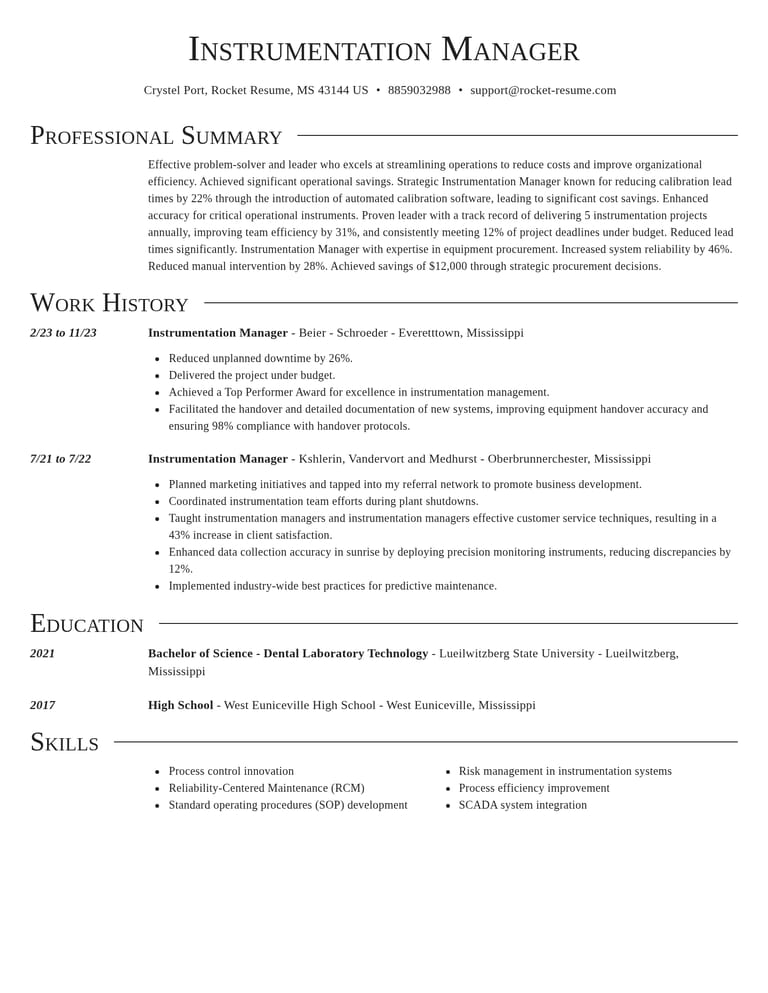
Keep the engineering record, then add the proof of management that the Bureau of Labor Statistics (BLS) describes for the role. Engineering managers typically advance after years as engineers, and their duties include determining staff, training and equipment needs, proposing budgets, and hiring and supervising staff. So under your senior engineer title, flag work that already looked like management, such as leading a loop-check crew or owning the instrument budget for a turnaround. Under the manager title, give headcount, budget, contractors and the calibration backlog or uptime you answer for. A master's in engineering management or an MBA, which BLS says some managers earn, goes under education. See Senior Instrumentation Engineer and Instrumentation Manager examples.
Resume guides and career advice

Before you write, pull together your job dates, results, education and the posting for the job you want. Fill in your contact details, work history, education and skills in that order, building each bullet from an action verb and a result. Write the summary last, even though it goes at the top, then tailor the resume to the job and proofread it before you apply. The same steps work for a first resume, with school, volunteering and part-time work counting as experience.

Updated May 18, 2026
Get practical guidance on tailoring job resumes, with good vs bad resume examples, skills, keywords, and writing tips.


Explore other industries
Featured industries



 9 examples
Veterinarian Assistant · Locum Tenens Veterinarian · Professional Pet Groomer
 5 examples
EHS Manager · Sustainability Manager · Health and Safety Officer
All industries
This page’s industry
- Aerospace & Defense, 8 examples
- Agriculture, 23 examples
- Apparel & Textiles, 13 examples
- Architecture, 15 examples
- Artificial Intelligence, 6 examples
- Arts & Entertainment, 24 examples
- Automotive, 21 examples
- Beauty & Personal Care, 17 examples
- Biotechnology & Life Sciences, 7 examples
- Business Services, 23 examples
- Chemical Engineering, this page’s industry, 4 examples
- Childcare, 14 examples
- Construction, 106 examples
- Creative, 15 examples
- Customer Service, 17 examples
- Education, 94 examples
- Energy, 39 examples
- Environmental Science, 5 examples
- Finance, 63 examples
- Food & Beverage, 68 examples
- Government, 48 examples
- Healthcare, 160 examples
- Hospitality, 35 examples
- Human Resources, 18 examples
- Insurance, 10 examples
- Legal, 12 examples
- Logistics, 37 examples
- Manufacturing, 68 examples
- Marketing, 8 examples
- Media, 20 examples
- Military, 24 examples
- Mining & Metals, 9 examples
- Nonprofit, 8 examples
- Pharmaceuticals, 11 examples
- Public Relations, 10 examples
- Real Estate, 7 examples
- Retail, 38 examples
- Robotics, 11 examples
- Sales, 14 examples
- Security Services, 19 examples
- Social Services & Counseling, 21 examples
- Social Work, 14 examples
- Sports & Fitness, 96 examples
- Technology, 67 examples
- Telecommunications, 6 examples
- Tourism & Travel, 8 examples
- Transportation, 38 examples
- Veterinary, 9 examples