Rocket Resume v. BOLD Limited — Antitrust Lawsuit
A resume is the front door to the economy: it is "often the first opportunity for jobseekers to market themselves to potential employers" (Compl. ¶ 45). One company secretly controls Monster, CareerBuilder, Resume Genius, My Perfect Resume, Zety, LiveCareer, and dozens of other online resume builders — manipulating Google search results, trapping job seekers in deceptive subscriptions, and using litigation to crush competitors. Rocket Resume is fighting back.
This page is provided as a resource for journalists and other interested parties.
In the news
BOLD Accused in Lawsuit of Monopolizing Online Resume-Building
Katie ArcieriBloomberg Law
Resume Market Is 'Bold, Bold, or Bold,' Antitrust Suit Alleges
Rae Ann VaronaLaw360 Employment Authority
Rocket Resume Accuses Monster, CareerBuilder Owner of 'Deception' in the Resume-Making Market
Kathryn MoodyHR Dive
Antitrust Suit Alleges Monster, CareerBuilder and Resume Genius Are All the Same Company
Jill BarthHR Executive
At a glance
- Case: Rocket Resume, Inc. v. BOLD Limited et al., No. 5:26-cv-02852 (N.D. Cal., filed April 2, 2026)
- BOLD controls an estimated 80–90% of the U.S. online resume-builder market — roughly $750M+ in commerce annually — in a country where 53 million Americans engaged in job-seeking activity in a single recent three-month window (Compl. ¶¶ 2, 8, 44, 76, 204)
- The download is advertised as free, but actually runs $1.85–$2.95 at checkout — a nominal fee that then converts to recurring charges of 10–20x this fee every four weeks, with cancellation made intentionally difficult (Compl. ¶¶ 3, 97, 180). The same billing practices are now the subject of a consumer class action, Rauf v. Bold LLC, No. 26CU019871C (Cal. Super. Ct., San Diego County, filed April 9, 2026)
Key facts
- Case: Rocket Resume, Inc. v. BOLD Limited et al., No. 5:26-cv-02852 (N.D. Cal., filed April 2, 2026)
- BOLD's market share: Over 80% of the U.S. online resume-builder market — an estimated 80–90% share nationally (Compl. ¶¶ 8, 76, 204)
- $750+ million: estimated annual commerce affected in the online resume-building market (Compl. ¶ 2)
- U.S. job seekers affected: 53 million Americans engaged in job-seeking activity November 2025 – January 2026 (Compl. ¶ 44)
- What job seekers pay: a download advertised as free is actually $1.85–$2.95 at checkout — a nominal fee that converts to recurring charges of 10–20x this fee every four weeks, with cancellation made intentionally difficult (Compl. ¶¶ 3, 97, 180)
- Duration of the conduct: Job seekers have been affected for over a decade (Compl. ¶ 83) — the sham-entity network traces back to the early 2000s (Compl. ¶ 86), BOLD's documented copyright-litigation campaign against competitors began on July 28, 2014 (Compl. ¶¶ 147–148), and BOLD's principals have overseen the scheme "from its inception" (Compl. ¶ 200)
- BOLD threatened litigation against Rocket Resume as recently as March 25, 2026 — 8 days before this case was filed (Compl. ¶ 21)
- Causes of action: Four counts — Sherman Act § 2 (monopolization), § 2 (attempted monopolization), § 1 (conspiracy to restrain trade), and California Business & Professions Code § 17200 (Compl. Counts I–IV)
- Status: BOLD moved to dismiss on June 18, 2026 (Dkt. 36); Rocket Resume filed its opposition on July 20, 2026 (Dkt. 44); BOLD filed its reply on August 10, 2026 (Dkt. 45). Hearing set for November 19, 2026. See motion to dismiss.
- Primary documents: the complaint (PDF), the opposition (PDF), and other key documents
The front door to the economy, rigged
Looking for work runs through a resume. 53 million U.S. workers, about 31% of the U.S. labor market, engaged in some type of job-seeking activity between November 2025 and January 2026 (Compl. ¶ 44). The resume is "often the first opportunity for jobseekers to market themselves to potential employers," and "the point at which many employers decide to cut a candidate from consideration" (Compl. ¶ 45). Recruiters skim a resume for an average of 7.4 seconds (Ladders eye-tracking study, HR Dive, Nov. 8, 2018).
At that door, job seekers meet "a large, yet illusory, number of 'options'—nearly all of which are in fact BOLD's low-quality offerings" (Compl. ¶ 3). "Jobseekers looking for online resume-builders believe they are comparing independent options; in reality, they face BOLD, BOLD or BOLD" (Compl. ¶ 179).
- It costs more than it looks. As of the April 2, 2026 complaint, after building a "free" resume, job seekers "have to pay a nominal subscription fee to download the final formatted resume," and then BOLD entities "charge customers 10-20x this fee every four weeks, while making this charge extraordinarily hard to cancel" (Compl. ¶ 3; see ¶ 180). Customers "who are not studious about their credit card bills … may end up spending hundreds of dollars for the resume they built and downloaded once" (Compl. ¶ 97). One My Perfect Resume user put it bluntly: "they make it really hard to cancel and are almost fraudulent with it" (Compl. ¶ 181).
- Prices climb anyway. BOLD raised resume-builder prices 61% from July 2023 to March 2026 "without a meaningful reduction in market share" (Compl. ¶ 68): "the hallmark of monopoly pricing" (Dkt. 44 at 10).
- Switching brands is no escape. Job seekers who give up on one BOLD brand "[o]verwhelmingly … will be unknowingly funneled to another BOLD sham entity. And there they will confront the same poor customer experience that upset them in the first place" (Compl. ¶ 99).
- The product stops getting better. "Instead of innovating, BOLD focuses its resources on driving competitors out of the market" (Compl. ¶ 213), leaving job seekers with "lack of meaningful innovation" and "reduced product quality" (Compl. ¶ 183).
The damage does not stop with the job seeker. Employers cut candidates at the resume (Compl. ¶ 45), and 88% of employers already agree that "qualified high-skills candidates" are vetted out at the initial resume-review stage (Compl. ¶ 47). When the dominant resume tool faces no pressure to improve and its offerings are "low-quality" (Compl. ¶ 3), qualified people are more likely to be screened out before an employer or recruiter ever sees them. Job seekers, recruiters and employers alike should be angry: "These behaviors destroy competition and damage the economy" (Compl. ¶ 4).
The case
Rocket Resume filed suit to stop a hidden monopoly in the online resume-builder market: one company secretly operating dozens of nearly identical resume-building services, and using that network to rig job seeker search results. It is a "monopolistic scheme of deception and anticompetitive conduct" that causes job seekers to be "systematically ripped off" and "artificially crowds out competitors" from search results.
The suit was filed on April 2, 2026, in U.S. District Court in San Jose against Bold Limited, Bold LLC, Bold Holdings LLC, and three individual defendants: Doug Jackson (Co-Chief Executive Officer), Jamie Freundlich (Co-Chief Executive Officer), and Heather Williams (former Chief Financial Officer). BOLD's corporate structure conceals common ownership of a web of sham entities that operate under "unified management control" (Compl. ¶ 7) and appear to job seekers as independent competitors — including Monster, CareerBuilder, My Perfect Resume, Resume Genius, LiveCareer, and dozens more. Rocket Resume is represented by Quinn Emanuel Urquhart & Sullivan, LLP.
Defendants' scheme affects over $750 million worth of commerce annually in the online resume-building industry and millions of job seekers in the United States (Compl. ¶ 2). At its center is a complex web of sham corporate entities around the globe, operating under shared ownership and oversight, with fictitious headquarters in places as diverse as Switzerland, Bermuda, and Puerto Rico.
When job seekers search Google for terms like "resume builder," they may see My Perfect Resume, Resume Genius, Resume Nerd, Resume Now, or many others occupying the top sponsored advertising positions and assume they can then select among competitive alternatives in a well-functioning market. Instead, they are just picking among Bold entities: these brands alone occupy, on average, 2.5 of the top advertising slots per search, and the #1 slot goes to BOLD 90% of the time (Compl. ¶ 9) — manipulation that violates Google's own advertising policies as well as antitrust law.
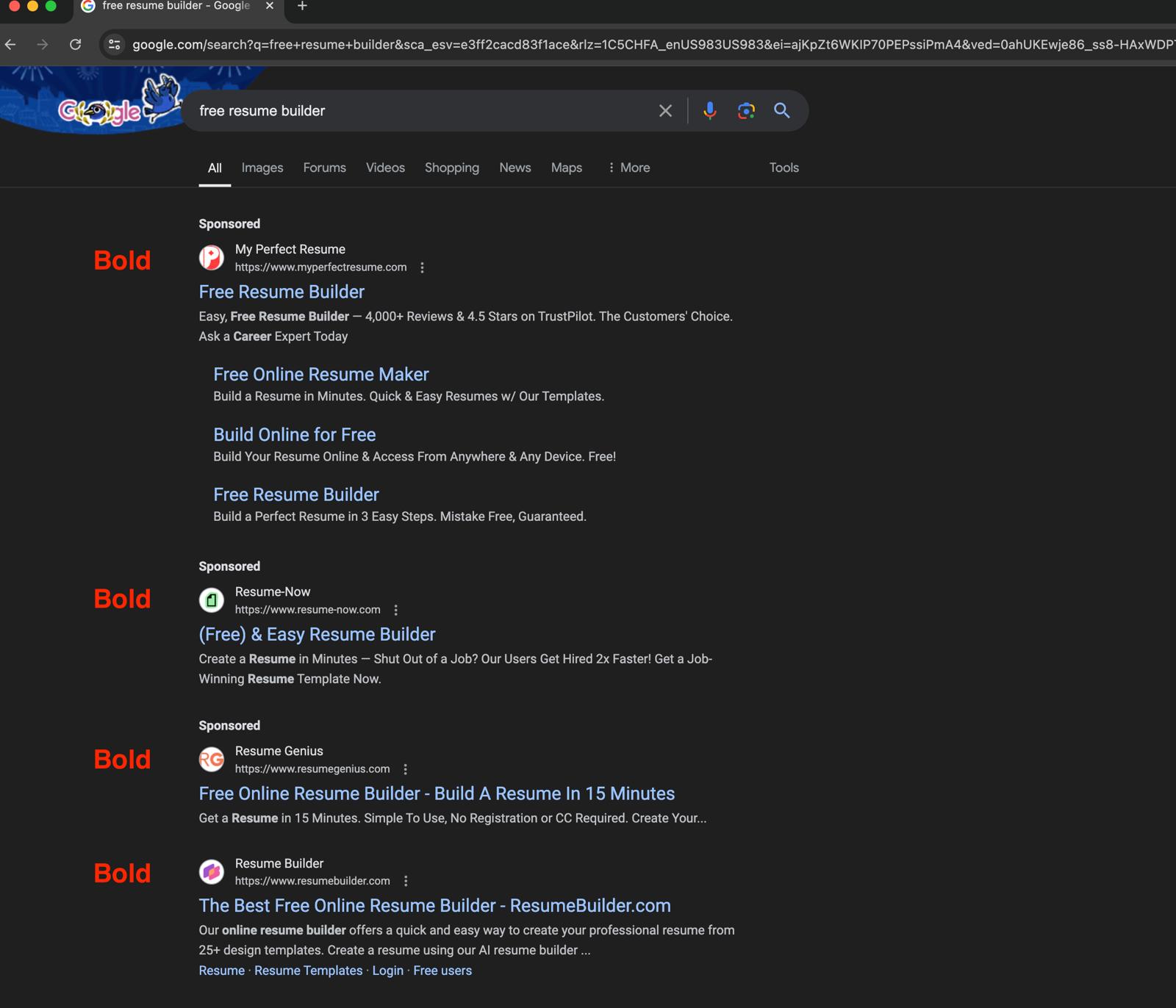
While Bold actively works to mask their ownership of over 80% of the market, their sham entities are strikingly similar. As the complaint puts it, Bold's entities "offer functionally identical services, target identical customers, charge virtually identical prices, draw from identical content databases, and operate under unified management control, often using the same technology. The only differences are cosmetic, and are just enough to fool customers: color schemes, logos, and domain names."
Bold's actions create an "illusion of choice and competition," the complaint continues. The result is that "customers, Google, and regulators are led to believe the Market is competitive and fair, but it is in fact rigged."
The complaint gives specifics. The brands "draw from the same content database, are coordinated by the same management team, and use the same misleading pricing practices" (Compl. ¶ 11). BOLD's U.S. Copyright Office registrations for its "Text Tuner Content" database cover job-description content used across My Perfect Resume, Resume Genius, Resume Nerd and other BOLD platforms (Compl. ¶ 113). "BOLD's sham entities all use this, or a very similar, pricing model" (Compl. ¶ 98). When BOLD moved Resume Genius and Resume Nerd to new domains, "[n]one of these domain switches were accompanied by any substantive changes to the websites and products" (Compl. ¶ 116).
Compare a company that owns many brands honestly. General Mills sells many cereals, but "does not pretend that it is actually multiple competitors. The General Mills logo is prominently displayed on all of its brands" (Compl. ¶ 139).
In addition, Bold's websites entice job seekers with "free" resume-builders — but after a job seeker has spent significant time and energy building a resume, downloading the final formatted version requires a subscription fee. A download advertised as free — and, after the job seeker has built their resume, presented as a small one-time charge of $1.85 to $2.95 — in fact enrolls them in a subscription charging 10–20x this fee every four weeks thereafter, with cancellation made intentionally difficult (Compl. ¶¶ 3, 97, 180, 182). Job seekers who are not watching their statements closely "may end up spending hundreds of dollars for the resume they built and downloaded once" (Compl. ¶ 97).
Rocket Resume isn't alone in describing this scheme. One week after this antitrust suit was filed, a California consumer filed a putative class action against Bold LLC — Rauf v. Bold LLC, No. 26CU019871C (Cal. Super. Ct., San Diego County, filed April 9, 2026) — alleging that Bold "is running an automatic renewal scheme that has victimized many California consumers," enrolling trial users in subscriptions that "post unauthorized recurring charges (often $23.95 every four weeks) until the consumer cancels," in violation of California's Automatic Renewal Law and Unfair Competition Law (Rauf Compl. ¶¶ 1–2).
Because no real rival remains to discipline those prices, they climb. BOLD raised its resume-builder prices by 61% between July 2023 and March 2026 without a meaningful loss of market share (Compl. ¶ 68) — what Rocket Resume's opposition brief calls "the hallmark of monopoly pricing."
The harm lands on Americans who are actively trying to find work. 53 million Americans (Compl. ¶ 44) — about 31% of the U.S. labor market — engaged in some type of job-seeking activity during a recent three-month window from November 2025 to January 2026, with 23.7 million youth working or actively looking for work as of July 2025. Resumes are typically the first chance these job seekers get to reach an employer at all: 97.8% of Fortune 500 companies filter applications through Applicant Tracking Systems (Compl. ¶ 46), and a 2021 Harvard Business School study cited in the complaint found that 88% of employers acknowledge their resume-review process vets out "qualified high-skills candidates" at the initial screening — a figure that rises to 94% for middle-skills workers (Compl. ¶ 47).
"The result is that customers and job seekers are systematically ripped off by what appears to be a large range of online resume-building services, when in fact the choice is often Bold, Bold or Bold. This is unfair to job seekers and unfair to honest rivals like Rocket Resume," says Steve Zimmerman, a software engineer who founded Rocket Resume in 2019.
Bold also has a pattern of using litigation to thwart competition — copyright suits that are really about eliminating rivals. BOLD "intentionally filed the lawsuit precisely when Rocket Resume's growth threatened to establish it as a significant competitive constraint" (Compl. ¶ 167), at a point when Rocket Resume was posting year-over-year growth exceeding 100% in multiple periods (Compl. ¶ 27). While other competitors were squashed by such tactics or absorbed into Bold's web of sham companies, Rocket Resume successfully defended itself against the 2022 copyright infringement suit filed by Bold, winning partial summary judgment (learn more) in May 2024.
Bold's litigation campaign against Rocket Resume has not ceased. On March 25, 2026 — just 8 days prior to this litigation — Bold threatened Rocket Resume with legal action again, this time demanding Rocket Resume stop bidding on Google Ads keywords containing BOLD brand names that BOLD refuses to identify, while BOLD itself routinely bids on Rocket Resume's keywords through its many sham entities (Compl. ¶ 21). This renewed threat is the latest phase of the same weaponized-litigation pattern Bold used to drive earlier competitors out of the market — see the FAQ on prior litigation for more detail.
Some of Bold's suspected sham entities
Bold owns and operates the following sham entities, among others (Compl. ¶¶ 5–6, 9):
- BuildUrCV — www.buildurcv.com
- CareerBuilder — www.careerbuilder.com
- Great Sample Resume — www.greatsampleresume.com
- Hloom — www.hloom.com
- Job Hero — www.jobhero.com
- LiveCareer — www.livecareer.com
- Monster — www.monster.com
- My Perfect Resume — www.myperfectresume.com
- Resume Builder — www.resumebuilder.com
- Resume Companion — www.resumecompanion.com
- Resume Genius — www.resumegenius.com
- Resume Genius (alternate domain) — www.resumegenius.co
- Resume Help — www.resumehelp.com
- Resume Lab — www.resumelab.com
- Resume Nerd — www.resumenerd.com
- Resume Nerd (alternate domain) — www.resumenerd.ai
- Resume-Now — www.resume-now.com
- Zen Resume (now directs to Resume Lab) — www.zenresume.com
- Zety — www.zety.com
Public USPTO records corroborate these common-ownership connections. A Trademark Security Agreement filed January 29, 2020 shows Bold Limited (Bermuda), Works Limited (Bermuda), and Sonaga Tech Limited (Switzerland) — all three acting jointly as a single borrower group — pledging 31 trademarks to HSBC Bank USA, N.A. as collateral. The trademarks include Hloom, Resume-Now, My Perfect Resume, Job Hero, LiveCareer, Zety, Resume Companion, Resume Genius, Resume Lab, and Zen Resume, among others.
Rocket Resume is one of Bold's last remaining independent rivals. It differentiates itself through its online platform, which gives job applicants access to proprietary technology and tailored recommendations that help them create polished resumes optimized for widely used AI-powered screening tools.
Google Ads policy violations
BOLD's coordinated, multi-brand advertising scheme violates Google's own advertising policies — not just antitrust law (Compl. ¶¶ 110–112):
- Unfair advantage (part of Google's Abusing the ad network policies) — prohibits "trying to show more than one ad for your business, app, or site in a single ad location," the practice known as "double-serving." BOLD goes further: "most cases are actually triple or even 'quadruple-serving'" (Compl. ¶ 30), with BOLD brands taking, on average, 2.5 of the top advertising slots per "resume builder" search (Compl. ¶ 9).
- Circumventing systems (Abusing the ad network) — prohibits "bypassing enforcement mechanisms and detection by creating variations of ads, domains or content that have been disapproved." That is precisely how BOLD has responded when Google enforced its policies against BOLD brands — switching domains while leaving the underlying products unchanged (Compl. ¶¶ 12, 116). Google treats this violation far more severely than double-serving. In Google's own words, such violations "are taken very seriously and are considered egregious," and "if violations of this policy are found, your Google Ads accounts will be suspended upon detection and without prior warning, and you will not be allowed to advertise with Google Ads again."
When Google enforced its advertising policies against BOLD brands, BOLD responded by switching domains to circumvent that enforcement — without changing the underlying products (Compl. ¶¶ 12, 116). Paragraph 116 of the complaint describes the pattern:
“BOLD merely pivoted to using slight variations on its domain names, moving ResumeGenius from www.resumegenius.com to www.resumegenius.co and ResumeNerd from www.resumenerd.com to www.resumenerd.ai, creating the appearance of new unrelated entities. None of these domain switches were accompanied by any substantive changes to the websites and products.”
BOLD says Google allows it. BOLD's sites are copies.
BOLD's motion argues that because Google has let BOLD advertise several brands, "the only plausible inference" is that its ad strategy "is consistent with Google policies," and that "the same company may submit separate bids for differentiated products" (Dkt. 36 at 15). BOLD's reply says Google's Unfair Advantage policy lets a company "place multiple ads in one location on Google if its products 'offer distinct value to users'" (Dkt. 45 at 4). BOLD is wrong on all three counts.
- The single-slot ban still stands. Google's policy prohibits "[t]rying to show more than one ad for your business, app, or site in a single ad location" (Google Ads, Unfair advantage policy, retrieved Oct. 17, 2026; Dkt. 44 at 4). BOLD does exactly that, "bidding for multiple spots in the same placement on a search page" (Compl. ¶ 110 n.14).
- "Distinct value" is a requirement, not a permission. The policy says: "Each website or app that you promote should offer distinct value to users" (Dkt. 44 at 4), and goes on: "For example, you should avoid promoting similar products and prices across related destinations" (Google Ads, Unfair advantage policy, retrieved Oct. 17, 2026).
- BOLD's brands offer no distinct value because they are functionally the same product. They "offer functionally identical services, target identical customers, charge virtually identical prices, draw from identical content databases," and that "[t]he only differences are cosmetic … color schemes, logos, and domain names" (Compl. ¶ 7). One product sold through many look-alike storefronts is exactly the "similar products and prices across related destinations" Google tells advertisers to avoid.
Google's tolerance is not permission. BOLD's motion never "directly address[es] Google's 'Unfair Advantage' or 'Circumventing Systems' policies"; it suggests "circularly, that the Court should assume that BOLD complies with it because BOLD has evaded significant consequences thus far" (Dkt. 44 at 8–9). BOLD stays ahead of enforcement by switching domains, and that "Google's automated systems struggle to identify common ownership when operators deliberately obscure connections" (Compl. ¶¶ 116–117).
Easy to enter, hard to survive: how BOLD built a moat
Building a resume builder is not the hard part. Reaching job seekers is. The complaint puts it plainly: "There are low natural barriers to entry with building an online resume-builder, yet BOLD's conduct creates substantial, artificial barriers to entry in the Market," "making new entry virtually impossible" (Compl. ¶ 81). BOLD protects its position with a moat built from two things: control of Google's ad slots, and lawsuits.
The first wall is the ad auction. Google search "drives over 90% of all customer acquisition" in this market (Compl. ¶ 73). Three BOLD brands alone (My Perfect Resume, Resume Genius and Resume Nerd) take "approximately 2.5 of the top advertising slots per search," based on Rocket Resume's internal analyses (Compl. ¶ 9), and BOLD spreads its costs "to achieve a blended average cost per click far below what any single competitor must pay for the top spot alone" (Compl. ¶ 13). Control of ads feeds organic search too, because "[s]uccess in organic growth depends on learnings derived from the Ads space" (Compl. ¶ 82). The result: new entrants "face an effectively impenetrable barrier: even if they develop a superior product, they cannot reach customers" (Compl. ¶ 146).
The second wall is litigation. "[W]henever BOLD sees a competitor has gained any market traction, BOLD threatens to file a copyright infringement lawsuit" (Compl. ¶ 18). The litigation campaign is the "'backstop' for BOLD if a competitor manages to nonetheless rise up through the ranks" (Compl. ¶ 177). "[I]n each case except Rocket Resume, those rivals either cave to BOLD's anticompetitive demands and join BOLD's web of zombie entities or exit the market entirely" (Compl. ¶ 17).
Rocket Resume hit that wall head-on. BOLD sued in February 2022, "just as Rocket Resume was approaching $10 million in annual revenue" (Compl. ¶ 167). Rocket Resume suspended marketing for several months to fund its defense (Compl. ¶ 169), and its 2024 revenue fell 53% (Compl. ¶ 170).
BOLD's answer is that Rocket Resume could copy BOLD: "nothing is stopping RR from itself engaging in multi-brand ad-bidding" (Dkt. 36 at 15; see Dkt. 45 at 5). Rocket Resume's response: "Defendants' argument that BOLD's rivals should copy its brazenly deceptive scheme in order to compete against BOLD only illustrates the extent to which it has corrupted the competitive process" (Dkt. 44 at 1). "[W]ithout engaging in BOLD's anticompetitive conduct, Rocket Resume cannot 'follow[] suit'" (Dkt. 44 at 11).
Timeline
Bold's anticompetitive conduct is not new. Bold has "maintained BOLD's monopoly through an overarching course of anticompetitive conduct that spans over a decade" (Compl. ¶ 83), with the documented litigation pattern beginning at least as early as July 28, 2014, when Bold filed the first of two near-identical copyright suits against then-independent competitors (Compl. ¶¶ 147–148).
Dated events below are drawn from the complaint, Rocket Resume, Inc. v. BOLD Limited et al., No. 5:26-cv-02852 (N.D. Cal., filed April 2, 2026) — cited by paragraph number — or, where noted, from public court filings, USPTO records, and Rocket Resume's own records. The full complaint is here.
- Early 2000s — BOLD begins constructing its web of sham entities (Compl. ¶ 86).
- July 28, 2014 — BOLD (as LiveCareer Ltd.) files LiveCareer Ltd. v. Mint Media, Inc., No. 3:14-cv-3420 (N.D. Cal.), targeting Resume Direct (Compl. ¶ 148).
- July 30, 2014 — BOLD files LiveCareer Ltd. v. Resume Companion LLC and Su Jia Technologies Ltd, dba ResumeGenius.co, No. 3:14-cv-03336-DMR (N.D. Cal.), targeting the then-independent operators of resumegenius.com and resumecompanion.com (Compl. ¶ 149).
- 2015 — A LiveCareer attorney files a Change of Correspondence Address application on the Resume-Now trademark — which the complaint cites as revealing that BOLD is behind the Resume-Now brand (Compl. ¶ 92).
- Late 2015 — Resume Companion and Su Jia Technologies settle with LiveCareer on undisclosed terms; Resume Genius and Resume Companion begin operating under a BOLD subsidiary called "Sonaga Tech" (Compl. ¶¶ 155–156).
- January 2019 — BOLD absorbs Zety (formerly Interview.me) into its portfolio (Compl. ¶ 158).
- March 2019 — Steve Zimmerman founds Rocket Resume (Compl. ¶ 23).
- January 2020 — Bold Limited, Works Limited, and Sonaga Tech Limited jointly execute a Trademark Security Agreement (filed with the USPTO on January 29, 2020), pledging 31 trademarks — including Hloom, Resume-Now, My Perfect Resume, LiveCareer, Zety, Resume Genius, and Resume Lab — to HSBC Bank USA, N.A. as collateral. The filing lists all three entities as a single borrower group, publicly documenting the common-ownership ties alleged in the complaint.
- May 2021 — BOLD first threatens copyright litigation against Rocket Resume (Rocket Resume records).
- February 18, 2022 — BOLD Limited files copyright-infringement and related claims against Rocket Resume and Steve Zimmerman in BOLD Limited v. Rocket Resume, Inc., No. 5:22-cv-01045-BLF-SVK (N.D. Cal.), seeking up to $112 billion in damages over 750,000 allegedly infringed works (Compl. ¶¶ 163, 165, 168).
- 2023 — BOLD switches both Resume Nerd (resumenerd.com → resumenerd.ai) and Resume Genius (resumegenius.com → resumegenius.co) to slight variations on their domain names with no substantive product change — what the complaint characterizes as evading Google's enforcement of its ad policies (Compl. ¶¶ 12, 116).
- 2023–2025 — Rocket Resume sharply reduces headcount and suspends marketing for several months to fund its legal defense (Compl. ¶ 169).
- January 2023–2024 — BOLD absorbs FlexJobs, the largest remote-work job-search site, and redirects its resume-builder traffic to myperfectresume.com (Compl. ¶ 158).
- Late 2023 — While the BOLD v. Rocket Resume case is pending, BOLD revises its copyright registration — which the complaint states was "[a]pparently to address" deficiencies in its claims (Compl. ¶ 166).
- 2024 — BOLD subsumes ResumeBuilder.com and Sonara.ai into its web of sham entities (Compl. ¶ 159).
- May 24, 2024 — The district court grants partial summary judgment (PDF) in favor of Rocket Resume, finding that BOLD "failed to supply direct evidence that Rocket Resume copied its MyPerfectResume website." The court rejects BOLD's lead compilation-infringement theory, rejects BOLD's claim for $150,000-per-work statutory damages and attorney's fees, and orders the parties to mediation — admonishing BOLD for the weakness of its evidentiary showing. The order is publicly released in redacted form on June 5, 2024 (Compl. ¶¶ 172–175).
- July 16, 2024 — BOLD and Rocket Resume file a joint stipulation informing the Court that they had entered into a confidential binding settlement term sheet.
- July–August 2025 — BOLD acquires CareerBuilder and Monster for $28.4 million following their Chapter 11 bankruptcy filings, listing both brands as owned by the offshore shell "MCB Bermuda Ltd." (Compl. ¶ 160).
- September 24, 2025 — The BOLD v. Rocket Resume copyright case is dismissed by joint stipulation.
- March 25, 2026 — BOLD threatens Rocket Resume again, demanding Rocket Resume stop bidding on Google Ads keywords containing BOLD brand names — brand names BOLD refuses to identify, rendering compliance impossible, even though BOLD itself routinely runs the same competitor-keyword bidding across its many sham entities, including bidding on Rocket Resume's own keywords (Compl. ¶ 21).
- April 2, 2026 — Rocket Resume files its antitrust complaint (PDF), Rocket Resume, Inc. v. BOLD Limited et al., No. 5:26-cv-02852 (N.D. Cal.).
- April 9, 2026 — A California consumer files a putative class action against Bold LLC, Rauf v. Bold LLC, No. 26CU019871C (Cal. Super. Ct., San Diego County), alleging Bold's "free" and low-cost trials unlawfully enroll consumers in automatic-renewal subscriptions posting "unauthorized recurring charges (often $23.95 every four weeks)," in violation of the California Automatic Renewal Law (Bus. & Prof. Code § 17600 et seq.) and the Unfair Competition Law (§ 17200) (Rauf Compl. ¶¶ 1–2; public court filing).
- June 18, 2026 — BOLD and the individual defendants move to dismiss the complaint under Federal Rule of Civil Procedure 12(b)(6) (Dkt. 36, PDF).
- July 20, 2026 — Rocket Resume files its opposition to the motion to dismiss (Dkt. 44, PDF) — see the summary.
- August 10, 2026 — BOLD files its reply in support of the motion to dismiss (Dkt. 45, PDF). The motion is set for hearing on November 19, 2026, before U.S. District Judge Beth Labson Freeman. The court has not ruled.
Motion to dismiss
On June 18, 2026, BOLD and the individual defendants moved to dismiss the complaint under Federal Rule of Civil Procedure 12(b)(6) (Dkt. 36, PDF).
On July 20, 2026, Rocket Resume filed its opposition (Dkt. 44, PDF, 33 pages). Law360 reported the filing on July 21.
On August 10, 2026, BOLD filed its reply (Dkt. 45, PDF, 21 pages). The reply does not deny that BOLD's brands take multiple top ad slots for the same search; it argues instead that BOLD "has every right" to "pursue a multi-brand strategy" and that Google's "Unfair Advantage" policy permits several ads from one company in a single location if its products "offer distinct value to users" (Dkt. 45 at 1, 4). The policy itself prohibits "[t]rying to show more than one ad for your business, app, or site in a single ad location," and states that each site promoted "should offer distinct value to users" (Dkt. 44 at 4), which is a requirement, not a permission. BOLD's brands "offer functionally identical services" and that "[t]he only differences are cosmetic … color schemes, logos, and domain names" (Compl. ¶ 7).
BOLD's arguments and Rocket Resume's answers
A motion to dismiss asks only whether the complaint's allegations, taken as true, state a claim. The court has not ruled. Rocket Resume says the allegations "must be taken as a whole" and that, together, "they show that BOLD's scheme is anticompetitive, regardless of how it is labeled" (Dkt. 44 at 8).
- BOLD: running many brands is lawful. "[S]elling similar products under different brand names is not itself improper" (Dkt. 36 at 2). Rocket Resume: the case is not about owning brands; it is about BOLD's "use of anticompetitive tactics to foreclose the Market's critical distribution channel" (Dkt. 44 at 8). In the case BOLD relies on, the plaintiff did not plausibly plead that it was foreclosed from advertising; "Rocket Resume pleads exactly what the Novation plaintiff did not" (Dkt. 44 at 9; Compl. ¶¶ 141–146).
- BOLD: its alleged omissions and statements are not actionable (Dkt. 36 at 8–12). Rocket Resume: its claim is not a false-advertising or disparagement case; it "does not premise its Section 2 violation on any of these predicate claims" (Dkt. 44 at 8).
- BOLD: its bidding is not predatory (Dkt. 36 at 12–15). Rocket Resume: it "does not bring a stand-alone predatory bidding claim"; it alleges BOLD's double-serving "allows it to bid up Google's auction prices to levels no rival can rationally match" (Dkt. 44 at 14; Compl. ¶¶ 13–15).
- BOLD: Google allows it. Rocket Resume: Google's policy still bans more than one ad for the same business in a single ad location, and requires each site to "offer distinct value". BOLD's sites are functionally identical (Dkt. 44 at 4; Compl. ¶¶ 7, 112). See Google's ad rules, and BOLD's answer.
- Google's Circumventing systems policy lists, as its first non-exhaustive example, "[b]ypassing enforcement mechanisms and detection by creating variations of ads, domains or content that have been disapproved" (Google Ads, Circumventing systems policy, retrieved Oct. 17, 2026). BOLD switched domains after Google appears to have enforced its policies, without changing its products (Compl. ¶¶ 12, 116).
- BOLD: consumers can scroll past the first three results (Dkt. 36 at 2, 15). Rocket Resume: scrolling leads back to BOLD. "Customers think they are shopping around; unbeknownst to them, they are choosing between BOLD, BOLD, and BOLD" (Dkt. 44 at 7; Compl. ¶ 99). And "a plaintiff need not allege that the exclusionary conduct has succeeded in displacing all competition" (Dkt. 44 at 9).
- BOLD: Rocket Resume could run many brands too (Dkt. 36 at 15; Dkt. 45 at 5). Rocket Resume: "Defendants' argument that BOLD's rivals should copy its brazenly deceptive scheme in order to compete against BOLD only illustrates the extent to which it has corrupted the competitive process" (Dkt. 44 at 1).
- BOLD: there is no plausible consumer harm; its prices are competitive, and any claim that consumers endure lower-quality builders is "wholly conclusory" (Dkt. 36 at 11). Rocket Resume: the complaint pleads the pricing mechanics, the cancellation barriers, a 61% price increase without a meaningful loss of share, and dissatisfied customers "funneled to another" BOLD brand (Compl. ¶¶ 68, 97, 99, 180; Dkt. 44 at 10). On Rocket Resume's own similar pricing (Compl. ¶ 97 n.8): "it indicates how Rocket Resume cannot put downward pressure on prices because of its failure to grow market share" (Dkt. 44 at 10).
- BOLD: review sites rate its brands highly (Dkt. 36 at 3, 11). Rocket Resume: that is the deception at work: Forbes Advisor's top four picks are all BOLD-affiliated, and "BOLD has fooled even reputable review sites like Forbes" (Compl. ¶ 96).
- BOLD: the market is crowded with options (Dkt. 36 at 3, 19). Rocket Resume: the article BOLD cites shows "how BOLD has fooled commentators into thinking there is a 'crowded' market when really the 'crowd' is all BOLD in disguise" (Dkt. 44 at 20; Compl. ¶ 100). Word processors, AI chatbots and the other tools BOLD names are not reasonable substitutes (Compl. ¶¶ 53–64).
- BOLD: low barriers to entry mean no lasting monopoly (Dkt. 36 at 21). Rocket Resume: natural barriers are low, but BOLD's conduct has built artificial ones; "[f]or over a decade, BOLD's conduct has created 'substantial, artificial barriers to entry'" (Dkt. 44 at 21; Compl. ¶ 81). See Easy to enter, hard to survive.
- BOLD: its lawsuits are protected petitioning (Dkt. 36 at 15–18). Rocket Resume: "BOLD's serial litigation is an enforcement arm of the same anticompetitive foreclosure scheme" (Dkt. 44 at 17), the "backstop" the complaint describes (Compl. ¶ 177). Rocket Resume argues that under the Hynix line of cases, litigation can be part of a broader anticompetitive scheme, and notes that Judge Freeman, who presides over this case, wrote in an earlier case that she "is persuaded by the reasoning of Hynix and will join those courts which have followed it" (Dkt. 44 at 16, quoting Arista Networks v. Cisco Sys., N.D. Cal. 2018). BOLD disputes that framework (Dkt. 45 at 9–10). The court will decide.
The opposition also answers BOLD's arguments on the California Unfair Competition Law claim and on the individual defendants (Dkt. 44 at 22–25).
How job seekers are impacted
The brief's central charge is that the motion "relies on willful blindness to the Complaint's detailed allegations." Much of what it says the motion ignores is the damage done to the people using these products — American job seekers when they're most vulnerable, in the middle of looking for work.
- Prices rise because nothing stops them. BOLD raised resume-builder prices 61% between July 2023 and March 2026 without a meaningful loss of market share (Compl. ¶ 68) — "the hallmark of monopoly pricing." Job seekers have been "deprived of the ability to choose between product alternatives" and left "stuck with lower market-wide output, BOLD's supracompetitive prices, and low-quality offerings."
- Leaving doesn't help. "Dissatisfied customers who leave one BOLD brand are funneled to another," so the ordinary remedy for a bad product — switching — quietly returns the job seeker to the same company. "Frustrated consumers may try to shop elsewhere, without realizing they are just going right back to BOLD again."
- The product stops improving. "Because BOLD faces no competitive pressure to improve its products… its products stagnate." Rivals, meanwhile, are "deprived … of the sales and revenue needed to invest" in making anything better.
- Job seekers pay hundreds for one resume. BOLD's pricing model "often leads to consumers paying far more than intended, sometimes hundreds of dollars for a single resume," and with no effective competition "this practice is pervasive."
- The deception is the point. Consumers are "fooled into thinking they have genuine choices, yet … systematically ripped off by BOLD's high prices and deceptive pricing practices." As the brief puts it, "as one consumer after another is swindled by BOLD and the various entities it controls, the whole market suffers."
The brief also states that the complaint "appears to be the first to uncover" that BOLD controls Resume Companion, Resume Genius, and Resume-Now through the sham entities Sonaga Tech Limited and NOW Limited — connections not previously public.
This lands at the entry point to the labor market. As the complaint documents, 97.8% of Fortune 500 companies screen applications through Applicant Tracking Systems (Compl. ¶ 46), and 88% of employers concede their resume screening rejects qualified candidates — 94% for middle-skills workers (Compl. ¶ 47). A resume is the first and often only thing standing between a job seeker and an employer. Rocket Resume's case is that a market rigged at that gate does not just overcharge people; it degrades the tool millions rely on to get hired at all.
The last independent standing
Rocket Resume is "one of the few independent competitors that remains," holding a single-digit share against BOLD's 80–90% (Compl. ¶¶ 8, 204). That is not an accident of the market; it is the designed result. Every other rival that gained traction was sued, then folded or was absorbed: Resume Direct ceased operations, and Resume Genius and Resume Companion ended up operating under BOLD's own shell entities (Compl. ¶¶ 155–156).
Rocket Resume is the one that did not fold. When BOLD sued in February 2022 seeking up to $112 billion, it asserted a copyright the brief describes as "dubious" — claiming ownership of short, generic resume phrases like "hard worker," "good communication," "Microsoft Office," and "Google Ads" (Compl. ¶ 166). The opposition states that because it emerged BOLD had itself copied much of the supposedly original content from public sources, BOLD "was forced to substantially narrow the scope of its asserted copyright registration mid-litigation, thus confirming the baseless nature of its original claims."
Fighting it was not free. Rocket Resume cut headcount and suspended marketing for months to fund its defense to stay alive, and as of 2026 had not returned to its 2023 marketing levels (Compl. ¶ 169). The complaint puts the harm to the company "in the hundreds of millions of dollars" (Compl. ¶ 191).
Rocket Resume's position is that it is the last independent builder of any scale still standing in this market, that it is litigating to restore a fair market for the millions of Americans who look for work every week, and that it looks forward to presenting its evidence in court. Readers who want to evaluate the allegations themselves are encouraged to read the complaint and the opposition directly.
Key documents
- The antitrust complaint — Rocket Resume, Inc. v. BOLD Limited et al., No. 5:26-cv-02852 (N.D. Cal.), filed April 2, 2026 (PDF, 57 pages).
- Rocket Resume's opposition to the motion to dismiss — Dkt. 44, filed July 20, 2026 (PDF, 33 pages). See the summary above.
- BOLD's reply in support of its motion to dismiss — Dkt. 45, filed August 10, 2026 (PDF, 21 pages).
- BOLD's motion to dismiss — Dkt. 36, filed June 18, 2026 (PDF, 35 pages; public redacted version).
- The full docket — free filings via CourtListener / RECAP; a free dated docket timeline is also available on PacerMonitor. The authoritative source is PACER, which requires a login and per-page fees.
- Summary-judgment order from BOLD's prior copyright case — Order Granting in Part and Denying in Part Motion for Summary Judgment, BOLD Limited v. Rocket Resume, Inc., No. 5:22-cv-01045-BLF (N.D. Cal.), ECF No. 290, May 24, 2024 (PDF). See the FAQ entry for a summary of what the court held.
- USPTO Trademark Security Agreement — filed January 29, 2020; publicly documents Bold Limited, Works Limited, and Sonaga Tech Limited acting jointly as a single borrower group pledging 31 resume-brand trademarks to HSBC Bank USA, N.A. (PDF).
Other online resources
- Sheets Resume Builder — one of the few other small rivals in the market explains on its own website that "many of the top resume builders on Google are owned by the same conglomerate (BOLD.com), presenting jobseekers with the illusion of choice." Recognizing the futility of competing, it even invites a buyout: "BOLD, if you're reading this, please reach out to team@sheetsresume.com and make us an offer. For the right EBITDA multiple, we'll totally sell out, delete this blog post, and join the fam[ily]."
- A.M. Neal on Medium — a job seeker who did his own investigating into the web of entities behind Resume Genius: "When I began researching Resume Genius' backstory, it seemed simple — Resume Genius is a company operating out of Taipei, Taiwan and is a subsidiary of Sonaga Tech Limited based in Switzerland. Curious about leadership at Resume Genius, I scoured their 'About' page . . . and LinkedIn, and was unable to identify a founder or executive for that matter. Sonaga Tech proved to be even more elusive — no website, no LinkedIn page — just a total mystery."
Media coverage
The case has drawn coverage from the legal, business, and HR-industry press:
Resume Builder Defends Antitrust Case Against Rival
Matthew PerlmanLaw360 Employment Authority (subscription required)
“Rocket Resume Inc. is defending its antitrust case in California federal court accusing Bold Ltd., the owner of Monster and CareerBuilder, of monopolizing the U.S. market for online resume-building platforms.”
BOLD Accused in Lawsuit of Monopolizing Online Resume-Building
Katie ArcieriBloomberg Law
“Rocket Resume Inc. alleges Bold manages a complex web of sham entities to dominate the market and weaponizes litigation to eliminate or absorb competitors.”
Resume Market Is 'Bold, Bold, or Bold,' Antitrust Suit Alleges
Rae Ann VaronaLaw360 Employment Authority
“Silicon Valley-based resume template company Rocket Resume Inc. on Thursday accused a competitor in California federal court of unlawfully monopolizing the U.S. market for online resume-building platforms...”
Antitrust Suit Alleges Monster, CareerBuilder and Resume Genius Are All the Same Company
Jill BarthHR Executive
“After the initial charge, users are billed 10 to 20 times that amount every four weeks, with cancellation made deliberately difficult.”
Rocket Resume Accuses Monster, CareerBuilder Owner of 'Deception' in the Resume-Making Market
Kathryn MoodyHR Dive
“Bold maintains its monopoly by paying "inflated prices" for Google search advertising positions, "prices that rivals like Rocket Resume cannot match."”
You Thought You Had Resume Options. A New Antitrust Lawsuit Says the Choice Was BOLD, BOLD, or BOLD.
Jim StroudThe Recruiting Life Newsletter
“According to Rocket Resume, the wall isn't a wall. It's a hallway. Same building. Same owner. Different doors.”
Frequently asked questions
Who is Rocket Resume suing?
Rocket Resume filed suit against Bold Limited, Bold LLC, Bold Holdings LLC, and three individual defendants: Doug Jackson (Co-CEO), Jamie Freundlich (Co-CEO), and Heather Williams (former CFO). The corporate defendants own and control a web of sham entities operating under unified management control — including resume-now.com, resumegenius.com, careerbuilder.com, monster.com, myperfectresume.com, Resume Nerd, Resume Lab, and dozens of related online resume-building websites (Compl. ¶¶ 5–7, 32).
Which brands does Bold control?
BOLD controls My Perfect Resume, Monster, CareerBuilder, Zety, LiveCareer, Resume Genius, Resume Companion, Resume Now, Resume Help, Resume Builder, Resume Lab, Great Sample Resume, BuildUrCV, Hloom, Job Hero, Zen Resume, and Resume Nerd, among others (Compl. ¶¶ 5–6, 9).
What does the complaint allege?
BOLD operates a web of sham entities that pose as independent resume-building services and manipulates Google Ad auctions to occupy the top sponsored positions across multiple BOLD-controlled brands (Compl. ¶¶ 7, 9). Simultaneously, Bold uses deceptive trial-to-subscription pricing that charges 10–20 times the initial fee every four weeks, and weaponizes copyright litigation to eliminate or absorb competitors. Taken together, Bold's conduct amounts to monopolization of a market affecting over $750 million in annual commerce and millions of U.S. job seekers.
What is "double-serving" in Google Ads, and why does it matter?
"Double-serving" is the practice of running multiple Google Ads from the same advertiser — or from advertisers affiliated with one another — that compete against each other to show in the same ad location for the same user query. On April 21, 2025, Google published a policy clarification stating that "the unfair advantage policy for Search ads applies to ads that compete with each other to show in a single ad location" and that "within a single ad location (either top or bottom), we will continue to apply and enforce the existing policy." In plain English: a single advertiser cannot occupy two of the top sponsored positions at the same time, even if they do so through what appear to be separate brands.
BOLD's conduct goes well beyond simple double-serving (Compl. ¶¶ 15, 30). "In reality, most cases are actually triple or even 'quadruple-serving'" (Compl. ¶ 30), with BOLD "bidding on behalf of three, four, or even more 'separate' brands for the top advertising positions" (Compl. ¶ 15). Based on Rocket Resume's internal analyses, three BOLD brands alone occupy approximately 2.5 of the top advertising slots per search for "resume builder" queries, with a BOLD-controlled brand taking the #1 spot 90% of the time (Compl. ¶ 9). BOLD evades Google's enforcement by switching domain names rather than changing the underlying products — for example, moving Resume Genius from resumegenius.com to resumegenius.co and Resume Nerd from resumenerd.com to resumenerd.ai (Compl. ¶¶ 12, 116).
Who is harmed by this conduct?
BOLD's conduct harms millions of U.S. job seekers (Compl. ¶¶ 2, 44). According to data cited in the complaint, 53 million Americans — about 31% of the U.S. labor market — engaged in some type of job-seeking activity during a recent three-month window from November 2025 to January 2026, with 23.7 million youth working or actively looking for work as of July 2025 (Compl. ¶ 44). Resumes are critical to the job hunt: 97.8% of Fortune 500 companies filter candidates through Applicant Tracking Systems (Compl. ¶ 46), and a 2021 Harvard Business School study cited in the complaint found that 88% of employers acknowledge their resume-review process vets out "qualified high-skills candidates" at the initial screening — rising to 94% for middle-skills workers (Compl. ¶ 47). BOLD's deceptive pricing, manipulated Google Ads results, and absence of real competition land on these job seekers while they are actively trying to find work (Compl. ¶¶ 3, 180–183). Without a competitive check on BOLD's pricing, BOLD charges 10–20 times the initial trial fee every four weeks — a download advertised at $1.85–$2.95 converting to $19.99–$23.95 every four weeks — and makes cancellation intentionally difficult (Compl. ¶¶ 3, 97, 180). BOLD raised prices 61% between July 2023 and March 2026 without a meaningful loss of market share (Compl. ¶ 68), and Rocket Resume's opposition brief argues job seekers are left "stuck with lower market-wide output, BOLD's supracompetitive prices, and low-quality offerings," with those who abandon one BOLD brand "funneled to another."
How much money is at stake in the resume-builder market?
BOLD's anticompetitive conduct affects over $750 million worth of commerce annually in the Online Resume-Building market (Compl. ¶ 2), with BOLD itself estimated to generate roughly $628 million in annual revenue (Compl. ¶ 18). The complaint cites BOLD's market share at over 80% of the U.S. market (Compl. ¶ 8) and puts BOLD's estimated share of the Market for Online Resume-Building Platforms at 80–90% nationally (Compl. ¶¶ 76, 204), affecting millions of U.S. job seekers each year.
How long has BOLD been engaged in this conduct?
BOLD's anticompetitive conduct "spans over a decade" (Compl. ¶ 83), and BOLD has "systematically deployed copyright infringement litigation against emerging competitors in the Market for over a decade" (Compl. ¶ 147). The earliest documented event in the complaint is July 28, 2014, when Bold (then operating as LiveCareer Ltd.) filed the first of two near-identical copyright suits against independent resume-builder competitors — meaning the documented pattern goes back over a decade as of the April 2026 filing of this antitrust complaint (Compl. ¶¶ 147–149, 153).
Where and when was the case filed?
The complaint was filed on April 2, 2026, in the United States District Court for the Northern District of California in San Jose. The case is Rocket Resume, Inc. v. BOLD Limited et al., No. 5:26-cv-02852.
Has BOLD responded to the lawsuit?
On June 18, 2026, BOLD and the individual defendants moved to dismiss the complaint under Federal Rule of Civil Procedure 12(b)(6) (Dkt. 36, PDF). Rocket Resume filed its opposition on July 20, 2026 (Dkt. 44), which answers each of BOLD's arguments in turn. BOLD filed its reply on August 10, 2026 (Dkt. 45). See BOLD's arguments and Rocket Resume's answers. A motion to dismiss is a routine early step that asks the court to rule on the written allegations before any discovery — it does not weigh evidence, and the court must accept the complaint's factual allegations as true for this purpose. The motion is set for hearing on November 19, 2026, before U.S. District Judge Beth Labson Freeman. The court has not ruled.
Has BOLD sued other resume-builder companies?
Yes. BOLD launched its first public copyright-infringement suit on July 28, 2014 — LiveCareer Ltd. v. Mint Media, Inc., No. 3:14-cv-3420 (N.D. Cal.), targeting the operator of resume-direct.com (Compl. ¶ 148). The complaint describes these claims as "threadbare at best, spanning just around one page" (Compl. ¶ 150). Just two days later, on July 30, 2014, BOLD filed a second, nearly identical suit against the then-independent operators of resumegenius.com and resumecompanion.com (LiveCareer Ltd. v. Resume Companion LLC and Su Jia Technologies Ltd, No. 3:14-cv-03336-DMR), using "the same alleged copyrighted materials, and the same legal theories" as the first suit (Compl. ¶¶ 149–150, 153).
Both targets either ceased operations or were absorbed into BOLD's portfolio after settling. Resume Genius and Resume Companion began operating under a BOLD-controlled shell entity, "Sonaga Tech Limited," and Mint Media ceased operations entirely — BOLD destroyed Resume Direct as an independent competitor (Compl. ¶¶ 155–156). The complaint characterizes these as part of a pattern of "litigation weaponization" where BOLD uses thin, minimal copyright suits to drain competitor resources, then either acquires the weakened company or watches it exit the market (Compl. ¶¶ 148–157).
Has BOLD sued Rocket Resume before?
Yes. On February 18, 2022, BOLD Limited filed a copyright-infringement suit against Rocket Resume and its founder Steve Zimmerman, Case No. 5:22-cv-01045-BLF-SVK (N.D. Cal.), seeking up to $112 billion in damages over 750,000 allegedly infringed works. On May 24, 2024, the district court granted partial summary judgment (PDF) in favor of Rocket Resume on key issues, publicly releasing the redacted order on June 5, 2024 (Compl. ¶¶ 172–175). The court found BOLD failed to provide direct evidence that Rocket Resume copied its MyPerfectResume website. Thereafter, the case was dismissed following a resolution among the parties.
BOLD has not stopped. On March 25, 2026, BOLD threatened Rocket Resume with legal action again, this time demanding Rocket Resume stop bidding on Google Ads keywords containing BOLD brand names that BOLD still refuses to identify — while BOLD itself routinely bids on Rocket Resume's keywords (Compl. ¶ 21). This renewed threat is part of the same pattern of weaponized litigation used against Rocket Resume's predecessors in the market (Compl. ¶¶ 21, 147).
What did the court rule about BOLD's copyright claims against Rocket Resume?
On May 24, 2024, U.S. District Judge Beth Labson Freeman granted partial summary judgment in favor of Rocket Resume in BOLD's 2022 copyright case (BOLD Limited v. Rocket Resume, Inc., No. 5:22-cv-01045-BLF, N.D. Cal.), with the redacted order publicly released on June 5, 2024. The court:
- Granted summary judgment to Rocket Resume on BOLD's lead compilation-infringement theory, finding that "Bold has failed to produce either direct evidence of copying or evidence showing that Bold's TTC database and Rocket Resume's database share similarities in their selection, coordination, or arrangement that would be probative of copying" (Order at 7).
- Granted summary judgment to Rocket Resume on BOLD's request for statutory damages and attorneys' fees, holding that 17 U.S.C. § 412 barred those claims because the first act of alleged infringement (April 2019) preceded the effective dates of BOLD's copyright registrations for the 2018, 2019, and 2020 versions of its "Text Tuner Content" (Order at 9–12).
- Denied without prejudice BOLD's fair market value license theory, directing that procedural question to Defendants' pending Rule 37 motion (Order at 12–13).
In one passage, the court characterized BOLD's evidentiary presentation as "the equivalent of dumping a semi-truck full of hay into the courtroom and asking the trier of fact to find a needle" — concluding that "this is not adequate to raise a genuine issue of fact" (Order at 8).
Read the full order: Order Granting in Part and Denying in Part Motion for Summary Judgment (ECF No. 290, May 24, 2024) — U.S. District Judge Beth Labson Freeman (PDF).