Career Pivot Wrap-Up: Positioning Yourself for a New Role
When testing different industry paths, tools like Rocket Resume allow a career changer to manage a centralized master profile while generating tailored, ATS-compliant résumé versions customized for every direction they pursue.


Being a successful career changer requires shifting an employer's focus from what you lack in industry-specific titles to what you offer in proven execution, cognitive diversity, and transferable business value. By positioning your cross-field experience as a competitive advantage, building tangible proof-of-work, and mastering your pivot narrative, you can land interviews and secure mid-to-senior roles in an entirely new domain.
When testing different industry paths, tools like Rocket Resume allow a career changer to manage a centralized master profile while generating tailored, ATS-compliant résumé versions customized for every direction they pursue.
How Employers Evaluate a Career Changer
When a recruiter or hiring manager opens a job application, their default orientation is risk reduction. When reviewing a traditional candidate moving linearly within the same field, assessing risk is straightforward—their past titles match the job requirements.
However, when evaluating a career changer, hiring managers must look beyond traditional title progression. They evaluate your application through four specific risk metrics:
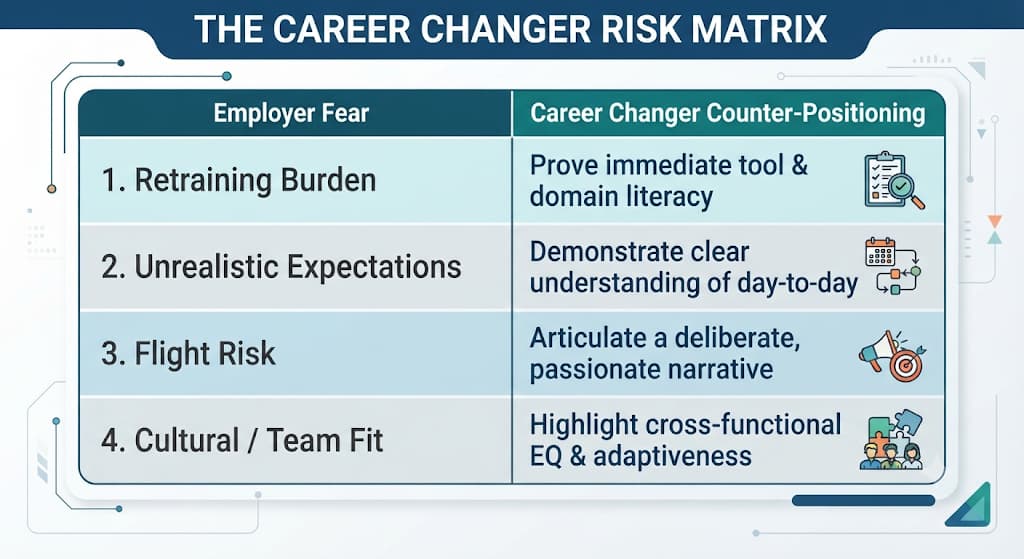
- Retraining Burden: Will this person require months of basic training, or can they hit the ground running with universal business skills?
- Domain Misunderstanding: Do they actually understand what this job entails daily, or are they chasing a romanticized idea of the industry?
- Flight Risk: Is this pivot a temporary reaction to burnout, or a deliberate, long-term career strategy?
- Execution Capability: Can they deliver measurable outcomes in our environment using our vocabulary and workflows?
Your entire application package—from your résumé and cover letter to your LinkedIn profile and interview answers—must systematically address these four concerns.
The Competitive Advantage of Diverse Experience
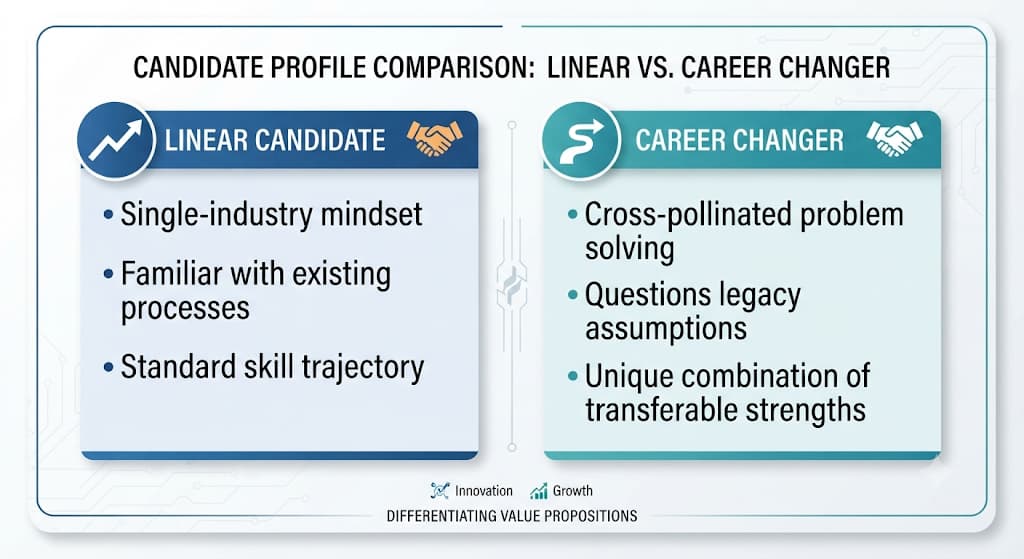
The most common mistake a career changer makes is apologizing for an unconventional background. In reality, cross-industry experience is a major competitive advantage.
Companies that only hire candidates from within their own industry suffer from institutional echo chambers. A career changer brings cognitive diversity, fresh perspectives, and cross-pollinated problem-solving techniques that linear candidates rarely possess.
Translating Non-Traditional Backgrounds into Enterprise Value
The table below illustrates how a career changer from various backgrounds can reframe past achievements into high-value enterprise capabilities:
Previous Industry | Target Industry & Role | Non-Traditional Asset | Enterprise Value Proposition |
K-12 Education | EdTech Customer Success Lead | Deep understanding of user adoption pain points in schools. | Reduces account churn by designing onboarding strategies tailored to actual educator workflows. |
Military Leadership | Corporate Supply Chain / Logistics | High-stakes operational crisis management and asset tracking. | Maintains supply chain resilience and SLA compliance during unpredictable market disruptions. |
Hospitality Management | SaaS Operations Analyst | Managing real-time P&Ls, vendor negotiations, and high-volume operations. | Streamlines operational bottlenecks, audits vendor contracts, and improves margin efficiency. |
Clinical Healthcare | HealthTech Product Manager | Direct experience with hospital EHR friction and regulatory compliance. | Guides software engineering teams to build compliant, clinician-friendly software features. |
Legal / Paralegal | Enterprise Compliance Manager | Rigorous contract analysis, risk discovery, and regulatory auditing. | Protects corporate entity from liability by building systematic compliance audit frameworks. |
Building Tangible Proof Before You Apply
To overcome the "lack of direct experience" obstacle, a career changer must move beyond theoretical knowledge. Telling an employer you are a quick learner is far less effective than showing them proof of execution.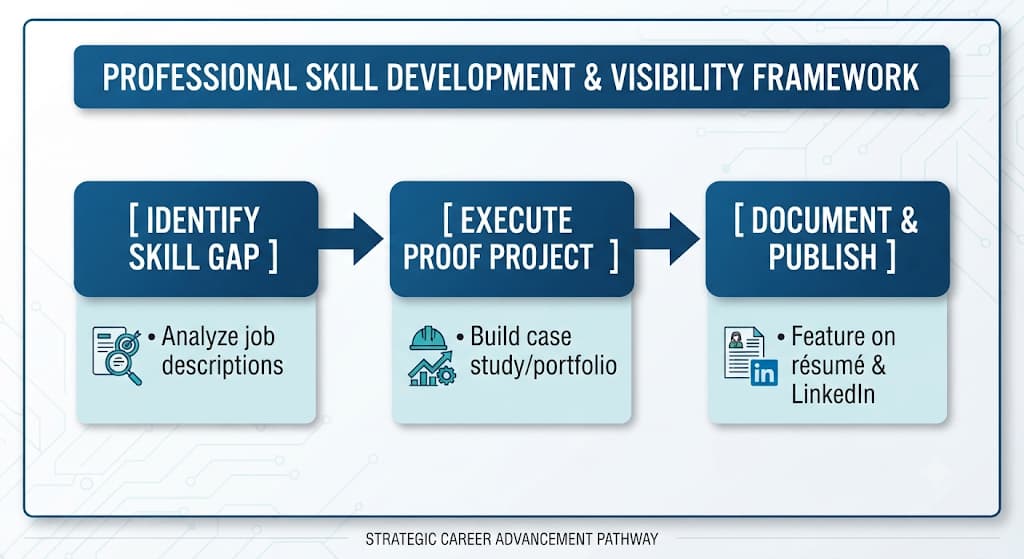
4 Low-Risk Ways to Build Proof-of-Work
- Independent Portfolio Case Studies: Download real-world datasets or public company challenges. Execute a complete project—such as a data analysis dashboard, an instructional design module, or a product tear-down—and publish the results on GitHub, Medium, or a personal website.
- Micro-Credentials & Industry Certifications: Complete recognized industry certifications (e.g., PMP, Certified ScrumMaster, Google Data Analytics, HubSpot Inbound) to prove foundational fluency in target methodologies.
- Pro Bono or Strategic Freelancing: Offer your target skills to non-profits, local businesses, or early-stage startups on a short-term project basis. Completing a 4-week freelance assignment gives you real-world metrics for your résumé.
- Advisory / Shadowing Initiatives: Request permission to shadow cross-departmental teams in your current company or participate in task forces that expose you to your target function.
Explaining the Move: Crafting Your Pivot Narrative
Every career changer must be prepared to answer one fundamental question in networking calls, cover letters, and interviews: "Why are you leaving your current field to do this?"
If your answer sounds unfocused, defensive, or negative about your past employer, interviewers will lose confidence. Instead, use the 3-Part Pivot Narrative Formula:
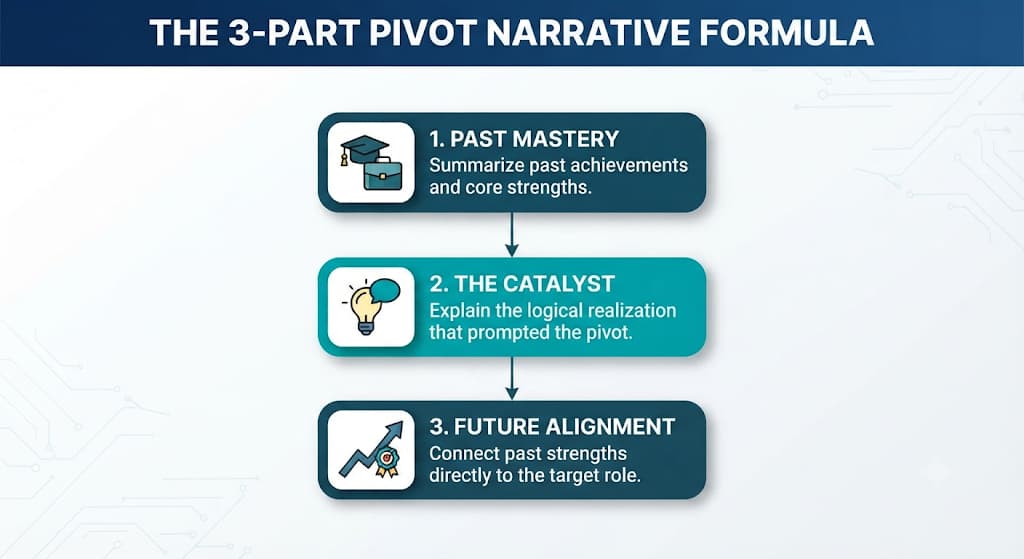
Pivot Narrative Example: Teacher Transitioning to Instructional Design
"Over the past seven years as an educator and curriculum lead, I developed deep expertise in designing outcome-based learning programs and measuring user engagement metrics across 150+ learners annually. While I loved classroom instruction, my most impactful work happened when I digitized our learning modules and trained faculty on instructional software. I realized that my passion lies in enterprise instructional systems design. I am now taking those core curriculum design, assessment analytics, and software tools to build scalable employee training solutions in the tech sector."
Strategic Networking for Career Changers
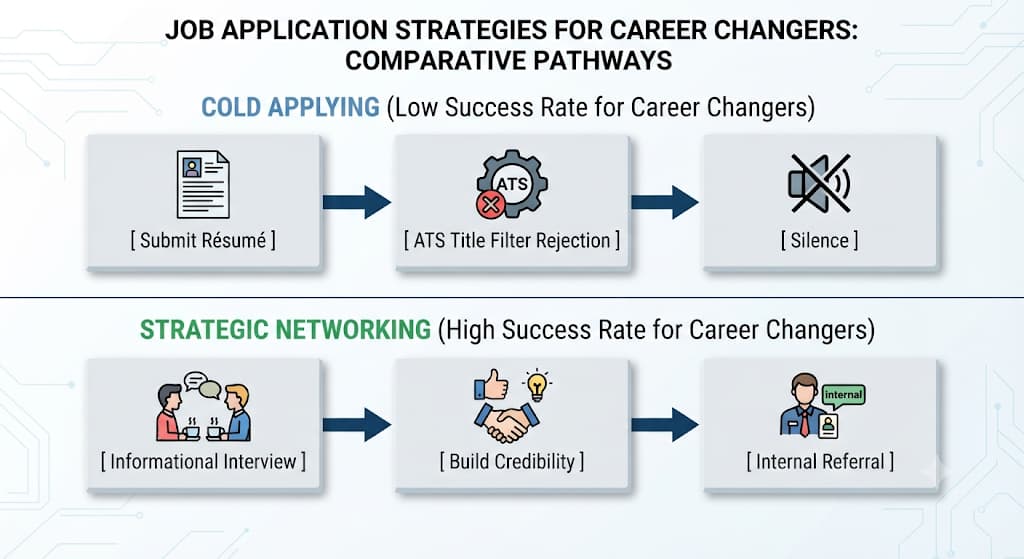
Applying cold through online job boards puts a career changer at a severe disadvantage, as automated Applicant Tracking Systems (ATS) and screeners prioritize matching past job titles.
To bypass the queue, a career changer must rely heavily on strategic network positioning.
How to Conduct Effective Outreach as a Career Changer
- Target the Right Contacts: Search LinkedIn for "peer changers"—professionals who successfully made the exact same career pivot you are attempting 1 to 3 years ago. They are far more likely to offer advice and referrals.
- Focus on Informational Interviews: Never reach out asking directly for a job. Request a 15-minute conversation to learn about their transition strategy and industry realities.
- Use the "Curiosity + Shared Background" Script:
SUBJECT: Fellow former educator / Quick question about your pivot to EdTech
Hi [Name],
I saw that you successfully transitioned from education into Customer Success at [Company] a couple of years ago—your trajectory is super inspiring!
I am currently in the middle of executing a similar pivot after 6 years in curriculum leadership. I would love to learn about how you translated your skills and what you wish you knew when you first made the leap.
Would you be open to a brief 15-minute virtual coffee sometime over the next two weeks?
Best regards,
[Your Name]
Résumé Positioning for the Modern Career Changer
To convert networking conversations into formal interviews, a career changer must structure their résumé using a Hybrid (Combination) Format.
Unlike a traditional chronological résumé that leads with past job titles, a hybrid résumé positions your target title, transferable core skills, and proof projects at the top of page one, while retaining a verified chronological work history below.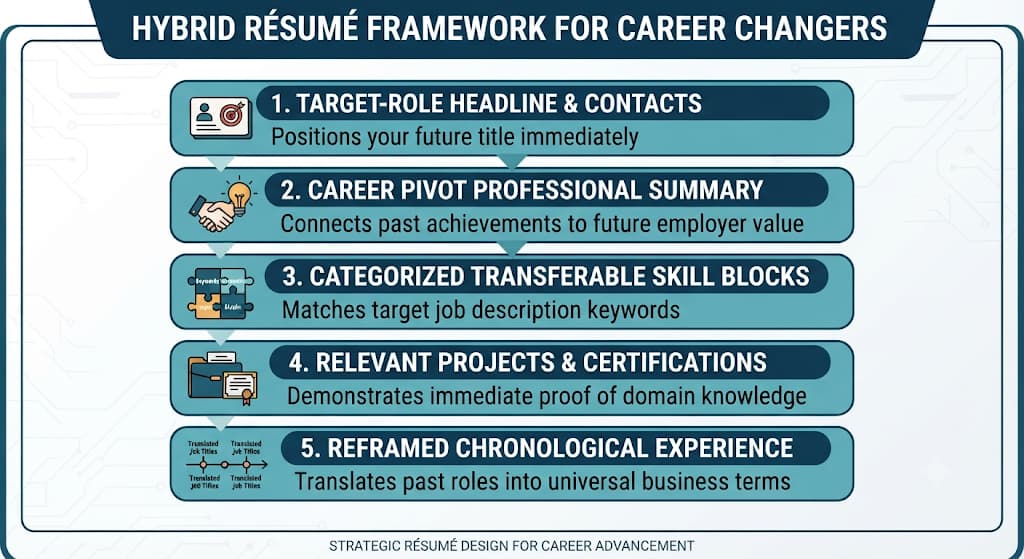
Managing Multiple Target Paths with Rocket Resume
If you are a career changer exploring two or three potential paths—such as Operations Management and Customer Success—sending a single generic résumé ensures rejection from both fields.
Rocket Resume simplifies the multi-path résumé challenge for career changers:
- Centralized Master Profile: Store your full employment history, metrics, education, and skill inventory once in a secure master profile.
- Instant Version Branching: Branch off dedicated, pre-formatted résumé versions tailored specifically for Path A (Operations), Path B (Customer Success), or Path C (Project Management) in seconds.
- ATS Keyword Matcher: Align your skills and summary keywords directly against specific job postings to pass automated screening filters.
- Matching Cover Letters: Generate tailored cover letters that articulate your career transition story for each application package.
- Asset Management Dashboard: Keep all your résumé versions and cover letters clearly organized, labeled, and ready to send.
Master the Interview: Frameworks and Sample Answers
When a career changer secures an interview, the goal shifts from proving technical qualifications on paper to demonstrating confidence, business maturity, and strategic alignment.
Common Interview Questions & Winning Strategic Answers
The table below contrasts how an unprepared career changer answers tough interview questions versus a strategically prepared candidate:
Common Interview Question | Unprepared Answer (Avoid) | Winning Strategic Answer (Use This) |
"Why do you want to leave your current industry?" | "I'm burned out, the pay is bad, and I don't see any career progression in my current field." | "I'm proud of what I built in my past field, but I discovered my strongest achievements occurred when solving [Target Skill] problems. I am making a deliberate pivot to bring those strengths to [Target Industry]." |
"You don't have direct experience in this role. How will you succeed?" | "I'm a really fast learner, and I'm willing to work hard from the bottom up to figure it out." | "While my job titles were in [Old Industry], the core mechanics of this role—vendor SLAs, process optimization, and risk compliance—are the exact deliverables I managed daily across a $3M operation." |
"How do we know you won't get bored and leave after six months?" | "Oh, I definitely won't leave. I really need a change and I'm very committed to this." | "This pivot is the result of a 12-month strategy where I earned my [Certification] and completed real-world projects. I am investing in this field for the remaining 15+ years of my career." |
Step-by-Step 90-Day Plan for Career Changers
Follow this 3-month strategic execution framework to transition cleanly into your new target industry:
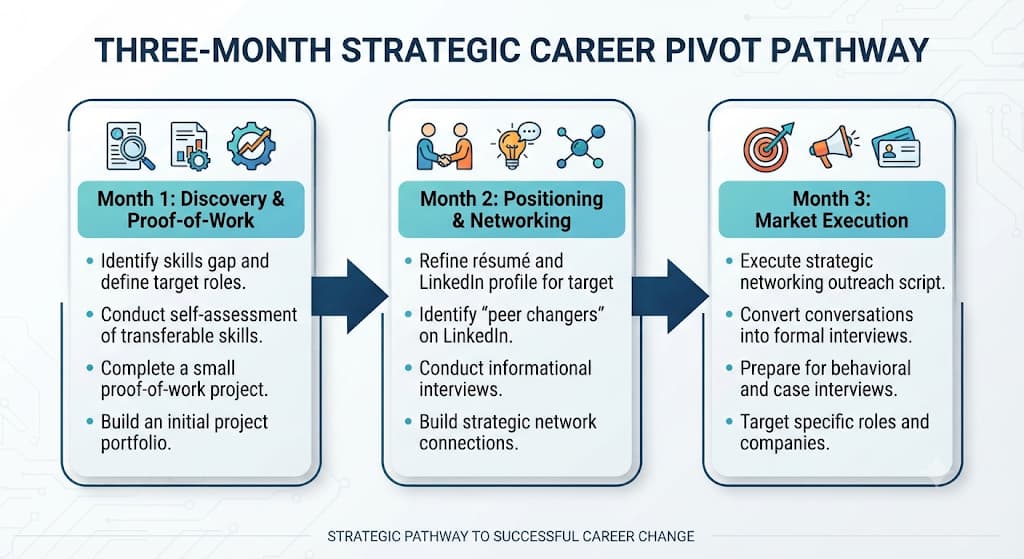
Month 1: Discovery & Proof-of-Work ──► Month 2: Positioning & Networking ──► Month 3: Market Execution
Month 1: Discovery & Proof-of-Work (Weeks 1–4)
- Week 1: Identify 2 target adjacent paths that value your transferable core strengths.
- Week 2: Audit 15+ job descriptions in your target field to catalog recurring keywords and technical tools.
- Weeks 3–4: Enroll in a targeted micro-credential and initiate a portfolio case study project to build proof-of-work.
Month 2: Positioning & Peer Outreach (Weeks 5–8)
- Week 5: Complete your portfolio project and publish the results online.
- Week 6: Build your Master Profile in Rocket Resume and generate tailored résumé versions for each target path.
- Weeks 7–8: Reach out to 10 "peer changers" on LinkedIn for informational interviews and refine your 3-part pivot narrative.
Month 3: Market Execution & Applications (Weeks 9–12)
- Week 9: Deploy targeted application packages (résumé + cover letter) to roles where you have built networking connections.
- Week 10: Optimize your LinkedIn profile headline, summary, and featured projects section to reflect your target field.
- Weeks 11–12: Conduct job interviews, utilize your pivot narrative frameworks, and negotiate your transition offer.
Frequently Asked Questions
What is the biggest mistake a career changer can make?
The biggest mistake is sending out a single, generic chronological résumé that uses old-industry jargon. A career changer must use a hybrid format, translate past achievements into universal business metrics, and tailor their application for every target job title.
Should a career changer take a pay cut when switching fields?
Not necessarily. If you execute an adjacent pivot—where you keep either your functional skill set or your industry domain knowledge constant—you can often preserve your seniority level and enter the new field at salary parity or higher.
How long does a typical career change take?
A well-executed career change typically takes between 3 to 6 months. This provides enough time to conduct informational interviews, build portfolio proof-of-work, earn targeted micro-credentials, and deploy customized application packages.
How do I pass ATS filters as a career changer without direct job titles?
Use a Hybrid Résumé Format that includes a Target-Role Headline and a dedicated Core Competencies section at the top of page one. Weave exact keywords from the target job posting into your summary, skill blocks, and bullet points.
Do I need to go back to college or get a Master's degree to change careers?
In most industries, no. Taking on student debt and stepping out of the workforce for two years is rarely necessary. Fast, targeted industry certifications combined with real-world portfolio projects are usually faster, cheaper, and more compelling to hiring managers.
Ready to Position Yourself for a New Role?
Start with your existing experience, build a tailored résumé for every career path you are considering, and keep every version organized in your Rocket Resume library.
Make your resume with our resume maker
Pick a template, then make a resume one section at a time.