Career Change at 30: How to Pivot Without Wasting Your Past
When testing different career paths, Rocket Resume lets you turn your core work history into multiple job-specific, ATS-optimized résumé versions built for every direction you choose to explore.


Career Change at 30: How to Pivot Without Wasting Your Past
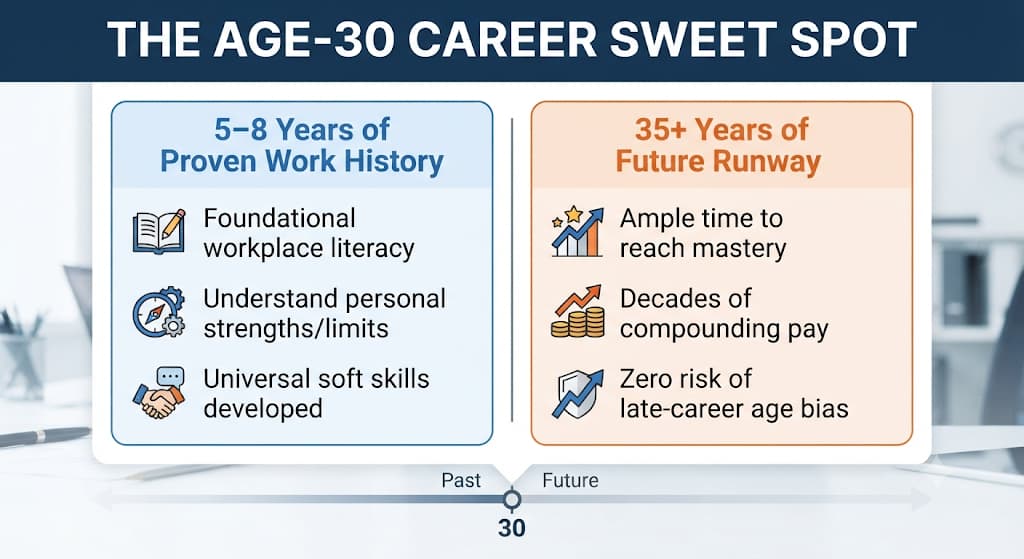
Making a career change at 30 is one of the most strategic moves you can make. At 30, you have built 5 to 8 years of tangible professional experience, developed soft skills, and clarified what you don't want—while retaining 35+ years of career runway ahead. By overcoming the psychological traps of sunk cost fallacy and peer comparison, avoiding unnecessary retraining, and testing multiple target directions with tailored résumés, you can pivot cleanly without starting over at the bottom.
When testing different career paths, Rocket Resume lets you turn your core work history into multiple job-specific, ATS-optimized résumé versions built for every direction you choose to explore.
Turning 30 often acts as a psychological catalyst. The idealism of your twenties collides with a sobering realization: I’ve spent almost a decade in this field, and I don't want to do this for the next thirty years.
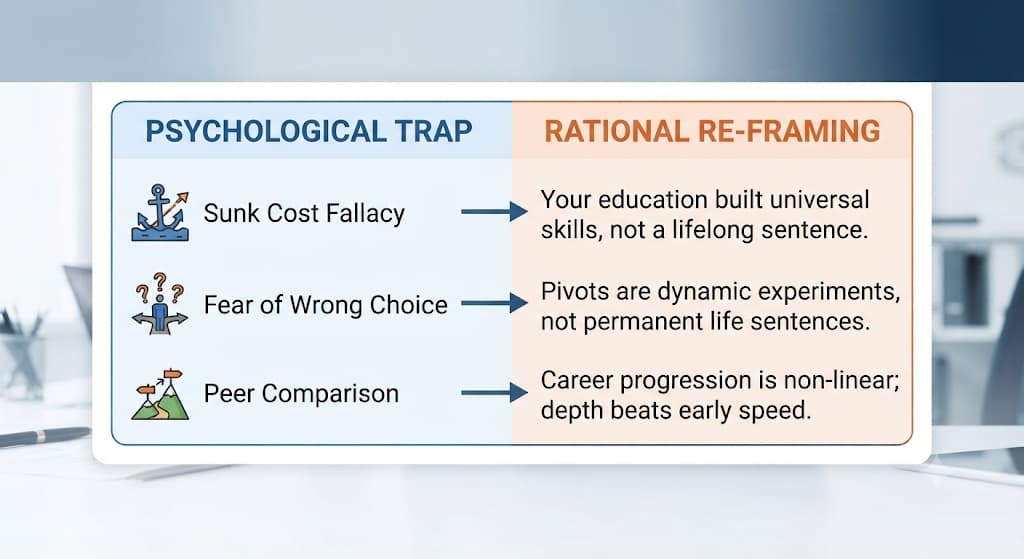
Yet, the decision to pivot at 30 is frequently paralyzed by three internal traps:
- The Fear of Choosing Incorrectly: What if I pivot to a new career and hate it just as much?
- Perceived Wasted Education: I spent four years getting this degree and five years building this title—if I leave, was it all a waste?
- Peer Comparison: My former classmates are buying homes or becoming managers. If I switch fields now, won't I fall behind?
The truth is that 30 is the ultimate sweet spot for a career pivot. You have enough real-world experience to bring immediate value to an employer, but you are young enough to build a 30-year trajectory in a completely new domain.
Overcoming the 3 Psychological Traps of Pivoting at 30
Before opening a job board or updating your résumé, you must resolve the mental roadblocks that hold 30-year-olds back.
1. Defeating the Sunk Cost Fallacy (Perceived Wasted Education)
The "sunk cost fallacy" is the belief that because you invested time, tuition, or effort into a specific degree or early career path, you must continue down that path forever.
A degree in Biology, Communications, or History earned at 22 is never wasted—it served as the training ground for your baseline professional literacy: critical thinking, written communication, data interpretation, and project completion. Employers hiring a 30-year-old care far more about your demonstrated execution and problem-solving abilities than the specific major printed on your diploma.
2. Overcoming the Fear of Choosing Incorrectly
Many 30-year-olds freeze because they are searching for their "one true passion." They worry that picking the wrong new path will permanently set them back.
Re-frame your pivot: you are not committing to a 30-year sentence; you are running a 2-year growth experiment. Modern careers are built in agile 3-to-5-year blocks. Switching to a field that is 70% better than your current situation builds momentum, expands your network, and gives you clearer data on what you enjoy.
3. Silencing Peer Comparison
Looking at former college peers on LinkedIn who have secured Director titles or higher salaries can trigger intense imposter syndrome.
Remember that career trajectories are non-linear. A professional who stays in a soul-crushing field just to maintain a title usually hits an energy ceiling by 35. Conversely, pivoting at 30 into an industry aligned with your natural strengths often results in rapid, compounding promotions that eclipse linear progression within five years.
Avoid Unnecessary Retraining: You Don't Need Another Degree
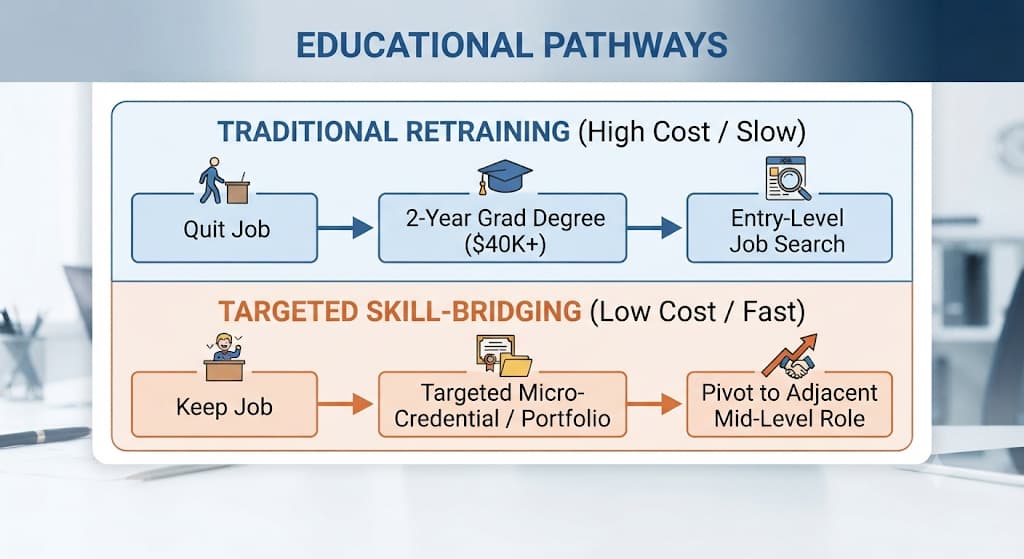
A common mistake 30-year-olds make when changing careers is immediately applying for a 2-year Master's program or an expensive $15,000 coding bootcamp.
In 80% of career pivots, getting a new degree is an expensive form of procrastination. Taking on student debt and stepping out of the workforce for two years costs you both tuition and lost income opportunity.
The 80/20 Rule of Career Change Skill Development
Most of what makes you valuable at 30 is your transferable core competence (stakeholder management, budgeting, project coordination, communication, analytical thinking). You only need to bridge the 20% technical gap specific to your new target role.
Fast, Cost-Effective Alternatives to Full Retraining
Target Career Pivot | Expensive Retraining (Avoid) | Targeted Skill Bridge (Do This) | Time to Complete |
Project Management | Master’s in Project Management ($30K+) | CAPM / PMP Certification or Google PM Certificate | 1 to 3 Months |
Data Analytics | B.S. in Data Science ($40K+) | SQL/Excel Course + 2 Tableau Portfolio Projects | 2 to 4 Months |
Customer Success | Master’s in Business Administration ($50K+) | Hubspot CRM Certificate + Portfolio Case Study | 1 Month |
Product Marketing | M.S. in Strategic Marketing ($35K+) | General Assembly Short Course + Marketing Audit Case Study | 1 to 2 Months |
UX Design | Full-Time Design Bootcamp ($15K) | Google UX Certificate + 2 Figma Case Studies | 3 to 6 Months |
Exploring Multiple Directions: The "Parallel Testing" Method
At 30, you don't need to pick a single target path right away. You can explore two or three parallel directions simultaneously to see where your background gets the most traction.
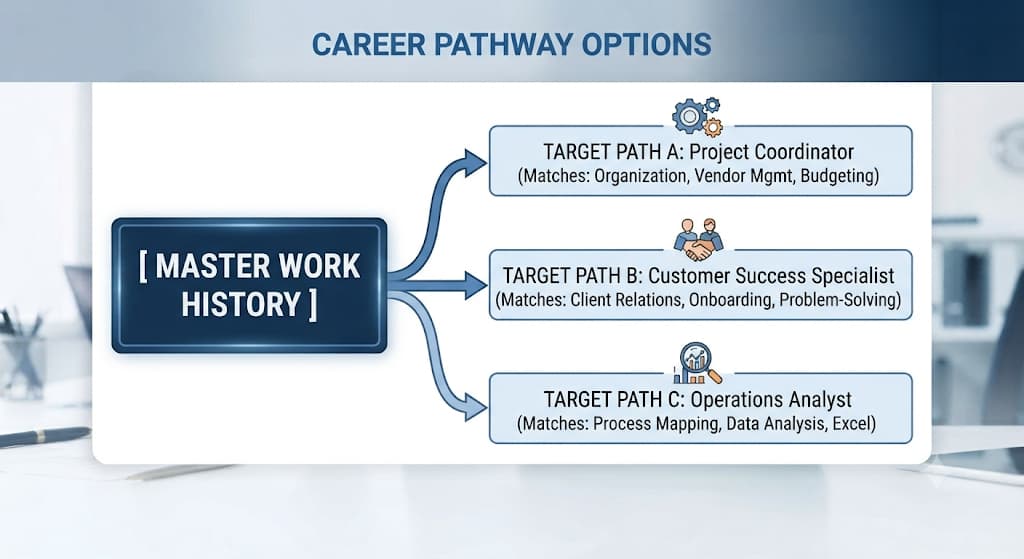
Suppose you have 6 years of experience as an Event Planner and want to pivot out of weekend event logistics. Your core skills could easily open doors in three distinct fields:
- Path A: Corporate Project Management (Focusing on timelines, vendor contracts, and budgets)
- Path B: Tech Customer Success Specialist (Focusing on account management, onboarding, and client retention)
- Path C: Corporate Operations Coordinator (Focusing on logistics, facility workflows, and vendor negotiation)
Instead of forcing yourself to choose one before applying, test all three paths concurrently.
Testing Paths with Separate, Targeted Résumés
Sending the exact same generic résumé to a Project Management role, a Customer Success role, and an Operations role ensures you will be rejected by all three.
A hiring manager reviewing applications for a Customer Success Specialist position wants to see client retention and onboarding language—not generic event logistics.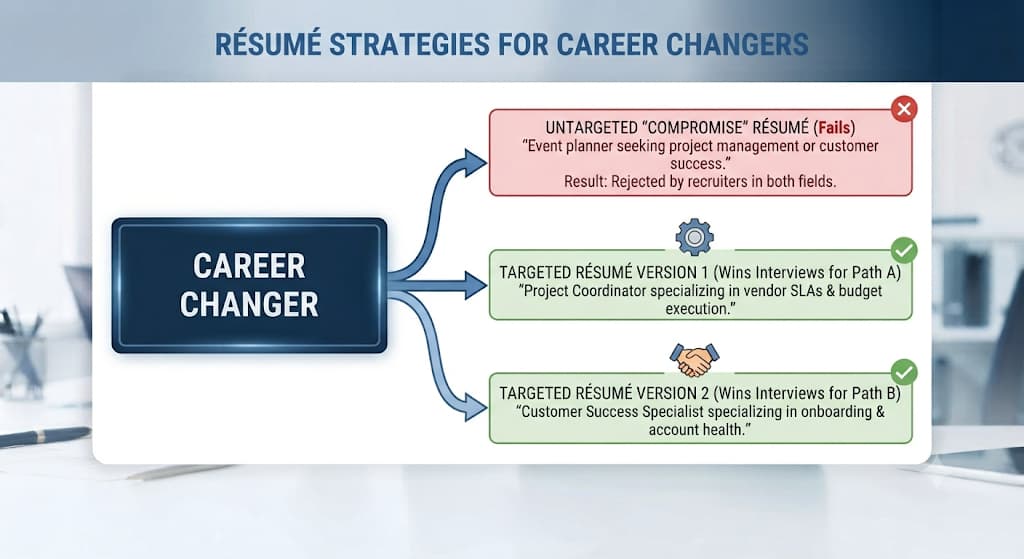
How to Reframe Your Experience for Different Paths
Below is an example of how a 30-year-old Retail Store Assistant Manager can reframe the exact same work history into two distinct targeted résumé versions:
Experience Category | Version A: Target Path = Operations Analyst | Version B: Target Path = Customer Success |
Target Job Title | Operations Specialist | Process Optimization | Customer Success Specialist | Client Onboarding |
Professional Summary Focus | Highlights inventory auditing, P&L management, and supply chain logistics. | Highlights customer satisfaction metrics, conflict resolution, and account retention. |
Skill Category 1 | Process Improvement & Workflow Automation | Client Lifecycle Management & Onboarding |
Skill Category 2 | Budgeting, Inventory Control & Vendor SLAs | Customer Relationship Management (CRM) & NPS |
Reframed Bullet Point | Audited weekly inventory workflows, reducing product variance by 14% across store operations. | Managed high-volume customer onboarding, maintaining a 96% positive satisfaction score over 2 years. |
Step-by-Step Guide to Repositioning Your 20s Experience
When writing your career change résumé at 30, apply this 4-part execution framework to reposition your early-career experience: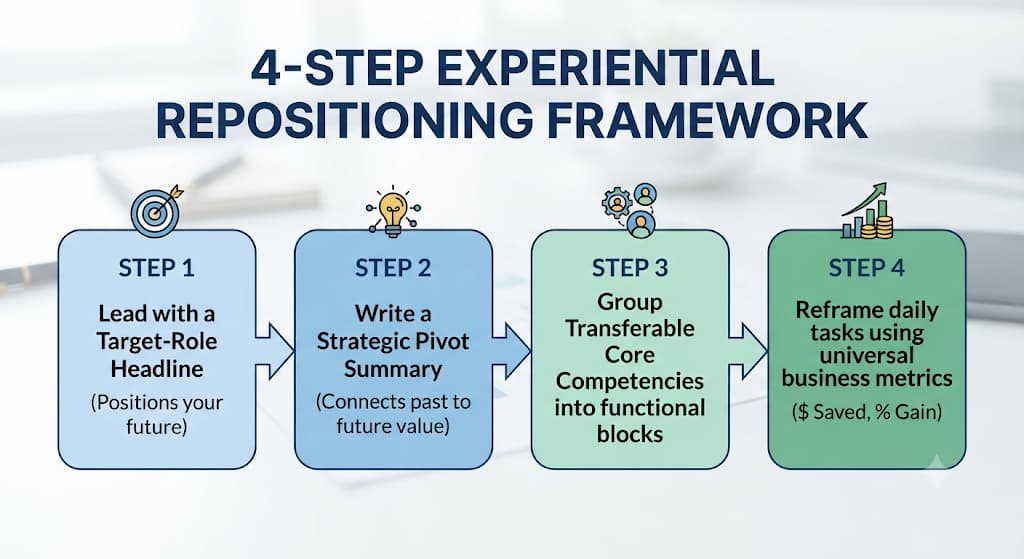
1. Use a Target-Role Headline
Place your target title at the top of your header so recruiters immediately understand your target path:
- ALEX CHEN | Project Coordinator & Operations Specialist | alex@email.com
2. Craft a Strategic Pivot Summary
Use this 3-sentence summary formula:
"Operations Specialist with 6+ years of experience managing vendor workflows, cross-functional project schedules, and resource allocation. Track record of reducing process bottlenecks by 20% through workflow automation. Applying proven project governance, budgeting, and stakeholder communication skills to enterprise IT project coordination."
3. Translate Industry Jargon into Universal Business Metrics
Original Bullet (Old Field Jargon) | Reframed Bullet (Universal Business Metric) |
Graded student papers and managed classroom behavior. | Evaluated 120+ performance deliverables weekly against quantitative benchmarks, maintaining a 94% retention rate. |
Coordinated restaurant table reservations and handled customer complaints. | Managed client onboarding and scheduling for high-volume operations, de-escalating service issues to maintain a 98% CSAT score. |
Answered phone calls and scheduled patient appointments at medical desk. | Administered front-office operations and patient intake systems, optimizing scheduling workflows to reduce wait times by 22%. |
Why You Need Multiple Résumé Versions (And How Rocket Resume Helps)
Managing multiple tailored résumés manually in Word or Google Docs quickly turns into a logistical mess of file versions, formatting errors, and inconsistent work histories.
Rocket Resume is built specifically to solve the multi-version challenge for career changers:
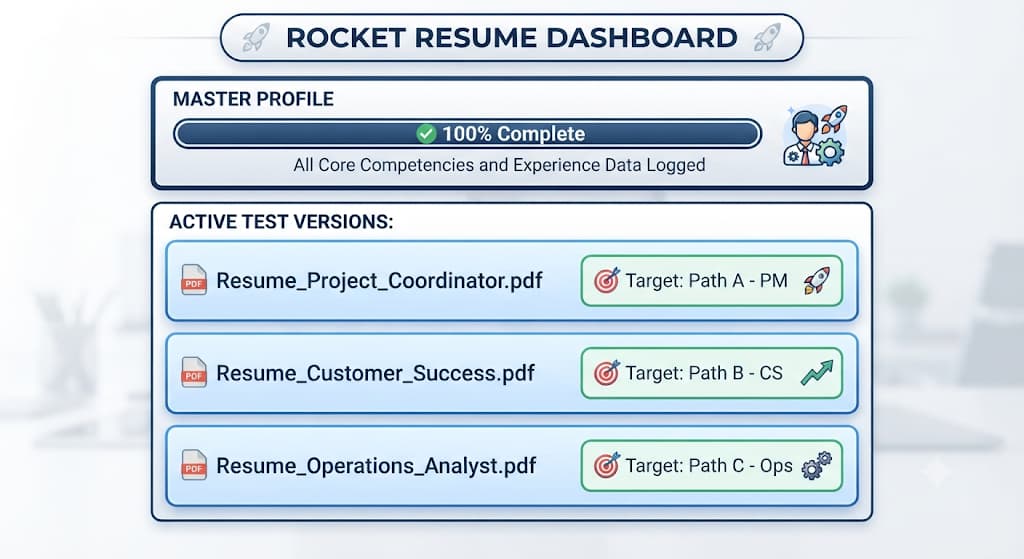
- Single Master History: Input your entire employment history, metrics, education, and credentials into one centralized master profile once.
- Instant Multi-Path Branching: Generate separate, tailored résumé versions for Path A (Project Management), Path B (Customer Success), or Path C (Operations) in minutes.
- ATS Keyword Matching: Match your experience against target job descriptions to ensure your pivot résumé passes Applicant Tracking System algorithms.
- Tailored Cover Letters: Instantly build matching cover letters that articulate your pivot narrative for each specific application.
- Organized Dashboard: Keep all your résumé versions clearly named, formatted, and accessible in one place so you never send the wrong document.
90-Day Pivot Plan for 30-Year-Olds
Execute your career change over a structured 3-month timeline while keeping your current job:
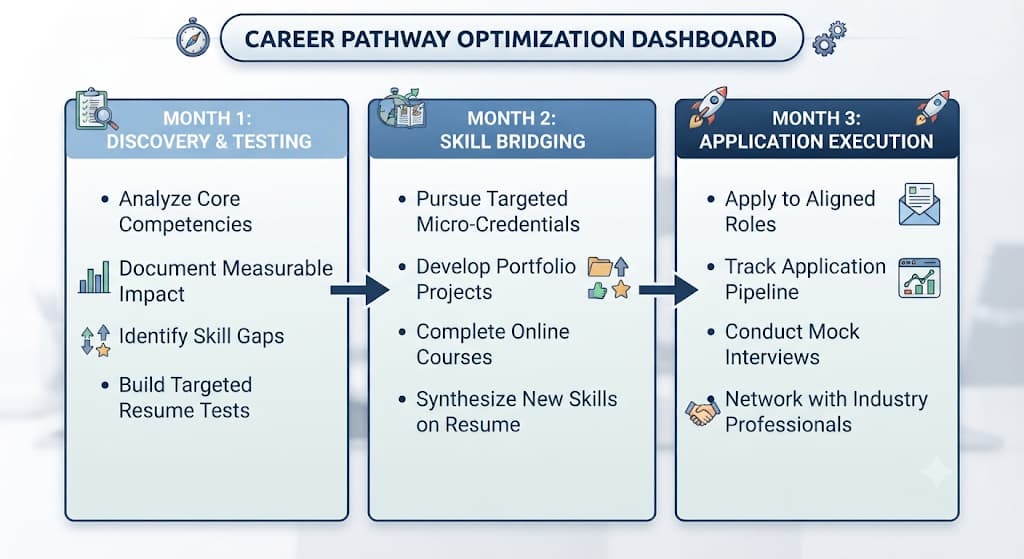
Month 1: Discovery & Path Selection (Weeks 1–4)
- Week 1: Identify 2 or 3 target career paths that share transferable skill overlaps with your current role.
- Week 2: Conduct 3 informational interviews on LinkedIn with professionals working in those target roles.
- Weeks 3–4: Audit target job postings to identify recurring skill keywords and software requirements.
Month 2: Skill Bridging & Proof-of-Work (Weeks 5–8)
- Week 5: Enroll in a targeted micro-credential (e.g., Google PM Certificate, ScrumMaster, or SQL course) to bridge your technical gap.
- Weeks 6–7: Complete a real-world case study or portfolio project demonstrating hands-on tool usage.
- Week 8: Build your Master Profile in Rocket Resume and generate tailored résumé versions for each path.
Month 3: Market Testing & Execution (Weeks 9–12)
- Week 9: Deploy 5 applications per week using your targeted résumé versions and track response rates.
- Week 10: Optimize your LinkedIn profile headline and summary to align with your top-performing target path.
- Weeks 11–12: Interview for target positions, refine your pivot narrative, and negotiate your offer.
Frequently Asked Questions
Is 30 too late to make a career change?
No. 30 is the sweet spot for changing careers. You have built 5 to 8 years of professional experience, communication skills, and workplace maturity, while retaining 35+ years of active career runway ahead.
Will I have to take an entry-level pay cut changing careers at 30?
Not if you pivot into an adjacent role that values your transferable core skills (e.g., moving from sales into customer success, or teaching into corporate instructional design). You can often enter at mid-level compensation.
Should I go back to school for a Master's degree at 30?
In 80% of cases, no. Full-time graduate programs cost tens of thousands of dollars and take two years of lost earning potential. Short, industry-recognized certifications combined with portfolio projects are faster, cheaper, and more effective.
How do I explain my career change in an interview?
Use a positive, forward-looking narrative: "Over the past 6 years in [Old Field], I developed deep expertise in [Transferable Skill A] and [Transferable Skill B]. I realised my strongest work happens when I am solving [Target Domain Problems], which is why I am transitioning those core strengths into [Target Role]."
How many different résumés should I use during a career change?
You should create a separate, tailored résumé version for every distinct target job title you pursue (e.g., one version for Project Management and another for Customer Success). Using tools like Rocket Resume allows you to manage multiple versions effortlessly.
Ready to Pivot Your Career at 30?
Start with your existing experience, create a tailored résumé for every career path you are considering, and keep every version organized in your Rocket Resume library.
Browse our resume templates
Pick a design you like, then fill in your resume one section at a time.