Career Change after 50: How to Pivot, Overcome Age Bias, and Protect Your Retirement
By shifting into flexible, knowledge-based, and less physically demanding roles, addressing age bias head-on, and applying the 10-to-15-year résumé rule, you can execute a fulfilling career pivot while safeguarding your retirement and benefits.


A career change at 50 is not about competing with 25-year-olds on technical hustle—it is about leveraging three decades of institutional wisdom, emotional intelligence, and operational leadership. By shifting into flexible, knowledge-based, and less physically demanding roles, addressing age bias head-on, and applying the 10-to-15-year résumé rule, you can execute a fulfilling career pivot while safeguarding your retirement and benefits.
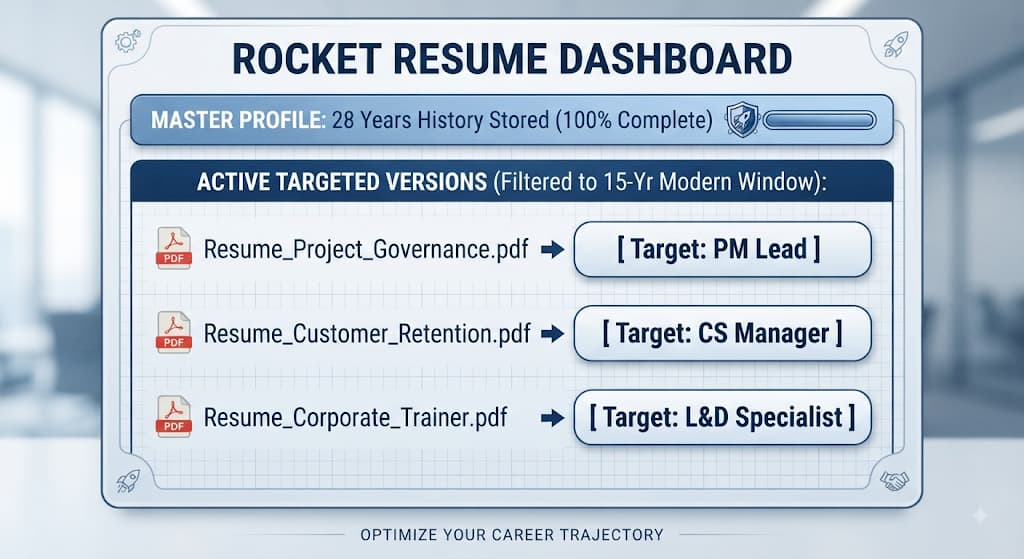
When translating a 25-to-30-year career history into targeted applications, Rocket Resume allows you to maintain a comprehensive master profile while generating focused, age-proofed résumé versions for every path you explore.
Turning 50 is a major professional milestone. For many, it brings a clear realization: you may have 15 to 20 years of active, high-value career runway remaining before traditional retirement, yet staying in your current role or physically taxing industry feels unsustainable.
Whether you are seeking to reduce workplace stress, avoid physical burnout, escape toxic corporate environments, or pursue a long-deferred passion, pivoting careers at 50 is increasingly common.
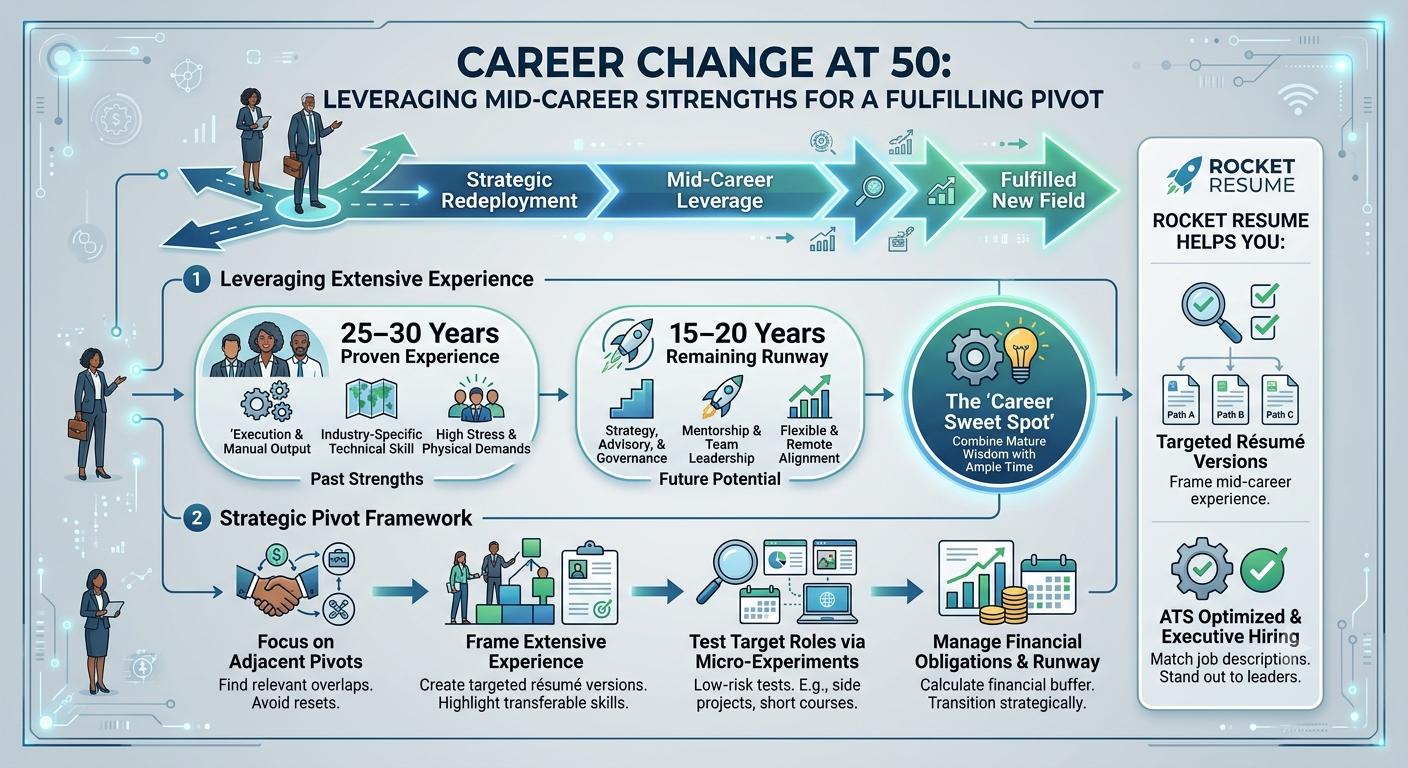
However, pivoting at 50 requires a vastly different strategy than pivoting at 30. You must navigate real-world challenges—such as unspoken age bias, technology gap perceptions, health insurance continuity, and retirement vesting schedules—without sacrificing the seniority you have spent decades earning.
Overcoming Age Bias and the "Overqualified" Label
Ageism in hiring is an unfortunate reality, but understanding why hiring managers hesitate allows you to proactively dismantle their objections before they become rejections.
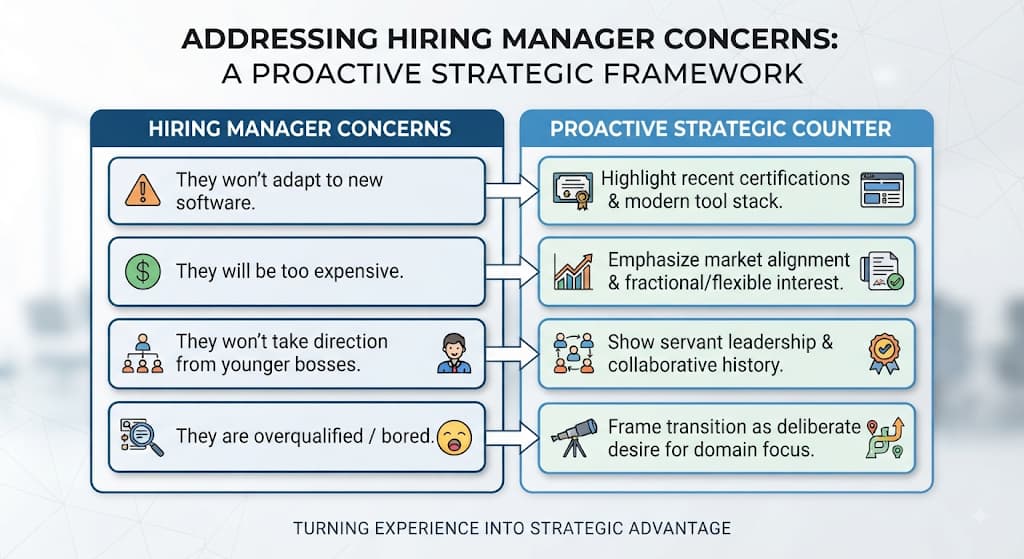
When recruiters label a 50+ applicant as "overqualified," they are rarely worried that you know too much. Instead, they are usually expressing three hidden fears:
- Salary Expectations: Will you demand an executive salary that exceeds their department budget?
- Management Friction: Will you be comfortable reporting to a 32-year-old manager?
- Flight Risk: Will you leave as soon as a higher-level role opens up elsewhere?
How to Neutralize Overqualification Concerns
- Frame the Pivot as Intentional: Explicitly state in your professional summary and cover letter why you are seeking this specific role. For example: "Seeking to leverage 25 years of operational leadership to focus entirely on hands-on project delivery and cross-functional team enablement."
- Emphasize Collaboration Over Hierarchy: Use vocabulary that highlights your adaptability and willingness to support team goals rather than command authority.
- Demonstrate Enthusiasm for Modern Work Culture: Highlight your experience working in flat organizations, asynchronous remote environments, and agile team structures.
Financial Realities: Protecting Benefits, Pensions, and Retirement
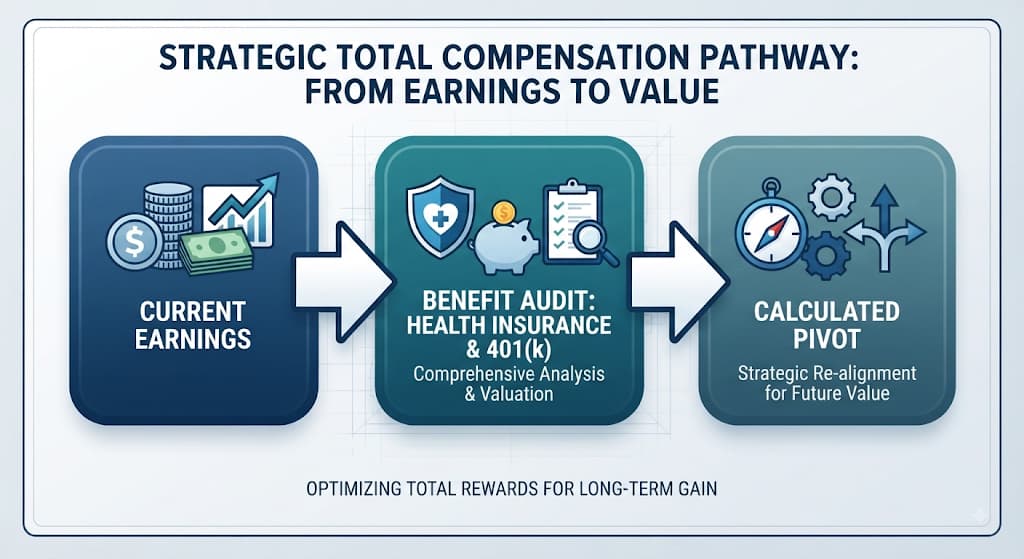
At 50, every career move must be evaluated through the lens of your long-term retirement security. You are entering your peak catch-up contribution years for retirement accounts, making benefit continuity critical.
Key Financial Considerations Before Pivoting at 50
- The 401(k) Catch-Up Rule: IRS regulations allow individuals aged 50 and older to make additional catch-up contributions to 401(k), 403(b), and IRA accounts. Ensure your new target role offers compensation that allows you to maximize these catch-up limits.
- Vesting Schedule Cliff Audit: If your current employer offers matched retirement contributions, equity grants, or pension benefits, audit your vesting schedules before resigning. Leaving six months before a major vesting cliff can cost tens of thousands of dollars.
- Bridging the Health Insurance Gap: If you are transitioning into contract, freelance, or small-business roles, factor in the cost of private health coverage or COBRA until you reach Medicare eligibility at age 65.
Financial Risk Comparison Table for 50+ Career Pivots
Transition Type | Income Impact | Benefit Security | Pension/401(k) Impact | Recommended Risk Strategy |
Adjacent Corporate Move | Parity or 5–10% Increase | Full Employer Benefits | Continuous Contributions | Low Risk: Ideal for preserving retirement growth |
Corporate to EdTech / Non-Profit | 10–20% Reduction | Full Employer Benefits | Potential Access to 403(b) / Public Pensions | Moderate Risk: Balance with catch-up contributions |
Full-Time to Fractional / Advisory | Variable (High Upside) | Self-Funded Benefits | Requires Solo 401(k) / SEP-IRA Setup | High Risk: Requires 12-month financial cushion |
Shift to Less Demanding Field | 20–30% Reduction | Varies (Verify Part-Time Benefits) | Lower Contribution Floor | Calculated Risk: Assess against lowered lifestyle costs |
Bridging Technology Gaps (Without Getting a Computer Science Degree)
One of the most persistent stereotypes facing 50+ job seekers is the assumption that they resist modern software tools or rely on outdated administrative habits.
You do not need to become a software engineer to disprove this myth. You simply need to demonstrate comfort with the standard cloud-based productivity stack used by modern workplaces.
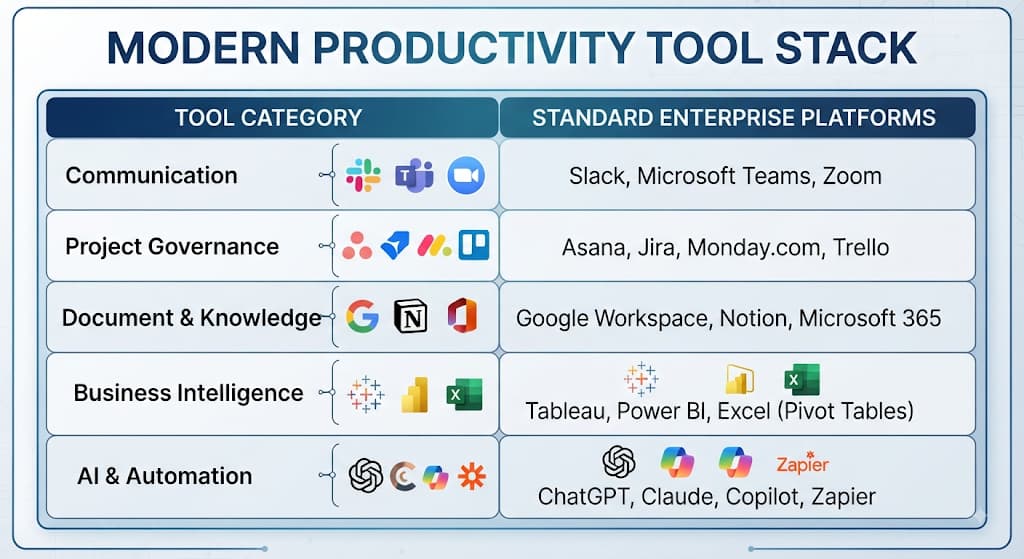
3 Ways to Prove Tech Fluency on Your Résumé
- Purge Outdated Software References: Remove references to obsolete platforms (e.g., Lotus Notes, Windows 95, WordPerfect, early proprietary databases). Listing ancient tools signals that your technical knowledge stopped updating years ago.
- Highlight Modern SaaS Tools: Explicitly list modern collaboration software in your skills section (e.g., Slack, Asana, Google Workspace, Jira, Salesforce).
- Showcase AI Tool Usage: Mention familiarity with modern AI productivity tools (e.g., "Leveraged generative AI tools for rapid documentation, research aggregation, and workflow optimization"). This signals that you stay ahead of workplace trends.
How Much Experience to Show: The 10-to-15-Year Rule
The biggest mistake 50+ job seekers make on their résumé is documenting every job they have held since the 1990s. A 4-page résumé detailing entry-level roles from 30 years ago invites age discrimination and buries your most relevant skills.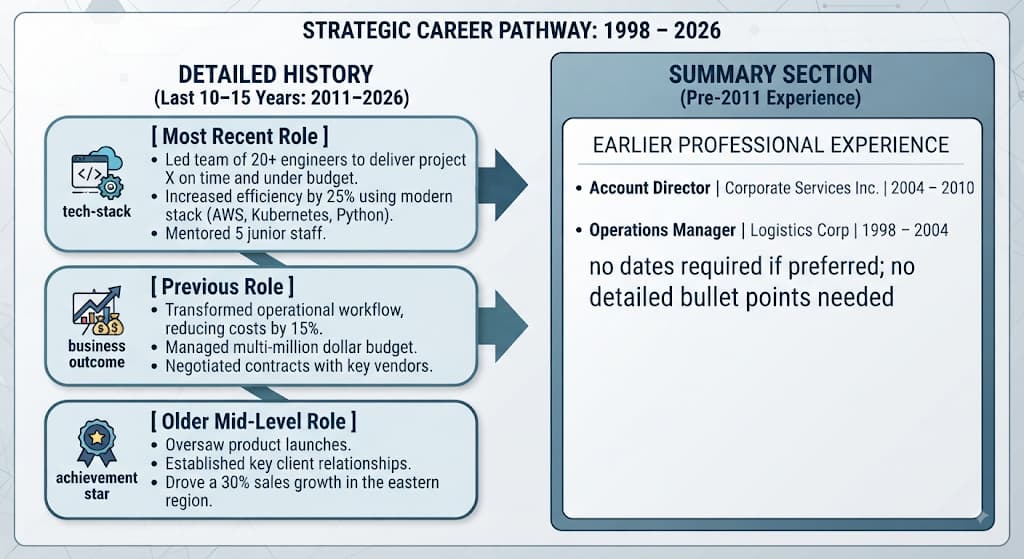
Essential Formatting Rules for 50+ Résumés
- Apply the 15-Year Cutoff: Focus 85% of your résumé space on experience gained within the last 10 to 15 years.
- Create an "Earlier Experience" Section: If you want to acknowledge earlier foundational roles, list them in a brief, un-dated section at the bottom (e.g., "Earlier Career Highlights includes Sales Manager at Enterprise Corp and Operations Analyst at Regional Co.").
- Remove Graduation Dates: Omit high school and college graduation years from your Education section. List your degree and institution name only.
- Modernize Contact Information: Replace full home street addresses with just City and State. Ensure your email handle is clean (e.g., firstname.lastname@gmail.com, avoiding legacy ISP handles like @aol.com or @comcast.net) and include an updated LinkedIn profile URL.
Transitioning into Flexible and Less Physically Demanding Roles
For professionals coming from high-stress corporate environments, healthcare, retail, or physical trades, a primary goal at 50 is transitioning into roles that offer better work-life balance and lower physical strain.
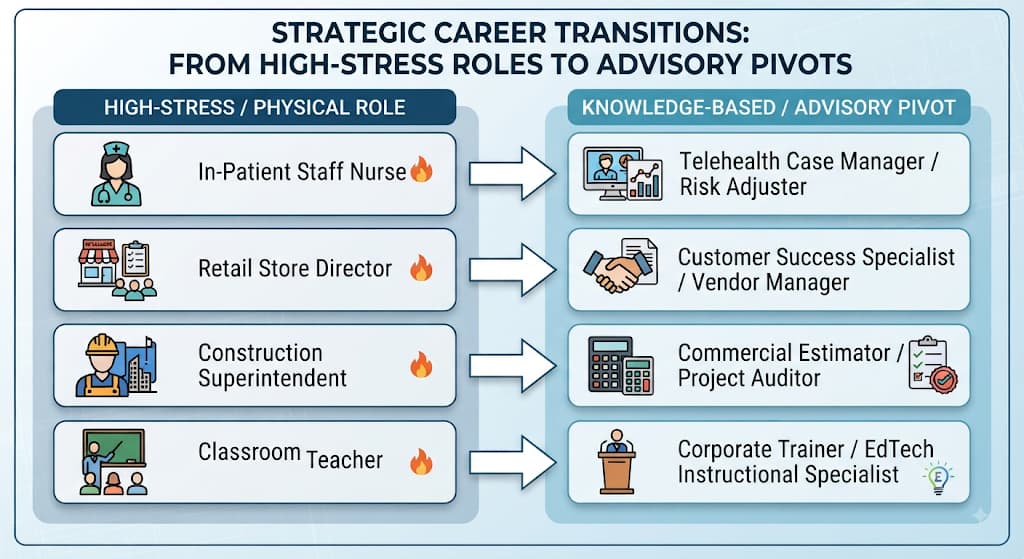
High-Growth, Flexible Fields Welcoming 50+ Candidates
- Customer Success Management (CSM): Tech and B2B service companies value mature professionals who know how to build long-term relationships, de-escalate unhappy clients, and manage retention.
- Project Governance & Scrum Master Roles: Managing timelines, budgets, and team alignment relies heavily on emotional intelligence and organization—skills that peak in mid-to-late career.
- Risk Management, Audit & Compliance: Regulatory compliance and risk management roles prioritize experience, domain authority, and attention to detail over raw technical execution.
- Corporate Training & Knowledge Management: Enterprise companies frequently hire experienced practitioners to build internal training programs and mentor junior employees.
Before-and-After Translation Matrix for 50+ Professionals
The table below illustrates how 50+ professionals can translate decades of industry experience into modern, business-focused vocabulary:
Past Career Background | Target Role | Unconverted Legacy Bullet Point | Reframed Modern Pivot Bullet Point |
25-Yr Classroom Teacher | Corporate L&D Specialist | Taught high school biology for 20+ years and served as department head for 8 years. | Directed curriculum design and performance evaluations across an 8-person team, implementing learning analytics to boost engagement by 28%. |
20-Yr In-Patient Nurse | Clinical Risk Analyst | Worked 12-hour shifts in ICU managing patient care, updating charts, and ordering supplies. | Audited clinical workflows against regulatory health standards, mitigating operational risk and training 30+ staff members on compliance software. |
28-Yr Retail District Manager | Customer Success Lead | Managed 12 retail locations, handled customer complaints, and ran monthly inventory counts. | Managed client retention strategy across 12 high-volume accounts, utilizing CRM analytics to reduce account churn by 14% and oversee $6M in annual revenue. |
22-Yr Manufacturing Lead | Supply Chain Project Manager | Supervised factory floor workers, maintained equipment schedules, and ordered raw materials. | Orchestrated supply chain vendor procurement and SLA management, executing process optimization initiatives that reduced production downtime by 19%. |
25-Yr Corporate Accountant | Financial Systems Consultant | Handled monthly closing, audited general ledgers, and prepared tax filings for corporate clients. | Advised enterprise clients on financial system integration and internal audit governance, streamlining reporting cycles using modern ERP platforms. |
Why 50+ Career Changers Need Multiple Targeted Résumés
When pivoting at 50, attempting to use a single, generic résumé that summarizes 25+ years of varied experience is a guaranteed way to fail.
A generic résumé created by a 50+ professional often ends up reading like an overwhelming biography rather than a focused marketing document.
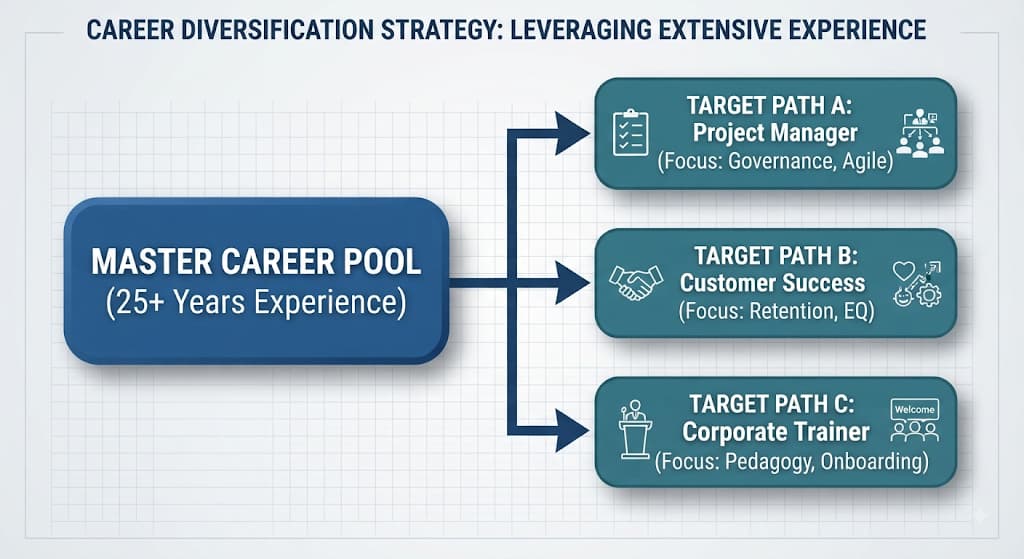
If you apply for a Project Manager position with a résumé that devotes equal space to old sales tasks, manual operations, and general administrative work, the hiring manager will assume you lack focus.
How Rocket Resume Simplifies the Pivot at 50
Rocket Resume is engineered to help mid-to-late career professionals organize decades of experience into targeted, age-proofed documents:
- Centralized Master Career Pool: Store your full 25-to-30-year work history, past achievements, certifications, and metrics in one secure master dashboard.
- 10-to-15-Year Targeted Exporting: Easily filter and pull experience from your master pool to generate sleek 2-page résumés focused strictly on the last 10 to 15 years.
- Instant Version Branching: Create separate, tailored résumés for Path A (Project Management), Path B (Customer Success), or Path C (Consulting) without retyping your history.
- Age-Proofed Template Design: Access modern, ATS-friendly résumé layouts that present your experience clearly without triggering age bias filters.
Matching Cover Letters: Generate tailored cover letters that articulate your career transition narrative and explain your passion for the target field.
Executing a successful career change at 50 requires a deliberate, structured approach over a three-month timeline:
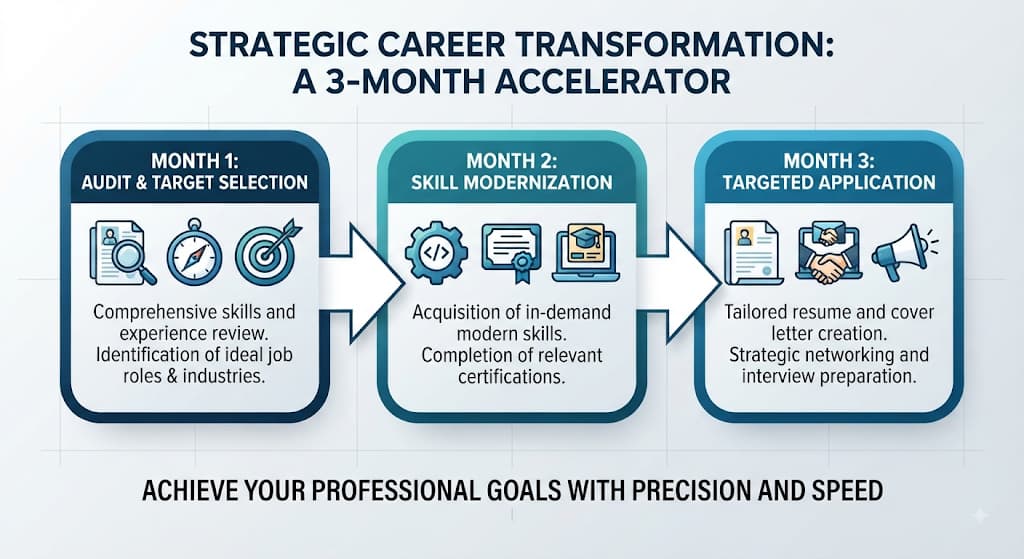
Month 1: Audit & Target Selection (Weeks 1–4)
- Week 1: Conduct a Financial & Retirement Audit. Review 401(k) vesting schedules, catch-up contribution goals, and health insurance requirements.
- Week 2: Identify 2 target fields that value maturity, emotional intelligence, and domain authority (e.g., Customer Success, Project Management, Compliance, Corporate Training).
- Weeks 3–4: Connect with 5 professionals aged 45–60 on LinkedIn who work in your target fields to conduct informational interviews.
Month 2: Skill Modernization & Proof-of-Work (Weeks 5–8)
- Week 5: Audit the technology requirements of target job descriptions and complete a short, recognized micro-credential (e.g., Google Project Management, Hubspot, or Certified ScrumMaster).
- Week 6: Familiarize yourself with modern workplace tools like Slack, Asana, and Google Workspace.
- Weeks 7–8: Build a real-world case study or take on a short advisory/freelance project to prove immediate, hands-on execution.
Month 3: Résumé Age-Proofing & Application (Weeks 9–12)
- Week 9: Build your Master Career Pool in Rocket Resume. Apply the 15-year rule, remove college graduation dates, and generate age-proofed, role-specific résumés.
- Week 10: Update your LinkedIn headline to align with your target role and join relevant industry networking groups.
- Weeks 11–12: Submit tailored applications, follow up with warm contacts, and practice modern interview framing.
Frequently Asked Questions
Is 50 too late to make a career change?
No. At 50, you have 15 to 20 years of active workforce runway remaining—roughly equivalent to the time between age 30 and age 50. Employers increasingly value mature professionals who bring operational stability, leadership, and emotional intelligence.
How do I handle age bias during job interviews?
Focus the conversation on your adaptability, enthusiasm for modern tools, and track record of solving business problems. Address stereotypes indirectly by demonstrating fluency with modern software, expressing excitement about learning new systems, and showing comfort working in collaborative, multi-generational teams.
Should I remove old experience from my résumé?
Yes. Limit your detailed employment history to the last 10 to 15 years. Older experience prior to 2011 can be summarized briefly in an un-dated "Earlier Experience" section at the end of your document.
How do I explain wanting to step down from a high-level role to an individual contributor role?
Frame your pivot around impact and domain focus. Explain that you want to step away from administrative corporate bureaucracy to focus 100% of your energy on hands-on execution, mentoring, and delivering direct outcomes in your target field.
Do I need to take a massive pay cut when pivoting at 50?
Not necessarily. By executing an adjacent pivot—where you keep your industry knowledge constant while changing your functional role (or vice versa)—you can often maintain your income level while reducing stress and physical demands.
Ready to Execute Your 50+ Career Pivot?
Start with your existing experience, create an age-proofed, tailored résumé for every career path you are considering, and keep every version organized in your Rocket Resume library.
Browse our resume examples
See what each section can say, then write your own resume one section at a time.