Career Change at 40: How to Pivot Without Starting Over
How to change careers at 40 with an adjacent pivot that preserves seniority and pay, a 6-to-9-month financial runway, five low-risk micro-experiments, and resume tactics like the 15-year rule.


A career change at 40 is not a reset—it is a strategic redeployment of mid-career leverage. At 40, you possess 15–20 years of leadership, emotional intelligence, and business acumen that entry-level candidates simply cannot match. By focusing on adjacent career pivots, testing target roles through low-risk micro-experiments, and managing financial obligations with a calculated runway, you can transition into a fulfilling new field without sacrificing your seniority or income.
When exploring multiple directions, Rocket Resume helps you frame your extensive mid-career experience into targeted, role-specific résumé versions optimized for Applicant Tracking Systems (ATS) and executive hiring managers.
Reaching age 40 often brings a stark professional realization: you have spent nearly two decades building expertise in a field, yet the path ahead no longer inspires you. The instinct to pivot is frequently met with immediate anxiety: Can I afford to take a pay cut with a mortgage and family obligations? Will I have to start over at the bottom reporting to someone ten years younger? Is it too late to enter a completely new industry?
The answer is no.
At 40, you are in a unique career sweet spot. You still have 20 to 25 years of active career runway ahead of you—more time than you have already spent in the workforce—while possessing mature leadership, strategic thinking, and institutional wisdom that entry-level candidates lack.
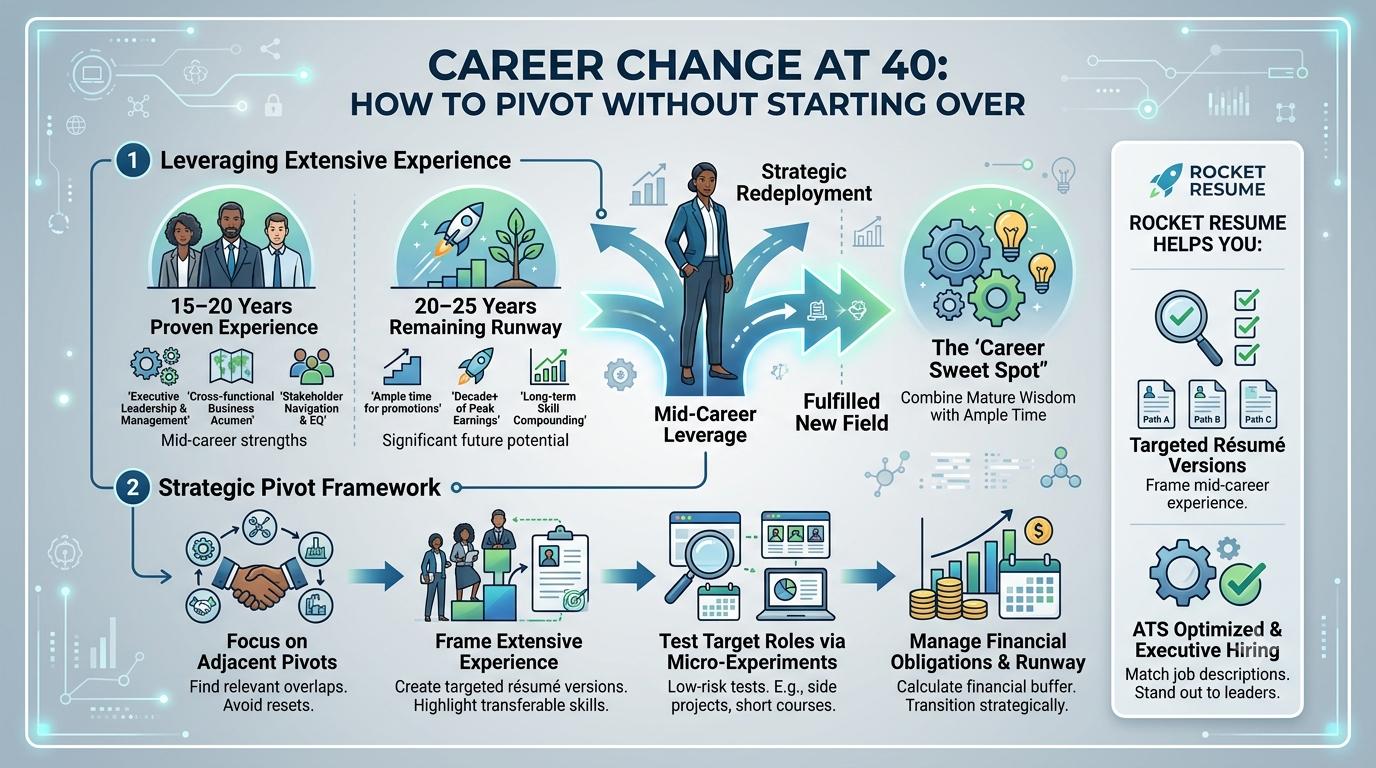
Making a successful career change at 40 is not about throwing away your past work. It is about executing an adjacent pivot that transfers your established seniority into a new, higher-growth context.
The 40+ Advantage: Why Employers Hire Mid-Career Changers
While ageism exists in some sectors, forward-thinking employers actively seek out mature professionals making deliberate career shifts. Younger workers may understand the latest software tools, but professionals at 40 offer rare operational stability:
- Executive Emotional Intelligence (EQ): You know how to navigate organizational politics, deliver constructive feedback, diffuse workplace conflict, and manage executive expectations.
- Crisis Management & Resilience: Having navigated economic downturns, organizational restructures, and failed projects, you do not panic when priorities shift.
- Business Acumen: You understand how companies actually generate revenue, control costs, manage risk, and serve stakeholders—knowledge that takes decades to acquire.
- Vendor & Stakeholder Governance: You have spent years running meetings, negotiating contracts, and aligning cross-functional teams toward business goals.
Your objective when pivoting at 40 is not to compete on technical execution alone; it is to position yourself as a high-leverage leader who brings immediate operational maturity to a new domain.
Managing Financial and Family Obligations During a Pivot
The primary barrier to a career change at 40 is financial risk. Unlike a 22-year-old who can live with roommates while taking an unpaid internship, a 40-year-old often manages fixed overhead: mortgages, childcare, healthcare, insurance, and retirement planning.
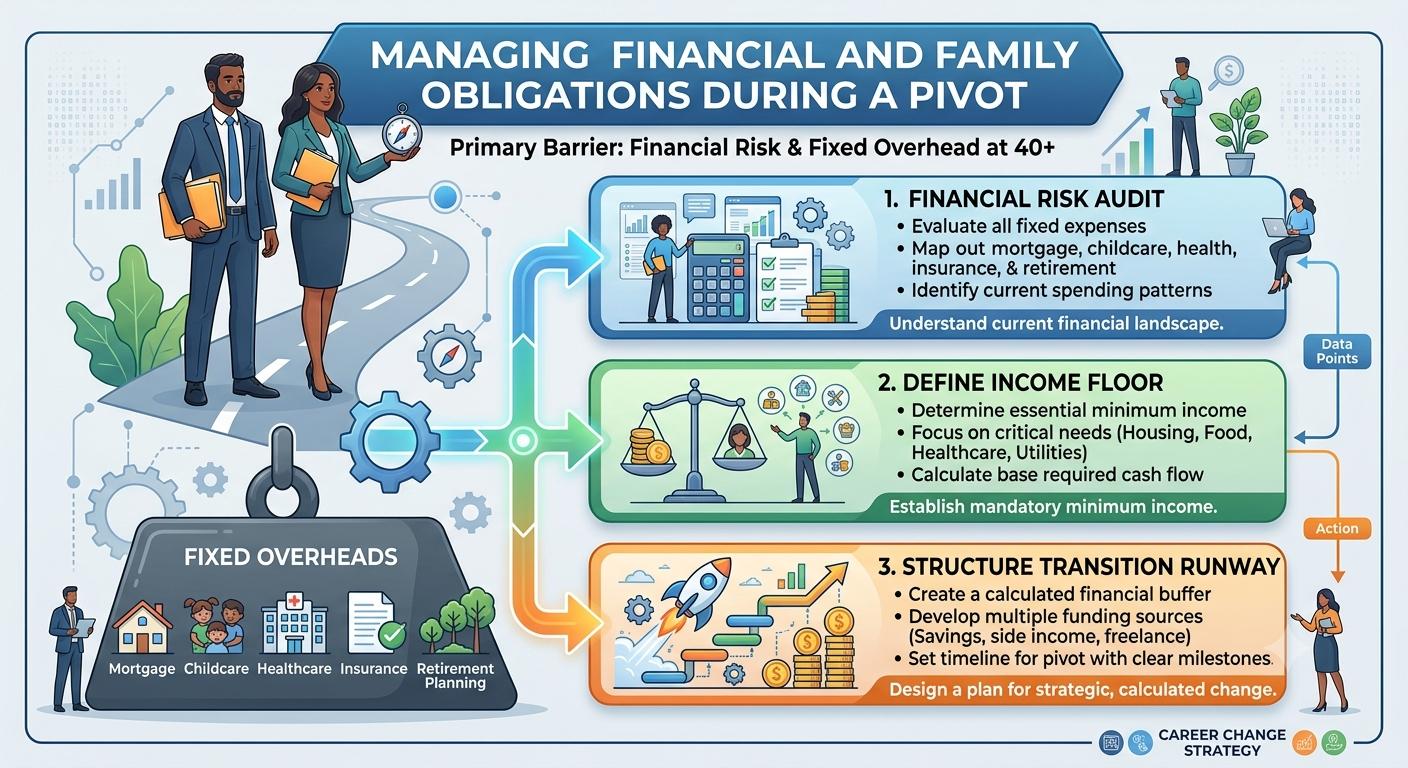
1. Perform a Financial Safety Audit
Before taking any concrete career steps, calculate your non-negotiable Monthly Baseline Income Floor. This includes:
- Fixed housing costs (mortgage/rent, property taxes, utilities)
- Dependent care and family healthcare expenses
- Debt service obligations (car loans, student debt)
- Minimum baseline retirement contributions
2. Establish Your Transition Runway
Do not resign from your current job without a structured financial buffer. Aim for a 6-to-9-month emergency runway in liquid savings. This safety net prevents you from taking a desperate, ill-fitting job if your transition takes longer than anticipated.
3. Financial Risk Comparison Framework
Transition Strategy | Financial Risk Level | Compensation Impact | Runway Required | Recommended For |
Cold Resignation & Bootcamp | Extremely High | Major Pay Cut (50%+ initially) | 9 to 12 Months Savings | High-net-worth individuals with zero dependents |
Distant Pivot (New Role + New Sector) | High | Moderate Pay Cut (20–30%) | 6 to 9 Months Savings | Professionals entering licensed fields (e.g., Law, Nursing) |
Adjacent Pivot (Leveraging Domain/Role) | Low | Salary Parity or Pay Increase | 3 to 6 Months Savings | Most 40+ Professionals (Gold Standard) |
Internal Lateral Transfer | Extremely Low | Zero Pay Cut (100% Retained) | No Additional Runway | Professionals in large enterprise organizations |
The "Adjacent Pivot" Strategy: Preserving Seniority & Pay
If you try to make a radical jump—such as moving from a 15-year career as a Senior Corporate Attorney straight to an Entry-Level Web Developer—you force hiring managers to evaluate you solely on baseline technical skills. In that scenario, you will take a massive pay cut and start at the bottom.
To preserve your seniority and maintain salary parity, execute an Adjacent Pivot:
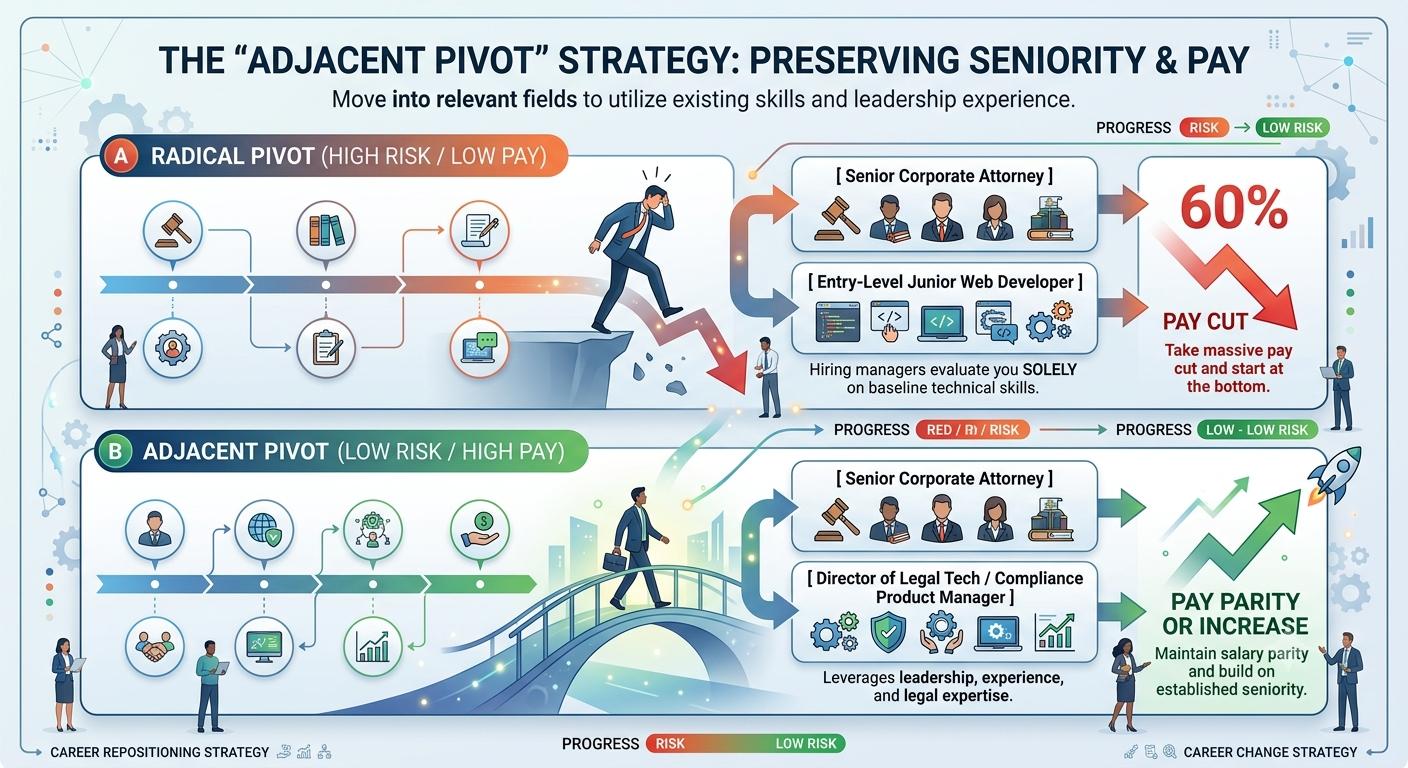
An adjacent pivot keeps one anchor constant—either your functional skill set or your industry domain knowledge—while changing the other.
Strategic Adjacent Pivot Examples for 40+ Professionals
Current Profession | Anchor Being Kept | New Target Role | Why Seniority & Pay Are Preserved |
K-12 School Principal | Management & Curriculum Domain | Director of Customer Success (EdTech) | Retains deep domain authority in school buying habits while leading customer success teams. |
Senior Construction PM | Project Governance & Vendor Management | Enterprise IT Infrastructure PM | Applies universal PM methodologies (budgeting, vendor management, risk) to IT rollouts. |
Commercial Bank Manager | Financial Risk & Client Relations | B2B SaaS Account Executive (FinTech) | Uses 15 years of financial credibility to sell high-value software to banking executives. |
Hospital Nurse Manager | Healthcare Operations & Clinical Domain | HealthTech Product Manager | Brings irreplaceable clinical workflow insights to software engineering teams. |
Retail District Manager | P&L Management & Multi-Unit Ops | Corporate Logistics / Supply Chain Lead | Translates P&L discipline, inventory control, and team management into enterprise supply chains. |
Testing Options Before Resigning: 5 Low-Risk Micro-Experiments
At 40, "leaping before you look" is an unnecessary gamble. Use these five low-risk strategies to validate your target career choice while maintaining your current salary:
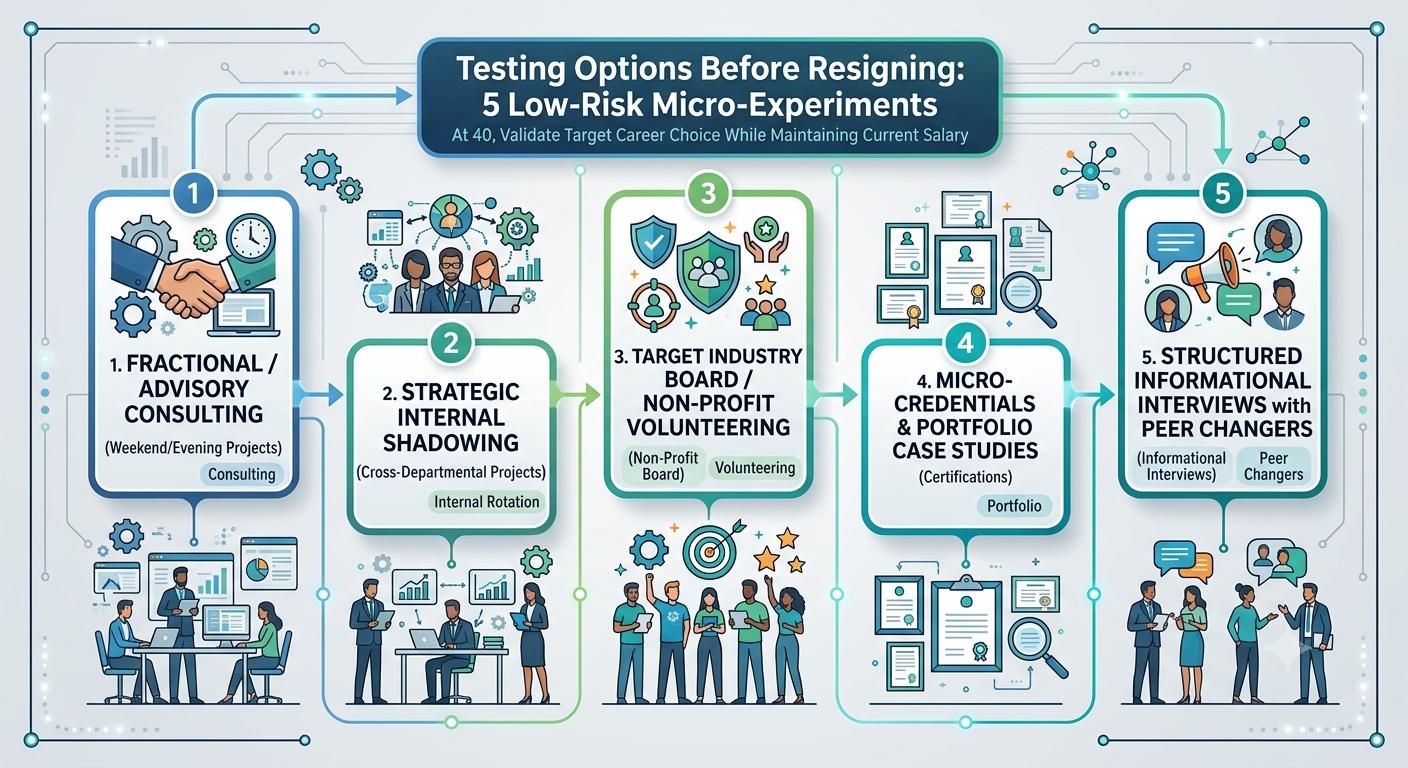
1. Fractional or Advisory Consulting
Offer your strategic skills to small businesses or startups in your target domain on a project basis. Taking on a 5-hour-a-week advisory role validates whether you enjoy the day-to-day subject matter before making a full transition.
2. Internal Cross-Departmental Projects
If you work at a mid-sized or large company, request permission to allocate 10% of your time to a cross-functional initiative. A Marketing Director wanting to shift into Product Management can offer to write product launch messaging for the internal software team.
3. Non-Profit Board Leadership
Join the board or operational committee of a non-profit operating in your target sector. Managing financial strategy or digital transformation for a non-profit builds real-world experience and portfolio proof points.
4. Target-Role Portfolio Projects
Complete a real-world case study independently. If you want to move into Data Analytics, download a public dataset, run SQL queries, build a Tableau dashboard, and publish a detailed write-up on LinkedIn or Medium.
5. Peer Informational Interviews
Connect with 5 to 10 professionals aged 35–50 on LinkedIn who successfully made the pivot you are considering. Ask pointed questions:
- "What surprised you most about the day-to-day realities of this role?"
- "Did you have to take an initial compensation cut, and how quickly did your earnings recover?"
- "What transferable skills proved most valuable during your first 90 days?"
Repositioning Mid-Career Experience on Your Résumé
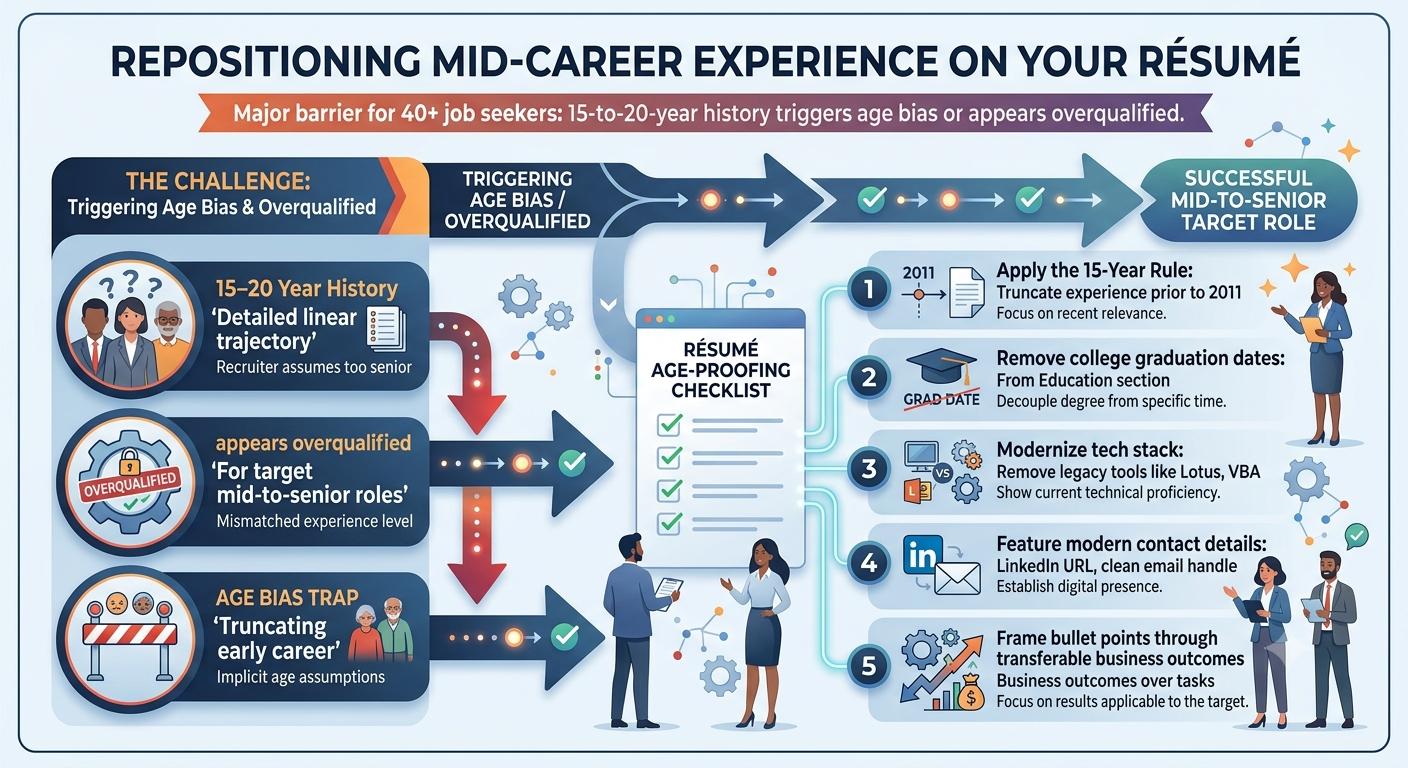
A major barrier for 40+ job seekers is presenting a 15-to-20-year history without triggering age bias or appearing overqualified for mid-to-senior target roles.
1. Apply the 15-Year Rule
Limit your detailed professional experience section to the last 10 to 15 years. Experience prior to 2011 should be summarized briefly in an "Earlier Professional Experience" section at the bottom, omitting specific dates.
2. Remove Graduation Dates
Remove high school and college graduation years from your Education section. List your degree, university name, and major. This keeps the focus squarely on your qualifications rather than your age.
3. Modernize Tech Vocabulary
Purge outdated software and legacy system references from your skills section (e.g., Windows 98, MS Access, old proprietary databases). Highlight modern cloud tools, collaboration software, and analytics platforms (e.g., Slack, Asana, Jira, Tableau, Excel/SQL, HubSpot).
4. Frame bullets through "Executive Impact"
Instead of writing operational bullet points that sound like entry-level tasks, frame your experience through leadership, revenue, and process transformation:
- Operational Focus (Weak): "Responsible for managing staff schedule and updating client records in software."
- Executive Impact Focus (Strong): "Directed workforce planning for a team of 18 professionals, implementing automated scheduling software that reduced overtime costs by $35K annually."
Before-and-After Translation Matrix for Mid-Career Professionals
The matrix below shows how 40+ professionals can translate extensive past experience into the strategic vocabulary required by target hiring managers:
Past Mid-Career Experience | Target Role | Unconverted Mid-Career Bullet | Reframed Transferable Bullet |
15-Yr High School Principal | Customer Success Lead (EdTech) | Managed daily operations of a 1,200-student school, supervised 80 teachers, and handled discipline. | Oversaw operational governance and stakeholder engagement across a 1,200-user community, directing 80 educators and driving a 94% retention rate. |
12-Yr Hospitality Director | Operations Manager (SaaS) | Managed restaurant floor operations, kitchen staff, vendor deliveries, and customer complaints. | Directed P&L operations ($4.5M annual budget), optimized vendor supply chain workflows, and reduced customer churn by 18% through SLA improvements. |
18-Yr Clinical Nurse Manager | Healthcare Account Manager | Managed 24/7 nursing schedules, updated patient charts, and ensured medical protocol compliance. | Led clinical quality assurance and risk compliance across a 40-bed unit, managing cross-functional stakeholder alignments and vendor device rollouts. |
14-Yr Commercial Real Estate Agent | Corporate Partnerships Lead | Showed commercial properties to corporate clients and negotiated lease agreements. | Executed full-cycle B2B deal structuring, managing executive negotiations and pipeline forecasting to deliver $12M+ in lifetime contract value. |
15-Yr Corporate Paralegal | Enterprise Risk & Compliance Analyst | Conducted legal research, reviewed corporate filings, and organized trial documentation. | Audited enterprise documentation against federal regulatory standards, establishing compliance governance and mitigating organizational legal risk. |
Why You Need Multiple Targeted Résumé Versions at 40
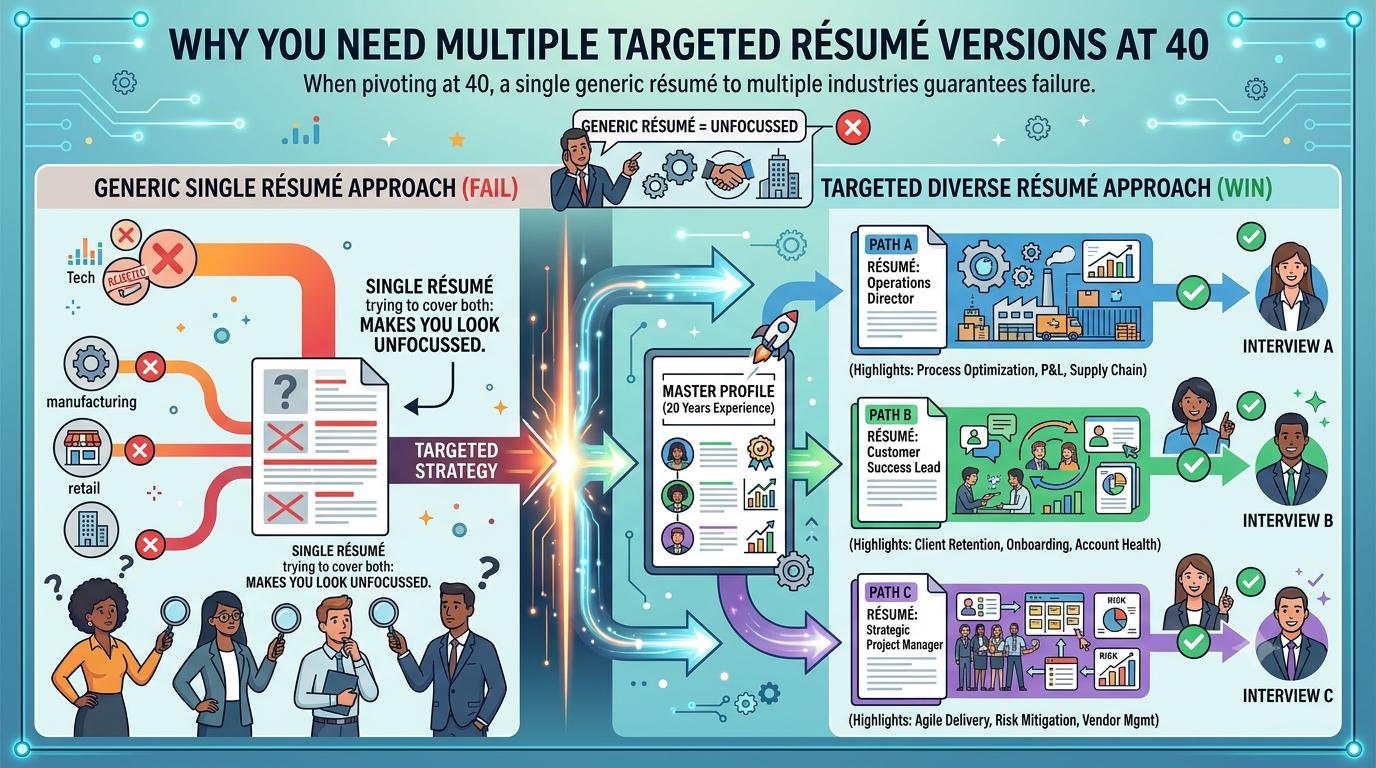
When pivoting at 40, sending a single generic résumé to multiple industries guarantees failure.
If you are exploring two potential adjacent paths—such as Operations Management and Customer Success Leadership—a single résumé that tries to cover both will make you look unfocused to recruiters in both sectors.
How Rocket Resume Solves the Mid-Career Pivot Challenge
Rocket Resume is designed to turn 15 to 20 years of experience into targeted, role-specific résumés built for every direction you choose to explore:
- Master Profile Hub: Input your entire 20-year work history, achievements, degrees, and core competencies into a single secure hub once.
- Instant Version Generation: Create separate, tailored résumé versions for Path A (Operations), Path B (Customer Success), or Path C (Project Management) in a few clicks.
- Targeted Summaries & Headlines: Customize executive summaries and target-role headlines for each path without altering your underlying master data.
- ATS Keyword Matching: Match your past achievements against target job descriptions to ensure your pivot résumé passes Applicant Tracking Systems.
- Unified Dashboard: Keep all your tailored résumés and matching cover letters organized, clearly labeled, and ready to deploy.
The 90-Day Transition Roadmap for 40+ Professionals
Follow this phased roadmap to execute your career change cleanly over a three-month period:
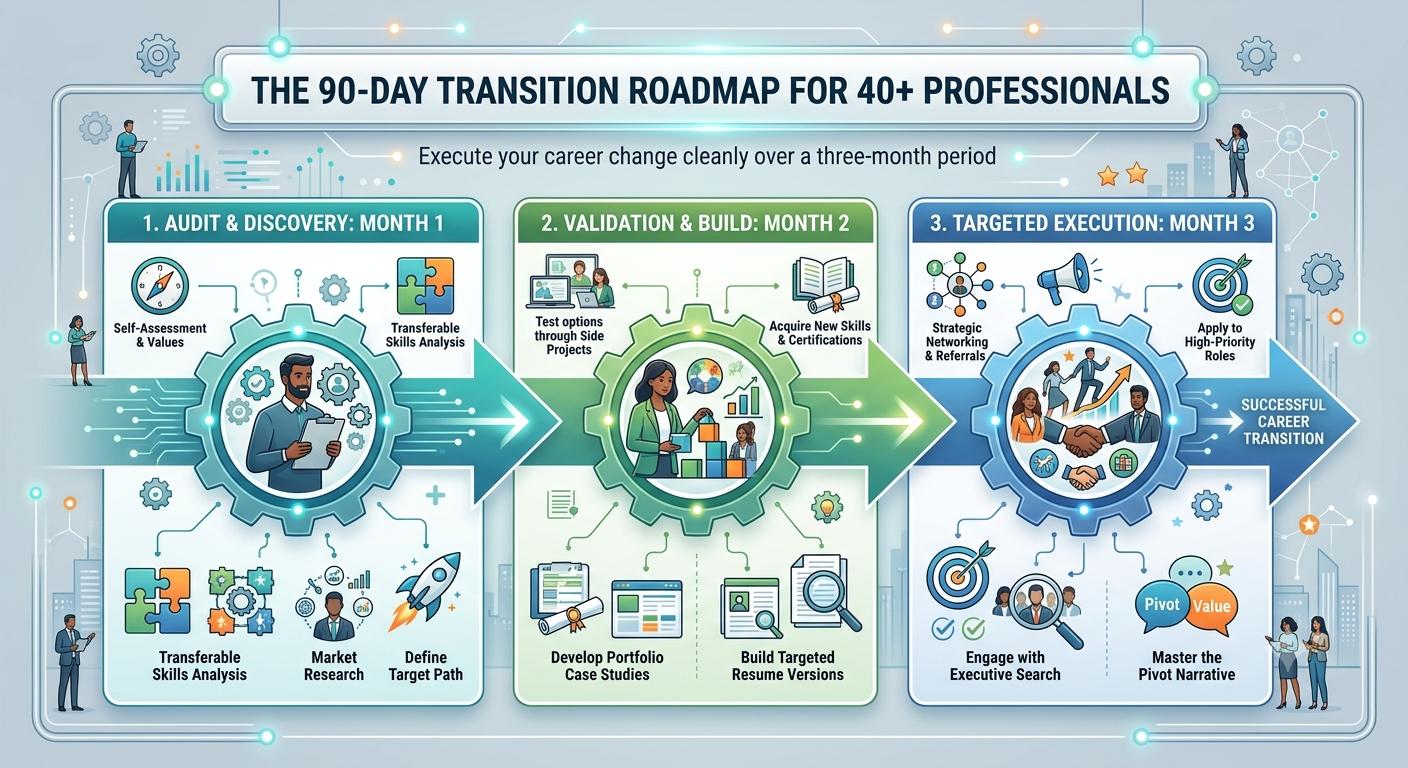
Month 1: Audit & Adjacent Discovery (Weeks 1–4)
- Week 1: Complete your Financial Safety Audit. Establish your baseline monthly income floor and emergency runway.
- Week 2: Identify 2 to 3 adjacent target career paths that preserve your core domain or functional strengths.
- Weeks 3–4: Conduct 5 informational interviews with professionals aged 35–50 in your target roles to validate salary baselines and daily realities.
Month 2: Validation & Skill Translation (Weeks 5–8)
- Week 5: Map your 15+ years of transferable skills against job postings in your target fields using tools like O*NET or Lightcast.
- Week 6: Complete a targeted micro-credential (e.g., Google Project Management Certificate, Hubspot, or ScrumMaster) to plug immediate knowledge gaps.
- Weeks 7–8: Execute a micro-experiment (freelance consulting project, non-profit assignment, or portfolio case study) to build fresh proof-of-work.
Month 3: Targeted Application Execution (Weeks 9–12)
- Week 9: Build your Master Career Profile in Rocket Resume and generate tailored résumé versions for each target path.
- Week 10: Update your LinkedIn profile to reflect your target-role headline and transferable skills matrix.
- Weeks 11–12: Begin submitting tailored applications, leverage warm contacts from informational interviews, and initiate interview prep.
Frequently Asked Questions
Is 40 too late for a career change?
No. At 40, you have 20 to 25 years of active workforce runway remaining—more time than you have already worked. You bring mature business acumen, emotional intelligence, and leadership that make you a high-value candidate when targeting adjacent fields.
Will I have to take a major pay cut changing careers at 40?
Not if you execute an adjacent pivot. By maintaining one anchor (either your functional skill set or your industry domain expertise), you can transfer your seniority into a new role at salary parity or even a pay increase.
How do I handle ageism on my résumé?
Apply the 15-year rule: limit detailed employment history to the last 10 to 15 years, remove college graduation dates, purge outdated software references, and frame all bullet points around measurable business impact and modern software tools.
Should I go back to school for a 2-year Master's degree at 40?
In most cases, no. Taking on tuition debt and stepping out of the workforce for two years is rarely necessary. Short industry-recognized certifications (such as PMP, CAPM, ScrumMaster, or Google Professional Certificates) combined with portfolio projects are faster, cheaper, and more effective for career changers.
How do I explain my career change in an interview without sounding like I am having a mid-life crisis?
Frame your pivot as a proactive, logical evolution based on strengths and market trends. Use this structure: "I have spent 15 years successfully mastering [X domain], where I developed deep strengths in [Y core skill]. I am now applying those core strengths to [Z target field] because [market opportunity / long-standing interest]."
Ready to Execute Your Mid-Career Pivot?
Start with your existing experience, create a tailored résumé for every career path you are considering, and keep every version organized in your Rocket Resume library.
Build your CV with our CV builder
Pick a template, then build a CV one section at a time.