Should You Ever Use a Two-Column Resume in 2026?
How two-column resumes fare against 2026 ATS parsing, their pros for human scannability, cons like mobile slivers and reading-order errors, when the split layout works, and why one column wins.


The Great Debate: One-Column vs. Two-Column Resumes in 2026
Resumes remain the primary currency of the professional world, serving as a comprehensive outline of your employment history, skills, and qualifications. However, as we move through 2026, the "vitality" of a well-formatted resume has taken on a new meaning. With AI-driven recruitment now the absolute standard, many candidates still sabotage their prospects by adding unnecessary aesthetic tweaks that clash with modern algorithms. A primary example of this is the ongoing debate between multi-column and single-column formatting.
This article explores the pros and cons of single and two-column resumes, how 2026’s Hyper-ATS (Applicant Tracking Systems) perceive them, and how to ensure your formatting choice doesn't get you ghosted by a bot. We also touch on where a minimalist resume fits into the debate as the cleanest expression of the single-column approach.
What is a Two-Column Resume?
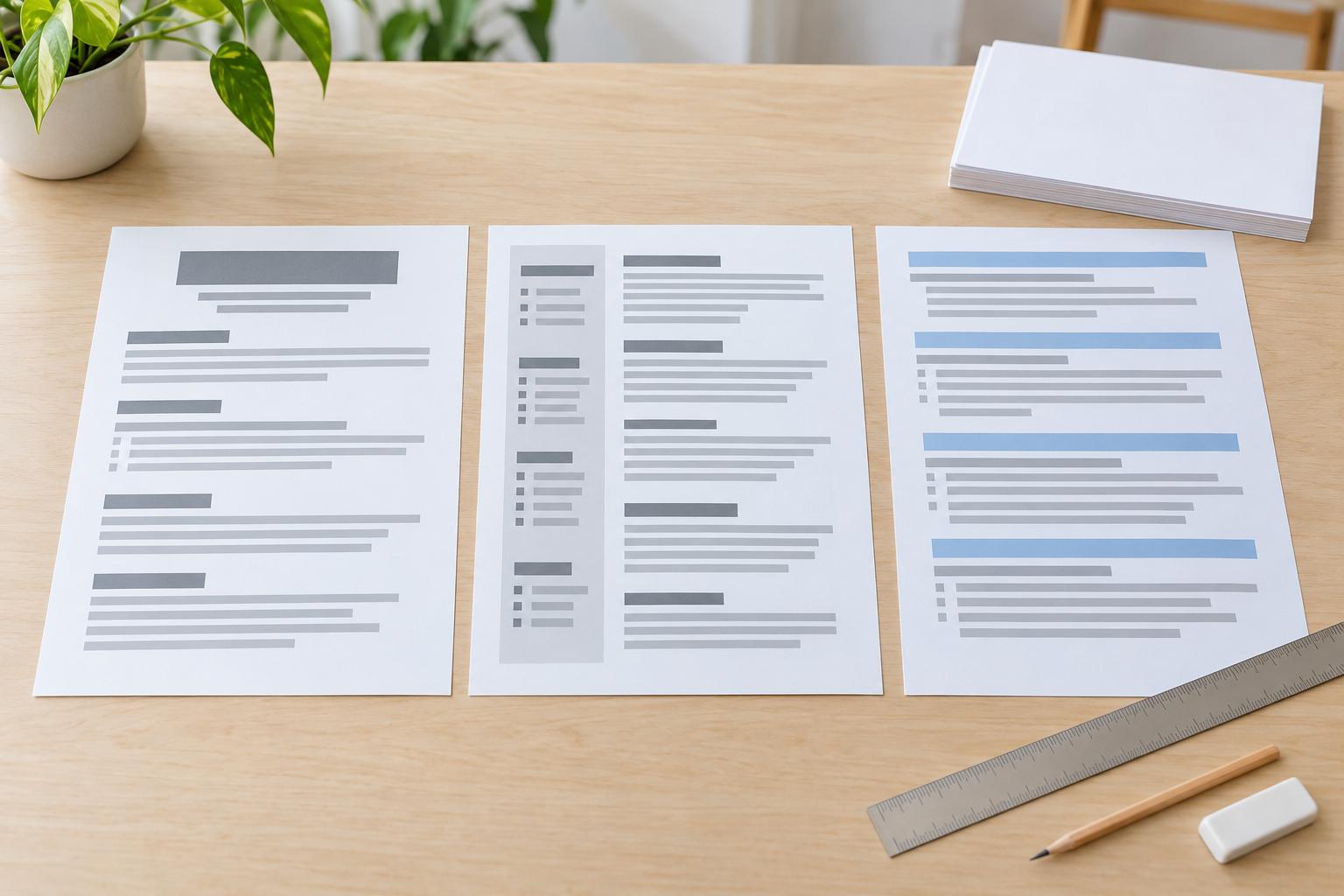
In 2026, the two-column resume—often called a "side-rail" or "split-view" layout—is a design-heavy format that segments information into two distinct vertical sections. Typically, the narrow left-hand column serves as a "quick-glance" sidebar containing contact details, technical skills, certifications, and languages. The wider right-hand column is reserved for the heavy lifting: your professional experience and detailed accomplishments.
While visually striking, these resumes are no longer judged solely on human aesthetics. In today's market, they are viewed as a tool for "information density management." They allow candidates to pack a significant amount of data into a single page without it feeling like a wall of text. For those with a "portfolio-first" career—like UX designers or AI prompt engineers—this format acts as a visual branding tool.
Why: It maximizes "above-the-fold" real estate, allowing a human recruiter to see your skills and your most recent job title simultaneously without scrolling.
How: Use a 30/70 split. Place static data (contact info, skills) on the left and dynamic data (experience) on the right.
Example: A Junior Developer uses the left column to list 15 different programming languages and the right column to detail two high-impact internships.
Key Takeaway: Two-column resumes are high-density tools used to organize diverse information types quickly, but they require careful balancing to avoid looking cluttered in a digital-first hiring environment.
What is the Difference Between a One and Two-Column Resume?
The fundamental difference lies in "parse-ability" and narrative flow. A standard one-column resume follows a linear, top-to-bottom path. This is the "Gold Standard" for 2026 AI agents because it mimics the natural reading pattern of Large Language Models (LLMs). It provides the most horizontal space, allowing you to use long-tail keywords and complex achievement statements that are vital for high-level roles.
In contrast, a two-column resume sacrifices horizontal space for vertical efficiency. While it looks modern, it can "confuse" older legacy systems still used by some government or academic institutions. The main 2026 differentiator is that one-column resumes are "AI-Optimized," whereas two-column resumes are "Human-Centric." If your resume is going directly to a human's inbox, two columns might win; if it’s going into a database of 10,000 applicants, one column is the safer bet.
Why: One-column layouts prevent "reading order errors" where an AI might accidentally read across the columns, mixing your 2024 job duties with your 2018 education.
How: When using one column, use wide margins and clear header tags (H1, H2) to help AI categorize your data.
Example: A Senior Project Manager uses a one-column format to provide three detailed bullet points per project, ensuring the AI captures every specific methodology used.
Key Takeaway: The choice is between a linear, AI-friendly flow (one-column) and a segmented, visually efficient layout (two-column).
What are the Pros of a Two-Column Resume?
In the 2026 job market, the two-column resume has become a favorite for "Creative Tech" and "Human-in-the-Loop" roles. Its primary advantage is scannability for human eyes. Because human attention spans have reached an all-time low, a two-column layout lets a recruiter scan your profile quickly. Weighing that advantage against broader professional resume design considerations will tell you whether the format actually suits your field.
Other benefits include:
- Showcasing Digital Literacy: It demonstrates you can handle modern design tools and understand visual hierarchy.
- Forcing Brevity: The narrower columns prevent you from writing rambling sentences, forcing you to use punchy, impact-oriented language.
- Professional Branding: It gives a modern, "consultant-style" look that feels more like a sleek profile than a dry document.
- Flexibility for Career Switchers: You can highlight transferable skills in a prominent sidebar even if your work history is in a different field.
Why: It creates a "dashboard" effect for your career, making it easy to find specific stats quickly.
How: Use a sans-serif font and subtle background shading for the sidebar to differentiate it from the main body.
Example: A Marketing Specialist uses the sidebar to list specific campaign ROIs, making the numbers pop against their job descriptions.
Key Takeaway: Two-column resumes excel in human-facing scenarios by providing a high-speed "dashboard" of your career highlights.
Are There Cons to a Two-Column Resume Template?
The risks of two-column layouts have intensified in 2026. "Parsing Fragmentation" is a major issue; many AI screening tools still struggle to determine which column to read first. If the underlying code of your PDF isn't layered correctly, the AI might see your resume as a jumbled word salad, causing your "Match Score" to plummet. Harvard Business School research on how automated hiring systems screen out qualified candidates shows this is not a fringe risk.
Other cons include:
- Mobile Unfriendliness: On mobile devices—where 60% of recruiters now view resumes—two columns can become thin, awkward slivers of text that are difficult to read.
- The "White Space Trap": If you don’t have enough content to fill both columns, the resume looks "hollow," signaling a lack of experience.
- Formatting Fragility: Adding a single line of text can cause the columns to misalign, leading to hours of frustrating troubleshooting.
Why: Incompatibility with legacy ATS systems can lead to your data being omitted or incorrectly categorized (e.g., your phone number listed as your job title).
How: Always test your two-column resume by copying and pasting the text into a plain .txt file. If the text is out of order, the AI won't read it correctly.
Example: An applicant loses out on a role because the ATS read their "Skills" column and "Experience" column as a single horizontal line, creating gibberish.
Key Takeaway: The visual appeal of two columns comes at the cost of technical stability and mobile readability, which are critical in 2026.
When Should I Use a Two-Column Resume?
Despite the risks, the two-column format is the right choice for specific 2026 scenarios. If you are applying to a boutique agency, a startup, or a role where you are emailing a hiring manager directly, the visual "wow factor" can set you apart. It is also the premier choice for "Gig Economy" resumes where you need to list various disparate skills (like video editing, Python coding, and project management) that don't fit into a traditional linear narrative.
Additionally, for entry-level candidates, the two-column format is a lifesaver. It allows you to emphasize your education and technical certifications—which are often more impressive than your early work history—by placing them in a high-visibility sidebar.
Why: It bridges the gap between a traditional resume and a modern digital portfolio.
How: Use this format when applying via LinkedIn InMail or personal referrals rather than generic job boards.
Example: A recent graduate uses the left column for their "AI Certifications" and "University Projects" to compensate for a short work history.
Key Takeaway: Use two columns for direct-to-human applications or when your skills are more impressive than your chronological experience.
What is the Best Resume Format to Use?
As we navigate the complexities of 2026, the traditional single-column format remains the undisputed king for general job searching. While it may feel less "creative," its reliability is its greatest strength. It is the only format that guarantees 100% accuracy across every AI parser, mobile device, and screen reader.
A resume is a functional document designed to get you an interview, not a graphic design project. By using a single column, you maximize your space for "Contextual Keyword Embedding"—the practice of weaving keywords into your achievements so AI understands how you used your skills. Remember, it’s not due to a lack of creativity that experts recommend this; it’s due to a focus on results.
Why: It offers the highest "Success Rate" across all digital platforms and ensures your narrative remains intact.
How: Use bold headers, bullet points, and 11pt font to maintain readability while utilizing a single-column flow.
Example: A CEO uses a one-column format to ensure their 20-year history of complex mergers is captured perfectly by the executive search firm’s AI.
Key Takeaway: When in doubt, go with a single column. It is the most robust, AI-friendly, and professional choice for the 2026 job market.
Conclusion: Navigating the 2026 Hiring Landscape
In 2026, the "best" resume format is the one that actually gets read. While two-column resumes offer a modern, dashboard-like aesthetic that can impress human recruiters in niche or creative fields, they carry significant technical risks in an era dominated by AI screening. The single-column resume remains the safer, more powerful choice for most professionals, ensuring that your achievements—not your formatting—take center stage. If you want proven starting points, review resume layouts that reliably get past ATS before committing to a design. To succeed today, you must balance visual appeal with algorithmic compatibility. Whether you choose one column or two, prioritize clear headers, keyword-rich content, and a narrative that proves your value in an AI-augmented world.
Build Your Resume with Rocket Resume
A single-column resume continues to be the best choice when it comes to applying for jobs online. If you’re ready to start a new career and want to upgrade your CV for the best results, you can start today with Rocket Resume.
When you build a resume with us, you don’t have to worry about making it through an ATS. All resumes from Rocket Resume clear this software with ease, increasing the likelihood of a hiring manager seeing your application.
If this is the first time you are writing a resume, you’re in luck. Our intuitive tools help you format your CV in minutes, reducing the hassle of choosing the most appropriate format and font size for the best results.
Are you ready to start building a resume that gives you results? Start your CV now with Rocket Resume.
Browse our resume templates
Pick a design you like, then fill in your resume one section at a time.