7 Resume Headers You Must Include (And 4 to Leave Out) in 2026
The seven resume headers that guide 2026 ATS and AI screeners — name, summary, skills, work history, education, and more — plus four outdated sections to cut and example phrasing for each.


Resumes must be concise and, ideally, no more than a page long, but you don’t want to leave important information out, either. That’s why it’s important to have the right resume structure.
As we navigate 2026, the job market has transformed dramatically. The dawn of advanced AI screeners and hyper-sophisticated Applicant Tracking Systems (ATS) means your resume is read by an algorithm first. Modern ATS networks don't just scan for keyword stuffing; they use semantic AI to evaluate context, impact, and structural clarity. Some resume headers are essential for guiding these AI models, while others just waste valuable space and risk breaking the formatting parsers. Harvard Business School’s research on how automated hiring systems screen out qualified candidates shows just how many strong applicants these filters reject.
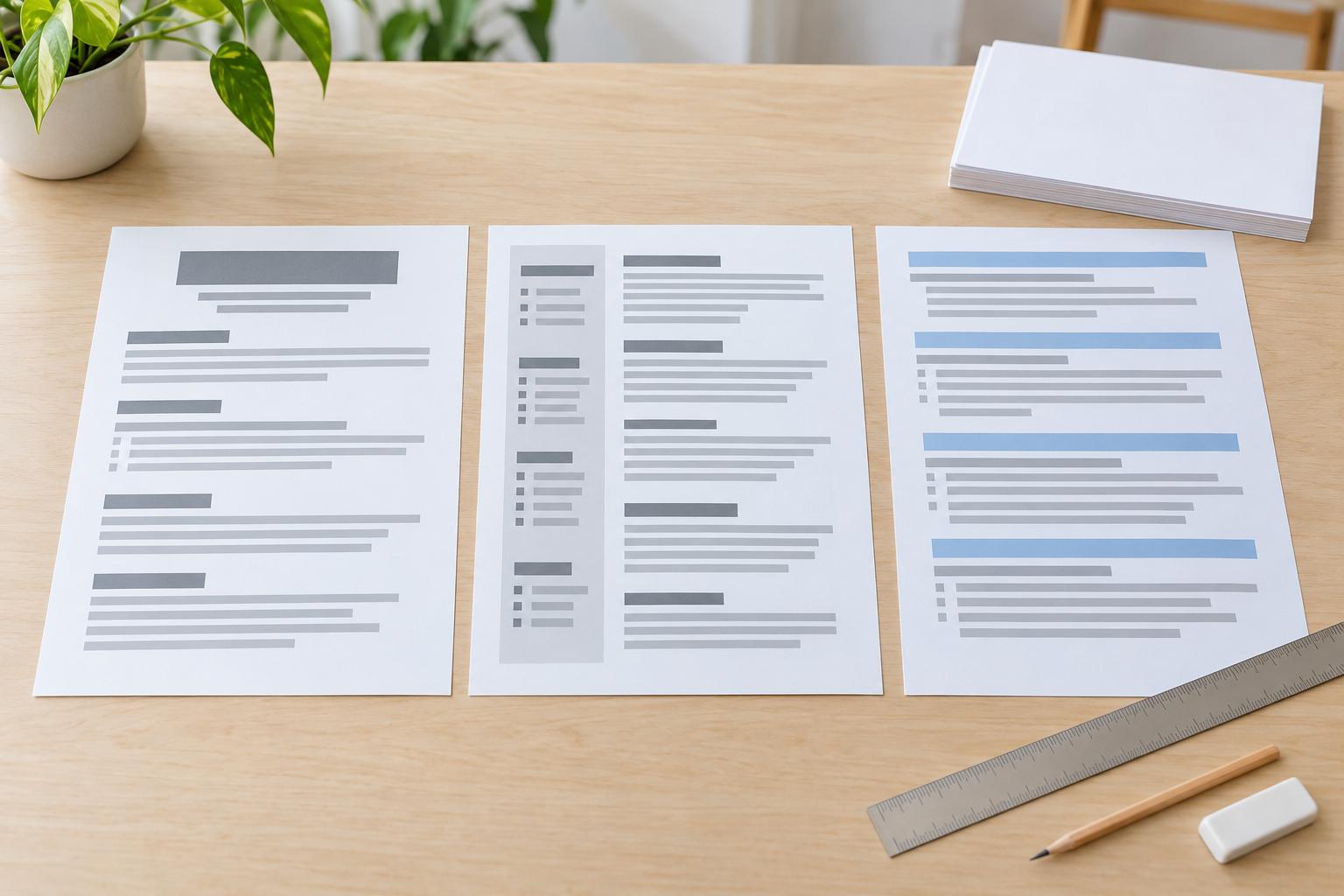
Let’s take a look at the resume headers you must include and the ones you should forget about to stay competitive in 2026. We’ll also include resume header examples, so you can use this article as a modern resume header template. For the content that belongs under each of these headers, see our companion guide on what to include in a resume.
Resume Headers You Should Include
Your Name
Don’t label your resume “Resume” — the recruiter and the AI parser already know what it is, so you’re just wasting prime real estate. Instead, make your name the primary document title or first header, and then include your contact details directly underneath. In 2026, clear typographic hierarchy is vital: your name should be the largest text on the page, serving as an H1 anchor for AI scraping tools that map candidate profiles into corporate databases. Your name carries more weight than you might expect: a landmark resume audit study found that the name at the top of a resume can significantly change how often employers call back.
That said, you should definitely include “resume” as well as your full name in the document file name (e.g., John_Doe_Resume_2026.pdf) to ensure it remains easily searchable in a recruiter's local drive.
- Why: AI parsers read from top to bottom. Labeling the file "Resume" inside the document confuses the semantic parsing of your actual identity, whereas a prominent name establishes a clean data structure.
- How: Use a bold, 16–20pt font for your name at the absolute top of the page, followed immediately by a single line or compact block of contact information without a secondary header.
- Example: Jane Doe jane.doe@email.com | (555) 019-2834 | linkedin.com/in/janedoe
- Key Takeaway: Your name is your brand and your primary data anchor; never waste space labeling the document "Resume," but do keep it in the digital file name.
Professional Summary
This is your chance to give a quick overview of who you are, why you’re applying for the job, and what makes you a good choice. In 2026, the professional summary has evolved into a "Value Proposition." AI-driven screening tools scan this paragraph to immediately match your core competencies with the core problems the company needs to solve. Try to use metrics or achievements when describing your skills and background rather than passive fluff like "hardworking professional." You must meticulously weave in key phrases from the job listing to satisfy modern semantic search algorithms.
- Why: AI filters heavily weight the opening of a resume for contextual relevance.
- How: Write a 3–4 sentence paragraph combining your years of experience, a major data-driven achievement, and how you intend to apply your expertise to the target role.
- Example: As a Shop Manager with three years of experience in a high-street store, I’m looking for a more challenging role in the luxury goods market. With a proven track record of boosting sales by 150% over the last twelve months through targeted visual merchandising and localized CRM strategies, I am a strong salesperson equipped to elevate regional market share.
- Key Takeaway: The modern professional summary is an AI-optimized elevator pitch that must blend specific keywords with quantifiable achievements right at the top.
Skills
Use this section to detail the technical and soft skills you have that make you a good fit for the job. In the era of AI-driven talent acquisition, the skills section is arguably the most critical component for passing automated keyword thresholds. Categorization is king. Separating your competencies allows modern ATS algorithms to index your profile accurately under specific technical capabilities. Ideally, you’ll mention points from the job listing and back them up with metrics and achievements where possible. Aim for around four to eight skills, each with its own bullet point. If you’re unsure how to balance hard skills vs. soft skills, lead with the technical requirements from the job listing and support them with the interpersonal strengths that fit the role.
For some jobs, you may wish to divide the skill section into two parts. For example, if you’re applying for a translator role, and you speak five languages, it would be worth adding a languages section as well as a more general skills section. Similarly, programmers might have a programming languages header, and graphic designers might opt for a software section.
When choosing whether to divide your skills section into two parts, ask yourself: are these skills highly relevant to the role? Is there a clear distinction between the two types of skills? And are there enough of each type of skill that it makes sense to have two sections?
- Why: Modern ATS filters use a skills-matching matrix to grade resumes. If a required skill from the job description is missing entirely from your text, the AI may filter you out automatically.
- How: Use clean, standard bullet points with clear sub-headers if dividing categories. Avoid complex graphics, progress bars, or skill level percentages (e.g., "Python: 80%"), as AI parsers cannot read them and human recruiters find them arbitrary.
- Example: Core Technical Skills: Data Analysis, Python, SQL, CRM Management
- Written Communication Skills: Rewrote company landing page leading to an 80% increase in sign-ups.
- Key Takeaway: Structure your skills clearly using recognizable industry terms so that AI filters can seamlessly match your competencies against the job description.
Work History
Also called career history or professional experience, the work history section goes into the details of your past roles and responsibilities. You don’t need to include every job you’ve ever had, however, especially if you’ve been in the workforce a long time. Stick to the roles that are recent and/or relevant. In 2026, AI tools easily spot "promotional gaps" and career trajectory, so focus your bullet points on action-driven outcomes rather than basic task descriptions. Instead of writing what you did, write what you achieved and how it impacted the business bottom line.
When listing roles, include your job title, the company name, and the start and end months and years. For the most important roles, you should add a bullet point list describing your responsibilities and achievements. Try to also include key phrases from the job listing where relevant.
- Why: Recruiters and AI algorithms prioritize historical performance and progressive responsibility. Chronological, metric-driven bullet points prove you can replicate your past success.
- How: Use the Action + Context + Result framework for your bullet points. Start each with a strong action verb, weave in relevant keywords, and end with a quantifiable metric.
- Example: Accountant, N&R Accountants, March 2018 — January 2022
- Worked on P&L statements, balance sheets, audits, and tax reports for mid-sized corporate clients.
- Reduced clients’ annual tax bills by up to 17% by advising them on deductibles and restructuring asset depreciation tracking.
- Key Takeaway: Your work history must tell a story of measurable success and strategic impact, formatted clearly so both AI parsers and human eyes can calculate your value instantly.
Education
If you have limited relevant work experience, you might want to move the education section above your work history. For example, this could apply to you if you’re a new graduate or looking to change careers to something more in line with your major. Otherwise, keep the education section below your work history.
Your education section should be brief. As recruiters shift heavily toward skills-based hiring models, your degrees serve as foundational baselines rather than primary selling points. There’s no need to include your GPA unless you recently graduated and your GPA was 3.5 or above. If you graduated from college, you don’t need to include your high school certificate, either.
- Why: AI filtering systems look for specific degree baselines if required by regulatory or corporate policy, but human recruiters care far more about functional skills and real-world results.
- How: List your highest degree first in reverse chronological order. Include the formal degree title, institution name, and graduation year. Keep it compact to save space.
- Example: Master of Arts in Corporate Communication, GPA: 3.9, 2021 The City University of New York Bachelor of Arts in Communication and Media Studies, 2019 Fayetteville State University
- Key Takeaway: Keep your education section concise, standardized, and placed strategically based on where you are in your career timeline.
Certifications and/or Licences
If you have multiple certifications or licences that are relevant to the role in question, it’s worth creating a section for them. However, if you only have one certification, either include it in the education or skills sections. In 2026, continuous upskilling is highly valued, and verified certifications (especially technical or industry-specific credentials) are frequently used as secondary filters by automated hiring platforms. If you’re not sure which credentials your target role demands, you can look up your state’s licensing requirements through the Department of Labor’s CareerOneStop tool.
- Why: Certifications show dedication to professional development and often serve as explicit filter criteria for highly specialized or regulated roles.
- How: Use a dedicated sub-header if you have two or more certifications, listing the official credential name, issuing body, and expiration date (if applicable).
- Example: Certifications
- Project Management Professional (PMP) – Project Management Institute, Exp. 2028
- AWS Certified Solutions Architect – Amazon Web Services, 2025
- Key Takeaway: Isolate your relevant certifications into their own section to capture automated filters that treat specific credentials as non-negotiable hiring requirements.
Affiliations and Memberships
Again, if you have multiple relevant affiliations, you can create a section for them. Alternatively, you can include them in the professional summary if you think they are important enough. Being part of recognized industry bodies signals to recruiters—and to semantic AI searching for community engagement keywords—that you are deeply embedded in your professional ecosystem.
- Why: Active membership in professional organizations highlights leadership, networking capability, and adherence to industry standards.
- How: Group them cleanly at the bottom of the document or integrate them into your summary if they carry massive industry weight.
- Example: Professional Affiliations
- Active Member, Society for Human Resource Management (SHRM), Since 2023
- Committee Chair, American Marketing Association (AMA) – New York Chapter
- Key Takeaway: Use industry affiliations to subtly inject high-value authority keywords and demonstrate your active commitment to your field.
Resume Headers to Leave Out
Contact Details
Your contact details need to be on your resume. They don’t, however, need a header. You can just list them under your name. Make sure you include your phone number, email address, and any relevant links, e.g., to a personal website, portfolio, or your fully updated LinkedIn profile.
In 2026, privacy and algorithmic bias prevention are major factors in recruitment. Do not include your full street address, date of birth, or photo. Including a photo or birthdate can cause modern AI systems to auto-reject your resume instantly to shield the employer from potential employment discrimination lawsuits.
- Why: AI software and human recruiters automatically recognize phone numbers, emails, and URLs; a header titled "Contact Details" is completely redundant and wastes valuable layout space.
- How: Strip out any explicit "Contact Info" header and cleanly align your phone number, email, and digital professional links right under your name in a smaller font size.
- Example: John Smith john.smith@email.com | (555) 014-7890 | linkedin.com/in/johnsmith
- Key Takeaway: Integrate contact information seamlessly beneath your name without a dedicated header, while omitting photos, age, and full physical addresses to protect against automated bias filters.
References
There’s no need to include your references on your resume, or even that single outdated sentence: “References available upon request.” Recruiters and HR managers will decide if and when they want to see references—usually during the final stages of the interview process—so skip this section entirely to save precious space. We cover the full reasoning in our guide to putting “references available upon request” on your resume.
- Why: Including references or placeholder text provides zero initial screening value to an AI parser or an HR manager, wasting 1–2 lines of premium space that could be used for keywords or achievements.
- How: Completely remove any mention of references from your document. Prepare a separate, standalone reference document to provide only when requested.
- Example: (Completely remove this section from your resume layout.)
- Key Takeaway: Omit references entirely; the phrase "References available upon request" is obsolete and wastes space that should be optimized for algorithmic keyword scoring.
Hobbies
Do your hobbies demonstrate your aptitude for the job in question? If so, you can work them into the Skills, Certifications, or Affiliations sections. If not, they don’t need to be on your resume.
As interesting as they may be, no recruiter will change their mind and invite you to the next stage of the hiring process just because of your hobbies. Furthermore, AI screening algorithms completely ignore unstructured data like personal interests. If the interviewer really does want to know about your personal interests to gauge cultural fit, they can ask you directly during the interview.
- Why: Personal hobbies do not map to the professional skills matrix evaluated by modern ATS, and human recruiters prioritize professional deliverables over personal pastimes.
- How: Delete the hobbies section completely. If a hobby resulted in a massive, relevant achievement (e.g., building an app with 10k users), reframe it as a personal project under the Skills or Work History sections.
- Example: (Completely remove sections titled "Hobbies" or "Interests" unless explicitly requested by an unconventional employer.)
- Key Takeaway: Keep your resume strictly professional; save your personal interests for the interview or your personal website, leaving resume real estate for quantifiable achievements.
Internships and Volunteer Experience
You’ve worked hard and gained valuable experience as a volunteer or an intern, and this should definitely go on your resume. However, it doesn’t need its own section. Include all internships and voluntary roles in the main work history section instead.
- Why: Separating internships or volunteer work into isolated headers can inadvertently signal to an AI parser that this experience is "lesser than" standard employment, damaging your professional authority scoring. After all, that’s where the recruiter will look to learn more about your professional experience.
- How: Thread these roles directly into your Professional Experience timeline, clearly using the titles "Volunteer [Role]" or "Intern" to maintain absolute transparency while keeping your format unified.
- Example: Marketing Intern, GreenTech Solutions, June 2024 — August 2024
- Coordinated a localized social media campaign that generated a 22% spike in inbound organic web traffic.
- Key Takeaway: Consolidate all professional experience—paid, interned, or volunteered—under a single structural header to maximize impact and maintain a clean chronological flow for AI parsers.
Conclusion
In 2026, a successful resume requires a delicate balance between human readability and machine optimization. As AI and automated ATS filters assume absolute control over the initial stages of hiring, your document structure must be flawlessly organized around predictable, clean headers. By including essential headers like a metric-driven Professional Summary, categorized Skills, and an impact-focused Work History, you ensure that algorithms can seamlessly index your value. Conversely, stripping away redundant headers like Contact Details labels, References, and Hobbies saves vital space, while keeping sensitive personal information hidden protects your profile from automated bias loops. Approach your resume structure as a clean data map: when you make it effortless for the AI to parse your achievements, you drastically increase your chances of landing that crucial human interview.
Resume Header Templates That are Guaranteed to Impress Recruiters
You have just seconds to impress a recruiter with your resume, so it’s important to include all the right information.
Our resume builder will help you decide how to structure your resume based on your experience level and qualifications. It will also suggest recruiter-approved phrasing, skills and more.
We have over 2 million resume templates that will launch you to job-hunting success.
It takes just minutes to customize them to the job in question and your background. What’s more, they’re all ATS machine-readable, so your resume will look as good to a computer as it will to a job interviewer.
So, what are you waiting for? Start building your resume today.
Build your resume with our resume builder
Pick a template, then build a resume one section at a time.