Nanny Resume: Your Complete Guide
Get practical nanny resume guidance with examples, skills, keywords, and writing tips to help you build a stronger job-ready resume.


Choose what should come first
Let relevant childcare experience and completed training guide your section order.
Explore resume outline ideasYour nanny resume needs to highlight your experience, skills, and education so that recruiters can see that you’re the ideal candidate for the role. It should also be customized to the job listing, machine-readable, and professionally presented.
Writing an excellent resume isn’t easy, but that’s where we come in. Keep reading as we break down everything you need to know about writing a nanny resume, from what to include to essential nanny skills. And if you’re still weighing the career itself, our guide on how to become a nanny covers the skills, requirements, and expectations to plan around.
Our builder includes recruiter-approved phrasing. Explore ways to introduce your care background in our nanny resume examples.
The Comprehensive Guide to Crafting a High-Impact Nanny Resume
Introduction
A professional nanny resume should help parents understand your experience and approach to care. Name the routines you managed, the responsibilities you held, and the relevant qualifications you can verify.
How to Write a Nanny Resume Summary or Objective
Why
The professional summary (or objective) is your resume's "hook." For parents who are reviewing dozens of applications, this brief section must immediately convey your experience level, specialized focus, and dedication to child development. It sets the tone, validates your qualifications, and, most importantly, starts building the initial trust needed for a highly personal role. The Bureau of Labor Statistics data on childcare worker pay and outlook can also help you position your experience level against the wider field.
How
- Choose the Right Format: Use a Professional Summary if you have significant, relevant experience (5+ years). Use a Resume Objective if you are new to nannying, transitioning careers, or have gaps in your history, focusing on transferable skills and enthusiasm.
- Highlight Specialization: Explicitly mention your niche expertise, such as Newborn Care, Special Needs Support, or Bilingual Communication (e.g., Spanish/English).
- State Value: Directly mention your philosophy or key success areas, like fostering a stimulating environment or maintaining 100% safety records.
Example
Professional Summary (Experienced Nanny): "With over 8 years of experience as a professional nanny, I bring a deep understanding of child development and a passion for creating engaging, educational environments. My expertise in bilingual communication and behavioral management has consistently resulted in positive developmental outcomes for the children under my care, including a 95% satisfaction rate from client feedback surveys."
How to Show Results in Your Nanny Work Experience
Why
The nanny role heavily relies on soft skills like empathy, patience, and creativity, which can be difficult to prove. Quantifying your work experience (listing how much and how well you did something) transforms these soft skills into measurable, verifiable achievements. This specific data shows parents exactly what you are capable of delivering beyond basic supervision.
How
- Use Action Verbs: Start your bullet points with what you did, such as organized, supervised, prepared, or supported.
- Provide Context: Describe the children's needs, the care setting, and your responsibilities without identifying the family.
- Describe Relevant Responsibilities: Include homework support, meal preparation, scheduling, and activities when they were part of your work.
Example
The following suggestions illustrate how to expand the sample bullet point “Supervised children and provided homework help.” Fill in your care routines and outcomes, using parent feedback or records of the children's progress to support a result.
- Supervised [number of children] aged [age range], following [agreed routines] and helping achieve [documented care outcome].
- Led homework sessions in [subject], using [approach], with [documented change in homework completion].
- Worked with parents on [daily routine], leading to [documented change in the routine].
Nanny Skills and Certifications to List on Your Resume
Why
The skills section is crucial for both Applicant Tracking Systems (ATS) and human recruiters. For nannies, the skills required fall into two vital categories: the hard skills that ensure safety and specialized care, and the soft skills that manage behavior and foster emotional growth. Verifiable certifications act as non-negotiable proof of competence, which recruiters prioritize for child safety.
How
Separate Hard and Soft Skills: Use two distinct lists to organize your abilities. Verifiable credentials such as a CPR certification from the American Red Cross belong at the top of the hard skills list.
- Hard Skills: Focus on technical and safety knowledge, such as First Aid, CPR, Newborn Care, and Meal Preparation.
- Soft Skills: Emphasize interpersonal traits that manage the unpredictable nature of children, such as Empathetic Communication, Creative Problem Solving, and Time Management.
- List Certifications and Education: Place degrees (e.g., Early Childhood Education, Psychology) and certifications (e.g., Red Cross CPR, Advanced Child Care Training) in dedicated sections to maximize visibility.
Example
Hard Skills
First Aid & CPR Certified Newborn Care Expertise Nutritional Meal Prep Ed Activities Planning
Soft Skills (Strengths)
Empathetic Communication Creative Problem Solving Time Management (Scheduling) Behavioral Management
Certifications
Advanced Child Care Training Pediatric First Aid & CPR (Current) Nutrition for Young Children
Key Takeaway
Professional Summary: Keep your introduction concise and focused on relevant care experience and any specialization you can support.
Work Experience: Describe your responsibilities and contributions clearly, including the care routines you managed and how you communicated with parents.
Key Skills & Certifications: Create separate lists for Hard Skills (safety, technical) and Soft Skills (interpersonal). Ensure First Aid/CPR are highly visible and current.
Nanny Resume Tips: Professional Summary or Objective Statement
The professional summary or objective for a nanny resume is your chance to tell potential employers who you are and why you’re the ideal fit for the role.
Keep this section concise. You can skip personal pronouns and begin with a description of your experience or strengths. The suggestions below are illustrative starting points; complete them with your own details.
- Experience: Nanny with experience caring for [age group] and managing [relevant routines].
- Strength: Responsible caregiver skilled in [care skill] and [communication skill].
- Focus: Nanny with a background in [relevant setting], supporting [type of care].
Nanny Resume Tips: Skills Section
Use this section to list the skills most relevant to the role. Format them as bullet points so parents or an agency can find them easily.
Key skills for a nanny resume include problem-solving, decision-making, time management, conflict resolution, mentoring and teaching, structured play, empathy, communication skills, and listening. For more ideas from an adjacent role, browse these babysitter skills for your resume.
Make sure to also include essential hard skills for a nanny resume, such as first aid and CPR, meal preparation, food hygiene, and foreign languages. Many of these carry over to broader child care roles, so the same list can serve multiple applications.
Nanny Resume Tips: Education Section
List your degree or certificate titles along with the school. You don’t normally need to include your GPA on your resume. However, you could include it if you have a high GPA and if teaching, homework help, or mentoring will play a large role in your nanny duties. This is particularly relevant for core academic majors, such as Math, English, and Science.
Your nanny resume sample may include the education below the experience section. The ideal resume format for a nanny will depend on how much experience you have. If you’re new to childminding, lead with your education. However, if you’ve already worked as a nanny in previous roles, like in our above example nanny resume, move the education section below the experience section.
To decide whether your childcare experience or education should lead, compare resume layouts.
Nanny Resume Tips: Experience Section
The experience section of your resume is often the most important part for potential employers, unless you’re writing a nanny functional resume, which focuses more on skills.
Include your job title and employer. If you’ve worked as a private nanny, you can list the employer as “Private Household.”
Underneath this, include your main responsibilities and accomplishments. For a nanny resume, bullet points are the ideal way to list these. Start each point with a powerful verb, such as “mentored,” “developed” or “cared for.”
Important responsibilities of a nanny for a resume include leading structured play, providing educational opportunities, homework help and tutoring, cooking, and maintaining a hygienic environment.
Nanny Resume Tips: Certifications and Licenses
List all the certifications and licenses that are relevant to the role you’re applying to, such as a driver’s license, First Aid certificate, foreign language certification, or food hygiene certificate. A profession-specific credential like the International Nanny Association credential exam can set you apart further.
Include the certification or license title along with the awarding body. If your certificate expires, add the expiration date.
Nanny Resume Tips: Volunteer and Extracurricular Activities
This section is optional, so only include it if you have hobbies or volunteer experiences that are relevant to the role. For example, our nanny resume sample above mentions the applicant’s volunteer work teaching children to read, but not their love of true crime documentaries or political activism.
Additional Tips and Tricks for Crafting a Strong Nanny Resume
Once you’ve written your resume, re-read it. Are there any typos or spelling mistakes?
Can you describe your contribution more clearly? Explain how you organized homework time or kept parents informed about the children's day.
Is your resume visually attractive and easy to read? Compare your resume to nanny resume examples online: do you have enough white space?
Prepare a follow-up message to send to the employer or agency. This will add a personal touch that can set you apart from other candidates.
How to Apply for Nanny Jobs
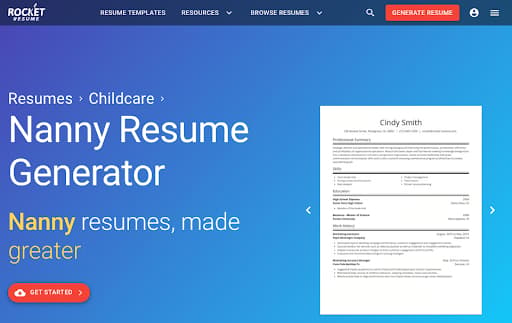
Applying for nanny jobs requires finding relevant opportunities online, building an impressive resume and cover letter, and preparing for interviews.
You can find nanny roles on websites such as Care.com, Sittercity, and Nanny Lane, as well as through nanny agencies. Check local community boards and online groups such as Nextdoor, too.
Compare your description of household responsibilities with the nanny resume examples. In a requested cover letter, draw on a care experience that shows how you would handle the family's stated routines or needs.
Finally, prepare your answers to common nanny interview questions so you can put parents’ and employers’ minds at ease. This preparation, along with your compelling resume, will help you make an excellent first impression on potential employers.
Frequently Asked Questions (FAQs)
How to Put Nanny on a Resume
Add your nanny role to the experience section of your resume, including details such as your start and end date, your employer, and your principal responsibilities. Use bullet points for your duties so that it’s reader-friendly.
How to List Nanny Experience on a Professional Resume
When listing your nanny experience on a professional resume, focus on the skills that are most relevant to the role. This might include leadership, mentoring, risk analysis, time management, and problem-solving.
How to Write a Nanny Resume
The first step in writing your nanny resume is selecting a template. Customize it to the role you’re applying for, in addition to your professional background and skills. Finally, proofread it and check that it’s visually attractive. Once you’ve done all this, you’re ready to apply for nanny jobs.
How to Describe a Nanny Job on Resume
Describe your nanny job on your resume by emphasizing the responsibilities and skills that are also relevant to the role you’re applying for. For example, if you’re looking for hospitality work, focus on your people skills, cooking, and hygiene. Alternatively, for a training role, mention homework help and structured play.
How to Make Nanny Sound Good on Resume
Make your nanny role sound good on your resume by highlighting the skills you’ve honed, such as problem-solving, decision-making, and time management. You can also emphasize the teaching, mentoring, and leadership elements of being a nanny.
How to Put Multiple Nanny Jobs on a Resume
If you’ve held multiple nanny roles at the same time, there are three ways you can include them on your resume. One option is to include all the roles under one job title of “Professional Nanny.” Alternatively, you can list them in descending order of importance, or with the most recent addition first.
How to Turn Nanny Job Into a Resume
Turn your nanny job into a resume entry by giving yourself a job title, such as Private Nanny or Professional Nanny, adding your start and end dates, your employer, and your key duties and achievements.
What to List For Skills as a Nanny on a Resume
Valuable nanny skills for a resume include teaching and homework help, time management, First Aid and safety awareness, problem-solving, decision-making, interpersonal skills, structured play, and leadership.
Conclusion
A standout nanny resume is built upon a foundation of trust, specificity, and verifiable credentials. By opening with a tailored Professional Summary, backing your experience with quantifiable achievements, and clearly demonstrating a comprehensive skill set validated by relevant certifications, you position yourself as a dedicated professional ready to take on the profound responsibility of caring for a family’s children.
Use our samples to check the order of your resume sections. To build your resume, get started now.
Make your caregiving background clear
Show where you worked, what you handled and which qualifications you actually hold.
Explore resume formats