How Many Bullet Points Per Job on a Resume Should You Include in 2026?
How many bullet points each resume job entry needs in 2026 — 3 to 6 per role, or up to 8 for your two most recent — plus why bullets beat paragraphs for six-second scans and metric-driven examples.


Have you ever been gripped by that familiar, late-night panic about how to land your next role? It’s incredibly easy to lose sleep, burn out, and feel entirely overwhelmed by the modern job hunt. In 2026, the job market has transformed into a highly sophisticated ecosystem, heavily driven by generative AI, automated screening tools, and hyper-targeted talent acquisition. Harvard Business School research has documented how automated screening tools filter resumes before humans read them, often excluding qualified candidates on formatting and keyword grounds alone.
While the landscape feels more complex than ever, the antidote remains anchored in a timeless asset: a high-performing, precision-engineered resume. To capture the attention of both human hiring managers and the sophisticated AI algorithms screening you, mastering the structural layout of your experience is paramount. Specifically, knowing exactly how to leverage formatting, visual hierarchy, and bullet points will determine whether your application advances or gets lost in the digital ether.
This comprehensive guide walks you through the evolved standards of modern resume architecture, ensuring you stand out, beat the bots, and land the perfect role in 2026.
Bullet Points or Paragraphs on your Resume?
The great debate between utilizing dense paragraphs or structured bullet points has officially been settled by the realities of 2026 technology. While the aesthetic of resumes has shifted toward sleek, minimalist, and interactive digital profiles, bullet points remain the undisputed champion of data presentation. Large blocks of narrative text are officially a relic of the past, and the resume writing guidance from Purdue's Online Writing Lab has long favored the same concise, scannable formatting.
In the current hiring landscape, your resume must cater to two distinct audiences: AI-driven Applicant Tracking Systems (ATS) and incredibly strapped-for-time human recruiters. AI models excel at parsing structured data points, while human eye-tracking studies prove that recruiters skim profiles in an "F-shaped" pattern, spending less than six seconds on an initial scan. Paragraphs create visual fatigue; they hide your achievements in a wall of words and demand too much cognitive effort from a reader. Bullet points, when executed correctly with bolded lead-ins and dynamic formatting, act as visual signposts that guide the reader’s eye directly to your highest-value contributions.
Why: In 2026, information density and instant scannability are the keys to surviving initial automated and human screenings. Paragraphs bury your impact, whereas formatted bullet points allow both human eyes and AI parsers to instantly extract your core competencies, tech stack utilization, and quantifiable successes without unnecessary fluff.
How: Replace all block paragraphs under your professional experience with highly structured, bite-sized bullet points. Start each bullet with a strong, front-loaded action verb or a bolded keyword that categorizes the achievement. Use standard, universally recognizable bullet characters (like solid dots or squares) to ensure seamless rendering across all mobile devices, AI platforms, and ATS software.
Example: > * Generated $140K in new pipeline revenue within Q1 by deploying advanced AI-driven predictive modeling tools to identify and target high-intent enterprise accounts.
- Led cross-functional squads consisting of 6 engineers and 2 UX designers to launch a decentralized application, reducing user friction scores by 42%.
Key Takeaway: Bullet points are mathematically superior to paragraphs for modern scannability; they break up visual density, satisfy the algorithmic appetite of AI screening tools, and ensure busy recruiters spot your peak achievements within a 6-second window.
How Many Bullet Points Per Job on a Resume?
A common pitfall for many modern job seekers is treating their resume as an exhaustive historical archive of everything they have ever done. In 2026, your resume is not a biography—it is a tightly curated marketing brochure tailored precisely to the specific role you want next. Because initial automated screenings filter for hyper-relevance, bloating your resume with excessive bullet points will actively dilute your impact and hurt your ranking.
The strategy for distributing your bullet points should reflect the trajectory of your career, placing the heavy visual weight on your most recent, high-impact achievements. You have two main structural methodologies to choose from depending on your career narrative:
Option 1: Equal Amount of Bullet Points Per Job
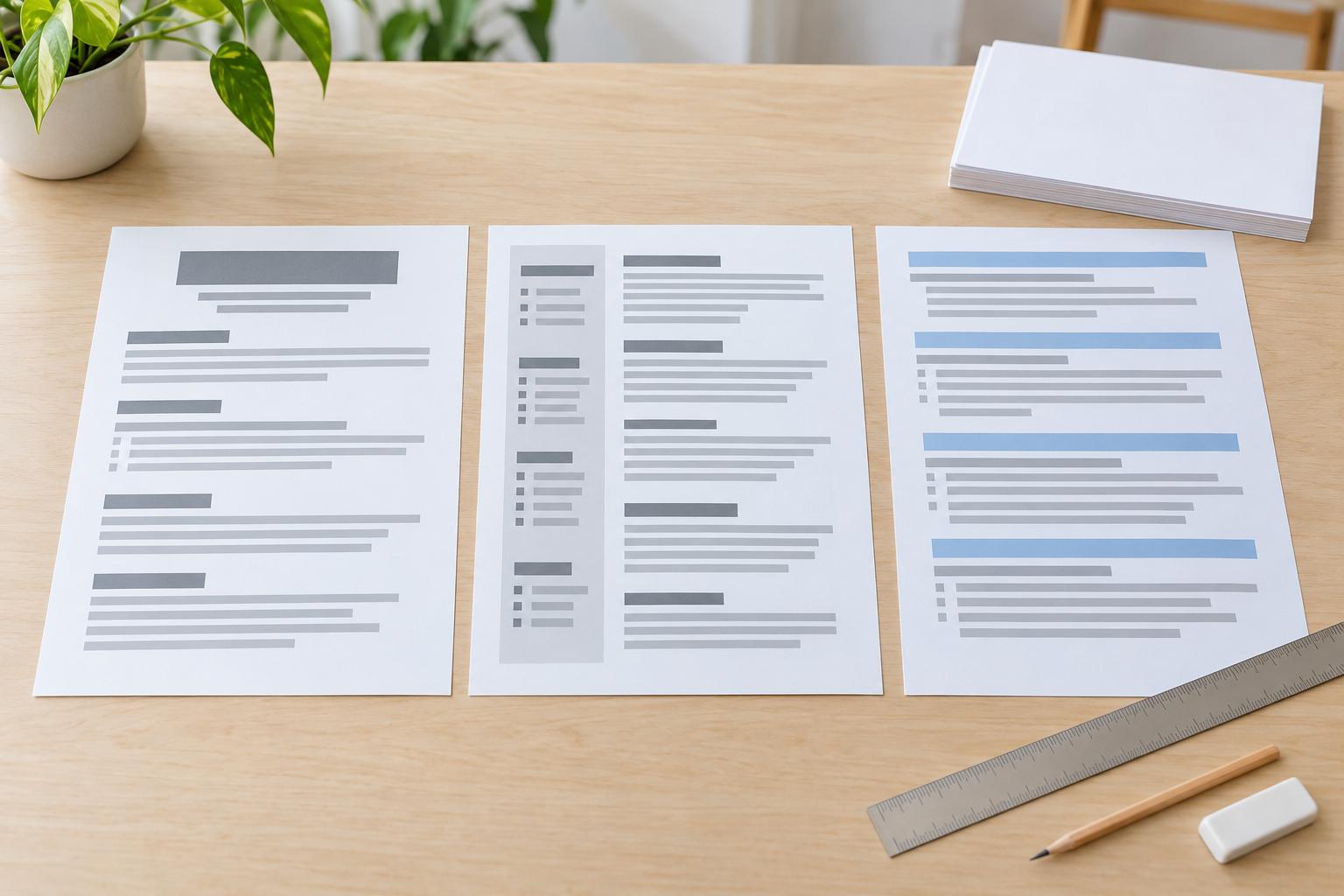
This approach is highly favored by mid-level professionals with a linear career path. Many resume experts recommend writing 3–6 bullet points per job, with each individual bullet limited strictly to 1–2 lines. This creates a perfectly balanced, aesthetically symmetrical document that demonstrates steady, consistent growth across all your recent tenures.
Option 2: Most Recent Experience gets More Bullet Points
Another option is to heavily weight your most recent two job experiences, which are almost universally the most technologically advanced and relevant to your current career goals. Under this formatting strategy, your two most recent roles receive a robust 8 bullet points each, allowing you to dive deep into complex projects and leadership metrics. Following those, your next two older roles are scaled down to 4 bullet points each.
Any remaining historical roles should be aggressively condensed, sharing no more than 10 bullet points altogether across the rest of the document. Modern employers are rarely interested in the granular day-to-day tasks of a position you held a decade ago. If an ancient role does not actively prove you possess the skills required for the 2026 market, compress it to a single line or omit it entirely to preserve valuable real estate.
The Golden Rule: Eliminate Repetition and Irrelevance
Ultimately, there is no rigid, one-size-fits-all number, but relevance is your north star. If you have over five years of experience, eliminate your high school or college side hustles unless they are directly foundational to your current executive track. Furthermore, audit your bullet points ruthlessly to eliminate task repetition — repetition and irrelevance rank high among the resume mistakes that can hurt your chances. If you performed similar duties across three different companies, do not repeat the verbs or descriptions. Instead, use each job's bullet points to highlight a completely different facet of your skill set—such as leadership at one, technical execution at another, and strategic scaling at the third.
Why: Strategic bullet point allocation prevents "resume fatigue" for the reader and ensures that your most impressive, modern, and technologically relevant achievements occupy the majority of the page real estate.
How: Audit your work history chronologically. Allocate 6–8 high-impact, data-driven bullet points to your current or most recent role, then systematically taper the number of bullets downward for older positions. Ruthlessly delete repetitive phrasing, mundane administrative tasks, and outdated software mentions.
Example: > * Senior Systems Architect (2024–Present): 7 Bullet Points (Focusing on enterprise AI integration, cloud infrastructure, and team leadership)
- Systems Engineer (2022–2024): 4 Bullet Points (Focusing on core engineering execution and cross-department collaboration)
- Junior IT Specialist (2020–2022): 2 Bullet Points (Abbreviated summary focusing purely on foundational technical milestones)
Key Takeaway: Customize your bullet count by weighting your most recent, high-value positions with up to 8 bullets, while scaling back older roles to 2–4 bullets, effectively guiding the recruiter’s focus to where your current expertise shines brightest.
Resume Bullet Point Examples
The absolute golden rule of writing resume bullet points in 2026 is the mandatory integration of quantifiable data, metrics, and outcomes. The era of simply listing your daily responsibilities is officially over. AI tools can generate generic lists of duties in seconds; what they cannot fabricate are your unique, verified human accomplishments and the mathematical proof of your success.
Instead of stating what you were "responsible for," your bullets must showcase the direct business impact of your actions. Every bullet point should ideally follow a proven formula: Action Verb + Context/Technology + Quantifiable Metric = Business Outcome. By showing that you understand how your work moves the needle on revenue, efficiency, user acquisition, or cost-reduction, you instantly separate yourself from the sea of average applicants.
Look at how these data-driven, accomplishment-focused bullet points elevate a resume's authority — and for full before-and-after rewrites, see these good vs. bad resume examples:
- Orchestrated, marketed, and executed 12 high-profile industry panels for monthly audiences of 25–50 executive stakeholders, achieving a 98% positive sentiment score.
- Accelerated event attendance by 70% year-over-year by engineering a targeted, automated hyper-personalized email marketing workflow.
- Expanded enterprise email subscriber base by 30% within 3 months, scaling digital community outreach from 10K to 13K active users.
Notice that these modern examples completely bypass passive language, opening each line with strong action verbs instead. They don't just say "Helped run events" or "Was in charge of emails." They aggressively highlight the scope, the speed, the data, and the tangible value brought to the organization.
Why: Quantifiable achievements provide verifiable proof of your capabilities, giving AI screeners the specific performance keywords they search for and giving human hiring managers concrete metrics to justify bringing you in for an interview.
How: Review your existing bullet points and identify every passive duty statement. Infuse them with numbers—percentages, dollar amounts, timeframes, or team sizes. Use the bolding toolkit to draw immediate attention to the metrics so they stand out during a quick skim.
Example: > *Before: Handled customer service inquiries and resolved client complaints over the phone.
- After (2026 Standard): Maintained a 96.8% CSAT (Customer Satisfaction) score while managing 200+ high-tier guest interactions nightly, leveraging automated CRM tools to slash average resolution times by 15%.
Key Takeaway: Transform passive responsibility statements into dynamic, metric-driven accomplishment bullets that explicitly prove your business value through percentages, revenue generated, and time saved.
Conclusion
Navigating the job market of 2026 requires an understanding of how human psychology and advanced AI technology intersect. Your resume is no longer just a piece of paper; it is a highly optimized data document. By abandoning dense paragraphs in favor of sleek, scannable bullet points, you ensure that your application passes both rigorous automated ATS filters and rapid human reviews. Dynamically scaling your bullet counts so that your most recent, technologically advanced roles receive the majority of the focus allows you to control the narrative of your career growth. Finally, anchoring every single statement in quantifiable metrics and business outcomes effectively eliminates fluff and highlights your true value. Treat your resume as a premium marketing asset, lean heavily into data-driven formatting, and you will navigate the competitive 2026 hiring landscape with absolute confidence.
Creating a Resume is Challenging
Creating an attention-grabbing resume is so much more than just deciding the right amount of bullet points to include per job. For example, should they be written in present or past tense? What bullet points should you include? How can you give your resume a professional appearance? It can all be overwhelming.
Rocket Resume can help with building a resume crafted for your dream job. Craft your resume with Rocket Resume now!
Build your resume with our resume builder
Pick a template, then build a resume one section at a time.