Is a Minimalist Resume Right for You in 2026?
What makes a minimalist resume work in 2026, from single-column layouts AI parsers read cleanly to the four essential headings, keyword-safe trimming, and the black-and-white printer test.

The 2026 Guide to Minimalist Resumes: Navigating the Age of AI Recruitment
In 2026, the job market has undergone a seismic shift. The "sleek and modern" aesthetic of a minimalist resume is no longer just a design preference—it is a strategic response to an environment where Artificial Intelligence (AI) serves as the primary gatekeeper. Recruiters and hiring managers, overwhelmed by rising application volume due to AI-automated job seeking, have less time than ever to review your credentials. While the minimalist approach is powerful for its readability and focus, the stakes for getting it right have never been higher.
Is a minimalist resume the best option for you in this hyper-automated landscape? This guide explores how to balance human-centric design with the machine-readability required in 2026.
1. What is a Minimalist Resume in 2026?
In the current era, minimalism isn’t just about "less code, more white space." It is about signal-to-noise ratio. A minimalist resume in 2026 is a high-density, low-clutter document designed to be parsed instantly by Large Language Model (LLM) scanners while remaining visually resting for the human eye.
The goal is no longer just "at-a-glance" understanding; it is "instant validation." With modern AI tools capable of summarizing a two-page document in milliseconds, your minimalist resume must ensure that the right 500 words are present. It typically fits on one page, utilizing a "modular" layout that allows AI agents to categorize your experience without error. The 2026 minimalist resume moves away from subjective graphics—like skill bars or star ratings—which are notoriously difficult for modern neural networks to quantify accurately, opting instead for precise, keyword-rich descriptors.
- Why: AI agents in 2026 prioritize "clean data." Extraneous formatting, heavy graphics, and non-standard fonts create "hallucinations" in recruiting software, potentially misrepresenting your years of experience.
- How: Use a single-column layout with standard fonts (like Inter or Roboto). Replace "Skill Progress Bars" with specific certifications or years of experience.
- Example: Instead of a graphic showing 80% proficiency in Python, write: "Python: 5+ years experience, specialized in LLM fine-tuning and API integration."
Key Takeaway: A 2026 minimalist resume is a data-optimized document that prioritizes machine-readability and high-impact "signal" over decorative "noise."
2. Minimalist vs. Functional, Chronological, and Hybrid Resumes
The "style" of your resume is its skeleton, but minimalism is its skin. In 2026, the distinction between these styles has blurred because AI algorithms favor the hybrid resume.
A chronological resume remains the standard for proving career progression, which is vital for senior roles. A functional resume is still used for career pivoters, though it faces more scrutiny from AI detectors looking for "employment gaps." The hybrid resume, however, has become the gold standard. It combines a robust "Technical Core" (skills) with a "Proof of Work" (history) section. In 2026, a minimalist hybrid resume is the most effective tool because it gives the AI the keywords it wants upfront while providing the human recruiter with the context they need to justify your salary.
- Why: Modern ATS (Applicant Tracking Systems) use "contextual ranking." They don't just look for a skill; they look for that skill used within a professional timeline.
- How: Start with a 3-line "Professional Impact" summary, followed by a minimalist grid of core competencies, then a streamlined chronological history.
- Example: Use a "Core Stack" section at the top with 6-8 keywords, followed by 2-3 bullet points per job focusing strictly on quantifiable outcomes (e.g., "Increased efficiency by 40%").
Key Takeaway: Minimalism is compatible with all structures, but the Minimalist Hybrid model is the most successful in 2026 for satisfying both AI scanners and human decision-makers.
3. Pros and Cons: The 7.4-Second Window vs. The AI Filter
The window for human review hasn’t changed much. In that short window, a minimalist resume wins by guiding the eye to "Power Results." However, the danger in 2026 is "Over-Minimalization."
If you cut too much, you risk failing the Applicant Tracking System (ATS) filters. If an AI is looking for "Predictive Analytics" and you summarized your role as "Data Analysis" to save space, you may be automatically rejected. The 2026 challenge is "Optimized Brevity"—being concise without being vague. You must ensure that every word removed isn't a keyword that an AI agent is programmed to find.
- Why: "Ghosting" by employers is often the result of minimalist resumes that lack the semantic depth required by modern AI filters.
- How: Audit your minimalist resume against the job description using an AI tool to ensure your "minimal" content still contains 90% of the required semantic keywords.
- Example: Instead of "Managed a team," use "Led a cross-functional team of 12 using Agile/Scrum," which hits three keywords in nearly the same space.
Key Takeaway: While minimalism improves human engagement, you must ensure your "ruthless cutting" doesn't remove the essential keywords that allow you to bypass AI gatekeepers.
4. Minimalist Resume Design Tips for 2026
Design in 2026 is about accessibility—both for humans and for machines. A resume that "looks cool" but can't be read by a screen reader or an AI parser is a failed document. For a broader view beyond minimalism, these professional resume design considerations cover the same ground in more depth.
Keep the Layout Simple
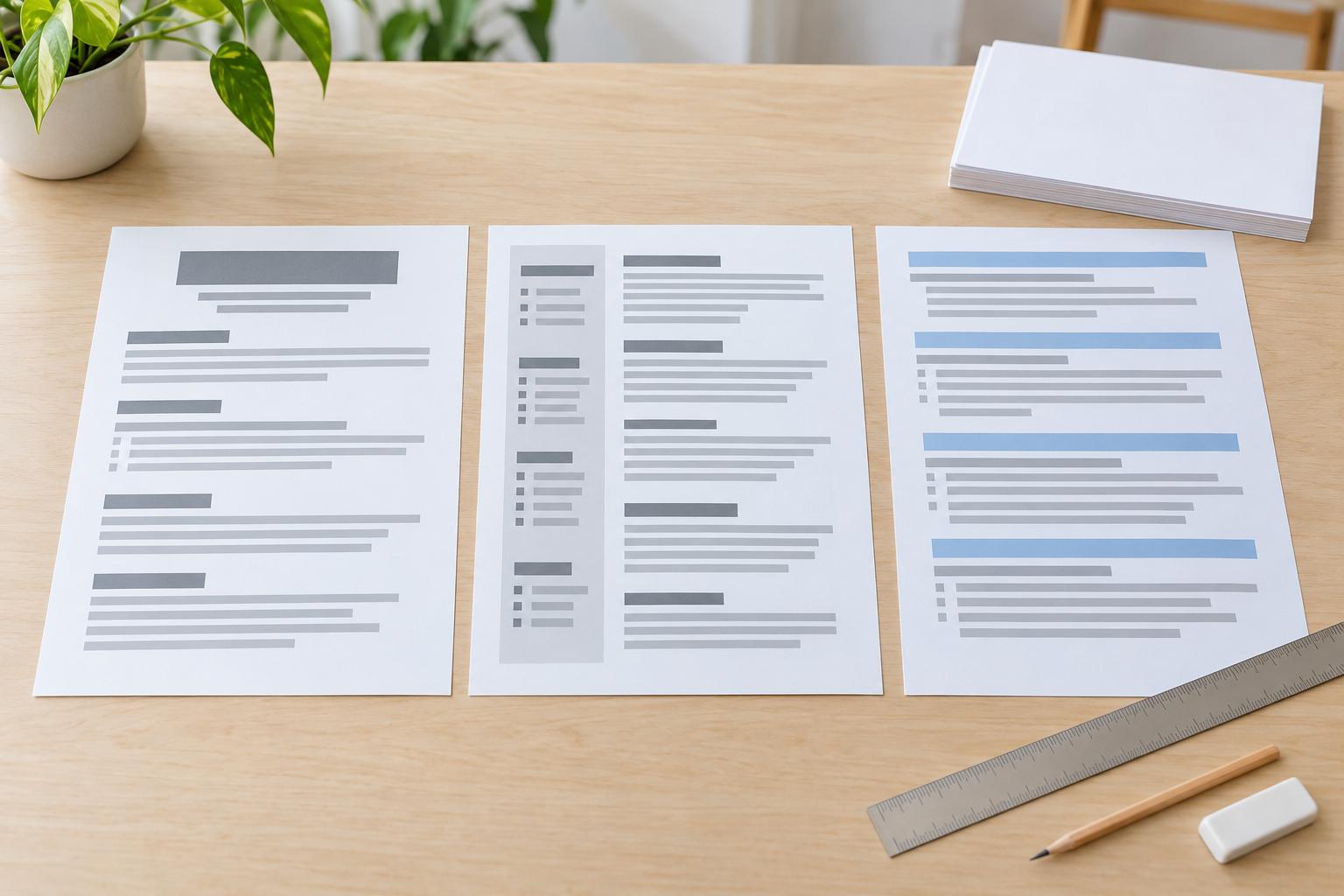
In 2026, we avoid "multi-column chaos." AI parsers read left-to-right; columns often cause them to mix text from different sections, creating a garbled profile. Furthermore, the 2026 trend is to avoid "external dependencies" like QR codes. Recruiters are increasingly wary of "QR-jacking" security risks and often won't scan them. If you want proven starting points, review these resume layouts that get past ATS, and if a sidebar still tempts you, weigh the two-column resume pros and cons first.
- Why: Simple, vertical layouts are the only way to guarantee 100% parsing accuracy across all HR tech platforms.
- How: Use standard margins (at least 0.75") and avoid "creative" sidebars.
- Example: Move your contact info from a side column to a simple centered header at the top of the page.
Use Essential Headings (and Cut the Rest)
Headings are the "anchors" for AI. In 2026, stick to the "Big Four": Summary, Skills, Experience, and Education. Modern AI is trained to look for these specific strings. Sections like "Hobbies" or "References Available Upon Request" are considered "legacy clutter" and should be removed to make room for a "Projects" or "Continuous Learning" section, which holds more weight in the 2026 skills-based economy.
- Why: Space is at a premium. Every line spent on a hobby is a line not spent on a skill that increases your market value.
- How: Consult a guide on which headings are useful to determine what to prune.
- Example: Delete "Interests: Hiking, Travel" and replace it with "Certifications: AWS Cloud Practitioner (2025)."
Ensure Black and White Compatibility
Even in 2026, the "Printer Test" is the ultimate accessibility check. Many high-level hiring committees still print resumes for "Deep Dive" sessions. If your minimalist design relies on subtle light-grey text or color-coded categories, it will fail in a high-contrast environment.
- Why: Contrast is king for both tired human eyes and OCR (Optical Character Recognition) software.
- How: Use bolding and font size (14pt for headers, 10-11pt for body) to create hierarchy instead of color.
- Example: Instead of a blue header, use a BOLD, ALL-CAPS BLACK HEADER to ensure it pops on any screen or paper.
Key Takeaway: Design for 2026 is about "Universal Accessibility"—ensuring your resume is equally effective when read by a human, an AI, or a black-and-white printer.
Conclusion: The State of the Resume in 2026
In 2026, the minimalist resume is more than a trend; it is a necessity for survival in a high-volume, AI-driven job market. By focusing on a Hybrid-Minimalist approach, you satisfy the machine's hunger for structured data and the human's desire for a clear, impactful narrative. The "perfect" resume this year is one that uses white space to highlight achievements, employs a single-column layout for technical accuracy, and ruthlessly prioritizes relevant keywords over aesthetic gimmicks. In a world of infinite noise, the most minimalist voice is often the one that is heard most clearly.
Minimalist Resume Templates that will Fast-Track Your Resume Writing
No matter what style you opt for, your resume should highlight your best features so you can make a positive first impression on recruiters and interviewers.
Here at Rocket Resume, we have millions of professional resume templates that will help you get started. They’re easy to customize, and our resume builder will guide you through choosing the best structure and layout based on your experience and qualifications. Plus, it will then suggest recruiter-approved phrasing based on the role you’re applying for.
They’re also all machine-readable, so you can beat the applicant tracking system and increase your chances of being invited to an interview.
It takes just 10 minutes to build your resume, so get started now.
Browse our resume templates
Pick a design you like, then fill in your resume one section at a time.