Phlebotomist resume examples, templates and tips
Follow a step-by-step expert guide to a phlebotomist resume, with practical tips, complete examples, skill and work history suggestions, and templates.
- Phlebotomist resume examples and templates
- Pay data and job outlook
- Easy editing as you go

How to write a phlebotomist resume
A first phlebotomist resume may have a certificate program, an externship and little else. The challenge is showing the care behind identity checks, test timing and requisition checks without burying that work in generic descriptions. This guide starts with six questions to answer first, then walks through each part of your resume with tips and links to the examples, templates and data on this page.
Six questions to answer first
- What belongs on a phlebotomist resume?
Step 1 places phlebotomy duties in the right resume sections.
- How do I write a phlebotomist resume with no experience?
Step 3 finds a starting point for a first or later resume.
- Which phlebotomist duties should I list?
Step 5 shows the detail a specimen-handling responsibility needs.
- Which phlebotomy skills belong on a resume?
Step 7 supports phlebotomy skills with work-history examples.
- What should a phlebotomist objective or summary say?
Step 8 shapes an opening around education and phlebotomy duties.
- How do I list a phlebotomy certification?
Step 9 places credentials in the certifications section.
What a phlebotomist does
A phlebotomist draws blood and collects specimens from patients and donors for tests, transfusions, donations or research. Techniques include venipuncture by vacuum tube, syringe or butterfly and capillary puncture by heel or finger stick. The job also goes by the titles Phlebotomy Technician (Phlebotomy Tech) and Patient Service Technician (PST).
A phlebotomist confirms the patient’s identity before the draw and checks the requisition against the specimen tubes. After the draw, they label the blood, log the specimens and record where they are sent for analysis.
The national median annual wage for phlebotomists was $45,230 in May 2025. The Occupational Outlook Handbook from the U.S. Bureau of Labor Statistics projects employment growth of 7% from 2025 to 2035.
See also: Choose the clinical details to name on a resumeWhere phlebotomists workProjected job growth
Tip: A hiring manager can assess a blood-draw responsibility more clearly when you name the collection method.
Write your phlebotomist resume in nine steps
Do the first two before you open the builder. The other seven follow the builder’s order.
Step 1 of 9
Before you open the builder
Job description: find the phlebotomy duties the role needs
What belongs on a phlebotomist resume?
Include venipuncture and capillary puncture methods in Skills, then describe confirming identities, checking requisitions against tubes and labeling specimens in Work history.
Tip: Look for the blood-draw methods, test timing and precautions named in the job description.
Make these easy to find
- Confirming patient identity before a procedure.
- Matching requisitions with specimen tubes.
- Venipuncture using vacuum tube, syringe or butterfly methods.
- Capillary puncture by heel or finger stick.
- Collecting timed specimens for drug-level tests.
- Labeling blood and logging specimens sent for analysis.
- Explaining procedures to nervous patients or donors.
Phlebotomy duties adapted from O*NET and the Occupational Outlook Handbook. See occupation sources.
Match each requirement in the job description
Here’s the step where you’ll show each one:
- Collection methods step 7
- Specimen checks step 5
- Timed collections step 5
- Phlebotomy program step 6
- Patient communication step 5
- Professional certification step 9
- Venipuncture experience step 8
Tip: Claim only what you did. Use the job description to decide which methods and precautions deserve space.
See also: Choose the clinical details to name on a resumeSkills and examplesPhlebotomy programs and credentials
Keep the tasks from the job description beside you as you build. Use them to choose which externship or employment details to include, so the reader can see how your program prepared you for the venipuncture, labeling or test timing the role describes.
Build My Resume
Before you open the builder
Examples: compare the graduate, hospital and lead examples
Tip: Notice how Lucia names supervised practice while Owen and Renee organize their resumes around clinical settings.
Follow how the graduate shows practical skills through an externship, the hospital example names units and timing, and the lead describes donor care and staff training. Look for the details that make each summary credible.
An externship can give a first resume useful detail about blood draws. Before building, note how the examples describe education, techniques and responsibilities, then organize the practice or employment that prepares you for the phlebotomist role.
Build My ResumeIn the builder: experience level
How much experience do you have?
How do I write a phlebotomist resume with no experience?
Put the program in Education and the externship in Work history. Use earlier jobs to show patient-facing skills such as listening and explaining next steps.
Tip: Keep customer service work relevant by describing communication, then give phlebotomy practice its own entry.
Start from Build My Resume and it’s the builder’s first question. The examples below show three starting points: a new certificate graduate with an externship, a hospital phlebotomist with nearly five years of experience and a donor-services lead with ten years of experience.
Choose an order that fits
- New certificate graduate:
- Summary, Education, Certifications, Work history with externship first, Skills.
- Hospital phlebotomist:
- Summary, Work history, Skills, Certifications, Education.
- Donor-services lead:
- Summary, Work history with lead responsibilities first, Skills, Certifications, Education.
The builder starts with a standard order, and you can move sections into the one you choose.
Give recent phlebotomy duties room to be specific. Shorten earlier jobs that repeat the same communication skills.
See also: Resume examplesTemplates
Begin with the experience level that fits your background when the builder asks. If phlebotomy is new to you, plan a work-history entry for the externship and another for earlier employment, with supervised procedures described under the place they happened.
Build My ResumeIn the builder
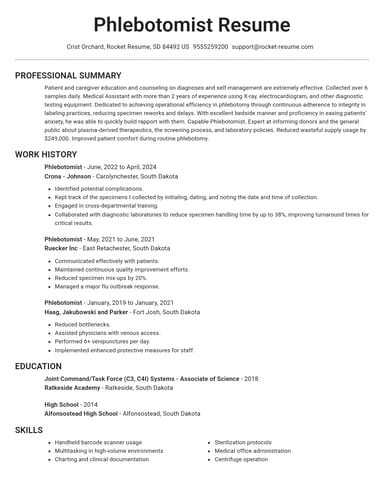
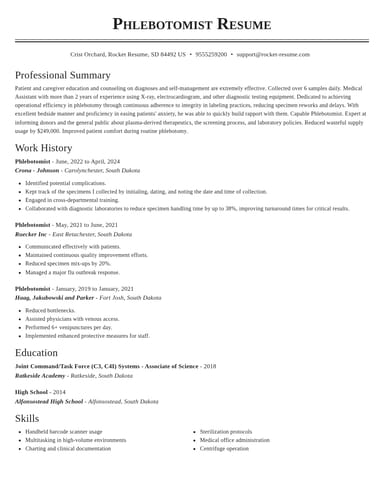
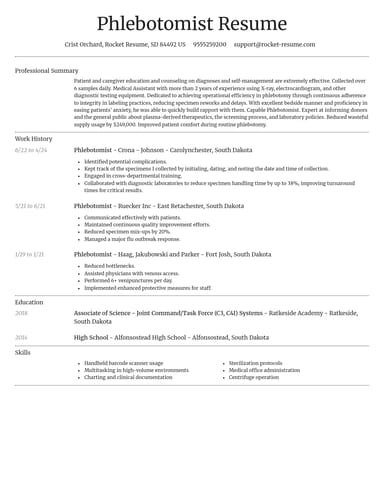
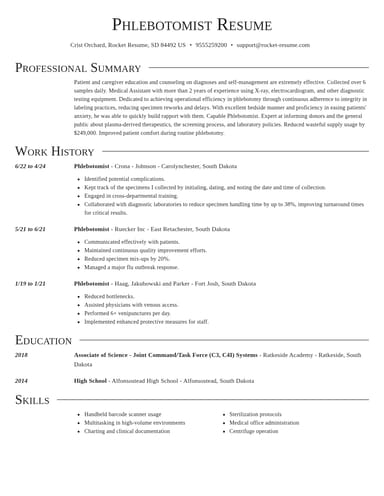
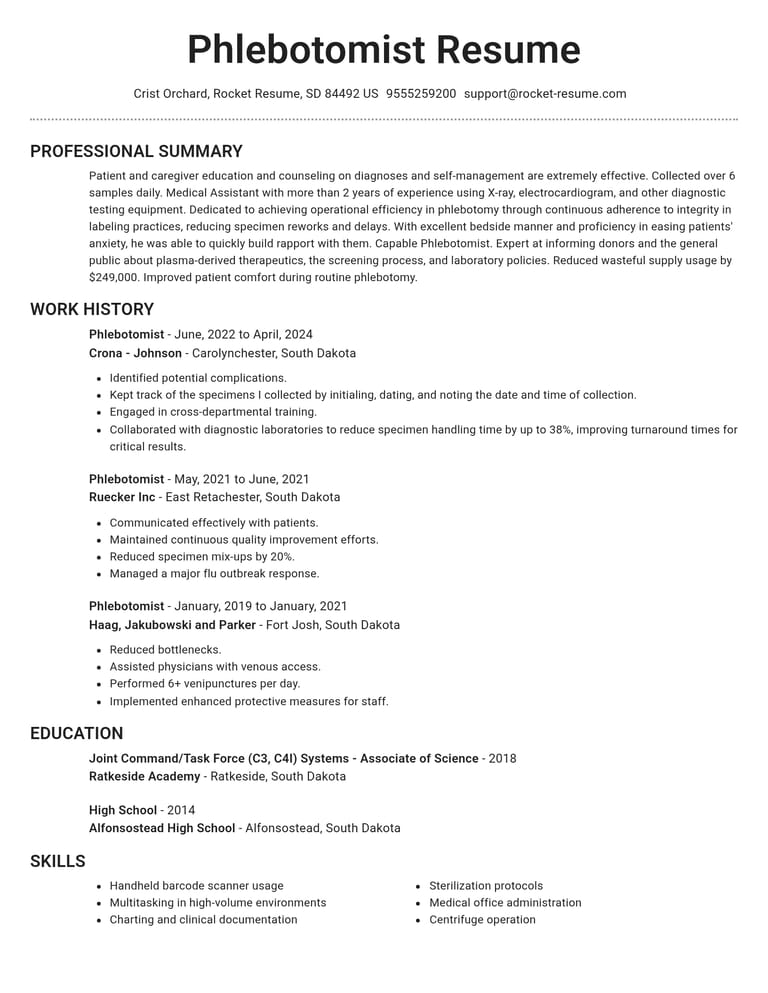
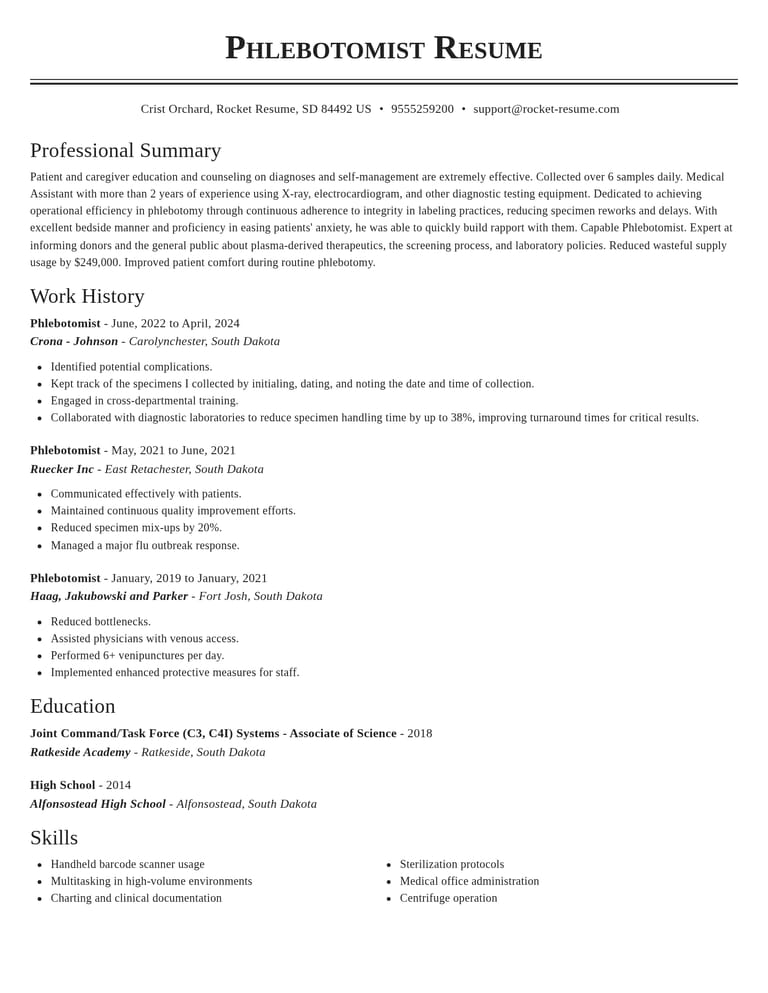
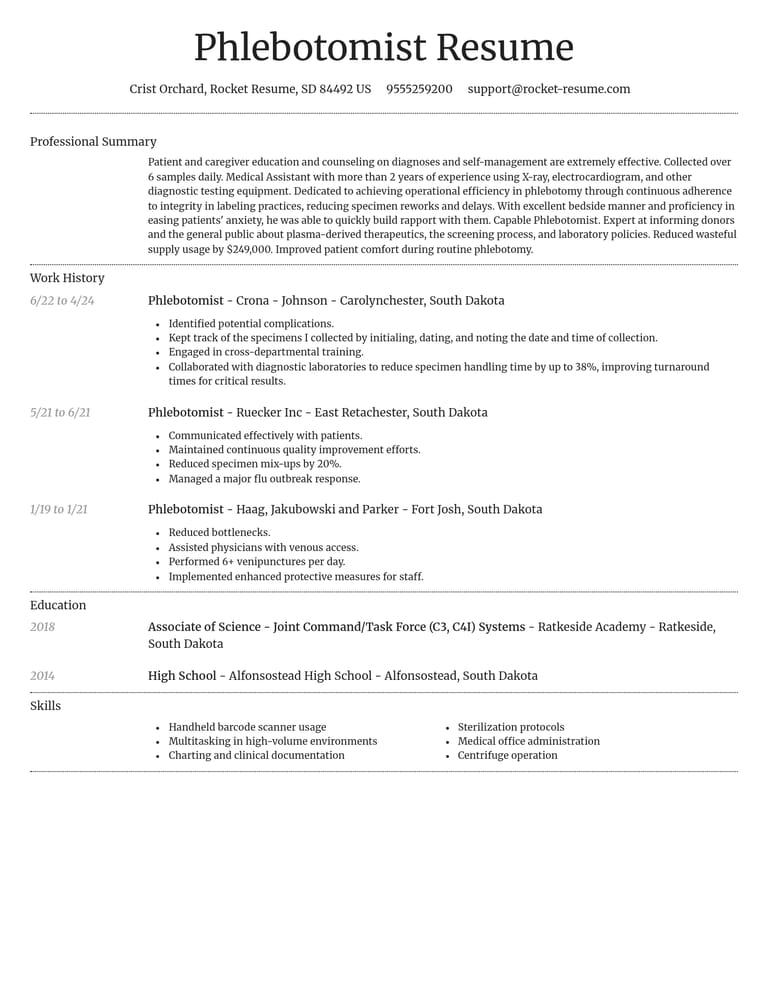
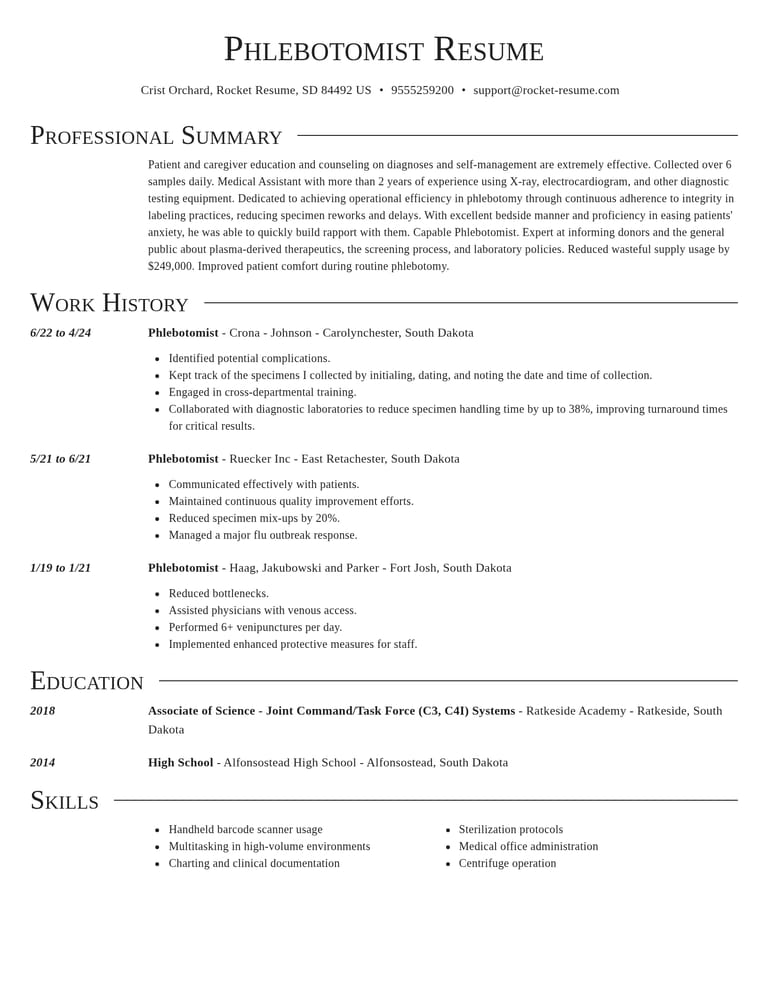
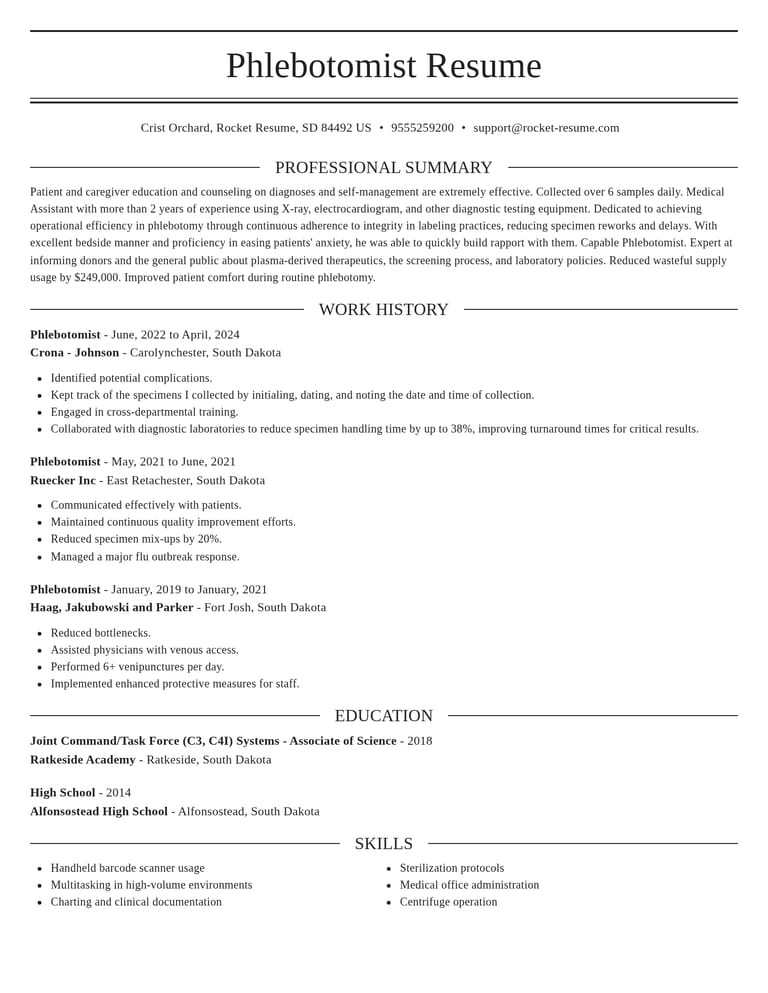
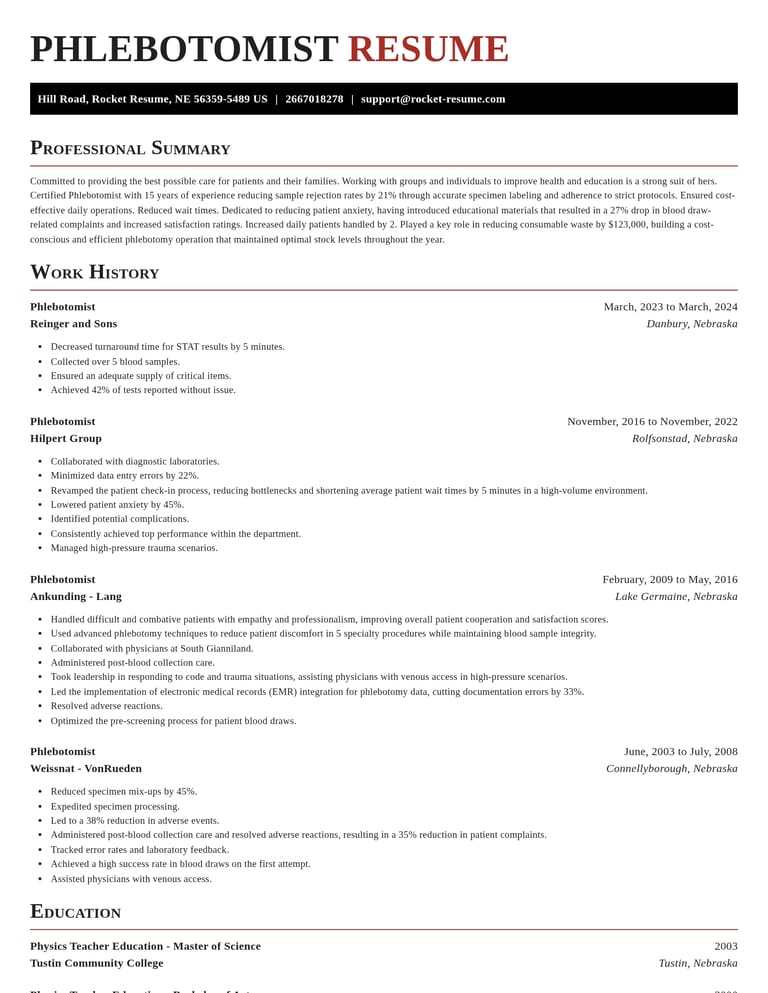
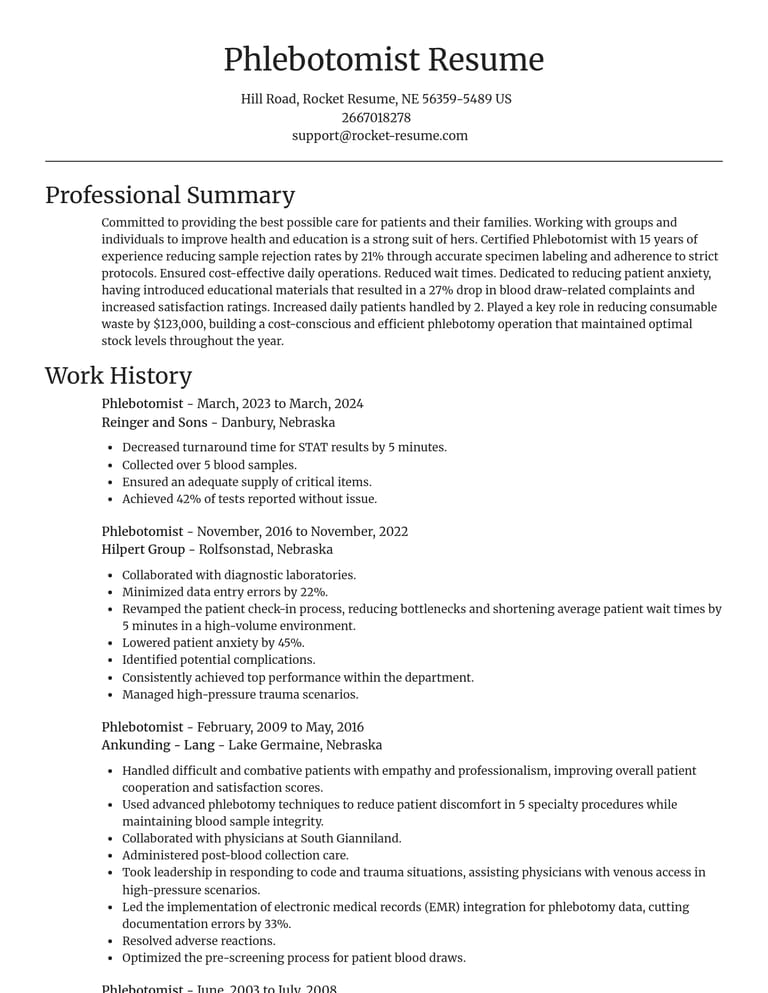
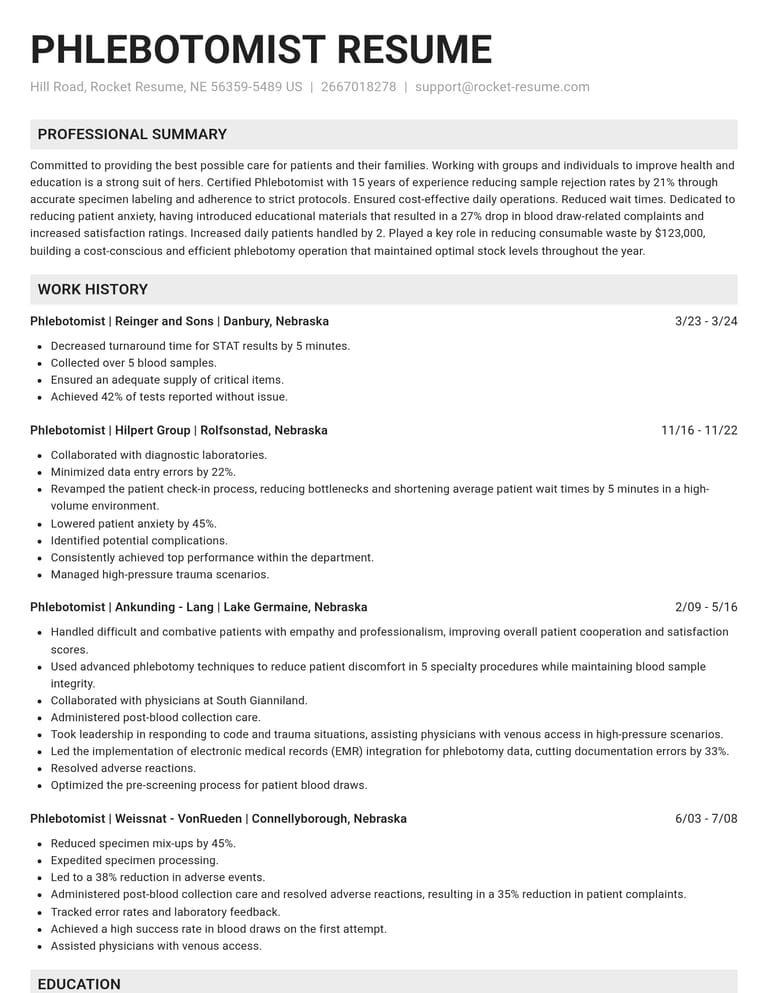
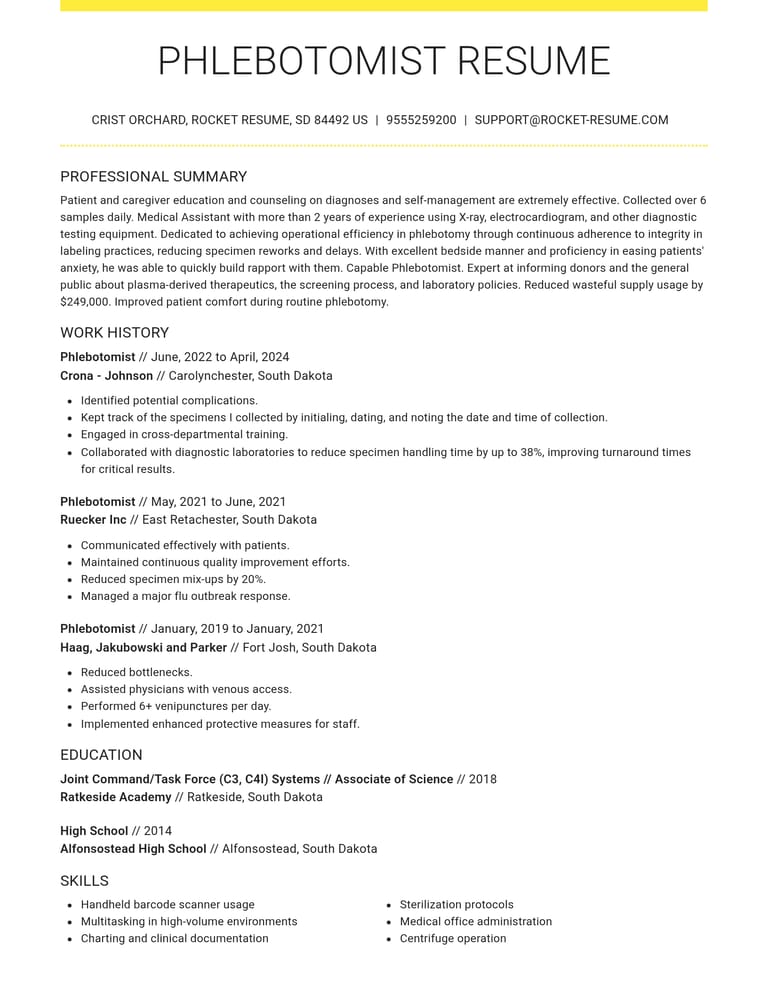
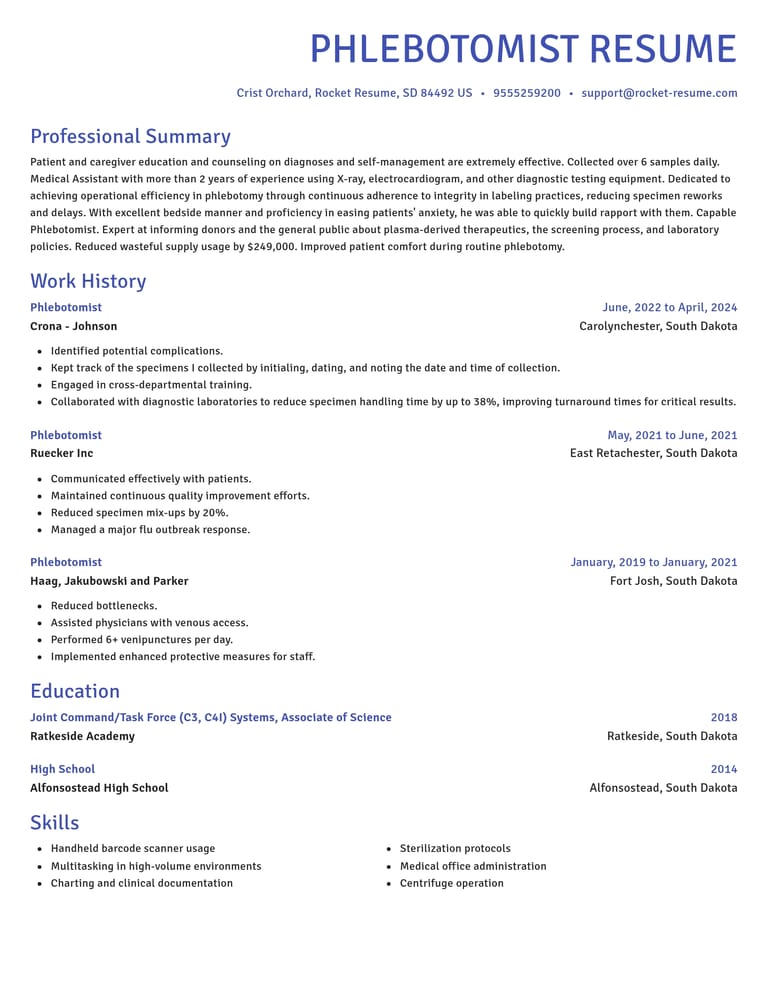
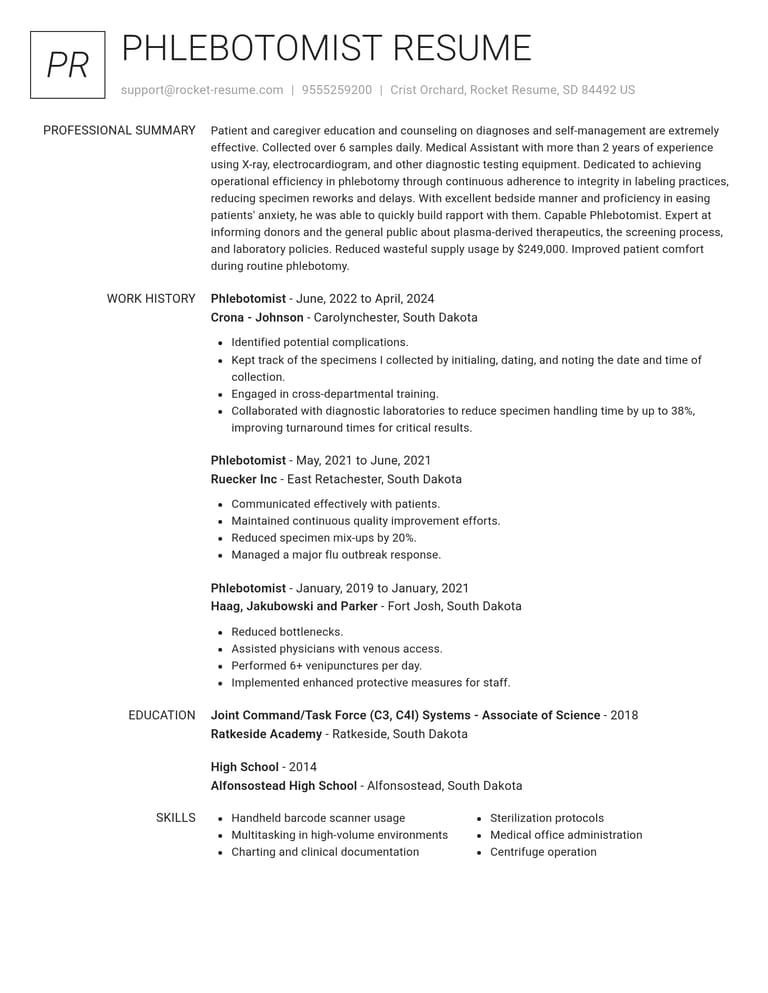
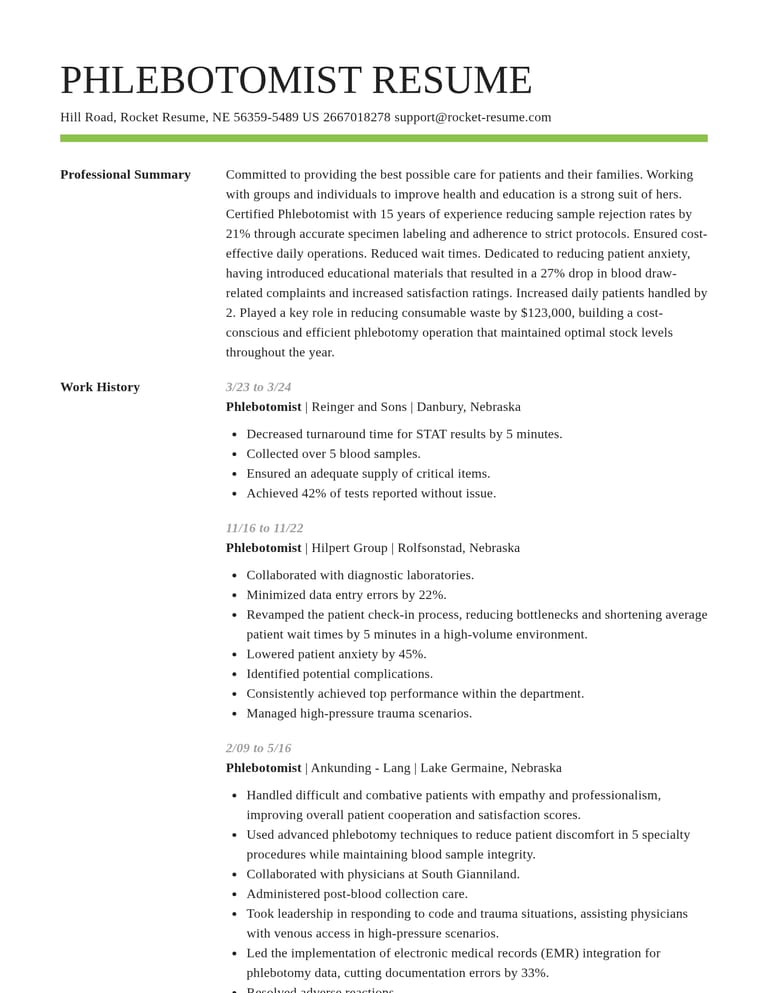
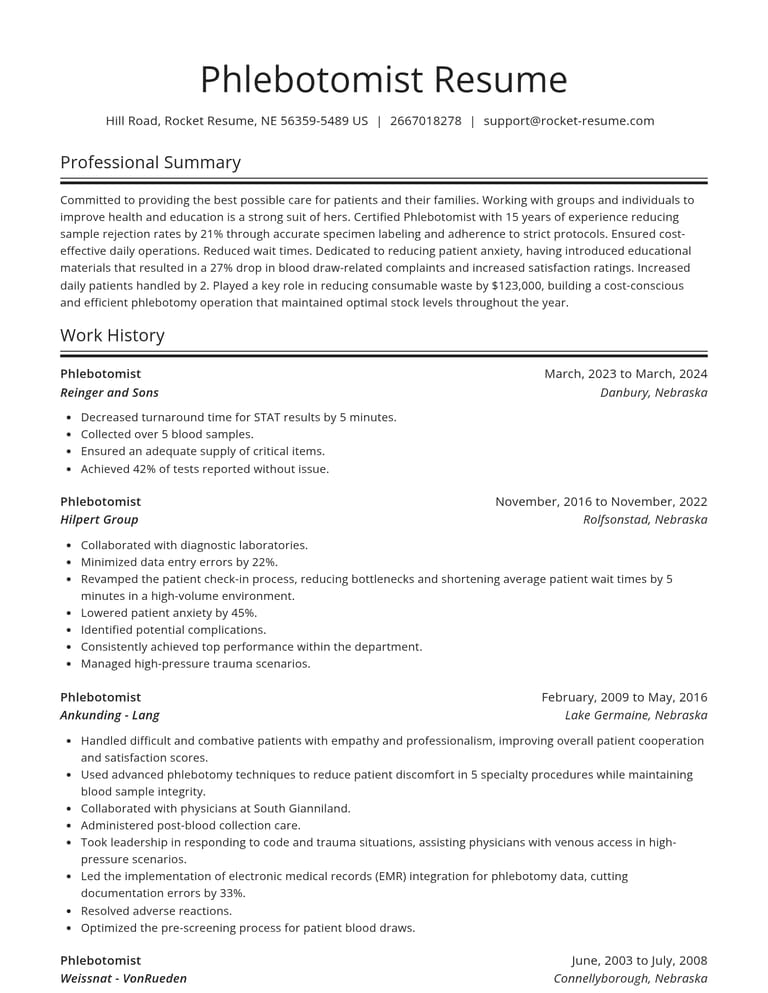
Template: give phlebotomy duties room in a readable layout
Tip: Preview the design with the longest job entry to check that techniques and precautions remain easy to read.
Use separate entries for the externship and earlier customer service jobs so phlebotomy practice stands out. Keep the summary brief enough that the education, credentials and recent responsibilities are easy to find.
A clear layout gives timed draws and newborn heel sticks room to stand out under a hospital job. Once you begin building, add contact details and work history, then continue through education, skills and summary before adding any optional sections.
Build My ResumeIn the builder
Work history: replace vague duties with draw details
Which phlebotomist duties should I list?
Describe venipuncture, capillary puncture, timed collections, labeling specimens and sending them to the lab. Include the setting and the steps you followed before and afterward.
Tip: Name the test and intervals for timed draws. For heel or finger sticks, identify the method and care setting.
Build a description around the method, the check and the setting. In each entry, describe drawing blood alongside labeling, logging or sending specimens to the lab, then add staff training or donor care when those were responsibilities.
If the job description asks for Show this on your resume Specimen checks A requisition checked against the tubes before sending specimens for analysis. Timed collections The intervals used for therapeutic drug-level tests. Patient communication How blood draws were explained to someone who felt nervous. Before
“Collected blood and handled samples.”
After
“Performed butterfly venipuncture during inpatient rounds, checked requisitions against specimen tubes and logged specimens sent to the laboratory.”
Use past tense for a completed externship and present tense for ongoing responsibilities.
See also: Choose the clinical details to name on a resumeResume examples
The requisition check can be as useful to describe as the draw itself. In the builder, describe the method and the care you took before or after it, giving each job entry a clear account of what you handled there.
Build My ResumeIn the builder
Education: show the program and its completion status
Tip: Use the school’s award name and make an unfinished program’s expected completion clear.
The Occupational Outlook Handbook says phlebotomists typically enter with a certificate from a postsecondary phlebotomy program, while some qualify with a high school diploma and on-the-job training. In Education, name the school, certificate and completion year for the training the handbook classifies as “Postsecondary nondegree award.” Programs include anatomy, physiology, medical terminology and laboratory work.
If the job description asks for Show this on your resume Phlebotomy program The school, award name and completed or expected completion year. List the school certificate in Education and professional certification in Certifications. Add the externship as its own work-history entry.
See also: Phlebotomy programs and credentials
Education gives context for the clinical practice on a phlebotomist resume. Continue building with Skills next, where suggestions for the job title can help you recall relevant collection methods and patient-care abilities to consider for the list.
Build My ResumeIn the builder
Skills: support the skill list with tasks performed
Which phlebotomy skills belong on a resume?
Group venipuncture and capillary techniques with specimen handling and patient communication. Support attention to detail with a check you performed, and adaptability with a change in tasks or setting.
Tip: Name heel-stick practice directly and identify the unit or care setting where you used it.
Select methods and specimen checks that match the job description. If you are moving from medical assistant or certified nursing assistant work, list relevant communication and recordkeeping alongside the phlebotomy methods you have practiced.
If the job description asks for Show this on your resume Collection methods The venipuncture or capillary methods used in an externship or job. Collection methods
- Venipuncture by vacuum tube, syringe or butterfly
- Heel-stick and finger-stick capillary puncture
- Timed specimen collection
Identification and specimen handling
- Patient identity confirmation
- Requisition checks
- Specimen logging
A skill list helps a reader scan. A bullet point under a job shows what you did.
Skill
Requisition checks
Work example
Matched laboratory requisitions with specimen tubes in outpatient care and documented the specimens sent to the laboratory.
See also: Skills and examplesChoose the clinical details to name on a resume
A technique becomes easier to assess when a job entry shows it in use. As you build, develop a relevant suggestion into a description of a concrete task, such as a heel stick in an externship or monitoring a donor afterward.
Build My ResumeIn the builder
Summary: write a phlebotomist resume objective or summary
What should a phlebotomist objective or summary say?
State the phlebotomist role sought, the setting you know and a relevant clinical task. A new graduate can introduce externship practice, while an experienced applicant can highlight hospital or donor work.
Tip: Keep the summary to two or three short sentences so the opening is easy to scan.
On a first resume, any sample summary can serve as an objective: name the phlebotomist job you want, your program and your externship. Describe techniques and patient identification from supervised practice or employment rather than opening with a general wish to help people.
If the job description asks for Show this on your resume Venipuncture experience The care setting and venipuncture methods you would bring to the phlebotomist job. Summary if you’re a new certificate graduate
“Phlebotomy certificate graduate seeking an outpatient phlebotomist role, bringing venipuncture practice, requisition checks and patient communication skills from a hospital externship.”
Summary if you’re experienced in hospital procedures
“Hospital phlebotomist experienced in inpatient and emergency department venipuncture, timed specimens and newborn heel sticks. Brings careful requisition checks and clear explanations to patient-facing duties.”
Summary if you’re leading donor services
“Lead phlebotomist in donor services with a background in laboratory procedures, donor monitoring, hemoglobin testing and training new staff in phlebotomy techniques.”
See also: Resume examplesSkills and examples
The opening becomes easier once the draw details are on the page. At the summary step, use the builder suggestions to introduce your care setting, techniques and patient communication, drawing on the externship or employment entries you have already completed.
Build My ResumeIn the builder
Certifications: give credentials their own section
How do I list a phlebotomy certification?
Write the certification name, issuer and year, in that order, in Certifications. Use the title printed on the phlebotomy credential.
Tip: Use More sections after the summary to add Certifications, including a life-support card.
Give each credential its own entry. The Occupational Outlook Handbook says some employers prefer professional certification and Basic Life Support certification may also be needed. Keep the school certificate in Education. See the examples for filled-in credential entries.
[certification name], [certifying organization], [year]
How to list it · copy the wording on your certificate
Basic Life Support (BLS), [issuing organization], [year]
How to list it · copy the wording on your certificate
Certified Phlebotomy Technician (CPT), National Healthcareer Association, [year]
How to list it · from the example resumes
If the job description asks for Show this on your resume Professional certification The professional certification you have that matches the job description’s request. See also: Phlebotomy programs and credentials
A phlebotomy job description may ask for professional certification alongside blood-draw experience. Before finishing in the builder, scan the resume for abbreviations a reader may not recognize and spell them out on first use.
Build My Resume
Phlebotomist resume mistakes to fix before you apply
How Rocket Resume helps
Four ways the builder helps with your phlebotomist resume:
- Job descriptions. Keep one resume in your account and adjust it to fit each one.
- Experience level. The builder asks how much experience you have first, then guides you from there.
- Your own numbers. Choose a suggestion, then edit it to add the numbers from your work.
- Saved suggestions. Save a skill, example, summary or certification on this page, and it waits for you in the builder.
Phlebotomist resume examples
Each illustrative composite follows a different stage: a new certificate graduate, a hospital phlebotomist and a donor-services lead. Compare the education and responsibilities behind each opening summary.
Tip: Use the entry-level example to see how earlier customer service work can sit alongside an externship.
Entry-level phlebotomist resume example
Albuquerque, NM · New certificate graduate · Externship completed in 2026
Lucia F.
Phlebotomist
lucia.f@example.com · (505) 555-0142 · Albuquerque, NM
Summary
Phlebotomy certificate graduate seeking an outpatient phlebotomist role after an externship at a hospital draw station. Brings vacuum-tube venipuncture, requisition checks, specimen labeling and customer service communication.
Experience
Phlebotomy extern · Example Regional Medical Center
Jun 2026 – Aug 2026
- Performed 80 vacuum-tube blood draws under supervision at an outpatient draw station.
- Confirmed patient identities and checked requisitions against tubes.
- Labeled blood samples and explained procedures to nervous patients.
Customer service associate · Example Grocery Store
Jan 2023 – Dec 2025
- Answered customer questions and listened to concerns across 4 checkout shifts each week.
- Coordinated with colleagues when a customer needed further assistance.
Education and credentials
Phlebotomy certificate · Example Technical Institute, 2026
Certified Phlebotomy Technician (CPT), National Healthcareer Association, 2026 · Basic Life Support (BLS), American Heart Association, 2026
Skills
- Vacuum-tube venipuncture
- Requisition checks
- Patient communication
- Specimen labeling
Why this example works
- Externship detailThe draw total and outpatient setting show the extent and context of Lucia’s supervised practice.
- Earlier experienceHer customer service entry shows repeated practice listening and explaining next steps.
- Training and practiceLucia’s summary names her phlebotomy certificate and the externship skills that her work history then shows.
Experienced phlebotomist resume example
Milwaukee, WI · Nearly five years in hospital phlebotomy
Owen T.
Phlebotomist
owen.t@example.com · (414) 555-0187 · Milwaukee, WI
Summary
Hospital phlebotomist with experience in inpatient and emergency department draws. Handles timed draws, newborn heel sticks and requisition checks while explaining procedures to patients.
Experience
Phlebotomist · Example General Hospital
Dec 2021 – Present
- Perform 35 inpatient and emergency department draws per shift using vacuum tube, syringe and butterfly venipuncture methods.
- Collect timed specimens for therapeutic drug-level tests across 2 hospital units.
- Perform heel sticks on the newborn unit and match requisitions with specimen tubes.
- Label blood samples, log specimens sent to the laboratory and explain procedures to patients.
Education and credentials
Phlebotomy certificate · Example Technical College, 2021
Phlebotomy Technician, PBT(ASCP), 2021 · Basic Life Support (BLS), American Red Cross, 2025
Skills
- Venipuncture
- Timed specimen collection
- Newborn heel sticks
- Requisition checks
- Specimen documentation
Why this example works
- Hospital scopeInpatient rounds and emergency department duties explain where the phlebotomy experience was gained.
- Method detailHeel sticks and timed draws give substance to the skills list.
- Specimen recordsRequisition checks, labeling and logging show the care Owen takes around each procedure.
Lead phlebotomist resume example
Omaha, NE · Ten years in phlebotomy · Donor services
Renee K.
Lead phlebotomist, donor services
renee.k@example.com · (402) 555-0119 · Omaha, NE
Summary
Lead phlebotomist in donor services with ten years in phlebotomy, including earlier reference laboratory experience. Coordinates donor care and maintains plasma collection machines while training staff in laboratory techniques.
Experience
Lead phlebotomist, donor services · Example Donor Center
Jun 2020 – Present
- Coordinate donor draws and follow-up care for a team of 5.
- Perform venipuncture for blood donors and monitor 20 blood or plasma donors per shift during and after procedures, attending to health, safety and comfort.
- Conduct hemoglobin tests for donor iron levels and maintain plasma collection machines.
- Train 6 new staff members in phlebotomy and laboratory techniques.
Phlebotomist · Example Reference Laboratory
Sep 2016 – May 2020
- Used vacuum tube and butterfly methods for venipuncture.
- Labeled blood samples and entered specimen information into the laboratory system.
Education and credentials
Phlebotomy certificate · Example Community College, 2016
Certified Phlebotomy Technician (CPT), National Healthcareer Association, 2016 · Basic Life Support (BLS), American Red Cross, 2025
Skills
- Donor monitoring
- Hemoglobin testing
- Maintaining plasma collection machines
- Staff training
- Venipuncture
Why this example works
- Donor focusThe donor total and monitoring responsibilities show the people and care involved in Renee’s recent work.
- Lead responsibilityTeam coordination, machine upkeep and staff training make the lead responsibilities concrete.
- Earlier foundationThe laboratory entry shows the foundation for later responsibilities through prior venipuncture practice.
Lucia’s externship, Owen’s hospital duties and Renee’s donor responsibilities give you different places to start. Build from the example closest to the work you have done, using its organization to show the techniques, precautions and program details that belong to you.
Build My ResumePhlebotomist resume skills and examples
Browse skills, work examples, summaries and certifications. Save the ones that fit, then make each one true to your own work.
Tip: Group venipuncture and capillary methods in the resume, then use work history to show the setting where you practiced them.
Venipuncture by vacuum tube, syringe or butterfly
Collection methods
Heel-stick and finger-stick capillary puncture
Collection methods
Timed specimen collection
Collection methods
Blood culture and glucose tolerance test draws
Collection methods
Patient identity confirmation
Identification and specimen handling
Requisition checks
Identification and specimen handling
Specimen logging
Identification and specimen handling
Specimen transport
Identification and specimen handling
Show all 27 skillsShow fewer
Specimen labeling
Identification and specimen handling
Explaining blood-draw procedures
Patient care and communication
Active listening
Patient care and communication
Reassuring nervous patients or donors
Patient care and communication
Donor monitoring
Patient care and communication
Sharps disposal
Safety and infection control
Biohazard disposal
Safety and infection control
Work area sanitation
Safety and infection control
Specimen data entry
Records and work habits
Attention to detail
Records and work habits
Interpersonal skills
Records and work habits
Adaptability
Records and work habits
Medical terminology
Records and work habits
Patient communication
From the example resumes
Newborn heel sticks
Collection methods · from the example resumes
Specimen documentation
From the example resumes
Hemoglobin testing
Collection methods · from the example resumes
Maintaining plasma collection machines
Collection methods · from the example resumes
Staff training
From the example resumes
Collected specimens at scheduled intervals for therapeutic drug-level tests during inpatient rounds.
Collection methods · writing example
Perform 35 inpatient and emergency department draws per shift using vacuum tube, syringe and butterfly venipuncture methods.
Collection methods · from the experienced example · use your own numbers
Collect timed specimens for therapeutic drug-level tests across 2 hospital units.
Collection methods · from the experienced example · use your own numbers
Used vacuum tube and butterfly methods for venipuncture.
Collection methods · from the lead example
Matched laboratory requisitions with specimen tubes in outpatient care and documented the specimens sent to the laboratory.
Identification and specimen handling · writing example
Confirmed patient identities and checked requisitions against tubes.
Identification and specimen handling · transferable, from the entry level example
Perform heel sticks on the newborn unit and match requisitions with specimen tubes.
Identification and specimen handling · from the experienced example
Label blood samples, log specimens sent to the laboratory and explain procedures to patients.
Identification and specimen handling · from the experienced example
Show all 18 work examplesShow fewer
Labeled blood samples and entered specimen information into the laboratory system.
Identification and specimen handling · from the lead example
Monitored blood and plasma donors during and after collection, attending to their comfort and reporting concerns.
Patient care and communication · writing example
Performed 80 vacuum-tube blood draws under supervision at an outpatient draw station.
Patient care and communication · transferable, from the entry level example · use your own numbers
Labeled blood samples and explained procedures to nervous patients.
Patient care and communication · transferable, from the entry level example
Answered customer questions and listened to concerns across 4 checkout shifts each week.
Patient care and communication · transferable, from the entry level example · use your own numbers
Coordinate donor draws and follow-up care for a team of 5.
Patient care and communication · from the lead example · use your own numbers
Perform venipuncture for blood donors and monitor 20 blood or plasma donors per shift during and after procedures, attending to health, safety and comfort.
Patient care and communication · from the lead example · use your own numbers
Conduct hemoglobin tests for donor iron levels and maintain plasma collection machines.
Patient care and communication · from the lead example
Coordinated with colleagues when a customer needed further assistance.
Transferable, from the entry level example
Train 6 new staff members in phlebotomy and laboratory techniques.
From the lead example · use your own numbers
Phlebotomy certificate graduate seeking an outpatient phlebotomist role, bringing venipuncture practice, requisition checks and patient communication skills from a hospital externship.
A new certificate graduate · writing example
Hospital phlebotomist experienced in inpatient and emergency department venipuncture, timed specimens and newborn heel sticks. Brings careful requisition checks and clear explanations to patient-facing duties.
Experienced in hospital procedures · writing example
Lead phlebotomist in donor services with a background in laboratory procedures, donor monitoring, hemoglobin testing and training new staff in phlebotomy techniques.
Leading donor services · writing example
Phlebotomy certificate graduate seeking an outpatient phlebotomist role after an externship at a hospital draw station. Brings vacuum-tube venipuncture, requisition checks, specimen labeling and customer service communication.
From the entry level example
Hospital phlebotomist with experience in inpatient and emergency department draws. Handles timed draws, newborn heel sticks and requisition checks while explaining procedures to patients.
From the experienced example
Lead phlebotomist in donor services with ten years in phlebotomy, including earlier reference laboratory experience. Coordinates donor care and maintains plasma collection machines while training staff in laboratory techniques.
From the lead example
[certification name], [certifying organization], [year]
How to list it · copy the wording on your certificate
Basic Life Support (BLS), [issuing organization], [year]
How to list it · copy the wording on your certificate
Certified Phlebotomy Technician (CPT), National Healthcareer Association, [year]
How to list it · from the example resumes
Skills are adapted from O*NET (31-9097.00) and the example resumes.
Where they go in your resume: Work historySkillsSummaryCertifications
Collection methods become more useful on a resume when you show the setting and task where you used them. Save the skills that match your practice, then build a work-history description that shows where you used each method or specimen check.
Build My ResumePhlebotomy programs and credentials
The Occupational Outlook Handbook describes a postsecondary phlebotomy certificate as the typical entry path for phlebotomists, though some enter with a high school diploma and on-the-job training. Training covers laboratory work along with anatomy, physiology and medical terminology. States may require an accredited training program, a license or certification, or other requirements. Contact the state licensing agency for specific requirements. The example resumes show completed credential entries you can use to check which details to include. Phlebotomists who transport samples may need a driver’s license. List it in Certifications or Additional information when the job involves transporting samples. For the training path, read how to become a phlebotomist.
Tip: Check the job description for the phlebotomy certification the employer asks for.
Phlebotomy certification
Professional organization
- How to list it
- [certification name], [certifying organization], [year]
- Handbook guidance
- Some employers prefer to hire phlebotomists who have earned professional certification, such as those offered by professional organizations. Requirements vary by organization but may include education and clinical experience, passing an exam, and practical components, such as drawing blood.
- Resume placement
- Add the professional credential through More sections, then Certifications.
Basic Life Support
Course provider named on the card
- How to list it
- Basic Life Support (BLS), [issuing organization], [year]
- Handbook guidance
- Phlebotomists also may need to have Basic Life Support certification.
- Resume placement
- Give the card its own Certifications entry.
Phlebotomy program still in progress
An employer asking for phlebotomy certification needs to find it without searching through the draw descriptions. As you build, give the credential a clear entry and review its details against the certification before finishing the resume.
Build My ResumeChoose the clinical details to name on a resume
Choose details that show the scope of each phlebotomy job.
Tip: Use these details in an externship entry as well as a phlebotomist job entry.
Phlebotomist salary and job outlook
Government estimates for May 2025. Pay depends on your state, work setting and experience.
Tip: Use the hospital and laboratory medians to put a setting’s pay in context. Emphasize the test timing and specimen handling that fit the role.
Phlebotomist pay by state
Median annual wage, May 2025. Highest: California, $56,040. Tap a state to see its numbers.
- Under $39,500
- $39,500–$42,999
- $43,000–$45,999
- $46,000–$47,499
- $47,500 or more
Selected state
California
- Median
- $56,040
- Average
- $56,600
- Lowest to highest 10%
- $45,490 – $74,340
- Jobs in the state
- 13,520
National median: $45,230. State figures are annual; see the national pay range for hourly wages.
See all 50 states and DC
| State | Median | Average | Lowest 10% | Highest 10% | Jobs |
|---|---|---|---|---|---|
| Alabama | $37,220 | $38,020 | $30,440 | $45,710 | 2,350 |
| Alaska | $45,900 | $48,140 | $40,300 | $59,780 | 210 |
| Arizona | $46,260 | $46,960 | $38,090 | $60,820 | 3,430 |
| Arkansas | $37,450 | $38,020 | $30,870 | $44,280 | 1,100 |
| California | $56,040 | $56,600 | $45,490 | $74,340 | 13,520 |
| Colorado | $47,180 | $48,520 | $39,400 | $59,540 | 2,420 |
| Connecticut | $45,820 | $47,440 | $38,360 | $59,730 | 1,630 |
| Delaware | $48,110 | $47,130 | $38,720 | $58,520 | 430 |
| District of Columbia | $51,980 | $52,070 | $46,010 | $57,250 | 180 |
| Florida | $40,230 | $41,990 | $35,560 | $48,190 | 10,220 |
| Georgia | $45,840 | $45,180 | $34,600 | $55,850 | 5,280 |
| Hawaii | $47,750 | $48,630 | $41,600 | $59,760 | 110 |
| Idaho | $43,400 | $42,140 | $35,490 | $47,340 | 1,010 |
| Illinois | $46,010 | $45,860 | $37,370 | $54,920 | 7,910 |
| Indiana | $39,250 | $41,770 | $35,870 | $48,290 | 2,410 |
| Iowa | $38,240 | $40,290 | $35,970 | $46,570 | 1,100 |
| Kansas | $39,100 | $42,000 | $34,410 | $50,350 | 1,120 |
| Kentucky | $42,480 | $42,600 | $35,230 | $48,820 | 2,500 |
| Louisiana | $36,120 | $37,420 | $29,770 | $47,120 | 3,410 |
| Maine | $45,640 | $44,590 | $37,810 | $50,740 | 500 |
| Maryland | $43,480 | $45,460 | $35,320 | $58,180 | 2,040 |
| Massachusetts | $50,170 | $52,540 | $42,950 | $62,350 | 2,580 |
| Michigan | $39,860 | $42,420 | $36,850 | $48,890 | 3,540 |
| Minnesota | $46,000 | $46,890 | $38,740 | $58,920 | 2,090 |
| Mississippi | $36,290 | $36,710 | $27,730 | $47,980 | 1,200 |
| Missouri | $43,120 | $42,640 | $34,070 | $51,390 | 1,890 |
| Montana | $45,470 | $45,030 | $36,950 | $52,590 | 370 |
| Nebraska | $39,540 | $41,480 | $35,660 | $48,900 | 920 |
| Nevada | $45,760 | $46,430 | $37,280 | $59,480 | 1,300 |
| New Hampshire | $48,660 | $49,330 | $40,640 | $58,780 | 630 |
| New Jersey | $48,650 | $49,140 | $39,730 | $58,520 | 5,230 |
| New Mexico | $42,910 | $42,140 | $32,400 | $48,350 | 760 |
| New York | $50,530 | $51,830 | $37,930 | $63,070 | 6,400 |
| North Carolina | $43,330 | $42,720 | $35,210 | $49,450 | 5,410 |
| North Dakota | $47,430 | $47,990 | $33,840 | $58,290 | 220 |
| Ohio | $39,770 | $42,130 | $36,190 | $48,680 | 5,120 |
| Oklahoma | $39,030 | $41,610 | $33,570 | $49,200 | 1,670 |
| Oregon | $49,160 | $51,060 | $40,060 | $62,280 | 1,800 |
| Pennsylvania | $43,910 | $43,540 | $37,010 | $50,060 | 5,510 |
| Rhode Island | $46,380 | $47,290 | $36,830 | $58,290 | 970 |
| South Carolina | $39,010 | $40,930 | $35,760 | $47,060 | 2,760 |
| South Dakota | $39,560 | $39,590 | $31,360 | $45,240 | 320 |
| Tennessee | $38,550 | $40,880 | $35,010 | $47,630 | 3,520 |
| Texas | $40,450 | $42,630 | $32,570 | $53,560 | 12,820 |
| Utah | $40,630 | $41,050 | $35,800 | $47,420 | 1,680 |
| Vermont | $46,000 | $46,970 | $38,630 | $58,960 | 200 |
| Virginia | $46,340 | $46,890 | $37,370 | $58,470 | 3,600 |
| Washington | $48,880 | $51,490 | $39,410 | $64,080 | 2,820 |
| West Virginia | $39,250 | $39,910 | $30,570 | $46,130 | 1,530 |
| Wisconsin | $46,470 | $45,590 | $37,680 | $51,950 | 3,610 |
| Wyoming | $38,180 | $42,860 | $31,500 | $60,590 | 190 |
Source: BLS OEWS, May 2025 · checked Oct 23, 2026 · lowest and highest 10% are the 10th and 90th percentile wages
National pay range
Annual wages, all U.S. phlebotomists
| Percentile | Annual | Hourly |
|---|---|---|
| 10th | $35,780 | $17.20 |
| 25th | $38,190 | $18.36 |
| Median | $45,230 | $21.75 |
| 75th | $48,930 | $23.53 |
| 90th | $58,780 | $28.26 |
Source: BLS OEWS, May 2025 · checked Oct 23, 2026
More pay data: state rankings and pay by work setting
State rankings
Top five states and DC
Source: BLS OEWS, May 2025 · checked Oct 23, 2026 · ranked by annual mean wage or jobs per 1,000 jobs
Median pay by work setting
Annual median, May 2025
- Outpatient care centers$48,030
- Medical and diagnostic laboratories$46,670
- Offices of physicians$44,500
- Hospitals; state, local, and private$44,220
- All other ambulatory healthcare services$39,930
Source: BLS Occupational Outlook Handbook, May 2025 · checked Nov 14, 2026
Projected job growth, 2025–35
Change in employment over ten years
- Phlebotomists7%
- Other healthcare support occupations jobs10%
- All occupations3%
That's 9,800 more jobs over ten years and about 18,000 openings a year, counting people who retire or change jobs.
Source: BLS Employment Projections 2025–35 · checked Nov 14, 2026
Where phlebotomists work
Share of the 143,900 jobs in 2025 (largest settings)
- Hospitals; state, local, and private36%
- Medical and diagnostic laboratories33%
- All other ambulatory healthcare services16%
- Offices of physicians9%
- Outpatient care centers2%
The rest work in other settings.
Source: BLS Occupational Outlook Handbook · checked Nov 14, 2026
The hourly median helps you assess hourly offers, while hospital and laboratory medians give each setting context. When you build a resume for either setting, describe the techniques and precautions that prepare you for its responsibilities.
Build My ResumePhlebotomist resume questions
What length and format should a phlebotomist resume use?
Do phlebotomists need to be certified?
How much do phlebotomists make?
Where do phlebotomists work?
How do I write a phlebotomist resume after medical assistant or nursing assistant work?
Should Basic Life Support go on a phlebotomist resume?
Is phlebotomy a growing field?
Identity checks and specimen labeling can give a first phlebotomist resume substance before a hospital job. Begin building with the program and externship you have completed, then add earlier employment and credentials as you complete the remaining sections.
Build My ResumeWhat a phlebotomist’s workday is like
O*NET, the U.S. Department of Labor’s occupation database, asked occupational experts about daily phlebotomy work in August 2026. These figures show the share of those experts who chose each answer about accuracy, errors, exposure to infections and contact with other people. Use their assessments to prepare interview questions.
Tip: Bring a question about handling samples to the interview, along with an example of how you did so.
88% of those experts rated being exact or accurate as extremely important.
Ask: Which checks does the team use to catch a requisition mismatch?
80% of those experts said an error would be extremely serious.
Ask: How are procedural errors reported and reviewed?
80% of those experts described exposure to disease or infections as occurring every day.
Ask: How does the team organize infection-control measures for blood draws?
88% of those experts described constant contact with others.
Ask: How are nervous patients supported during a busy inpatient round?
O*NET OnLine: Phlebotomists (31-9097.00).
Accuracy and close contact with people deserve more than a broad claim about working well under pressure. Build a description around a requisition check or a calm explanation before a procedure, using a task you can discuss in an interview.
Build My ResumeWhere a phlebotomist career can lead
Build on clinical practice by teaching techniques, taking on team leadership or focusing on donor care. Compare the medical laboratory technician and blood bank supervisor resumes to see how responsibilities can be organized, then explore resume examples for related jobs.
Grow as a phlebotomist
- Take on teaching other medical personnel the phlebotomy or laboratory techniques you use. On the resume, describe the techniques taught and the colleagues supported.
- Prepare a lead resume by describing how you coordinate a team, monitor donors, maintain plasma collection machines and train staff, as Renee’s example does. Make the responsibility behind the title clear.
- Explore donor services by describing how you explain procedures to nervous patients and watch them after a draw. Put those tasks under the job where you did them to show preparation for donor care.
- Plan further education for clinical laboratory technologist or technician roles, whose typical entry education in the Occupational Outlook Handbook is “Bachelor's degree.” Add completed degree study and relevant laboratory training to Education when preparing a resume for that work.
Tip: Show when a lead or training responsibility began so a reader can follow how the role changed.
Compare related healthcare jobs
| Job | Median pay |
|---|---|
| Phlebotomists (this page) | $45,230 |
| Medical assistants | $45,690 |
| Dental assistants | $48,070 |
| Medical records specialists | $51,140 |
| Clinical laboratory technologists and technicians | $62,930 |
Pay gaps don’t show a typical career move, and each job has its own requirements. Compare with phlebotomist pay in your state.
Source: BLS, median annual pay, May 2025 · checked Nov 14, 2026
If your phlebotomy responsibilities have expanded, a new resume can give that change more space than an older version does. Start building with the role you want next in mind, and give recent responsibilities more room than routine tasks from earlier work.
Build My ResumeAbout this guide
Updated November 14, 2026.
Sources
Loading resume templates…
Loading industries…
Build your phlebotomist resume
Turn the phlebotomy methods and coursework you can describe into a complete resume, from the first externship to hospital or donor-services responsibilities.