Radiographer resume examples, templates and tips
Show the x-ray exams you performed, the techniques you used and the patients you helped. Compare radiographer resume examples, then start with your most recent imaging role or clinical placement.
- Resume examples and templates
- X-ray duties made specific
- Clinical placement guidance
- Certification entry examples

What radiographer hiring managers look for
- Positioning the person and x-ray equipment for the ordered body area.
- Setting exposure time and distance for an examination.
- Recognizing an inadequate exposure and repeating it.
- Shielding areas outside the image and protecting patients and staff.
- Portable x-rays and fluoroscopy, if both are part of the duties you have performed.
- Checking diagnostic image quality with physicians.
How to write a radiographer resume
Start with the exams and settings in the job description, whether it uses radiographer, radiologic technologist or x-ray technician. Match them to your own experience. If you’re a new graduate, include any supervised clinical work from your program and label it clearly. This guide starts with six questions to answer first, then walks through each part of your resume with tips and links to the examples, templates and data on this page.
Six questions to answer first
- What should a radiographer resume show first?
Step 1 identifies the x-ray duties worth bringing forward.
- How can a new graduate write a radiographer resume?
Step 3 matches program experience to a first staff resume.
- Which x-ray duties belong in work history?
Step 5 turns broad duties into exam details.
- Which radiologic technologist skills belong on a resume?
Step 7 pairs technical skills with duties that demonstrate them.
- Which title fits: radiographer or x-ray technician?
Step 8 uses the job description’s title in the summary.
- How should certification and life support be listed?
Step 9 shows the details to enter for each credential.
What a radiographer does
A radiographer takes x-ray images of the body that physicians use to diagnose. The role includes positioning the person and equipment for the ordered body area, setting exposure time and distance, and repeating an exposure that falls short. Describe the radiation-protection measures you used under the facility’s protocol. Patient shielding is not routine for every examination.
O*NET lists radiologic technologist, x-ray technician and radiology technician among the reported titles for this occupation. The median annual wage for radiologic technologists and technicians was $80,110 in May 2025.
Employment of radiologic technologists and technicians is projected to grow 5% from 2025 to 2035. Describe the examinations you have performed and the responsibilities you can explain in an interview.
See also: Name the technique behind each exposureResume examplesLicensing and certification for radiographers
Tip: Pair an exposure adjustment with the exam it supported, such as an extremity view or a portable chest exam.
Write your radiographer resume in nine steps
Do the first two before you open the builder. The other seven follow the builder’s order.
Step 1 of 9
Before you open the builder
Job description: find the x-rays the role needs
What should a radiographer resume show first?
Lead with the x-ray exams and settings that match the job description. Show how you positioned patients, adjusted exposure and used radiation protection.
Tip: Underline the body areas and settings in the job description, then mark the ones you can describe from experience.
Make these easy to find
- Positioning the person and x-ray equipment for the ordered body area.
- Setting exposure time and distance for an examination.
- Recognizing an inadequate exposure and repeating it.
- Shielding areas outside the image and protecting patients and staff.
- Portable x-rays and fluoroscopy, if both are part of the duties you have performed.
- Checking diagnostic image quality with physicians.
- Maintaining imaging records and checking imaging equipment.
Duty prompts adapted from O*NET and the Occupational Outlook Handbook. Occupation sources
Match each requirement in the job description
Here’s the step where you’ll show each one:
- Ordered exams step 5
- Exposure technique step 7
- Radiation protection step 5
- Portable exams and fluoroscopy step 5
- Radiography education step 6
- Imaging responsibilities step 8
- Certification step 9
- Life-support card step 9
Tip: Keep the physician’s requested examination connected to the technique you used, rather than listing equipment without context.
See also: Name the technique behind each exposureLicensing and certification for radiographers
Choose a matching x-ray duty and use it to start your work history.
Build My Resume
Before you open the builder
Examples: compare the detail at each experience level
Tip: Notice how the lead example adds staff assignments while the graduate keeps her supervised clinical practice visible.
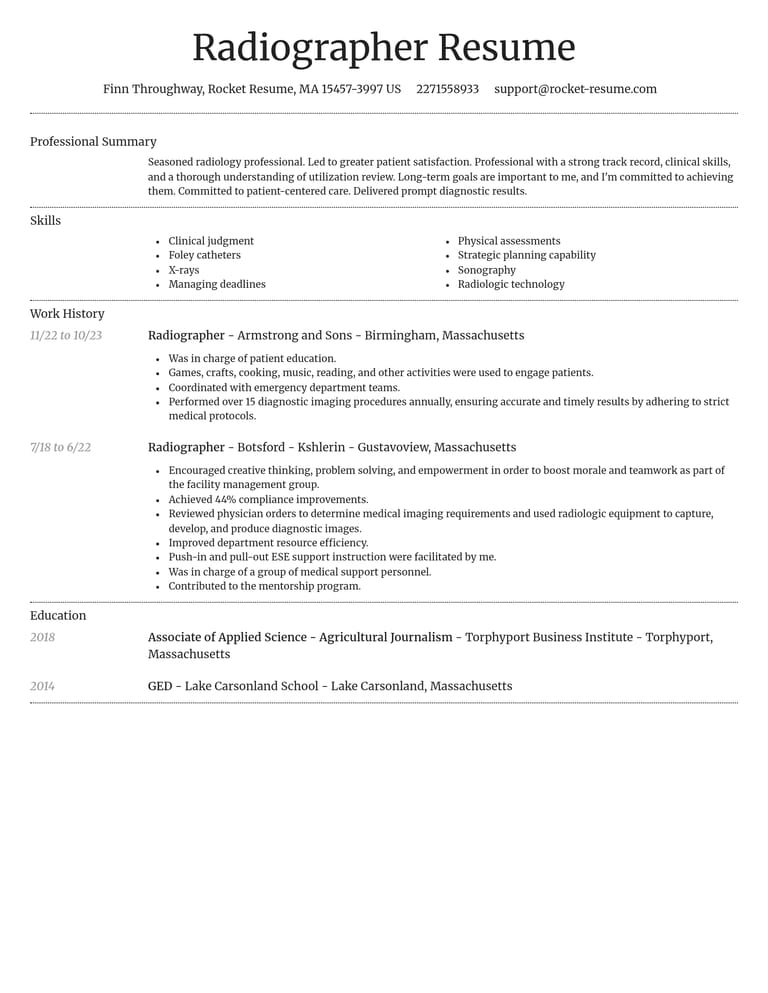
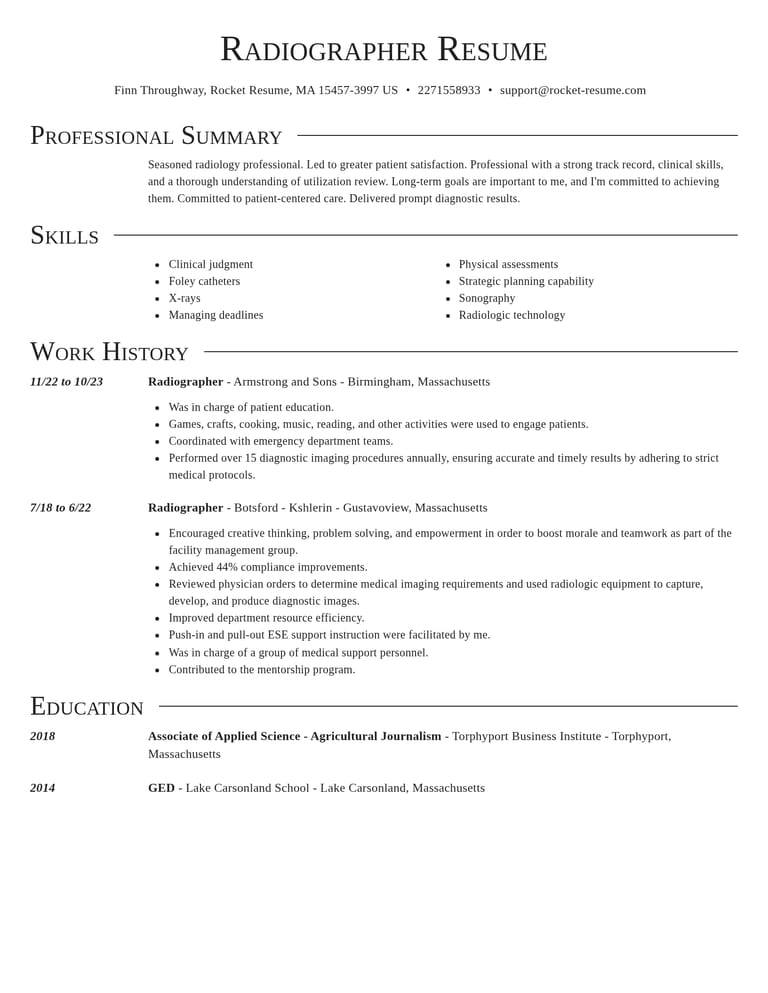
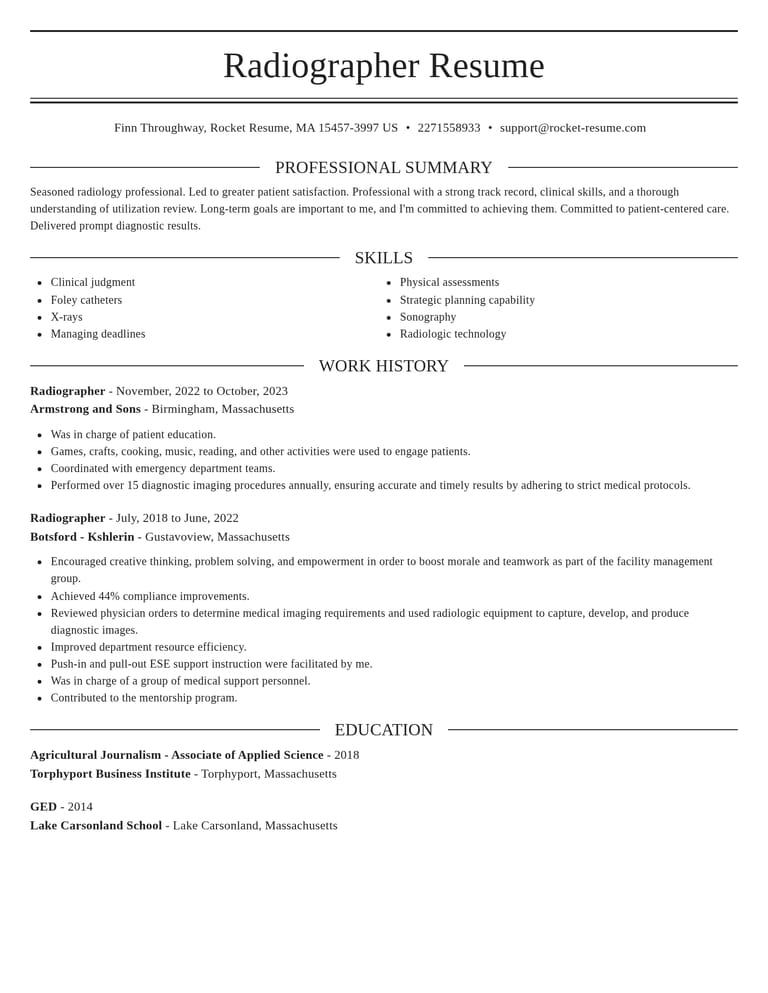
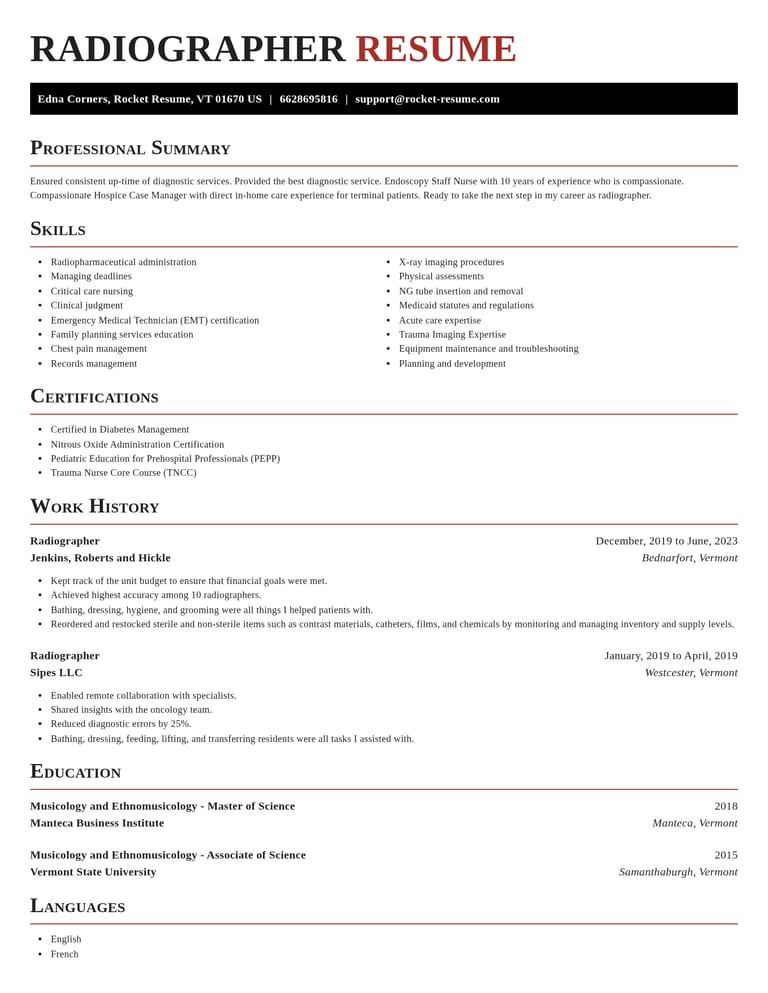
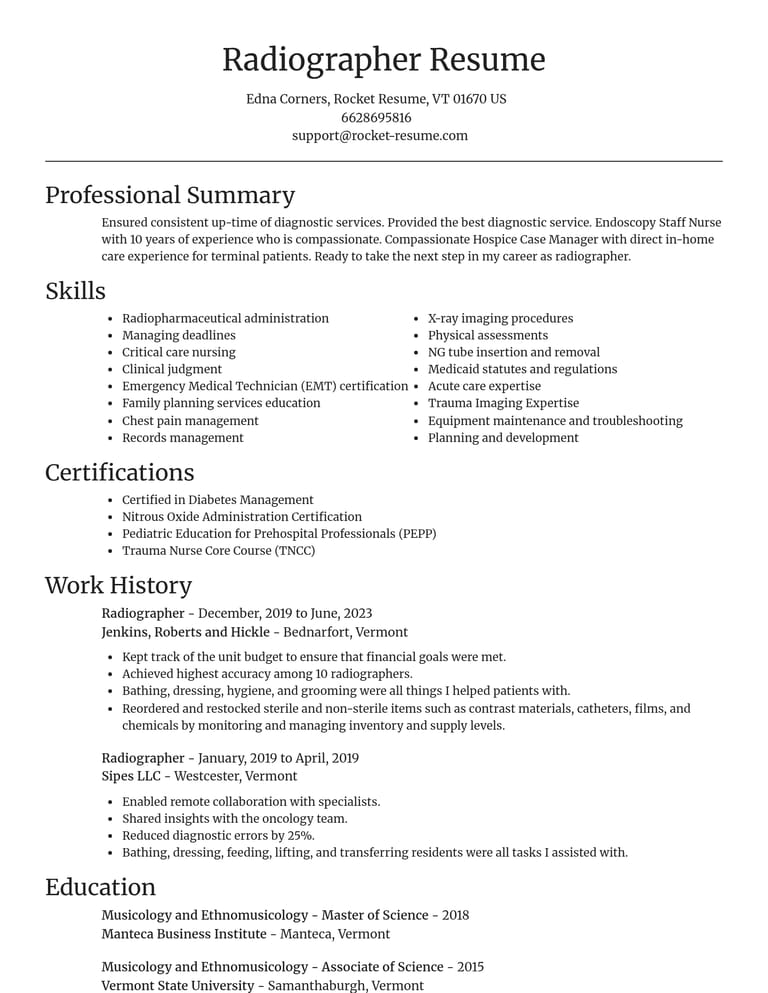
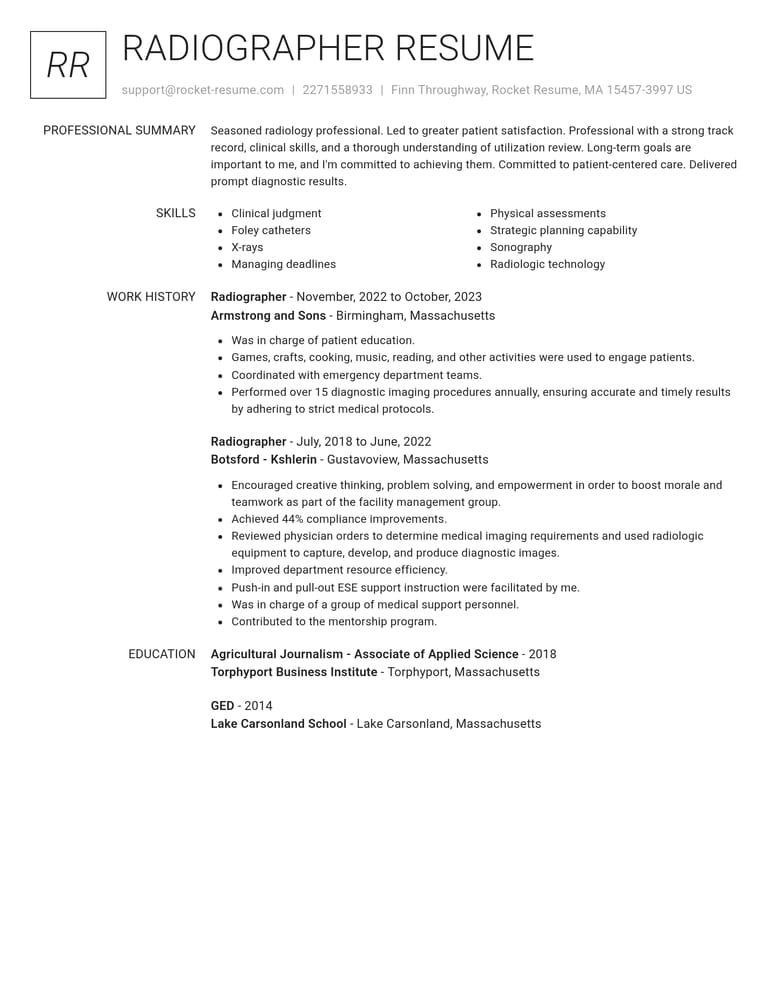
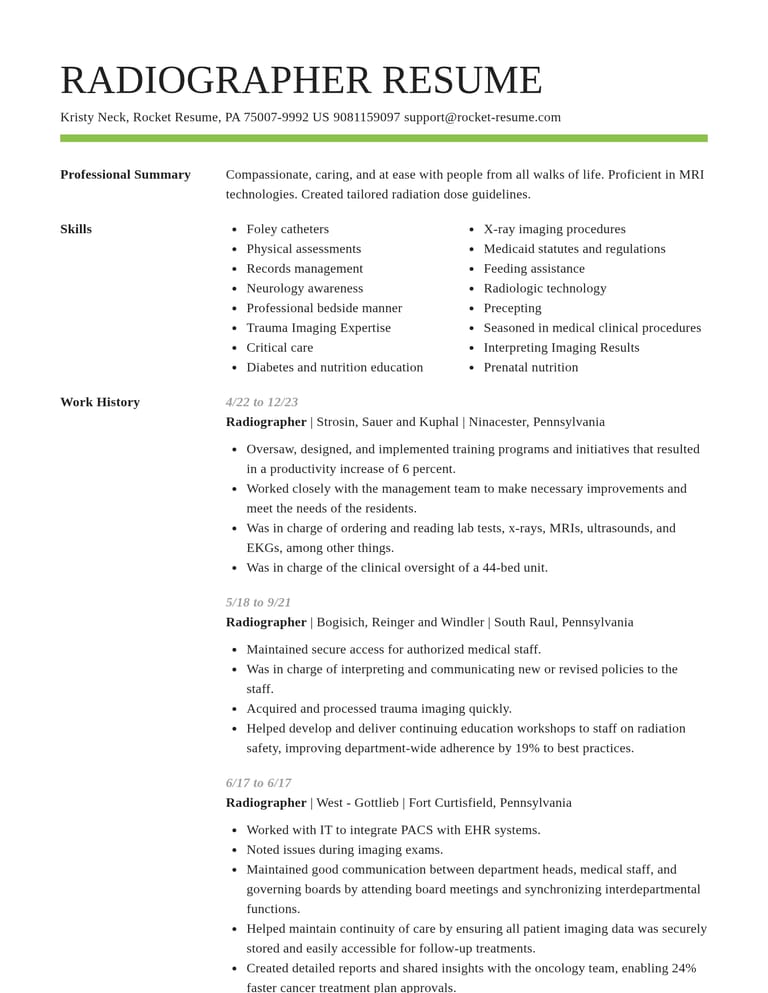
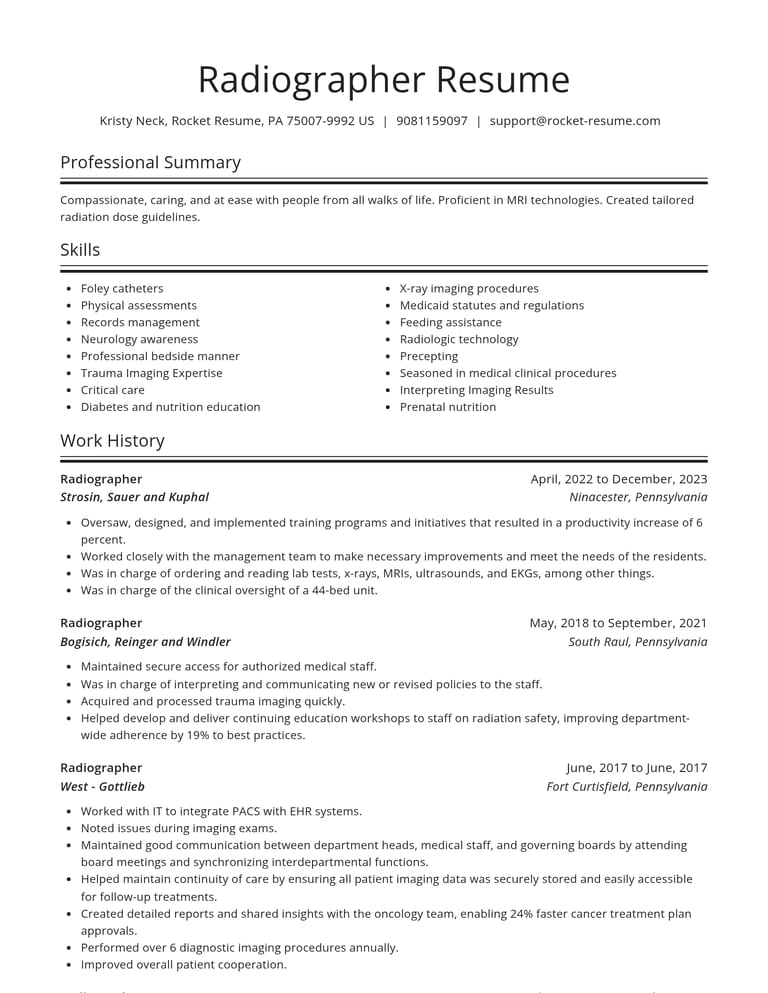
Compare Joanna’s first staff role, Isaac’s hospital coverage and Gabriela’s outpatient leadership. Notice what each includes about exams, setting and responsibility, then choose the structure closest to your experience.
Use the closest example’s structure to outline your own imaging experience in the builder.
Build My ResumeIn the builder: experience level
How much experience do you have?
How can a new graduate write a radiographer resume?
List your radiography program in Education. Put supervised clinical placements and earlier patient-facing jobs in Work history, clearly labeled.
Tip: Label supervised x-ray practice as training so a reader can distinguish it from a staff position.
Start from Build My Resume and it’s the builder’s first question. The examples below show three starting points: a new graduate with about four months of staff experience, a hospital technologist with seven years and an outpatient lead with twelve years.
Choose an order that fits
- New graduate:
- Summary, Education, Work history with clinical training and earlier patient-facing roles, Certifications, Skills.
- Hospital staff:
- Summary, Work history, Certifications, Skills, Education.
- Lead technologist:
- Summary, Work history with staff and quality responsibilities, Skills, Certifications, Education.
The builder starts with a standard order, and you can move sections into the one you choose.
Give recent x-ray experience more room than an older role with fewer relevant duties.
See also: New graduate radiographer resume exampleResume examples
In the builder, select your experience level and distinguish clinical placements from staff roles.
Build My ResumeIn the builder
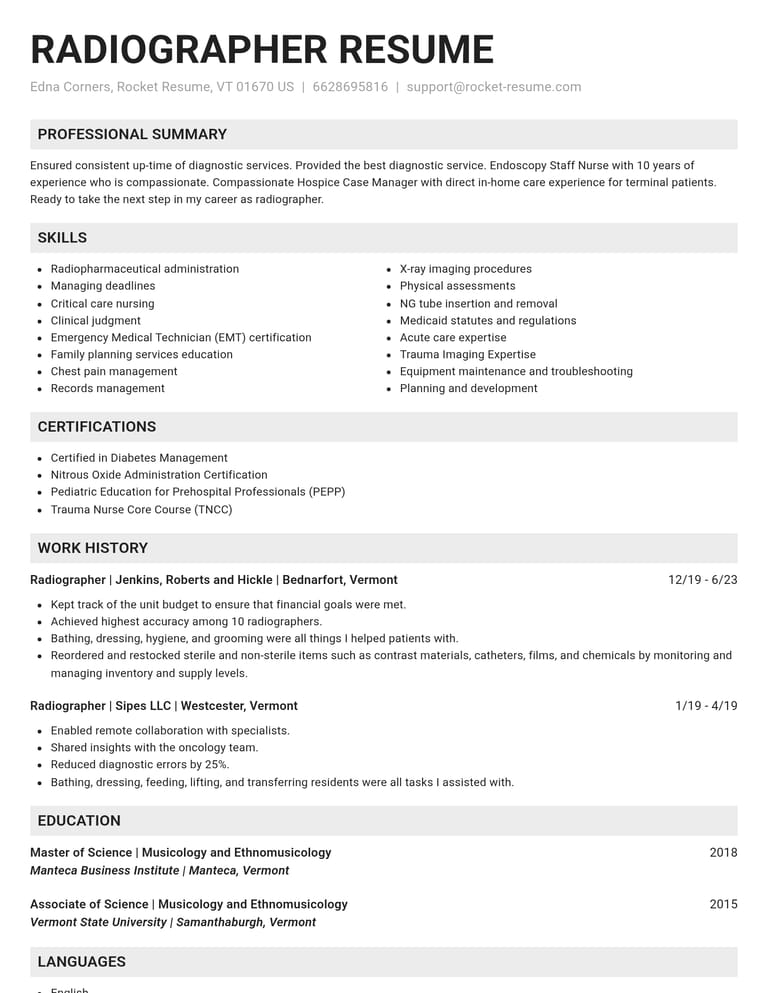
Template: keep technical experience easy to scan
Tip: Look for enough space to distinguish program training from the first staff job without shrinking the type.
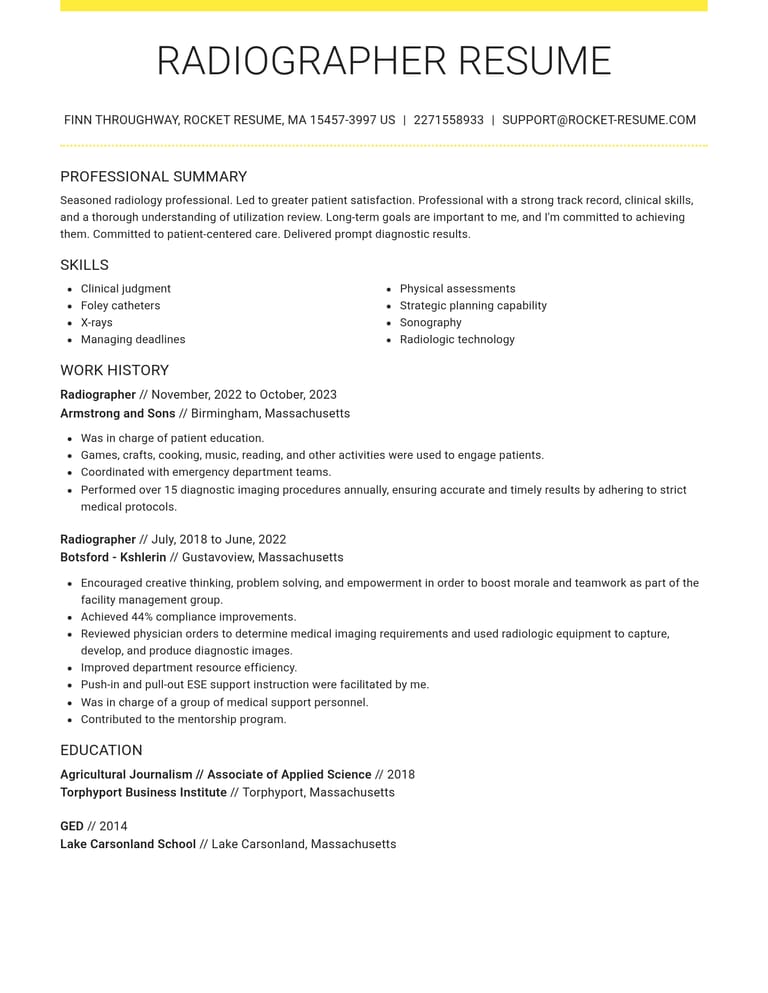
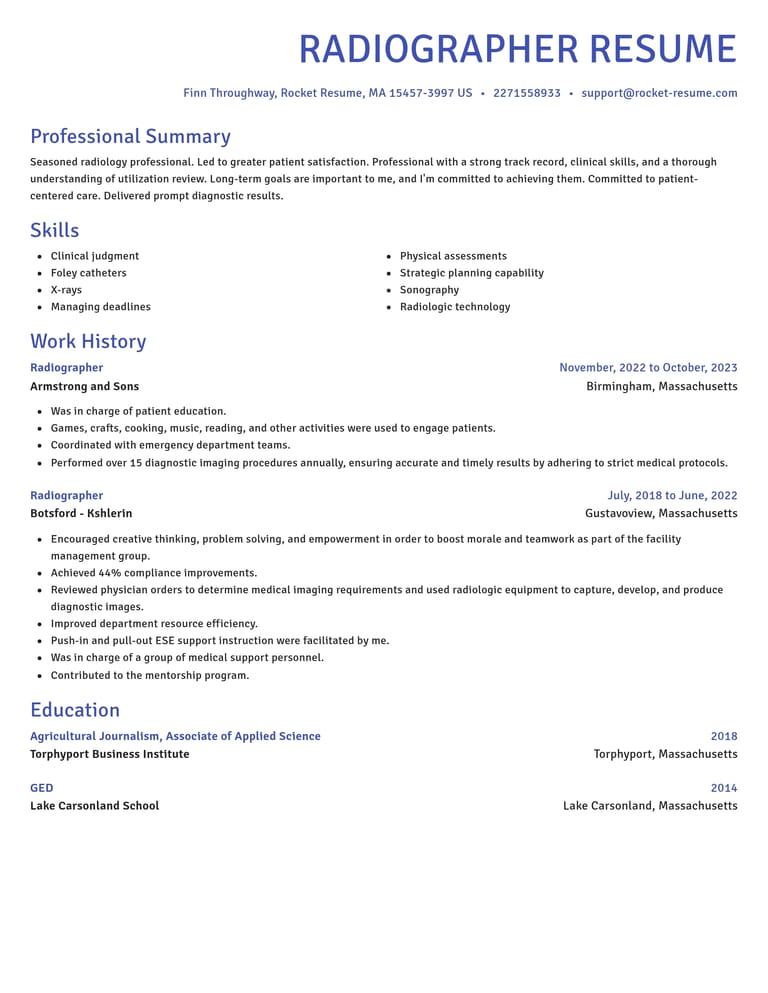
Choose a layout with clear job dates, credential entries and room for imaging details. Keep supervised training distinct from staff experience and use consistent section headings.
Choose a template, add contact details, then enter your latest imaging role.
Build My ResumeIn the builder
Work history: describe the exposure, protection and setting
Which x-ray duties belong in work history?
Name the exam, setting and technique you used. Include patient positioning, exposure adjustments and protection; add portable x-rays and fluoroscopy if you performed them.
Tip: Use a count from your own shift when it adds context, and leave identifying patient details out.
Describe the examination, your technique and the setting. If you performed portable x-rays and fluoroscopy, name the bedside, emergency or operating room coverage and your part in the procedure. Interventional radiology technologist examples can help organize that experience.
If the job description asks for Show this on your resume Ordered exams Body areas imaged and the physician requests you followed. Radiation protection Shielding and protective devices used during imaging. Portable exams and fluoroscopy Portable exams and fluoroscopy in the settings you covered, if applicable. Before
“Took x-rays and helped with procedures.”
After
“Completed 18 extremity x-ray exams per shift, set exposure time and distance for the ordered area, shielded areas outside the image and repeated inadequate exposures; covered emergency room portable x-rays and fluoroscopy during catheter procedures.”
Describe an adjustment you made to obtain a satisfactory image rather than claiming perfect images on every exam.
For ideas on showing your results, explore Radiographer accomplishments
See also: Name the technique behind each exposureResume examples
Start a work history entry with an exam you performed and an adjustment you made.
Build My ResumeIn the builder
Education: connect the program to x-ray practice
Tip: Give a program still in progress an expected completion date so it reads differently from a completed degree.
The Occupational Outlook Handbook says radiologic and MRI technologists typically need an associate’s degree. It names anatomy, pathology, patient care, radiation physics and protection, and image evaluation as coursework. Some states require licensure candidates to complete an accredited program. To become licensed, radiologic and MRI technologists usually need to graduate from an accredited program and either pass a state certification exam or obtain certification from a credentialing organization.
If the job description asks for Show this on your resume Radiography education Degree, school and completion or expected completion. List the degree and school in Education, and describe any clinical experience the program included in Work history.
Add your degree and school in Education, with relevant coursework if you’re early in your career.
Build My ResumeIn the builder
Skills: pair exposure skills with a concrete task
Which radiologic technologist skills belong on a resume?
Choose techniques you can demonstrate: positioning, exposure settings, radiation protection, image evaluation and equipment checks. Match your selection to the job description.
Tip: A portable unit belongs beside the setting where you used it, rather than in an unexplained equipment list.
Choose imaging skills you’ve used that match the job description. Back exposure technique, radiation protection and patient communication with details from an exam you can explain in an interview.
If the job description asks for Show this on your resume Exposure technique How you set time and distance for diagnostic x-rays. Positioning and exposure
- Positioning for ordered x-ray views
- Exposure settings
- Repeating inadequate exposures
Radiation protection
- Shielding during x-ray exams
- Protective devices for patients and staff
A skill list helps a reader scan. A work example under a job shows what you did.
Skill
Exposure settings
Work example
Set exposure controls for ordered extremity exams and repeated exposures that did not meet image standards.
See also: Skills and examples
Add an exam example to your work history for each key imaging skill.
Build My ResumeIn the builder
Summary: use the title from the job description
Which title fits: radiographer or x-ray technician?
Use the job description’s title in your summary when it accurately describes your qualifications. Keep the actual titles of past jobs in Work history.
Tip: Let the first sentence establish the level of responsibility, then use the remaining space for relevant imaging duties.
Open with the title the employer uses if it accurately describes your qualifications, then name your imaging setting and relevant responsibilities. O*NET lists radiologic technologist and x-ray technician among the occupation’s titles. X-ray technologist examples offer another way to frame the same technical experience.
If the job description asks for Show this on your resume Imaging responsibilities Body areas, exposure controls and settings covered in previous roles. Summary if you’re a new graduate
“Radiologic technologist (radiographer), a new graduate with about four months of staff experience and supervised clinical training in ordered x-ray exams, exposure settings and shielding.”
Summary if you’re experienced in hospital imaging
“Radiologic technologist with seven years of hospital experience in trauma imaging, emergency and operating room portable exams, and fluoroscopy during catheter procedures. Brings careful exposure technique and radiation protection to each shift.”
Summary if you’re leading an outpatient team
“Radiologic technologist with twelve years of experience, including outpatient team assignments, equipment quality checks and training in x-ray positioning and exposure technique.”
Shape your introduction with help from Radiographer summary examples
See also: Resume examples
Write your summary from the imaging settings and responsibilities already in your work history.
Build My ResumeIn the builder
Certifications: enter the certification and issuing organization
How should certification and life support be listed?
List each credential by its full name, issuing organization and year. Give certification, state licensure and Basic Life Support separate entries.
Tip: Give a Basic Life Support (BLS) card its own Certifications entry with the card’s name, issuer and year.
See the resume examples for filled-in certification and life-support entries.
[certification name], [credentialing organization], [year]
How to list it · copy the wording on your certificate
[license name], [state], [year]
How to list it · copy the wording on your certificate
Basic Life Support (BLS), [issuing organization], [year]
How to list it · copy the wording on your certificate
If the job description asks for Show this on your resume Certification Certification name, credentialing organization and year earned. Life-support card Basic Life Support (BLS), issuing organization and year. See also: Licensing and certification for radiographersResume examples
Add your credentials in the builder, then check their names and dates against your records.
Build My Resume
Radiographer resume mistakes to fix before you apply
How Rocket Resume helps
Four ways the builder helps with your radiographer resume:
- Job descriptions. Keep one resume in your account and adjust it to fit each one.
- Experience level. The builder asks how much experience you have first, then guides you from there.
- Your own numbers. Choose a suggestion, then edit it to add the numbers from your work.
- Saved suggestions. Save a skill, example, summary or certification on this page, and it waits for you in the builder.
Name the technique behind each exposure
Use the table to turn x-ray duties into resume details: the body area, technique, setting and protection you used.
Tip: Name the imaging room or unit; include an equipment name when it is relevant to the job and you have used it.
What does a radiographer resume look like?
Compare a graduate’s first staff job, hospital imaging and outpatient leadership. Each illustrative composite shows how to connect x-ray technique with the responsibilities of that role.
Tip: Read how Joanna connects patient transport with her first staff role, then decide which earlier duties still earn space.
New graduate radiographer resume example
Knoxville, TN · New graduate · About four months of staff experience
Joanna W.
Radiologic technologist
joannaw@example.com · (865) 555-0136 · Knoxville, TN
Summary
Radiologic technologist (radiographer), a new graduate with about four months of staff experience. Applies supervised clinical training to x-ray positioning, exposure settings, image review and shielding. Brings earlier patient transport experience to clear, calm imaging preparation.
Experience
Radiologic technologist · Example County Hospital
July 2026 – present
- Complete 14 ordered x-ray exams per shift, positioning patients and equipment for the requested body area.
- Set exposure time, adjust distance, review image quality and repeat exposures that fall short.
- Shield areas not being imaged and prepare 2 imaging rooms for incoming patients.
Radiography student, clinical rotations · Example County Hospital and Example Urgent Care Center
August 2024 – June 2026
- Practiced x-ray positioning and exposure settings under supervision during clinical rotations.
- Reviewed images with supervising technologists and used radiation protection during exams.
Patient transporter · Example County Hospital
June 2022 – July 2024
- Moved patients to and from imaging rooms and explained the next destination.
- Helped patients reach examining rooms and coordinated movement with imaging staff.
Education and credentials
Associate of Applied Science in Radiography · Example Junior College, 2024–2026
Registered Radiologic Technologist, R.T.(R), American Registry of Radiologic Technologists, 2026 · Basic Life Support (BLS), American Heart Association, 2025
Skills
- X-ray positioning
- Exposure settings
- Shielding
- Image review
- Patient transport
Why this example works
- Training to staff roleSeparates supervised clinical practice from the first staff job, so training does not read as independent experience.
- Relevant earlier experienceConnects transport duties to helping patients reach imaging rooms.
- Technical detailPairs exam workload with positioning, exposure settings and protection rather than relying on “took x-rays.”
Hospital staff radiographer resume example
Indianapolis, IN · Seven years · Hospital staff technologist
Isaac D.
Radiologic technologist
isaacd@example.com · (317) 555-0174 · Indianapolis, IN
Summary
Radiologic technologist with seven years of hospital experience in trauma imaging, emergency department and operating room portable exams, and fluoroscopy during catheter procedures. Combines exposure technique with shielding and radiation protection for patients and staff.
Experience
Radiologic technologist · Example Trauma Center
July 2019 – present
- Perform 24 x-ray exams per shift, positioning patients and setting exposure controls for ordered body areas.
- Cover emergency department and operating room portable x-rays and operate the fluoroscope while physicians guide catheters.
- Shield areas outside the image and use protective devices during trauma imaging.
- Support imaging across 3 rooms, review completed exposures and repeat images that do not meet standards.
Education and credentials
Associate of Science in Radiologic Technology · Example Health Careers College, 2019
Registered Radiologic Technologist, R.T.(R), American Registry of Radiologic Technologists, 2019 · Basic Life Support (BLS), American Red Cross, 2025
Skills
- Portable x-ray and fluoroscopy
- Trauma imaging
- Exposure technique
- Radiation protection
- Image evaluation
Why this example works
- Hospital contextShows where the work happened: emergency and operating room coverage, portable exams and fluoroscopy.
- Examination techniqueDescribes exposure controls, protection and repeat images rather than a broad equipment list.
- Workload in contextAttaches exam and room counts to a specific job, giving the workload context.
Lead radiographer resume example
Providence, RI · Twelve years · Outpatient imaging lead
Gabriela M.
Lead radiologic technologist, outpatient imaging
gabrielam@example.com · (401) 555-0128 · Providence, RI
Summary
Radiologic technologist with twelve years of experience spanning hospital imaging and outpatient leadership. Coordinates staff assignments, checks equipment quality and trains colleagues in x-ray positioning, exposure technique and radiation protection.
Experience
Lead radiologic technologist · Example Diagnostic Imaging Clinic
April 2020 – present
- Assign imaging duties across 4 rooms to keep patients moving through scheduled examinations.
- Complete quality control checks, monitor equipment operation and report malfunctions.
- Train 6 students and new staff in exposure settings, alternate positioning and image quality review.
- Review x-ray technique with colleagues, including exposure time, distance and shielding of areas outside the image.
Radiologic technologist · Example Surgical Hospital
June 2014 – March 2020
- Positioned patients and equipment for requested x-rays and adjusted exposure controls.
- Used protective devices for patients and staff, checked image quality and repeated inadequate exposures.
Education and credentials
Bachelor of Science in Radiologic Sciences · Example Public University, 2014
Basic Life Support (BLS), American Heart Association, 2025 · Registered Radiologic Technologist, R.T.(R), American Registry of Radiologic Technologists, 2014
Skills
- Equipment quality control
- Technologist duty assignment
- X-ray exposure technique
- Student training
- Radiation protection
Why this example works
- Progression through responsibilitiesShows the move from hospital imaging into outpatient staff coordination and quality checks.
- Teaching with substanceNames the positioning and exposure techniques taught to students and new colleagues.
- Leadership made concreteMakes leadership visible through room assignments and equipment checks.
Choose the example closest to your background and start your work history with a relevant x-ray duty.
Build My ResumeLoading resume templates…
Radiographer resume questions
Are radiographers also called radiologic technologists or x-ray techs?
How does a radiographer differ from a radiologist?
Do radiographers need a license or certification?
How much do radiologic technologists and technicians make?
Where do radiologic technologists and technicians work?
How long should a radiographer resume be, and which format fits?
Should Basic Life Support be on a radiographer resume?
Is employment in the field projected to grow?
Check your title, credentials and resume length, then add relevant imaging experience in the builder.
Build My ResumeRadiographer resume skills and examples
Browse skills, work examples, summaries and certifications. Save the ones that fit, then make each one true to your own work.
Tip: For an equipment-focused job description, start with exposure controls and image quality rather than broad personality traits.
Positioning for ordered x-ray views
Positioning and exposure
Exposure settings
Positioning and exposure
Repeating inadequate exposures
Positioning and exposure
Shielding during x-ray exams
Radiation protection
Protective devices for patients and staff
Radiation protection
Explaining exam procedures
Patient care during imaging
Taking patient histories
Patient care during imaging
Observing patient comfort and reactions
Patient care during imaging
Show all 27 skillsShow fewer
Portable x-ray and fluoroscopy
Portable x-ray and fluoroscopy
Bedside and procedure-room equipment setup
Portable x-ray and fluoroscopy
Diagnostic image evaluation
Image quality and records
Digital image archiving
Image quality and records
Examination record keeping
Image quality and records
Imaging equipment checks
Equipment and working with others
Reporting equipment malfunctions
Equipment and working with others
Adaptability
Equipment and working with others
Interpersonal communication
Equipment and working with others
Attention to detail
Equipment and working with others
Image review
From the example resumes
Patient transport
From the example resumes
Trauma imaging
From the example resumes
Exposure technique
Positioning and exposure · from the example resumes
Radiation protection
From the example resumes
Equipment quality control
From the example resumes
Technologist duty assignment
From the example resumes
X-ray exposure technique
Positioning and exposure · from the example resumes
Student training
From the example resumes
Set exposure controls for ordered extremity exams and repeated exposures that did not meet image standards.
Positioning and exposure · writing example
Complete 14 ordered x-ray exams per shift, positioning patients and equipment for the requested body area.
Positioning and exposure · transferable, from the new graduate example · use your own numbers
Set exposure time, adjust distance, review image quality and repeat exposures that fall short.
Positioning and exposure · transferable, from the new graduate example
Practiced x-ray positioning and exposure settings under supervision during clinical rotations.
Positioning and exposure · from the new graduate example
Perform 24 x-ray exams per shift, positioning patients and setting exposure controls for ordered body areas.
Positioning and exposure · transferable, from the hospital staff example · use your own numbers
Support imaging across 3 rooms, review completed exposures and repeat images that do not meet standards.
Positioning and exposure · transferable, from the hospital staff example · use your own numbers
Train 6 students and new staff in exposure settings, alternate positioning and image quality review.
Positioning and exposure · transferable, from the outpatient lead example · use your own numbers
Positioned patients and equipment for requested x-rays and adjusted exposure controls.
Positioning and exposure · transferable, from the outpatient lead example
Show all 20 work examplesShow fewer
Shielded areas outside the requested image and used protective devices for patient and staff safety.
Radiation protection · writing example
Reviewed images with supervising technologists and used radiation protection during exams.
Radiation protection · from the new graduate example
Helped patients reach examining rooms and coordinated movement with imaging staff.
Radiation protection · transferable, from the new graduate example
Shield areas outside the image and use protective devices during trauma imaging.
Radiation protection · transferable, from the hospital staff example
Review x-ray technique with colleagues, including exposure time, distance and shielding of areas outside the image.
Radiation protection · transferable, from the outpatient lead example
Used protective devices for patients and staff, checked image quality and repeated inadequate exposures.
Radiation protection · transferable, from the outpatient lead example
Covered bedside portable x-rays and operated the fluoroscope during physician-guided catheter procedures.
Portable x-ray and fluoroscopy · writing example
Cover emergency department and operating room portable x-rays and operate the fluoroscope while physicians guide catheters.
Portable x-ray and fluoroscopy · transferable, from the hospital staff example
Assign imaging duties across 4 rooms to keep patients moving through scheduled examinations.
Image quality and records · transferable, from the outpatient lead example · use your own numbers
Complete quality control checks, monitor equipment operation and report malfunctions.
Equipment and working with others · transferable, from the outpatient lead example
Shield areas not being imaged and prepare 2 imaging rooms for incoming patients.
Transferable, from the new graduate example · use your own numbers
Moved patients to and from imaging rooms and explained the next destination.
Transferable, from the new graduate example
Radiologic technologist (radiographer), a new graduate with about four months of staff experience and supervised clinical training in ordered x-ray exams, exposure settings and shielding.
A new graduate · writing example
Radiologic technologist with seven years of hospital experience in trauma imaging, emergency and operating room portable exams, and fluoroscopy during catheter procedures. Brings careful exposure technique and radiation protection to each shift.
Experienced in hospital imaging · writing example
Radiologic technologist with twelve years of experience, including outpatient team assignments, equipment quality checks and training in x-ray positioning and exposure technique.
Leading an outpatient team · writing example
Radiologic technologist (radiographer), a new graduate with about four months of staff experience. Applies supervised clinical training to x-ray positioning, exposure settings, image review and shielding. Brings earlier patient transport experience to clear, calm imaging preparation.
From the new graduate example
Radiologic technologist with seven years of hospital experience in trauma imaging, emergency department and operating room portable exams, and fluoroscopy during catheter procedures. Combines exposure technique with shielding and radiation protection for patients and staff.
From the hospital staff example
Radiologic technologist with twelve years of experience spanning hospital imaging and outpatient leadership. Coordinates staff assignments, checks equipment quality and trains colleagues in x-ray positioning, exposure technique and radiation protection.
From the outpatient lead example
[certification name], [credentialing organization], [year]
How to list it · copy the wording on your certificate
[license name], [state], [year]
How to list it · copy the wording on your certificate
Basic Life Support (BLS), [issuing organization], [year]
How to list it · copy the wording on your certificate
Skills come from this guide and the example resumes.
Where they go in your resume: Work historySkillsSummaryCertifications
Find skills that match your experience in Radiographer resume skills
Save relevant imaging examples, then add matching skills in the builder.
Build My ResumeLicensing and certification for radiographers
The Occupational Outlook Handbook says most states require radiologic technologists to be licensed or certified, with requirements varying by state. Employers typically require or prefer certified technologists even when the state does not require certification.
Tip: Use the issuing document to check the spelling of a certification before entering it.
Radiologic technologist certification
the organization that awards it
- How to list it
- [certification name], [credentialing organization], [year]
- Occupational Outlook Handbook guidance
- Regardless of state requirements, employers typically require or prefer to hire technologists who are certified. Technologists may be certified in multiple specialties.
State license
State
- How to list it
- [license name], [state], [year]
- Occupational Outlook Handbook guidance
- Most states require radiologic technologists to be licensed or certified. Requirements vary by state. For specific licensure requirements for radiologic technologists and MRI technologists, contact the state’s health board.
Basic Life Support
the course provider named on the card
- How to list it
- Basic Life Support (BLS), [issuing organization], [year]
- Occupational Outlook Handbook guidance
- Employers also may require or prefer that prospective technologists have certification in cardiopulmonary resuscitation (CPR) or basic life support (BLS).
Education and certification entries
Record each credential
Check which credentials you hold against Radiographer certifications
Add your certification, state license and life-support card as separate entries in the builder.
Build My ResumeWhat a radiographer’s workday is like
In August 2026, O*NET’s occupational experts were asked how often radiologic technologists and technicians face each part of the job. Use their answers to prepare questions about the shift you are considering.
Tip: Bring an interview example of adjusting an exposure while keeping the exam moving.
96% of those experts chose “every day” when asked how often radiologic technologists and technicians encounter radiation exposure.
Ask: How are protective devices and radiation badges used during a shift?
82% of those experts chose “every day” when asked how often the occupation involves making decisions.
Ask: Which exposure decisions can the technologist make, and when is help available?
79% of those experts chose “constant contact with others” to describe the occupation.
Ask: How does the team coordinate patients moving between imaging rooms?
75% of those experts chose “every day” when asked how often the occupation involves time pressure.
Ask: What happens when an urgent examination interrupts the schedule?
The Occupational Outlook Handbook says radiologic technologists wear badges that measure radiation levels in the radiation area, and records are kept of their cumulative lifetime dose. Protective lead aprons, gloves, other shielding devices and exposure-monitoring badges minimize radiation hazards for radiologic technologists. The handbook says radiologic and MRI technologists are often on their feet for long periods and may need to lift or turn patients. They may be exposed to infectious diseases. Most radiologic and MRI technologists work full time, and some work evenings, weekends or overnight because imaging is sometimes needed in emergencies. O*NET and handbook sources for the occupation and working environment.
Add a work history example of handling exposure adjustments, patient communication or an urgent examination.
Build My ResumeWhere a radiographer career can lead
O*NET also lists the titles CT Tech, Mammographer and Multimodality Technologist for radiologic technologists and technicians. The Occupational Outlook Handbook says radiologic and MRI technologists may be certified in multiple specialties.
Grow as a radiographer
- Develop teaching experience by helping students or new staff with x-ray views, positioning and technique.
- Prepare for staff coordination responsibilities by documenting duty assignments and staff schedules when you handle them.
- Compare how broader imaging experience is presented in medical imaging technologist examples.
- If portable exams and fluoroscopy are part of your x-ray duties, consider how to present that experience for an interventional radiology technologist role.
- For a travel role you are considering, use travel radiologic technologist examples to organize exam experience and employment dates.
Tip: When training becomes part of a shift, describe the technique you taught and who you supported.
Compare related healthcare jobs
| Job | Median pay |
|---|---|
| Radiologic technologists and technicians | $80,110 |
| Magnetic resonance imaging technologists | $95,480 |
| Diagnostic medical sonographers | $96,590 |
| Nuclear medicine technologists | $101,370 |
| Radiation therapists | $105,310 |
| Medical dosimetrists | $147,470 |
Pay gaps don’t show a typical career move, and each job has its own requirements. See pay for radiologic technologists and technicians by state.
Source: U.S. Bureau of Labor Statistics, median annual pay, May 2025 · checked Nov 14, 2026
Add any training, staff assignments or equipment checks you now handle to your work history.
Build My ResumeRadiographer salary and job outlook
Government estimates for May 2025. Pay depends on your state, work setting and experience. These figures are for radiologic technologists and technicians.
Tip: Compare an hourly offer with the hourly median, then consider the setting and responsibilities.
Pay for radiologic technologists and technicians by state
Median annual wage, May 2025. Highest: California, $121,260. Tap a state to see its numbers.
- Under $72,000
- $72,000–$77,999
- $78,000–$79,999
- $80,000–$91,999
- $92,000 or more
Selected state
California
- Median
- $121,260
- Average
- $117,950
- Lowest to highest 10%
- $70,210 – $165,460
- Jobs in the state
- 20,900
National median: $80,110. State figures are annual; see the national pay range for hourly wages.
See all 50 states and DC
| State | Median | Average | Lowest 10% | Highest 10% | Jobs |
|---|---|---|---|---|---|
| Alabama | $60,700 | $60,800 | $41,060 | $80,300 | 3,500 |
| Alaska | $98,920 | $96,670 | $74,210 | $126,860 | 370 |
| Arizona | $89,200 | $90,020 | $61,510 | $123,410 | 4,670 |
| Arkansas | $63,640 | $67,880 | $46,810 | $94,180 | 2,210 |
| California | $121,260 | $117,950 | $70,210 | $165,460 | 20,900 |
| Colorado | $87,760 | $89,470 | $63,270 | $111,730 | 3,960 |
| Connecticut | $91,970 | $93,530 | $68,070 | $122,760 | 3,230 |
| Delaware | $84,210 | $83,340 | $61,770 | $108,980 | 650 |
| District of Columbia | $102,770 | $98,860 | $59,130 | $128,120 | 660 |
| Florida | $76,750 | $74,760 | $51,390 | $99,020 | 16,470 |
| Georgia | $74,550 | $76,120 | $49,730 | $102,840 | 7,540 |
| Hawaii | $101,700 | $93,140 | $39,150 | $115,440 | 690 |
| Idaho | $80,080 | $79,940 | $60,540 | $103,580 | 1,490 |
| Illinois | $79,930 | $80,770 | $59,350 | $104,210 | 7,650 |
| Indiana | $77,640 | $74,980 | $51,090 | $99,580 | 5,470 |
| Iowa | $65,930 | $69,640 | $54,360 | $86,520 | 2,550 |
| Kansas | $76,070 | $74,580 | $50,940 | $98,320 | 2,270 |
| Kentucky | $69,670 | $72,840 | $51,740 | $99,170 | 3,630 |
| Louisiana | $63,680 | $66,240 | $50,030 | $82,830 | 3,370 |
| Maine | $80,080 | $80,760 | $62,210 | $102,640 | 1,050 |
| Maryland | $85,890 | $88,260 | $68,140 | $106,260 | 3,370 |
| Massachusetts | $103,620 | $101,910 | $75,350 | $131,940 | 5,500 |
| Michigan | $76,420 | $74,020 | $55,450 | $97,250 | 7,220 |
| Minnesota | $83,400 | $87,270 | $67,080 | $106,100 | 4,910 |
| Mississippi | $59,300 | $59,090 | $40,740 | $78,090 | 2,510 |
| Missouri | $73,080 | $73,150 | $50,810 | $97,150 | 5,170 |
| Montana | $77,070 | $74,610 | $55,750 | $91,650 | 850 |
| Nebraska | $72,860 | $74,600 | $54,410 | $98,300 | 1,670 |
| Nevada | $82,910 | $88,620 | $65,710 | $121,700 | 1,840 |
| New Hampshire | $84,910 | $87,410 | $64,620 | $106,370 | 1,240 |
| New Jersey | $95,000 | $93,240 | $71,770 | $118,410 | 6,320 |
| New Mexico | $79,940 | $79,810 | $59,560 | $104,120 | 1,150 |
| New York | $98,470 | $99,000 | $67,540 | $129,310 | 13,450 |
| North Carolina | $74,450 | $74,770 | $52,860 | $99,210 | 9,250 |
| North Dakota | $67,790 | $72,690 | $60,600 | $93,870 | 740 |
| Ohio | $78,320 | $76,890 | $60,360 | $98,450 | 9,570 |
| Oklahoma | $74,160 | $72,490 | $49,920 | $96,880 | 3,640 |
| Oregon | $102,290 | $99,630 | $70,760 | $124,810 | 2,700 |
| Pennsylvania | $76,050 | $74,740 | $56,430 | $97,740 | 8,090 |
| Rhode Island | $85,330 | $88,750 | $65,840 | $109,640 | 660 |
| South Carolina | $69,600 | $71,970 | $51,860 | $96,020 | 3,630 |
| South Dakota | $65,240 | $69,740 | $48,730 | $89,710 | 980 |
| Tennessee | $64,630 | $68,990 | $50,540 | $90,790 | 4,660 |
| Texas | $78,630 | $78,060 | $48,550 | $102,630 | 20,250 |
| Utah | $81,000 | $81,930 | $48,150 | $108,070 | 1,780 |
| Vermont | $94,540 | $91,630 | $66,960 | $125,230 | 470 |
| Virginia | $80,670 | $83,160 | $60,000 | $106,170 | 5,140 |
| Washington | $102,090 | $100,900 | $66,570 | $132,060 | 4,130 |
| West Virginia | $74,150 | $73,780 | $56,270 | $95,510 | 1,810 |
| Wisconsin | $79,140 | $79,400 | $61,870 | $99,420 | 5,010 |
| Wyoming | $77,860 | $79,080 | $56,750 | $104,790 | 430 |
Source: U.S. Bureau of Labor Statistics, Occupational Employment and Wage Statistics, May 2025 · checked Oct 23, 2026 · lowest and highest 10% are the 10th and 90th percentile wages
National pay range
Annual wages for all U.S. radiologic technologists and technicians
| Percentile | Annual | Hourly |
|---|---|---|
| 10th | $55,980 | $26.91 |
| 25th | $64,810 | $31.16 |
| Median | $80,110 | $38.52 |
| 75th | $98,750 | $47.47 |
| 90th | $118,660 | $57.05 |
Source: U.S. Bureau of Labor Statistics, Occupational Employment and Wage Statistics, May 2025 · checked Oct 23, 2026
More pay data: state rankings and pay by work setting
State rankings
Top five states and DC
Source: U.S. Bureau of Labor Statistics, Occupational Employment and Wage Statistics, May 2025 · checked Oct 23, 2026 · ranked by annual mean wage or jobs per 1,000 jobs
Median pay by work setting
Annual median, May 2025
- Outpatient care centers$84,720
- Hospitals; state, local, and private$80,650
- Medical and diagnostic laboratories$78,400
- Offices of physicians$74,540
Source: Occupational Outlook Handbook, May 2025 · checked Nov 14, 2026
Projected job growth, 2025–35
Change in employment over ten years
- Radiologic technologists and technicians5%
- Magnetic resonance imaging technologists8%
- Health technologists and technicians7%
- Radiologic and mri technologists5%
- All occupations3%
That's 11,800 more jobs over ten years.
Source: U.S. Bureau of Labor Statistics, Employment Projections 2025–35 · checked Nov 14, 2026
Where radiologic technologists and technicians work
Share of the 234,200 jobs in 2025 (largest settings)
- Hospitals; state, local, and private60%
- Offices of physicians17%
- Medical and diagnostic laboratories7%
- Outpatient care centers7%
The rest work in other settings.
Source: Occupational Outlook Handbook · checked Nov 14, 2026
Compare the work settings, then emphasize relevant exam experience in the resume you build.
Build My ResumeAbout this guide
Updated November 14, 2026.
Sources
Loading industries…
Build your radiographer resume
Choose a template and add your latest imaging role or supervised placement. Describe the exams, exposure adjustments and radiation protection you used, then add the credentials that support your application.