Interventional radiology technologist resume: templates and tips
Use examples to choose what leads your resume: supervised IR clinicals, hospital C-arm views or assisting the physician during angiography.
- Show your role in procedures
- Put ARRT credentials in order
- New graduate to lead examples
- Match the IR job title

What interventional radiology technologist hiring managers look for
- Fluoroscopy that helped the physician see a wire or catheter.
- Positioning patients and adjusting equipment for requested views.
- Contrast preparation under a radiologist’s direction.
- C-arm experience from general radiography or procedure rooms.
- Image handling in PACS, with an example of what you did.
- Radiography training and the credentials you currently hold.
How to write an interventional radiology technologist resume
Naming a procedure gives the reader context. Explaining your part shows what you can do. Use this guide to describe who you assisted, what equipment you used and which credentials you hold. This guide starts with five questions to answer first, then walks through each part of your resume with tips and links to the examples, templates and data on this page.
Five questions to answer first
- How should I describe the procedures I supported?
Step 5 shows how to describe your part in a case.
- Which skills should I list for IR?
Step 7 shows how to back up your skills with a case.
- Which credentials should I list first?
Step 9 shows where radiography and specialty credentials go.
- Which job title should I use when applying?
Step 1 shows how to match the role the employer names.
- How do I show a move from general X-ray into IR?
Step 3 helps you order relevant hospital experience.
What an interventional radiology technologist does
In the procedure room, the interventional radiology technologist works alongside the physician. O*NET records these tasks for radiologic technologists and technicians:
Position patient on examining table and set up and adjust equipment to obtain optimum view of specific body area as requested by physician. Prepare contrast material, radiopharmaceuticals, or anesthetic or antispasmodic drugs under the direction of a radiologist. Operate fluoroscope to aid physician to view and guide wire or catheter through blood vessels to area of interest.
The national median annual wage for radiologic technologists and technicians was $80,110 in May 2025. For that occupation, BLS projects employment growth of 5% over 2025–2035.
See also: Where radiologic technologists and technicians workProjected job growthPay for radiologic technologists and technicians by state
Tip: When you read an IR job description, mark the tasks you did during a case and the tasks you practiced during training. Keep that distinction in the resume.
What an interventional radiology technologist’s workday is like
Write your interventional radiology technologist resume in nine steps
Do the first two before you open the builder. The other seven follow the builder’s order.
Step 1 of 9
Before you open the builder
Job description: find what the suite needs
Which job title should I use when applying?
Match the target title in the job description, such as special procedures tech. Keep the titles you actually held in your work history.
Tip: Read past the title to see which procedures and equipment the employer names. Rank the duties you can show with a specific case or rotation.
Procedure tasks adapted from O*NET OnLine, Radiologic Technologists and Technicians (29-2034.00), CC BY 4.0.
Match each requirement in the job description
Here’s the step where you’ll show each one:
- Procedure support step 5
- Radiography training step 6
- Imaging equipment step 7
- Relevant background step 8
- Current credentials step 9
Tip: For a role titled angio tech, check whether the job description names angiography, biopsies or other cases you can discuss.
See also: Pay for radiologic technologists and technicians by stateWhere radiologic technologists and technicians workInterventional radiology technologist certifications compared
Choose a task from the job description and use a specific case in your resume to show how you handled it.
Build My Resume
Before you open the builder
Examples: compare rotation, transfer and lead resumes
Tip: Look at how the new graduate names supervision and how the lead technologist explains what newer staff learned.
Derek lists C-arm work for physician-requested views before his general X-ray duties. The lead resume gives angiography and training their own space.
Use the example closest to your background to draft a resume entry that names the case and your level of supervision.
Build My ResumeIn the builder: experience level
How much experience do you have?
How do I show a move from general X-ray into IR?
Under your hospital job, name the view you helped obtain and how you set up the C-arm. Give supervised IR clinicals a separate entry if you completed them.
Tip: Base your experience level on your time in paid hospital roles when you’re moving into IR. Date supervised IR clinicals separately.
Start from Build My Resume and it’s the builder’s first question. The examples below show three starting points: a new graduate with an IR rotation, a hospital technologist with C-arm work and a lead technologist who trains staff.
Choose an order that fits
- New graduate:
- Summary, Certifications, Education and clinical rotations, Skills, Other jobs.
- Moving into IR:
- Summary, Work history with C-arm experience, Certifications, Skills, Education.
- Experienced in IR:
- Summary, IR work history, Certifications, Skills, Education.
The builder starts with a standard order, and you can move sections into the one you choose.
Keep an early-career resume to one page if the rotation, radiography credential and relevant skills fit. Give lead duties more room when they show relevant experience.
See also: TemplatesCan I apply to IR from general radiography?
Start your resume with the setting closest to the procedure room. Give supervised IR clinicals room under Education or put hospital C-arm cases first under the job where you handled them.
Build My ResumeIn the builder
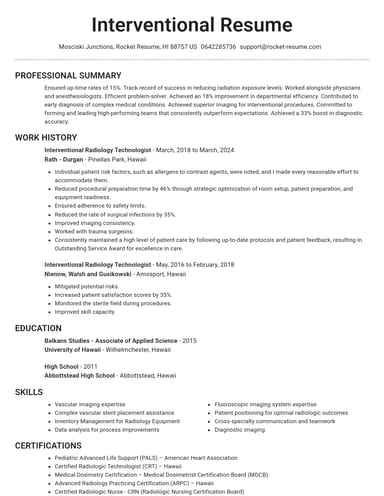
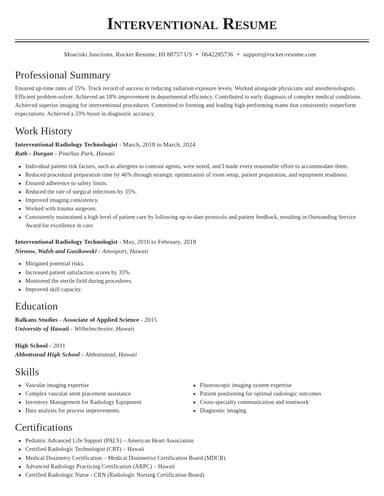
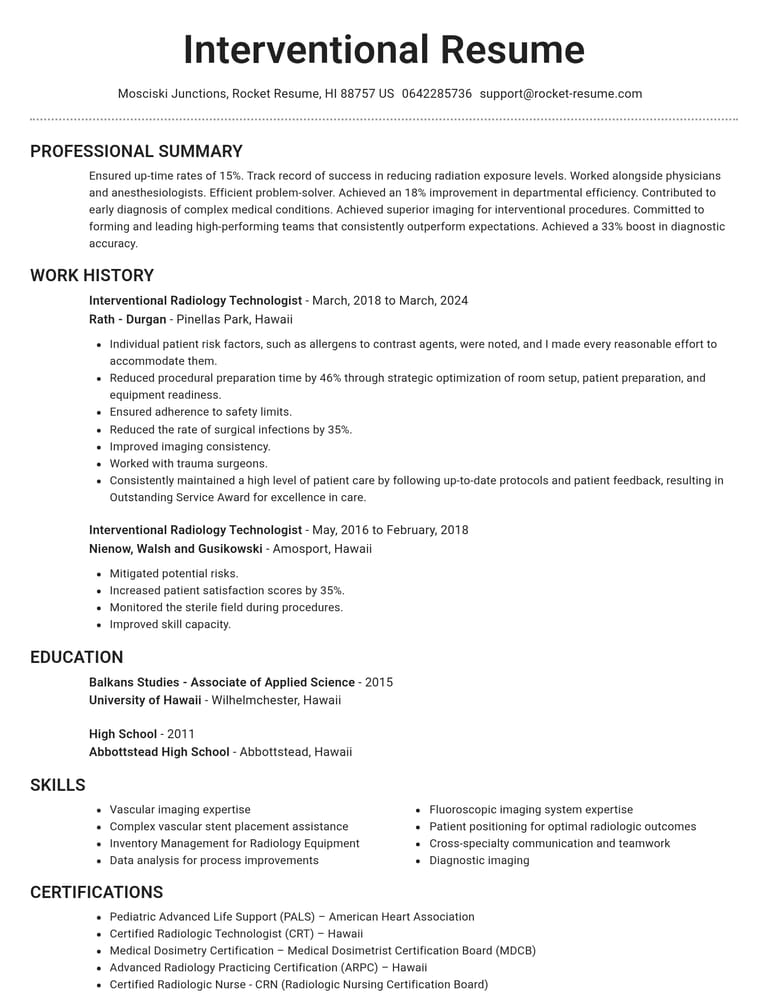
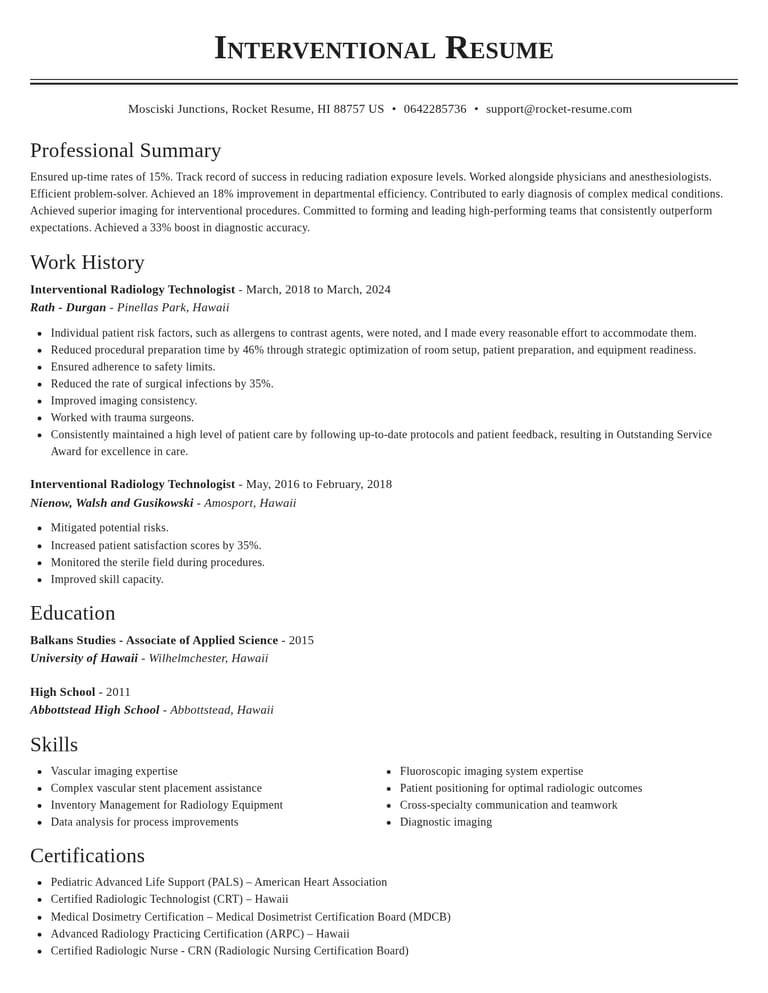
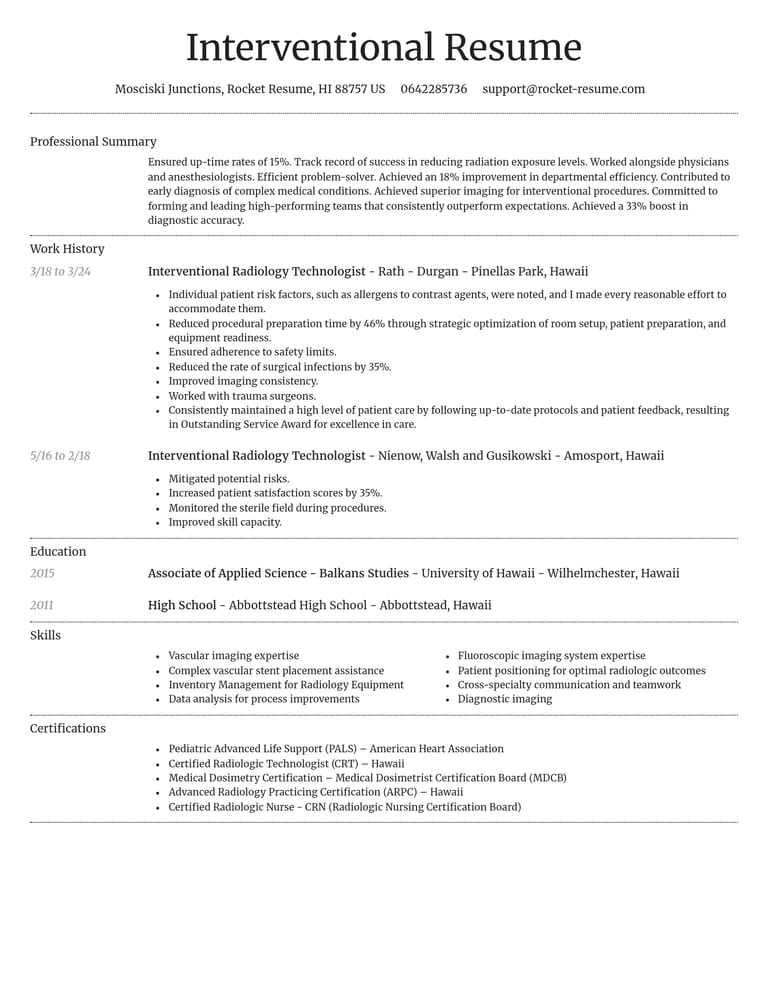
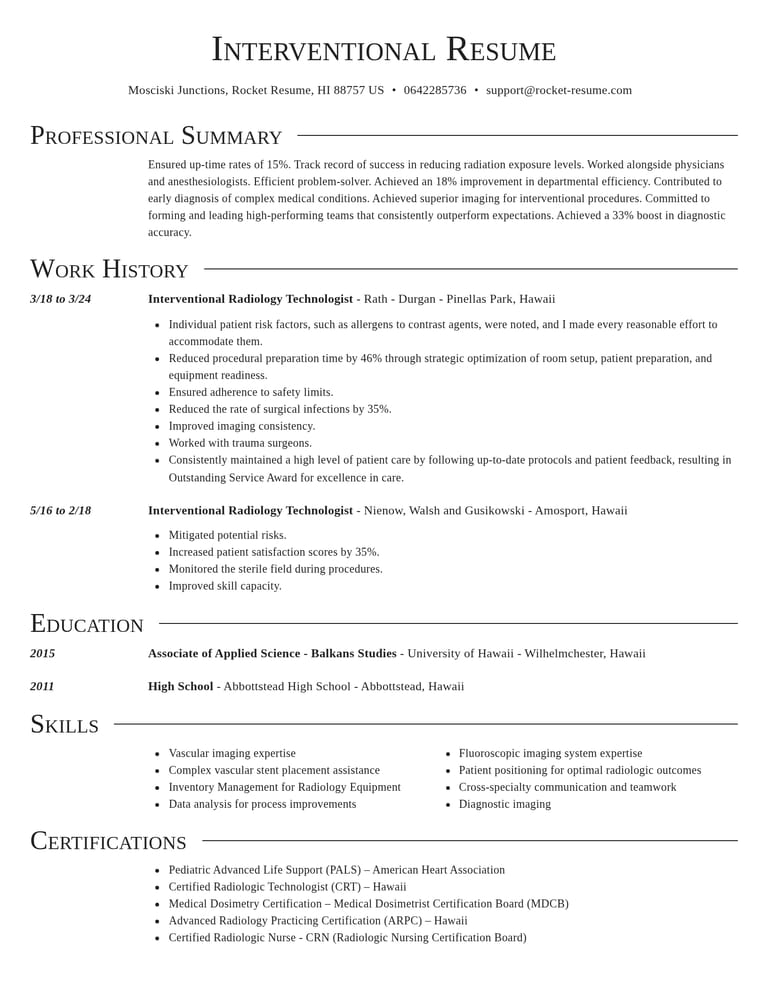
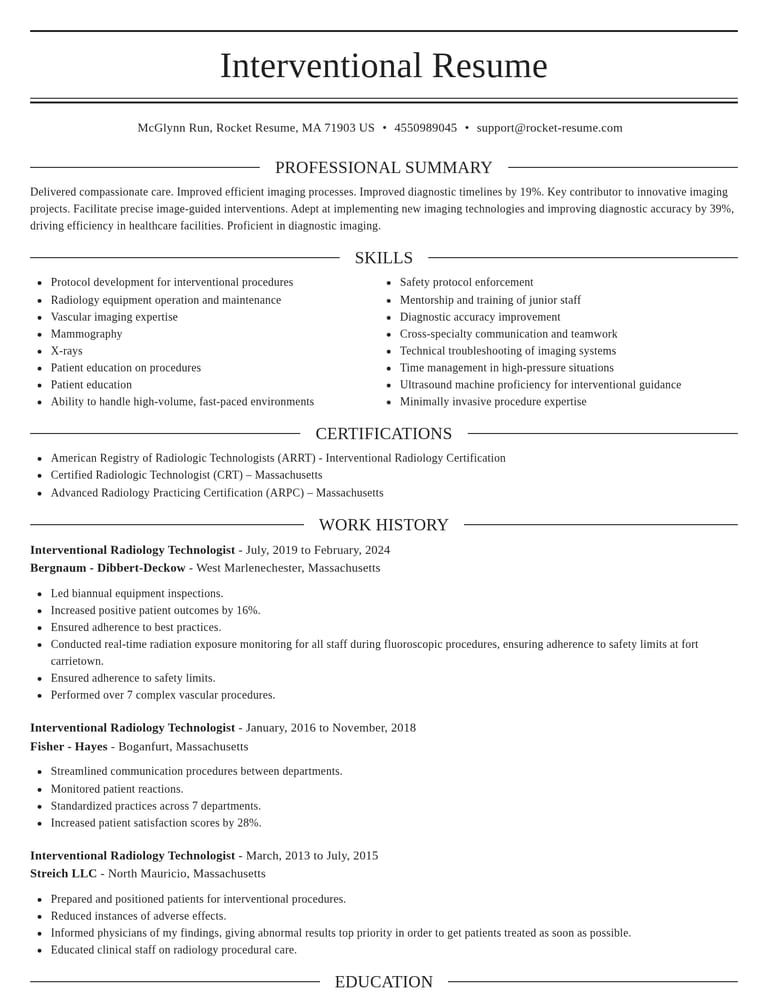
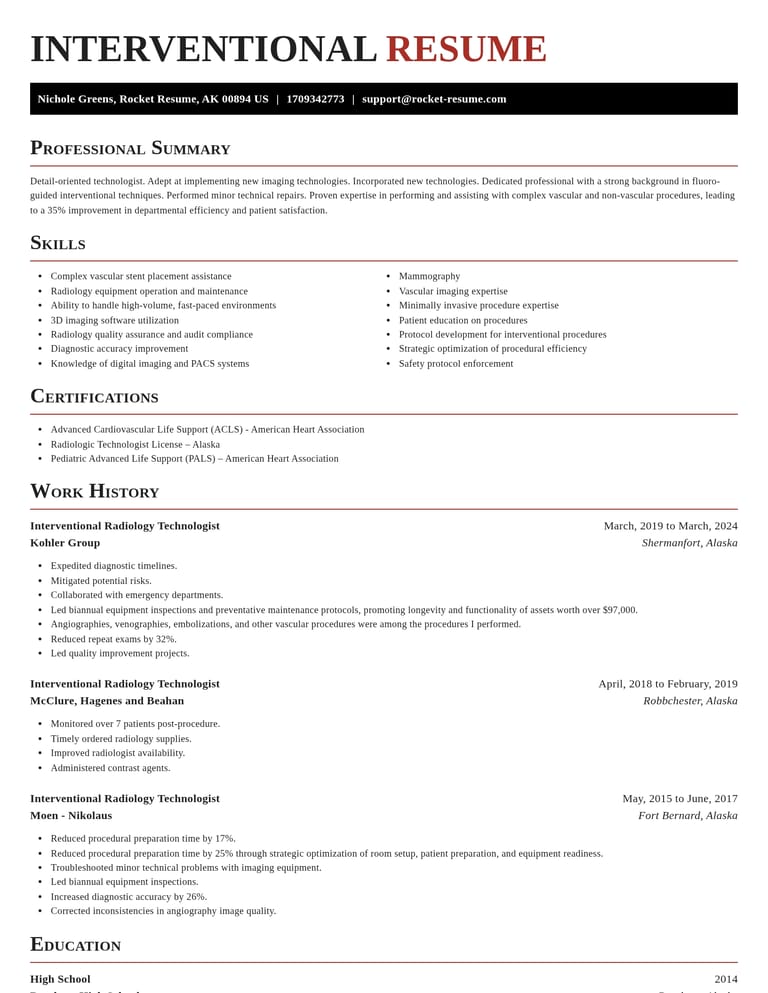
Template: make procedures and credentials easy to find
Tip: Check that your credential names and imaging roles are easy to spot when you scan the template.
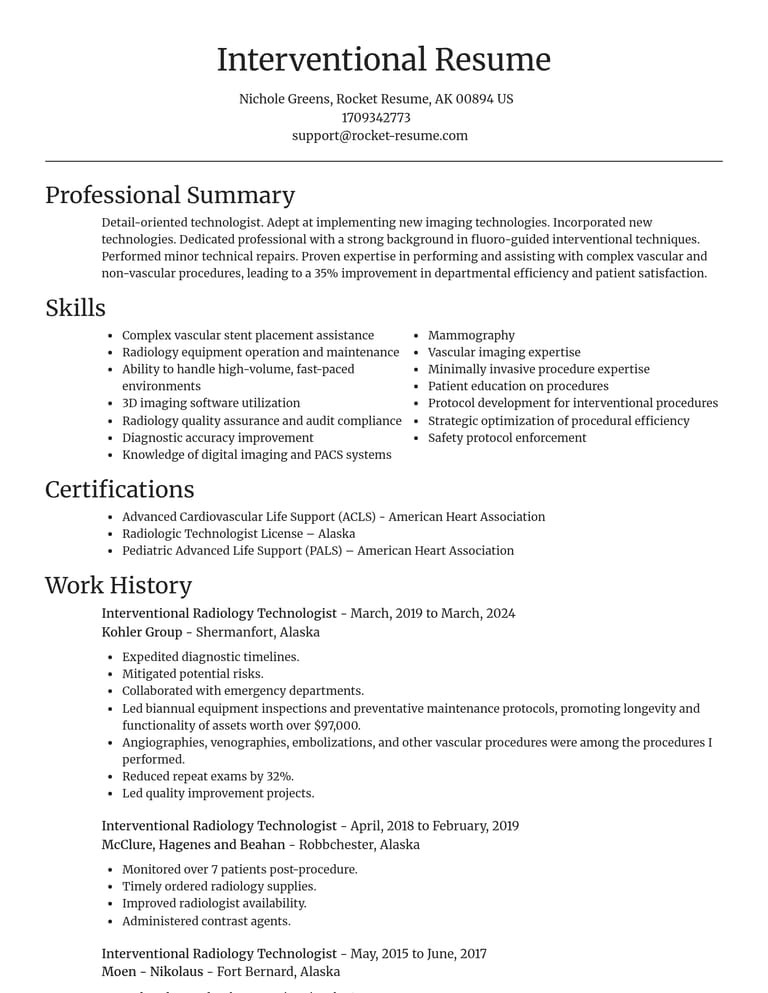
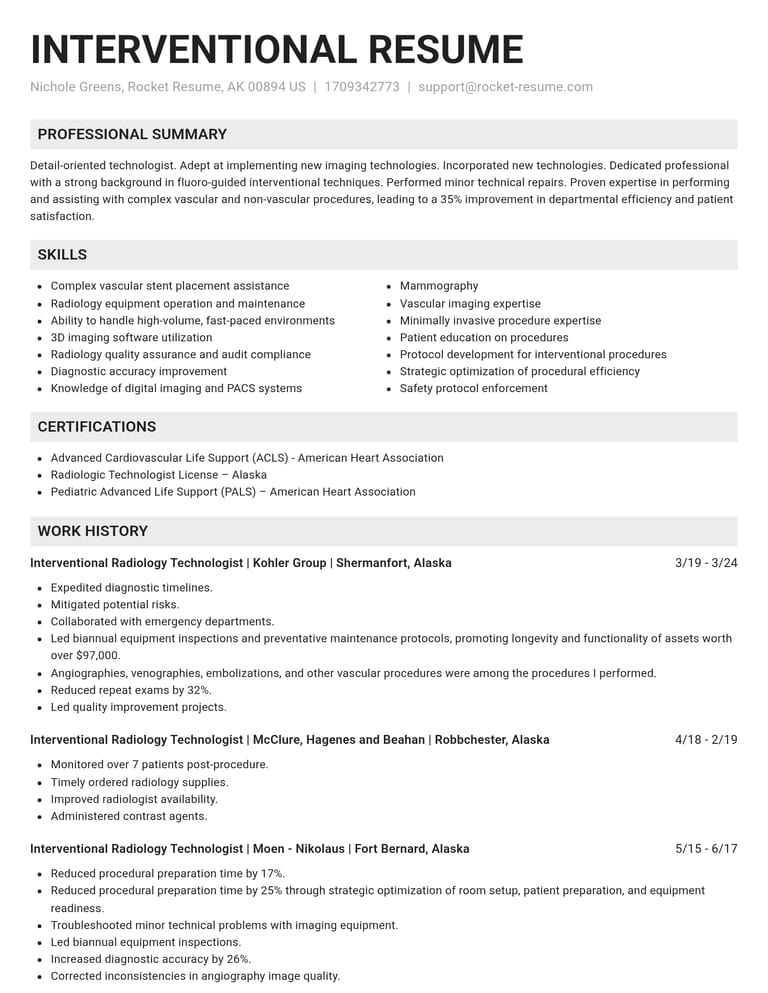
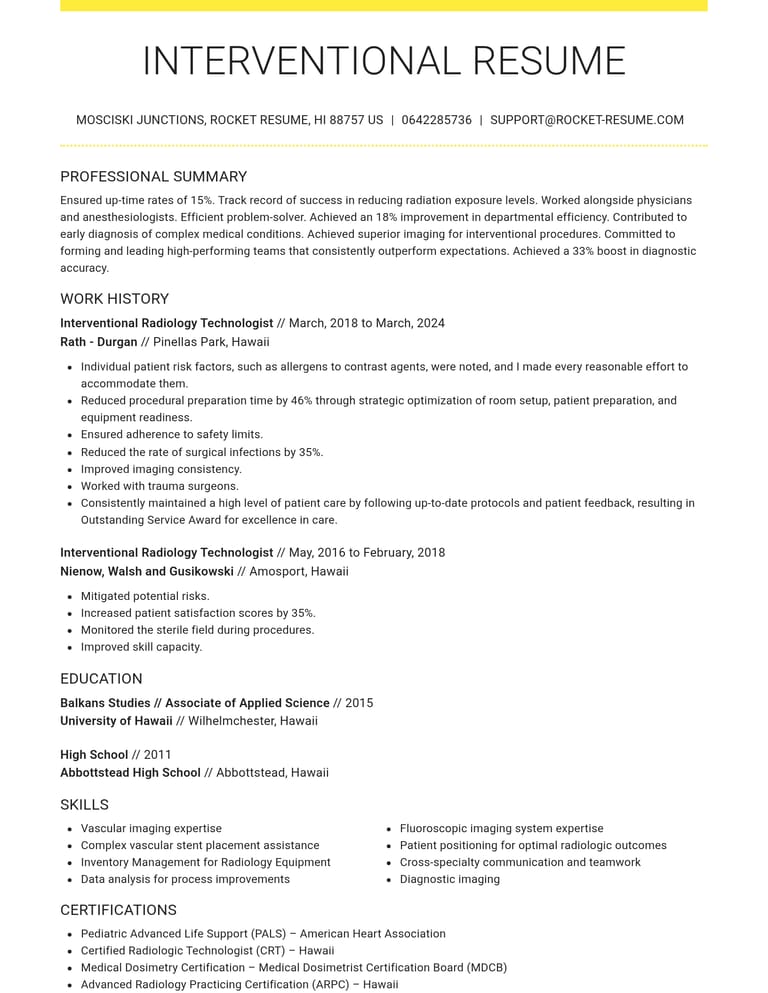
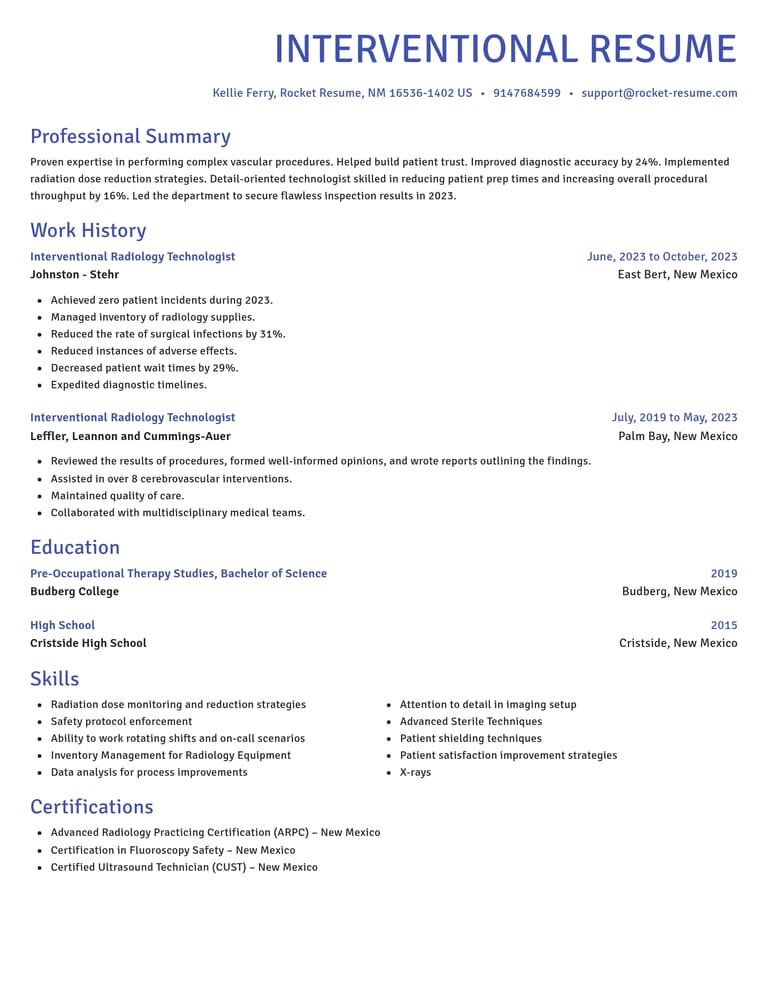
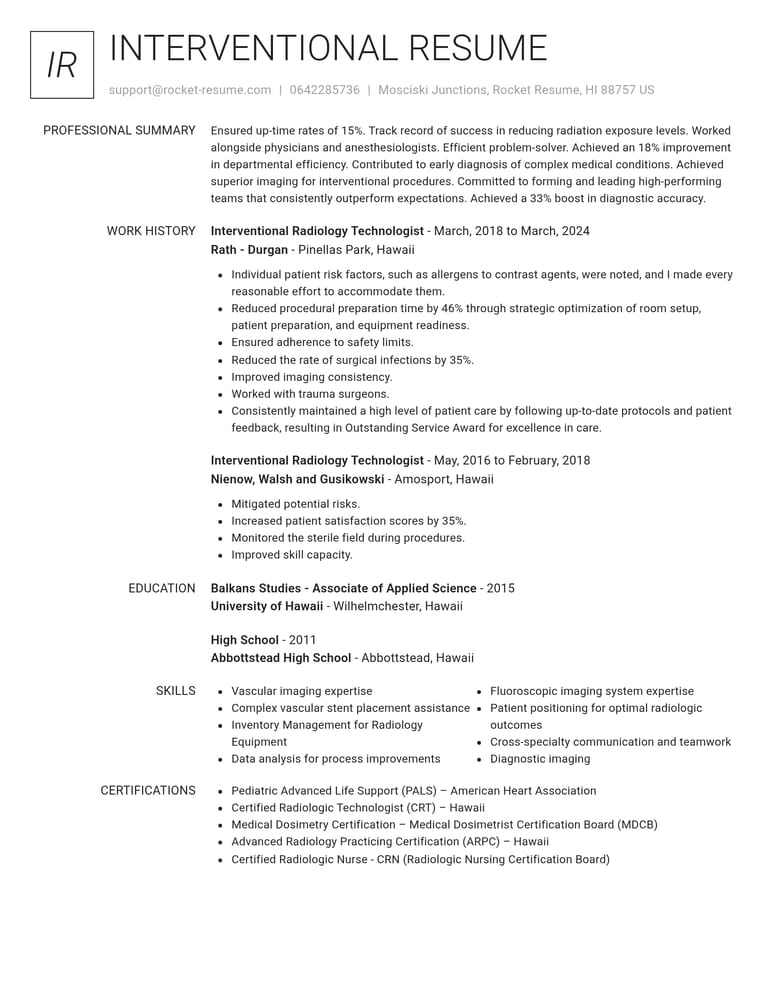
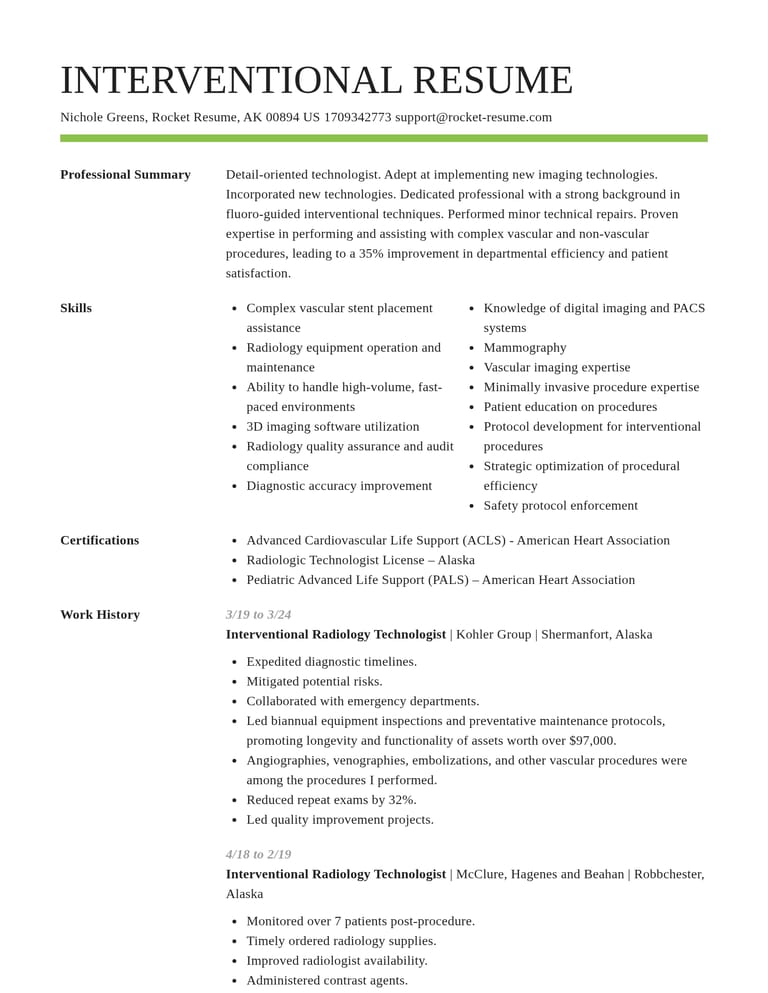
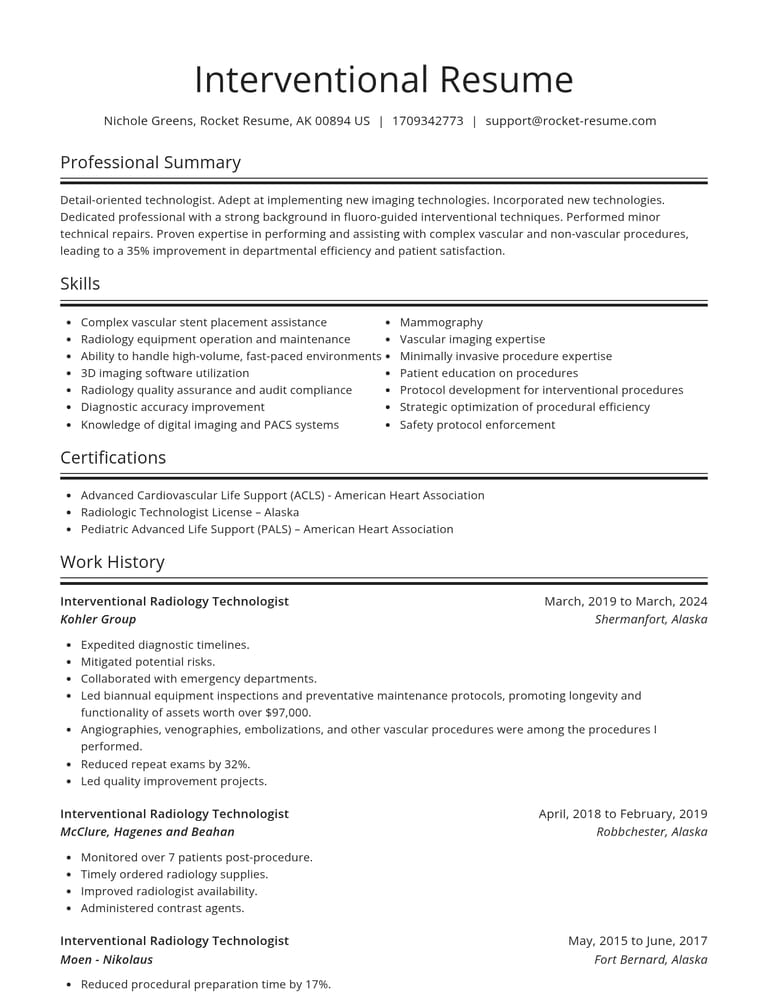
A simple layout gives you room to name a procedure and explain how you helped the physician. Keep the hospital, job title and dates together so the reader can see when and where you used fluoroscopy.
Choose a template that leaves room for your procedure experience and makes your ARRT credentials easy to find.
Build My ResumeIn the builder
Work history: name your part in the procedure
How should I describe the procedures I supported?
Name the procedure and describe your part in it. For angiography, say whether you positioned the patient, prepared contrast or operated the fluoroscope.
Tip: If you assisted with a biopsy or drain placement, describe the part you handled and who directed it.
O*NET describes positioning patients and adjusting equipment for the physician’s requested view, preparing contrast under a radiologist’s direction and operating the fluoroscope to help the physician guide a wire or catheter. For each case, say what you handled and who supervised you.
If the job description asks for Show this on your resume Procedure support Name the procedure, what you handled and who supervised you, if applicable. Before
“Assisted with angiography.”
After
“Operated the fluoroscope during angiography to help the physician view and guide the catheter through blood vessels.”
Under your general X-ray job, explain how you set up the C-arm for the views the physician requested.
For ideas on showing your results, explore Interventional radiology technologist accomplishments
See also: Work examples (15)Resume examples
Write a resume bullet that names the procedure and your imaging task, such as adjusting the fluoroscope during angiography.
Build My ResumeIn the builder
Education: show the training behind your imaging work
Tip: List the setting and dates of a clinical rotation. Under that entry, name what you practiced with a supervising technologist.
The BLS handbook describes education for radiologic and MRI technologists. An associate’s degree is the education typically required for radiologic and MRI technologists. Depending on the field of degree, education programs may include both academic study and clinical work. Coursework includes anatomy, pathology, patient care, radiation physics and protection, and image evaluation.
If the job description asks for Show this on your resume Radiography training Give the degree, school and any supervised procedure-suite rotation. If your degree is recent, bring the clinical rotation and relevant coursework forward. If you’ve worked in an IR suite, give paid experience more space.
See also: Education and clinical trainingInterventional radiology technologist certifications compared
List the radiography program under Education, then name the procedure suite rotation and explain what you did under supervision.
Build My ResumeIn the builder
Skills: tie the equipment to the work
Which skills should I list for IR?
Start with skills you used, such as C-arm fluoroscopy, patient positioning or contrast preparation. Include PACS, IV skills or ECG setup when they match your experience.
Tip: List C-arm fluoroscopy if you used it, then say in the hospital job entry what you helped the physician see.
Use the employer’s wording for the target role, whether it’s IR tech, interventional technician, angio tech or special procedures tech. Under Skills, use terms you can back up, such as patient positioning, fluoroscopy to aid catheter guidance, and contrast preparation under a radiologist’s direction.
If the job description asks for Show this on your resume Imaging equipment Name the fluoroscopy or C-arm equipment you’ve used, if you know its name. Clinical
- C-arm fluoroscopy
- Contrast preparation
- Patient positioning
Administrative
- PACS
- Imaging records
A skill list helps a reader scan. A work example under a job shows what you did.
Skill
C-arm fluoroscopy
Work example
Positioned the C-arm and adjusted it to obtain the view the physician requested.
See also: Skills (14)Work examples (15)
Add the imaging tools you know to Skills. Under the relevant hospital job or clinical placement, name a case where you used each one.
Build My ResumeIn the builder
Summary: lead with the experience you bring to IR
Tip: If you’re changing specialties, open with your current radiography role and the views you helped obtain with a C-arm.
Open with a task you practiced in supervised clinicals, a view you obtained with a hospital C-arm or a procedure you supported in IR. List ARRT Radiography, followed by the vascular or cardiac interventional specialty if you hold it. See the certification comparison for issuer links.
If the job description asks for Show this on your resume Relevant background Open with supervised IR clinicals, hospital C-arm use or the cases you support in the suite. Summary if you’re a new graduate
“ARRT-credentialed radiography graduate with supervised experience positioning patients and preparing equipment during an IR rotation.”
Summary if you’re moving from general X-ray
“Hospital radiologic technologist with an ARRT radiography credential and experience positioning patients and using a C-arm to obtain physician-requested views.”
Summary if you’re leading in the suite
“ARRT radiography and vascular interventional credentials. Leads technologist orientation for patient positioning and equipment setup, and operates the fluoroscope in physician-directed angiography.”
Shape your introduction with help from Interventional radiology technologist summary examples
See also: Summaries (6)Resume examples
Start the summary with your clinical setting, then bring in the strongest procedure responsibility or credential for this job.
Build My ResumeIn the builder
Certifications: list radiography before the specialty
Which credentials should I list first?
Put your ARRT radiography credential first. Follow it with any interventional credential you hold, then include current BLS if it’s relevant to the job.
Tip: In the optional Certifications section, enter the issuer and year with each credential you hold.
Use the name on your ARRT record. Place Radiography ahead of Vascular Interventional Radiography or Cardiac Interventional Radiography, then list a current BLS card if it fits the job description. For state licensing and the issuer’s requirements, use the links in the certification section.
Radiography (R), ARRT, [year]
How to list it · copy the wording on your certificate
Vascular Interventional Radiography (VI), ARRT, [year]
How to list it · copy the wording on your certificate
Cardiac Interventional Radiography (CI), ARRT, [year]
How to list it · copy the wording on your certificate
If the job description asks for Show this on your resume Current credentials Give the credential name and issuer, beginning with radiography. See also: Certifications (4)Interventional radiology technologist certifications comparedWhere can I check interventional credential requirements?
Gather the exact names and dates from your records so the credentials you add in the builder match what you hold.
Build My Resume
Interventional radiology technologist resume mistakes to fix before you apply
How Rocket Resume helps
Four ways the builder helps with your interventional radiology technologist resume:
- Job descriptions. Keep one resume in your account and adjust it to fit each one.
- Experience level. The builder asks how much experience you have first, then guides you from there.
- Your own numbers. Choose a suggestion, then edit it to add the numbers from your work.
- Saved suggestions. Save a skill, example, summary or certification on this page, and it waits for you in the builder.
What does an interventional radiology technologist resume look like?
Each illustrative composite shows a different starting point for an IR application, from a supervised clinical rotation to leading and training staff in the suite.
Tip: Notice how the graduate dates her supervised clinicals and the transfer applicant lists C-arm work under his hospital job.
Entry-level interventional radiology technologist resume
Richmond, VA · Supervised IR rotation
Tessa L.
Radiography graduate
tessa.l@example.com · (804) 555-0138 · Richmond, VA
Summary
ARRT-credentialed radiography graduate seeking a first interventional radiology technologist role. Completed a clinical rotation in an IR suite and practiced patient positioning and equipment setup under supervision.
Experience
Radiography student, IR rotation · Example River Hospital
Jan 2026 – Apr 2026
- Helped position patients and set up imaging equipment for angiography at the supervising technologist’s direction.
- Assisted with contrast preparation under the radiologist’s direction.
- Archived procedure images in PACS with the supervising technologist.
Radiography student, general X-ray rotation · Example Capital Medical Center
Aug 2025 – Dec 2025
- Positioned patients for general X-ray under supervision and reviewed images with the technologist.
Education and credentials
Associate degree in radiography · Example River College, 2026
Radiography (R), ARRT, 2026
Skills
- Patient positioning
- Equipment setup
- Contrast preparation
- PACS
Why this example works
- Clinical settingThe IR suite and dates show when and where Tessa assisted with angiography.
- Supervised workTessa says who directed contrast preparation and who was with her when she archived images.
- Current credentialThe radiography credential includes the issuer and year.
Hospital X-ray and C-arm experience for an IR resume
Cincinnati, OH · General X-ray and C-arm fluoroscopy
Derek N.
Radiologic technologist
derek.n@example.com · (513) 555-0163 · Cincinnati, OH
Summary
Hospital radiologic technologist with an ARRT radiography credential and current BLS. Experienced in positioning patients and using a C-arm to obtain physician-requested views. Seeking to bring that fluoroscopy experience into an IR suite.
Experience
Radiologic technologist · Example Olentangy Hospital
Sep 2020 – Present
- Position patients and operate the C-arm to obtain views requested by physicians during procedures.
- Work with physicians to review images and determine when additional views are needed.
- Perform general X-ray exams and archive images in PACS for review.
Education and credentials
Associate degree in radiography · Example Scioto College, 2020
Radiography (R), ARRT, 2020 · Basic Life Support (BLS), American Heart Association, 2025; current
Skills
- C-arm fluoroscopy
- General radiography
- Patient positioning
- PACS
Why this example works
- Imaging experienceDerek opens with how he uses the C-arm during procedures.
- Transferable taskThe description makes clear that Derek obtained views at the physician’s request.
- Relevant trainingRadiography and current BLS are visible without crowding out hospital experience.
Lead interventional radiology technologist resume
Tucson, AZ · Angiography and staff training
Leah P.
Lead interventional radiology technologist
leah.p@example.com · (520) 555-0191 · Tucson, AZ
Summary
Lead interventional radiology technologist with ARRT radiography and vascular interventional credentials. Operates the fluoroscope during angiography and trains newer technologists in equipment setup and patient positioning.
Experience
Lead interventional radiology technologist · Example Sonoran Hospital
Mar 2022 – Present
- Operate the fluoroscope during angiography to help the physician view and guide wires and catheters through blood vessels.
- Train new technologists to position patients and set up equipment for physician-requested views.
- Prepare contrast under the radiologist’s direction during angiography and embolization cases.
Interventional radiology technologist · Example Desert Medical Center
Jun 2017 – Feb 2022
- Supported biopsies and drain placements by positioning patients and setting up imaging equipment as requested.
- Prepared contrast for procedures under a radiologist’s direction.
Education and credentials
Associate degree in radiography · Example Santa Cruz College, 2015
Radiography (R), ARRT, 2015 · Vascular Interventional Radiography (VI), ARRT, 2020
Skills
- Fluoroscopy
- Angiography support
- Contrast preparation
- Patient positioning
- Staff training
Why this example works
- Scope of supportThe angiography entry explains how the physician uses fluoroscope images to guide a wire or catheter.
- Hands-on trainingThe lead entry names the skills Leah teaches during orientation.
- Specialty credentialThe vascular interventional credential follows the radiography entry.
Use the rotation, transfer or lead resume to decide how much space your own procedure experience needs.
Build My ResumeLoading resume templates…
Interventional radiology technologist resume questions
How long should an IR technologist resume be?
Can I apply to IR from general radiography?
What pay and outlook figures are available?
Where can I check interventional credential requirements?
What do employers call this role?
How do I write an IR technologist resume summary?
How does this role differ from cardiac cath lab work?
What belongs in the Skills section?
Write a summary that pairs the title in the job description with a skill you can demonstrate, such as fluoroscopy or patient positioning.
Build My ResumeInterventional radiology technologist resume skills and examples
Browse skills, work examples, summaries and certifications. Save the ones that fit, then make each one true to your own work.
Tip: If you list PACS, give an example of what you did with images. Use that same test for IV skills or ECG setup.
C-arm fluoroscopy
Clinical
Contrast preparation
Clinical
Patient positioning
Clinical
Fluoroscopy for physician-guided wire or catheter procedures
Clinical
IV skills
Clinical
ECG setup
Clinical
PACS
Administrative
Imaging records
Administrative
Show all 14 skillsShow fewer
Communication with physicians during imaging
People and systems
Patient instructions before imaging
People and systems
Training technologists in equipment setup
People and systems
General radiography
From the example resumes
Angiography support
From the example resumes
Staff training
People and systems · from the example resumes
Positioned the C-arm and adjusted it to obtain the view the physician requested.
Clinical · writing example
Prepared contrast for angiography under the direction of the radiologist.
Clinical · writing example
Assisted with contrast preparation under the radiologist’s direction.
Clinical · transferable, from the new graduate example
Positioned patients for general X-ray under supervision and reviewed images with the technologist.
Clinical · transferable, from the new graduate example
Operate the fluoroscope during angiography to help the physician view and guide wires and catheters through blood vessels.
Clinical · from the lead technologist example
Prepare contrast under the radiologist’s direction during angiography and embolization cases.
Clinical · from the lead technologist example
Supported biopsies and drain placements by positioning patients and setting up imaging equipment as requested.
Clinical · from the lead technologist example
Prepared contrast for procedures under a radiologist’s direction.
Clinical · from the lead technologist example
Show all 15 work examplesShow fewer
Archived general X-ray images in PACS for physician review.
Administrative · writing example
Archived procedure images in PACS with the supervising technologist.
Administrative · transferable, from the new graduate example
Perform general X-ray exams and archive images in PACS for review.
Administrative · from the moving into IR example
Helped position patients and set up imaging equipment for angiography at the supervising technologist’s direction.
People and systems · transferable, from the new graduate example
Position patients and operate the C-arm to obtain views requested by physicians during procedures.
People and systems · from the moving into IR example
Work with physicians to review images and determine when additional views are needed.
People and systems · from the moving into IR example
Train new technologists to position patients and set up equipment for physician-requested views.
People and systems · from the lead technologist example
ARRT-credentialed radiography graduate with supervised experience positioning patients and preparing equipment during an IR rotation.
A new graduate · writing example
Hospital radiologic technologist with an ARRT radiography credential and experience positioning patients and using a C-arm to obtain physician-requested views.
Moving from general X-ray · writing example
ARRT radiography and vascular interventional credentials. Leads technologist orientation for patient positioning and equipment setup, and operates the fluoroscope in physician-directed angiography.
Leading in the suite · writing example
ARRT-credentialed radiography graduate seeking a first interventional radiology technologist role. Completed a clinical rotation in an IR suite and practiced patient positioning and equipment setup under supervision.
From the new graduate example
Hospital radiologic technologist with an ARRT radiography credential and current BLS. Experienced in positioning patients and using a C-arm to obtain physician-requested views. Seeking to bring that fluoroscopy experience into an IR suite.
From the moving into IR example
Lead interventional radiology technologist with ARRT radiography and vascular interventional credentials. Operates the fluoroscope during angiography and trains newer technologists in equipment setup and patient positioning.
From the lead technologist example
Radiography (R), ARRT, [year]
How to list it · copy the wording on your certificate
Vascular Interventional Radiography (VI), ARRT, [year]
How to list it · copy the wording on your certificate
Cardiac Interventional Radiography (CI), ARRT, [year]
How to list it · copy the wording on your certificate
Basic Life Support (BLS), American Heart Association, current through [month year]
How to list it · from the example resumes
Skills are adapted from O*NET (29-2034.00) and the example resumes.
Where they go in your resume: Work historySkillsSummaryCertifications
Find skills that match your experience in Interventional radiology technologist resume skills
List fluoroscopy, C-arm setup or patient positioning under Skills if you can describe a case or rotation where you used it.
Build My ResumeInterventional radiology technologist certifications compared
List Radiography first among your ARRT credentials, followed by the interventional specialty you hold. Use the issuer links below to check requirements.
Tip: Check the issuer’s record for the credential name before writing its initials on your resume.
R: Radiography
ARRT
- How to list it
- Radiography (R), ARRT, [year]
- Issuer requirements
- Radiography requirements
- Resume placement
- List first among your ARRT credentials.
VI: Vascular Interventional Radiography
ARRT
- How to list it
- Vascular Interventional Radiography (VI), ARRT, [year]
- Issuer requirements
- Vascular Interventional Radiography requirements
- Resume placement
- List after radiography if you hold it.
CI: Cardiac Interventional Radiography
ARRT
- How to list it
- Cardiac Interventional Radiography (CI), ARRT, [year]
- Issuer requirements
- Cardiac Interventional Radiography requirements
- Resume placement
- Include if you hold it and it’s relevant to the job.
Still in training? Exam prep, programs and state rules
Education and clinical training
State licensing and employer requirements
Check which credentials you hold against Interventional radiology technologist certifications
List your ARRT radiography credential under Certifications, then check the issuer’s wording for any interventional credential you hold.
Build My ResumeWhat an interventional radiology technologist’s workday is like
Think of a procedure you know. Did you position the patient for the physician’s requested view, prepare contrast at the radiologist’s direction or operate the fluoroscope to help the physician see and guide a wire or catheter? List that task under the hospital or clinical placement where you performed it.
Tip: Think of a case where the physician asked for a different view. Describe how you adjusted the equipment or repositioned the patient.
78.57% of respondents reported constant contact with others.
Recall how you communicated a change in positioning during a case.
53.57% of respondents rated working with a team extremely important.
Think of how you coordinated fluoroscopy with the physician.
96.43% of respondents reported exposure to radiation every day.
If the job description mentions radiation protection, identify the training you can list.
Occupational experts answered O*NET’s work-context questions about radiologic technologists and technicians. See the O*NET occupation profile for the work context and tasks.
Describe a procedure in your resume and the equipment adjustment you made for the physician’s requested view.
Build My ResumeWhere an interventional radiology technologist career can lead
For your next application, decide whether you want more procedure support work or more responsibility for training newer technologists in the suite.
Grow as an interventional radiology technologist
- If you want more procedure experience, compare the case types in IR job descriptions and mark the ones you’ve already supported.
- For a lead position, describe the equipment setup or positioning you taught and who you trained.
Tip: For lead roles, note what you taught newer staff and the procedures or equipment you covered.
Compare related healthcare jobs
| Job | Median pay | Typical entry education |
|---|---|---|
| Radiologic Technologists and Technicians | $80,110 | Associate's degree |
| Diagnostic Medical Sonographers | $96,590 | Associate's degree |
| Nuclear Medicine Technologists | $101,370 | Associate's degree |
| Radiation Therapists | $105,310 | Associate's degree |
| Medical Dosimetrists | $147,470 | Bachelor's degree |
Pay gaps don’t show a typical career move, and each job has its own requirements. See pay for radiologic technologists and technicians by state.
Source: U.S. Bureau of Labor Statistics, median annual pay, May 2025 · checked Nov 14, 2026
Applying for a lead role? Describe in Work history how you trained a newer technologist to set up the C-arm.
Build My ResumeInterventional radiology technologist salary and job outlook
Government estimates for May 2025. Pay depends on your state, work setting and experience. These figures are for radiologic technologists and technicians.
Tip: Use the state median as background when comparing the pay ranges in the IR job descriptions you’re considering.
Pay for radiologic technologists and technicians by state
Median annual wage, May 2025. Highest: California, $121,260. Tap a state to see its numbers.
- Under $72,000
- $72,000–$77,999
- $78,000–$79,999
- $80,000–$91,999
- $92,000 or more
Selected state
California
- Median
- $121,260
- Average
- $117,950
- Lowest to highest 10%
- $70,210 – $165,460
- Jobs in the state
- 20,900
National median: $80,110. State figures are annual; see the national pay range for hourly wages.
See all 50 states and DC
| State | Median | Average | Lowest 10% | Highest 10% | Jobs |
|---|---|---|---|---|---|
| Alabama | $60,700 | $60,800 | $41,060 | $80,300 | 3,500 |
| Alaska | $98,920 | $96,670 | $74,210 | $126,860 | 370 |
| Arizona | $89,200 | $90,020 | $61,510 | $123,410 | 4,670 |
| Arkansas | $63,640 | $67,880 | $46,810 | $94,180 | 2,210 |
| California | $121,260 | $117,950 | $70,210 | $165,460 | 20,900 |
| Colorado | $87,760 | $89,470 | $63,270 | $111,730 | 3,960 |
| Connecticut | $91,970 | $93,530 | $68,070 | $122,760 | 3,230 |
| Delaware | $84,210 | $83,340 | $61,770 | $108,980 | 650 |
| District of Columbia | $102,770 | $98,860 | $59,130 | $128,120 | 660 |
| Florida | $76,750 | $74,760 | $51,390 | $99,020 | 16,470 |
| Georgia | $74,550 | $76,120 | $49,730 | $102,840 | 7,540 |
| Hawaii | $101,700 | $93,140 | $39,150 | $115,440 | 690 |
| Idaho | $80,080 | $79,940 | $60,540 | $103,580 | 1,490 |
| Illinois | $79,930 | $80,770 | $59,350 | $104,210 | 7,650 |
| Indiana | $77,640 | $74,980 | $51,090 | $99,580 | 5,470 |
| Iowa | $65,930 | $69,640 | $54,360 | $86,520 | 2,550 |
| Kansas | $76,070 | $74,580 | $50,940 | $98,320 | 2,270 |
| Kentucky | $69,670 | $72,840 | $51,740 | $99,170 | 3,630 |
| Louisiana | $63,680 | $66,240 | $50,030 | $82,830 | 3,370 |
| Maine | $80,080 | $80,760 | $62,210 | $102,640 | 1,050 |
| Maryland | $85,890 | $88,260 | $68,140 | $106,260 | 3,370 |
| Massachusetts | $103,620 | $101,910 | $75,350 | $131,940 | 5,500 |
| Michigan | $76,420 | $74,020 | $55,450 | $97,250 | 7,220 |
| Minnesota | $83,400 | $87,270 | $67,080 | $106,100 | 4,910 |
| Mississippi | $59,300 | $59,090 | $40,740 | $78,090 | 2,510 |
| Missouri | $73,080 | $73,150 | $50,810 | $97,150 | 5,170 |
| Montana | $77,070 | $74,610 | $55,750 | $91,650 | 850 |
| Nebraska | $72,860 | $74,600 | $54,410 | $98,300 | 1,670 |
| Nevada | $82,910 | $88,620 | $65,710 | $121,700 | 1,840 |
| New Hampshire | $84,910 | $87,410 | $64,620 | $106,370 | 1,240 |
| New Jersey | $95,000 | $93,240 | $71,770 | $118,410 | 6,320 |
| New Mexico | $79,940 | $79,810 | $59,560 | $104,120 | 1,150 |
| New York | $98,470 | $99,000 | $67,540 | $129,310 | 13,450 |
| North Carolina | $74,450 | $74,770 | $52,860 | $99,210 | 9,250 |
| North Dakota | $67,790 | $72,690 | $60,600 | $93,870 | 740 |
| Ohio | $78,320 | $76,890 | $60,360 | $98,450 | 9,570 |
| Oklahoma | $74,160 | $72,490 | $49,920 | $96,880 | 3,640 |
| Oregon | $102,290 | $99,630 | $70,760 | $124,810 | 2,700 |
| Pennsylvania | $76,050 | $74,740 | $56,430 | $97,740 | 8,090 |
| Rhode Island | $85,330 | $88,750 | $65,840 | $109,640 | 660 |
| South Carolina | $69,600 | $71,970 | $51,860 | $96,020 | 3,630 |
| South Dakota | $65,240 | $69,740 | $48,730 | $89,710 | 980 |
| Tennessee | $64,630 | $68,990 | $50,540 | $90,790 | 4,660 |
| Texas | $78,630 | $78,060 | $48,550 | $102,630 | 20,250 |
| Utah | $81,000 | $81,930 | $48,150 | $108,070 | 1,780 |
| Vermont | $94,540 | $91,630 | $66,960 | $125,230 | 470 |
| Virginia | $80,670 | $83,160 | $60,000 | $106,170 | 5,140 |
| Washington | $102,090 | $100,900 | $66,570 | $132,060 | 4,130 |
| West Virginia | $74,150 | $73,780 | $56,270 | $95,510 | 1,810 |
| Wisconsin | $79,140 | $79,400 | $61,870 | $99,420 | 5,010 |
| Wyoming | $77,860 | $79,080 | $56,750 | $104,790 | 430 |
Source: U.S. Bureau of Labor Statistics, Occupational Employment and Wage Statistics, May 2025 · checked Oct 23, 2026 · lowest and highest 10% are the 10th and 90th percentile wages
National pay range
Annual wages for all U.S. radiologic technologists and technicians
| Percentile | Annual | Hourly |
|---|---|---|
| 10th | $55,980 | $26.91 |
| 25th | $64,810 | $31.16 |
| Median | $80,110 | $38.52 |
| 75th | $98,750 | $47.47 |
| 90th | $118,660 | $57.05 |
Source: U.S. Bureau of Labor Statistics, Occupational Employment and Wage Statistics, May 2025 · checked Oct 23, 2026
More pay data: state rankings and pay by work setting
State rankings
Top five states and DC
Source: U.S. Bureau of Labor Statistics, Occupational Employment and Wage Statistics, May 2025 · checked Oct 23, 2026 · ranked by annual mean wage or jobs per 1,000 jobs
Median pay by work setting
Annual median, May 2025
- Outpatient care centers$84,720
- Hospitals; state, local, and private$80,650
- Medical and diagnostic laboratories$78,400
- Offices of physicians$74,540
Source: Occupational Outlook Handbook, May 2025 · checked Nov 14, 2026
Projected job growth, 2025–35
Change in employment over ten years
- Radiologic technologists and technicians5%
- Magnetic resonance imaging technologists8%
- Health technologists and technicians7%
- Radiologic and mri technologists5%
- All occupations3%
That's 11,800 more jobs over ten years.
Source: U.S. Bureau of Labor Statistics, Employment Projections 2025–35 · checked Nov 14, 2026
Where radiologic technologists and technicians work
Share of the 234,200 jobs in 2025 (largest settings)
- Hospitals; state, local, and private60%
- Offices of physicians17%
- Medical and diagnostic laboratories7%
- Outpatient care centers7%
The rest work in other settings.
Source: Occupational Outlook Handbook · checked Nov 14, 2026
Use the job descriptions from the settings you’re comparing to highlight relevant cases in your resume.
Build My ResumeAbout this guide
Updated November 17, 2026.
Sources
Loading industries…
Build your interventional radiology technologist resume
Choose a template and build your resume around a supervised suite case, a C-arm view you obtained or a procedure you supported in IR. Explain your part and list the ARRT credentials you hold.