X-ray technologist resume tips, templates and examples
X-ray tech resume examples for each career stage show how to connect exams, office duties and added scan skills.
- CT and multimodality experience
- Outpatient summary suggestions
- Imaging and office skills

What X-ray technologist hiring managers look for
- Explaining an x-ray exam to patients beforehand.
- Computer commands for imaging sequences.
- Imaging records linked to the correct examination.
- Appointment scheduling and telephone coordination.
- Contrast preparation under a radiologist’s direction.
- Experience with the modalities named in the job description.
How to write an X-ray technologist resume
An office x-ray job can include appointments and records; a CT role adds different scan tasks. Build a resume that gives each part of your experience a clear place. This guide starts with five questions to answer first, then walks through each part of your resume with tips and links to the examples, templates and data on this page.
Five questions to answer first
- What goes into an x-ray tech resume?
Step 1 sorts the requested imaging and office duties.
- Can clinical rotations lead my first x-ray tech resume?
Step 3 helps you give supervised imaging practice a prominent place.
- How do I describe equipment across x-ray and CT?
Step 5 separates the tasks performed with each imaging system.
- What belongs in an outpatient x-ray tech summary?
Step 8 brings imaging and office responsibilities together.
- Where do my x-ray certification and license go?
Step 9 keeps professional credentials separate from education.
What an X-ray technologist does
X-ray tech work can extend beyond the exam room. O*NET includes scheduling appointments and maintaining imaging files among the occupation’s tasks. Build a work history that connects these responsibilities to the exams you performed.
For radiologic technologists and technicians, the national median annual pay is $80,110 in May 2025. Employment is projected to grow 5%, with 13,000 openings a year on average. These figures describe the whole occupation.
The handbook says hospitals employ 60% of radiologic and MRI technologists; physicians’ offices follow at 17%. Use the setting you know to focus your resume.
See also: X-ray technologist salary and job outlookShow what changed when you added another scan type
Tip: An office role and a hospital CT role can share an occupation code while needing different work history examples.
Write your X-ray technologist resume in nine steps
Do the first two before you open the builder. The other seven follow the builder’s order.
Step 1 of 9
Before you open the builder
Job description: separate exam work from office responsibilities
What goes into an x-ray tech resume?
Include exams, equipment, training and current credentials. For an office role, give scheduling and imaging records space alongside the exams you perform.
Tip: Mark the requested exams and appointment duties separately, then find a real example of each in your background.
O*NET lists imaging and administrative tasks for radiologic technologists and technicians. One task reads: “Perform general administrative tasks, such as answering phones, scheduling patient appointments, or pulling and filing films.” These are occupation tasks, not a survey of employer requirements.
Match each requirement in the job description
Here’s the step where you’ll show each one:
- Exams and equipment step 5
- Clinic coordination step 5
- Imaging education step 6
- Patient communication step 7
- Relevant setting step 8
- Credentials held step 9
Tip: When the job description asks for CT experience, give a CT example rather than a broad list of imaging duties.
See also: Show what changed when you added another scan typeCredentials to identify on an x-ray tech resume
Build a focused first draft by matching the requested exams and office duties to work you can describe.
Build My Resume
Before you open the builder
Examples: compare rotations, office work and added CT
Tip: Read the office example for scheduling details and the CT example for a change in scan responsibilities.
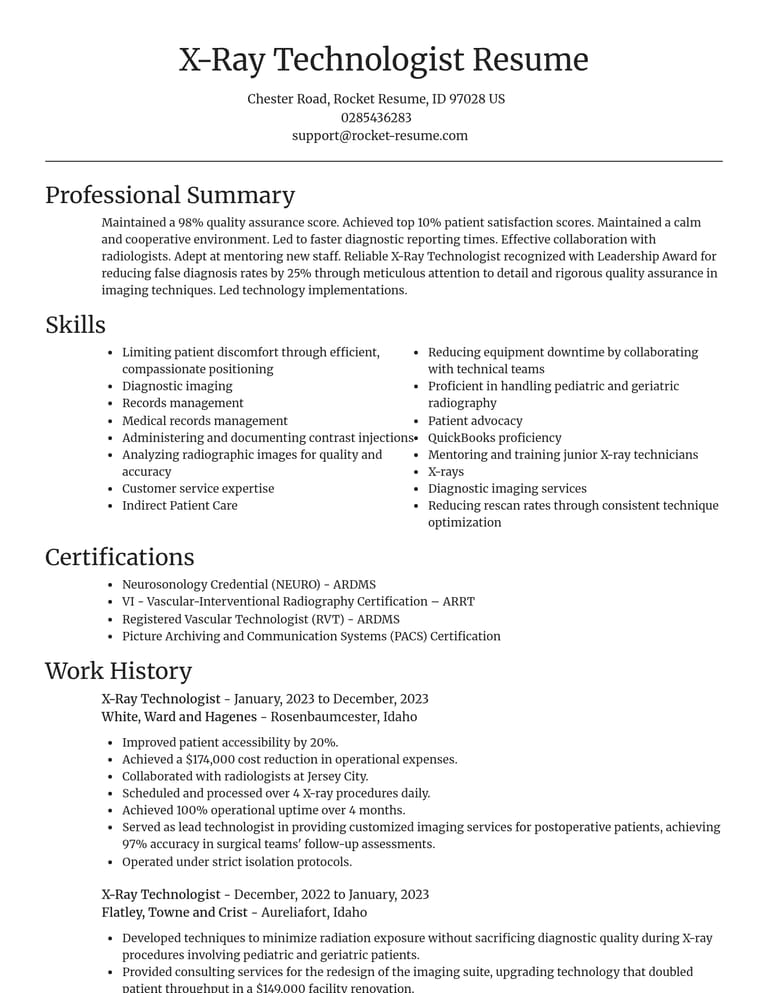
The x-ray technician examples cover supervised rotations, imaging in a physician’s office and work that expanded into CT. Use the structure that fits your situation.
See also: Resume examples
Use an example to organize your resume around the setting you know, then replace its exams and equipment with your own.
Build My ResumeIn the builder: experience level
How much experience do you have?
Can clinical rotations lead my first x-ray tech resume?
Yes. Give rotations their own dated entries and identify supervision. Follow them with earlier employment that demonstrates patient communication, organization or service.
Tip: For a first imaging role, keep the clinical rotation title visible so the reader can distinguish practice from employment.
Start from Build My Resume and it’s the builder’s first question. The examples below show three starting points: New graduate with clinical rotations, Physician’s-office x-ray tech and X-ray technologist who added CT.
Choose an order that fits
- New graduate:
- Summary, Education, Clinical rotations, Other employment, Skills, Certifications.
- Office or CT experience:
- Summary, Work history, Skills, Education, Certifications.
The builder starts with a standard order, and you can move sections into the one you choose.
Aim for one page when rotations and a short work history cover the relevant experience. Use a second page when distinct imaging roles and responsibilities justify it.
See also: Resume examples
Start your resume with the experience level that reflects your paid work, then prepare rotation details for the work history section.
Build My ResumeIn the builder
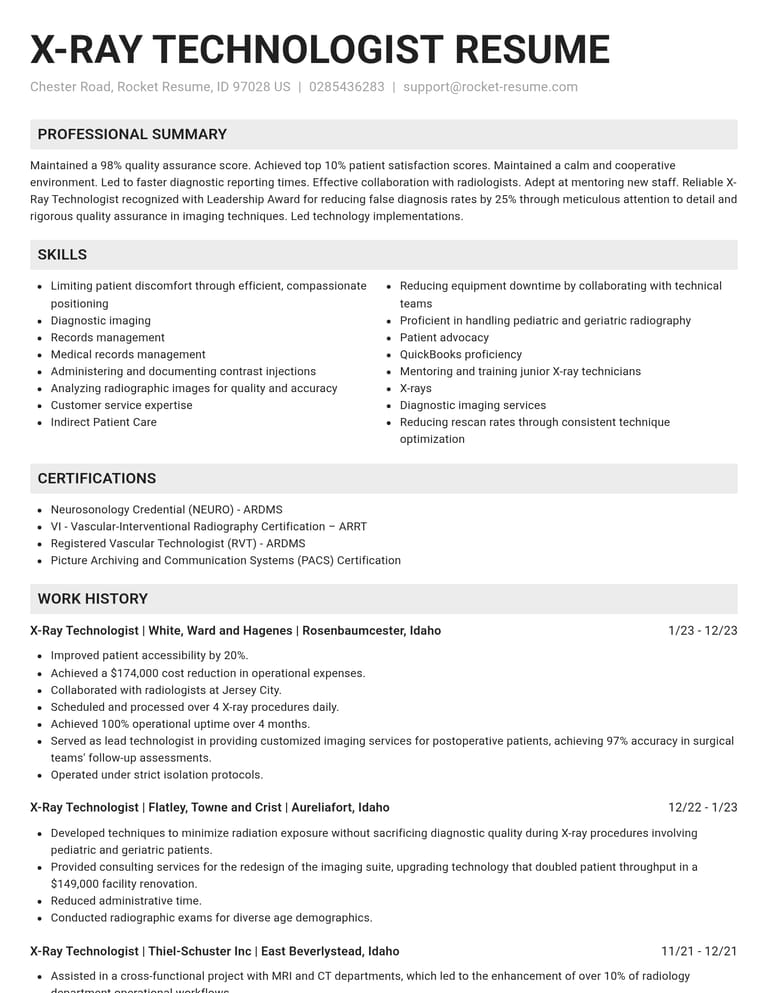
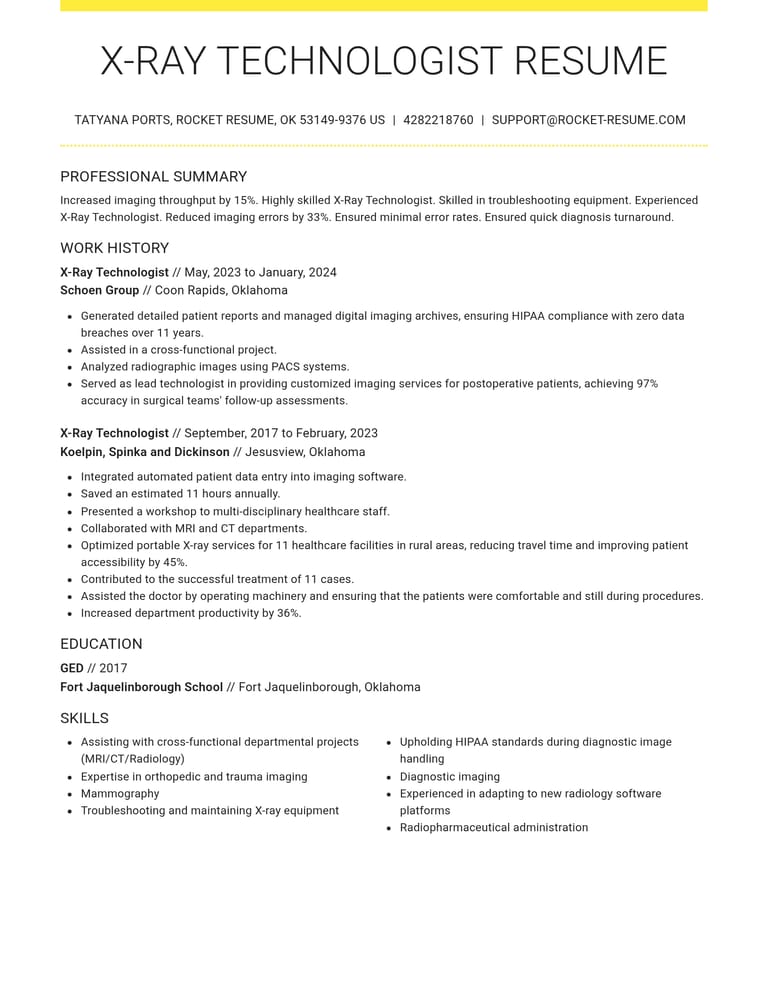
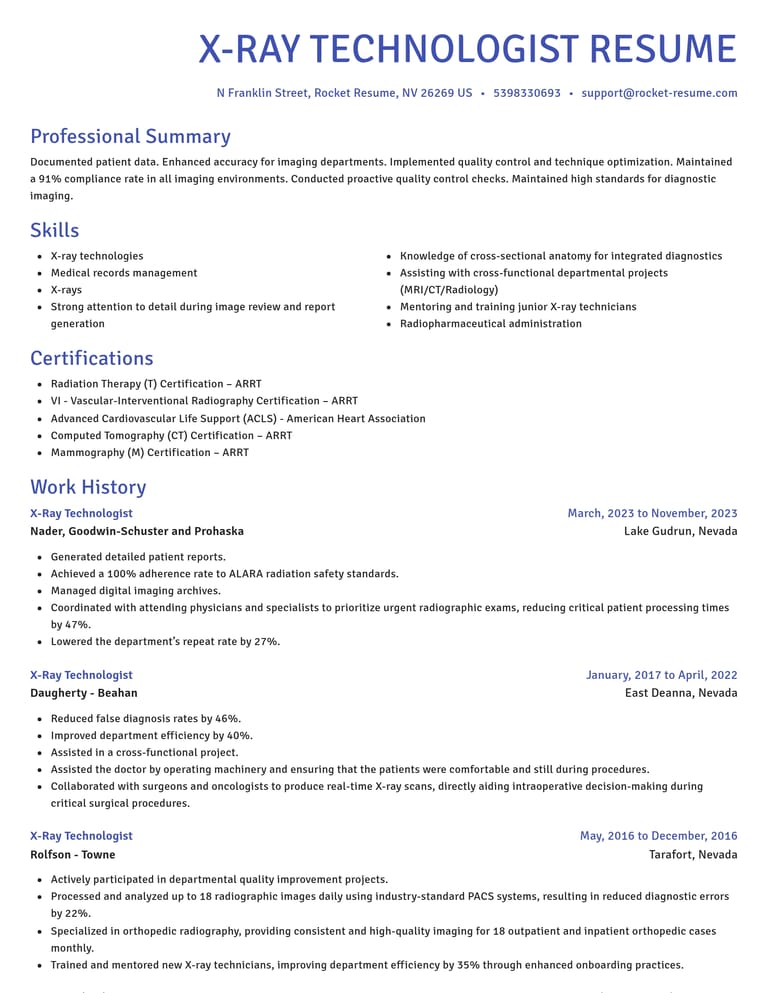
Template: give each modality enough space
Tip: Preview how a longer CT job entry fits beside the earlier x-ray role before settling on a template.
Choose a layout where exam types, equipment and employment dates are easy to follow. A separate credential section keeps license information from crowding the summary.
See also: Templates
Choose a template for your resume that leaves room to distinguish office imaging, supervised practice and CT work.
Build My ResumeIn the builder
Work history: connect the scan to the rest of the visit
How do I describe equipment across x-ray and CT?
Connect each machine to an exam and your responsibility. Put CT scan sequences in the CT entry and x-ray exams in the role where you performed them.
Tip: For an office job, describe what happened before and after the exam, such as arranging the appointment and updating imaging records.
Start an entry with the employer, actual job title and dates. Describe the exams and equipment you used there. Include scheduling, records and any added modality in the entry for the role where you handled them.
If the job description asks for Show this on your resume Exams and equipment Connect each exam type to the imaging system used. Clinic coordination Describe appointments, calls or imaging records handled alongside exams. Before
“Performed x-rays and helped in the office.”
After
“Performed ordered wrist and ankle exams on a digital x-ray system in a physician’s office, scheduled imaging appointments and filed exam records for clinician review.”
Keep supervised rotations clearly labeled. Add a workload or improvement only when your own records support it.
For ideas on showing your results, explore X-ray technologist accomplishments
See also: Work examples (20)Resume examplesShow what changed when you added another scan type
Describe the full imaging visit in your work history, from appointment coordination to the exam record, wherever those duties were yours.
Build My ResumeIn the builder
Education: separate the program from clinical practice
Tip: Put the degree with the school; put rotation tasks with the clinical site and its dates.
Radiologic technologists and MRI technologists typically need an associate’s degree. Depending on the field of degree, education programs may include both academic study and clinical work. In your resume, name the degree or certificate and school, then the clinical setting where you practiced.
If the job description asks for Show this on your resume Imaging education Give the degree or certificate and its actual or expected completion date. If you’re still studying, mark the completion date as expected. Keep program completion and professional certification in separate entries.
See also: Program planning and exam preparationCredentials to identify on an x-ray tech resume
List your imaging program in Education, then build a separate rotation entry for the equipment and examinations practiced under supervision.
Build My ResumeIn the builder
Skills: balance scan controls with patient communication
Tip: Name CT controls, patient explanations and appointment coordination separately instead of grouping them all as imaging skills.
A radiologic technologist resume can show technical and interpersonal strengths together. Select skills that explain what you did with a patient, a scanner or an imaging record.
If the job description asks for Show this on your resume Patient communication Show how instructions helped a patient prepare for an exam. Scan equipment and reasoning
- Operation and control
- Critical thinking
- Computers and electronics
Patients and office coordination
- Active listening
- Speaking
- Customer and personal service
A skill list helps a reader scan. A work example under a job shows what you did.
Skill
Operation and control
Work example
Entered CT scan commands at the console and documented the sequence used for the ordered examination.
See also: Skills (20)Work examples (20)
Add skills that distinguish your imaging responsibilities, then build a work history example showing how each was used.
Build My ResumeIn the builder
Summary: introduce the setting and the scan work
What belongs in an outpatient x-ray tech summary?
Name the office setting, exams and patient coordination you know. Connecting imaging with appointment or record work says more than a list of personal qualities.
Tip: An office summary can mention appointment coordination; a CT summary should explain the added scan work.
Make your imaging work clear from the start of your X-ray technologist resume summary. If the job description says radiology tech, radiology technician or radiologic technologist, use that title when it accurately fits your background; keep previous job titles unchanged. For another perspective, see the radiographer resume guide.
If the job description asks for Show this on your resume Relevant setting Name the physician’s office or imaging department in the opening. Summary if you’re a new imaging graduate
“Radiologic technology graduate with supervised clinical practice in chest and abdomen imaging. Brings experience explaining exam instructions, preparing digital equipment and recording examinations, alongside customer service work.”
Summary if you’re an outpatient x-ray tech
“X-ray tech in a physician’s office, combining hand and foot exams with appointment scheduling and imaging records. Uses digital x-ray equipment and clear patient instructions to support the visit from arrival through documentation.”
Summary if you’re adding CT experience
“Radiologic technologist with an x-ray background and current CT responsibilities in a hospital imaging department. Experienced in scan-sequence entry, image documentation and contrast preparation under a radiologist’s direction.”
Shape your introduction with help from X-ray technologist summary examples
See also: Summaries (6)Resume examples
Write an opening summary that connects the role you want with your office imaging, clinical practice or added CT responsibilities.
Build My ResumeIn the builder
Certifications: distinguish the credential from the state license
Where do my x-ray certification and license go?
List credentials you hold in Certifications with the issuing organization and year. Give the state license its own entry and verify its status before using the resume.
Tip: Read each card or license before entering its title, issuer and date; an employer’s title is not a credential.
A radiologic technologist can hold a professional certification, a state license and a life-support card. Give each its own entry using the information on the document you hold.
Radiologic technologist certification, the organization that awards it, [year]
How to list it · copy the wording on your certificate
State license, State, [year]
How to list it · copy the wording on your certificate
Basic Life Support, the course provider named on the card, [year]
How to list it · copy the wording on your certificate
R.T.(R), ARRT, [year]
How to list it · from the example resumes
If the job description asks for Show this on your resume Credentials held Record the certification issuer and the license’s state separately. See also: Certifications (4)Credentials to identify on an x-ray tech resumeCheck the state’s rules
Build the Certifications section from your current documents, with separate entries for professional certification, state licensure and life-support training.
Build My Resume
X-ray technologist resume mistakes to fix before you apply
How Rocket Resume helps
Four ways the builder helps with your X-ray technologist resume:
- Job descriptions. Keep one resume in your account and adjust it to fit each one.
- Experience level. The builder asks how much experience you have first, then guides you from there.
- Your own numbers. Choose a suggestion, then edit it to add the numbers from your work.
- Saved suggestions. Save a skill, example, summary or certification on this page, and it waits for you in the builder.
Show what changed when you added another scan type
Adding CT or mammography should change more than the skills list. Build a work history entry that names the additional equipment and what you did during the exam.
Tip: “Entered scan sequences on the CT console in the hospital CT room and recorded examination details.” Use your own room and equipment.
What does an X-ray technologist resume look like?
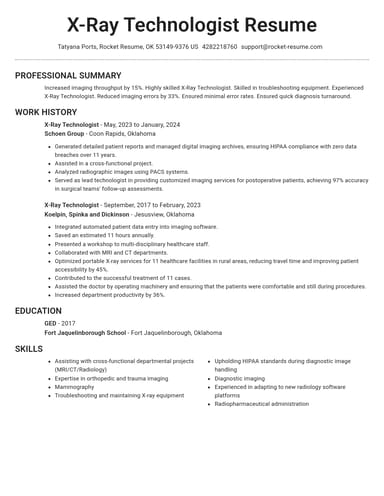
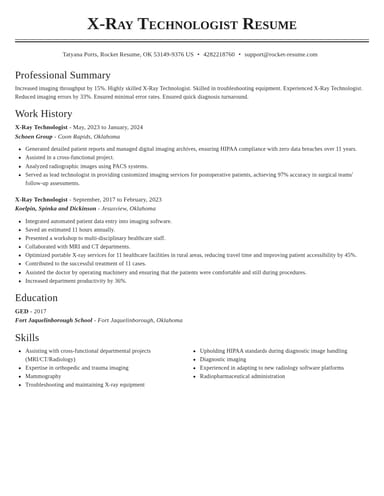
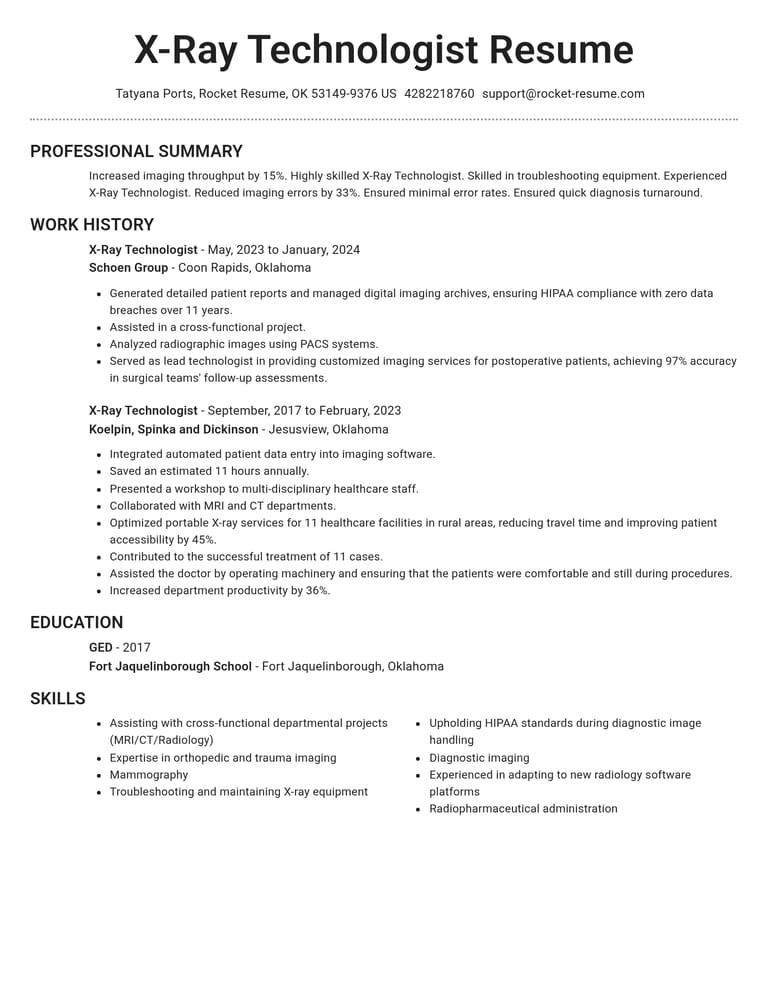
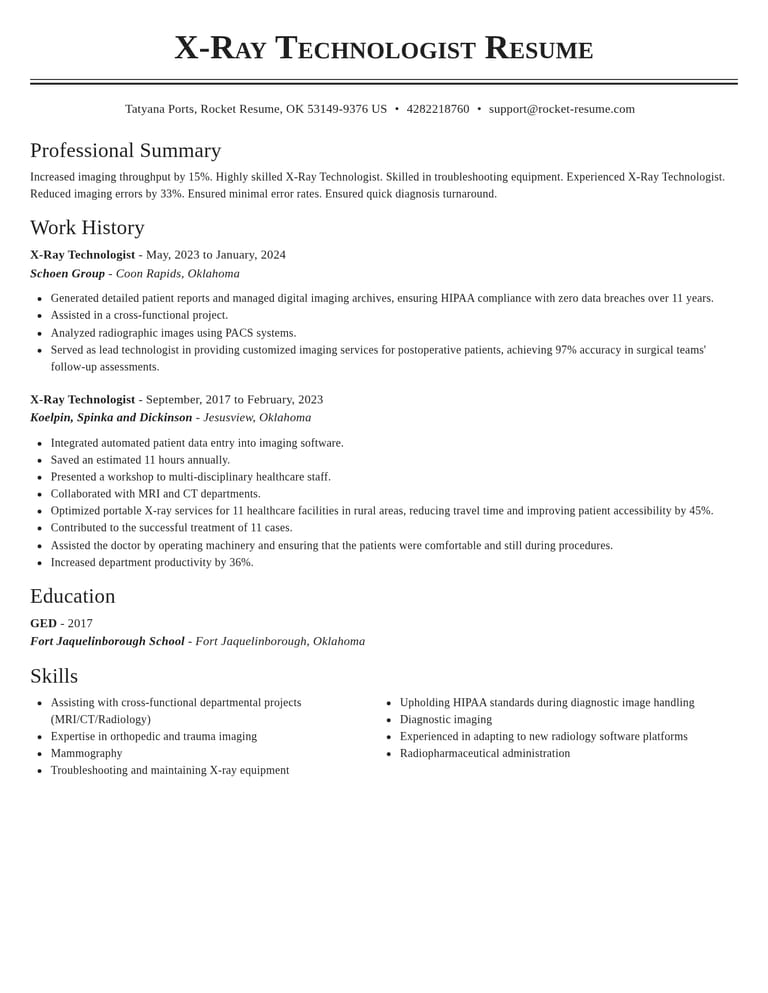
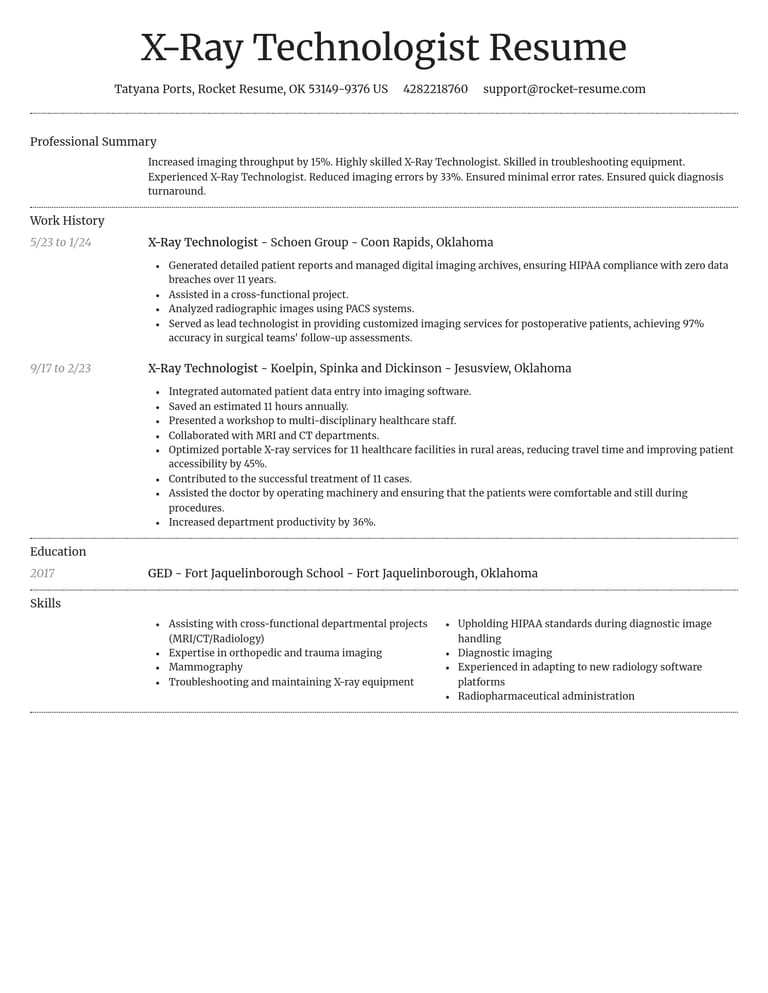
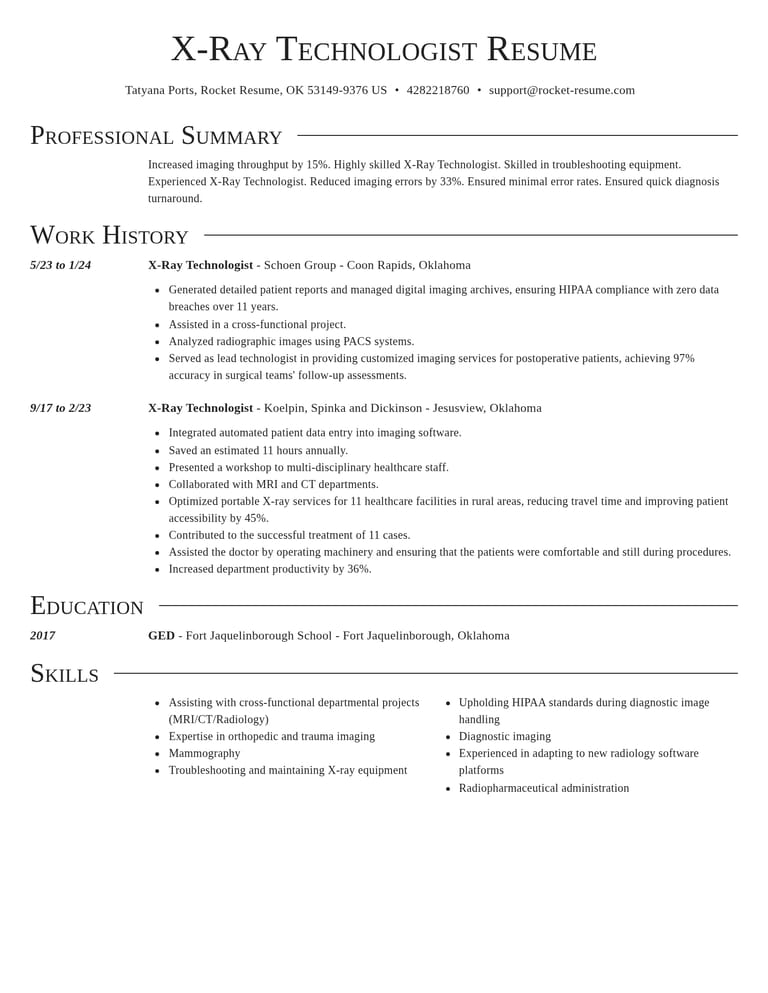
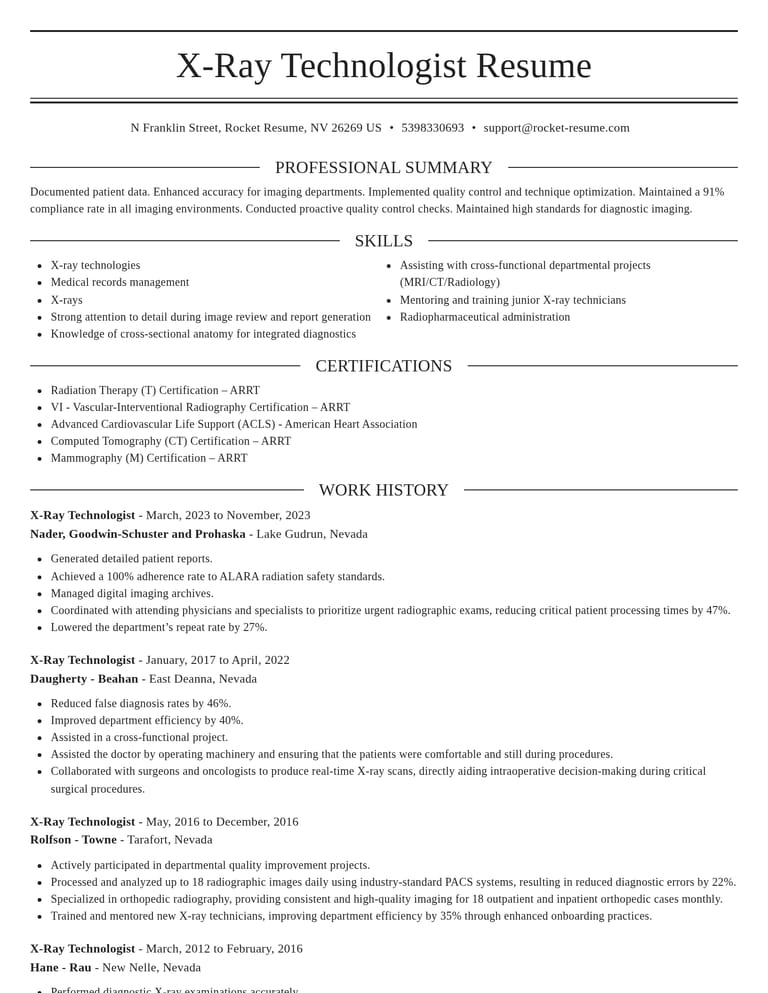
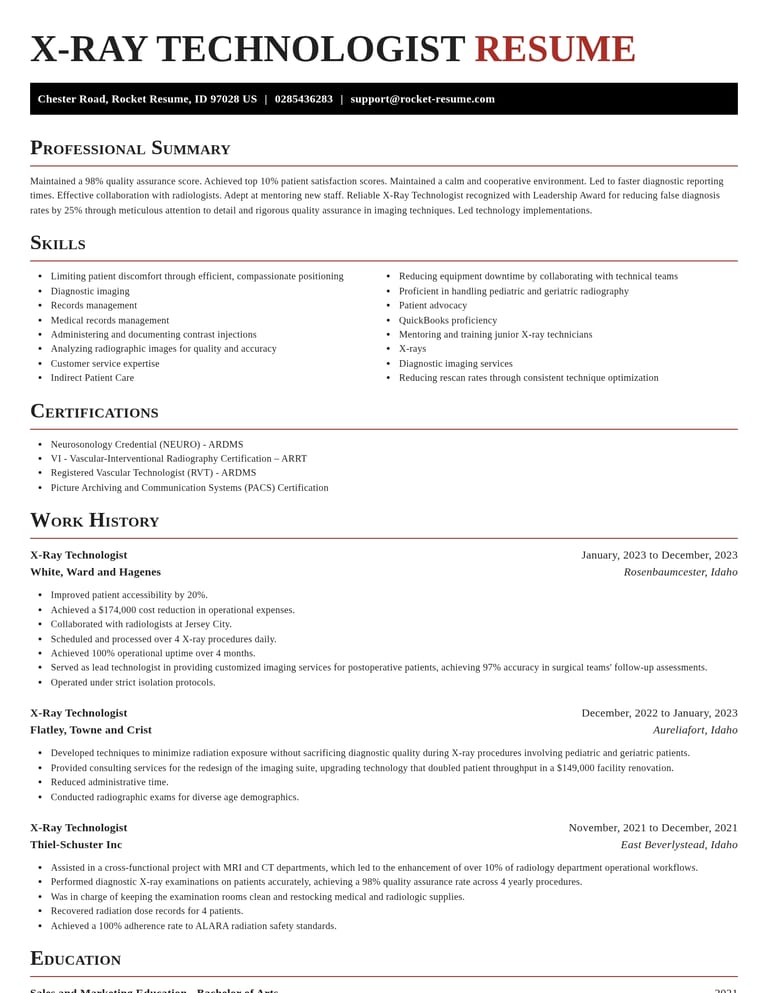
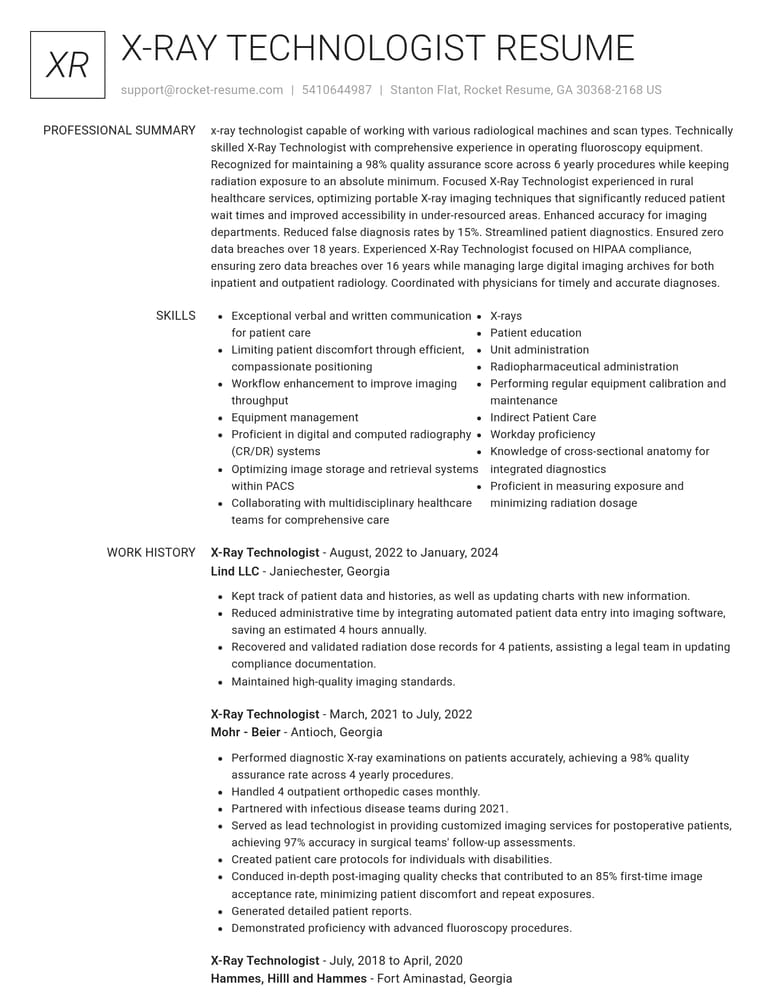
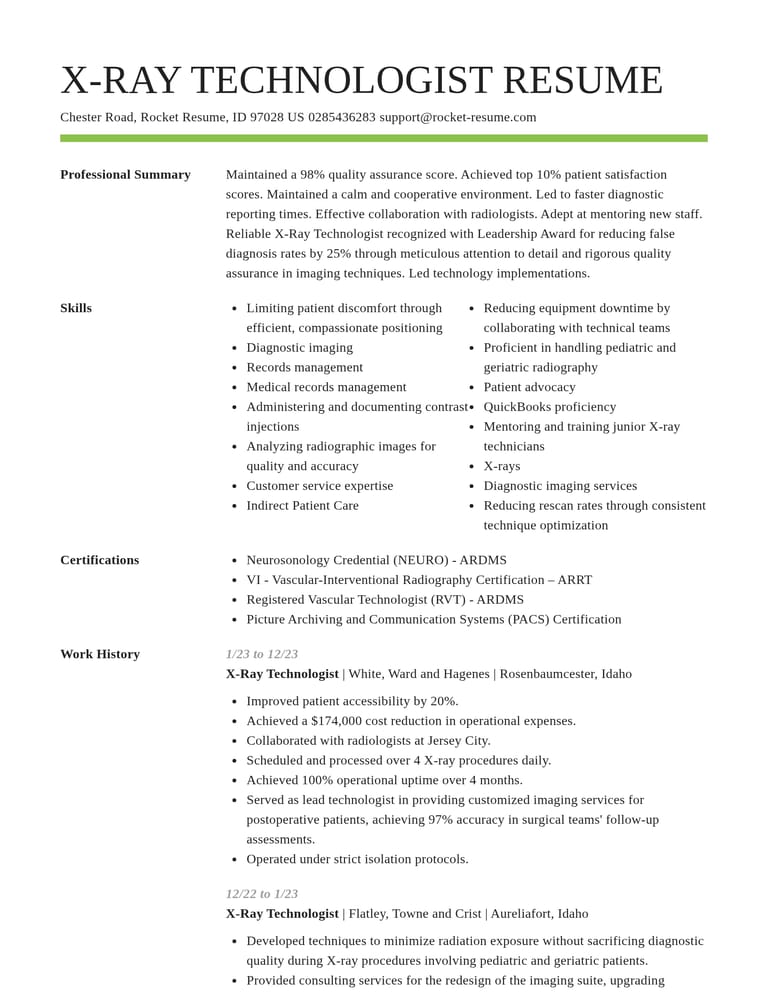
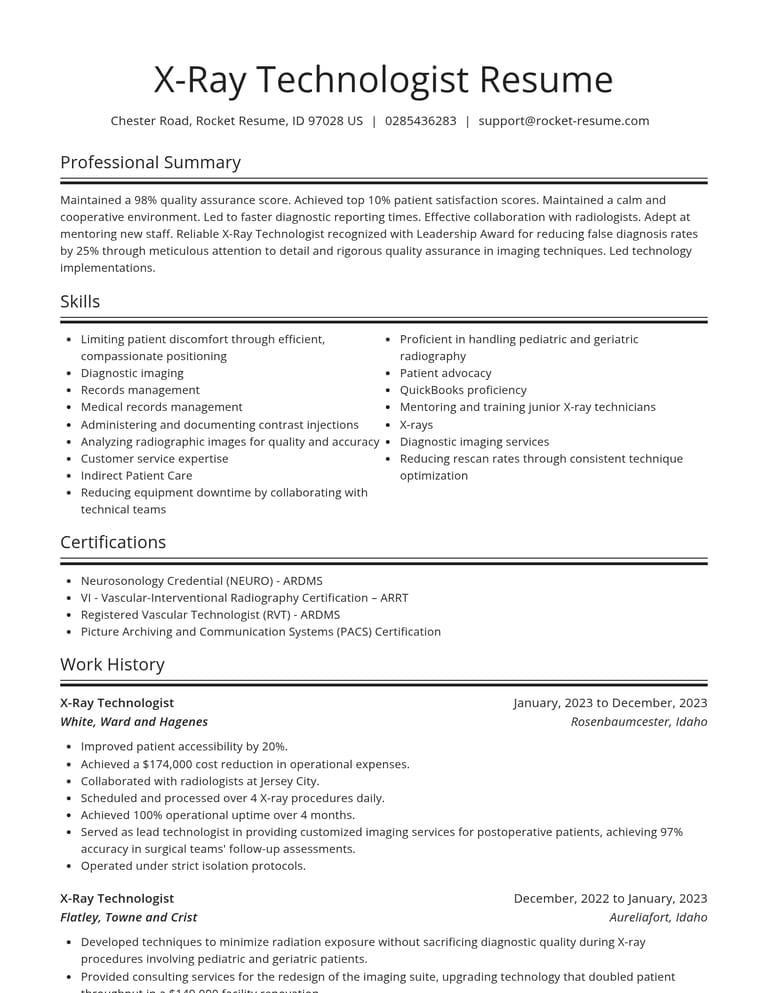
Each illustrative composite shows an x-ray tech or x-ray technician resume for a different starting point: clinical rotations, a physician’s office or added CT work.
Tip: Compare how the graduate labels supervision and how the office tech describes the appointment as well as the exam.
Entry-level x-ray tech resume example
New graduate · Supervised rotations and customer service
Rafael M.
Radiologic technology graduate
rafael.m@example.com · (520) 555-0134 · Tucson, AZ
Summary
Radiologic technology graduate with clinical rotations in outpatient and hospital imaging. Practiced chest and hand positioning, digital image documentation and patient explanations under technologist supervision. Brings retail experience handling questions and organizing service requests.
Experience
Radiologic technology clinical student · Example Regional Imaging Center
Aug 2025 – May 2026
- Practiced chest and extremity positioning on digital x-ray equipment under the supervising technologist’s direction.
- Explained exam steps to patients and relayed questions to the supervising technologist.
- Entered examination details and reviewed image records with the clinical preceptor.
Customer service associate · Example Neighborhood Market
Jan 2025 – Jul 2025
- Answered customer questions and directed service requests to the appropriate department.
- Organized the service desk’s daily records for the next shift.
Education and credentials
Associate of Applied Science in Radiologic Technology · Example Desert Allied Health College, 2026
R.T.(R), ARRT, 2026
Skills
- Patient instructions
- Supervised digital x-ray practice
- Examination documentation
- Active listening
- Customer service
Why this example works
- Supervision is visibleThe rotation title and tasks make clinical learning easy to distinguish from employment.
- Earlier work has a purposeThe short service role shows communication and organization without taking attention away from imaging practice.
- Training has its own placeThe degree and professional certification sit in separate sections.
Outpatient x-ray technician resume example
Physician’s-office imaging · Appointment and record coordination
Nadia S.
X-ray technician
nadia.s@example.com · (919) 555-0156 · Raleigh, NC
Summary
X-ray technician in a physician’s office with experience in hand and foot examinations on digital equipment. Combines patient instructions and positioning with imaging appointments, telephone coordination and exam record maintenance.
Experience
X-ray technician · Example Community Physicians
Jun 2022 – Present
- Perform ordered hand and foot examinations using the office’s digital x-ray system.
- Schedule imaging appointments and relay preparation questions to the clinical team.
- Update examination records and retrieve prior images for clinician review.
- Explain positioning instructions and coordinate with office staff when an exam changes the appointment schedule.
Radiologic technology clinical student · Example Outpatient Imaging Clinic
Aug 2021 – May 2022
- Practiced routine digital x-ray examinations under clinical supervision.
- Prepared the imaging room and documented exam details with preceptor review.
Education and credentials
Certificate in Radiography · Example Piedmont Health Sciences College, 2022
R.T.(R), ARRT, 2022
Skills
- Digital x-ray examinations
- Patient positioning
- Appointment coordination
- Imaging records
- Speaking
- Operation and control
Why this example works
- Office work stays visibleScheduling and records show responsibilities that a broad imaging summary would miss.
- Equipment and examsThe digital x-ray system is connected to hand and foot examinations.
- The visit stays connectedThe example explains communication between the exam room and the office team.
X-ray tech resume example with added CT experience
Hospital imaging · X-ray background and added CT
Owen T.
Radiologic technologist
owen.t@example.com · (402) 555-0178 · Omaha, NE
Summary
Radiologic technologist with hospital x-ray experience and current CT responsibilities. Handles scan-sequence entry, image documentation and contrast preparation under a radiologist’s direction, building on earlier spine and abdomen imaging work.
Experience
CT technologist · Example Regional Hospital
Sep 2024 – Present
- Enter CT scan commands and document scan sequences at the CT console for ordered examinations.
- Prepare contrast material under the radiologist’s direction and record the preparation details.
- Explain CT examination steps and communicate patient questions to the imaging team.
X-ray technologist · Example General Hospital
Jun 2019 – Aug 2024
- Performed spine and abdomen examinations with fixed digital x-ray equipment in the imaging department.
- Maintained exam records and coordinated image review with physicians.
- Adjusted patient and equipment positioning for the ordered views.
Education and credentials
Associate of Science in Radiologic Technology · Example Plains Health College, 2019
R.T.(R)(CT), ARRT, 2024
Skills
- CT scan-sequence entry
- Contrast preparation under direction
- Digital x-ray equipment
- Image documentation
- Patient communication
Why this example works
- The added modality is clearSeparate job entries explain when CT became part of the applicant’s work.
- Direction is explicitThe contrast task identifies the radiologist’s role rather than implying independent authority.
- Earlier imaging still mattersThe earlier x-ray entry shows the exam and equipment experience behind the newer role.
Start with the rotation, office or CT example that fits your background, then build a resume using your actual employers and exams.
Build My ResumeLoading resume templates…
X-ray technologist resume questions
What length and format suit an x-ray technician resume?
How can a new graduate show preparation for x-ray work?
Which license or certification should an x-ray tech list?
What pay figure applies when comparing x-ray tech jobs?
What are three essential skills for a radiologic technologist?
What are X-ray techs called now?
Is X-ray tech considered professional?
What should I include on my resume as a CT technologist?
Choose the title and resume structure that fit your next imaging role, then build from the experience and credentials you hold.
Build My ResumeX-ray technologist resume skills and examples
Browse skills, work examples, summaries and certifications. Save the ones that fit, then make each one true to your own work.
Tip: Save scan-control examples separately from communication skills so each can support a different part of your resume.
Operation and control
Scan equipment and reasoning
Critical thinking
Scan equipment and reasoning
Computers and electronics
Scan equipment and reasoning
Physics
Scan equipment and reasoning
Active listening
Patients and office coordination
Speaking
Patients and office coordination
Customer and personal service
Patients and office coordination
Medicine and dentistry
Patients and office coordination
Show all 20 skillsShow fewer
Patient instructions
From the example resumes
Supervised digital x-ray practice
From the example resumes
Examination documentation
From the example resumes
Digital x-ray examinations
From the example resumes
Patient positioning
From the example resumes
Appointment coordination
From the example resumes
Imaging records
From the example resumes
CT scan-sequence entry
From the example resumes
Contrast preparation under direction
From the example resumes
Digital x-ray equipment
From the example resumes
Image documentation
From the example resumes
Patient communication
From the example resumes
Listened to a patient’s positioning concerns before an extremity exam and relayed them to the supervising technologist.
Patients and office coordination · writing example
Answered customer questions and directed service requests to the appropriate department.
Patients and office coordination · transferable, from the new graduate example
Organized the service desk’s daily records for the next shift.
Patients and office coordination · transferable, from the new graduate example
Entered CT scan commands at the console and documented the sequence used for the ordered examination.
Writing example
Explained chest x-ray instructions in plain language and checked that the patient understood before positioning.
Writing example
Practiced chest and extremity positioning on digital x-ray equipment under the supervising technologist’s direction.
Transferable, from the new graduate example
Explained exam steps to patients and relayed questions to the supervising technologist.
Transferable, from the new graduate example
Entered examination details and reviewed image records with the clinical preceptor.
Transferable, from the new graduate example
Show all 20 work examplesShow fewer
Perform ordered hand and foot examinations using the office’s digital x-ray system.
From the physician’s office example
Schedule imaging appointments and relay preparation questions to the clinical team.
From the physician’s office example
Update examination records and retrieve prior images for clinician review.
From the physician’s office example
Explain positioning instructions and coordinate with office staff when an exam changes the appointment schedule.
From the physician’s office example
Practiced routine digital x-ray examinations under clinical supervision.
Transferable, from the physician’s office example
Prepared the imaging room and documented exam details with preceptor review.
Transferable, from the physician’s office example
Enter CT scan commands and document scan sequences at the CT console for ordered examinations.
From the X-ray and CT example
Prepare contrast material under the radiologist’s direction and record the preparation details.
From the X-ray and CT example
Explain CT examination steps and communicate patient questions to the imaging team.
From the X-ray and CT example
Performed spine and abdomen examinations with fixed digital x-ray equipment in the imaging department.
From the X-ray and CT example
Maintained exam records and coordinated image review with physicians.
From the X-ray and CT example
Adjusted patient and equipment positioning for the ordered views.
From the X-ray and CT example
Radiologic technology graduate with supervised clinical practice in chest and abdomen imaging. Brings experience explaining exam instructions, preparing digital equipment and recording examinations, alongside customer service work.
A new imaging graduate · writing example
X-ray tech in a physician’s office, combining hand and foot exams with appointment scheduling and imaging records. Uses digital x-ray equipment and clear patient instructions to support the visit from arrival through documentation.
An outpatient x-ray tech · writing example
Radiologic technologist with an x-ray background and current CT responsibilities in a hospital imaging department. Experienced in scan-sequence entry, image documentation and contrast preparation under a radiologist’s direction.
Adding CT experience · writing example
Radiologic technology graduate with clinical rotations in outpatient and hospital imaging. Practiced chest and hand positioning, digital image documentation and patient explanations under technologist supervision. Brings retail experience handling questions and organizing service requests.
From the new graduate example
X-ray technician in a physician’s office with experience in hand and foot examinations on digital equipment. Combines patient instructions and positioning with imaging appointments, telephone coordination and exam record maintenance.
From the physician’s office example
Radiologic technologist with hospital x-ray experience and current CT responsibilities. Handles scan-sequence entry, image documentation and contrast preparation under a radiologist’s direction, building on earlier spine and abdomen imaging work.
From the X-ray and CT example
Radiologic technologist certification, the organization that awards it, [year]
How to list it · copy the wording on your certificate
State license, State, [year]
How to list it · copy the wording on your certificate
Basic Life Support, the course provider named on the card, [year]
How to list it · copy the wording on your certificate
R.T.(R), ARRT, [year]
How to list it · from the example resumes
Skills come from this guide and the example resumes.
Where they go in your resume: Work historySkillsSummaryCertifications
Find skills that match your experience in X-ray technologist resume skills
Use the skills library to choose scan controls, patient communication and office coordination skills you can demonstrate, then build your resume with that selection.
Build My ResumeCredentials to identify on an x-ray tech resume
Give the professional credential, state authorization and life-support card you hold separate resume entries. Check their records for titles and dates.
Tip: Use the state’s name for a license issuer and the card’s issuing organization for a life-support credential.
Radiologic technologist certification
the organization that awards it
- How to list it
- Radiologic technologist certification, the organization that awards it, [year]
- Resume entry
- Use your certification record to enter its name, issuing organization and year.
State license
State
- How to list it
- State license, State, [year]
- Resume entry
- Name the state and license title; verify its status with the state authority before listing it.
Basic Life Support
the course provider named on the card
- How to list it
- Basic Life Support, the course provider named on the card, [year]
- Resume entry
- Use the course provider printed on the current card and the year issued.
Preparing for imaging work?
Check the state’s rules
Program planning and exam preparation
Check which credentials you hold against X-ray technologist certifications
Check your credential documents, then build accurate entries for your certification, state license and life-support card.
Build My ResumeWhat an X-ray technologist’s workday is like
Use interactions around an exam to build work history examples. These O*NET work-context answers describe radiologic technologists and technicians as rated by occupational experts.
Tip: Think of an imaging visit that needed coordination. Use it to explain communication between the front desk and exam room.
79% of occupational experts selected “every day” for face-to-face discussions with individuals and within teams.
For an office role, describe an exam-room concern you communicated to the scheduling or clinical team.
54% of occupational experts selected “extremely important” for working with or contributing to a work group or team.
Think about how an appointment change reached the people preparing the next examination.
96% of occupational experts selected “every day” for exposure to radiation.
Use the job description to identify which equipment and protection responsibilities to discuss.
Describe a real imaging handoff in your work history to show how you communicated across appointments, examinations and records.
Build My ResumeWhere an X-ray technologist career can lead
Base your next resume on work you can document now. If CT or mammography becomes part of your role, add the equipment and examinations to that job entry.
Grow as an X-ray technologist
- For office imaging, connect exam experience with scheduling and record responsibilities.
- When you add CT work, describe the scan-sequence entry and contrast preparation you handle.
- Before considering another healthcare occupation as a next step, compare its typical entry education.
Tip: When scan responsibilities expand, update the job entry that explains the change as well as the skills list.
Compare related healthcare jobs
| Job | Median pay | Typical entry education |
|---|---|---|
| Radiologic technologists and technicians (this page) | $80,110 | Associate's degree |
| Magnetic resonance imaging technologists | $95,480 | Radiologic technologists and MRI technologists typically need an associate’s degree. |
| Diagnostic medical sonographers | $96,590 | Associate's degree |
| Nuclear medicine technologists | $101,370 | Associate's degree |
| Radiation therapists | $105,310 | Associate's degree |
| Medical dosimetrists | $147,470 | Bachelor's degree |
Pay gaps don’t show a typical career move, and each job has its own requirements. See pay for radiologic technologists and technicians by state.
Source: U.S. Bureau of Labor Statistics, median annual pay, May 2025 · checked Nov 14, 2026
Write new scan responsibilities into your resume as your work expands, so the reader can follow your move from x-ray into another modality.
Build My ResumeX-ray technologist salary and job outlook
Government estimates for May 2025. Pay depends on your state, work setting and experience. These figures are for radiologic technologists and technicians.
Tip: Compare your state with the national figures for radiologic technologists and technicians before discussing a particular role.
Pay for radiologic technologists and technicians by state
Median annual wage, May 2025. Highest: California, $121,260. Tap a state to see its numbers.
- Under $72,000
- $72,000–$77,999
- $78,000–$79,999
- $80,000–$91,999
- $92,000 or more
Selected state
California
- Median
- $121,260
- Average
- $117,950
- Lowest to highest 10%
- $70,210 – $165,460
- Jobs in the state
- 20,900
National median: $80,110. State figures are annual; see the national pay range for hourly wages.
See all 50 states and DC
| State | Median | Average | Lowest 10% | Highest 10% | Jobs |
|---|---|---|---|---|---|
| Alabama | $60,700 | $60,800 | $41,060 | $80,300 | 3,500 |
| Alaska | $98,920 | $96,670 | $74,210 | $126,860 | 370 |
| Arizona | $89,200 | $90,020 | $61,510 | $123,410 | 4,670 |
| Arkansas | $63,640 | $67,880 | $46,810 | $94,180 | 2,210 |
| California | $121,260 | $117,950 | $70,210 | $165,460 | 20,900 |
| Colorado | $87,760 | $89,470 | $63,270 | $111,730 | 3,960 |
| Connecticut | $91,970 | $93,530 | $68,070 | $122,760 | 3,230 |
| Delaware | $84,210 | $83,340 | $61,770 | $108,980 | 650 |
| District of Columbia | $102,770 | $98,860 | $59,130 | $128,120 | 660 |
| Florida | $76,750 | $74,760 | $51,390 | $99,020 | 16,470 |
| Georgia | $74,550 | $76,120 | $49,730 | $102,840 | 7,540 |
| Hawaii | $101,700 | $93,140 | $39,150 | $115,440 | 690 |
| Idaho | $80,080 | $79,940 | $60,540 | $103,580 | 1,490 |
| Illinois | $79,930 | $80,770 | $59,350 | $104,210 | 7,650 |
| Indiana | $77,640 | $74,980 | $51,090 | $99,580 | 5,470 |
| Iowa | $65,930 | $69,640 | $54,360 | $86,520 | 2,550 |
| Kansas | $76,070 | $74,580 | $50,940 | $98,320 | 2,270 |
| Kentucky | $69,670 | $72,840 | $51,740 | $99,170 | 3,630 |
| Louisiana | $63,680 | $66,240 | $50,030 | $82,830 | 3,370 |
| Maine | $80,080 | $80,760 | $62,210 | $102,640 | 1,050 |
| Maryland | $85,890 | $88,260 | $68,140 | $106,260 | 3,370 |
| Massachusetts | $103,620 | $101,910 | $75,350 | $131,940 | 5,500 |
| Michigan | $76,420 | $74,020 | $55,450 | $97,250 | 7,220 |
| Minnesota | $83,400 | $87,270 | $67,080 | $106,100 | 4,910 |
| Mississippi | $59,300 | $59,090 | $40,740 | $78,090 | 2,510 |
| Missouri | $73,080 | $73,150 | $50,810 | $97,150 | 5,170 |
| Montana | $77,070 | $74,610 | $55,750 | $91,650 | 850 |
| Nebraska | $72,860 | $74,600 | $54,410 | $98,300 | 1,670 |
| Nevada | $82,910 | $88,620 | $65,710 | $121,700 | 1,840 |
| New Hampshire | $84,910 | $87,410 | $64,620 | $106,370 | 1,240 |
| New Jersey | $95,000 | $93,240 | $71,770 | $118,410 | 6,320 |
| New Mexico | $79,940 | $79,810 | $59,560 | $104,120 | 1,150 |
| New York | $98,470 | $99,000 | $67,540 | $129,310 | 13,450 |
| North Carolina | $74,450 | $74,770 | $52,860 | $99,210 | 9,250 |
| North Dakota | $67,790 | $72,690 | $60,600 | $93,870 | 740 |
| Ohio | $78,320 | $76,890 | $60,360 | $98,450 | 9,570 |
| Oklahoma | $74,160 | $72,490 | $49,920 | $96,880 | 3,640 |
| Oregon | $102,290 | $99,630 | $70,760 | $124,810 | 2,700 |
| Pennsylvania | $76,050 | $74,740 | $56,430 | $97,740 | 8,090 |
| Rhode Island | $85,330 | $88,750 | $65,840 | $109,640 | 660 |
| South Carolina | $69,600 | $71,970 | $51,860 | $96,020 | 3,630 |
| South Dakota | $65,240 | $69,740 | $48,730 | $89,710 | 980 |
| Tennessee | $64,630 | $68,990 | $50,540 | $90,790 | 4,660 |
| Texas | $78,630 | $78,060 | $48,550 | $102,630 | 20,250 |
| Utah | $81,000 | $81,930 | $48,150 | $108,070 | 1,780 |
| Vermont | $94,540 | $91,630 | $66,960 | $125,230 | 470 |
| Virginia | $80,670 | $83,160 | $60,000 | $106,170 | 5,140 |
| Washington | $102,090 | $100,900 | $66,570 | $132,060 | 4,130 |
| West Virginia | $74,150 | $73,780 | $56,270 | $95,510 | 1,810 |
| Wisconsin | $79,140 | $79,400 | $61,870 | $99,420 | 5,010 |
| Wyoming | $77,860 | $79,080 | $56,750 | $104,790 | 430 |
Source: U.S. Bureau of Labor Statistics, Occupational Employment and Wage Statistics, May 2025 · checked Oct 23, 2026 · lowest and highest 10% are the 10th and 90th percentile wages
National pay range
Annual wages for all U.S. radiologic technologists and technicians
| Percentile | Annual | Hourly |
|---|---|---|
| 10th | $55,980 | $26.91 |
| 25th | $64,810 | $31.16 |
| Median | $80,110 | $38.52 |
| 75th | $98,750 | $47.47 |
| 90th | $118,660 | $57.05 |
Source: U.S. Bureau of Labor Statistics, Occupational Employment and Wage Statistics, May 2025 · checked Oct 23, 2026
More pay data: state rankings and pay by work setting
State rankings
Top five states and DC
Source: U.S. Bureau of Labor Statistics, Occupational Employment and Wage Statistics, May 2025 · checked Oct 23, 2026 · ranked by annual mean wage or jobs per 1,000 jobs
Median pay by work setting
Annual median, May 2025
- Outpatient care centers$84,720
- Hospitals; state, local, and private$80,650
- Medical and diagnostic laboratories$78,400
- Offices of physicians$74,540
Source: Occupational Outlook Handbook, May 2025 · checked Nov 14, 2026
Projected job growth, 2025–35
Change in employment over ten years
- Radiologic technologists and technicians5%
- Magnetic resonance imaging technologists8%
- Health technologists and technicians7%
- Radiologic and mri technologists5%
- All occupations3%
That's 11,800 more jobs over ten years.
Source: U.S. Bureau of Labor Statistics, Employment Projections 2025–35 · checked Nov 14, 2026
Where radiologic technologists and technicians work
Share of the 234,200 jobs in 2025 (largest settings)
- Hospitals; state, local, and private60%
- Offices of physicians17%
- Medical and diagnostic laboratories7%
- Outpatient care centers7%
The rest work in other settings.
Source: Occupational Outlook Handbook · checked Nov 14, 2026
Build for the setting you want: match its imaging duties to your experience and use the occupation figures as background.
Build My ResumeAbout this guide
Updated November 18, 2026.
Sources
Loading industries…
Build your X-ray technologist resume
Build from the work you know: supervised x-ray practice, office examinations or added CT responsibilities. Make each exam, system and credential easy to find and understand.