Medical laboratory technician resume examples, templates and tips
Build an MLT resume that shows your bench experience. Use examples and tips to explain analyzer work, quality control and training at the technician level.
- Show bench skills clearly
- Write a focused MLT summary
- Separate training from work
- Make credentials easy to find

What medical laboratory technician hiring managers look for
- Chemical analyses of body fluids with a microscope or automatic analyzer.
- Quality-control analyses to check the accuracy of test results.
- Equipment setup, calibration, maintenance and cleaning.
- Checking findings against specifications.
- Examination of dye-stained cells and consultation with a pathologist when abnormalities are found.
- Preparation of standard volumetric solutions and reagents.
How to write a medical laboratory technician resume
“Ran tests” leaves out what you know. Name the instrument, the analysis and the checks you performed so a lab can see your technician experience. This guide starts with six questions to answer first, then walks through each part of your resume with tips and links to the examples, templates and data on this page.
Six questions to answer first
- What belongs on an MLT resume?
Step 1 identifies the bench work worth describing.
- How can I write an MLT resume with no experience?
Step 3 gives a section order for a resume with no paid lab work yet.
- Which medical laboratory technician duties should I list?
Step 5 turns a testing duty into a concrete work example.
- Which skills should an MLT resume highlight?
Step 7 connects bench skills to the work that demonstrates them.
- What should an MLT summary or objective say?
Step 8 gives the opening a clear laboratory focus.
- How should I list MLT certification on a resume?
Step 9 places the credential with its issuer and year.
What a medical laboratory technician does
According to the Occupational Outlook Handbook from the U.S. Bureau of Labor Statistics, a medical laboratory technician (MLT) performs routine tests that may be more automated, while technologists perform more complex tests. Technicians usually work under the general supervision of technologists or laboratory managers. Technologists carry more overall quality-assurance responsibility.
The U.S. Bureau of Labor Statistics reported a national median annual wage of $62,930 for clinical laboratory technologists and technicians in May 2025.
The handbook projects employment of clinical laboratory technologists and technicians to grow 3% from 2025 to 2035. For your resume, describe the body-fluid analyses you ran with a microscope or automatic analyzer and how you entered findings in the computer.
See also: Compare MLT and technologist levels to describe MLT dutiesPay for clinical laboratory technologists and technicians by stateProjected job growth
Tip: Name the instruments you operate and the computer system or laboratory record where you enter analysis results in your role summary.
Write your medical laboratory technician resume in nine steps
Do the first two before you open the builder. The other seven follow the builder’s order.
Step 1 of 9
Before you open the builder
Job description: find the bench duties the lab needs
What belongs on an MLT resume?
Include your laboratory training, credentials and testing experience. Show which instruments you used and how you checked and recorded results.
Tip: Match the instrument to its purpose, such as an automatic analyzer used for chemical analyses of body fluids.
Make these easy to find
- Chemical analyses of body fluids with a microscope or automatic analyzer.
- Quality-control analyses to check the accuracy of test results.
- Equipment setup, calibration, maintenance and cleaning.
- Checking findings against specifications.
- Examination of dye-stained cells and consultation with a pathologist when abnormalities are found.
- Preparation of standard volumetric solutions and reagents.
- Transfusion tests and blood counts.
- Computer entry of findings from laboratory analyses.
O*NET OnLine: medical and clinical laboratory technicians, tasks adapted for resume writing.
Match each requirement in the job description
Here’s the step where you’ll show each one:
- Chemical testing step 5
- Quality control step 5
- Equipment upkeep step 7
- Microscopy step 5
- Education step 6
- Reagents step 7
- Computer recording step 5
- Certification or license step 9
Tip: Separate testing duties from credential requirements as you read. Both matter, but they belong in different resume sections.
See also: Skills and examplesMLT training, certification and licensingCompare MLT and technologist levels to describe MLT duties
Use the lab’s requirements to choose which testing tasks deserve space on your resume.
Build My Resume
Before you open the builder
Examples: read for the instrument and the check
Tip: Use the example’s structure without borrowing its sample counts, equipment totals or credentials.
Compare the recent graduate’s first hospital job, the hospital MLT’s six years of experience and the lead’s technician instruction. Choose the example closest to the work you can describe.
Use the closest example to build a resume around the instruments and checks you’ve actually used.
Build My ResumeIn the builder: experience level
How much experience do you have?
How can I write an MLT resume with no experience?
Start with your MLT program. Describe supervised instrument practice and quality-control checks, clearly labeled as training rather than employment.
Tip: Keep the title you held at each lab, even if your next role uses a different title.
Start from Build My Resume and it’s the builder’s first question. The examples below show three starting points: a recent graduate with about a year and a half of experience, a hospital MLT with about six years of experience and a lead MLT with about eleven years of experience.
Choose an order that fits
- No paid lab experience:
- Summary, Education, Skills, Work history, Certifications if applicable.
- Experienced hospital MLT:
- Summary, Work history, Skills, Certifications, Education.
- Lead MLT:
- Summary, Work history with instruction responsibilities, Certifications, Skills, Education.
The builder starts with a standard order, and you can move sections into the one you choose.
Give a recent job more detail when it shows the testing and equipment work the next lab needs.
See also: Resume examplesCompare MLT and technologist levels to describe MLT duties
Build your work history around each laboratory assignment. Keep supervised program practice clearly labeled as training.
Build My ResumeIn the builder
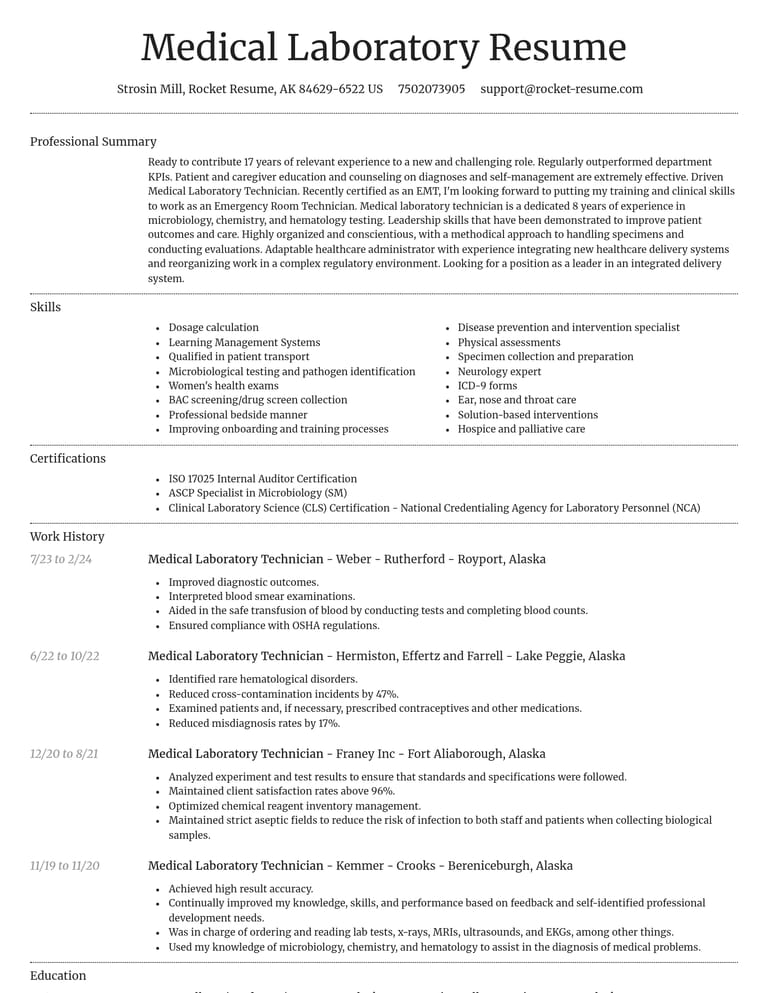
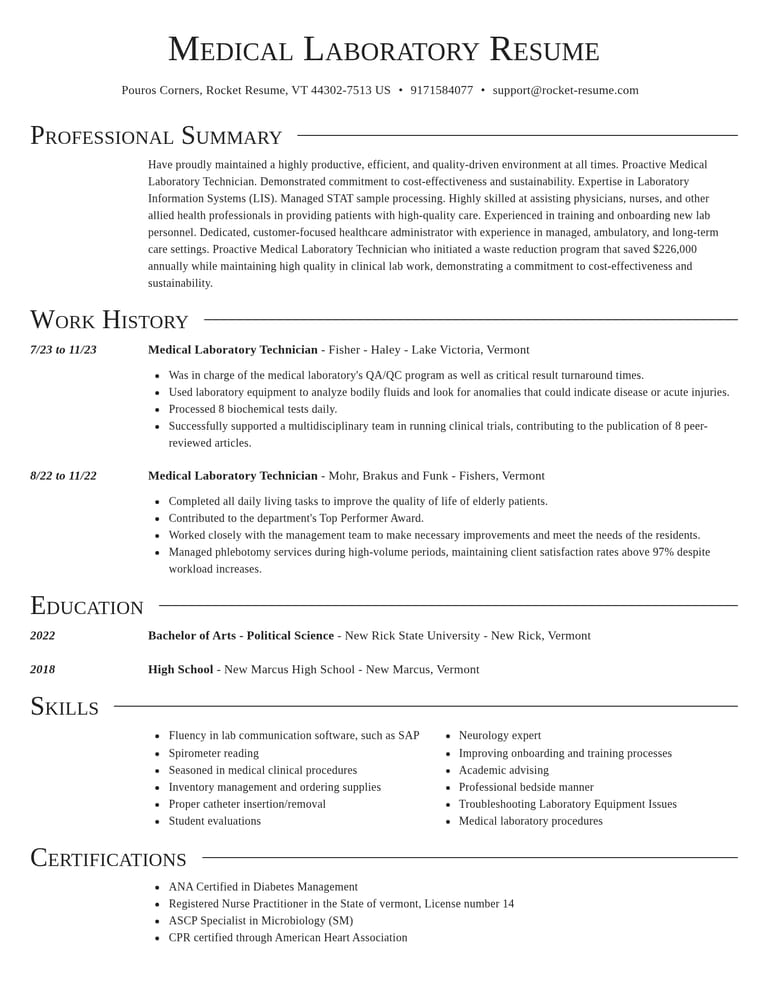
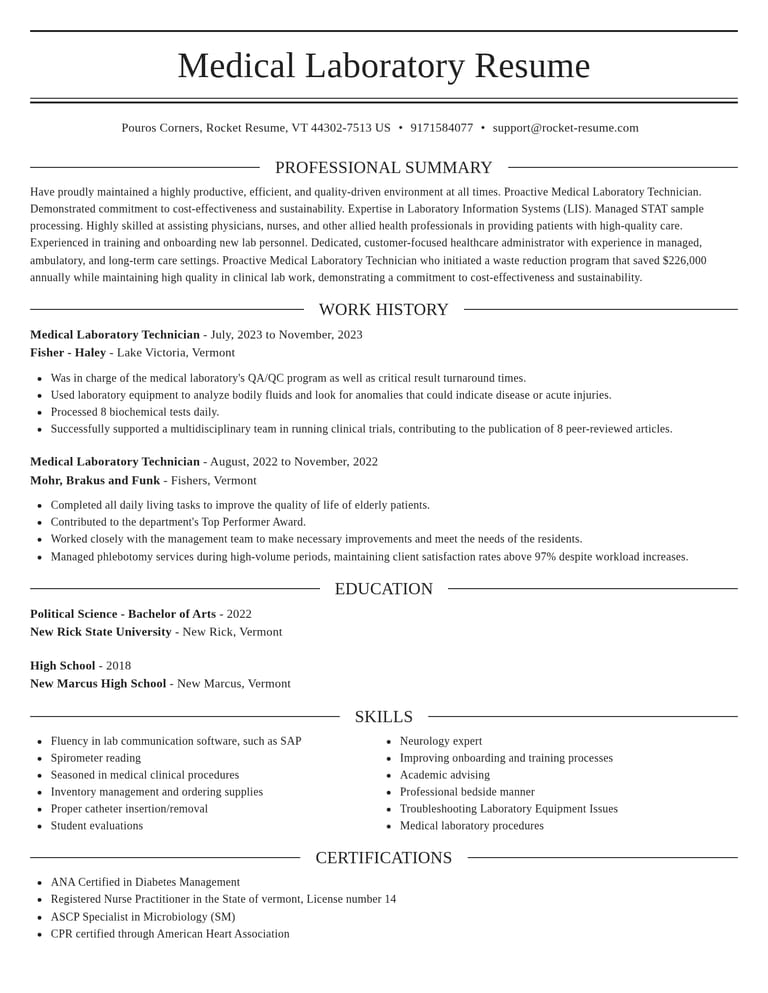
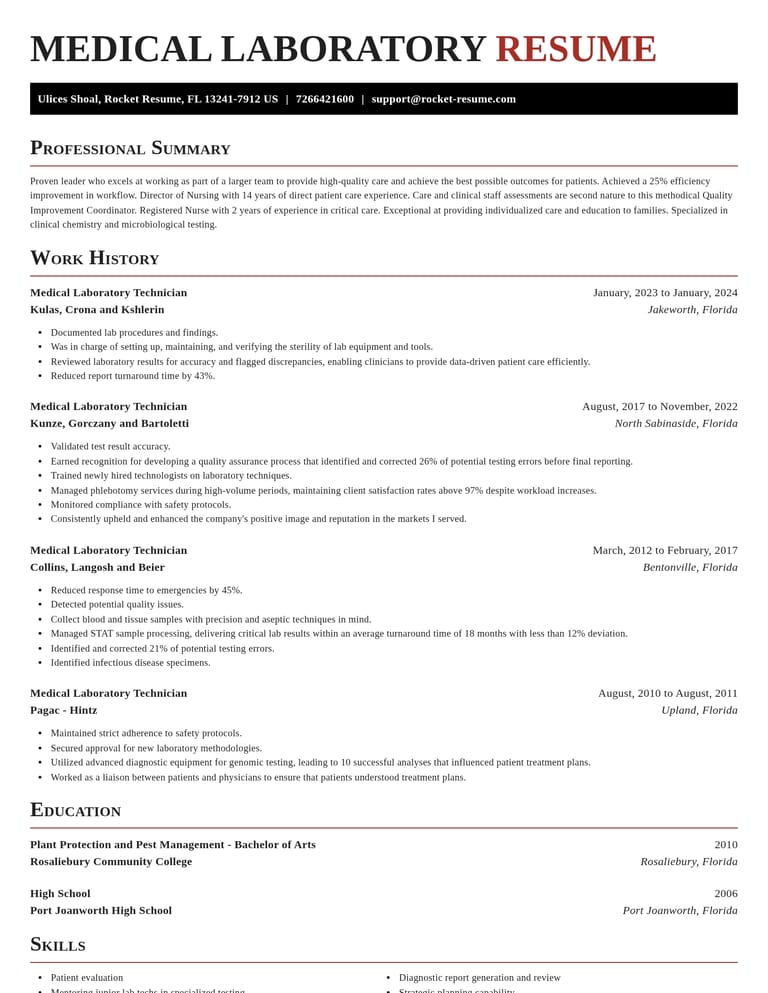
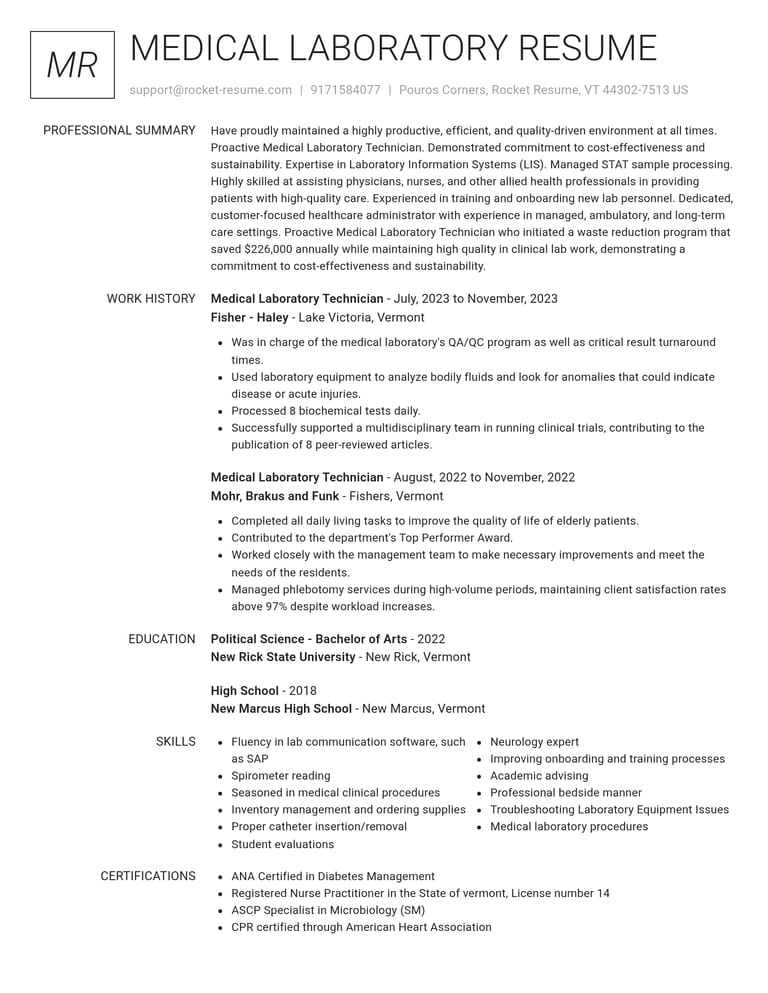
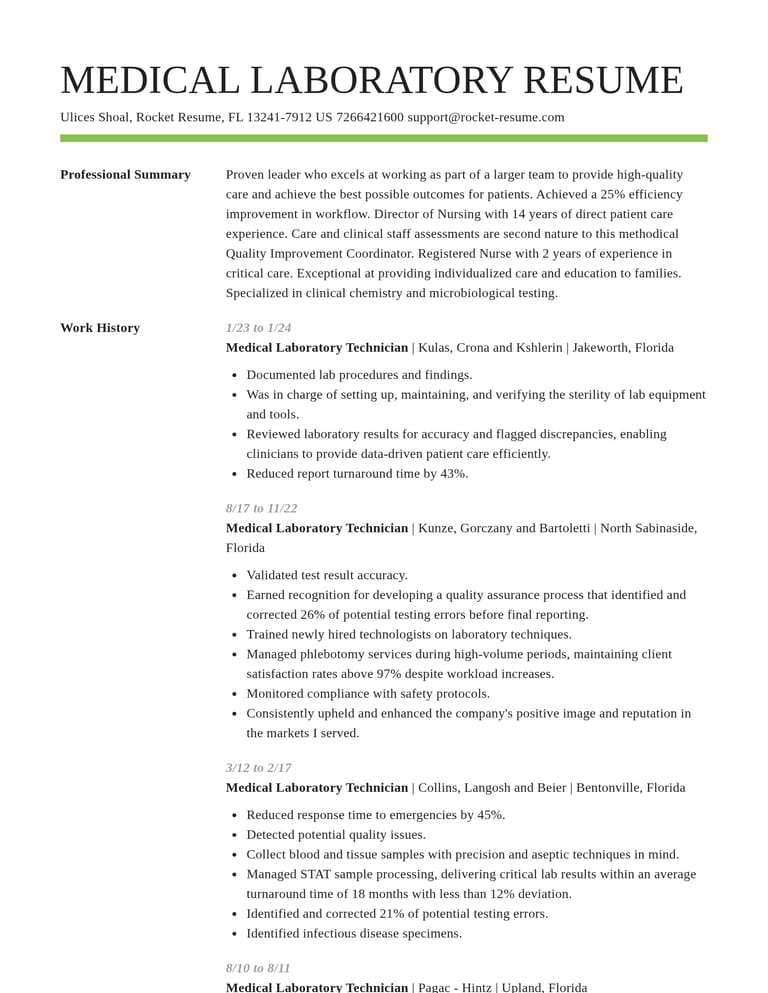
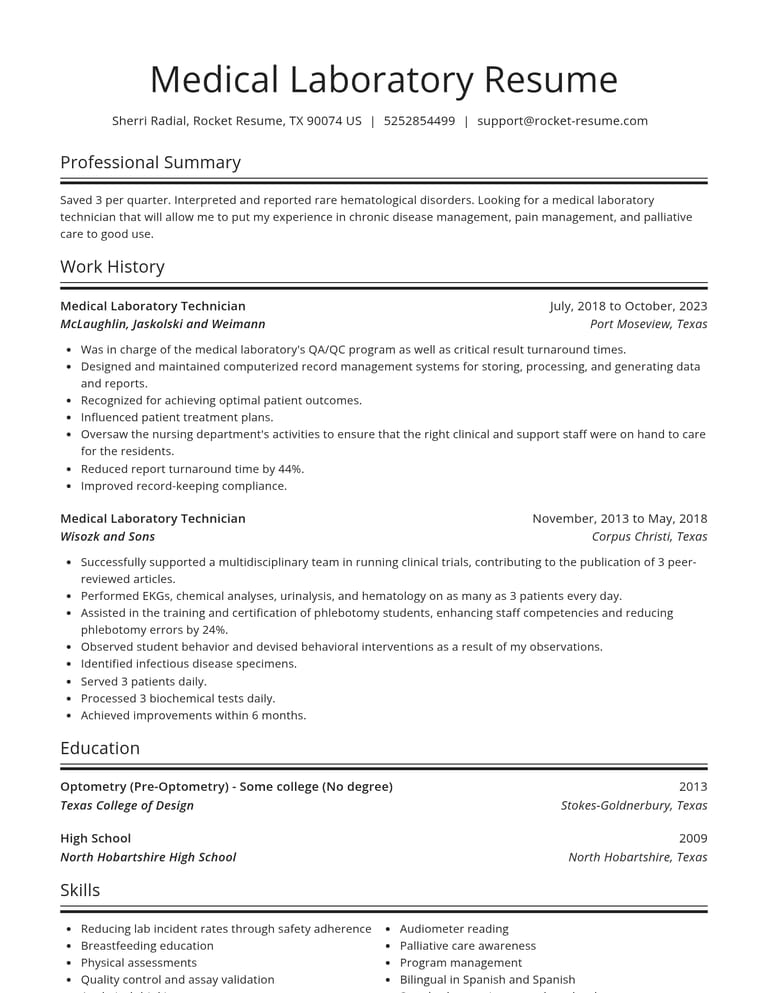
Template: leave room for lab work experience
Tip: Check how the design presents a long laboratory job title and its dates before you settle on it.
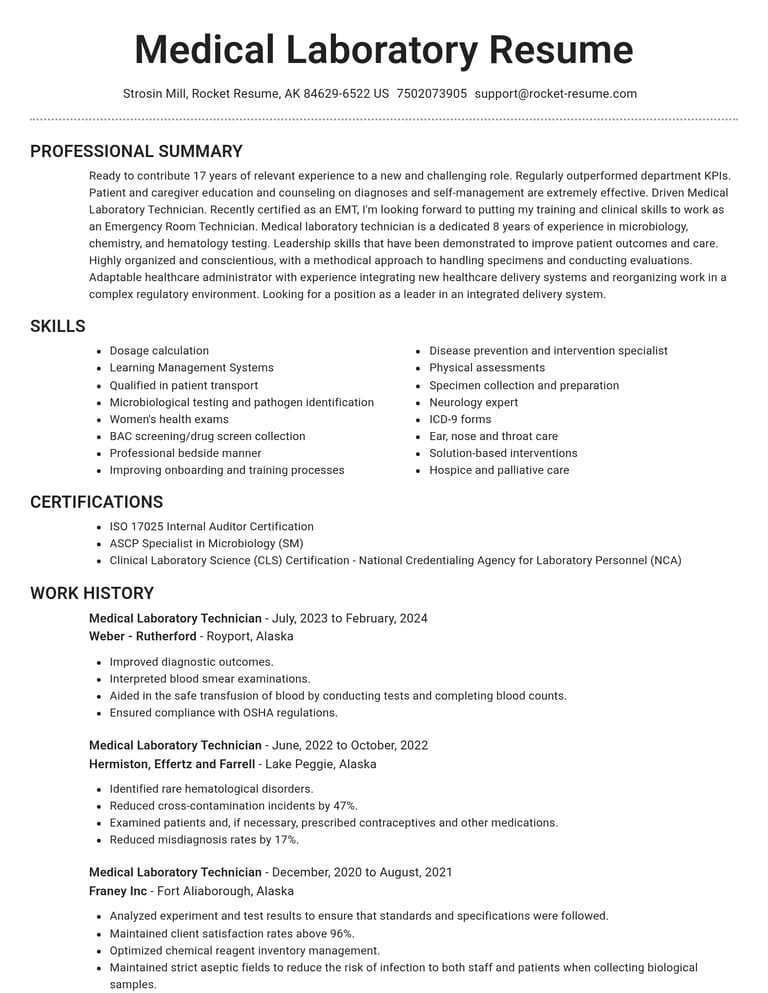
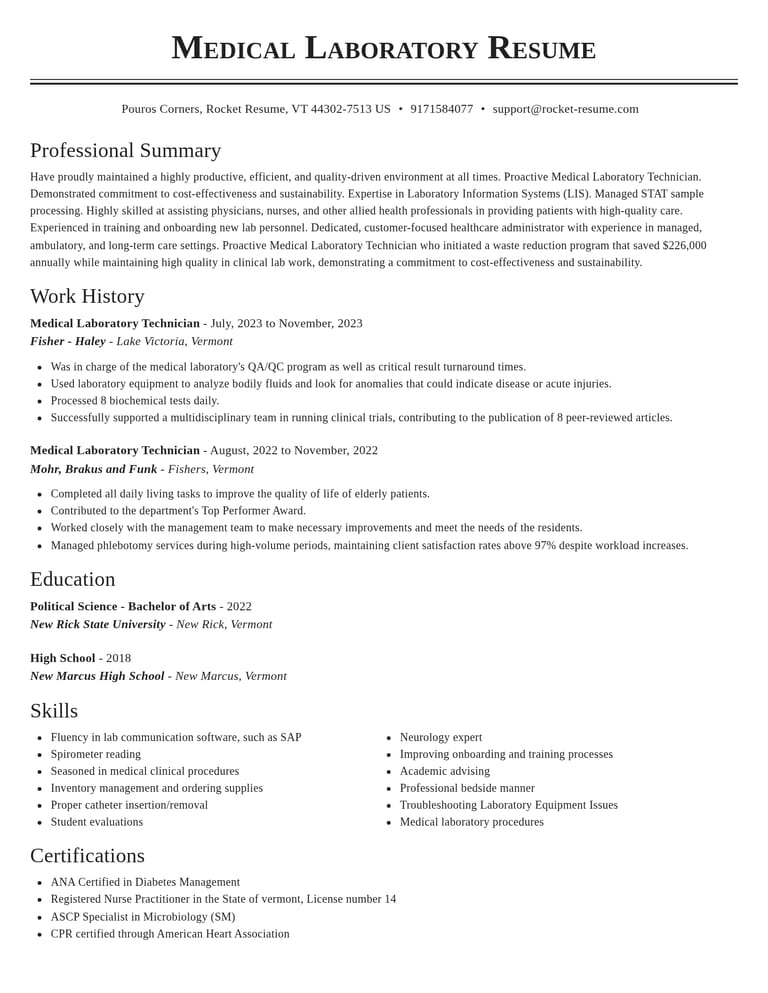
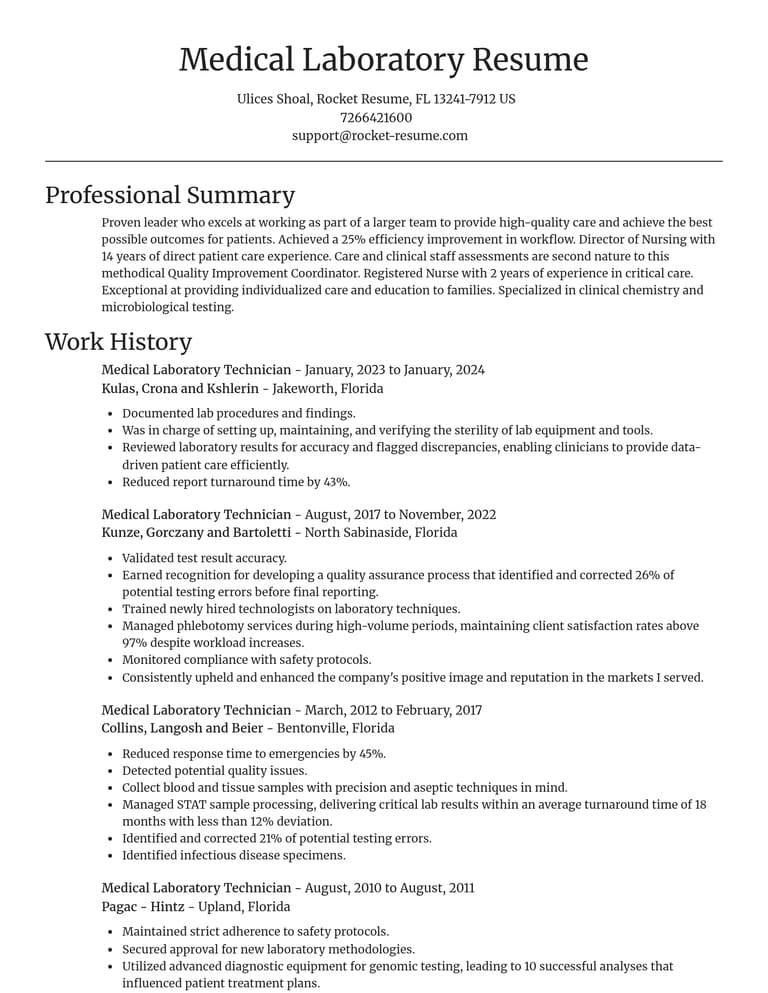
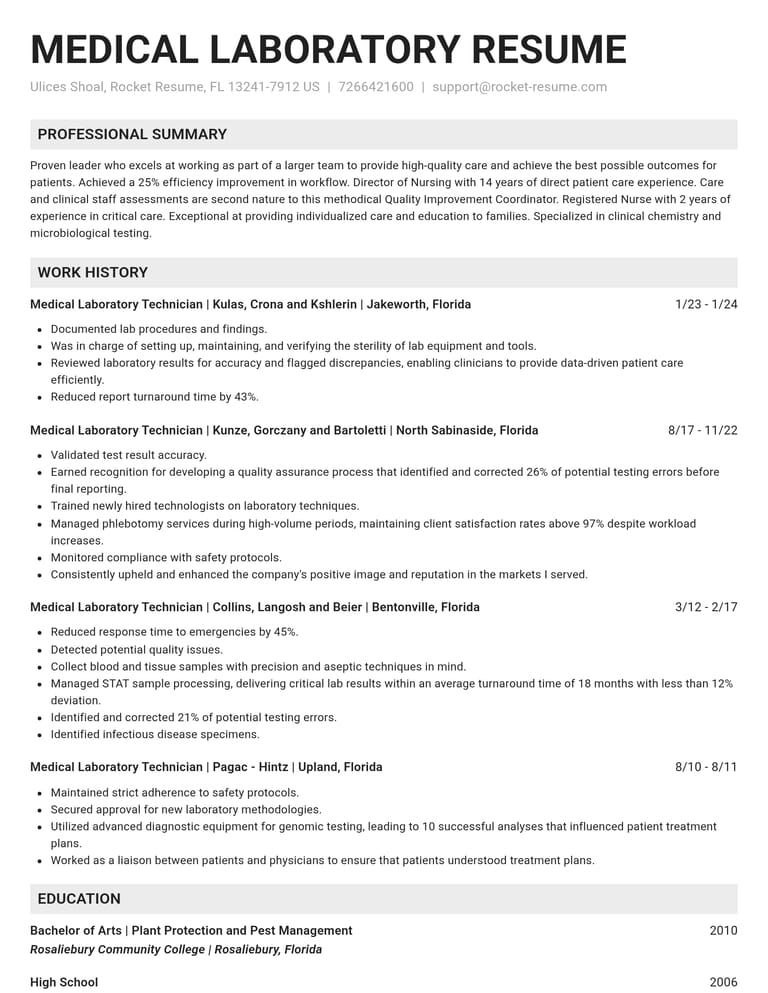
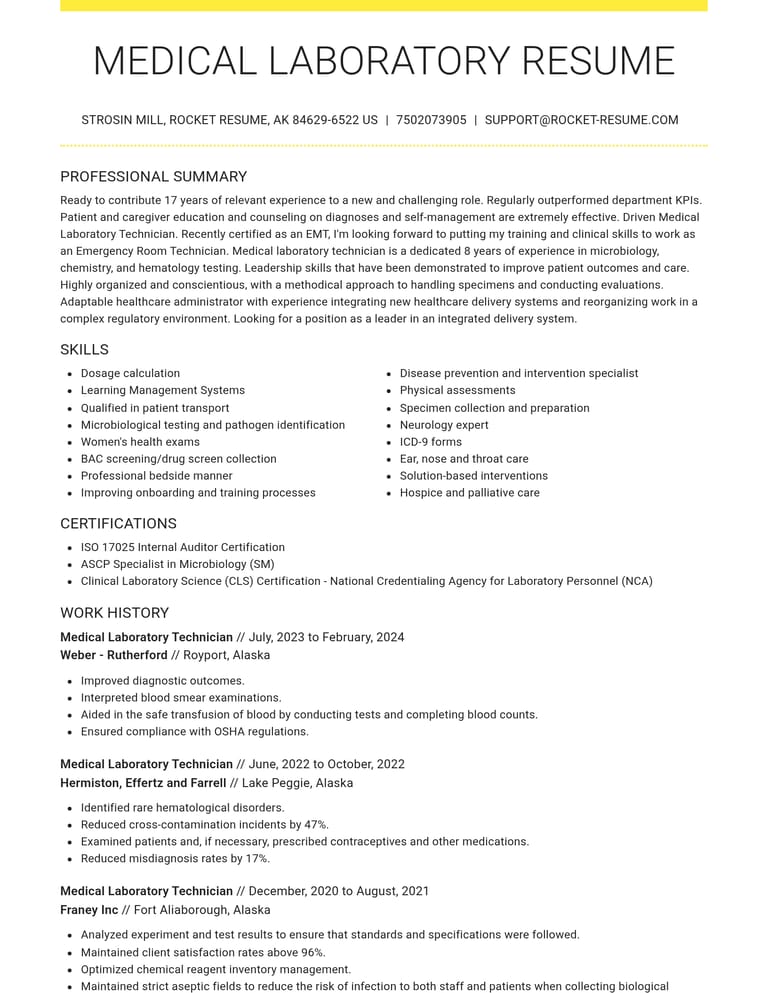
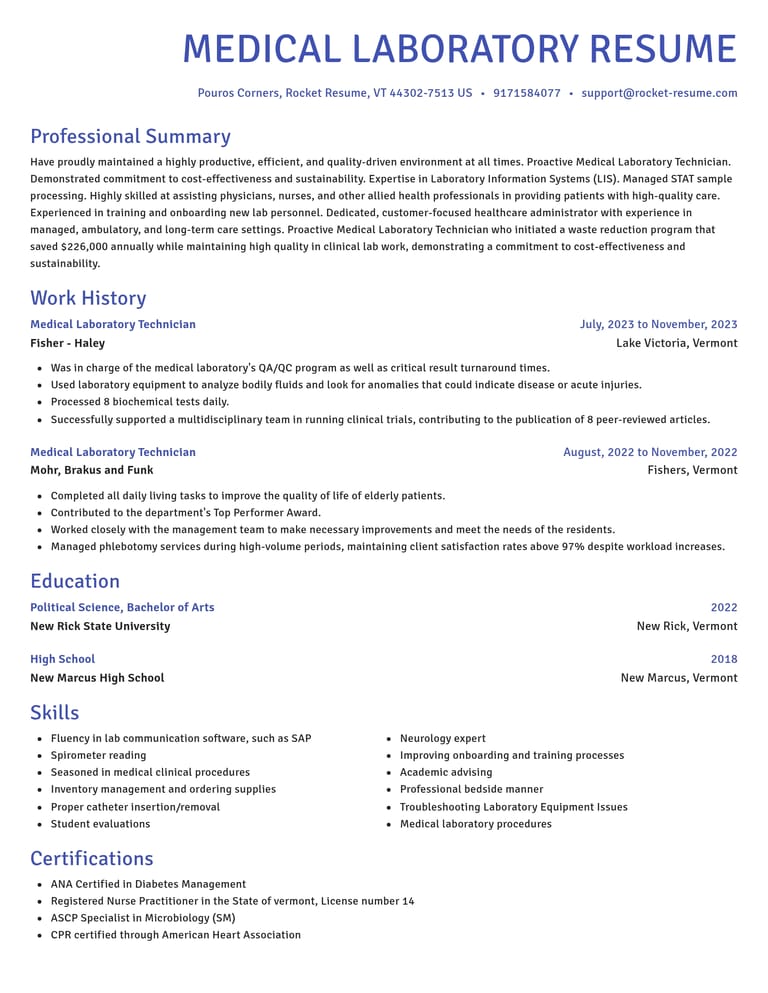
Look for clear job titles, dates and credential entries. Leave enough space under each hospital or laboratory job to explain the testing work without crowding your education.
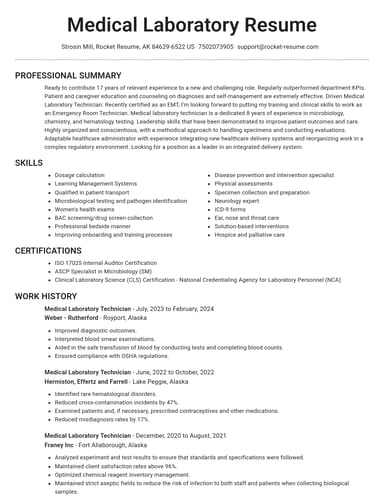
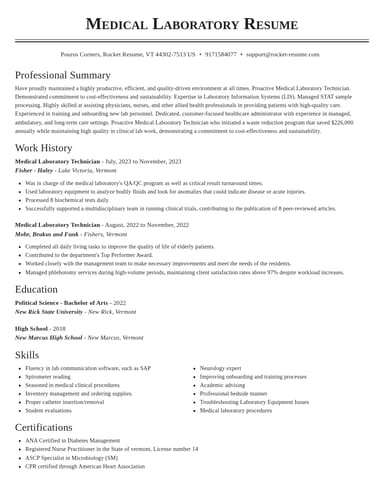
Choose a template with room for testing duties, instrument names and credentials that are easy to scan.
Build My ResumeIn the builder
Work history: replace “ran lab tests” with the actual work
Which medical laboratory technician duties should I list?
Choose duties that match the lab’s job description. For each, name the analysis, equipment and check you performed before recording findings.
Tip: Keep calibration and testing examples separate when they show different parts of your bench experience.
Use an action, an instrument and a check in your bullet points. If your lab has you obtain specimens and cultivate, isolate or identify microorganisms, describe that assignment. If you inoculate bacteriological media or collect blood or tissue samples from patients, include that work when it matches the job description.
If the job description asks for Show this on your resume Chemical testing The body fluid analyzed and the instrument you used. Quality control A run you checked and how you assessed its accuracy. Microscopy Dye-stained cells you examined and how you consulted on abnormalities. Computer recording The computer system or laboratory record in which you entered analysis results. Before
“Ran lab tests.”
After
“Performed chemical analyses of body fluids on an automatic analyzer, ran daily quality-control checks and compared results with specifications before entering findings in the computer.”
Keep patient identities out of work examples. Describe the testing task and its scope instead.
For ideas on showing your results, explore Medical laboratory technician accomplishments
See also: Skills and examplesResume examples
Write your work history with examples that connect the analysis, the equipment and the accuracy check.
Build My ResumeIn the builder
Education: record the degree or certificate accurately
Tip: Use the degree or certificate title printed by the school, then add a completion date or mark it as expected.
The Occupational Outlook Handbook says clinical laboratory technologists and technicians typically need a bachelor's degree to enter the occupation, while technicians sometimes qualify with an associate's degree. See the technician and technologist comparison. Clinical laboratory technicians typically complete an associate's degree program in clinical laboratory science. The Armed Forces and vocational or technical schools also may offer postsecondary certificate programs for medical laboratory technicians. Completion of an accredited education program is typically required to sit for a certification exam. Add this entry in the builder’s education section.
If the job description asks for Show this on your resume Education Program accreditation, if the job description asks for it. If your experience comes from a program, label the instrument practice as training and describe the supervision accurately.
See also: Compare MLT and technologist levels to describe MLT dutiesMLT training, certification and licensing
Build your education section around your laboratory program, completion status and relevant instrument practice.
Build My ResumeIn the builder
Skills: show the method behind each skill
Which skills should an MLT resume highlight?
Focus on methods you can explain: calibration, quality-control analysis, cell examination or transfusion testing. Support the most relevant skills with a work example.
Tip: Put the skills named in the job description first when your own testing experience supports them.
Pair an equipment skill with a task that demonstrates it. O*NET rates quality-control analyses as the highest-relevance task for medical and clinical laboratory technicians, so describe how you checked accuracy rather than leaving “quality control” unexplained.
If the job description asks for Show this on your resume Equipment upkeep Calibration and cleaning you performed on the equipment. Reagents Solutions you prepared using standardized formulas. Analyzers and chemical testing
- Automatic analyzer operation
- Chemical analyses of body fluids
- Microscope use
Quality control and calibration
- Quality-control analysis
- Equipment calibration
- Equipment cleaning and maintenance
A skill list helps a reader scan. A work example under a job shows what you did.
Skill
Equipment calibration
Work example
Calibrated and maintained 2 automatic analyzers and completed daily quality-control analyses before recording chemical test findings.
See also: Skills and examples
Choose the bench skills you can support with a specific testing or equipment example.
Build My ResumeIn the builder
Summary: write a summary or objective with a bench focus
What should an MLT summary or objective say?
Name your laboratory background and strongest testing skills. If you’re starting out, explain how your program practice prepares you for the MLT role.
Tip: Keep the opening to a few short sentences so the reader can reach your laboratory work quickly.
With laboratory employment, summarize the setting and testing work you know. If your program is your main experience, use an objective that connects that practice to the MLT role. Leave individual runs for work history.
Summary if you’re a new graduate
“MLT program graduate seeking a medical laboratory technician role, bringing practice in automatic analyzer testing, microscope use and daily quality-control checks.”
Summary if you’re an experienced hospital MLT
“MLT with about six years of hospital experience in chemical analyses and microscopic cell examination. Brings equipment calibration, daily quality-control checks and accurate laboratory data entry.”
Summary if you’re a lead MLT
“MLT with about eleven years in medical laboratories, including transfusion testing and blood counts. Combines quality-control analysis with experience instructing technicians and laboratory assistants.”
Shape your introduction with help from Medical laboratory technician summary examples
See also: Resume examplesSkills and examples
Write your summary after the rest of the resume, using your strongest laboratory experience to shape the opening.
Build My ResumeIn the builder
Certifications: put each credential in certifications
How should I list MLT certification on a resume?
List the credential’s exact title, certifying organization and year earned. Keep a state license separate, and identify any pending credential clearly.
Tip: Give a state license and a certification their own entries when you have both.
Use the optional certifications section after the summary to list earned credentials. Include the exact title, issuer and year; keep license details separate from certification.
[certification name], [certifying organization], [year]
How to list it · copy the wording on your certificate
[license title], [state], [year]
How to list it · copy the wording on your certificate
MLT, ASCP, [year]
How to list it · from the example resumes
If the job description asks for Show this on your resume Certification or license The state license named in the job description, if you have it. Build your certifications section with earned credentials, checking each title, issuer and date against your records.
Build My Resume
Medical laboratory technician resume mistakes to fix before you apply
How Rocket Resume helps
Four ways the builder helps with your medical laboratory technician resume:
- Job descriptions. Keep one resume in your account and adjust it to fit each one.
- Experience level. The builder asks how much experience you have first, then guides you from there.
- Your own numbers. Choose a suggestion, then edit it to add the numbers from your work.
- Saved suggestions. Save a skill, example, summary or certification on this page, and it waits for you in the builder.
Compare MLT and technologist levels to describe MLT duties
The Occupational Outlook Handbook profiles clinical laboratory technicians, also known as medical laboratory technicians, with technologists, also known as medical laboratory scientists. Use the comparison to describe your duties at the technician level.
Tip: Show the program you completed and the duties you performed, rather than adopting a technologist title.
What does a medical laboratory technician resume look like?
Compare a recent graduate, a hospital MLT and a lead technician. Each illustrative composite shows a different mix of testing, equipment and instruction.
Tip: Read the lead example for how instruction fits beside transfusion testing without hiding the bench work.
Entry level medical laboratory technician resume example
Boise, ID · About a year and a half on the job · Program completed May 2025
Hannah R.
Medical laboratory technician
hannah.r@example.com · (208) 555-0136 · Boise, ID
Summary
Medical laboratory technician with about a year and a half of hospital experience after completing a medical laboratory technology program. Runs automatic analyzers, checks quality control daily and enters findings in the record.
Experience
Medical laboratory technician · Example Regional Medical Center
Jun 2025 – Present
- Run batches of 40 body-fluid samples on an automatic analyzer, check quality control daily and enter findings in the record.
- Calibrate and clean 2 analyzers under a technologist’s direction.
Education and credentials
Associate of Applied Science, Medical Laboratory Technology · Example Community College, May 2025
MLT(ASCP), 2026
Skills
- Automatic analyzer operation
- Daily quality control
- Equipment calibration
- Laboratory data entry
Why this example works
- A clear beginningThe program and job dates distinguish completed training from about a year and a half of employment.
- Testing detailThe batch size, analyzer work and daily checks make the first job concrete.
Experienced medical laboratory technician resume example
Kansas City, MO · About six years of hospital experience
Tyrone B.
Medical laboratory technician
tyrone.b@example.com · (816) 555-0172 · Kansas City, MO
Summary
Medical laboratory technician with about six years in hospital chemistry and hematology work. Performs chemical analyses, maintains analyzers and examines stained cells, consulting with a pathologist on abnormal findings.
Experience
Medical laboratory technician, chemistry and hematology · Example Community Hospital
Jun 2020 – Present
- Analyze body fluids in batches of 80 samples, check quality control daily and enter findings in the computer.
- Calibrate, clean and maintain 3 automatic analyzers used for laboratory analyses.
- Examine dye-stained cells for abnormalities and consult with a pathologist when abnormal cells are found.
Education and credentials
Certificate, Medical Laboratory Technology · Example Technical Institute, 2020
Medical Laboratory Technician (MLT), American Medical Technologists, 2022
Skills
- Chemical analyses of body fluids
- Analyzer maintenance
- Quality-control analysis
- Microscopic cell examination
Why this example works
- Hospital assignmentChemistry and hematology name the assignment while keeping the technician title accurate.
- Equipment ownershipCalibration and maintenance show what Tyrone did with the testing equipment.
Lead medical laboratory technician resume example
Lincoln, NE · About eleven years in medical laboratories
Mei L.
Lead medical laboratory technician
mei.l@example.com · (402) 555-0158 · Lincoln, NE
Summary
Lead medical laboratory technician with about eleven years of laboratory experience, including transfusion testing and blood counts. Instructs technicians and laboratory assistants while maintaining a clear focus on quality-control analysis.
Experience
Lead medical laboratory technician, blood bank · Example Teaching Hospital
Jun 2020 – Present
- Conduct blood tests for transfusion purposes and blood counts, with quality-control analyses of test results.
- Instruct 4 technicians and 2 laboratory assistants in instrument setup and quality-control checks.
Medical laboratory technician · Example Reference Laboratory
Jun 2015 – Jun 2020
- Analyzed body fluids across 2 automatic analyzers and recorded findings in the computer.
- Prepared volumetric solutions and reagents using standardized formulas.
Education and credentials
Associate of Applied Science, Clinical Laboratory Science · Example Health Sciences College, 2015
MLT(ASCP), 2017
Skills
- Transfusion testing
- Blood counts
- Quality-control analysis
- Technician instruction
- Reagent preparation
Why this example works
- Instruction with scopeThe team counts show the scope of Mei’s instruction, alongside the methods taught.
- A connected historyThe earlier job shows testing and reagent preparation before the move into a lead role.
Choose the graduate, hospital or lead example that fits your background, then build a resume around your own laboratory work.
Build My ResumeLoading resume templates…
Medical laboratory technician resume questions
How long should an MLT resume be and which format works?
What does MLT stand for and what does the job involve?
How is an MLT different from a medical technologist?
Do MLTs need a license or certification?
What do clinical laboratory technologists and technicians earn?
Where do clinical laboratory technologists and technicians work?
Is employment in the clinical laboratory field growing?
Start your MLT resume with the training or testing experience you can explain most clearly.
Build My ResumeMedical laboratory technician resume skills and examples
Browse skills, work examples, summaries and certifications. Save the ones that fit, then make each one true to your own work.
Tip: A long equipment list can hide your strongest skills. Give priority to methods the target lab asks for and you have used.
Automatic analyzer operation
Analyzers and chemical testing
Chemical analyses of body fluids
Analyzers and chemical testing
Microscope use
Analyzers and chemical testing
Testing laboratory equipment for sterility
Analyzers and chemical testing
Quality-control analysis
Quality control and calibration
Equipment calibration
Quality control and calibration
Equipment cleaning and maintenance
Quality control and calibration
Checking results against specifications
Quality control and calibration
Show all 22 skillsShow fewer
Microscopic cell examination
Microscopy and stained cells
Recognizing cell abnormalities
Microscopy and stained cells
Consulting a pathologist on abnormal cells
Microscopy and stained cells
Transfusion testing
Transfusion tests and blood counts
Blood counts
Transfusion tests and blood counts
Reagent preparation
Solutions and reagents
Volumetric solution preparation
Solutions and reagents
Laboratory data entry
Results and records
Test data recording
Results and records
Computer use
Results and records
Active listening
Teamwork and communication
Clear verbal communication
Teamwork and communication
Technician instruction
Teamwork and communication
Analyzer maintenance
From the example resumes
Calibrate, clean and maintain 3 automatic analyzers used for laboratory analyses.
Analyzers and chemical testing · from the hospital MLT example · use your own numbers
Calibrate and clean 2 analyzers under a technologist’s direction.
Quality control and calibration · from the recent graduate example · use your own numbers
Examined dye-stained cells for abnormalities and consulted with a pathologist when abnormal cells were found.
Microscopy and stained cells · writing example
Examine dye-stained cells for abnormalities and consult with a pathologist when abnormal cells are found.
Microscopy and stained cells · from the hospital MLT example
Conduct blood tests for transfusion purposes and blood counts, with quality-control analyses of test results.
Transfusion tests and blood counts · from the lead MLT example
Prepared standard volumetric solutions and reagents using standardized formulas for body-fluid analyses.
Solutions and reagents · writing example
Prepared volumetric solutions and reagents using standardized formulas.
Solutions and reagents · from the lead MLT example
Analyze body fluids in batches of 80 samples, check quality control daily and enter findings in the computer.
Results and records · from the hospital MLT example · use your own numbers
Show all 12 work examplesShow fewer
Analyzed body fluids across 2 automatic analyzers and recorded findings in the computer.
Results and records · from the lead MLT example · use your own numbers
Instruct 4 technicians and 2 laboratory assistants in instrument setup and quality-control checks.
Teamwork and communication · from the lead MLT example · use your own numbers
Calibrated and maintained 2 automatic analyzers and completed daily quality-control analyses before recording chemical test findings.
Writing example · use your own numbers
Run batches of 40 body-fluid samples on an automatic analyzer, check quality control daily and enter findings in the record.
From the recent graduate example · use your own numbers
MLT program graduate seeking a medical laboratory technician role, bringing practice in automatic analyzer testing, microscope use and daily quality-control checks.
A new graduate · writing example
MLT with about six years of hospital experience in chemical analyses and microscopic cell examination. Brings equipment calibration, daily quality-control checks and accurate laboratory data entry.
An experienced hospital MLT · writing example
MLT with about eleven years in medical laboratories, including transfusion testing and blood counts. Combines quality-control analysis with experience instructing technicians and laboratory assistants.
A lead MLT · writing example
Medical laboratory technician with about a year and a half of hospital experience after completing a medical laboratory technology program. Runs automatic analyzers, checks quality control daily and enters findings in the record.
From the recent graduate example
Medical laboratory technician with about six years in hospital chemistry and hematology work. Performs chemical analyses, maintains analyzers and examines stained cells, consulting with a pathologist on abnormal findings.
From the hospital MLT example
Lead medical laboratory technician with about eleven years of laboratory experience, including transfusion testing and blood counts. Instructs technicians and laboratory assistants while maintaining a clear focus on quality-control analysis.
From the lead MLT example
[certification name], [certifying organization], [year]
How to list it · copy the wording on your certificate
[license title], [state], [year]
How to list it · copy the wording on your certificate
MLT, ASCP, [year]
How to list it · from the example resumes
Skills come from this guide and the example resumes.
Where they go in your resume: Work historySkillsSummaryCertifications
Find skills that match your experience in Medical laboratory technician resume skills
Build a focused skills section from the methods you use, supported by examples from the bench.
Build My ResumeMLT training, certification and licensing
The Occupational Outlook Handbook says vocational or technical schools and the Armed Forces also may offer postsecondary certificate programs for medical laboratory technicians. Some states require laboratory personnel to be licensed or registered, and those requirements vary by state and specialty. For specific requirements, the handbook points to the state department of health or state board of occupational licensing.
Tip: Compare the job description with the certification or licensing status you can document.
Medical laboratory technician certification
Organization named on the certificate
- How to list it
- [certification name], [certifying organization], [year]
- Certification or licensing
- Individuals may earn certification as a medical laboratory scientist or medical laboratory technician.
- Program or state condition
- Completion of an accredited education program is typically required to sit for a certification exam.
State license
The state
- How to list it
- [license title], [state], [year]
- Certification or licensing
- Some states require laboratory personnel to be licensed or registered.
- Program or state condition
- In some states, licensure requires certification.
Listing a program or credential in progress
Check which credentials you hold against Medical laboratory technician certifications
Build the resume around your laboratory experience, then add the credentials you can document.
Build My ResumeWhat a medical laboratory technician’s workday is like
O*NET asked people working as medical and clinical laboratory technicians about their working conditions. Their answers are from O*NET’s data dated August 2026. Bring questions about equipment and the assigned schedule to an interview.
Tip: Ask about instruments, movement and the assigned schedule so you can picture the bench you would join.
99% of medical and clinical laboratory technicians reported wearing common protective or safety equipment “Every day”.
Ask: Which protective equipment does this laboratory require at the bench?
97% of medical and clinical laboratory technicians described their work schedule as “Regular (established routine, set schedule)”.
Ask: Which shift and days is this role set for?
84% of medical and clinical laboratory technicians reported bending or twisting “Less than half the time”.
Ask: Which testing stations involve bending or twisting?
80% of medical and clinical laboratory technicians answered “Never” when asked how often they wear specialized protective or safety equipment, such as breathing apparatus, safety harness, full protection suits or radiation protection.
Ask: Does any assignment in this role require specialized protective equipment?
The Occupational Outlook Handbook says clinical laboratory technologists and technicians may work in facilities that are always open, so the combined occupation may have shifts that include nights, weekends or holidays. Source of the four figures: O*NET OnLine, Medical and Clinical Laboratory Technicians
Describe your laboratory assignments on the resume, and keep questions about shifts and protective equipment ready for the interview.
Build My ResumeWhere a medical laboratory technician career can lead
Develop the responsibilities you can already explain at the bench. O*NET includes instructing other technicians or laboratory assistants, and the Occupational Outlook Handbook says technicians may work across areas or specialize in one. It identifies histotechnicians as technicians who cut and stain tissue specimens for pathologists. Keep the technician level clear when considering related jobs. The U.S. Bureau of Labor Statistics’ Employment Projections projects the share of employment held by clinical laboratory technologists and technicians in private general medical and surgical hospitals to decrease as laboratory workflows become increasingly automated, allowing clinical laboratory technologists and technicians to perform their tasks more efficiently. In offices of physicians, the combined occupation’s share is projected to decrease as physician office laboratories rely on non-laboratory personnel, such as nurses and medical assistants, to perform simple tests. Respond in your resume with the automatic analyzers you operate and the quality-control analyses you perform.
Grow as a medical laboratory technician
- Describe instruction you have taken on, naming the technicians or laboratory assistants and the methods you teach.
- Build experience across laboratory areas or deepen work in one, as the handbook describes for technicians.
- Consider specialty certification if you meet requirements for additional education and work experience. The handbook names histology and clinical chemistry as examples.
Tip: For a lead role, keep technician instruction beside bench work so neither part of your experience disappears.
Compare related healthcare jobs
| Job | Median pay |
|---|---|
| Clinical laboratory technologists and technicians | $62,930 |
| Cardiovascular technologists and technicians | $74,310 |
| Diagnostic medical sonographers | $96,590 |
Pay gaps don’t show a typical career move, and each job has its own requirements. See pay for clinical laboratory technologists and technicians by state.
Source: U.S. Bureau of Labor Statistics, median annual pay, May 2025 · checked Nov 14, 2026
Build on your resume as you take on new analyzers, testing areas or technician instruction.
Build My ResumeMedical laboratory technician salary and job outlook
Government estimates for May 2025. Pay depends on your state, work setting and experience. These figures are for clinical laboratory technologists and technicians.
Tip: Compare hospital and laboratory medians for clinical laboratory technologists and technicians, then ask how the offer’s hourly rate compares.
Pay for clinical laboratory technologists and technicians by state
Median annual wage, May 2025. Highest: New York, $97,280. Tap a state to see its numbers.
- Under $56,000
- $56,000–$59,999
- $60,000–$63,999
- $64,000–$71,999
- $72,000 or more
Selected state
Texas
- Median
- $59,290
- Average
- $61,730
- Lowest to highest 10%
- $38,330 – $94,830
- Jobs in the state
- 29,530
National median: $62,930. State figures are annual; see the national pay range for hourly wages.
See all 50 states and DC
| State | Median | Average | Lowest 10% | Highest 10% | Jobs |
|---|---|---|---|---|---|
| Alabama | $49,440 | $53,500 | $34,790 | $79,520 | 7,250 |
| Alaska | $60,950 | $69,270 | $44,550 | $109,080 | 680 |
| Arizona | $62,530 | $66,140 | $40,520 | $99,560 | 6,440 |
| Arkansas | $49,670 | $54,340 | $35,580 | $79,420 | 3,180 |
| California | $76,010 | $78,840 | $47,580 | $126,870 | 29,210 |
| Colorado | $70,050 | $73,270 | $47,050 | $102,900 | 5,000 |
| Connecticut | $65,310 | $74,820 | $43,320 | $111,940 | 3,670 |
| Delaware | $68,630 | $70,300 | $46,650 | $98,420 | 690 |
| District of Columbia | $76,560 | $81,650 | $47,470 | $126,300 | 960 |
| Florida | $60,510 | $63,650 | $37,530 | $96,860 | 25,790 |
| Georgia | $62,180 | $67,320 | $37,970 | $101,020 | 11,540 |
| Hawaii | $66,020 | $70,930 | $48,070 | $100,340 | 1,090 |
| Idaho | $47,450 | $57,450 | $38,130 | $92,280 | 1,590 |
| Illinois | $71,950 | $72,140 | $44,980 | $99,970 | 10,330 |
| Indiana | $57,080 | $60,670 | $38,910 | $87,470 | 7,210 |
| Iowa | $54,260 | $57,530 | $38,790 | $79,660 | 3,240 |
| Kansas | $62,050 | $64,310 | $38,490 | $94,780 | 3,930 |
| Kentucky | $60,880 | $61,770 | $37,800 | $88,750 | 4,860 |
| Louisiana | $54,460 | $57,130 | $33,140 | $84,720 | 3,790 |
| Maine | $68,690 | $68,900 | $46,280 | $94,320 | 1,250 |
| Maryland | $63,690 | $66,280 | $34,760 | $98,260 | 6,200 |
| Massachusetts | $79,120 | $77,230 | $47,360 | $105,750 | 10,850 |
| Michigan | $61,260 | $61,840 | $37,560 | $91,280 | 10,000 |
| Minnesota | $74,440 | $73,630 | $49,810 | $101,190 | 7,190 |
| Mississippi | $50,640 | $54,580 | $33,760 | $81,200 | 3,070 |
| Missouri | $60,300 | $61,240 | $37,490 | $91,540 | 7,670 |
| Montana | $65,190 | $67,510 | $38,910 | $97,070 | 1,020 |
| Nebraska | $60,540 | $62,070 | $38,090 | $85,610 | 1,930 |
| Nevada | $57,320 | $66,160 | $40,390 | $103,890 | 2,040 |
| New Hampshire | $81,020 | $74,530 | $42,090 | $99,930 | 800 |
| New Jersey | $68,450 | $74,830 | $46,530 | $107,470 | 7,000 |
| New Mexico | $47,360 | $55,380 | $36,770 | $80,990 | 2,160 |
| New York | $97,280 | $93,610 | $50,060 | $132,530 | 16,460 |
| North Carolina | $60,650 | $62,140 | $39,860 | $86,490 | 13,710 |
| North Dakota | $62,680 | $62,250 | $37,300 | $83,920 | 1,370 |
| Ohio | $63,800 | $64,910 | $39,250 | $95,100 | 13,050 |
| Oklahoma | $53,300 | $57,600 | $35,780 | $83,970 | 4,250 |
| Oregon | $83,010 | $83,990 | $49,260 | $117,640 | 2,660 |
| Pennsylvania | $51,680 | $59,470 | $37,630 | $86,390 | 13,020 |
| Rhode Island | $75,780 | $74,120 | $41,850 | $102,650 | 1,060 |
| South Carolina | $55,280 | $58,670 | $36,420 | $81,930 | 4,380 |
| South Dakota | $60,890 | $60,940 | $37,550 | $81,560 | 1,280 |
| Tennessee | $62,070 | $62,930 | $37,800 | $87,210 | 8,410 |
| Texas | $59,290 | $61,730 | $38,330 | $94,830 | 29,530 |
| Utah | $49,090 | $56,980 | $38,220 | $86,080 | 6,370 |
| Vermont | $78,680 | $80,100 | $56,460 | $101,120 | 460 |
| Virginia | $61,050 | $65,200 | $38,910 | $96,080 | 7,150 |
| Washington | $72,760 | $76,370 | $46,780 | $112,020 | 7,430 |
| West Virginia | $61,810 | $61,890 | $37,240 | $88,470 | 1,800 |
| Wisconsin | $60,670 | $63,560 | $46,350 | $84,980 | 8,480 |
| Wyoming | $65,510 | $65,610 | $34,270 | $99,440 | 450 |
Source: U.S. Bureau of Labor Statistics, Occupational Employment and Wage Statistics, May 2025 · checked Oct 23, 2026 · lowest and highest 10% are the 10th and 90th percentile wages
National pay range
Annual wages for all U.S. clinical laboratory technologists and technicians
| Percentile | Annual | Hourly |
|---|---|---|
| 10th | $38,910 | $18.71 |
| 25th | $47,650 | $22.91 |
| Median | $62,930 | $30.26 |
| 75th | $81,450 | $39.16 |
| 90th | $100,990 | $48.55 |
Source: U.S. Bureau of Labor Statistics, Occupational Employment and Wage Statistics, May 2025 · checked Oct 23, 2026
More pay data: state rankings and pay by work setting
State rankings
Top five states and DC
Source: U.S. Bureau of Labor Statistics, Occupational Employment and Wage Statistics, May 2025 · checked Oct 23, 2026 · ranked by annual mean wage or jobs per 1,000 jobs
Median pay by work setting
Annual median, May 2025
- General medical and surgical hospitals; private$69,190
- Hospitals; state and local$66,990
- Educational services; state, local, and private$63,690
- Medical and diagnostic laboratories$58,320
- Offices of physicians$56,850
Source: Occupational Outlook Handbook, May 2025 · checked Nov 14, 2026
Projected job growth, 2025–35
Change in employment over ten years
- Clinical laboratory technologists and technicians3%
- Health technologists and technicians7%
- All occupations3%
That's 9,400 more jobs over ten years and about 20,800 openings a year, counting people who retire or change jobs.
Source: U.S. Bureau of Labor Statistics, Employment Projections 2025–35 · checked Nov 14, 2026
Where clinical laboratory technologists and technicians work
Share of the 343,000 jobs in 2025 (largest settings)
- General medical and surgical hospitals; private36%
- Medical and diagnostic laboratories19%
- Offices of physicians10%
- Hospitals; state and local7%
- Educational services; state, local, and private4%
The rest work in other settings.
Source: Occupational Outlook Handbook · checked Nov 14, 2026
Use the setting you’re considering to focus your resume on the testing assignments that match its job description.
Build My ResumeAbout this guide
Updated November 14, 2026.
Sources
Loading industries…
Build your medical laboratory technician resume
Bring your analyzer work, quality-control checks and credentials together in a medical laboratory technician resume that shows the experience you can offer a lab.