ECG technician resume examples, templates and tips
Turn “ran EKGs” into clear resume experience. Compare examples for clinical training, clinic testing and hospital leadership, then describe the patient preparation and recording work you’ve done.
- Show supervised EKG practice
- Explain recording skills
- Clarify training and credentials

What ECG technician hiring managers look for
- Attach electrodes to the chest, arms and legs, connect the machine’s leads and obtain an EKG reading.
- Explain the test to gain cooperation and reduce anxiety.
- Prepare and position the patient for the recording.
- Record patient identification, history and test results.
- Watch patient comfort and safety and report changes to the physician.
- Check and maintain test equipment.
How to write an ECG technician resume
ECG and EKG refer to the same test. On your resume, explain the work behind the abbreviation: patient preparation, electrode placement and recording. If you’re starting out, label supervised practice clearly. This guide starts with six questions to answer first, then walks through each part of your resume with tips and links to the examples, templates and data on this page.
Six questions to answer first
- What does an EKG technician job description ask for?
Step 1 connects the EKG procedure to details on a resume.
- How can I write an EKG resume with no experience?
Step 3 shows how to describe clinical training and earlier jobs.
- Should the resume title say ECG or EKG technician?
Step 5 covers the job title before the duties.
- Which skills belong on an EKG technician resume?
Step 7 turns a technical skill into a concrete example.
- What should an EKG technician summary or objective say?
Step 8 helps introduce relevant qualifications.
- How should EKG certification appear on a resume?
Step 9 places the credential in the builder’s certifications section.
What an ECG technician does
An ECG technician runs electrocardiogram tests that monitor the heart’s performance and provide results for physicians to use. The Occupational Outlook Handbook from the U.S. Bureau of Labor Statistics lists EKG technicians as a type of cardiovascular technologist or technician.
The median annual wage for cardiovascular technologists and technicians was $74,310 in May 2025. Employment of cardiovascular technologists and technicians is projected to grow 4% from 2025 to 2035.
See also: ECG technician work within the cardiovascular occupationWork history: show how you obtained the reading
Tip: Keep obtaining a recording distinct from the physician’s use of the results when describing your part in a test.
Write your ECG technician resume in nine steps
Do the first two before you open the builder. The other seven follow the builder’s order.
Step 1 of 9
Before you open the builder
Job description: find the procedure behind the task
What does an EKG technician job description ask for?
Look for electrode placement, connections to the machine’s leads, and obtaining a reading. Match those tasks to what you have done.
Tip: Match each requested test to your own experience; clinic testing and unit monitoring should not become one vague duty.
Make these easy to find
- Attach electrodes to the chest, arms and legs, connect the machine’s leads and obtain an EKG reading.
- Explain the test to gain cooperation and reduce anxiety.
- Prepare and position the patient for the recording.
- Record patient identification, history and test results.
- Watch patient comfort and safety and report changes to the physician.
- Check and maintain test equipment.
- Review the recording for quality.
Match each requirement in the job description
Here’s the step where you’ll show each one:
- EKG procedure step 5
- Patient communication step 7
- Training step 6
- Recording quality step 5
- Testing strengths step 8
- Credentials step 9
- Equipment care step 7
See also: ECG technician work within the cardiovascular occupationSkills and examples
Build your resume around the testing tasks you’ve performed that match the job description.
Build My Resume
Before you open the builder
Examples: see the procedure in a full resume
Tip: Compare how a graduate describes supervised practice with how a clinic technician describes completed recordings.
Kofi shows supervised practice, Nell describes clinic testing, and Dario explains staff instruction. Choose the example that fits the work you need to present.
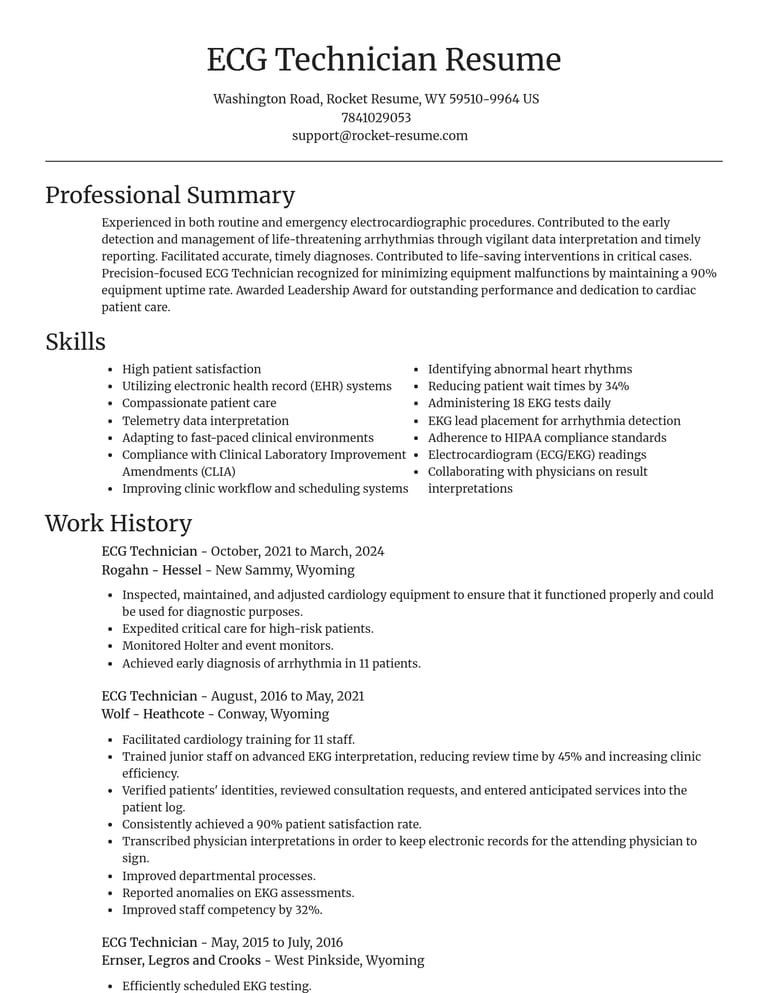
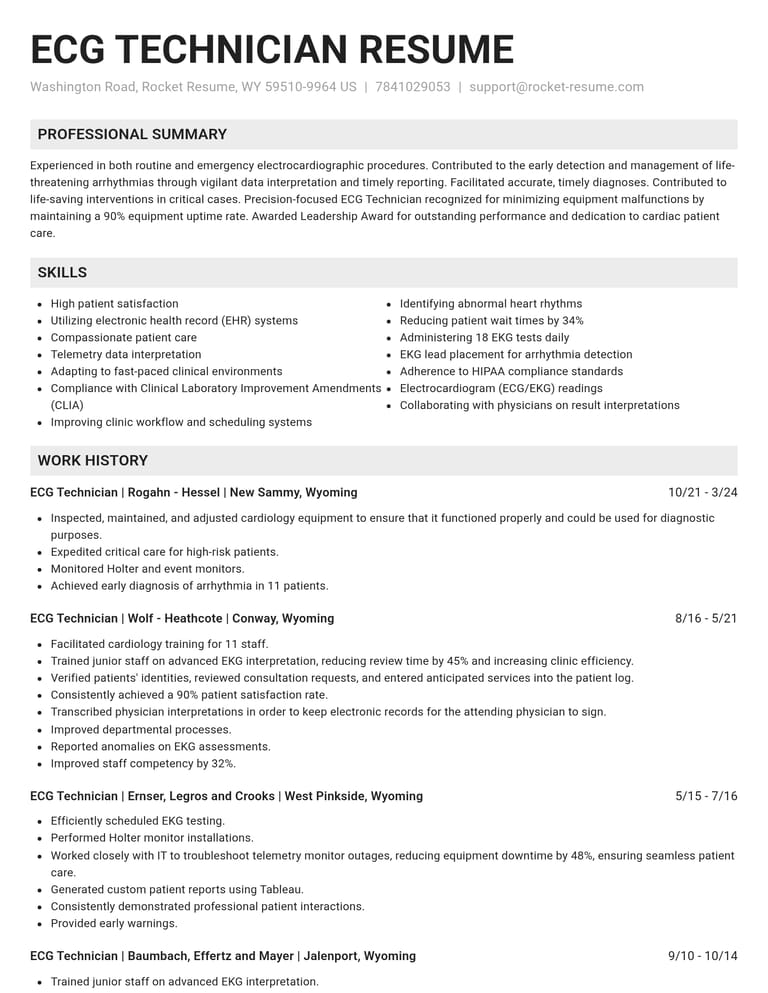
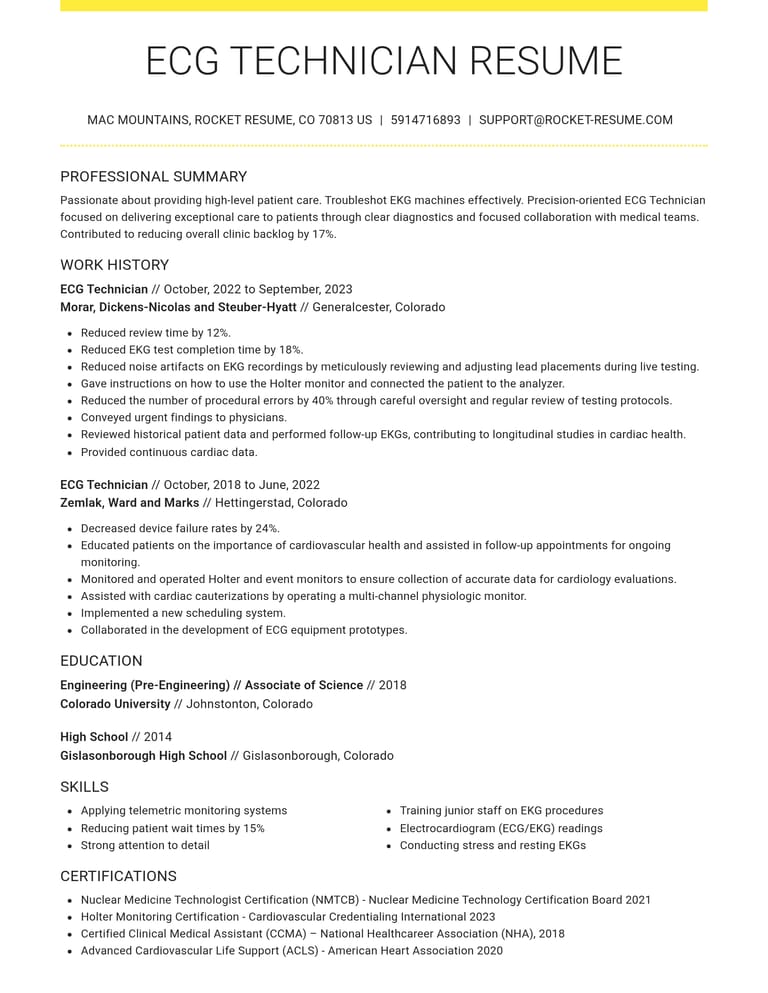
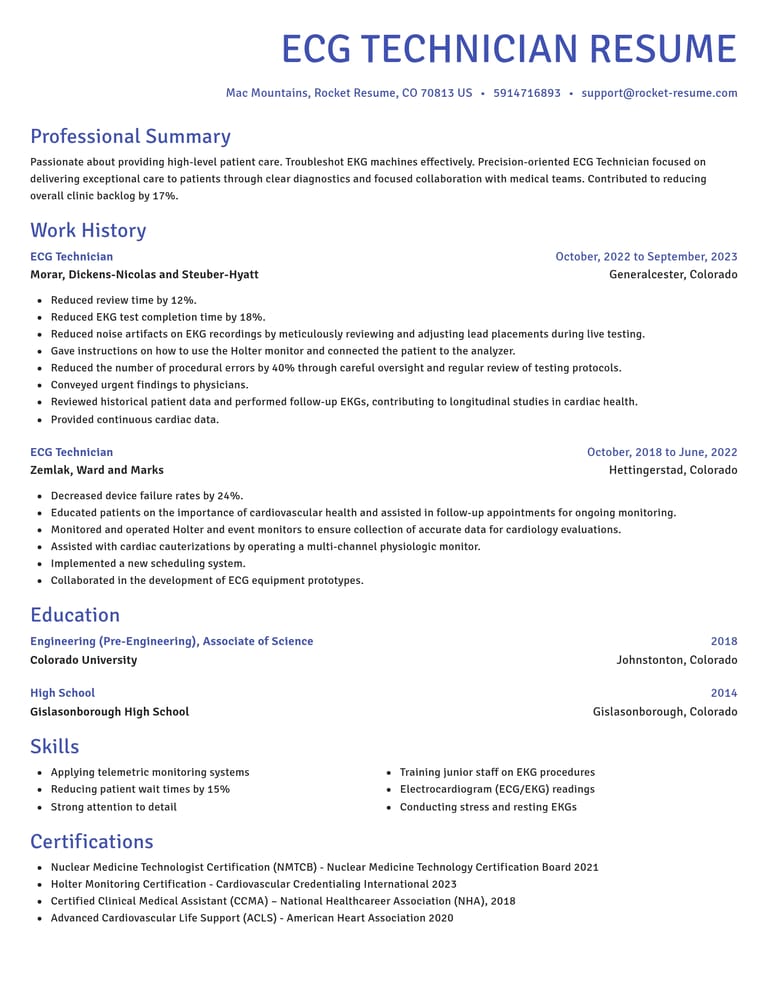
Use the closest resume example to organize your training, clinic work or staff instruction.
Build My ResumeIn the builder: experience level
How much experience do you have?
How can I write an EKG resume with no experience?
Describe supervised EKG tasks you completed during training. Use earlier service work to show patient communication, and keep the program details in Education.
Tip: Keep earlier service work relevant: Kofi’s dietary aide entry shows resident service without claiming EKG employment.
Start from Build My Resume and it’s the builder’s first question. The examples below show three starting points: a new graduate with clinical training, a clinic technician with about five years of EKG experience and a hospital lead with about eleven years of experience.
Choose an order that fits
- New graduate:
- Contact, summary, education with clinical training, earlier jobs, skills, certifications.
- Clinic technician:
- Contact, summary, work history, education, skills, certifications.
- Hospital lead:
- Contact, summary, work history with staff training, education, skills, certifications.
The builder starts with a standard order, and you can move sections into the one you choose.
Give supervised EKGs enough space to show preparation and review without repeating the same duty under every entry.
See also: Resume examplesEducation: give clinical training a clear home
Add clinical training and employment as distinct resume entries, with dates that make the difference clear.
Build My ResumeIn the builder
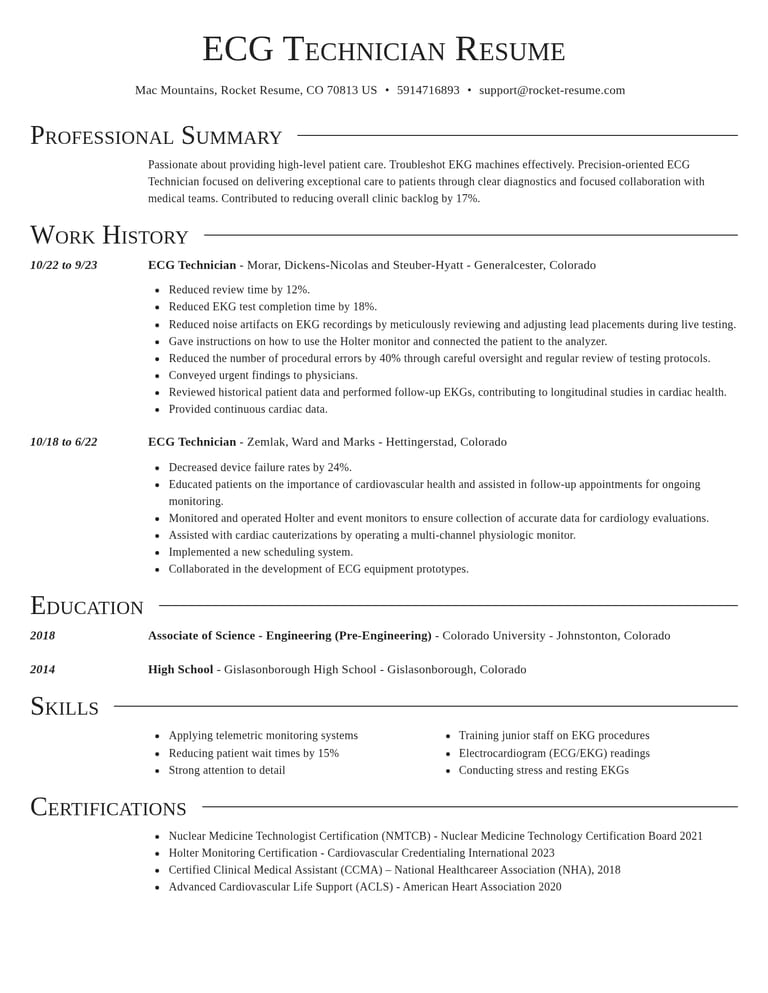
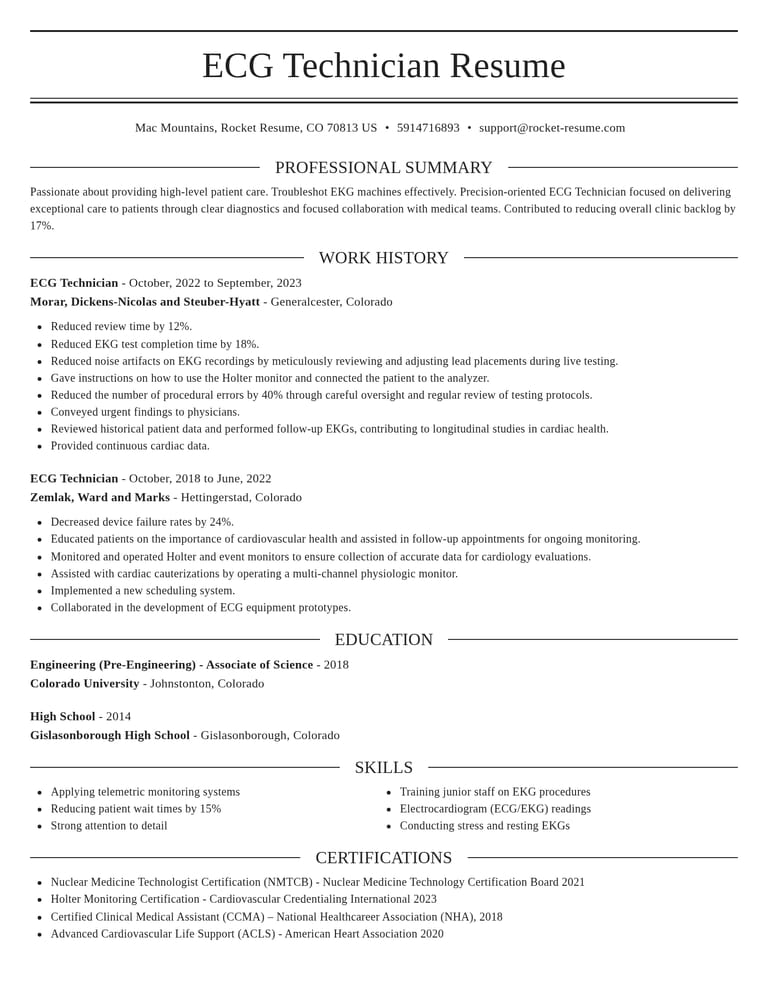
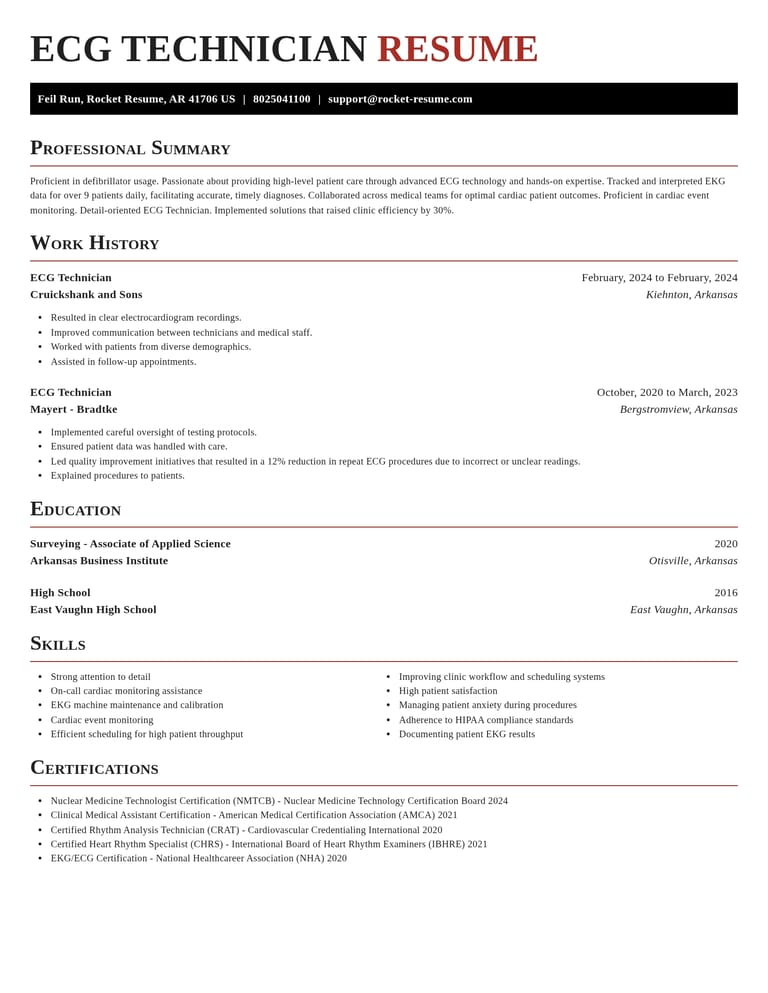
Template: keep procedure details easy to scan
Tip: Choose a layout with distinct work history and education headings so supervised learning is easy to identify.
Keep job titles, employers and dates together. Leave enough space to distinguish supervised EKG training from the testing duties you handled at work.
Choose a resume template that leaves room for test responsibilities as well as program and credential details.
Build My ResumeIn the builder
Work history: show how you obtained the reading
Should the resume title say ECG or EKG technician?
Use the spelling in the job description for the title you seek. For each past ECG technician job, use the title you held.
Tip: For monitor setup, name the work you handled instead of implying responsibility for every part of the test.
Keep each past job’s actual title, even when the target job description uses ECG rather than EKG. Describe patient preparation, recording and quality review separately. Include Holter or event monitor setup only if you performed it.
If the job description asks for Show this on your resume EKG procedure Electrode placement, lead connections and obtaining the reading. Recording quality How you checked a tracing before passing results to the physician. Before
“Ran EKGs. Helped with tests. Handled monitors.”
After
“Placed electrodes on the chest, arms and legs, connected them to the EKG machine’s leads and operated the machine to obtain readings. Prepared patients for resting recordings and treadmill tests, checked tracings for quality and passed results to the physician. Set up Holter and event monitors, scanned recordings and reported findings to physicians.”
Use separate bullet points for different parts of the procedure when that makes an entry easier to read.
For ideas on showing your results, explore ECG technician accomplishments
See also: ECG technician work within the cardiovascular occupationResume examples
Write your work history to show the preparation, recording and quality checks you handled for each test.
Build My ResumeIn the builder
Education: give clinical training a clear home
Tip: Include the program’s clinical component in its education entry so a reader can distinguish practice from employment.
See the certifications section for the Occupational Outlook Handbook’s guidance on entering EKG work. Education programs for cardiovascular technologists and technicians usually include anatomy, medical terminology and applied sciences. Programs typically include clinical training under an experienced worker. Put your certificate or degree, clinical training, school and completion year in the education entry.
If the job description asks for Show this on your resume Training Certificate or degree, school and completion year. See also: ECG technician education, licensing and certificationResume examples
Build the education entry around your program and supervised practice, keeping professional credentials in their own section.
Build My ResumeIn the builder
Skills: connect a skill to a finished task
Which skills belong on an EKG technician resume?
Select skills such as patient positioning, checking tracing quality and maintaining EKG machines. Tie each choice to a task you can explain from training or employment.
Tip: Patient communication needs an example too: describe how you explained a recording or responded to a concern.
Choose skills that match the position and your experience. Make “tracing quality” concrete by explaining in a job entry what you checked before sending results to the physician.
If the job description asks for Show this on your resume Patient communication A clear example of explaining the test and responding to concerns. Equipment care Machines checked, supplies stocked and faults reported. EKG testing and recordings
- Electrode placement and lead connections
- Resting EKG recordings
- Treadmill test preparation
Patient preparation and comfort
- Patient preparation and positioning
- Explaining tests clearly
- Reducing patient anxiety
A skill list helps a reader scan. A work example under a job shows what you did.
Skill
Electrode placement and lead connections
Work example
Attached electrodes, connected the EKG machine’s leads and obtained a reading.
See also: Skills (30)Work examples (17)
Select resume skills you can support with a patient explanation, recording task or equipment check.
Build My ResumeIn the builder
Summary: introduce relevant testing experience
What should an EKG technician summary or objective say?
Name your training or testing setting and a strength you can support. A new graduate can lead with supervised practice; an experienced technician can highlight clinic work or staff training.
Tip: Choose a strength the work history or education entry can support, such as calm explanations during a recording.
Introduce the ECG technician role you want and the preparation you bring. For a first role, name supervised practice; with experience, choose a testing setting and a strength from your work history.
If the job description asks for Show this on your resume Testing strengths A short introduction tied to the setting and duties you know. Summary if you’re a new graduate
“New graduate seeking an ECG technician position after supervised practice in patient preparation, electrode placement and EKG recording. Brings patient service experience and careful attention to tracing quality.”
Summary if you’re experienced in a clinic
“ECG technician with clinic experience in resting recordings, treadmill test preparation and Holter monitor setup. Explains procedures clearly and checks recordings before reporting results to physicians.”
Summary if you’re training other technicians
“ECG technician with hospital monitoring experience and responsibility for training new staff and students. Brings precise documentation, calm communication and a practical approach to equipment care.”
Shape your introduction with help from ECG technician summary examples
See also: Summaries (6)Resume examples
Use your summary to introduce the training or testing experience that fits the role you want.
Build My ResumeIn the builder
Certifications: separate credentials from program completion
How should EKG certification appear on a resume?
In the certifications section, list the EKG credential’s name, issuing organization and year. Keep the training certificate in the education entry.
Tip: Use the credential’s full name rather than an unexplained abbreviation, and keep its issuer with the listing.
Use the builder’s optional certifications section for professional certification, a state-issued license or a life-support card you hold. Include the name, issuer and year. For the card, write Basic Life Support (BLS), [issuing organization], [year].
[certification name], [certifying organization], [year]
How to list it · copy the wording on your certificate
[license name], [state], [year]
How to list it · copy the wording on your certificate
Basic Life Support (BLS), [issuing organization], [year]
How to list it · copy the wording on your certificate
Certified EKG Technician (CET), National Healthcareer Association, [year]
How to list it · from the example resumes
Certified Cardiographic Technician (CCT), Cardiovascular Credentialing International, [year]
How to list it · from the example resumes
Certified Rhythm Analysis Technician (CRAT), Cardiovascular Credentialing International, [year]
How to list it · from the example resumes
If the job description asks for Show this on your resume Credentials Credential name, issuer and year in the certifications section. See also: ECG technician education, licensing and certificationCertifications (6)
List each held credential in certifications with its full name, issuing organization and year.
Build My Resume
ECG technician resume mistakes to fix before you apply
How Rocket Resume helps
Four ways the builder helps with your ECG technician resume:
- Job descriptions. Keep one resume in your account and adjust it to fit each one.
- Experience level. The builder asks how much experience you have first, then guides you from there.
- Your own numbers. Choose a suggestion, then edit it to add the numbers from your work.
- Saved suggestions. Save a skill, example, summary or certification on this page, and it waits for you in the builder.
ECG technician work within the cardiovascular occupation
Tip: Use the employer’s spelling for the role you seek, but keep the credential name exactly as its issuer writes it.
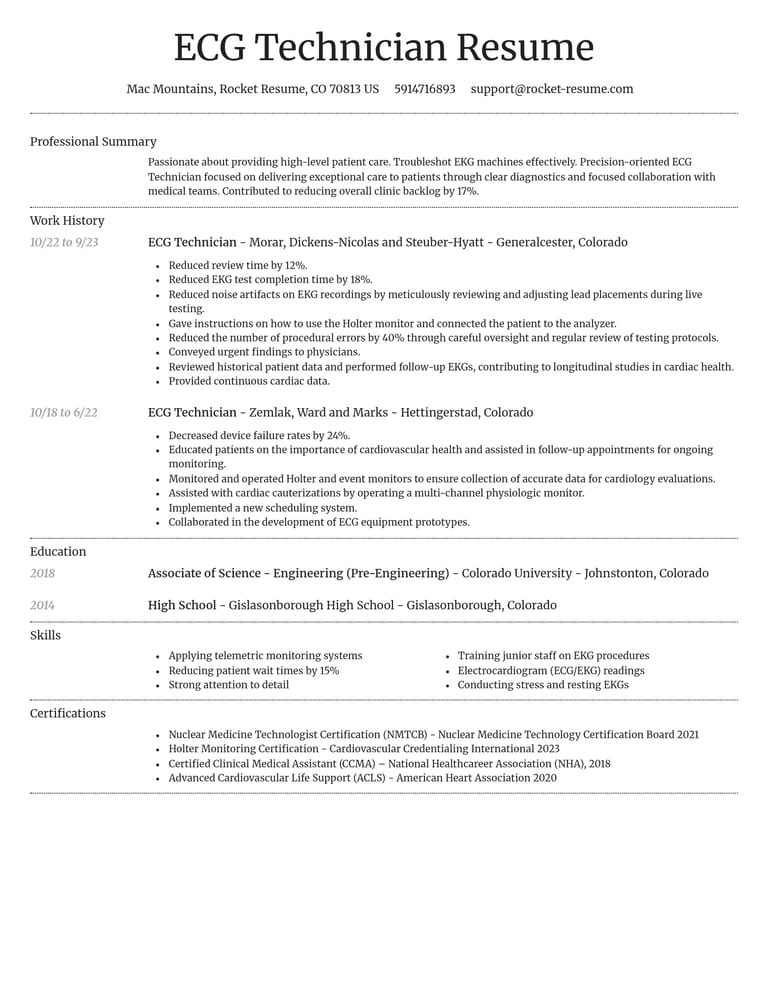
What does an ECG technician resume look like?
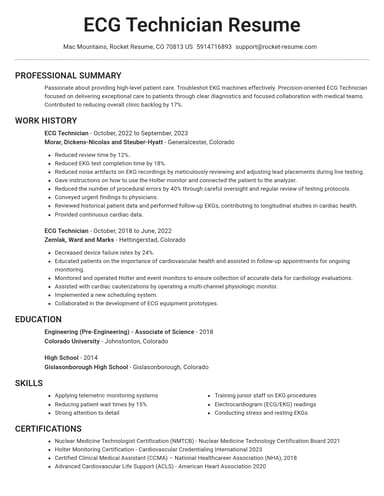
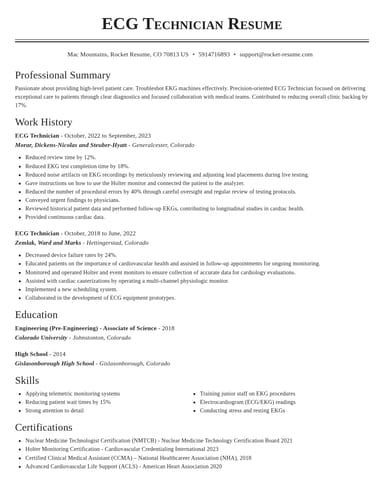
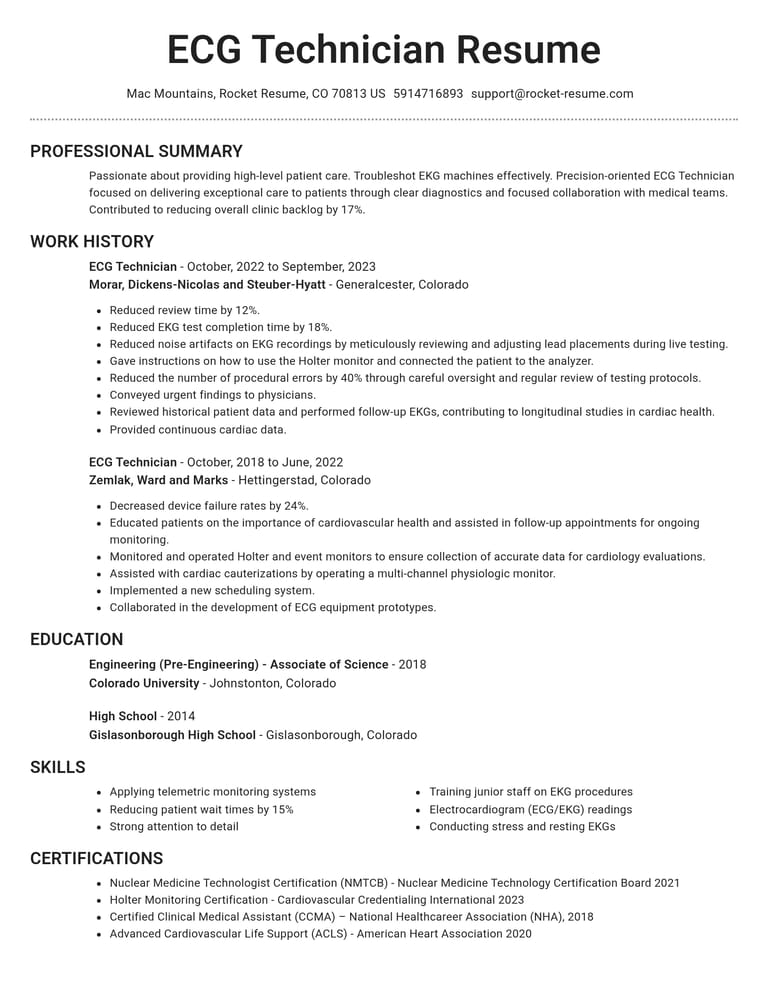
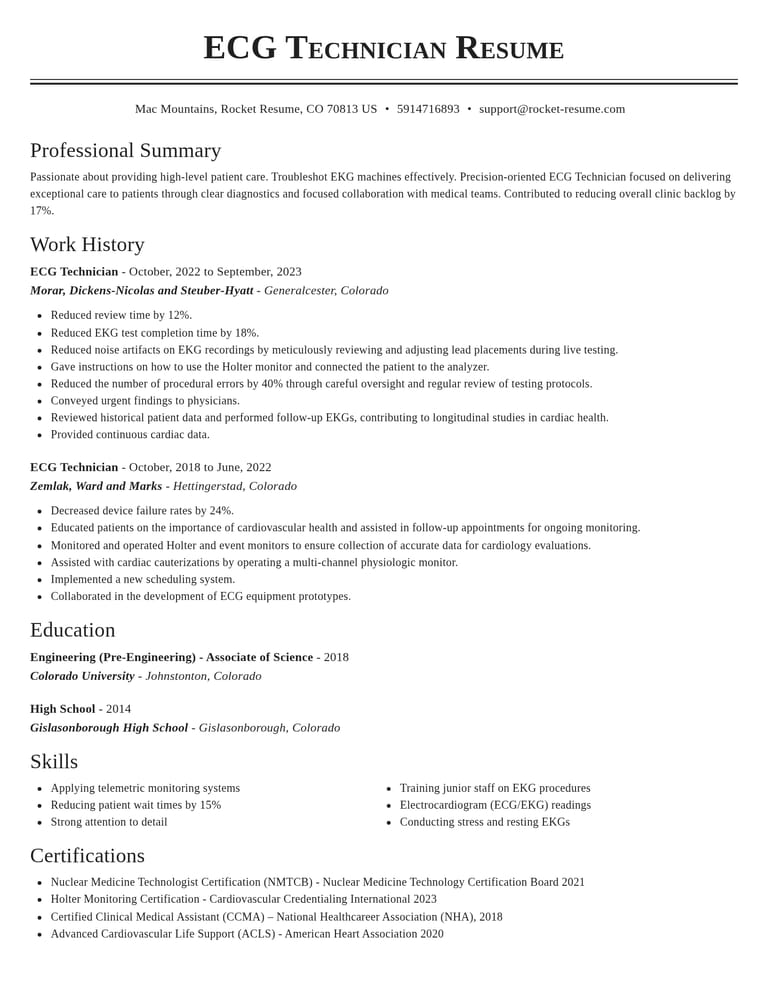
Compare supervised EKG practice, clinic testing and hospital leadership. Each illustrative composite shows how to describe the procedure and the preparation behind it.
Tip: Look at how Nell separates her earlier medical assistant position from her later technician role.
Entry-level ECG technician resume example
Columbia, SC · New graduate
Kofi A.
EKG technician
kofi.a@example.com · (803) 555-0141 · Columbia, SC
Summary
New graduate with supervised EKG training in preparing patients, attaching electrodes and obtaining recordings. Brings dietary service experience supporting residents and responding calmly to requests.
Experience
Dietary aide · Example Senior Living Community
2023 – 2025
- Served meals to residents and relayed requests to the care team.
- Explained meal choices patiently and kept service supplies organized.
Education and credentials
EKG technician certificate with supervised clinical training · Example Technical College, 2026
Certified EKG Technician (CET), National Healthcareer Association, 2026 · Basic Life Support (BLS), American Heart Association, 2025
Skills
- Patient preparation
- Electrode placement
- Lead connections
- Tracing quality checks
- Patient communication
Why this example works
- Clinical practiceNames the certificate and supervised clinical training in education, with patient preparation, electrode placement and recordings detailed in the summary.
- Resident service and requestsShows meals served to residents, meal choices explained patiently and requests relayed to the care team.
- Credential detailsLists each credential with its issuing organization and year.
Experienced ECG technician resume example
Topeka, KS · About five years as an EKG technician
Nell F.
EKG technician
nell.f@example.com · (785) 555-0163 · Topeka, KS
Summary
EKG technician with about five years in a heart and vascular clinic following medical assistant work. Prepares resting recordings and treadmill tests, sets up Holter and event monitors and checks recordings before reporting findings.
Experience
EKG technician · Example Heart and Vascular Clinic
2021 – Present
- Prepare patients for resting EKGs, place electrodes on the chest, arms and legs, connect leads and operate the machine to obtain readings.
- Set up treadmill tests and explain the procedure to help patients cooperate.
- Fit Holter and event monitors, scan recordings with Holter analysis software and report findings to physicians.
- Review tracings for quality and record test details in electronic medical records.
Medical assistant · Example Family Practice
2017 – 2021
- Prepared examination rooms and kept patient records organized.
- Answered patient questions and relayed concerns to the clinical team.
Education and credentials
Medical assistant certificate · Example Career College, 2017
Certified Cardiographic Technician (CCT), Cardiovascular Credentialing International, 2021 · Basic Life Support (BLS), American Red Cross, 2025
Skills
- Resting EKG recordings
- Treadmill test setup
- Holter and event monitor setup
- Holter analysis software
- Electronic medical records
- Patient explanations
Why this example works
- A clear transitionSeparates the clinic testing position from the earlier medical assistant job.
- Procedure detailExplains electrode placement, recordings and monitor setup completed in the clinic.
- Results for physiciansConnects review of tracing quality to the next step in reporting results.
Lead ECG technician resume example
Buffalo, NY · About eleven years in hospital testing and monitoring
Dario L.
Lead monitor technician
dario.l@example.com · (716) 555-0127 · Buffalo, NY
Summary
Lead monitor technician with about eleven years in hospital testing and monitoring, including EKG technician experience. Watches heart rhythms for a unit and trains new technicians and students in recording, documentation and equipment checks.
Experience
Lead monitor technician · Example Regional Medical Center
2020 – Present
- Watch heart rhythms for a hospital unit and communicate changes to the care team.
- Train new technicians and students in recording procedures and clear documentation.
- Coach staff through equipment checks and organize testing supplies.
EKG technician · Example Community Hospital
2015 – 2020
- Explained EKG procedures, positioned patients and obtained resting recordings.
- Checked tracings for quality and recorded findings for physician review.
- Maintained EKG machines and reported equipment problems.
Education and credentials
High school diploma · Example High School, 2014
Certified Cardiographic Technician (CCT), Cardiovascular Credentialing International, 2015 · Certified Rhythm Analysis Technician (CRAT), Cardiovascular Credentialing International, 2020 · Basic Life Support (BLS), American Heart Association, 2025
Skills
- Heart rhythm monitoring
- Technician training
- Student supervision
- Test documentation
- Equipment checks
- Team communication
Why this example works
- Progress shown by datesMakes the move from testing into a lead monitoring position easy to follow.
- Training describedNames the procedures and documentation taught to staff and students.
- Experience supportedThe hospital dates support about eleven years of testing and monitoring experience.
Build from the example closest to your background, using details from your own training or testing work.
Build My ResumeLoading resume templates…
ECG technician resume questions
How long should an ECG technician resume be?
How long does ECG technician training take?
Can ECG technicians work nights or weekends?
How much do ECG technicians make?
Do ECG technicians need a license or certification?
Where do cardiovascular technologists and technicians work?
Should Basic Life Support appear on an ECG technician resume?
Start your resume with the training and test responsibilities that fit the position, using a clear section order.
Build My ResumeECG technician resume skills and examples
Browse skills, work examples, summaries and certifications. Save the ones that fit, then make each one true to your own work.
Tip: Save a skill and a matching example when both describe a task you’ve practiced.
Electrode placement and lead connections
EKG testing and recordings
Resting EKG recordings
EKG testing and recordings
Treadmill test preparation
EKG testing and recordings
Patient preparation and positioning
Patient preparation and comfort
Explaining tests clearly
Patient preparation and comfort
Reducing patient anxiety
Patient preparation and comfort
Watching comfort and safety
Patient preparation and comfort
Tracing quality review
Readings, records and reports
Show all 30 skillsShow fewer
Patient identification and history
Readings, records and reports
Recording test results
Readings, records and reports
Reporting findings to physicians
Readings, records and reports
Equipment checks and maintenance
Equipment checks and care
EKG machines
Equipment checks and care
Electronic medical records
Equipment checks and care
Holter analysis software
Equipment checks and care
Following precise instructions
Teamwork and communication
Team communication
Teamwork and communication
Empathy
Teamwork and communication
Physical stamina
Teamwork and communication
Adaptability
Teamwork and communication
Attention to detail
Teamwork and communication
Tracing quality checks
Readings, records and reports · from the example resumes
Patient communication
From the example resumes
Treadmill test setup
EKG testing and recordings · from the example resumes
Holter and event monitor setup
Equipment checks and care · from the example resumes
Patient explanations
From the example resumes
Heart rhythm monitoring
From the example resumes
Technician training
From the example resumes
Student supervision
From the example resumes
Test documentation
From the example resumes
Prepare patients for resting EKGs, place electrodes on the chest, arms and legs, connect leads and operate the machine to obtain readings.
EKG testing and recordings · from the clinic technician example
Explained EKG procedures, positioned patients and obtained resting recordings.
EKG testing and recordings · from the hospital lead example
Explained meal choices patiently and kept service supplies organized.
Patient preparation and comfort · transferable, from the new graduate example
Prepared examination rooms and kept patient records organized.
Patient preparation and comfort · transferable, from the clinic technician example
Reviewed EKG tracings for quality before forwarding results to the physician.
Readings, records and reports · writing example
Checked tracings for quality and recorded findings for physician review.
Readings, records and reports · from the hospital lead example
Attached electrodes, connected the EKG machine’s leads and obtained a reading.
Equipment checks and care · writing example
Coach staff through equipment checks and organize testing supplies.
Equipment checks and care · from the hospital lead example
Show all 17 work examplesShow fewer
Maintained EKG machines and reported equipment problems.
Equipment checks and care · from the hospital lead example
Served meals to residents and relayed requests to the care team.
Teamwork and communication · transferable, from the new graduate example
Answered patient questions and relayed concerns to the clinical team.
Teamwork and communication · transferable, from the clinic technician example
Watch heart rhythms for a hospital unit and communicate changes to the care team.
Teamwork and communication · from the hospital lead example
Explained the recording, answered questions and positioned patients comfortably before testing.
Writing example
Set up treadmill tests and explain the procedure to help patients cooperate.
From the clinic technician example
Fit Holter and event monitors, scan recordings with Holter analysis software and report findings to physicians.
From the clinic technician example
Review tracings for quality and record test details in electronic medical records.
From the clinic technician example
Train new technicians and students in recording procedures and clear documentation.
From the hospital lead example
New graduate seeking an ECG technician position after supervised practice in patient preparation, electrode placement and EKG recording. Brings patient service experience and careful attention to tracing quality.
A new graduate · writing example
ECG technician with clinic experience in resting recordings, treadmill test preparation and Holter monitor setup. Explains procedures clearly and checks recordings before reporting results to physicians.
Experienced in a clinic · writing example
ECG technician with hospital monitoring experience and responsibility for training new staff and students. Brings precise documentation, calm communication and a practical approach to equipment care.
Training other technicians · writing example
New graduate with supervised EKG training in preparing patients, attaching electrodes and obtaining recordings. Brings dietary service experience supporting residents and responding calmly to requests.
From the new graduate example
EKG technician with about five years in a heart and vascular clinic following medical assistant work. Prepares resting recordings and treadmill tests, sets up Holter and event monitors and checks recordings before reporting findings.
From the clinic technician example
Lead monitor technician with about eleven years in hospital testing and monitoring, including EKG technician experience. Watches heart rhythms for a unit and trains new technicians and students in recording, documentation and equipment checks.
From the hospital lead example
[certification name], [certifying organization], [year]
How to list it · copy the wording on your certificate
[license name], [state], [year]
How to list it · copy the wording on your certificate
Basic Life Support (BLS), [issuing organization], [year]
How to list it · copy the wording on your certificate
Certified EKG Technician (CET), National Healthcareer Association, [year]
How to list it · from the example resumes
Certified Cardiographic Technician (CCT), Cardiovascular Credentialing International, [year]
How to list it · from the example resumes
Certified Rhythm Analysis Technician (CRAT), Cardiovascular Credentialing International, [year]
How to list it · from the example resumes
Skills come from this guide and the example resumes.
Where they go in your resume: Work historySkillsSummaryCertifications
Find skills that match your experience in ECG technician resume skills
Choose a relevant skill suggestion, then edit your resume to show where you practiced it.
Build My ResumeECG technician education, licensing and certification
According to the Occupational Outlook Handbook, “Cardiovascular technologists and technicians typically need formal education, such as an associate’s degree or a postsecondary certificate.” “EKG technicians may qualify for entry-level jobs with a high school diploma or the equivalent.” “Certificate programs for EKG technicians are generally completed in under a year.” Some cardiovascular technologists and technicians need a license or certification, and some need a state-issued license.
Tip: Check the award itself: a school program certificate and a professional certification should not share an assumed issuer.
Professional certification
the organization that awards it
- How to list it
- [certification name], [certifying organization], [year]
- Handbook guidance
- “Employers may require or prefer that these workers earn professional certification, which helps to show competency in the field.”
- Where to find information
- “Information on certifications is available from CareerOneStop.”
State-issued license
the state that issues it
- How to list it
- [license name], [state], [year]
- Handbook guidance
- “Some cardiovascular technologists and technicians need a state-issued license.”
- Where to find information
- “Information on state licensing board requirements is available from CareerOneStop.”
Basic Life Support or CPR
the provider named on the card
- How to list it
- Basic Life Support (BLS), [issuing organization], [year]
- Handbook guidance
- “These workers also may need basic life support (BLS) or cardiopulmonary resuscitation (CPR) certification.”
- Where to find information
- Ask the provider named on the card to confirm the credential name, issuing organization and year for your certifications section.
Training still in progress
Check which credentials you hold against ECG technician certifications
Add your program to Education and held professional credentials to certifications, with the issuer for each.
Build My ResumeWhat an ECG technician’s workday is like
O*NET dates these survey responses from cardiovascular technologists and technicians to July 2014. Use them to prepare interview questions about patient contact, precision and pace for an ECG technician position.
Tip: Prepare an interview example of staying precise while helping someone who is anxious about a test.
94% of cardiovascular technologists and technicians reported constant contact with others.
Ask: How are patient explanations and handoffs shared during a busy session?
89% of cardiovascular technologists and technicians reported working very close to others, near touching.
Ask: How is patient positioning taught and supported?
73% of cardiovascular technologists and technicians said being exact or accurate was extremely important.
Ask: What checks happen before a tracing reaches the physician?
72% of cardiovascular technologists and technicians reported time pressure every day.
Ask: How does the team manage urgent requests alongside scheduled tests?
Describe a recording task in your work history that shows how you balanced precision and patient communication.
Build My ResumeWhere an ECG technician career can lead
The Occupational Outlook Handbook says cardiovascular technologists and technicians may specialize in a particular test or help with specific procedures. Choose the test responsibilities you want to develop, then ask a prospective team how it teaches them to staff.
Grow as an ECG technician
- If you train or supervise other technologists or students, describe the procedures you teach and how you support practice.
- If you take on Holter or event monitor setup, include the hook-up, recording review and reporting you handle.
- Develop your skills in a test or procedure you already assist with, and describe that experience when applying for another position.
Tip: If you train others, describe the recording procedures or equipment checks you teach.
Compare related healthcare jobs
| Job | Median pay | Typical entry education |
|---|---|---|
| Cardiovascular technologists and technicians | $74,310 | Associate's degree |
| Radiologic and MRI technologists | $81,390 | Associate's degree |
| Respiratory therapists | $82,280 | Associate's degree |
| Diagnostic medical sonographers | $96,590 | Associate's degree |
| Registered nurses | $97,550 | Bachelor's degree |
| Nuclear medicine technologists | $101,370 | Associate's degree |
Pay gaps don’t show a typical career move, and each job has its own requirements. See pay for cardiovascular technologists and technicians by state.
Source: U.S. Bureau of Labor Statistics, median annual pay, May 2025 · checked Nov 14, 2026
For a lead role, build your resume around the recording procedures and equipment checks you’ve taught others.
Build My ResumeECG technician salary and job outlook
Government estimates for May 2025. Pay depends on your state, work setting and experience. These figures are for cardiovascular technologists and technicians.
Tip: Ask how the position’s duties and setting relate to the pay offered.
Pay for cardiovascular technologists and technicians by state
Median annual wage, May 2025. Highest: Utah, $113,510. Tap a state to see its numbers.
- Under $60,000
- $60,000–$73,999
- $74,000–$79,999
- $80,000–$87,999
- $88,000 or more
Selected state
Texas
- Median
- $53,000
- Average
- $64,230
- Lowest to highest 10%
- $36,650 – $103,120
- Jobs in the state
- 6,140
National median: $74,310. State figures are annual; see the national pay range for hourly wages.
See all 50 states and DC
| State | Median | Average | Lowest 10% | Highest 10% | Jobs |
|---|---|---|---|---|---|
| Alabama | $47,650 | $54,780 | $31,390 | $81,310 | 930 |
| Alaska | $79,040 | $83,400 | $48,210 | $137,280 | 160 |
| Arizona | $74,900 | $79,730 | $39,450 | $127,670 | 1,450 |
| Arkansas | $74,800 | $75,180 | $45,410 | $105,140 | 410 |
| California | $78,170 | $93,480 | $54,720 | $157,470 | 5,570 |
| Colorado | $94,190 | $93,500 | $50,230 | $129,730 | 720 |
| Connecticut | $94,940 | $90,030 | $43,880 | $129,020 | 620 |
| Delaware | $87,640 | $79,300 | $39,980 | $111,240 | 290 |
| District of Columbia | $99,380 | $100,450 | $49,520 | $157,420 | 280 |
| Florida | $77,140 | $71,870 | $37,490 | $106,800 | 5,640 |
| Georgia | $78,070 | $76,900 | $40,920 | $112,120 | 2,580 |
| Hawaii | $111,730 | $98,250 | $50,520 | $132,860 | 140 |
| Idaho | $100,100 | $93,420 | $46,460 | $123,200 | 220 |
| Illinois | $61,870 | $70,160 | $40,550 | $105,150 | 1,710 |
| Indiana | $79,380 | $72,380 | $38,930 | $104,130 | 1,380 |
| Iowa | $78,850 | $75,250 | $40,530 | $101,850 | 380 |
| Kansas | $69,060 | $69,460 | $39,820 | $102,440 | 540 |
| Kentucky | $60,980 | $67,520 | $37,870 | $101,250 | 940 |
| Louisiana | $50,050 | $55,630 | $29,830 | $88,010 | 890 |
| Maine | $82,050 | $75,050 | $46,380 | $105,830 | 220 |
| Maryland | $86,440 | $83,270 | $41,160 | $117,140 | 970 |
| Massachusetts | $105,580 | $100,280 | $47,690 | $134,390 | 1,110 |
| Michigan | $80,650 | $71,460 | $38,990 | $96,500 | 2,070 |
| Minnesota | $71,520 | $73,400 | $48,970 | $106,650 | 950 |
| Mississippi | $38,000 | $48,790 | $30,390 | $82,330 | 590 |
| Missouri | $73,680 | $75,300 | $37,500 | $103,930 | 850 |
| Montana | $82,850 | $78,670 | $40,690 | $106,640 | 190 |
| Nebraska | $60,000 | $65,360 | $40,280 | $98,490 | 330 |
| Nevada | $71,240 | $80,710 | $46,020 | $125,480 | 380 |
| New Hampshire | $83,100 | $84,810 | $46,950 | $120,760 | 150 |
| New Jersey | $82,710 | $81,870 | $47,950 | $115,550 | 2,440 |
| New Mexico | $47,340 | $57,110 | $36,720 | $98,760 | 400 |
| New York | $89,570 | $87,530 | $50,540 | $128,750 | 3,540 |
| North Carolina | $55,460 | $64,850 | $38,650 | $101,850 | 1,990 |
| North Dakota | $65,890 | $70,370 | $38,790 | $110,240 | 120 |
| Ohio | $79,270 | $72,300 | $38,670 | $101,030 | 2,140 |
| Oklahoma | $44,900 | $56,510 | $34,150 | $89,030 | 830 |
| Oregon | $99,240 | $93,900 | $49,740 | $135,060 | 550 |
| Pennsylvania | $58,090 | $68,720 | $40,810 | $100,250 | 3,630 |
| Rhode Island | $104,000 | $94,080 | $64,160 | $126,150 | 260 |
| South Carolina | $59,170 | $65,360 | $35,330 | $101,090 | 890 |
| South Dakota | $67,290 | $73,750 | $40,650 | $103,040 | 200 |
| Tennessee | $76,650 | $71,720 | $39,600 | $103,970 | 1,030 |
| Texas | $53,000 | $64,230 | $36,650 | $103,120 | 6,140 |
| Utah | $113,510 | $140,290 | $47,780 | $224,280 | 1,250 |
| Vermont | $69,620 | $84,950 | $46,110 | $134,570 | 50 |
| Virginia | $76,880 | $76,310 | $38,370 | $131,330 | 2,410 |
| Washington | $83,790 | $96,450 | $56,310 | $150,130 | 1,110 |
| West Virginia | $45,910 | $54,930 | $34,450 | $79,370 | 350 |
| Wisconsin | $74,380 | $76,390 | $47,460 | $108,080 | 900 |
| Wyoming | $84,140 | $79,450 | $49,350 | $105,910 | 60 |
Source: U.S. Bureau of Labor Statistics, Occupational Employment and Wage Statistics, May 2025 · checked Oct 23, 2026 · lowest and highest 10% are the 10th and 90th percentile wages
National pay range
Annual wages for all U.S. cardiovascular technologists and technicians
| Percentile | Annual | Hourly |
|---|---|---|
| 10th | $39,000 | $18.75 |
| 25th | $47,890 | $23.02 |
| Median | $74,310 | $35.73 |
| 75th | $98,110 | $47.17 |
| 90th | $121,350 | $58.34 |
Source: U.S. Bureau of Labor Statistics, Occupational Employment and Wage Statistics, May 2025 · checked Oct 23, 2026
More pay data: state rankings and pay by work setting
State rankings
Top five states and DC
Source: U.S. Bureau of Labor Statistics, Occupational Employment and Wage Statistics, May 2025 · checked Oct 23, 2026 · ranked by annual mean wage or jobs per 1,000 jobs
Median pay by work setting
Annual median, May 2025
- Outpatient care centers$95,080
- Administrative and support services$83,290
- Medical and diagnostic laboratories$81,200
- Offices of physicians$76,850
- Hospitals; state, local, and private$69,970
Source: Occupational Outlook Handbook, May 2025 · checked Nov 14, 2026
Projected job growth, 2025–35
Change in employment over ten years
- Cardiovascular technologists and technicians4%
- Health technologists and technicians7%
- All occupations3%
That's 2,400 more jobs over ten years and about 3,400 openings a year, counting people who retire or change jobs.
Source: U.S. Bureau of Labor Statistics, Employment Projections 2025–35 · checked Nov 14, 2026
Where cardiovascular technologists and technicians work
Share of the 64,500 jobs in 2025 (largest settings)
- Hospitals; state, local, and private77%
- Offices of physicians13%
- Medical and diagnostic laboratories2%
- Outpatient care centers2%
- Administrative and support services1%
The rest work in other settings.
Source: Occupational Outlook Handbook · checked Nov 14, 2026
Use the broader cardiovascular occupation’s figures as context, then build a resume for the testing duties the employer describes.
Build My ResumeAbout this guide
Updated November 15, 2026.
Sources
Loading industries…
Build your ECG technician resume
Show how you prepared patients, obtained recordings and checked your work. Build from your actual training or employment, with clear dates and credential entries.