Traveling medical technologist resume examples, templates and tips
Make each laboratory assignment easy to follow. Use resume examples and tips to show the benches, analyzers and systems you know, from your first technologist job to senior work.
- Organize travel assignments
- Show bench and system skills
- Examples across lab careers

What traveling medical technologist hiring managers look for
- Chemical analysis of blood, urine or spinal fluid.
- Cell counts, morphology and blood compatibility testing.
- Checking findings for accuracy.
- Operating, calibrating or maintaining computer-controlled analyzers.
- Establishing or monitoring quality assurance activities.
- Developing, standardizing or evaluating procedures.
How to write a traveling medical technologist resume
Travel assignments can blur together on a resume. Show what you did at each laboratory, with dates, bench sections and systems that make your experience easy to follow. This guide starts with six questions to answer first, then walks through each part of your resume with tips and links to the examples, templates and data on this page.
Six questions to answer first
- What should a travel technologist resume show first?
Step 1 connects laboratory duties to the resume sections.
- How should a new graduate write this resume?
Step 3 sets an order for an early laboratory career.
- How do I describe testing across assignments?
Step 5 turns broad duties into specific bench experience.
- Which skills should a medical technologist show?
Step 7 connects technical skills to bench examples.
- What should the summary or objective say?
Step 8 shapes an opening around technical experience.
- How should certification and a license be listed?
Step 9 shows where laboratory credentials belong.
What a traveling medical technologist does
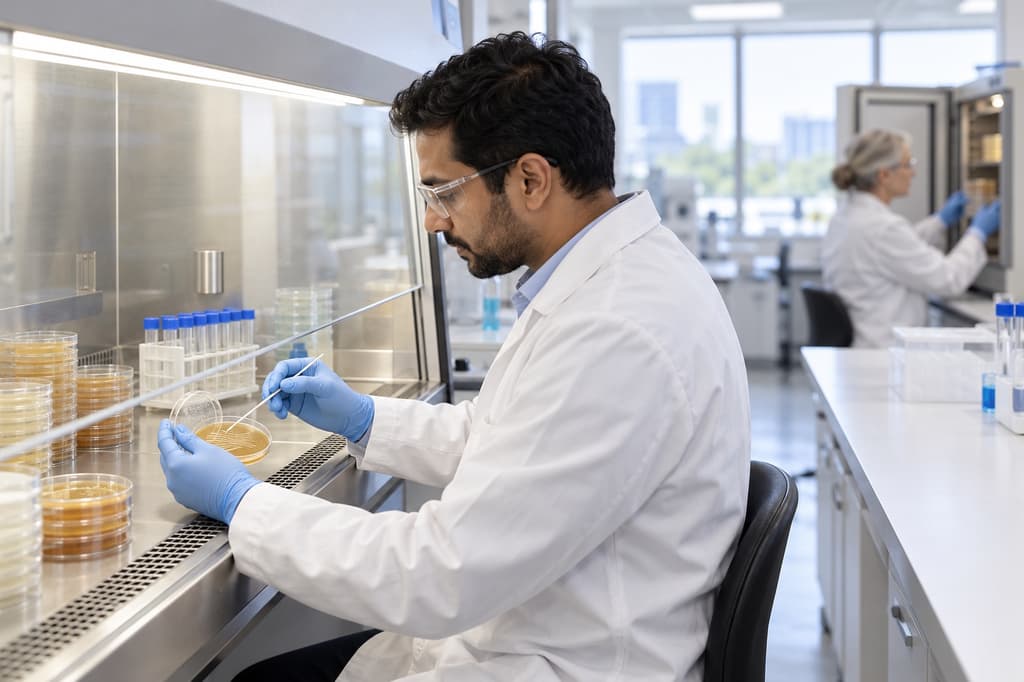
A medical technologist performs complex medical laboratory tests for the diagnosis, treatment and prevention of disease, and may train or supervise staff. A traveling medical technologist takes the same work to assignments at laboratories in more than one place.
If you analyze body fluids, name the blood, urine or spinal fluid tests you perform. If you cover hematology or the blood bank, describe cell counts, morphology, blood typing or compatibility checks for transfusion.
Employment of clinical laboratory technologists and technicians is projected to grow 3% from 2025 to 2035, according to the Occupational Outlook Handbook from the U.S. Bureau of Labor Statistics. Clinical laboratory technologists and technicians had a median annual wage of $62,930 in May 2025.
See also: National pay rangeProjected job growth
Tip: Use the target MT, MLS or CLS title in the opening when it fits. Keep the titles you actually held in work history.
Are medical technologist and medical laboratory scientist the same job?
Write your traveling medical technologist resume in nine steps
Do the first two before you open the builder. The other seven follow the builder’s order.
Step 1 of 9
Before you open the builder
Job description: match the assignment to your bench experience
What should a travel technologist resume show first?
Make your assignment history easy to follow. For each laboratory, show the dates, sections covered and equipment or systems you used.
Tip: Check whether the job calls for broad bench coverage or a specialty. Bring forward the laboratory work that matches.
Make these easy to find
- Chemical analysis of blood, urine or spinal fluid.
- Cell counts, morphology and blood compatibility testing.
- Checking findings for accuracy.
- Operating, calibrating or maintaining computer-controlled analyzers.
- Establishing or monitoring quality assurance activities.
- Developing, standardizing or evaluating procedures.
- Explaining technical findings to physicians.
- Training or directing laboratory staff.
Match each requirement in the job description
Here’s the step where you’ll show each one:
- Laboratory sections step 5
- Analyzer experience step 5
- Education step 6
- Information systems step 7
- Quality assurance step 5
- Technical communication step 5
- Role title step 8
- Credentials step 9
Tip: Use dated job entries to show where you used an analyzer or system. A software list alone leaves that context out.
See also: What a traveling medical technologist doesSkills and examplesLaboratory licensing and certification
Build your resume around the assignment’s testing needs, using bench experience you can explain in an interview.
Build My Resume
Before you open the builder
Examples: compare the bench work behind each role
Tip: Grant’s assignments have separate dates and facility types. Use that structure when several laboratories belong in your work history.
Fatima separates assistant work from her first technologist role. Grant traces work across laboratories, while Yolanda shows procedure evaluation and staff training. Choose the example that fits the experience you need to explain.
See also: Resume examples
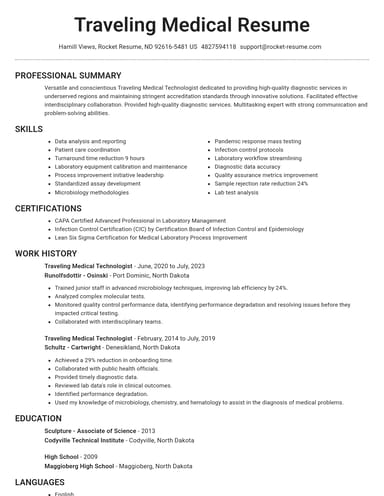
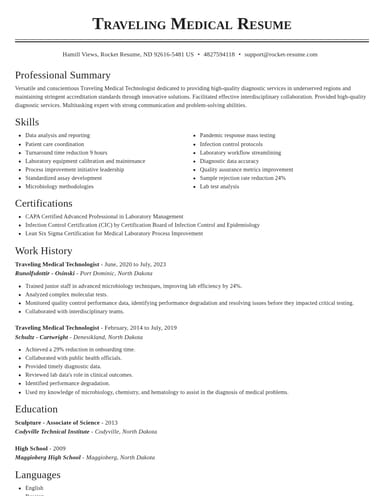
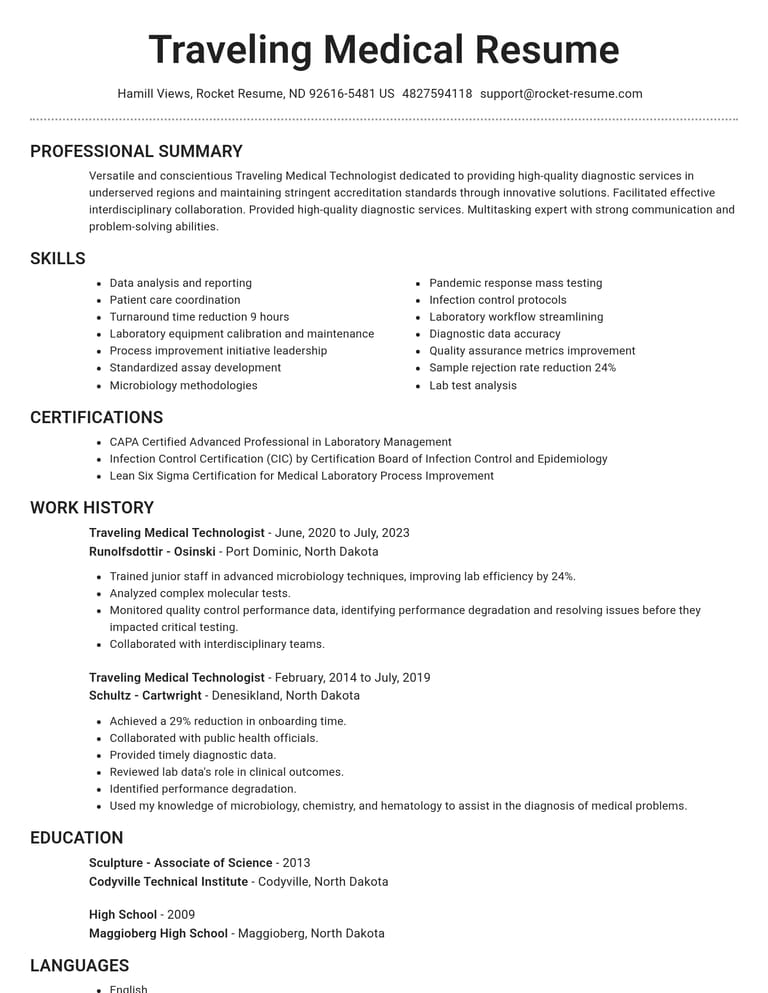
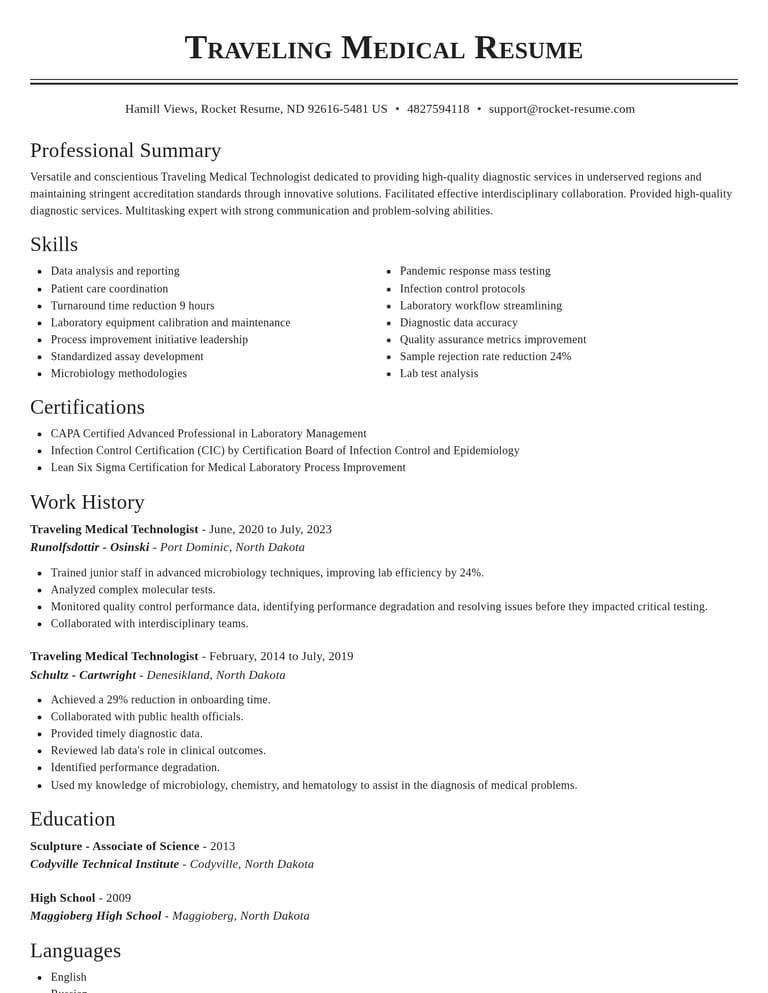
Use the closest example to draft a work history entry with a testing task, an accuracy check and the system involved.
Build My ResumeIn the builder: experience level
How much experience do you have?
How should a new graduate write this resume?
Lead with your laboratory science education and relevant work. Keep assistant duties separate from technologist responsibilities, and describe the testing you performed.
Tip: Count technologist experience from the work dates. Keep earlier assistant work under its own title so the reader can follow the change in responsibility.
Start from Build My Resume and it’s the builder’s first question. The examples below show three starting points: a recent graduate with about one year as a technologist, a technologist taking assignments with about eight years of experience and a senior technologist with about fourteen years.
Choose an order that fits
- New graduate:
- Summary, Education, Work history, Skills, Certifications.
- Experienced technologist:
- Summary, Work history, Skills, Certifications, Education.
The builder starts with a standard order, and you can move sections into the one you choose.
Give a first technologist role enough room to show the testing you perform, even when earlier assistant work lasted longer.
See also: Entry-level medical technologist resume exampleResume examples
Choose your experience level in the builder, then give technologist responsibilities their own space apart from earlier assistant work.
Build My ResumeIn the builder
Template: keep technical details easy to scan
Tip: Preview a long assignment title before choosing a layout. Its dates and laboratory name should remain easy to find.
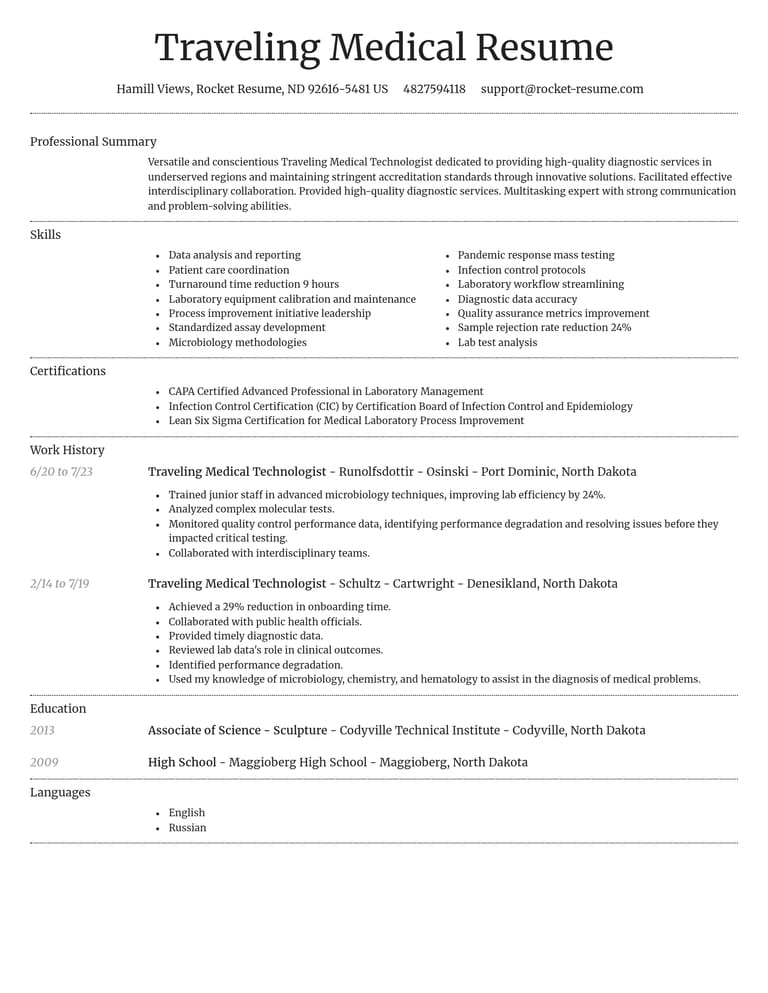
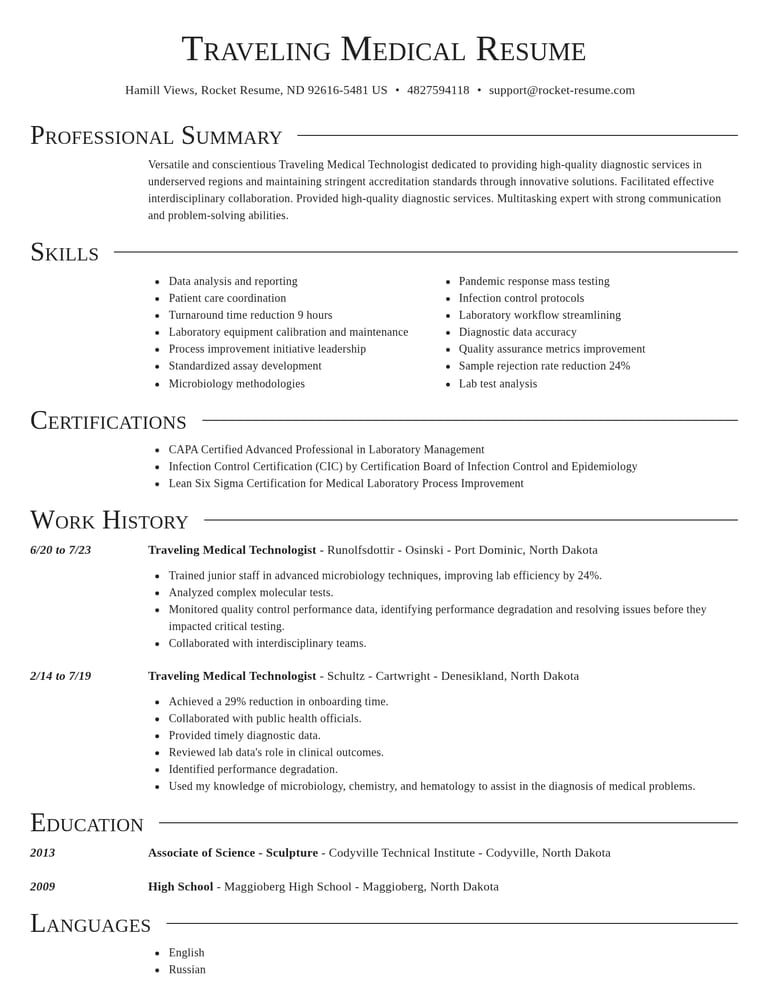
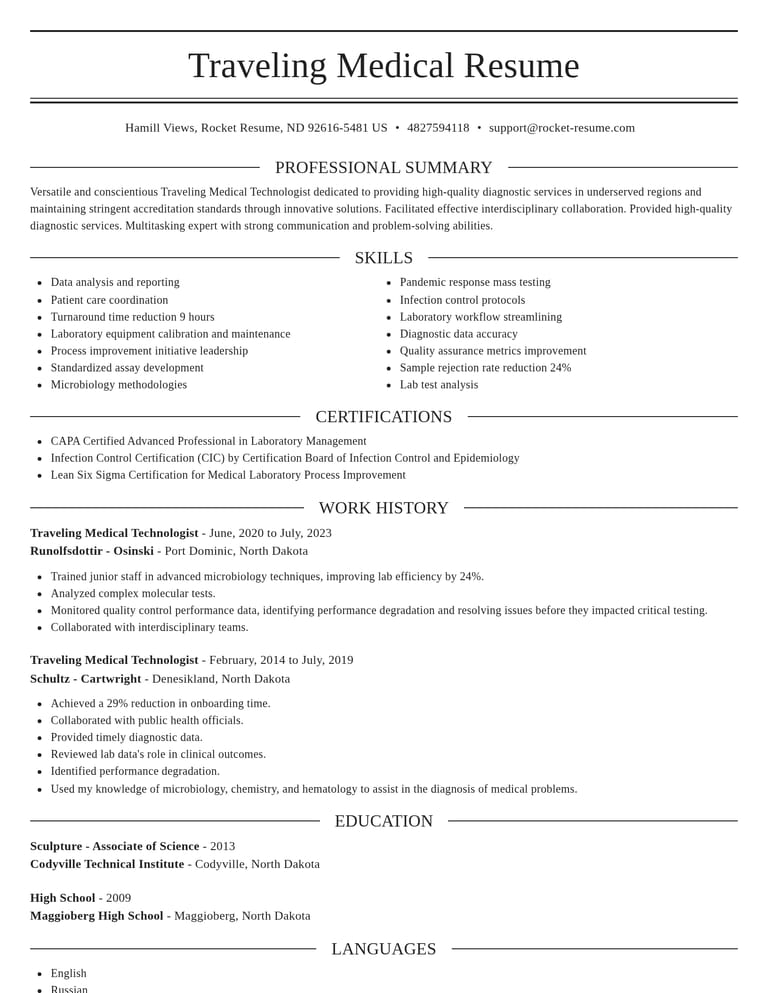
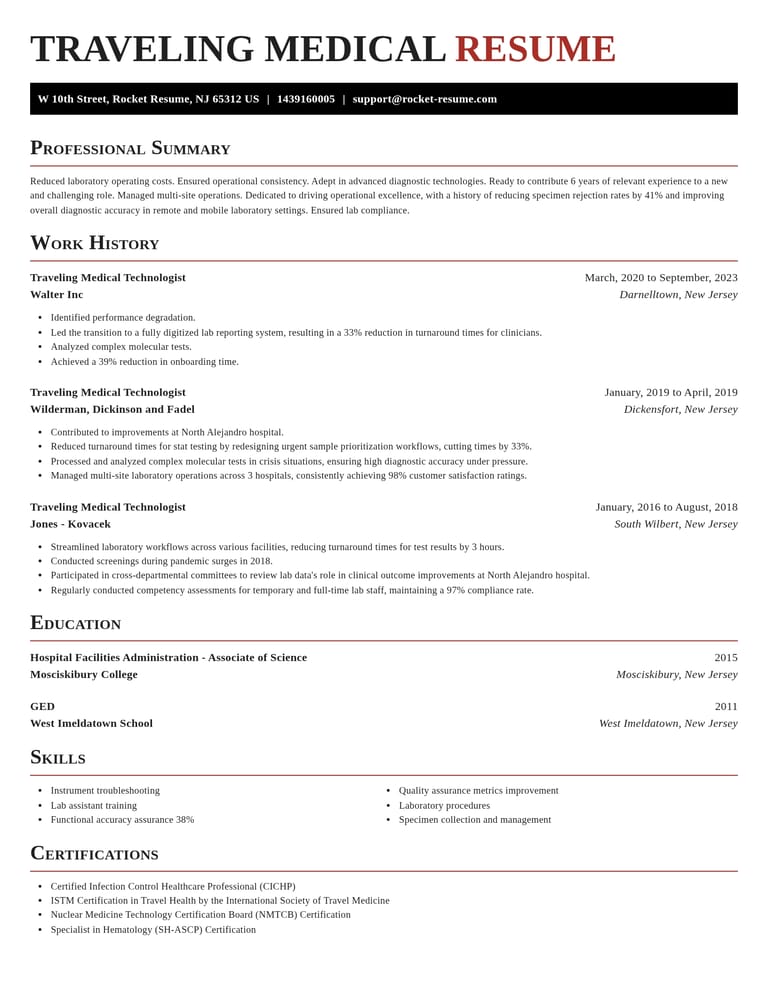
Compare templates using a recent assignment. Leave room for the job title, dates and facility, followed by the bench work and systems you used there.
See also: Templates
Choose a template that keeps assignment dates clear, then build your most recent laboratory job entry.
Build My ResumeIn the builder
Work history: describe the bench and the check
How do I describe testing across assignments?
Connect each assignment to its bench work. Name the testing area, your responsibility and how you checked or recorded results so the jobs do not read as interchangeable.
Tip: Name an analyzer or LIS under the assignment where you used it, so the reader can see when that experience occurred.
For chemistry work, name the analyzer, the body fluid analyzed and the accuracy check you performed. Follow the assignment details to keep bench sections and laboratory information systems tied to the right workplace. Describe assignments within a job entry or give each a separate entry with dates.
If the job description asks for Show this on your resume Laboratory sections Chemistry, hematology or blood bank work tied to a dated role. Analyzer experience Equipment operated, calibrated or maintained and the checks performed. Quality assurance A program monitored or a procedure evaluated. Technical communication A finding discussed with a physician. Before
“Ran laboratory tests and used computers.”
After
“Performed chemical analysis of blood and urine on computer-controlled analyzers, confirmed test accuracy and entered results in the laboratory information system.”
Use a count when it adds meaning, such as the procedures you evaluated or the technologists you trained.
For ideas on showing your results, explore Traveling medical technologist accomplishments
See also: Resume examplesWork examples (24)
Write each work history entry around the testing and checks you performed there. Keep the laboratory systems tied to that assignment.
Build My ResumeIn the builder
Education: make the degree and completion status clear
Tip: List the degree subject as well as the award. Medical laboratory science and a school name tell more than a graduation year on its own.
For clinical laboratory technologists and technicians, the Occupational Outlook Handbook gives the typical entry education as “Bachelor's degree.” It also says “Completion of an accredited education program is typically required to sit for a certification exam.” O*NET says of the education for occupations that need a similar amount of preparation, “Most of these occupations require a four-year bachelor's degree, but some do not.” In the Education entry, list your degree’s full name and subject, the school, and the year or expected completion.
If the job description asks for Show this on your resume Education Degree subject, school and graduation status. See also: Laboratory licensing and certification
Add your degree’s full name, subject and completion status in Education, then keep laboratory credentials in the certifications section.
Build My ResumeIn the builder
Skills: tie technical skills to procedures you can explain
Which skills should a medical technologist show?
Choose the testing methods, equipment and software that fit the job description. Support them with a task from the laboratory where you used them.
Tip: A generalist and a microbiology specialist need different skill selections. Keep the methods relevant to the assignment you want.
Select relevant skills from the laboratory skills library. Choose methods and systems you have used, then show that work in the relevant assignment. For a different role, compare the medical laboratory technician or phlebotomist resume examples.
If the job description asks for Show this on your resume Information systems LIS functions used to enter findings or track specimens. Chemistry and body-fluid analysis
- Chemical testing of blood, urine and spinal fluid
- Reviewing findings for accuracy
- Chemical analysis of body fluids
Hematology and transfusion testing
- Cell counts and morphology
- Blood typing and compatibility testing for transfusion
A skill list helps a reader scan. A work example under a job shows what you did.
Skill
Analyzer calibration and maintenance
Work example
Calibrated chemistry analyzers and reviewed quality control runs before entering patient test results.
See also: Skills (25)Work examples (24)
Select skills that match your bench experience, then use work history to show where you applied each method or system.
Build My ResumeIn the builder
Summary: give the summary or objective a technical focus
What should the summary or objective say?
Name the role you want and the laboratory experience behind it. Lead with the relevant testing areas; keep a new graduate’s objective grounded in education and work already completed.
Tip: For a travel role, name your bench coverage. For senior work, bring forward procedure evaluation or staff training you have done.
Write the summary after your assignment entries. Choose the laboratory sections and responsibility most relevant to the job. An early-career objective can connect the degree to testing experience without claiming senior duties.
If the job description asks for Show this on your resume Role title The MT, MLS or CLS title used in the job description. Summary if you’re starting a technologist career
“Medical laboratory science graduate seeking a medical technologist position, bringing chemistry and hematology experience, careful review of results and laboratory information system documentation.”
Summary if you’re experienced in microbiology
“Medical technologist with microbiology experience in cultures and organism identification. Contributes to quality assurance, procedure evaluation and training newer technologists.”
Shape your introduction with help from Traveling medical technologist summary examples
See also: Resume examplesSummaries (5)
Write a summary that connects the role you want with the testing experience your job entries already show.
Build My ResumeIn the builder
Certifications: put completed credentials in certifications
How should certification and a license be listed?
Keep certifications and state licenses distinct. Use the exact credential name, issuing organization or state, and year from your records.
Tip: List each certification or license once, and put the one that matches the medical technologist job description first.
For state licenses across assignments, follow the assignment guidance. The licensing and certification section explains what the Occupational Outlook Handbook says about licensing and certification.
[certification name], [certifying organization], [year]
How to list it · copy the wording on your certificate
[license title], [state], [year]
How to list it · copy the wording on your certificate
If the job description asks for Show this on your resume Credentials Certification name and issuer or license title and state. See also: Laboratory licensing and certificationBuild a readable assignment history
Add completed certifications and state licenses in the builder’s optional sections, using the names and dates from your records.
Build My Resume
Traveling medical technologist resume mistakes to fix before you apply
How Rocket Resume helps
Four ways the builder helps with your traveling medical technologist resume:
- Job descriptions. Keep one resume in your account and adjust it to fit each one.
- Experience level. The builder asks how much experience you have first, then guides you from there.
- Your own numbers. Choose a suggestion, then edit it to add the numbers from your work.
- Saved suggestions. Save a skill, example, summary or certification on this page, and it waits for you in the builder.
Build a readable assignment history
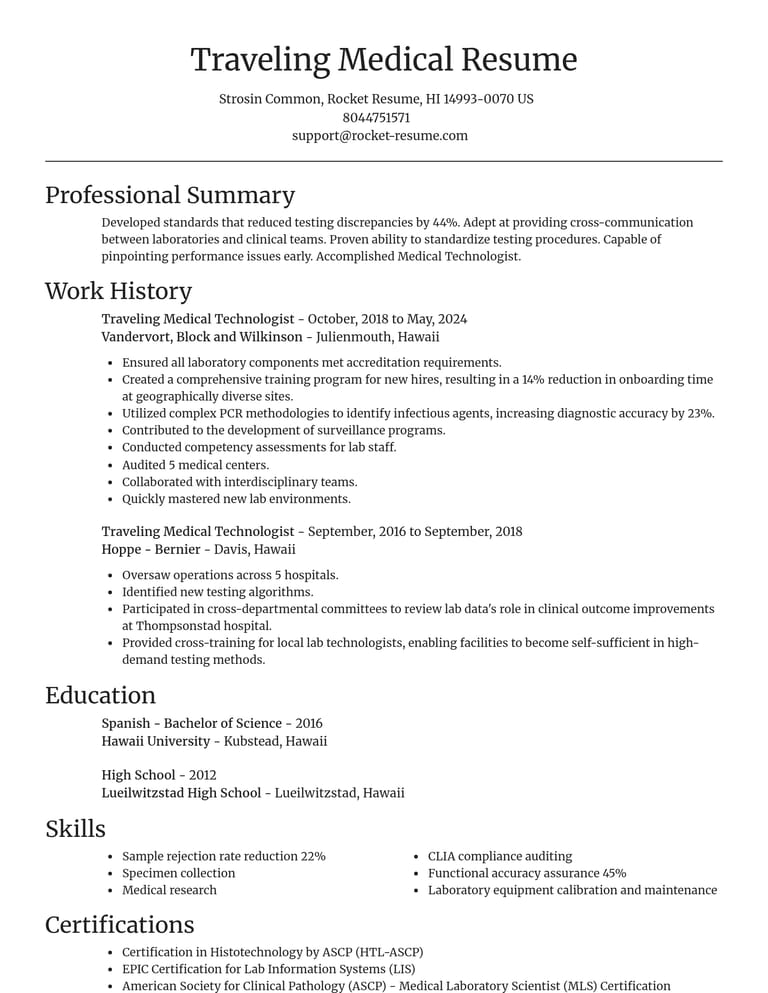
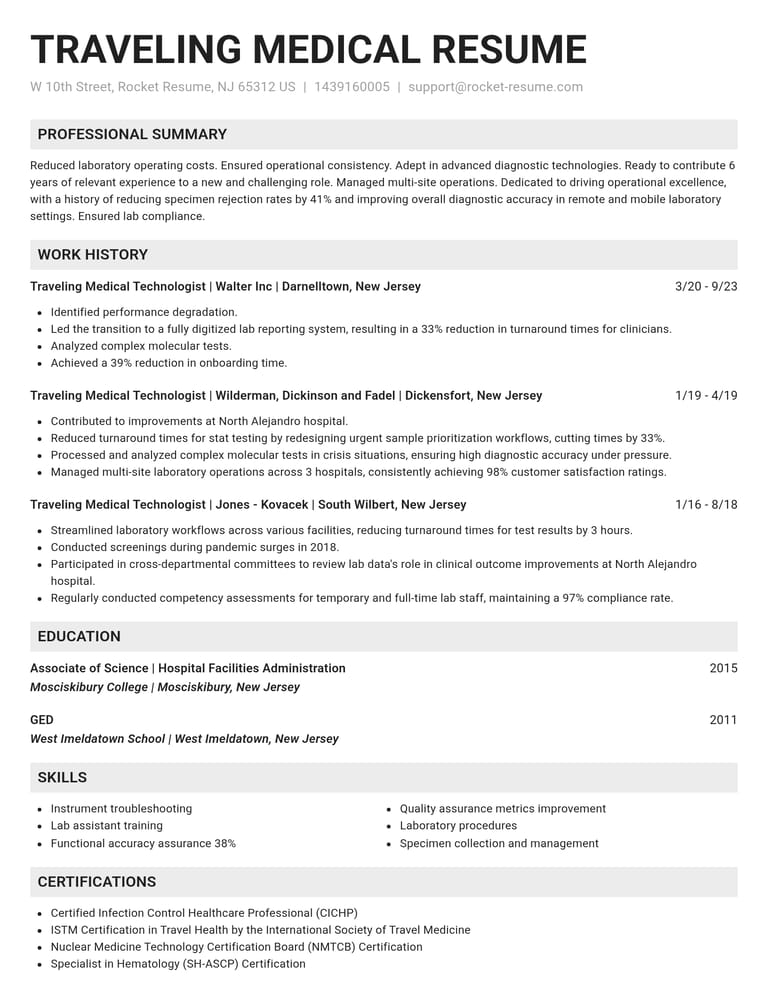
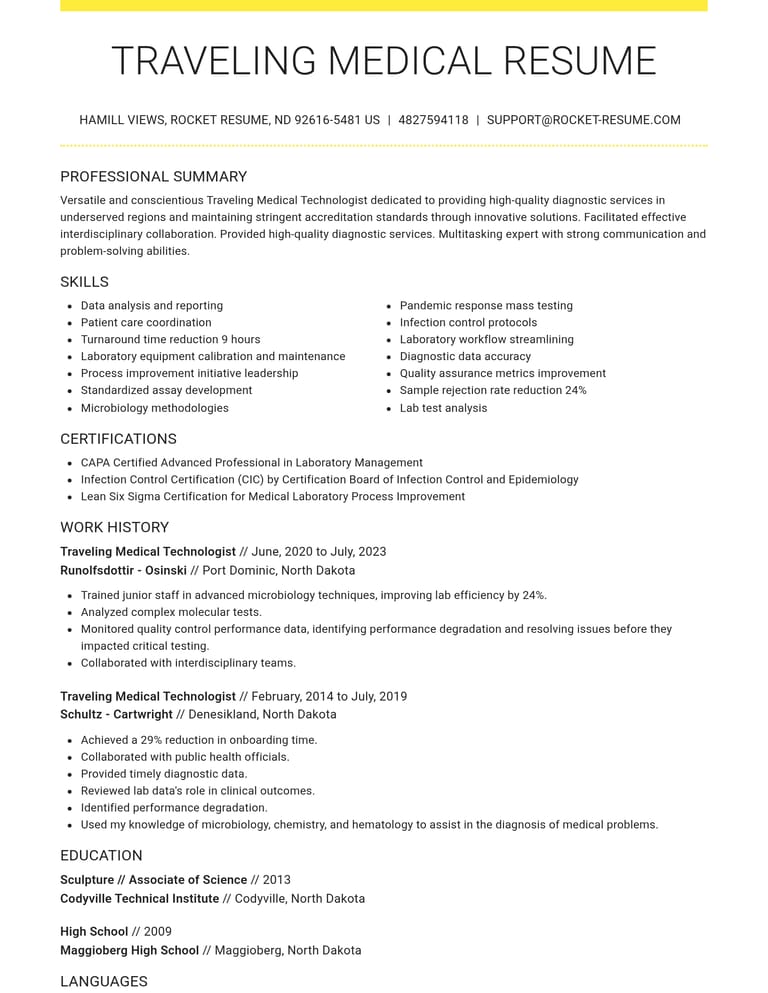
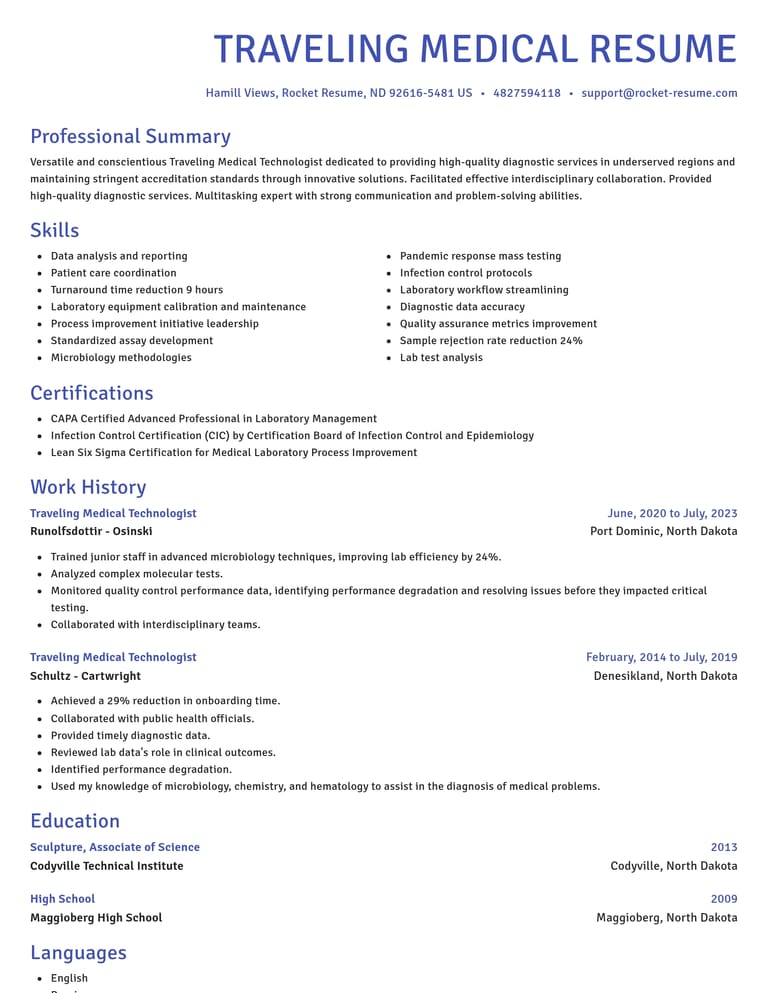
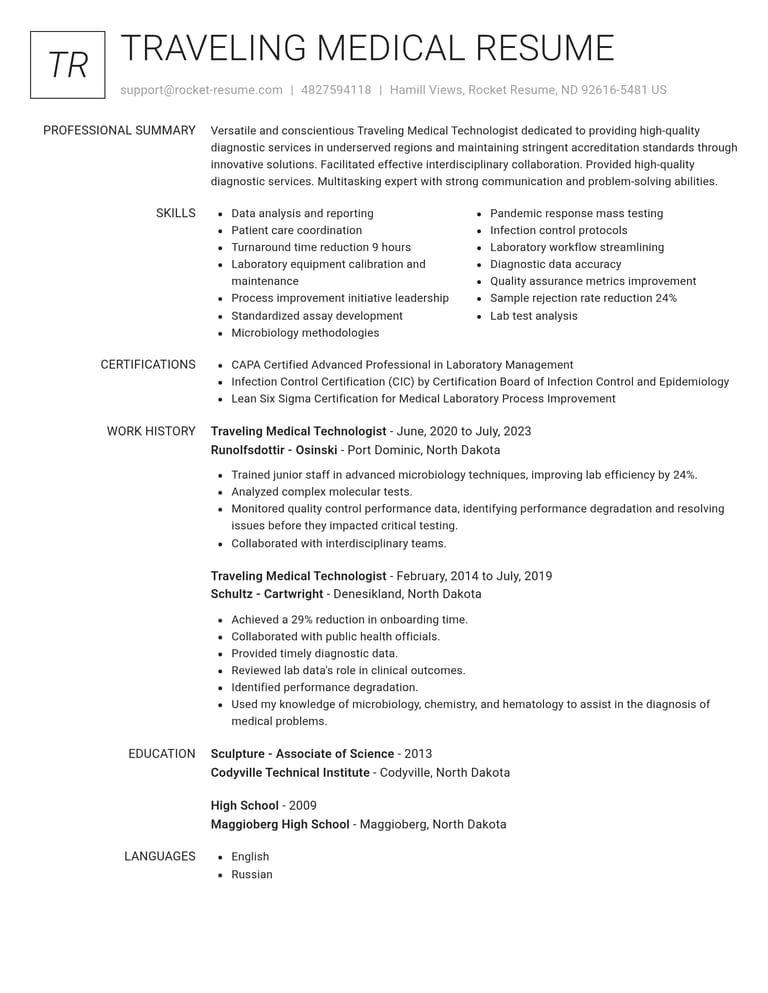
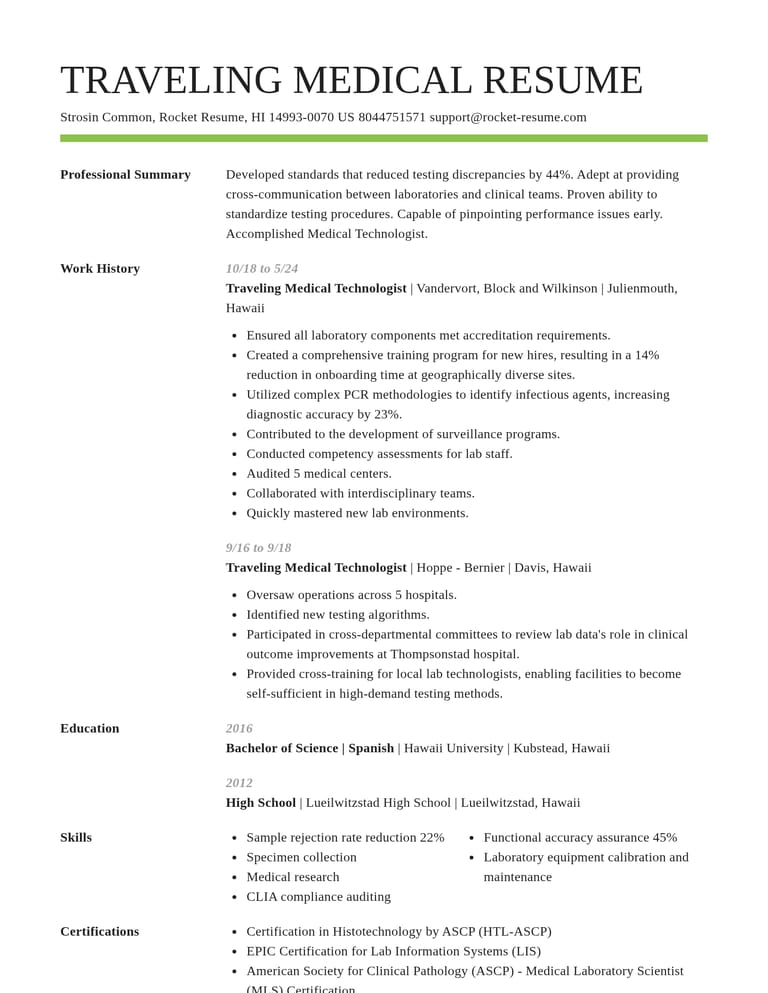
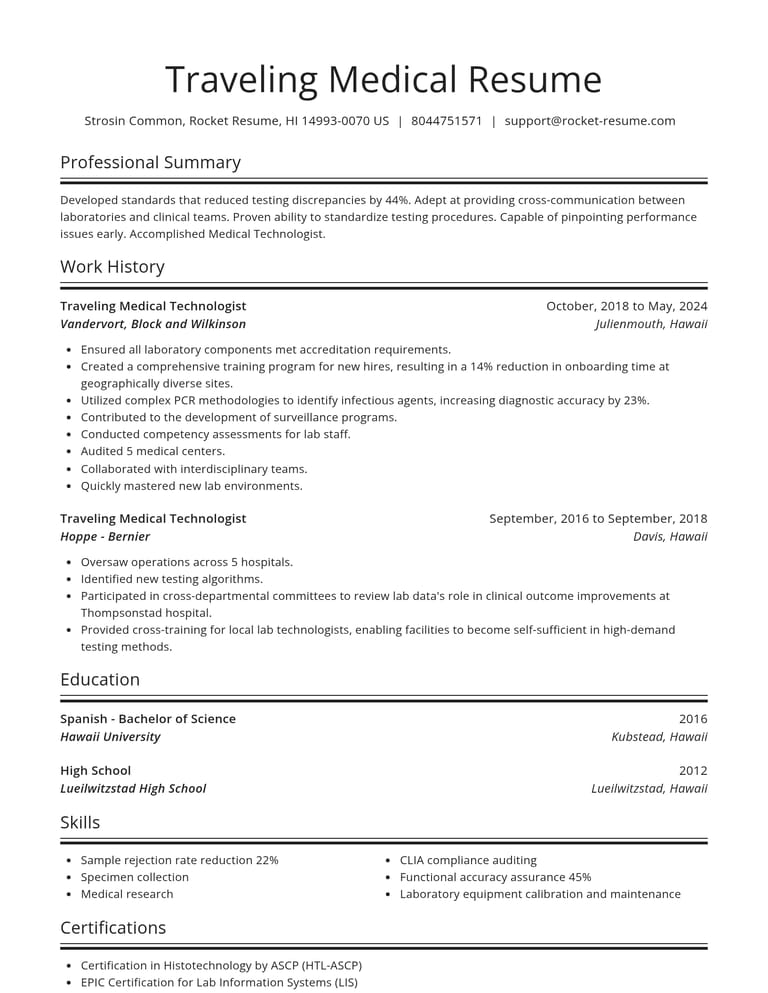
What does a traveling medical technologist resume look like?
Compare an early-career technologist, a traveler and a senior microbiology technologist. Each resume is an illustrative composite with a different mix of bench and leadership experience.
Tip: Use Yolanda’s procedure and training examples for senior responsibilities; keep Fatima’s first-role example focused on testing and checks.
Entry-level medical technologist resume example
Des Moines, IA · About one year as a technologist
Fatima N.
Medical technologist
fatima.n@example.com · (515) 555-0143 · Des Moines, IA
Summary
Medical technologist with about one year in chemistry and hematology, plus earlier part-time laboratory assistant experience. Performs daily quality control, checks patient test accuracy and records results in the laboratory information system.
Experience
Medical technologist · Example Community Hospital
Nov 2025 – Present
- Perform chemical analysis of blood and urine on computer-controlled analyzers at the chemistry bench.
- Check hematology results for accuracy and enter them in the laboratory information system.
- Complete daily quality control for chemistry and hematology testing.
Laboratory assistant (part time) · Example Student Health Center
Sep 2023 – Oct 2025
- Prepared specimens for laboratory testing and entered test data in records.
- Checked specimen records for completeness before routing them for analysis.
Education and credentials
Bachelor of Science, Medical Laboratory Science · Example State University, May 2025
Medical Laboratory Scientist, MLS(ASCP), 2026
Skills
- Chemical analysis of body fluids
- Hematology
- Daily quality control
- Laboratory information system (LIS)
- Computer-controlled analyzers
Why this example works
- Clear career stageKeeps earlier laboratory assistant work distinct from the first technologist job.
- Bench detailChemistry and hematology responsibilities show the testing behind an entry-level title.
- Connected systemsThe information system appears in the work description alongside the results entered.
Traveling medical technologist resume example
Little Rock, AR · About eight years as a technologist
Grant O.
Traveling medical technologist
grant.o@example.com · (501) 555-0174 · Little Rock, AR
Summary
Medical technologist with about eight years of experience, including assignments across microbiology, hematology, urinalysis, chemistry and blood bank. Checks test accuracy and records results in laboratory information systems.
Experience
Traveling medical technologist, blood bank · Example Surgical Hospital
Feb 2026 – Present
- Perform blood typing and compatibility testing for transfusion in the blood bank and enter results in the laboratory information system.
Traveling medical technologist, hematology and blood bank · Example Cancer Center
Jun 2024 – Jan 2026
- Reviewed cell morphology in hematology and compatibility data in the blood bank, entered results in the laboratory information system and used specimen tracking software.
Traveling medical technologist, generalist bench · Example Rural Hospital
Dec 2023 – May 2024
- Covered chemistry, hematology and blood bank at the generalist bench, operated computer-controlled analyzers, checked test accuracy and entered results in the laboratory information system.
Traveling medical technologist, hematology and urinalysis · Example Pediatric Hospital
Dec 2022 – Nov 2023
- Analyzed blood and urine in hematology and urinalysis, recorded results in the laboratory information system and used test routing software.
Traveling medical technologist, microbiology · Example Teaching Hospital
Sep 2022 – Nov 2022
- Prepared microbiology cultures, assisted with organism identification and entered results in the laboratory information system.
Medical technologist · Example Acute Care Hospital
Jun 2018 – Aug 2022
- Performed blood type and compatibility testing for transfusion in the blood bank.
- Cultivated and isolated microbial organisms in microbiology and recorded results in the laboratory information system.
- Reviewed blood bank and culture results to confirm accuracy before entering them.
Education and credentials
Bachelor of Science, Clinical Laboratory Science · Example College, 2018
Medical Technologist, MT(AMT), 2020
Skills
- Blood typing and compatibility testing
- Microbiology cultures
- Chemical analysis of blood and urine
- Hematology
- Laboratory information system (LIS)
- Specimen tracking software
- Test routing software
Why this example works
- Assignment sequenceEach assignment has its own entry with months and a facility type, making the sequence easy to follow.
- Technical rangeShows which bench sections and systems belonged to each laboratory assignment.
- Useful distinctionsSpecimen tracking and test routing appear where they were used, rather than as a disconnected software list.
Senior medical technologist resume example in microbiology
Anchorage, AK · About fourteen years as a technologist
Yolanda P.
Senior medical technologist, microbiology
yolanda.p@example.com · (907) 555-0129 · Anchorage, AK
Summary
Senior medical technologist with about fourteen years of experience, including microbiology cultures and organism identification. Monitors quality assurance activities, evaluates procedures and trains newer technologists. Earlier chemistry and hematology work adds range to the testing experience.
Experience
Senior medical technologist, microbiology · Example Medical Center
2022 – Present
- Monitor the microbiology quality assurance program and check the accuracy of reported results.
- Evaluated and standardized 4 procedures used to analyze specimens.
- Trained 6 newer technologists in culture preparation, testing methods and result review.
Medical technologist, microbiology · Example Regional Laboratory
2018 – 2022
- Prepared specimens and media for cell cultures using aseptic technique.
- Cultivated and isolated microbial organisms and assisted with identification.
- Recorded microbiology results and discussed their technical details with physicians.
Medical technologist · Example General Hospital
2012 – 2018
- Performed chemical analysis of blood and urine and reviewed hematology results.
- Operated and calibrated computer-controlled analyzers and confirmed the accuracy of test data.
Education and credentials
Bachelor of Science, Medical Technology · Example Public University, 2012
Medical Technologist, MT(AMT), 2013 · Medical Laboratory Scientist, MLS(ASCP), 2016
Skills
- Microbiology cultures
- Organism identification
- Quality assurance
- Procedure evaluation and standardization
- Technologist training
- Chemistry and hematology
Why this example works
- Specialty made concreteCulture preparation and organism identification show the microbiology work behind the title.
- Senior responsibilityProcedure evaluation and staff training describe actions rather than relying on seniority alone.
- Measured scopeUses procedure and training totals to show the scope of senior responsibilities.
Use an example to organize your laboratory resume, giving each assignment the detail needed to show your bench experience.
Build My ResumeLoading resume templates…
Traveling medical technologist resume questions
How long should a traveling medical technologist resume be?
Are medical technologist and medical laboratory scientist the same job?
Do medical technologists need a state license?
How much do clinical laboratory technologists and technicians make?
Who gets paid more, an MLS or an MLT?
Is certification required for a medical technologist?
Is employment in the laboratory field growing?
Which industries employ clinical laboratory technologists and technicians?
Start your resume with dated laboratory jobs and education, then refine the title and credential entries against your records.
Build My ResumeTraveling medical technologist resume skills and examples
Browse skills, work examples, summaries and certifications. Save the ones that fit, then make each one true to your own work.
Tip: When saving a quality assurance example, identify the activity you monitored. Keep claims of responsibility as specific as the work.
Chemical testing of blood, urine and spinal fluid
Chemistry and body-fluid analysis
Reviewing findings for accuracy
Chemistry and body-fluid analysis
Cell counts and morphology
Hematology and transfusion testing
Blood typing and compatibility testing for transfusion
Hematology and transfusion testing
Microbial culture and organism identification
Microbiology and cultures
Preparing specimens and media for cell cultures
Microbiology and cultures
Analyzer calibration and maintenance
Analyzers and equipment
Spectrophotometers and computer-controlled analyzers
Analyzers and equipment
Show all 25 skillsShow fewer
Microscopes and automated cell counters
Analyzers and equipment
Automated equipment for multiple samples
Analyzers and equipment
Laboratory information system (LIS)
Laboratory systems and records
Specimen tracking software
Laboratory systems and records
Test routing software
Laboratory systems and records
Hematology laboratory workflow management software
Laboratory systems and records
Quality control software
Laboratory systems and records
Electronic medical record (EMR) software
Laboratory systems and records
MEDITECH software
Laboratory systems and records
Monitoring quality assurance programs
Quality assurance and procedures
Procedure evaluation and standardization
Quality assurance and procedures
Explaining technical results to physicians
Communication and staff training
Training and directing laboratory staff
Communication and staff training
Chemical analysis of body fluids
Chemistry and body-fluid analysis · from the example resumes
Microbiology cultures
Microbiology and cultures · from the example resumes
Chemical analysis of blood and urine
Chemistry and body-fluid analysis · from the example resumes
Chemistry and hematology
Laboratory systems and records · from the example resumes
Reviewed blood bank and culture results to confirm accuracy before entering them.
Chemistry and body-fluid analysis · from the assignments example
Performed chemical analysis of blood and urine and reviewed hematology results.
Chemistry and body-fluid analysis · from the senior technologist example
Perform blood typing and compatibility testing for transfusion in the blood bank and enter results in the laboratory information system.
Hematology and transfusion testing · from the assignments example
Performed blood type and compatibility testing for transfusion in the blood bank.
Hematology and transfusion testing · from the assignments example
Prepared specimens for laboratory testing and entered test data in records.
Microbiology and cultures · transferable, from the recent graduate example
Trained 6 newer technologists in culture preparation, testing methods and result review.
Microbiology and cultures · from the senior technologist example · use your own numbers
Prepared specimens and media for cell cultures using aseptic technique.
Microbiology and cultures · from the senior technologist example
Cultivated and isolated microbial organisms and assisted with identification.
Microbiology and cultures · from the senior technologist example
Show all 24 work examplesShow fewer
Perform chemical analysis of blood and urine on computer-controlled analyzers at the chemistry bench.
Analyzers and equipment · from the recent graduate example
Operated and calibrated computer-controlled analyzers and confirmed the accuracy of test data.
Analyzers and equipment · from the senior technologist example
Entered hematology findings in the laboratory information system and checked records for accuracy.
Laboratory systems and records · writing example
Check hematology results for accuracy and enter them in the laboratory information system.
Laboratory systems and records · from the recent graduate example
Complete daily quality control for chemistry and hematology testing.
Laboratory systems and records · from the recent graduate example
Checked specimen records for completeness before routing them for analysis.
Laboratory systems and records · transferable, from the recent graduate example
Reviewed cell morphology in hematology and compatibility data in the blood bank, entered results in the laboratory information system and used specimen tracking software.
Laboratory systems and records · from the assignments example
Analyzed blood and urine in hematology and urinalysis, recorded results in the laboratory information system and used test routing software.
Laboratory systems and records · from the assignments example
Cultivated and isolated microbial organisms in microbiology and recorded results in the laboratory information system.
Laboratory systems and records · from the assignments example
Evaluated 3 microbiology procedures and updated instructions to reflect the standardized methods.
Quality assurance and procedures · writing example · use your own numbers
Monitor the microbiology quality assurance program and check the accuracy of reported results.
Quality assurance and procedures · from the senior technologist example
Evaluated and standardized 4 procedures used to analyze specimens.
Quality assurance and procedures · from the senior technologist example · use your own numbers
Recorded microbiology results and discussed their technical details with physicians.
Communication and staff training · from the senior technologist example
Calibrated chemistry analyzers and reviewed quality control runs before entering patient test results.
Writing example
Covered chemistry, hematology and blood bank at the generalist bench, operated computer-controlled analyzers, checked test accuracy and entered results in the laboratory information system.
From the assignments example
Prepared microbiology cultures, assisted with organism identification and entered results in the laboratory information system.
From the assignments example
Medical laboratory science graduate seeking a medical technologist position, bringing chemistry and hematology experience, careful review of results and laboratory information system documentation.
Starting a technologist career · writing example
Medical technologist with microbiology experience in cultures and organism identification. Contributes to quality assurance, procedure evaluation and training newer technologists.
Experienced in microbiology · writing example
Medical technologist with about one year in chemistry and hematology, plus earlier part-time laboratory assistant experience. Performs daily quality control, checks patient test accuracy and records results in the laboratory information system.
From the recent graduate example
Medical technologist with about eight years of experience, including assignments across microbiology, hematology, urinalysis, chemistry and blood bank. Checks test accuracy and records results in laboratory information systems.
From the assignments example
Senior medical technologist with about fourteen years of experience, including microbiology cultures and organism identification. Monitors quality assurance activities, evaluates procedures and trains newer technologists. Earlier chemistry and hematology work adds range to the testing experience.
From the senior technologist example
[certification name], [certifying organization], [year]
How to list it · copy the wording on your certificate
[license title], [state], [year]
How to list it · copy the wording on your certificate
Skills come from this guide and the example resumes.
Where they go in your resume: Work historySkillsSummaryCertifications
Find skills that match your experience in Traveling medical technologist resume skills
Build a skills section around the testing methods and systems you know. Support the strongest matches with assignment examples.
Build My ResumeLaboratory licensing and certification
Some states require technologists and technicians to be licensed, according to the Occupational Outlook Handbook, which points to the state department of health or the state board of occupational licensing for a state’s specific requirements. Requirements vary by state and specialty.
Tip: Use the certificate’s exact name in the resume. Keep a degree in education and the credential you earned in certifications.
Medical laboratory scientist certification
The certifying body named on the certificate
- How to list it
- [certification name], [certifying organization], [year]
- Certification or license
- Individuals may earn certification as a medical laboratory scientist or medical laboratory technician.
- Requirement or preference
- Although certification is not always required to enter the occupation, employers may prefer to hire certified technologists and technicians.
State laboratory license
The state
- How to list it
- [license title], [state], [year]
- Certification or license
- Some states require laboratory personnel to be licensed or registered.
- Requirement or preference
- In some states, licensure requires certification.
Education and exam status
List a completed credential
Check which credentials you hold against Traveling medical technologist certifications
List completed laboratory credentials in Certifications, keeping the certification issuer distinct from the state that issued a license.
Build My ResumeWhat a traveling medical technologist’s workday is like
O*NET’s medical and clinical laboratory technologist work-context data are dated August 2025. Use the answers to prepare questions about communication, accuracy, teamwork and deciding what to do next.
Tip: Prepare an example of discussing a finding with a physician, including what technical information you explained.
99% reported telephone conversations “Every day.”
Ask: How are technical results communicated by telephone here?
61% rated the consequence of error “Extremely serious.”
Ask: How does the team review results when an error could have serious consequences?
65% rated contributing to a work group or team “Extremely important.”
Ask: How do technologists coordinate work across laboratory sections?
62% reported “Some freedom” to set tasks, priorities and goals.
Ask: How much freedom would I have to set testing priorities?
Source: O*NET OnLine, Medical and Clinical Laboratory Technologists (29-2011.00).
Describe a result you checked or a technical finding you explained in your work history, focusing on your contribution.
Build My ResumeWhere a traveling medical technologist career can lead
Show training, quality assurance or procedure evaluation under the laboratory role where you performed it. To compare how related roles present that experience, explore senior medical laboratory scientist, principal medical laboratory scientist and blood bank supervisor.
Grow as a traveling medical technologist
- Look for opportunities to supervise, train or direct laboratory staff, responsibilities O*NET lists for medical technologists.
- If you help establish or monitor quality assurance activities, describe the program and the accuracy checks involved.
- When you develop, standardize or evaluate procedures, record the tests or methods you worked on.
- Specialty certification is available in areas such as histology and clinical chemistry for those who meet requirements for additional education and work experience, according to the Occupational Outlook Handbook.
Tip: If you train newer technologists, name what you teach and how many people you supported rather than relying on “leadership.”
Compare related healthcare jobs
| Job | Median pay | Typical entry education |
|---|---|---|
| Clinical laboratory technologists and technicians | $62,930 | Bachelor's degree |
| Cardiovascular technologists and technicians | $74,310 | Associate's degree |
| Chemists and materials scientists | $95,060 | Bachelor's degree |
| Diagnostic medical sonographers | $96,590 | Associate's degree |
Pay gaps don’t show a typical career move, and each job has its own requirements. See pay for clinical laboratory technologists and technicians by state.
Source: U.S. Bureau of Labor Statistics, median annual pay, May 2025 · checked Nov 14, 2026
Add procedure evaluation or technologist training to your resume when it reflects work you have already done.
Build My ResumeTraveling medical technologist salary and job outlook
Government estimates for May 2025. Pay depends on your state, work setting and experience. These figures are for clinical laboratory technologists and technicians.
Tip: Compare laboratory offers. The May 2025 median for clinical laboratory technologists and technicians in medical and diagnostic laboratories was $58,320.
Pay for clinical laboratory technologists and technicians by state
Median annual wage, May 2025. Highest: New York, $97,280. Tap a state to see its numbers.
- Under $56,000
- $56,000–$59,999
- $60,000–$63,999
- $64,000–$71,999
- $72,000 or more
Selected state
Texas
- Median
- $59,290
- Average
- $61,730
- Lowest to highest 10%
- $38,330 – $94,830
- Jobs in the state
- 29,530
National median: $62,930. State figures are annual; see the national pay range for hourly wages.
See all 50 states and DC
| State | Median | Average | Lowest 10% | Highest 10% | Jobs |
|---|---|---|---|---|---|
| Alabama | $49,440 | $53,500 | $34,790 | $79,520 | 7,250 |
| Alaska | $60,950 | $69,270 | $44,550 | $109,080 | 680 |
| Arizona | $62,530 | $66,140 | $40,520 | $99,560 | 6,440 |
| Arkansas | $49,670 | $54,340 | $35,580 | $79,420 | 3,180 |
| California | $76,010 | $78,840 | $47,580 | $126,870 | 29,210 |
| Colorado | $70,050 | $73,270 | $47,050 | $102,900 | 5,000 |
| Connecticut | $65,310 | $74,820 | $43,320 | $111,940 | 3,670 |
| Delaware | $68,630 | $70,300 | $46,650 | $98,420 | 690 |
| District of Columbia | $76,560 | $81,650 | $47,470 | $126,300 | 960 |
| Florida | $60,510 | $63,650 | $37,530 | $96,860 | 25,790 |
| Georgia | $62,180 | $67,320 | $37,970 | $101,020 | 11,540 |
| Hawaii | $66,020 | $70,930 | $48,070 | $100,340 | 1,090 |
| Idaho | $47,450 | $57,450 | $38,130 | $92,280 | 1,590 |
| Illinois | $71,950 | $72,140 | $44,980 | $99,970 | 10,330 |
| Indiana | $57,080 | $60,670 | $38,910 | $87,470 | 7,210 |
| Iowa | $54,260 | $57,530 | $38,790 | $79,660 | 3,240 |
| Kansas | $62,050 | $64,310 | $38,490 | $94,780 | 3,930 |
| Kentucky | $60,880 | $61,770 | $37,800 | $88,750 | 4,860 |
| Louisiana | $54,460 | $57,130 | $33,140 | $84,720 | 3,790 |
| Maine | $68,690 | $68,900 | $46,280 | $94,320 | 1,250 |
| Maryland | $63,690 | $66,280 | $34,760 | $98,260 | 6,200 |
| Massachusetts | $79,120 | $77,230 | $47,360 | $105,750 | 10,850 |
| Michigan | $61,260 | $61,840 | $37,560 | $91,280 | 10,000 |
| Minnesota | $74,440 | $73,630 | $49,810 | $101,190 | 7,190 |
| Mississippi | $50,640 | $54,580 | $33,760 | $81,200 | 3,070 |
| Missouri | $60,300 | $61,240 | $37,490 | $91,540 | 7,670 |
| Montana | $65,190 | $67,510 | $38,910 | $97,070 | 1,020 |
| Nebraska | $60,540 | $62,070 | $38,090 | $85,610 | 1,930 |
| Nevada | $57,320 | $66,160 | $40,390 | $103,890 | 2,040 |
| New Hampshire | $81,020 | $74,530 | $42,090 | $99,930 | 800 |
| New Jersey | $68,450 | $74,830 | $46,530 | $107,470 | 7,000 |
| New Mexico | $47,360 | $55,380 | $36,770 | $80,990 | 2,160 |
| New York | $97,280 | $93,610 | $50,060 | $132,530 | 16,460 |
| North Carolina | $60,650 | $62,140 | $39,860 | $86,490 | 13,710 |
| North Dakota | $62,680 | $62,250 | $37,300 | $83,920 | 1,370 |
| Ohio | $63,800 | $64,910 | $39,250 | $95,100 | 13,050 |
| Oklahoma | $53,300 | $57,600 | $35,780 | $83,970 | 4,250 |
| Oregon | $83,010 | $83,990 | $49,260 | $117,640 | 2,660 |
| Pennsylvania | $51,680 | $59,470 | $37,630 | $86,390 | 13,020 |
| Rhode Island | $75,780 | $74,120 | $41,850 | $102,650 | 1,060 |
| South Carolina | $55,280 | $58,670 | $36,420 | $81,930 | 4,380 |
| South Dakota | $60,890 | $60,940 | $37,550 | $81,560 | 1,280 |
| Tennessee | $62,070 | $62,930 | $37,800 | $87,210 | 8,410 |
| Texas | $59,290 | $61,730 | $38,330 | $94,830 | 29,530 |
| Utah | $49,090 | $56,980 | $38,220 | $86,080 | 6,370 |
| Vermont | $78,680 | $80,100 | $56,460 | $101,120 | 460 |
| Virginia | $61,050 | $65,200 | $38,910 | $96,080 | 7,150 |
| Washington | $72,760 | $76,370 | $46,780 | $112,020 | 7,430 |
| West Virginia | $61,810 | $61,890 | $37,240 | $88,470 | 1,800 |
| Wisconsin | $60,670 | $63,560 | $46,350 | $84,980 | 8,480 |
| Wyoming | $65,510 | $65,610 | $34,270 | $99,440 | 450 |
Source: U.S. Bureau of Labor Statistics, Occupational Employment and Wage Statistics, May 2025 · checked Oct 23, 2026 · lowest and highest 10% are the 10th and 90th percentile wages
National pay range
Annual wages for all U.S. clinical laboratory technologists and technicians
| Percentile | Annual | Hourly |
|---|---|---|
| 10th | $38,910 | $18.71 |
| 25th | $47,650 | $22.91 |
| Median | $62,930 | $30.26 |
| 75th | $81,450 | $39.16 |
| 90th | $100,990 | $48.55 |
Source: U.S. Bureau of Labor Statistics, Occupational Employment and Wage Statistics, May 2025 · checked Oct 23, 2026
More pay data: state rankings and pay by work setting
State rankings
Top five states and DC
Source: U.S. Bureau of Labor Statistics, Occupational Employment and Wage Statistics, May 2025 · checked Oct 23, 2026 · ranked by annual mean wage or jobs per 1,000 jobs
Median pay by work setting
Annual median, May 2025
- General medical and surgical hospitals; private$69,190
- Hospitals; state and local$66,990
- Educational services; state, local, and private$63,690
- Medical and diagnostic laboratories$58,320
- Offices of physicians$56,850
Source: Occupational Outlook Handbook, May 2025 · checked Nov 14, 2026
Projected job growth, 2025–35
Change in employment over ten years
- Clinical laboratory technologists and technicians3%
- Health technologists and technicians7%
- All occupations3%
That's 9,400 more jobs over ten years and about 20,800 openings a year, counting people who retire or change jobs.
Source: U.S. Bureau of Labor Statistics, Employment Projections 2025–35 · checked Nov 14, 2026
Where clinical laboratory technologists and technicians work
Share of the 343,000 jobs in 2025 (largest settings)
- General medical and surgical hospitals; private36%
- Medical and diagnostic laboratories19%
- Offices of physicians10%
- Hospitals; state and local7%
- Educational services; state, local, and private4%
The rest work in other settings.
Source: Occupational Outlook Handbook · checked Nov 14, 2026
Build your next resume for the laboratory role you are considering, with the relevant bench sections and equipment easy to find.
Build My ResumeAbout this guide
Updated November 14, 2026.
Sources
Loading industries…
Build your traveling medical technologist resume
Build a resume that makes each laboratory assignment clear, from the benches you covered to the equipment, systems and checks you used.