Surgical ICU nurse resume: examples, templates and career guide
Use complete examples, templates and suggestions for skills and work history to write a surgical ICU nurse resume showing what you assessed and reported during post-op recovery.
- Show immediate post-op care
- SICU skills to include
- From med-surg, ED or step-down
- RN pay and job outlook

What surgical ICU nurse hiring managers look for
- Receiving an operating room or recovery room handoff
- Documenting early changes after surgery
- Tracking chest tube or drain output
- Coordinating with surgical and anesthesia teams
- Caring for patients after trauma or transplant
- Describing how you watched for bleeding and wound changes
How to write a surgical ICU nurse resume
A surgical ICU resume should explain your part in surgical care. Name a procedure or injury you encountered, a handoff or change you handled, and a device you used or assessment you performed. This guide starts with six questions to answer first, then walks through each part of your resume with tips and links to the examples, templates and data on this page.
Six questions to answer first
- What goes in a surgical ICU resume summary?
Step 8 helps you open with your surgical experience.
- Which skills should I list for a SICU role?
Step 7 helps you choose skills from actual assignments.
- How do I move from med-surg or ED into the SICU?
Step 3 helps you choose a starting point for a transfer.
- Which credentials should I show for a SICU role?
Step 9 shows where to put your license and credentials.
- How do I show surgical and trauma patient care?
Step 5 shows how to describe a specific patient assignment.
- How should I describe a SICU practicum?
Step 6 shows where your supervised SICU work belongs.
What a surgical ICU nurse does
Show when you took over care and what you handled during the first hours of recovery. If you’re transferring from another unit, describe a surgical assignment that prepared you for that work.
If you worked in a surgical ICU, describe your part after the patient left the operating room or recovery room. Name the assessment you performed and the information you passed to the team.
The U.S. median annual wage for registered nurses was $97,550 in May 2025. BLS projects 6% employment growth for registered nurses from 2025 to 2035.
See also: Show your care right after surgerySurgical ICU nurse certifications comparedSurgical ICU nurse salary and job outlook
Tip: Start with a post-op admission you remember well enough to explain from handoff through the next set of checks.
Write your surgical ICU nurse resume in nine steps
Do the first two before you open the builder. The other seven follow the builder’s order.
Step 1 of 9
Before you open the builder
Job description: find the surgical work the unit needs
Tip: Mark the patient population before you pick examples from your shifts.
For registered nurse occupation context, see O*NET OnLine, Registered Nurses (29-1141.00).
Match each requirement in the job description
Here’s the step where you’ll show each one:
- Surgical patient mix step 8
- Post-op admission step 5
- Hemodynamic monitoring step 7
- Drains and chest tubes step 7
- Trauma escalation step 5
- Supervised SICU rotation step 6
- RN practice authorization step 9
- Life-support credentials step 9
Tip: Read the required credentials separately from the preferred ones. Compare each with the license, cards or courses you can document.
See also: Show your care right after surgerySkills and examplesSurgical ICU nurse certifications compared
Mark the procedures and equipment named in the job description. Add a matching post-op assignment to your work history.
Build My Resume
Before you open the builder
Examples: choose a similar path into the SICU
Tip: Compare the transfer and practicum examples if you have both floor experience and student time in a surgical ICU.
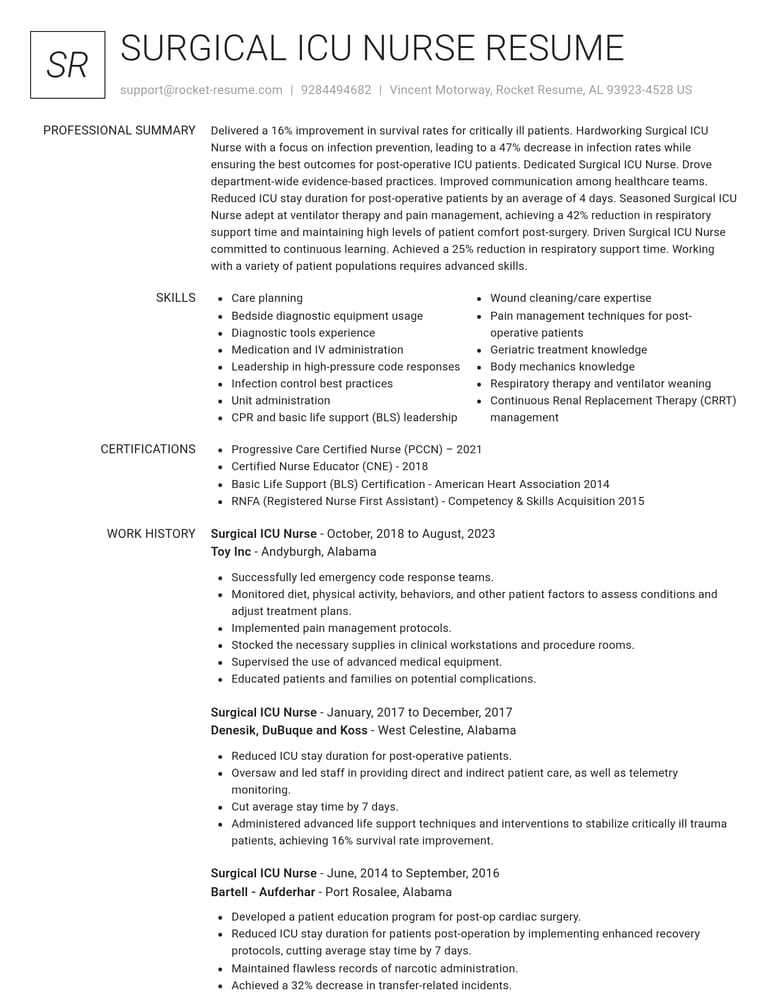
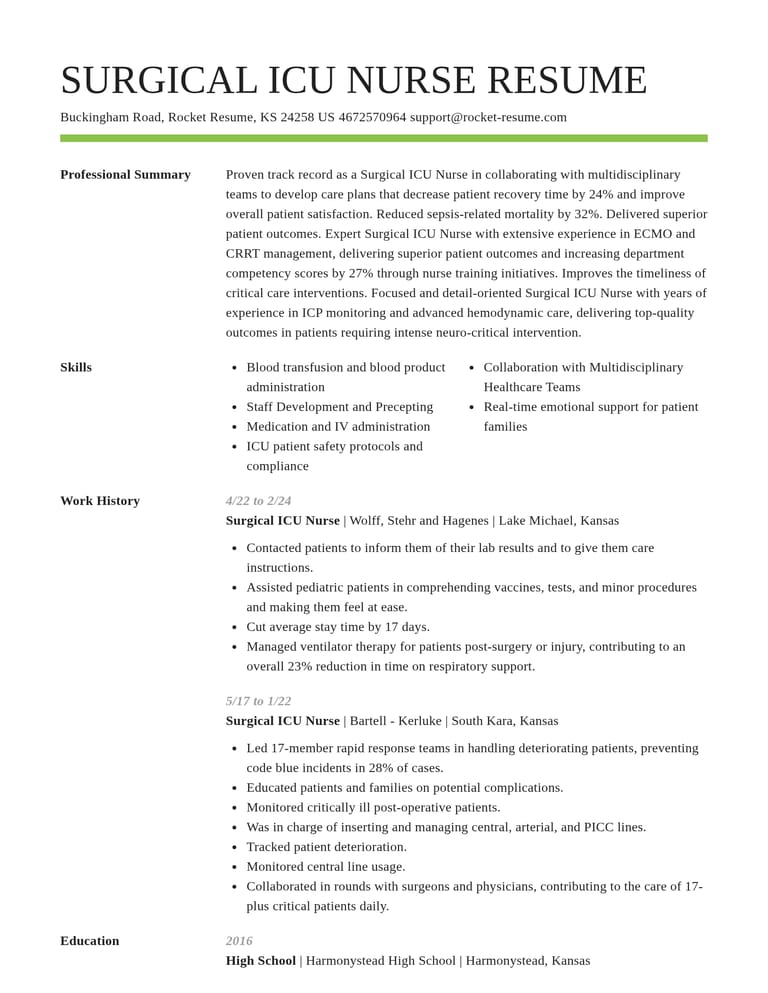
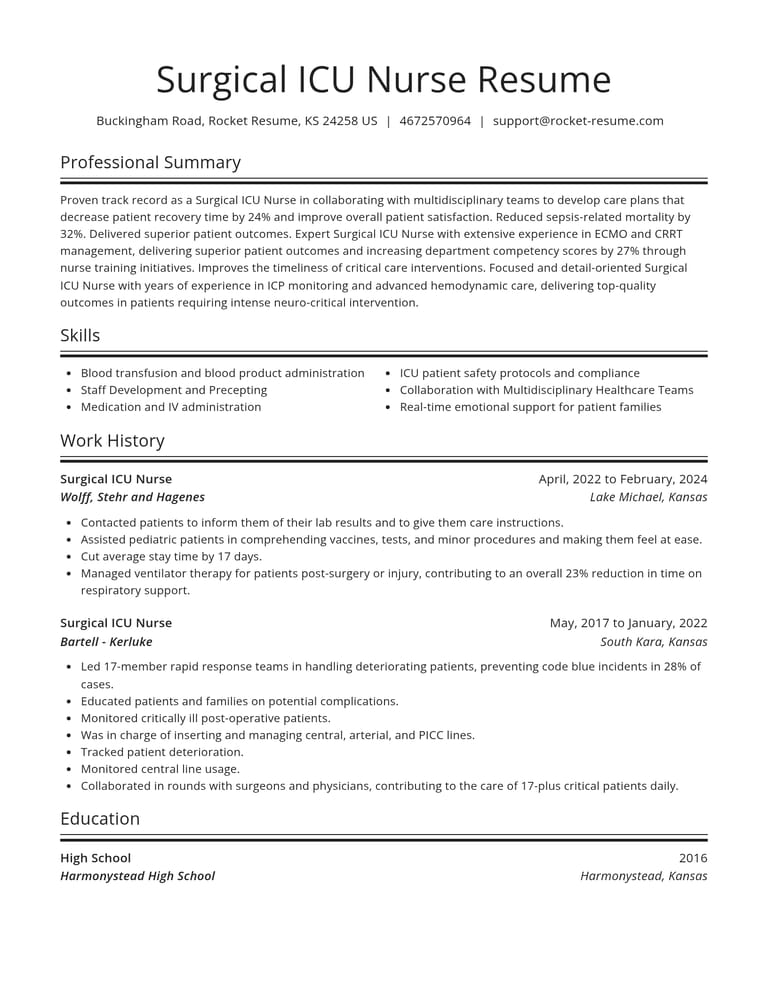
The transfer example highlights surgical float shifts. The graduate puts supervised SICU practice ahead of unrelated rotations. Compare the experienced resumes to see how they distinguish trauma from planned surgical care.
Find the example closest to your experience. Use its resume structure to highlight a surgical assignment you can explain in an interview.
Build My ResumeIn the builder: experience level
How much experience do you have?
How do I move from med-surg or ED into the SICU?
From med-surg, lead with surgical floor shifts and changes you escalated. From the ED, describe acute trauma care or handoffs you actually handled. Keep your original unit title.
Tip: Choose the experience level that reflects your work history. Explain the move into surgical critical care in your summary.
Start from Build My Resume and it’s the builder’s first question. The examples below show four starting points: Step-down RN with surgical float shifts, New RN with a SICU practicum, SICU nurse in trauma and organ transplant and SICU nurse with abdominal and vascular care.
Choose an order that fits
- Practicing RN:
- Summary, skills, work history, education, credentials
- New graduate:
- Summary, skills, education and clinical placement, other work history, credentials
The builder starts with a standard order, and you can move sections into the one you choose.
Start with one page. Add a second if relevant SICU assignments or projects need more space to explain.
See also: Resume examplesTemplate: keep surgical unit names visible
When the builder asks about experience, use your actual work history. List supervised SICU practice separately when you fill in the resume sections.
Build My ResumeIn the builder
Template: keep surgical unit names visible
Tip: Check whether the latest unit and title stand out at a glance.
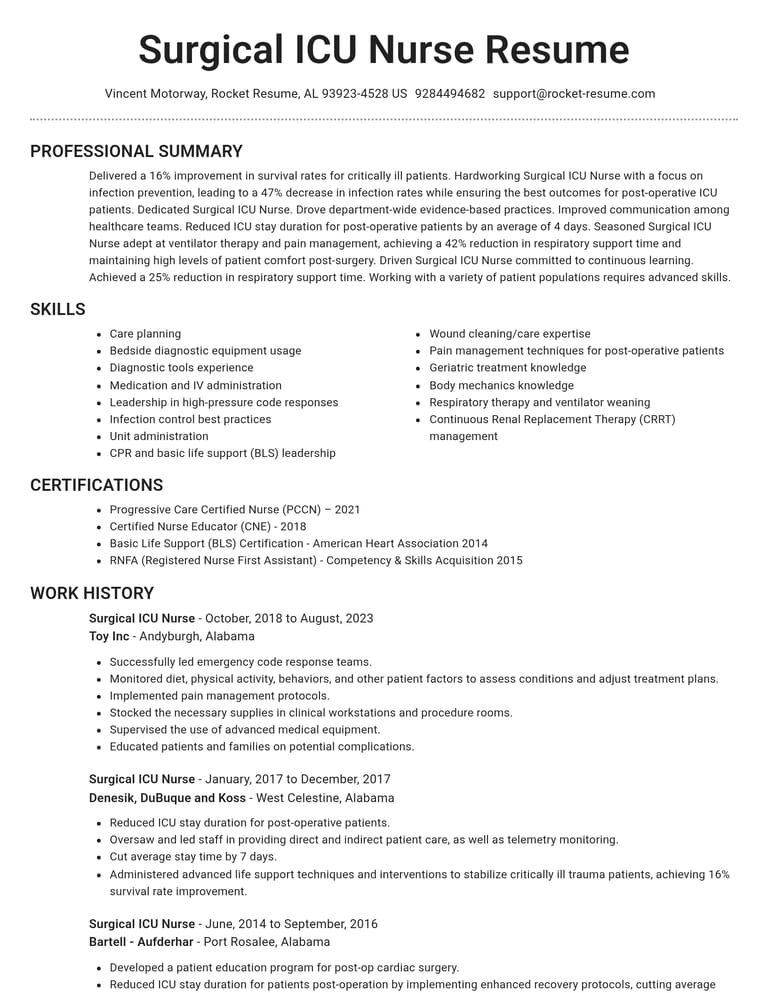
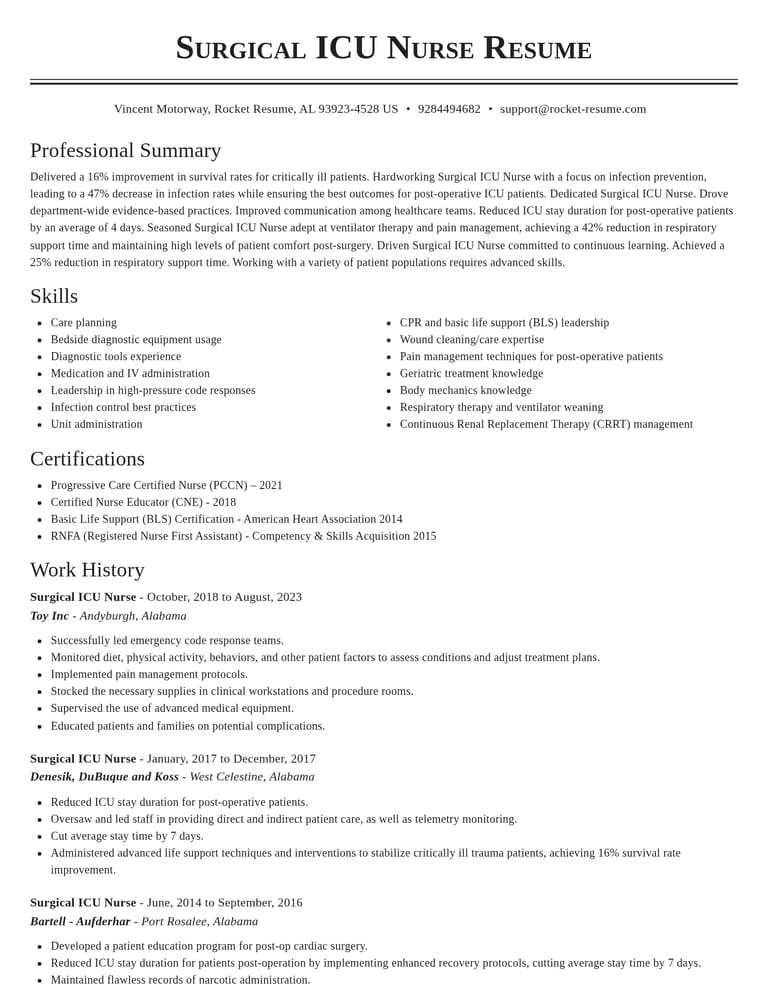
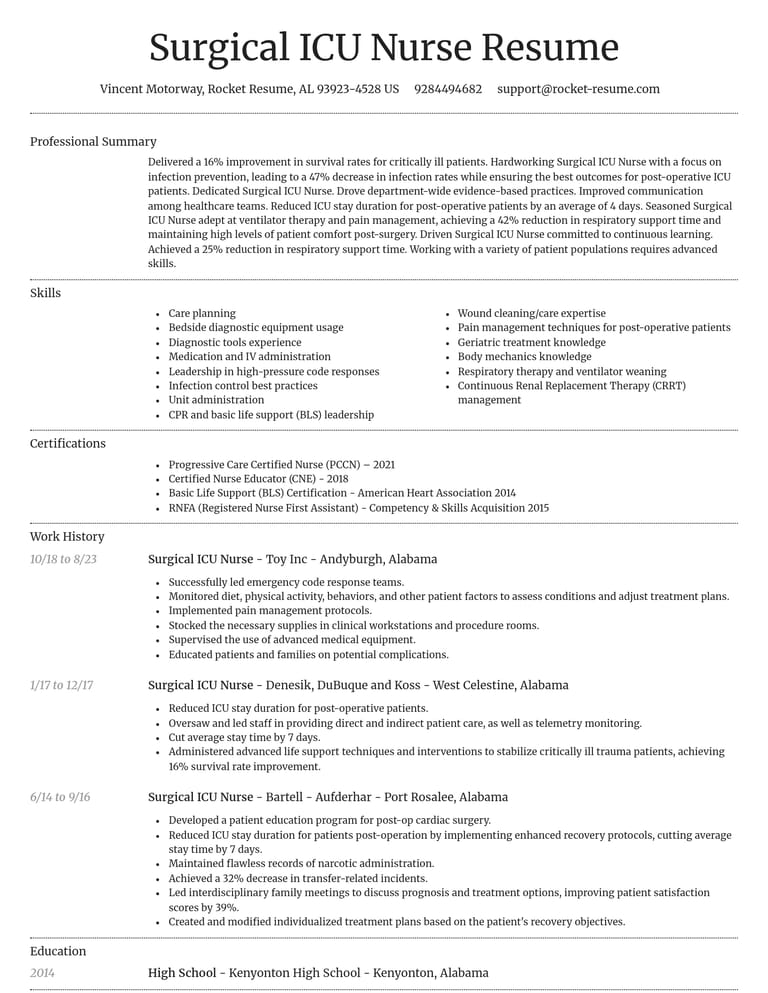
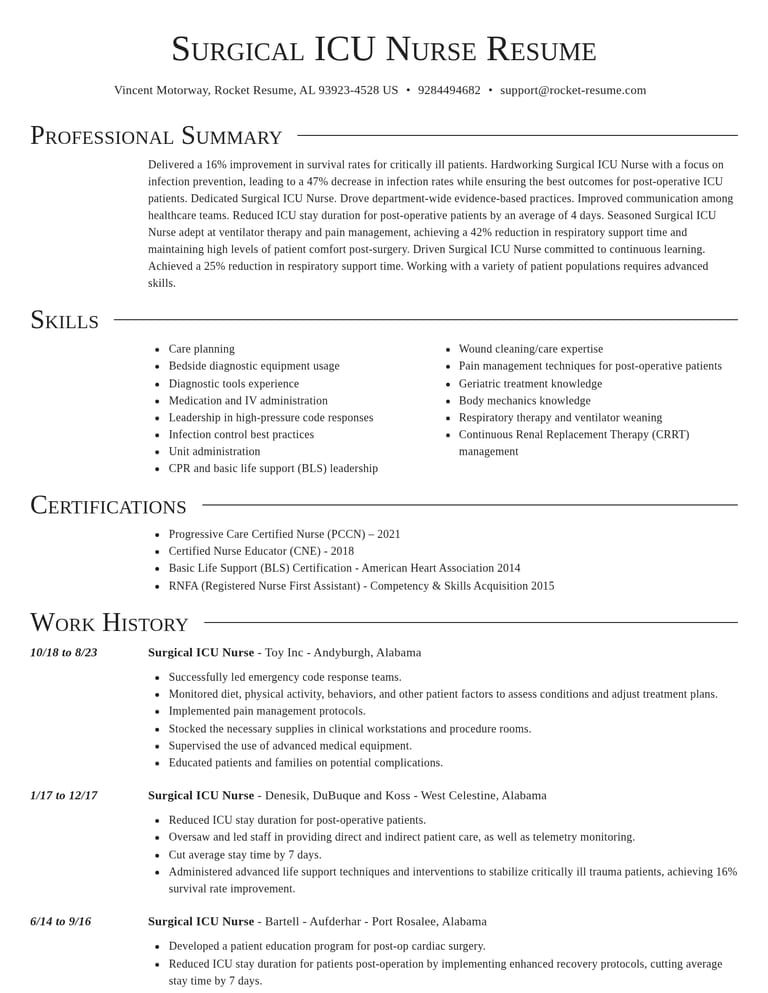
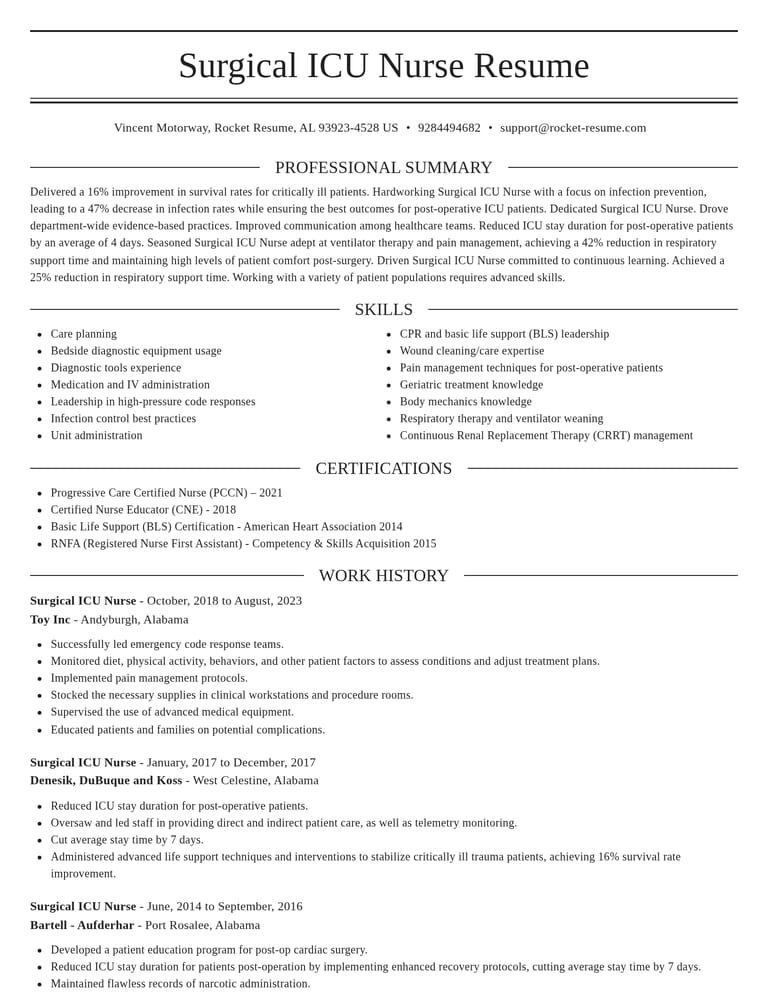
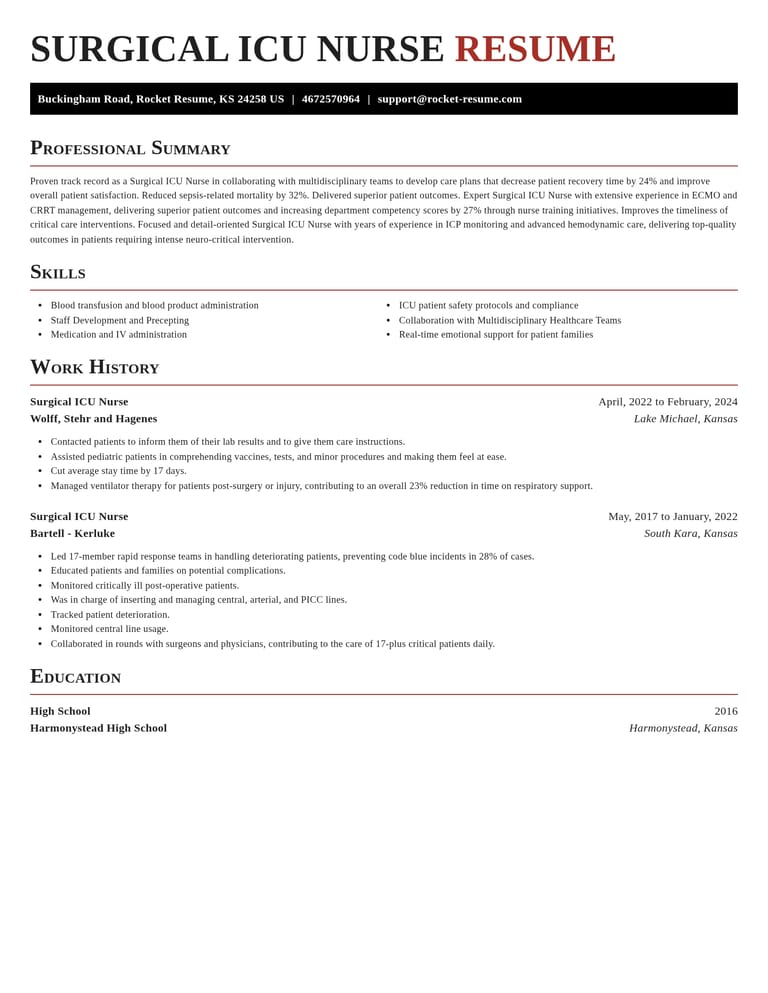
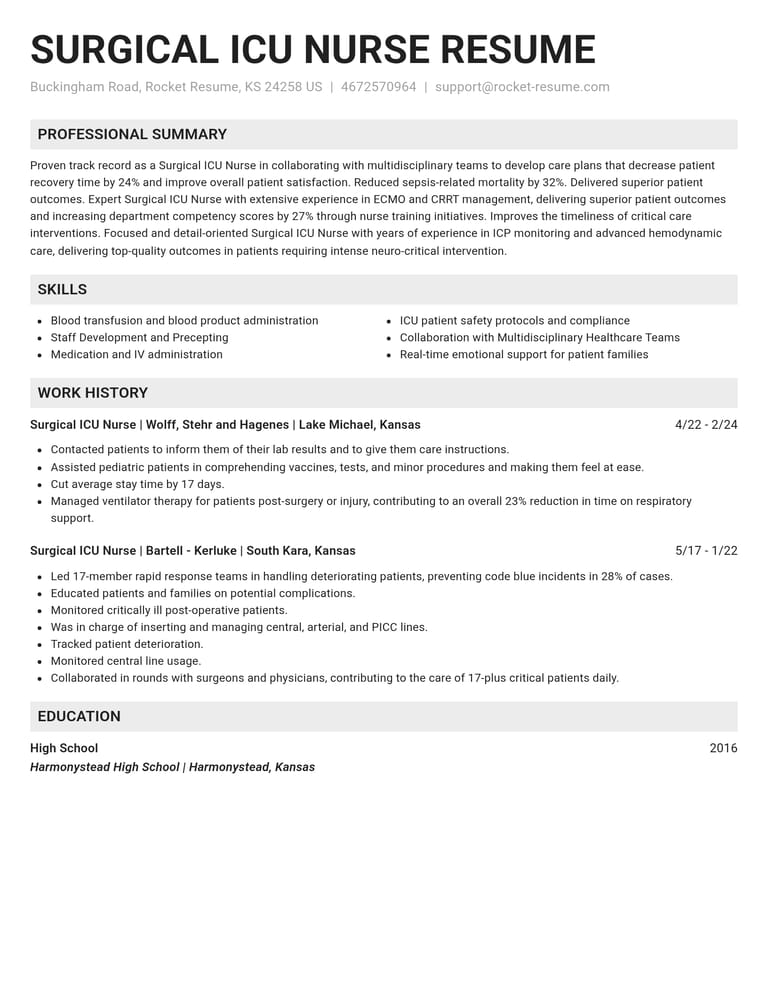
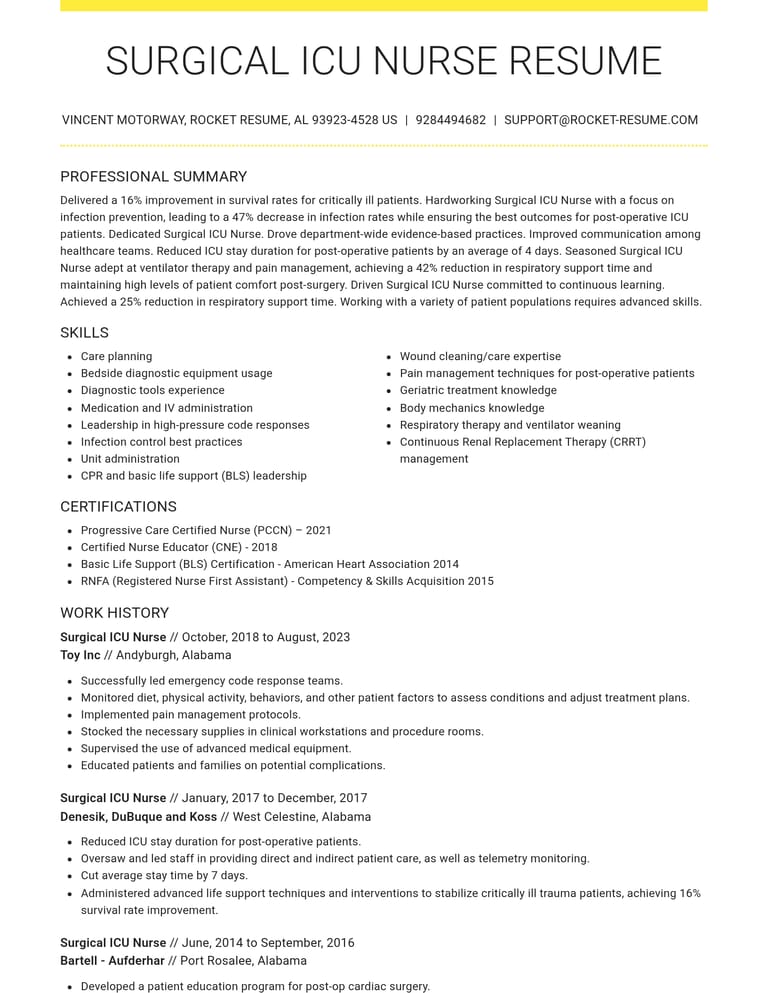
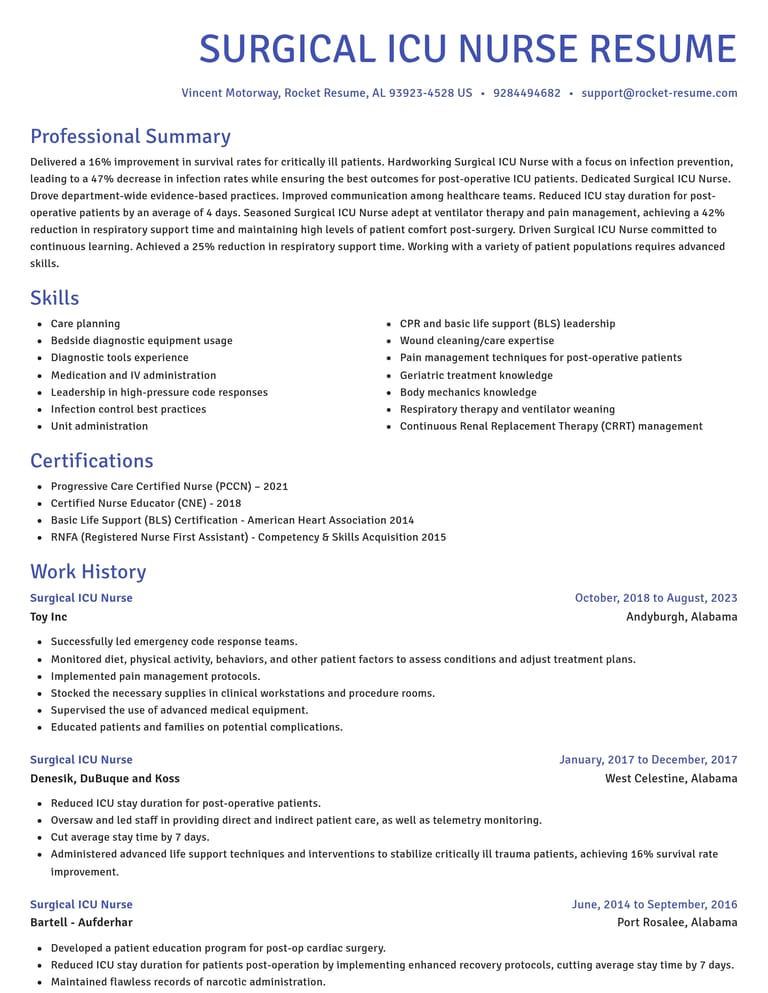
Look for space below your name for a short summary focused on surgery. Keep dates beside each role and give longer credentials enough room to read on their own.
Select a template that gives each surgical unit its own entry and leaves room to name the equipment you used.
Build My ResumeIn the builder
Work history: write about a patient assignment
How do I show surgical and trauma patient care?
Name the type of surgery or injury and when you took over. Describe the change you noticed, the person you contacted or the information you passed to the next team.
Tip: If you can verify the numbers, add patients per shift, admissions received or practicum hours.
Lead with an action and name the procedure or injury. If you noticed a change during the admission, explain what you tracked, who you alerted and what follow-up you passed on at handoff. Keep patient identifiers out.
If the job description asks for Show this on your resume Post-op admission Describe a patient admission you received from the operating room or recovery room. Trauma escalation Describe what prompted a call to the trauma team and what you reported. Before
“Monitored patients after surgery.”
After
“Received 2 vascular surgery patients from recovery, tracked arterial pressures and drain output, and reported a change in perfusion to the surgical team.”
Use a count from an assignment you can verify.
For ideas on showing your results, explore Surgical ICU nurse accomplishments
Start your work history with the assignment that shows what you noticed, documented or escalated after surgery.
Build My ResumeIn the builder
Education: name your SICU placement
How should I describe a SICU practicum?
List the unit, clinical dates and verified hours. Include an assigned task, such as recording drain output, and identify any procedures you observed.
Tip: Use the official degree name and identify the surgical ICU assignment as a clinical placement.
Registered nurses usually take one of three education paths: a bachelor's degree in nursing (BSN), an associate's degree in nursing (ADN or ASN), or a diploma from an approved nursing program. All programs include supervised clinical experience.
If the job description asks for Show this on your resume Supervised SICU rotation Show the placement, verified hours and work you did with your preceptor. Include the clinical term or documented hours. Put the placement close to your degree if it’s your strongest surgical experience.
See also: Check where your license authorizes practiceResume examples
Add your nursing program to your education section, then list the SICU rotation and describe what you did with your preceptor.
Build My ResumeIn the builder
Skills: show how you used equipment
Which skills should I list for a SICU role?
Start with what you used after surgery: arterial pressure monitoring, chest tubes, drains or ventilators. Include the specific devices you know and keep your level of responsibility clear.
Tip: Choose a device you used and be ready to explain what you checked, recorded or handed off.
Group your monitoring, airway care and surgical devices for easy scanning. If the role calls for chest tube experience, pair that skill with a real assignment in your work history.
If the job description asks for Show this on your resume Hemodynamic monitoring Name the monitoring you used and the change you relayed to the team. Drains and chest tubes Identify the devices you managed and how you tracked output. Hemodynamic and cardiac monitoring
- Arterial pressure monitoring
- Hemodynamic trend documentation
- Post-op rhythm surveillance
Airway and ventilator care
- Post-op ventilator monitoring
- Artificial airway care
- Coordination with respiratory therapy
A skill list helps a reader scan. A work example under a job shows what you did.
Skill
Monitoring output from surgical drains
Work example
Trended output from 2 closed-suction drains after abdominal surgery and flagged a change in character to the surgical team.
See also: Skills and examplesShow your care right after surgery
Add the surgical devices you can discuss to your skills section, then connect the most relevant one to a work example.
Build My ResumeIn the builder
Summary: open with your surgical patient mix
What goes in a surgical ICU resume summary?
Name your unit or rotation, the procedures or injuries you saw, and one part of post-op care you can describe. If you came from another unit, lead with the surgical experience you bring.
Tip: If your SICU experience came through school, describe the rotation as precepted.
Identify the unit where you gained your surgical experience and mention a procedure, injury or type of monitoring. If you’re transferring, name your current unit and the work that prepared you to care for post-op patients.
If the job description asks for Show this on your resume Surgical patient mix Name the procedures or injuries your patients had and the unit where you cared for them. Summary if you’re moving from step-down
“Step-down RN with surgical float experience caring for patients after bowel resections and vascular procedures. Documented changes in drain output and escalated new symptoms to the surgical team.”
Summary if you’re experienced in transplant care
“Surgical ICU nurse with 5 years of SICU experience, including abdominal transplant and major vascular cases. Experienced in receiving post-op transfers and documenting hemodynamic trends after arrival.”
Shape your introduction with help from Surgical ICU nurse summary examples
See also: Resume examplesWork history: write about a patient assignment
Pick a surgical assignment or a task from your SICU rotation. Write a resume summary that names the procedure or injury and explains your role.
Build My ResumeIn the builder
Certifications: show the license and credentials you hold
Which credentials should I show for a SICU role?
Start with your RN license and the issuing board. Add current BLS, ACLS and any specialty credential you hold that matches the job description. Identify TNCC as a completed course if you took it.
Tip: Check the issuer and dates against your records. Label courses as courses.
Use the exact license and credential names on your records. If a surgical unit asks for trauma training, give the course its own entry with the completion date.
Registered Nurse (RN), the state board of nursing that issued the license, [year]
How to list it · copy the wording on your certificate
Basic Life Support (BLS), the provider of your Basic Life Support course, [year]
How to list it · copy the wording on your certificate
Advanced Cardiovascular Life Support (ACLS), the training provider listed on your ACLS card, [year]
How to list it · copy the wording on your certificate
Specialty certification, a professional association, [year]
How to list it · copy the wording on your certificate
CCRN, American Association of Critical-Care Nurses, [year]
How to list it · from the example resumes
If the job description asks for Show this on your resume RN practice authorization List your issuing board and license or compact status, as applicable. Life-support credentials List current BLS and ACLS with the provider shown on each card. See also: Surgical ICU nurse certifications comparedCheck where your license authorizes practiceEducation: name your SICU placement
Pull up your license and life-support cards. Add the current credentials the surgical unit asks for to your resume.
Build My Resume
Surgical ICU nurse resume mistakes to fix before you apply
How Rocket Resume helps
Four ways the builder helps with your surgical ICU nurse resume:
- Job descriptions. Keep one resume in your account and adjust it to fit each one.
- Experience level. The builder asks how much experience you have first, then guides you from there.
- Your own numbers. Choose a suggestion, then edit it to add the numbers from your work.
- Saved suggestions. Save a skill, example, summary or certification on this page, and it waits for you in the builder.
Show your care right after surgery
Use a post-op admission from work or supervised practice to show what you did from arrival through the first hours.
Tip: Read the post-op entry on its own. Check that someone outside your unit can identify the case and understand your contribution.
What does a surgical ICU nurse resume look like?
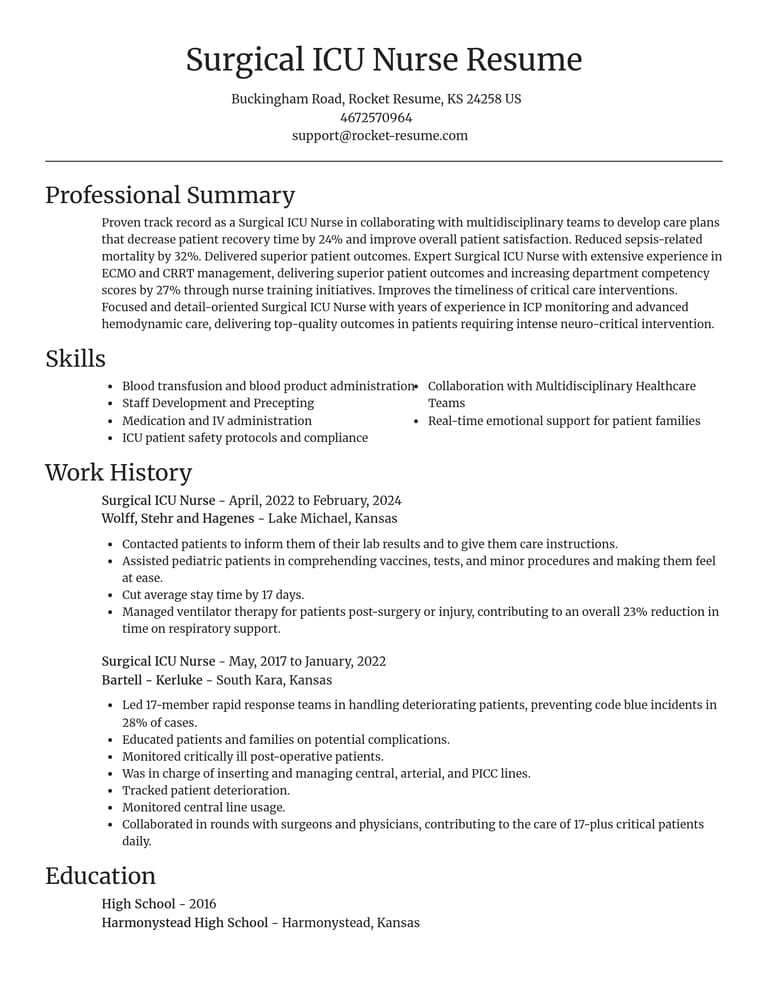
Each illustrative composite follows a different path: a step-down transfer, a new grad’s SICU practicum, trauma and organ transplant care, or recovery from major abdominal and vascular surgery.
Tip: Compare how the experienced nurses describe transplant recovery and trauma admissions. Use the patient mix that fits your history.
From step-down to a first surgical ICU role
Milwaukee, WI · Surgical floor float experience
Hannah P.
Step-down registered nurse
hannah.p@example.com · (414) 555-0107 · Milwaukee, WI
Summary
Step-down RN who floats to a surgical floor and cares for patients recovering from abdominal and vascular procedures. Experienced in tracking drain output, escalating changes in perfusion and handing off pending assessments.
Experience
Step-down RN · Example Milwaukee Medical Center
Feb 2023 – Present
- Cared for up to 4 step-down patients per shift and flagged new perfusion concerns to the covering team.
- Floated to the surgical floor twice a month and documented drain output, incision checks and pain reassessments during recovery from abdominal surgery.
- Received vascular patients from recovery and passed on pending neurovascular checks at shift change.
Medical-surgical RN · Example Lakeshore Community Hospital
Jun 2022 – Jan 2023
- Reviewed dressing and mobility instructions with patients recovering from abdominal surgery before discharge.
- Escalated unexpected changes in wound drainage to the surgical service and recorded the follow-up plan.
Education and credentials
Associate Degree in Nursing · Example Lakeshore College of Nursing, 2022
Registered Nurse (RN), Wisconsin Board of Nursing, 2022 · Basic Life Support (BLS), American Heart Association, 2026 · Advanced Cardiovascular Life Support (ACLS), American Heart Association, 2026
Skills
- Post-op reassessment
- Monitoring output from surgical drains
- Neurovascular checks
- Infusion pump checks
- Shift handoff
Why this example works
- Transfer evidenceSurgical float shifts show recent post-op work alongside the step-down title.
- Assignment sizeThe patient count describes her own shift.
- Relevant handoffThe vascular entry names what the next nurse needed to check.
New graduate with a surgical ICU practicum
Minneapolis, MN · Precepted SICU practicum
Eli R.
New graduate registered nurse
eli.r@example.com · (612) 555-0123 · Minneapolis, MN
Summary
New graduate RN with 144 hours of precepted surgical ICU practice. Assisted with recovery room handoffs and, under supervision, documented early recovery assessments for abdominal surgery cases.
Experience
Student nurse, surgical ICU practicum · Example Minneapolis University Hospital
Jan 2026 – May 2026
- Completed 144 precepted hours and helped receive 6 abdominal surgery patients from the recovery room.
- Recorded pain scores and measured output from drains under preceptor supervision, then reported changes during rounds.
- Checked infusion pump labels against the handoff record with a preceptor and documented active infusions.
Student nurse, surgical floor rotation · Example Nokomis Community Hospital
Aug 2025 – Dec 2025
- Assisted with supervised incision assessments and recorded patient responses to mobility during recovery.
- Reviewed discharge instructions on wound care with a supervising nurse present.
Education and credentials
Bachelor of Science in Nursing · Example Minneapolis School of Nursing, 2026
Registered Nurse (RN), Minnesota Board of Nursing, 2026 · Basic Life Support (BLS), American Heart Association, 2025 · Advanced Cardiovascular Life Support (ACLS), American Heart Association, 2026
Skills
- Precepted post-op assessments
- Intake and output documentation
- Recovery room handoff
- Infusion pump checks
- Pain reassessment
Why this example works
- Supervision is clearThe title and work examples identify the placement and preceptor.
- Surgical detailsDrain records and pump checks show which parts of recovery he supported.
- Training scopeThe recorded hours show how much time he spent in the placement.
SICU nurse at a trauma and transplant center
Kansas City, MO · Trauma cases and organ transplants
Carla T.
Surgical ICU nurse
carla.t@example.com · (816) 555-0148 · Kansas City, MO
Summary
Surgical ICU nurse with experience receiving trauma patients after emergency surgery and transplant patients from the operating room. Tracks changes in neurologic status and postsurgical bleeding and relays findings to the team.
Experience
Surgical ICU RN · Example Kansas City Center for Trauma and Organ Transplantation
Mar 2022 – Present
- Managed assignments of up to 2 SICU patients, including patients with head injuries after trauma surgery and abdominal transplant recipients.
- Monitored chest tube output after thoracic trauma and escalated a change in drainage to the trauma team.
- Received 3 liver transplant admissions in one month, confirming active infusions and pending assessments with anesthesia.
Surgical step-down RN · Example Riverbend Hospital
Aug 2019 – Feb 2022
- Tracked wound and drain changes during recovery from abdominal procedures and relayed concerns during rounds.
- Oriented 3 nurses to the unit’s surgical transfer handoff and documentation workflow.
Education and credentials
Bachelor of Science in Nursing · Example Riverbend Nursing College, 2019
Registered Nurse (RN), Missouri State Board of Nursing, 2019 · Basic Life Support (BLS), American Heart Association, 2026 · Advanced Cardiovascular Life Support (ACLS), American Heart Association, 2026 · CCRN, American Association of Critical-Care Nurses, 2024 · Trauma Nursing Core Course (TNCC) completion, Emergency Nurses Association, 2025
Skills
- Neurologic assessments
- Chest tube monitoring
- Hemodynamic trend documentation
- Trauma team communication
- Operating room handoff
Why this example works
- Distinct patient groupsSeparate entries distinguish trauma monitoring from transplant admissions.
- Specific escalationThe chest tube example shows what Carla reported and to whom.
- Course entryTNCC appears as completed coursework.
SICU nurse caring for abdominal and vascular surgery patients
Albuquerque, NM · Recovery from abdominal and vascular surgery
Sam K.
Surgical ICU nurse
sam.k@example.com · (505) 555-0162 · Albuquerque, NM
Summary
Surgical ICU nurse with experience in early recovery from major abdominal and vascular surgery. Receives transfers from anesthesia and follows early changes in arterial pressure, surgical drainage and perfusion.
Experience
Surgical ICU RN · Example Albuquerque Surgical Center
Jul 2020 – Present
- Monitored arterial pressure trends for 1 to 2 patients per shift recovering from major abdominal or vascular surgery.
- Reconciled active infusions with anesthesia at bedside handoff and flagged differences for the receiving team.
- Documented output from multiple abdominal drains and escalated new bleeding concerns during the first hours after arrival.
Surgical floor RN · Example Mesa Community Hospital
Sep 2017 – Jun 2020
- Managed negative-pressure wound therapy and tracked dressing changes after major abdominal surgery.
- Precepted 2 new nurses on surgical handoffs, wound documentation and communication with the surgical service.
Education and credentials
Bachelor of Science in Nursing · Example Mesa College of Nursing, 2017
Registered Nurse (RN), New Mexico Board of Nursing, 2017 · Basic Life Support (BLS), American Heart Association, 2026 · Advanced Cardiovascular Life Support (ACLS), American Heart Association, 2026 · CCRN, American Association of Critical-Care Nurses, 2025
Skills
- Arterial pressure monitoring
- Monitoring output from surgical drains
- Vasoactive infusion titration
- Post-op pain reassessment
- Negative-pressure wound therapy
Why this example works
- Patient mixThe first work entry names abdominal and vascular procedures and shows the range of patients per assignment.
- Equipment in contextThe arterial pressure and drain entries show what Sam checked during recovery.
- Teaching responsibilityThe earlier role gives a clear example of precepting.
Use the resume closest to your situation as a guide. Add your own surgical assignments to the corresponding section of your resume.
Build My ResumeLoading resume templates…
Surgical ICU nurse resume questions
What experience should go first on a SICU resume?
How long should a surgical ICU nurse resume be?
What can I write if I’ve never worked in an ICU?
Where should I put my SICU practicum?
How should I list courses and specialty credentials?
How can I show my experience with surgical drains?
What pay data can I use to compare surgical ICU jobs?
Start your resume with the post-op experience you can describe most clearly.
Build My ResumeSurgical ICU nurse resume skills and examples
Browse skills, work examples, summaries and certifications. Save the ones that fit, then make each one true to your own work.
Tip: Pair a device with the right verb. If you monitored a chest tube, describe your checks without implying that you placed it.
Arterial pressure monitoring
Hemodynamic and cardiac monitoring
Hemodynamic trend documentation
Hemodynamic and cardiac monitoring
Post-op rhythm surveillance
Hemodynamic and cardiac monitoring
Vasoactive infusion titration
Hemodynamic and cardiac monitoring
Post-op ventilator monitoring
Airway and ventilator care
Artificial airway care
Airway and ventilator care
Coordination with respiratory therapy
Airway and ventilator care
Extubation readiness checks
Airway and ventilator care
Show all 26 skillsShow fewer
Monitoring output from surgical drains
Drains and surgical devices
Chest tube monitoring
Drains and surgical devices
Incision and dressing assessment
Drains and surgical devices
Negative-pressure wound therapy
Drains and surgical devices
Continuous renal replacement therapy
Drains and surgical devices
Post-op pain reassessment
Sedation and pain
Sedation scoring
Sedation and pain
Infusion pump checks
Sedation and pain
Basic life support
Life support and handoffs
Advanced cardiovascular life support
Life support and handoffs
Operating room handoff
Life support and handoffs
Recovery room handoff
Life support and handoffs
Trauma team communication
Life support and handoffs
Neurovascular checks
From the example resumes
Shift handoff
Life support and handoffs · from the example resumes
Precepted post-op assessments
From the example resumes
Intake and output documentation
From the example resumes
Neurologic assessments
Drains and surgical devices · from the example resumes
Monitored arterial pressure trends for 1 to 2 patients per shift recovering from major abdominal or vascular surgery.
Hemodynamic and cardiac monitoring · from the abdominal and vascular ICU example · use your own numbers
Reviewed discharge instructions on wound care with a supervising nurse present.
Airway and ventilator care · from the new graduate example
Trended output from 2 closed-suction drains after abdominal surgery and flagged a change in character to the surgical team.
Drains and surgical devices · writing example · use your own numbers
Recorded pain scores and measured output from drains under preceptor supervision, then reported changes during rounds.
Drains and surgical devices · from the new graduate example
Assisted with supervised incision assessments and recorded patient responses to mobility during recovery.
Drains and surgical devices · from the new graduate example
Monitored chest tube output after thoracic trauma and escalated a change in drainage to the trauma team.
Drains and surgical devices · from the trauma and transplant example
Documented output from multiple abdominal drains and escalated new bleeding concerns during the first hours after arrival.
Drains and surgical devices · from the abdominal and vascular ICU example
Managed negative-pressure wound therapy and tracked dressing changes after major abdominal surgery.
Drains and surgical devices · from the abdominal and vascular ICU example
Show all 23 work examplesShow fewer
Received 3 abdominal surgery admissions in one shift and recorded procedure details, active infusions and pending checks.
Sedation and pain · writing example · use your own numbers
Checked infusion pump labels against the handoff record with a preceptor and documented active infusions.
Sedation and pain · from the new graduate example
Tracked arterial pressure during the first 2 hours after transfer from the operating room and relayed trends at handoff.
Life support and handoffs · writing example · use your own numbers
Completed 144 precepted hours and helped receive 6 abdominal surgery patients from the recovery room.
Life support and handoffs · from the new graduate example · use your own numbers
Managed assignments of up to 2 SICU patients, including patients with head injuries after trauma surgery and abdominal transplant recipients.
Life support and handoffs · from the trauma and transplant example · use your own numbers
Cared for up to 4 step-down patients per shift and flagged new perfusion concerns to the covering team.
Transferable, from the step-down transfer example · use your own numbers
Floated to the surgical floor twice a month and documented drain output, incision checks and pain reassessments during recovery from abdominal surgery.
Transferable, from the step-down transfer example
Received vascular patients from recovery and passed on pending neurovascular checks at shift change.
Transferable, from the step-down transfer example
Reviewed dressing and mobility instructions with patients recovering from abdominal surgery before discharge.
From the step-down transfer example
Escalated unexpected changes in wound drainage to the surgical service and recorded the follow-up plan.
From the step-down transfer example
Received 3 liver transplant admissions in one month, confirming active infusions and pending assessments with anesthesia.
From the trauma and transplant example · use your own numbers
Tracked wound and drain changes during recovery from abdominal procedures and relayed concerns during rounds.
From the trauma and transplant example
Oriented 3 nurses to the unit’s surgical transfer handoff and documentation workflow.
From the trauma and transplant example · use your own numbers
Reconciled active infusions with anesthesia at bedside handoff and flagged differences for the receiving team.
From the abdominal and vascular ICU example
Precepted 2 new nurses on surgical handoffs, wound documentation and communication with the surgical service.
From the abdominal and vascular ICU example · use your own numbers
Step-down RN with surgical float experience caring for patients after bowel resections and vascular procedures. Documented changes in drain output and escalated new symptoms to the surgical team.
Moving from step-down · writing example
Surgical ICU nurse with 5 years of SICU experience, including abdominal transplant and major vascular cases. Experienced in receiving post-op transfers and documenting hemodynamic trends after arrival.
Experienced in transplant care · writing example · use your own numbers
Step-down RN who floats to a surgical floor and cares for patients recovering from abdominal and vascular procedures. Experienced in tracking drain output, escalating changes in perfusion and handing off pending assessments.
From the step-down transfer example
New graduate RN with 144 hours of precepted surgical ICU practice. Assisted with recovery room handoffs and, under supervision, documented early recovery assessments for abdominal surgery cases.
From the new graduate example · use your own numbers
Surgical ICU nurse with experience receiving trauma patients after emergency surgery and transplant patients from the operating room. Tracks changes in neurologic status and postsurgical bleeding and relays findings to the team.
From the trauma and transplant example
Surgical ICU nurse with experience in early recovery from major abdominal and vascular surgery. Receives transfers from anesthesia and follows early changes in arterial pressure, surgical drainage and perfusion.
From the abdominal and vascular ICU example
Registered Nurse (RN), the state board of nursing that issued the license, [year]
How to list it · copy the wording on your certificate
Basic Life Support (BLS), the provider of your Basic Life Support course, [year]
How to list it · copy the wording on your certificate
Advanced Cardiovascular Life Support (ACLS), the training provider listed on your ACLS card, [year]
How to list it · copy the wording on your certificate
Specialty certification, a professional association, [year]
How to list it · copy the wording on your certificate
CCRN, American Association of Critical-Care Nurses, [year]
How to list it · from the example resumes
Trauma Nursing Core Course (TNCC) completion, Emergency Nurses Association, [year]
How to list it · from the example resumes
Skills are adapted from O*NET (29-1141.00) and the example resumes.
Where they go in your resume: Work historySkillsSummaryCertifications
Find skills that match your experience in Surgical ICU nurse resume skills
List the devices you handled in the skills section, then add a work history example that shows how you used one after surgery.
Build My ResumeSurgical ICU nurse certifications compared
Start with the license that authorizes your nursing practice. Give life-support cards, specialty credentials and completed courses their own entries.
Tip: Compare the surgical unit’s requirements with the names on your cards and the authorization shown on your nursing record.
RN: Registered Nurse
the state board of nursing that issued the license
- How to list it
- Registered Nurse (RN), the state board of nursing that issued the license, [year]
- What to check
- Confirm your practice authorization with the board for the patient’s location. Find the board through NCSBN.
BLS: Basic Life Support
the provider of your Basic Life Support course
- How to list it
- Basic Life Support (BLS), the provider of your Basic Life Support course, [year]
- What to check
- Registered nursing positions may require cardiopulmonary resuscitation (CPR), basic life support (BLS) or advanced cardiac life support (ACLS) certification.
ACLS: Advanced Cardiovascular Life Support
the training provider listed on your ACLS card
- How to list it
- Advanced Cardiovascular Life Support (ACLS), the training provider listed on your ACLS card, [year]
- What to check
- Check the job description for ACLS and use the full name printed on your card.
Specialty certification
a professional association
- How to list it
- Specialty certification, a professional association, [year]
- What to check
- Nurses may become certified through professional associations in specific areas, such as ambulatory care, gerontology or pediatrics. Certification is usually voluntary, but some employers require it.
Still in training? Exam prep, programs and state rules
Prepare for RN licensure
Check where your license authorizes practice
Check which credentials you hold against Surgical ICU nurse certifications
Gather your license record, life-support cards and course records. Add your current credentials to your resume once you’ve checked the dates.
Build My ResumeWhat a surgical ICU nurse’s workday is like
O*NET surveyed registered nurses about these working conditions. Use their responses to recall specific work from a surgical assignment.
Tip: Recall a surgical handoff where you checked a detail that changed what the next team needed to watch.
91.33% of respondents chose “Extremely important” for working with or contributing to a group or team.
Describe the part of a post-op handoff you coordinated with anesthesia or the surgical team.
57.41% of respondents chose “Extremely serious” on the consequence-of-error scale.
Think of a discrepancy you caught in the transfer record and how you clarified it.
61.49% of respondents chose “Every day” on the frequency scale for exposure to disease or infections.
If you documented isolation precautions during surgical transfers, show how you made that information available at handoff.
58.09% of respondents chose “Extremely important” on the scale for being exact or accurate.
Recall what you checked before documenting a change in drain output.
O*NET OnLine: Registered Nurses (29-1141.00), work context from the O*NET 31.0 release.
Think back to one surgical admission where a careful check mattered. Write a work history entry that explains what you checked and how you followed up.
Build My ResumeWhere a surgical ICU nurse career can lead
Decide whether you want to focus more on a particular surgical patient group or take on more responsibility within the unit. Let that choice guide what you highlight in your next resume.
Grow as a surgical ICU nurse
- For a transplant-focused role, name the organs or procedures involved and explain how you supported early recovery.
- For a trauma-focused role, choose an example that shows your handoff from the trauma or operating room team and how you reported new findings.
- If you want to coordinate a unit, review the charge nurse resume guide and describe any surgical assignments or staff orientation you helped organize.
Tip: If you want more responsibility in a surgical unit, describe how you oriented a colleague or helped improve a handoff.
Compare related healthcare jobs
| Job | Median pay |
|---|---|
| Registered Nurses | $97,550 |
| Nurse Practitioners | $132,300 |
| Nurse Midwives | $134,040 |
| Nurse Anesthetists | $236,590 |
Pay gaps don’t show a typical career move, and each job has its own requirements. See pay for registered nurses by state.
Source: U.S. Bureau of Labor Statistics, median annual pay, May 2025 · checked Oct 23, 2026
Pick the surgical specialty or team responsibility you want next. Describe the assignment that prepared you for it in your work history.
Build My ResumeSurgical ICU nurse salary and job outlook
Government estimates for May 2025. Pay depends on your state, work setting and experience. These figures are for registered nurses.
Tip: Compare registered nurse pay by state while reading surgical ICU job descriptions for the locations you’re considering.
Pay for registered nurses by state
Median annual wage, May 2025. Highest: California, $140,270. Tap a state to see its numbers.
- Under $82,000
- $82,000–$83,999
- $84,000–$95,999
- $96,000–$101,999
- $102,000 or more
Selected state
California
- Median
- $140,270
- Average
- $150,280
- Lowest to highest 10%
- $101,260 – $213,320
- Jobs in the state
- 338,940
National median: $97,550. State figures are annual; see the national pay range for hourly wages.
See all 50 states and DC
| State | Median | Average | Lowest 10% | Highest 10% | Jobs |
|---|---|---|---|---|---|
| Alabama | $77,080 | $77,020 | $58,150 | $98,910 | 54,340 |
| Alaska | $109,480 | $114,870 | $85,030 | $149,070 | 7,510 |
| Arizona | $99,500 | $99,730 | $70,540 | $130,930 | 73,150 |
| Arkansas | $78,940 | $81,520 | $60,780 | $103,660 | 29,400 |
| California | $140,270 | $150,280 | $101,260 | $213,320 | 338,940 |
| Colorado | $100,260 | $99,370 | $79,500 | $124,940 | 54,490 |
| Connecticut | $102,740 | $105,250 | $80,350 | $134,870 | 40,110 |
| Delaware | $99,520 | $99,460 | $78,340 | $123,860 | 14,290 |
| District of Columbia | $102,540 | $106,980 | $79,390 | $151,170 | 11,440 |
| Florida | $84,190 | $90,650 | $67,970 | $120,330 | 229,940 |
| Georgia | $93,550 | $95,080 | $68,920 | $128,640 | 100,950 |
| Hawaii | $136,320 | $124,340 | $82,500 | $147,830 | 12,940 |
| Idaho | $92,460 | $92,710 | $71,210 | $121,230 | 16,880 |
| Illinois | $95,990 | $94,360 | $69,170 | $118,190 | 138,910 |
| Indiana | $83,500 | $89,150 | $66,750 | $105,750 | 68,980 |
| Iowa | $78,630 | $80,540 | $63,840 | $100,500 | 34,420 |
| Kansas | $79,320 | $82,360 | $63,180 | $100,840 | 33,800 |
| Kentucky | $81,040 | $86,140 | $64,170 | $111,750 | 50,300 |
| Louisiana | $80,230 | $84,190 | $63,800 | $104,740 | 48,970 |
| Maine | $86,990 | $91,700 | $74,160 | $106,950 | 16,540 |
| Maryland | $99,790 | $99,010 | $76,780 | $124,790 | 52,910 |
| Massachusetts | $104,550 | $117,960 | $80,310 | $174,510 | 88,200 |
| Michigan | $94,300 | $94,300 | $77,260 | $116,710 | 104,950 |
| Minnesota | $101,510 | $103,420 | $79,960 | $132,430 | 70,110 |
| Mississippi | $77,090 | $78,950 | $60,610 | $100,350 | 29,060 |
| Missouri | $81,780 | $85,900 | $63,230 | $104,390 | 76,310 |
| Montana | $85,280 | $91,510 | $70,120 | $113,920 | 10,950 |
| Nebraska | $84,730 | $88,330 | $66,020 | $106,190 | 24,720 |
| Nevada | $103,670 | $105,710 | $79,500 | $133,270 | 27,070 |
| New Hampshire | $99,700 | $97,900 | $75,610 | $123,190 | 15,390 |
| New Jersey | $106,500 | $110,100 | $83,060 | $135,170 | 92,680 |
| New Mexico | $94,340 | $95,290 | $74,300 | $123,540 | 17,980 |
| New York | $109,440 | $113,440 | $79,760 | $157,090 | 205,810 |
| North Carolina | $84,350 | $90,470 | $67,660 | $110,220 | 111,120 |
| North Dakota | $80,730 | $83,600 | $65,520 | $103,480 | 11,340 |
| Ohio | $82,510 | $87,730 | $66,980 | $105,290 | 143,730 |
| Oklahoma | $82,920 | $85,060 | $60,530 | $106,390 | 38,270 |
| Oregon | $129,010 | $123,140 | $95,280 | $155,010 | 39,730 |
| Pennsylvania | $96,430 | $94,020 | $70,800 | $117,900 | 146,520 |
| Rhode Island | $100,640 | $101,260 | $77,410 | $129,840 | 10,090 |
| South Carolina | $82,360 | $87,670 | $66,860 | $106,520 | 49,750 |
| South Dakota | $78,060 | $77,140 | $54,040 | $98,220 | 14,710 |
| Tennessee | $81,500 | $85,390 | $63,970 | $104,920 | 72,200 |
| Texas | $95,970 | $95,380 | $67,120 | $127,950 | 271,380 |
| Utah | $84,600 | $90,950 | $68,920 | $109,050 | 27,420 |
| Vermont | $97,460 | $96,650 | $77,670 | $126,100 | 7,410 |
| Virginia | $93,600 | $93,850 | $67,830 | $125,580 | 77,490 |
| Washington | $124,200 | $121,540 | $89,630 | $161,910 | 69,260 |
| West Virginia | $80,130 | $86,970 | $57,210 | $131,760 | 23,430 |
| Wisconsin | $95,530 | $94,690 | $77,470 | $119,860 | 68,060 |
| Wyoming | $83,760 | $88,600 | $65,770 | $107,350 | 5,330 |
Source: U.S. Bureau of Labor Statistics, Occupational Employment and Wage Statistics, May 2025 · checked Oct 23, 2026 · lowest and highest 10% are the 10th and 90th percentile wages
National pay range
Annual wages for all U.S. registered nurses
| Percentile | Annual | Hourly |
|---|---|---|
| 10th | $68,940 | $33.14 |
| 25th | $80,330 | $38.62 |
| Median | $97,550 | $46.90 |
| 75th | $112,350 | $54.02 |
| 90th | $137,470 | $66.09 |
Source: U.S. Bureau of Labor Statistics, Occupational Employment and Wage Statistics, May 2025 · checked Oct 23, 2026
More pay data: state rankings and pay by work setting
State rankings
Top five states and DC
Source: U.S. Bureau of Labor Statistics, Occupational Employment and Wage Statistics, May 2025 · checked Oct 23, 2026 · ranked by annual mean wage or jobs per 1,000 jobs
Median pay by work setting
Annual median, May 2025
- Government, excluding state and local education and hospitals$110,780
- Hospitals; state, local, and private$100,220
- Ambulatory healthcare services$91,230
- Nursing and residential care facilities$84,300
- Educational services; state, local, and private$78,620
Source: Occupational Outlook Handbook, May 2025 · checked Oct 23, 2026
Projected job growth, 2025–35
Change in employment over ten years
- Registered nurses6%
- Healthcare diagnosing or treating practitioners9%
- All occupations3%
That's 194,700 more jobs over ten years and about 180,800 openings a year, counting people who retire or change jobs.
Source: U.S. Bureau of Labor Statistics, Employment Projections 2025–35 · checked Oct 23, 2026
Where registered nurses work
Share of the 3,465,400 jobs in 2025 (largest settings)
- Hospitals; state, local, and private59%
- Ambulatory healthcare services19%
- Nursing and residential care facilities6%
- Government, excluding state and local education and hospitals5%
- Educational services; state, local, and private3%
The rest work in other settings.
Source: Occupational Outlook Handbook · checked Oct 23, 2026
Compare registered nurse pay by location as you decide which surgical role to pursue. Write a resume summary that highlights the experience that role calls for.
Build My ResumeAbout this guide
Updated November 17, 2026.
Sources
Loading industries…
Build your surgical ICU nurse resume
Choose a template and start with the surgical assignment or precepted rotation you can describe most clearly. Add the devices you used and check the credentials against your records.