ICU nurse resume examples, templates and tips
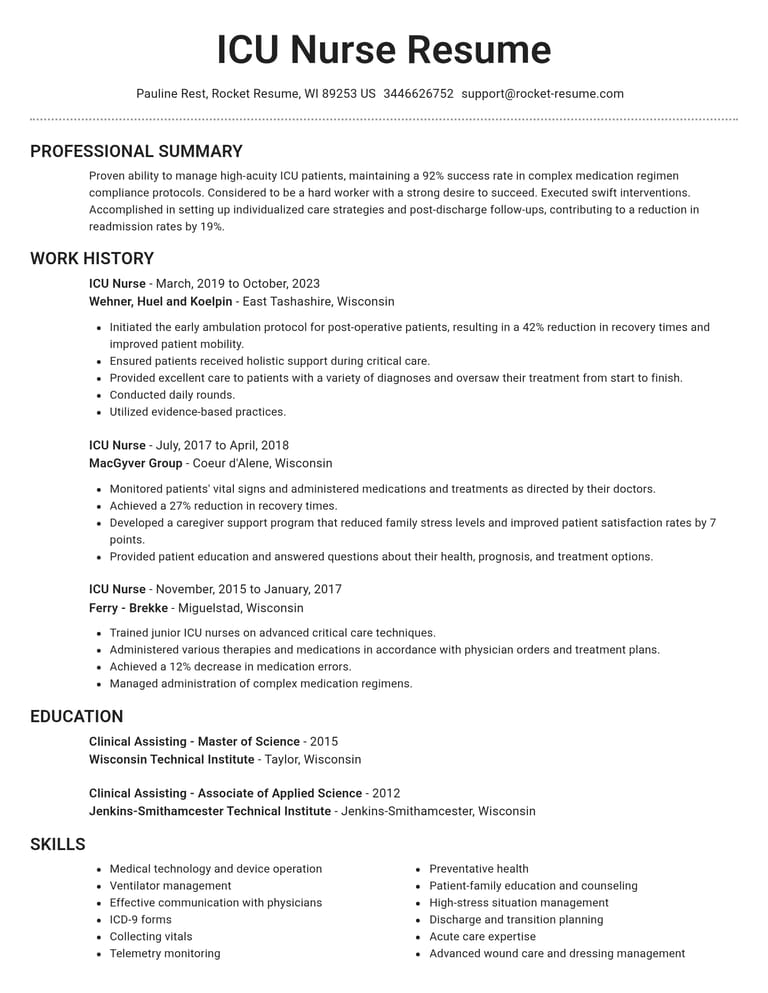
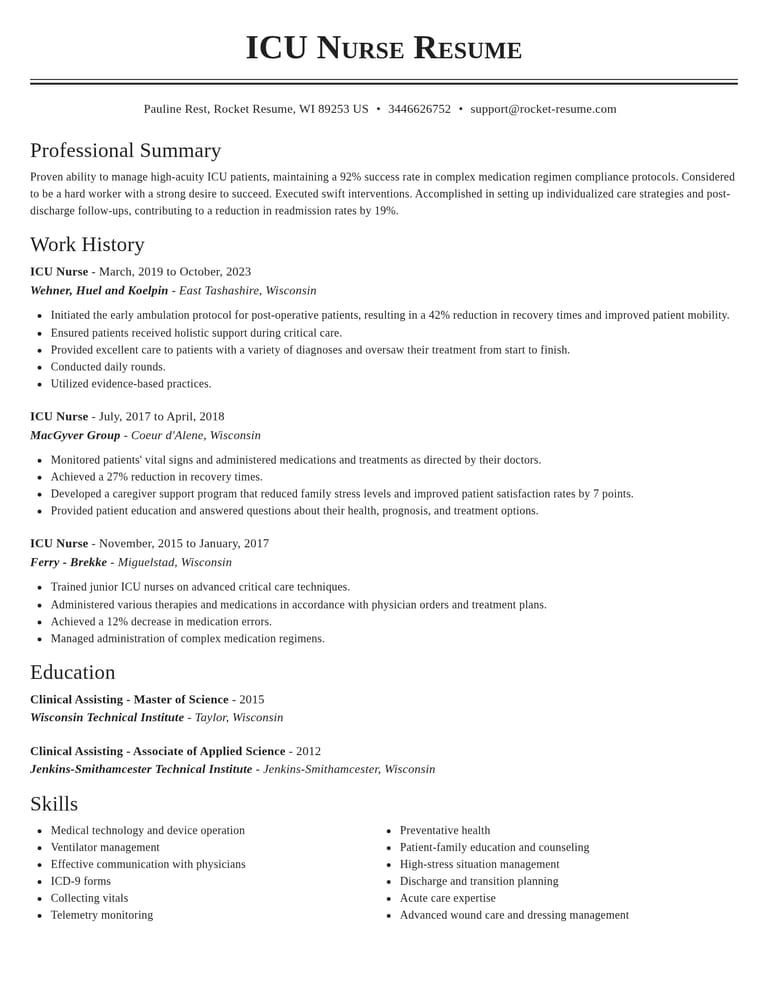
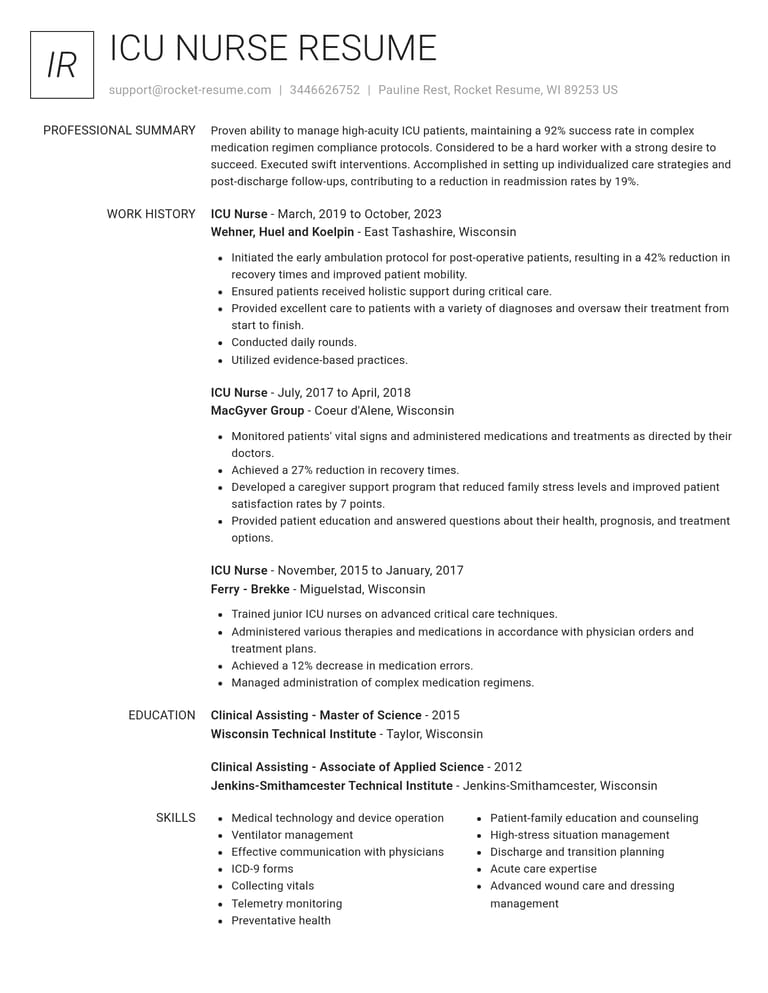
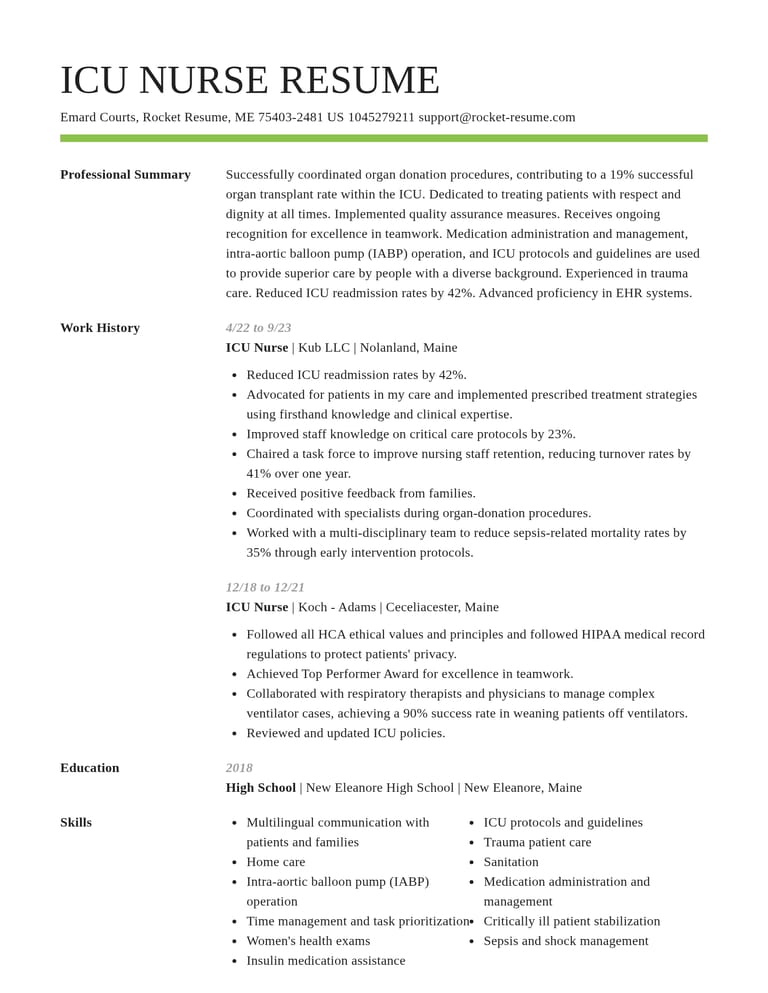
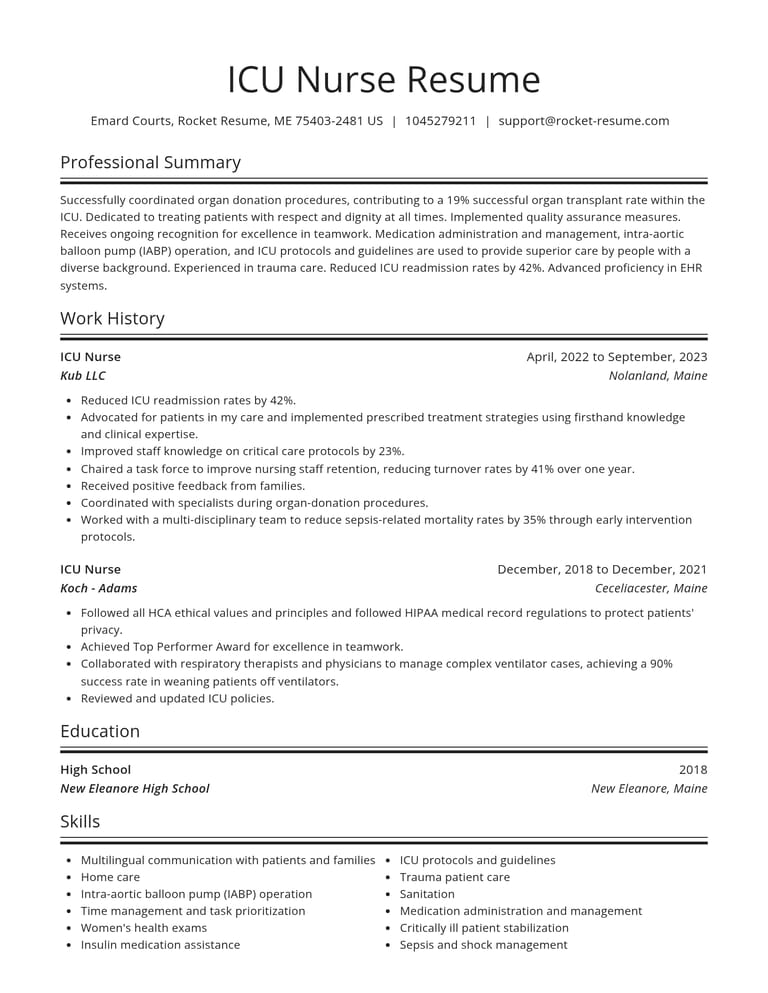
Show the patients you cared for, the equipment you used and the decisions you made. Explore ICU nurse resume examples, then build a resume for your next role.
- MICU and CVICU resume examples
- Tips for a first ICU application
- Show bedside skills in context
- Clear guidance on RN credentials

What ICU nurse hiring managers look for
- Unit type and patient population.
- RN license and life support certifications.
- Bedside equipment responsibilities.
- Recognizing a change in condition and responding.
- Support for patients’ families.
- Unit leadership during charge shifts.
How to write an ICU nurse resume
An ICU resume needs more than a list of nursing duties: show the unit, the patients and what you managed at the bedside. A move from telemetry needs a different opening from a move between intensive care units. This guide starts with five questions to answer first, then walks through each part of your resume with tips and links to the examples, templates and data on this page.
Five questions to answer first
- How do I match my resume to an ICU job?
Step 1 starts with the target ICU’s requirements.
- Which experience should lead my ICU resume?
Step 3 chooses the experience most relevant to the ICU role.
- How can acute care experience show ICU readiness?
Step 5 connects earlier unit work to intensive care.
- Which ICU devices and checks should I name?
Step 7 connects device names with bedside practice.
- Which certifications belong on an ICU nurse resume?
Step 9 organizes the RN license and other credentials.
What an ICU nurse does
Critical care nurses work in hospital intensive-care units, caring for patients with serious, complex and acute illnesses and injuries that need close monitoring and treatment.
The national median annual pay for registered nurses was $97,550 in May 2025. The Occupational Outlook Handbook from the U.S. Bureau of Labor Statistics projects registered nurse employment growth of 6% over 2025–2035. These figures cover all registered nurses, including specialties beyond intensive care.
See also: Where registered nurses workProjected job growthPay for registered nurses by stateShow how you used ICU equipment
Tip: Name the ICU patient population you want to care for in the resume summary.
Write your ICU nurse resume in nine steps
Do the first two before you open the builder. The other seven follow the builder’s order.
Step 1 of 9
Before you open the builder
Job description: match the unit before listing duties
How do I match my resume to an ICU job?
Start with the ICU job description. Note the required experience, license and certifications. Then choose examples from your work that show how you meet them.
Tip: Separate required credentials from preferred experience before choosing what to highlight.
A public health system's critical care nurse job description describes individualized nursing care for critically ill patients and supportive care for the people close to them, and asks for reading and interpreting EKG strips and calculating medication levels using weight and age. For equipment and assessment prompts, duties are adapted from O*NET OnLine, Critical Care Nurses.
Match each requirement in the job description
Here’s the step where you’ll show each one:
- Unit and patients step 8
- Acute care experience step 5
- Devices and assessments step 7
- Medication responsibilities step 5
- Nursing education step 6
- RN license step 9
- Current certifications step 9
Tip: Mark each ICU requirement as work to describe, a question to check or a skill to develop before applying.
See also: Show how you used ICU equipmentRN license, life support cards and specialty certificationResume examples
An unfamiliar ICU may emphasize a different patient population from the unit you know. Before building, mark the job description’s clinical requirements and gather a work example for each, so the strongest evidence reaches the opening of the resume.
Build My Resume
Before you open the builder
Examples: compare the unit behind each resume
Tip: Read the telemetry example for a first ICU application, then compare how the MICU and CVICU examples describe their assignments.
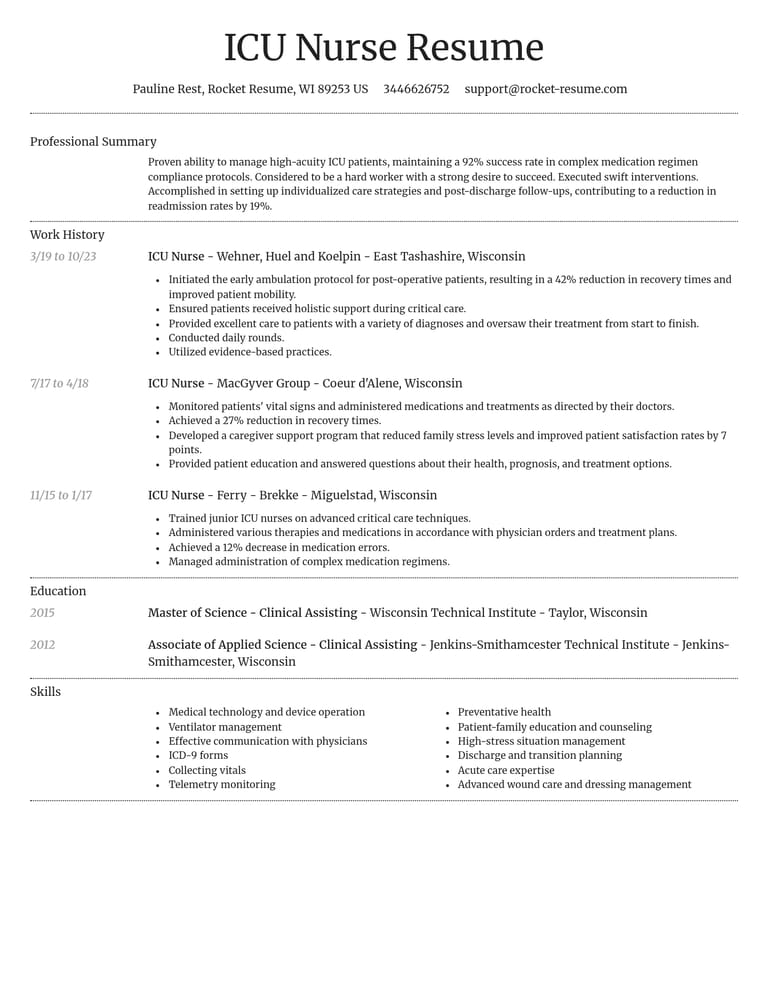
Choose the example closest to your background: telemetry, medical ICU or cardiovascular ICU. Look at how each describes patients, equipment and responsibilities.
See also: Skills and examples
The telemetry resume gives escalation and transfer handoffs space beside routine care. When building your resume for a move from telemetry to the ICU, describe a rhythm change you recognized and the information you passed to the responding team before adding committee or preceptor work.
Build My ResumeIn the builder: experience level
How much experience do you have?
Which experience should lead my ICU resume?
Applying to your first ICU role? Lead with relevant acute care experience. Already working in intensive care? Start with your most recent ICU role and the patients you cared for.
Tip: Choose the example closest to your work: telemetry for an initial ICU application, MICU or CVICU for established intensive care practice.
Start from Build My Resume and it’s the builder’s first question. The examples below show three starting points: a telemetry RN with two years applying to a first ICU job, an MICU RN with several years of critical care experience and an experienced CVICU RN who takes charge shifts.
Choose an order that fits
- Moving from acute care:
- Summary, RN license and certifications, Telemetry or med-surg experience, Education, Skills.
- Experienced in critical care:
- Summary, ICU experience, RN license and certifications, Education, Skills.
The builder starts with a standard order, and you can move sections into the one you choose.
Start a new unit entry when a transfer changed the patient population or the devices you managed.
See also: Resume examplesCan a new graduate nurse apply to the ICU?Templates
Your earlier acute care work can show monitoring, medication administration and escalation when you seek your first ICU job. Tell the builder how much experience you have, then arrange that history so the most relevant patient care appears before less relevant responsibilities.
Build My ResumeIn the builder
Template: keep unit names and dates visible
Tip: Use a template with clear job headings so a transfer into MICU stays visible beside the employer and dates.
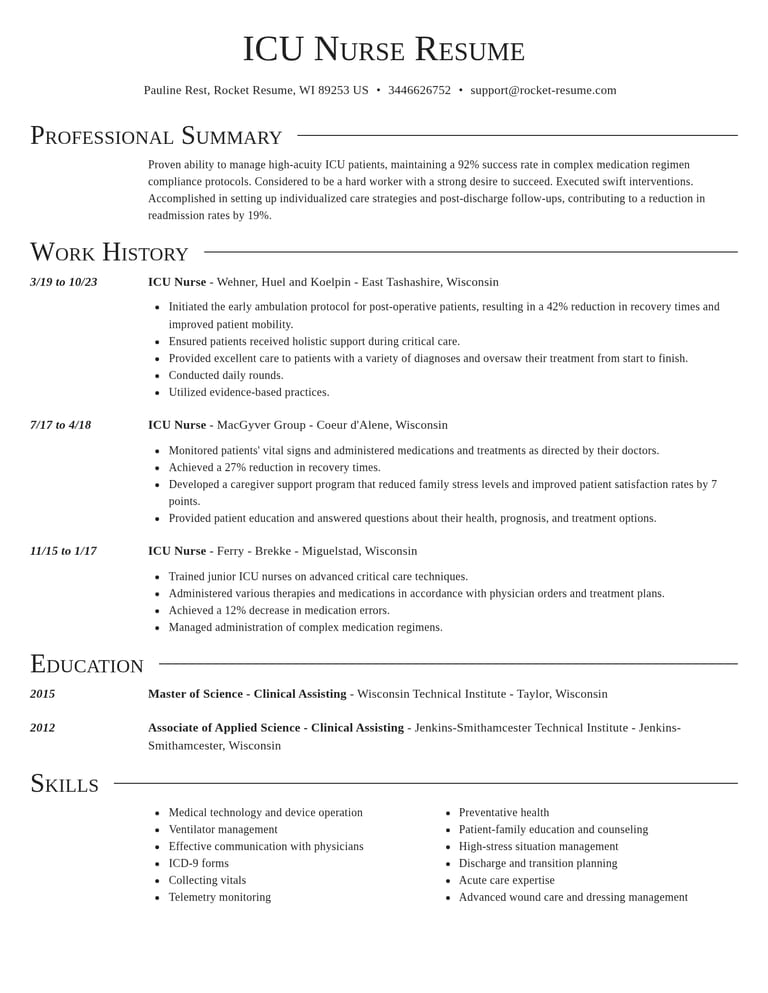
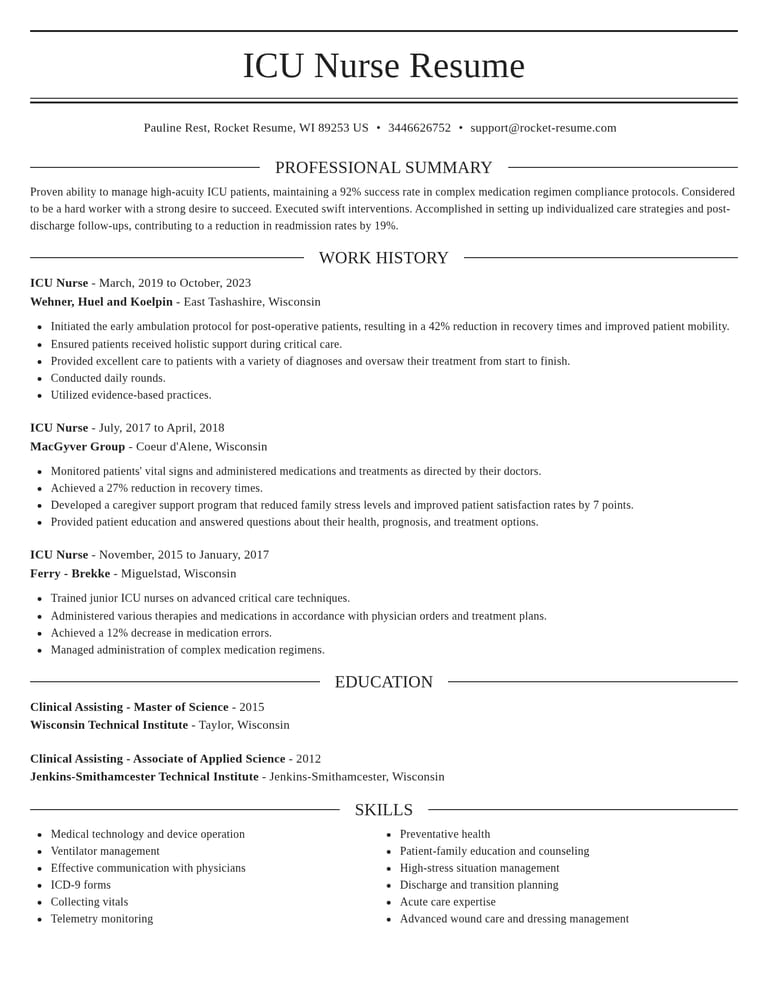
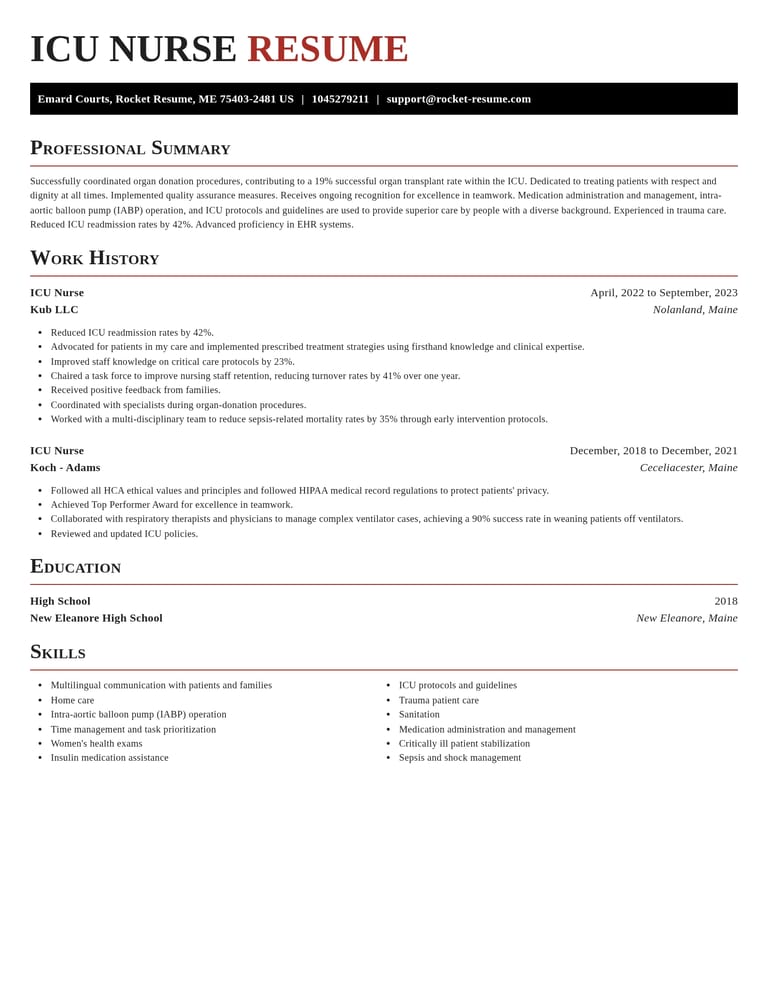
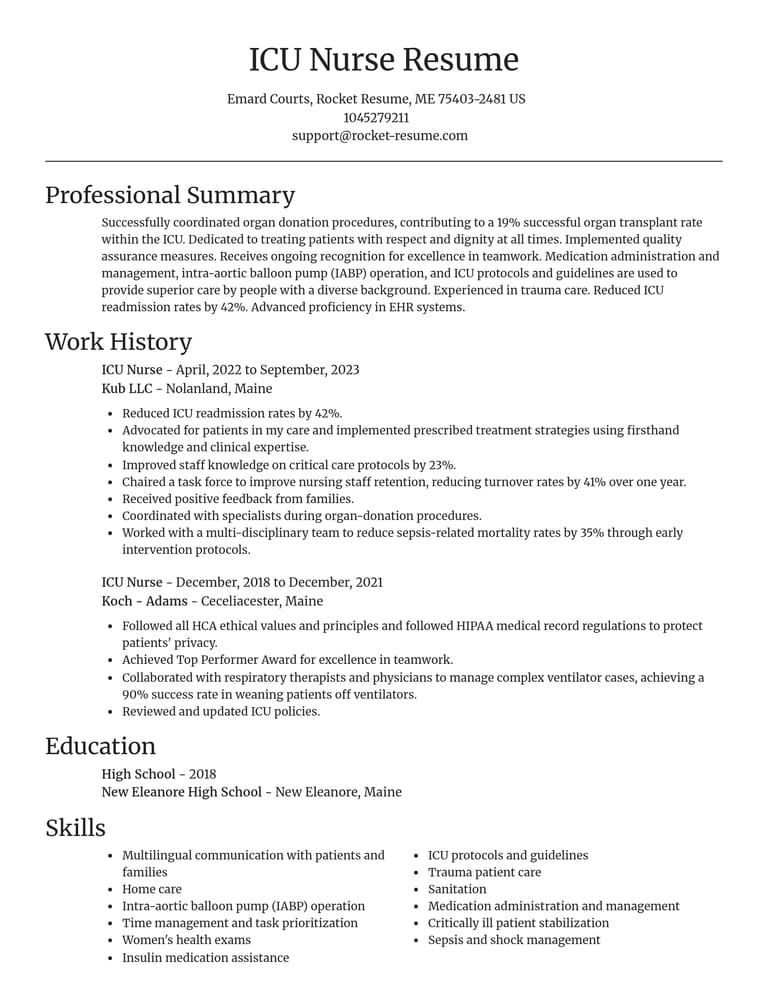
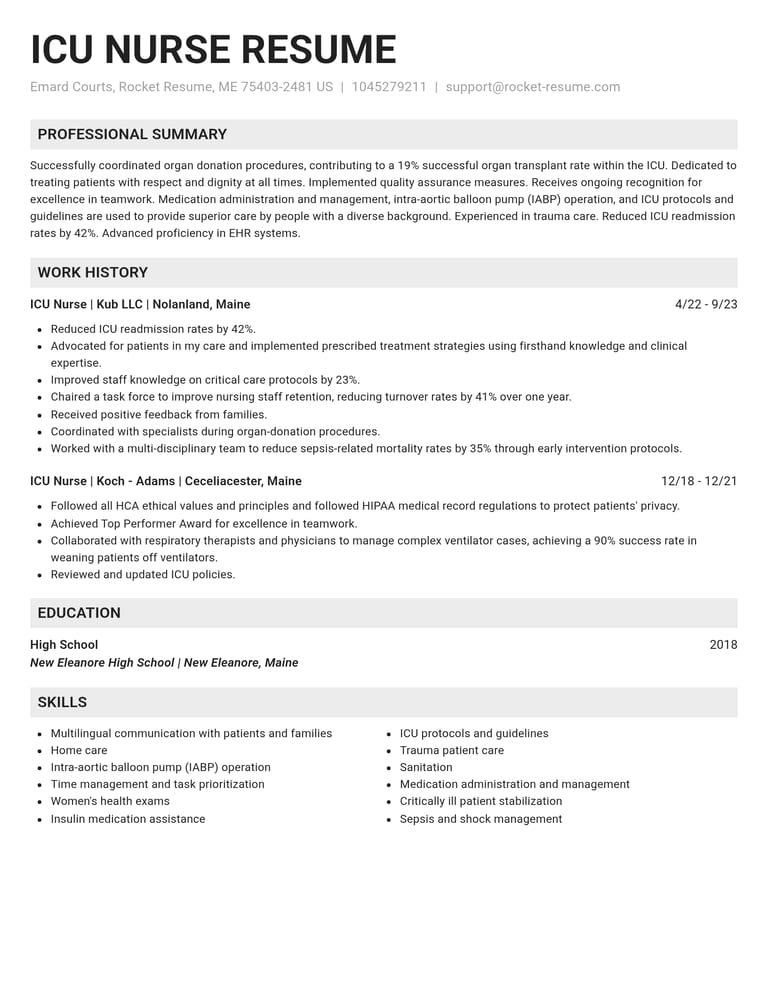
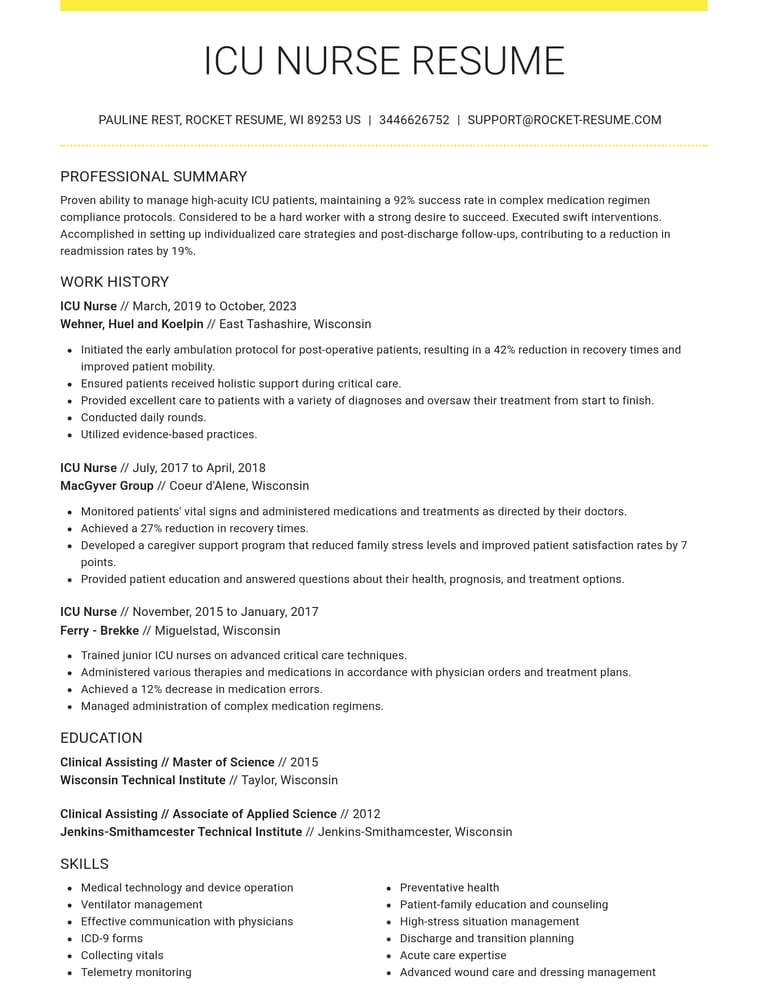
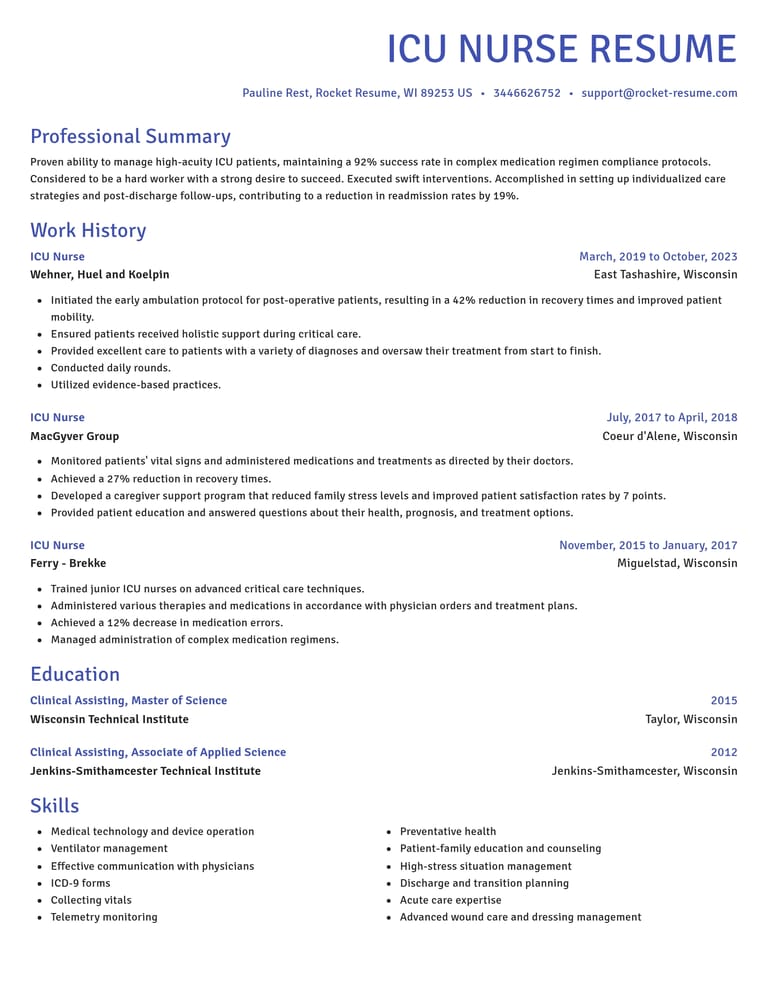
Choose a layout that makes your units, job dates and credentials easy to scan. Give each unit a separate entry when your responsibilities changed.
See also: Which resume format works best for an ICU application?
Clear job headings let a reader follow a move from telemetry into intensive care. After choosing a template in the builder, add contact details and start the work history with the most recent nursing position.
Build My ResumeIn the builder
Work history: show the assessment and the response
How can acute care experience show ICU readiness?
Describe how you prioritized care when several patients needed attention before an ICU transfer.
Tip: Describe the change you recognized, the action you took and the team involved without including identifying patient information.
Describe what you noticed, what you did and who you worked with. Include the unit and patient assignment when they help explain your responsibilities. Leave out identifying patient details.
If the job description asks for Show this on your resume Acute care experience Give nursing job dates and identify critical care and other acute care roles. Medication responsibilities Explain medication work and monitoring within the role you performed. Before
“Cared for telemetry patients and helped during emergencies.”
After
“Managed a four-patient telemetry assignment, recognized a new rhythm change, called the rapid-response team and shared rhythm strips and recent vital signs.”
Only claim what you did or hold. Describe the patient ratio and acuity so the reader can understand the assignment.
For ideas on showing your results, explore ICU nurse accomplishments
See also: Resume examplesSkills and examplesShow how you used ICU equipment
Use a specific patient-care example to start your work history.
Build My ResumeIn the builder
Education: identify the nursing degree or diploma
Tip: Keep nursing education separate from the RN license so the ICU reader can check each without searching through a combined entry.
List your nursing degree or diploma, school and completion year. If you're still studying, make that clear. Put supervised clinical placements under education, separate from paid nursing roles.
If the job description asks for Show this on your resume Nursing education Show the completed nursing degree or diploma and the program. See also: RN license, life support cards and specialty certificationCan a new graduate nurse apply to the ICU?
A completed nursing degree and a program still in progress need different dates on an ICU resume. In the builder’s education step, enter the school and degree or diploma, then check that the completion status and year are clear.
Build My ResumeIn the builder
Skills: choose skills with supporting examples
Which ICU devices and checks should I name?
Name cardiac monitors and alarms, mechanical ventilators, transducers for pressure monitoring, watching for sepsis or shock, and pain and sedation assessment.
Tip: Give assessment skills priority when the ICU job description emphasizes recognizing deterioration.
Choose skills you've used that match the job description. Name the equipment and assessments you know, then show how you used them in your work history.
If the job description asks for Show this on your resume Devices and assessments Prioritize the equipment and assessments named in the ICU job description. Patient assessment
- Critical care assessment
- Sedation assessment
Devices and monitoring
- Cardiac monitoring
- Ventilator monitoring
- Invasive pressure monitoring
A skill list helps a reader scan. A work example under a job shows what you did.
Skill
Critical care assessment
Work example
Recognized signs of shock in an MICU patient, reported the change in pressure readings and documented the intervention and reassessment.
See also: Show how you used ICU equipmentSkills and examples
Assessment priorities help you decide which skills deserve the limited space on an ICU resume. Save the relevant suggestions, then use the builder’s skills step to arrange critical care assessment, medication administration and documentation around the job you want.
Build My ResumeIn the builder
Summary: write a focused ICU resume summary
Tip: Choose the details that connect the current unit to the target ICU instead of opening with a general claim about compassion.
Start with your current role, experience and patient population. Add one or two strengths that matter to the ICU you're applying to.
If the job description asks for Show this on your resume Unit and patients Identify the nursing unit and the population in the opening description. Summary if you’re moving from telemetry
“Telemetry RN with two years caring for adult patients. Experienced in cardiac monitoring, IV infusions and rapid-response support, with a focus on moving into intensive care.”
Summary if you’re experienced in MICU
“MICU RN with four years caring for critically ill adults with respiratory failure and sepsis. Experienced with mechanical ventilation, invasive monitoring and coordinated bedside handoffs. Brings pain assessment and sedation monitoring to adult intensive care.”
Summary if you’re covering CVICU charge shifts
“CVICU RN with seven years in cardiovascular intensive care and regular charge-shift responsibility. Combines experience in postoperative cardiac care, invasive hemodynamic monitoring, staffing and admissions coordination on charge shifts, and precepting.”
Shape your introduction with help from ICU nurse summary examples
See also: Resume examplesSkills and examples
Respiratory failure or postoperative cardiac care gives an ICU summary a clearer focus than a broad nursing objective. When building that section, open with the patient population, then select an assessment or monitoring responsibility that the work history already demonstrates.
Build My ResumeIn the builder
Certifications: identify the license and certifications
Which certifications belong on an ICU nurse resume?
Your RN license, life-support cards such as BLS and ACLS, and a specialty certification if you hold one belong on an ICU nurse resume.
Tip: Use the issuing state for the RN license and the exact names on certifications, listing each date with the relevant credential.
List your RN license separately from your degree. Add the certifications you hold, using the names, issuers and dates on your records. Check the job description for required credentials.
Registered Nurse (RN), [state], [year]
How to list it · copy the wording on your certificate
Basic Life Support (BLS), [issuing organization], [year]
How to list it · copy the wording on your certificate
Advanced Cardiovascular Life Support (ACLS), [issuing organization], [year]
How to list it · copy the wording on your certificate
CCRN, American Association of Critical-Care Nurses, [year]
How to list it · from the example resumes
If the job description asks for Show this on your resume RN license Use the license name exactly as it appears in the record. Current certifications Use the job description to decide which current certifications to feature. See also: RN license, life support cards and specialty certificationDo ICU nurses need a certification?How should I list the RN license on an ICU resume?
Card names and dates are easiest to check against the records before you finish the ICU resume. Add certifications in the builder’s optional sections, entering the issuer and year beside each credential so the hiring reader can review them together.
Build My Resume
ICU nurse resume mistakes to fix before you apply
How Rocket Resume helps
Four ways the builder helps with your ICU nurse resume:
- Job descriptions. Keep one resume in your account and adjust it to fit each one.
- Experience level. The builder asks how much experience you have first, then guides you from there.
- Your own numbers. Choose a suggestion, then edit it to add the numbers from your work.
- Saved suggestions. Save a skill, example, summary or certification on this page, and it waits for you in the builder.
Show how you used ICU equipment
O*NET, the U.S. Department of Labor’s occupational database, describes the equipment and assessments behind intensive care nursing.
Tip: Use a procedure’s name to distinguish assistance during intubation or cardioversion from routine bedside monitoring.
What does an ICU nurse resume look like?
Compare a first ICU application, an established MICU resume and a CVICU resume with charge shifts. Each is an illustrative composite.
Tip: Read the work dates beside each unit to see how the nurse’s responsibilities developed.
Telemetry RN applying for a first ICU role
Houston, TX · 2 years in telemetry · First ICU application
Sofia R.
Registered nurse, telemetry
sofia.r@example.com · (713) 555-0142 · Houston, TX
Summary
Telemetry RN with two years on a busy adult unit, caring for four monitored patients per shift. Reads and reports heart rhythms, manages IV infusions on pumps, monitors patient response and contributes to rapid-response calls and transfer handoffs. Precepts new colleagues and contributes to a handoff committee.
Experience
Registered nurse, adult telemetry · Example Community Hospital
Jul 2024 – Present
- Care for a four-patient adult telemetry assignment, reviewing cardiac monitor findings and reporting changes in condition.
- Manage IV infusions using infusion pumps and document patient response in the electronic record.
- Contribute rhythm strips and recent observations during rapid-response calls, then support transfer handoffs to the receiving ICU.
- Precepted two new RNs and helped a unit committee revise the shift-handoff checklist.
Education and credentials
Associate Degree in Nursing (ADN) · Example Community College, 2024
Registered Nurse (RN), Texas, 2024 · BLS, American Heart Association, 2026 · ACLS, American Heart Association, 2026
Skills
- Cardiac monitoring
- Medication administration
- Rapid-response support
- Infusion pumps
- Precepting
Why this example works
- Transferable monitoringConnects cardiac monitoring and escalation to the original telemetry unit.
- Visible assignmentShows the hiring reader the size of the telemetry assignment and the monitoring responsibilities.
- Additional contributionIncludes precepting and committee work alongside patient care.
MICU nurse with established critical care practice
Tampa, FL · 4 years in MICU · Adult critical care
Julian T.
Registered nurse, MICU
julian.t@example.com · (813) 555-0153 · Tampa, FL
Summary
MICU RN with four years caring for critically ill adults with respiratory failure, sepsis and shock. Manages two patients using mechanical ventilators, cardiac monitors, pressure transducers and infusion pumps. Assesses sedation response and supports families through acute illness.
Experience
Registered nurse, MICU · Example University Hospital
Jul 2022 – Present
- Manage a two-patient MICU assignment involving respiratory failure, sepsis or shock, tracking changes in condition and escalating concerns.
- Monitor ventilator alarms and invasive pressure readings, investigate equipment concerns and communicate findings to the respiratory therapist and treating team.
- Assess pain and sedation response, calculate weight-based medication doses and document reassessment for bedside handoffs.
- Assist with intubation preparation and keep families informed about the nursing care plan.
Registered nurse, general medicine · Example University Hospital
Jul 2020 – Jun 2022
- Cared for a five-patient general medicine assignment involving pneumonia, diabetes and complex discharge needs.
- Taught patients and families how to manage medications after discharge and coordinated follow-up with the care team.
Education and credentials
Bachelor of Science in Nursing (BSN) · Example University, 2020
Registered Nurse (RN), Florida, 2020 · BLS, American Heart Association, 2026 · ACLS, American Heart Association, 2026 · CCRN, American Association of Critical-Care Nurses, 2025
Skills
- Critical care assessment
- Mechanical ventilation monitoring
- Invasive pressure monitoring
- Medication administration
- Clinical handoff
Why this example works
- Unit-specific openingIdentifies MICU, adult patient conditions and the devices used together.
- Clear progressionShows general medicine experience before the later medical intensive care job.
- Current certificationsGroups life support cards and specialty certification with the state-issued RN license for review against the job requirements.
CVICU nurse who also takes charge shifts
Phoenix, AZ · 7 years in CVICU · Regular charge shifts
Naomi K.
Registered nurse, CVICU
naomi.k@example.com · (602) 555-0164 · Phoenix, AZ
Summary
CVICU RN with seven years caring for adults after cardiac surgery and during cardiovascular critical illness. Manages two patients with mechanical ventilation, temporary pacing and invasive hemodynamic monitoring. Takes regular charge shifts coordinating staffing and admissions.
Experience
Registered nurse, CVICU · Example Regional Medical Center
Jul 2019 – Present
- Care for a two-patient CVICU assignment after coronary artery bypass or valve surgery, monitoring ventilators, temporary epicardial pacing and invasive hemodynamics.
- Serve as charge nurse on designated shifts for a twelve-bed CVICU, coordinating assignments and communicating bed and staffing needs.
- Assess chest tube output and postoperative hemodynamic changes, titrate vasoactive infusions and communicate concerns to the cardiac surgery team.
- Precepted six nurses joining the CVICU and added equipment checks to the handoff checklist with the unit team.
Registered nurse, cardiac telemetry · Example Regional Medical Center
Jul 2016 – Jun 2019
- Managed a four-patient cardiac telemetry assignment involving heart failure and acute coronary syndromes.
- Prepared patients for cardiac catheterization and provided medication teaching before discharge.
Education and credentials
Diploma in Nursing · Example Medical Center School of Nursing, 2016
Registered Nurse (RN), Arizona, 2016 · BLS, American Heart Association, 2026 · ACLS, American Heart Association, 2026 · CCRN, American Association of Critical-Care Nurses, 2024
Skills
- Postoperative cardiac care
- Invasive pressure monitoring
- Mechanical ventilation monitoring
- Clinical handoff
- Charge nursing
- Precepting
Why this example works
- Charge-shift leadershipGives charge shifts their own responsibility beside the bedside assignment.
- Cardiovascular contextLinks postoperative patients to the monitoring and devices used in their care.
- Mentoring and teamworkShows mentoring and coordination as work performed within the CVICU.
A telemetry transfer handoff and a CVICU charge shift reveal different nursing responsibilities. Start building from a specific event in the work history, then add the patient ratio and acuity so the hiring reader can understand the assignment.
Build My ResumeLoading resume templates…
ICU nurse resume questions
How long should an ICU nurse resume be?
Which resume format works best for an ICU application?
Can a new graduate nurse apply to the ICU?
How much do ICU nurses make?
Do ICU nurses need a certification?
What does an ICU nurse do?
Is a critical care nurse the same as an ICU nurse?
How should I list the RN license on an ICU resume?
Should charge shifts go on an ICU resume?
Check whether the ICU job description asks for prior nursing experience before choosing what to feature. Start building with the qualifications you already meet, then use the summary to connect those strengths to the unit you want to join.
Build My ResumeICU nurse resume skills and examples
Browse skills, work examples, summaries and certifications. Save the ones that fit, then make each one true to your own work.
Tip: Keep assessment, medication administration and documentation in distinct skill groups for a quick scan.
Critical care assessment
Patient assessment
Sedation assessment
Patient assessment
Cardiac monitoring
Devices and monitoring
Ventilator monitoring
Devices and monitoring
Invasive pressure monitoring
Devices and monitoring
Medication administration
Medications
Weight-based medication calculation
Medications
Clinical handoff
Teamwork and handoffs
Show all 18 skillsShow fewer
Procedure assistance
Teamwork and handoffs
Family support
Teamwork and handoffs
Vital signs documentation
Documentation
Nursing documentation
Documentation
Rapid-response support
Teamwork and handoffs · from the example resumes
Infusion pumps
From the example resumes
Precepting
From the example resumes
Mechanical ventilation monitoring
Devices and monitoring · from the example resumes
Postoperative cardiac care
Devices and monitoring · from the example resumes
Charge nursing
From the example resumes
Cared for a five-patient general medicine assignment involving pneumonia, diabetes and complex discharge needs.
Patient assessment · from the MICU experience example
Care for a four-patient adult telemetry assignment, reviewing cardiac monitor findings and reporting changes in condition.
Devices and monitoring · from the telemetry to ICU example
Monitor ventilator alarms and invasive pressure readings, investigate equipment concerns and communicate findings to the respiratory therapist and treating team.
Devices and monitoring · from the MICU experience example
Care for a two-patient CVICU assignment after coronary artery bypass or valve surgery, monitoring ventilators, temporary epicardial pacing and invasive hemodynamics.
Devices and monitoring · from the CVICU and charge example
Assess chest tube output and postoperative hemodynamic changes, titrate vasoactive infusions and communicate concerns to the cardiac surgery team.
Devices and monitoring · from the CVICU and charge example
Managed a four-patient cardiac telemetry assignment involving heart failure and acute coronary syndromes.
Devices and monitoring · from the CVICU and charge example
Calculated weight-based medication doses for a ventilated MICU patient and documented the sedation response for bedside handoff.
Medications · writing example
Assess pain and sedation response, calculate weight-based medication doses and document reassessment for bedside handoffs.
Medications · from the MICU experience example
Show all 19 work examplesShow fewer
Contribute rhythm strips and recent observations during rapid-response calls, then support transfer handoffs to the receiving ICU.
Teamwork and handoffs · from the telemetry to ICU example
Precepted two new RNs and helped a unit committee revise the shift-handoff checklist.
Teamwork and handoffs · from the telemetry to ICU example
Assist with intubation preparation and keep families informed about the nursing care plan.
Teamwork and handoffs · from the MICU experience example
Precepted six nurses joining the CVICU and added equipment checks to the handoff checklist with the unit team.
Teamwork and handoffs · from the CVICU and charge example
Recognized signs of shock in an MICU patient, reported the change in pressure readings and documented the intervention and reassessment.
Documentation · writing example
Manage IV infusions using infusion pumps and document patient response in the electronic record.
Documentation · from the telemetry to ICU example
Handed over an MICU patient receiving mechanical ventilation, highlighting a ventilator alarm and the response requiring follow-up.
Writing example
Manage a two-patient MICU assignment involving respiratory failure, sepsis or shock, tracking changes in condition and escalating concerns.
From the MICU experience example
Taught patients and families how to manage medications after discharge and coordinated follow-up with the care team.
From the MICU experience example
Serve as charge nurse on designated shifts for a twelve-bed CVICU, coordinating assignments and communicating bed and staffing needs.
From the CVICU and charge example
Prepared patients for cardiac catheterization and provided medication teaching before discharge.
From the CVICU and charge example
Telemetry RN with two years caring for adult patients. Experienced in cardiac monitoring, IV infusions and rapid-response support, with a focus on moving into intensive care.
Moving from telemetry · writing example
MICU RN with four years caring for critically ill adults with respiratory failure and sepsis. Experienced with mechanical ventilation, invasive monitoring and coordinated bedside handoffs. Brings pain assessment and sedation monitoring to adult intensive care.
Experienced in MICU · writing example
CVICU RN with seven years in cardiovascular intensive care and regular charge-shift responsibility. Combines experience in postoperative cardiac care, invasive hemodynamic monitoring, staffing and admissions coordination on charge shifts, and precepting.
Covering CVICU charge shifts · writing example
Telemetry RN with two years on a busy adult unit, caring for four monitored patients per shift. Reads and reports heart rhythms, manages IV infusions on pumps, monitors patient response and contributes to rapid-response calls and transfer handoffs. Precepts new colleagues and contributes to a handoff committee.
From the telemetry to ICU example
MICU RN with four years caring for critically ill adults with respiratory failure, sepsis and shock. Manages two patients using mechanical ventilators, cardiac monitors, pressure transducers and infusion pumps. Assesses sedation response and supports families through acute illness.
From the MICU experience example
CVICU RN with seven years caring for adults after cardiac surgery and during cardiovascular critical illness. Manages two patients with mechanical ventilation, temporary pacing and invasive hemodynamic monitoring. Takes regular charge shifts coordinating staffing and admissions.
From the CVICU and charge example
Registered Nurse (RN), [state], [year]
How to list it · copy the wording on your certificate
Basic Life Support (BLS), [issuing organization], [year]
How to list it · copy the wording on your certificate
Advanced Cardiovascular Life Support (ACLS), [issuing organization], [year]
How to list it · copy the wording on your certificate
CCRN, American Association of Critical-Care Nurses, [year]
How to list it · from the example resumes
Skills are adapted from O*NET (29-1141.00) and the example resumes.
Where they go in your resume: Work historySkillsSummaryCertifications
Find skills that match your experience in ICU nurse resume skills
Medication calculations, clinical handoffs and documentation need distinct places in an ICU skills list. Save suggestions for the responsibilities the employer emphasizes, then build the section in that order so the reader can identify the relevant strengths quickly.
Build My ResumeRN license, life support cards and specialty certification
List your RN license separately from your certifications.
Tip: Read required and preferred qualifications separately when deciding which certifications to feature.
Registered Nurse (RN)
The state that issued the license
- How to list it
- Registered Nurse (RN), [state], [year]
- License and certification guidance
- Registered nurses must hold a nursing license issued by the state where they work. To be licensed, a nurse graduates from an approved nursing program and passes a qualifying exam; other requirements, such as a criminal background check, vary by state. The Occupational Outlook Handbook states this requirement. An eligible multistate RN license is issued by the nurse’s primary state of residence and permits practice in other compact states. List the issuing board and multistate status, when applicable.
BLS: Basic Life Support
the basic life support training provider
- How to list it
- Basic Life Support (BLS), [issuing organization], [year]
- License and certification guidance
- List BLS with the issuing organization and year so the hiring reader can check the card separately from the state-issued license.
ACLS: Advanced Cardiovascular Life Support
the advanced life support training provider
- How to list it
- Advanced Cardiovascular Life Support (ACLS), [issuing organization], [year]
- License and certification guidance
- Check whether the ICU job requires ACLS and, if so, its completion deadline; list the certification with its issuing organization and year.
Still in nursing training?
Life support certifications
Specialty certification
Check which credentials you hold against ICU nurse certifications
A clear credential section helps an ICU reader distinguish the RN license from life support certification. Start building with the nursing history now, then add credentials in the optional sections and check each name against the record you have.
Build My ResumeWhat an ICU nurse’s workday is like
O*NET’s registered-nurse work-context data were updated in August 2021. O*NET is the U.S. Department of Labor’s occupational database. Pair ICU nurse interview questions to practice with the teamwork and bedside-check examples you prepare.
Tip: Choose a handoff or escalation example that shows the contribution you made rather than naming only the team.
Teamwork 91% of registered nurses rate working with or contributing to a team as extremely important.
Describe the information you contributed during a rapid response on the unit.
Consequence of error 57% of registered nurses say the consequence of an error is extremely serious.
Describe a check that helped you catch an error before an ICU handoff.
Exposure to infections 61% of registered nurses report exposure to disease or infections every day.
Ask: How does the ICU team communicate infection precautions during a bedside handoff?
A rapid response or difficult handoff can reveal responsibilities that a device list misses. Recall an example you could explain clearly, then build a work history entry around the team contribution and decisions you made during that nursing assignment.
Build My ResumeWhere an ICU nurse career can lead
ICU experience can lead you toward charge responsibilities or a role in another intensive care unit. Choose the direction first, then emphasize the patient care and coordination that support it.
Grow as an ICU nurse
- Take on unit leadership through charge shifts. The charge nurse resume examples show how to present that experience.
- Move to another intensive care unit, using the surgical ICU nurse resumes, NICU nurse resume examples and neuro ICU registered nurse examples to compare how each resume emphasizes its unit.
Tip: For a move to another intensive care unit, lead with the patient population and monitoring experience relevant to that unit.
Compare related healthcare jobs
| Job | Median pay |
|---|---|
| Registered nurses | $97,550 |
| Nurse practitioners | $132,300 |
| Nurse midwives | $134,040 |
| Physician assistants | $135,880 |
| Nurse anesthetists | $236,590 |
Pay gaps don’t show a typical career move, and each job has its own requirements. See pay for registered nurses by state.
Source: U.S. Bureau of Labor Statistics, median annual pay, May 2025 · checked Oct 23, 2026
Choose a bedside role, charge responsibility or a move to another intensive care unit. Start building with the patient care, staffing decisions or admissions work that supports your choice, then give those responsibilities space in the work history.
Build My ResumeICU nurse salary and job outlook
Government estimates for May 2025. Pay depends on your state, work setting and experience. These figures are for registered nurses.
Tip: Compare the state’s registered nurse median with the salary stated for the ICU job before deciding where to apply.
Pay for registered nurses by state
Median annual wage, May 2025. Highest: California, $140,270. Tap a state to see its numbers.
- Under $82,000
- $82,000–$83,999
- $84,000–$95,999
- $96,000–$101,999
- $102,000 or more
Selected state
California
- Median
- $140,270
- Average
- $150,280
- Lowest to highest 10%
- $101,260 – $213,320
- Jobs in the state
- 338,940
National median: $97,550. State figures are annual; see the national pay range for hourly wages.
See all 50 states and DC
| State | Median | Average | Lowest 10% | Highest 10% | Jobs |
|---|---|---|---|---|---|
| Alabama | $77,080 | $77,020 | $58,150 | $98,910 | 54,340 |
| Alaska | $109,480 | $114,870 | $85,030 | $149,070 | 7,510 |
| Arizona | $99,500 | $99,730 | $70,540 | $130,930 | 73,150 |
| Arkansas | $78,940 | $81,520 | $60,780 | $103,660 | 29,400 |
| California | $140,270 | $150,280 | $101,260 | $213,320 | 338,940 |
| Colorado | $100,260 | $99,370 | $79,500 | $124,940 | 54,490 |
| Connecticut | $102,740 | $105,250 | $80,350 | $134,870 | 40,110 |
| Delaware | $99,520 | $99,460 | $78,340 | $123,860 | 14,290 |
| District of Columbia | $102,540 | $106,980 | $79,390 | $151,170 | 11,440 |
| Florida | $84,190 | $90,650 | $67,970 | $120,330 | 229,940 |
| Georgia | $93,550 | $95,080 | $68,920 | $128,640 | 100,950 |
| Hawaii | $136,320 | $124,340 | $82,500 | $147,830 | 12,940 |
| Idaho | $92,460 | $92,710 | $71,210 | $121,230 | 16,880 |
| Illinois | $95,990 | $94,360 | $69,170 | $118,190 | 138,910 |
| Indiana | $83,500 | $89,150 | $66,750 | $105,750 | 68,980 |
| Iowa | $78,630 | $80,540 | $63,840 | $100,500 | 34,420 |
| Kansas | $79,320 | $82,360 | $63,180 | $100,840 | 33,800 |
| Kentucky | $81,040 | $86,140 | $64,170 | $111,750 | 50,300 |
| Louisiana | $80,230 | $84,190 | $63,800 | $104,740 | 48,970 |
| Maine | $86,990 | $91,700 | $74,160 | $106,950 | 16,540 |
| Maryland | $99,790 | $99,010 | $76,780 | $124,790 | 52,910 |
| Massachusetts | $104,550 | $117,960 | $80,310 | $174,510 | 88,200 |
| Michigan | $94,300 | $94,300 | $77,260 | $116,710 | 104,950 |
| Minnesota | $101,510 | $103,420 | $79,960 | $132,430 | 70,110 |
| Mississippi | $77,090 | $78,950 | $60,610 | $100,350 | 29,060 |
| Missouri | $81,780 | $85,900 | $63,230 | $104,390 | 76,310 |
| Montana | $85,280 | $91,510 | $70,120 | $113,920 | 10,950 |
| Nebraska | $84,730 | $88,330 | $66,020 | $106,190 | 24,720 |
| Nevada | $103,670 | $105,710 | $79,500 | $133,270 | 27,070 |
| New Hampshire | $99,700 | $97,900 | $75,610 | $123,190 | 15,390 |
| New Jersey | $106,500 | $110,100 | $83,060 | $135,170 | 92,680 |
| New Mexico | $94,340 | $95,290 | $74,300 | $123,540 | 17,980 |
| New York | $109,440 | $113,440 | $79,760 | $157,090 | 205,810 |
| North Carolina | $84,350 | $90,470 | $67,660 | $110,220 | 111,120 |
| North Dakota | $80,730 | $83,600 | $65,520 | $103,480 | 11,340 |
| Ohio | $82,510 | $87,730 | $66,980 | $105,290 | 143,730 |
| Oklahoma | $82,920 | $85,060 | $60,530 | $106,390 | 38,270 |
| Oregon | $129,010 | $123,140 | $95,280 | $155,010 | 39,730 |
| Pennsylvania | $96,430 | $94,020 | $70,800 | $117,900 | 146,520 |
| Rhode Island | $100,640 | $101,260 | $77,410 | $129,840 | 10,090 |
| South Carolina | $82,360 | $87,670 | $66,860 | $106,520 | 49,750 |
| South Dakota | $78,060 | $77,140 | $54,040 | $98,220 | 14,710 |
| Tennessee | $81,500 | $85,390 | $63,970 | $104,920 | 72,200 |
| Texas | $95,970 | $95,380 | $67,120 | $127,950 | 271,380 |
| Utah | $84,600 | $90,950 | $68,920 | $109,050 | 27,420 |
| Vermont | $97,460 | $96,650 | $77,670 | $126,100 | 7,410 |
| Virginia | $93,600 | $93,850 | $67,830 | $125,580 | 77,490 |
| Washington | $124,200 | $121,540 | $89,630 | $161,910 | 69,260 |
| West Virginia | $80,130 | $86,970 | $57,210 | $131,760 | 23,430 |
| Wisconsin | $95,530 | $94,690 | $77,470 | $119,860 | 68,060 |
| Wyoming | $83,760 | $88,600 | $65,770 | $107,350 | 5,330 |
Source: U.S. Bureau of Labor Statistics, Occupational Employment and Wage Statistics, May 2025 · checked Oct 23, 2026 · lowest and highest 10% are the 10th and 90th percentile wages
National pay range
Annual wages for all U.S. registered nurses
| Percentile | Annual | Hourly |
|---|---|---|
| 10th | $68,940 | $33.14 |
| 25th | $80,330 | $38.62 |
| Median | $97,550 | $46.90 |
| 75th | $112,350 | $54.02 |
| 90th | $137,470 | $66.09 |
Source: U.S. Bureau of Labor Statistics, Occupational Employment and Wage Statistics, May 2025 · checked Oct 23, 2026
More pay data: state rankings and pay by work setting
State rankings
Top five states and DC
Source: U.S. Bureau of Labor Statistics, Occupational Employment and Wage Statistics, May 2025 · checked Oct 23, 2026 · ranked by annual mean wage or jobs per 1,000 jobs
Median pay by work setting
Annual median, May 2025
- Government, excluding state and local education and hospitals$110,780
- Hospitals; state, local, and private$100,220
- Ambulatory healthcare services$91,230
- Nursing and residential care facilities$84,300
- Educational services; state, local, and private$78,620
Source: Occupational Outlook Handbook, May 2025 · checked Oct 23, 2026
Projected job growth, 2025–35
Change in employment over ten years
- Registered nurses6%
- Healthcare diagnosing or treating practitioners9%
- All occupations3%
That's 194,700 more jobs over ten years and about 180,800 openings a year, counting people who retire or change jobs.
Source: U.S. Bureau of Labor Statistics, Employment Projections 2025–35 · checked Oct 23, 2026
Where registered nurses work
Share of the 3,465,400 jobs in 2025 (largest settings)
- Hospitals; state, local, and private59%
- Ambulatory healthcare services19%
- Nursing and residential care facilities6%
- Government, excluding state and local education and hospitals5%
- Educational services; state, local, and private3%
The rest work in other settings.
Source: Occupational Outlook Handbook · checked Oct 23, 2026
Compare the state’s registered nurse median with the pay listed for the ICU job you want. Once you choose a location and unit, build your resume around that job description and the patient care you can describe from experience.
Build My ResumeAbout this guide
Updated November 14, 2026.
Sources
Loading industries…
Build your ICU nurse resume
Choose a template and start with your most recent nursing role. Add the skills and credentials that fit the ICU you're applying to.