Pediatric home health nurse resume examples, templates and tips
For pediatric home health RN roles, show how you care for children and work with families. Use the examples to write work history, skills and credentials for your next application.
- Show parent teaching skills
- Hospital-to-home resume tips
- Clear RN credentials
- Examples by experience

What pediatric home health nurse hiring managers look for
- RN license with the state named.
- Child assessment and observations recorded clearly.
- Medicines and treatments described through the work performed.
- Care plans and coordination with doctors.
- Teaching parents about illness or injury management.
- Accurate nursing records from care in the home.
How to write a pediatric home health nurse resume
An agency name alone doesn’t explain your nursing work. Show the children you cared for, what you did in the home and how you worked with parents. Keep hospital experience and home care experience distinct. This guide starts with four questions to answer first, then walks through each part of your resume with tips and links to the examples, templates and data on this page.
Four questions to answer first
- How can work history show pediatric care at home?
Step 5 connects a nursing duty to care in a child’s home.
- What goes first on a home health nurse resume?
Step 1 helps put the relevant home care details in reach.
- Which credentials should a home health RN resume list?
Step 9 shows how to present the license and life-support cards.
- Which home care resume example fits a new graduate?
Step 3 compares a recent graduate’s work with longer nursing histories.
What a pediatric home health nurse does
A pediatric home health nurse cares for children in their families’ homes. Describe assessing a child’s condition, recording observations and coordinating care with doctors. If you taught parents how to manage an illness or injury, include what you explained.
The Occupational Outlook Handbook from the U.S. Bureau of Labor Statistics projects 6% growth in registered nurses’ employment from 2025 to 2035. Registered nurses’ national median annual pay was $97,550 in May 2025.
For a broader account of nursing experience, read the registered nurse resume examples. When using those examples, state in your job entries that you cared for children in their families’ homes.
See also: Show care in the child’s home and work with the familyPediatric home health nurse salary and job outlook
Tip: Put the child patients and home setting beside the job title rather than leaving that context for the summary.
Write your pediatric home health nurse resume in nine steps
Do the first two before you open the builder. The other seven follow the builder’s order.
Step 1 of 9
Before you open the builder
Job description: bring home care into focus
What goes first on a home health nurse resume?
Open with a brief nursing summary, then show recent work, education and skills. Make the state RN license easy to find with your credentials.
Tip: Underline the patient group and setting in the job description, then check where those details appear in your resume.
Show your RN license alongside duty suggestions adapted from registered nurse tasks in O*NET and the Occupational Outlook Handbook.
Match each requirement in the job description
Here’s the step where you’ll show each one:
- RN license step 9
- Children in home care step 5
- Home or family needs step 5
- Nursing education step 6
- Assessment and records step 7
- Family teaching step 5
- Relevant background step 8
Tip: Match the job description’s teaching responsibilities to an example of how you explained care instructions to the child’s family.
See also: Show care in the child’s home and work with the familyLicense, life-support card and specialty certification
Choose a responsibility from the job description and show where you’ve done it. Start your resume with that evidence, whether it comes from home care or a pediatric unit.
Build My Resume
Before you open the builder
Examples: read for setting and experience
Tip: Notice how each example identifies children as the patient group and the family’s home as the care setting without including personal details.
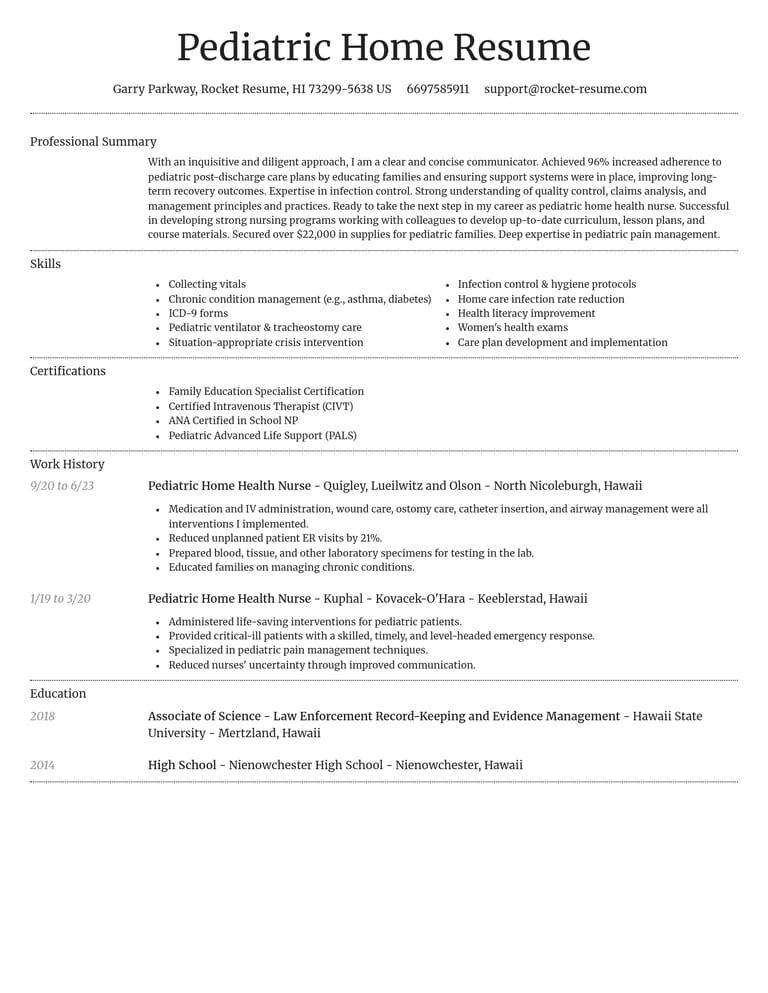
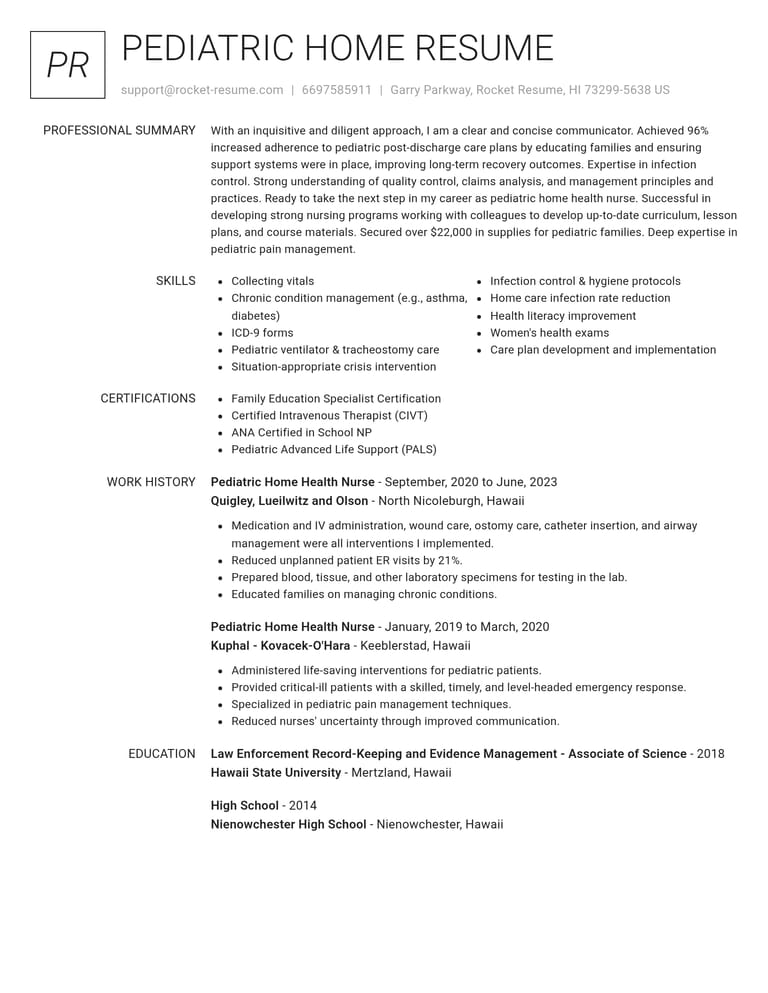
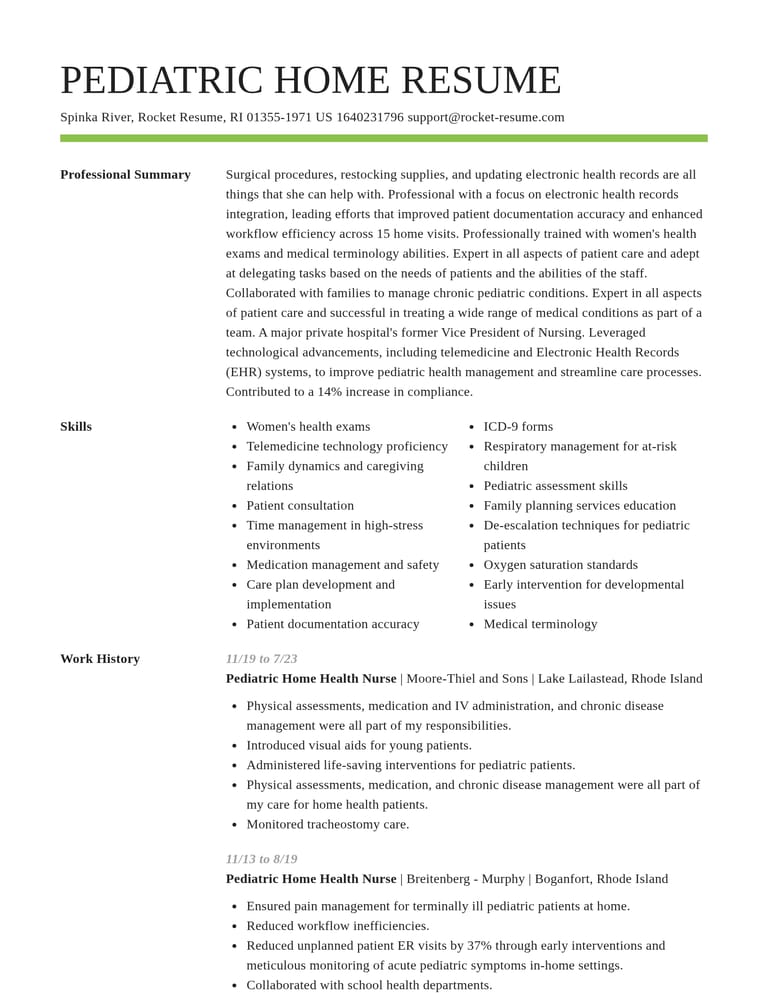
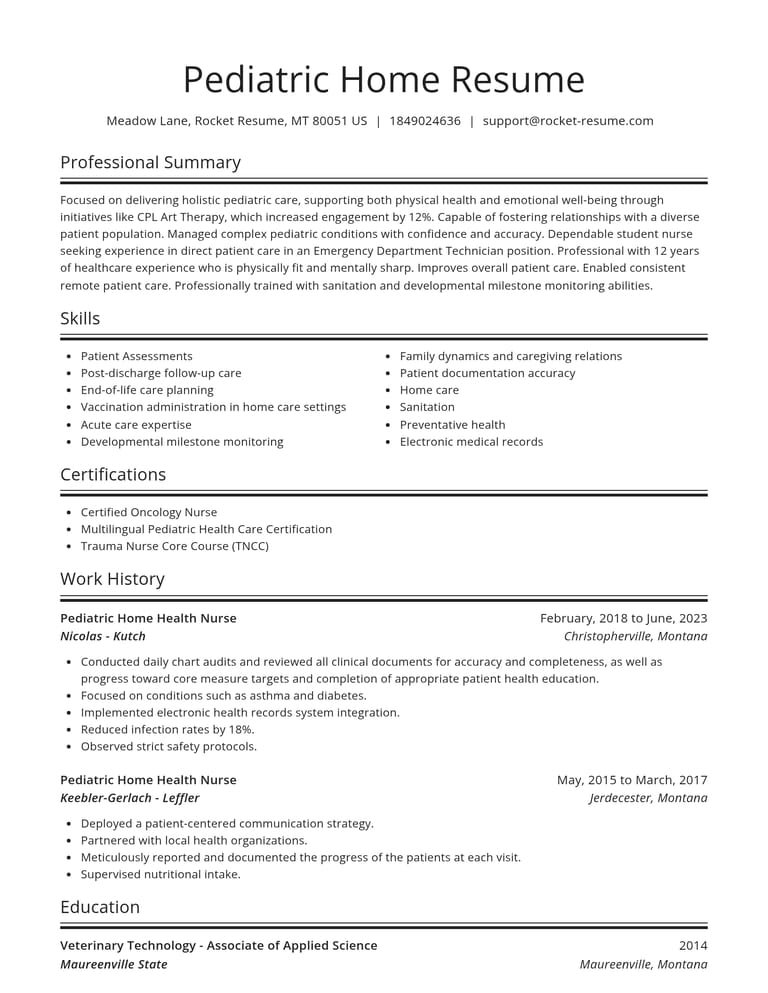
Paloma shows early home care experience, Sunita separates hospital and home nursing, and Reggie trims an older role. Choose the example closest to your background, then compare how each gives space to recent work.
Use the closest example to organize your resume. Gather your own employer names, dates and care responsibilities before drafting the work entries.
Build My ResumeIn the builder: experience level
How much experience do you have?
Which home care resume example fits a new graduate?
Paloma’s example fits a graduate with some home care experience. If you haven’t held a nursing job, use relevant supervised clinical work and label it clearly.
Tip: Count clinical rotations as education details and paid nursing work as work history, so the dates tell a clear story.
Start from Build My Resume and it’s the builder’s first question. The examples below show three starting points: a first home care job after graduation, a move from a hospital children’s unit and eight years in home health.
Choose an order that fits
- Resume section order:
- Summary, Experience, Education and credentials, Skills.
The builder starts with a standard order, and you can move sections into the one you choose.
Give recent work caring for children in their homes more space than older entries that repeat the same responsibilities.
See also: Resume examples
Build your resume around the nursing experience you have. Keep clinical rotations clearly labeled so a reader can distinguish supervised training from employment.
Build My ResumeIn the builder
Template: keep nursing details easy to scan
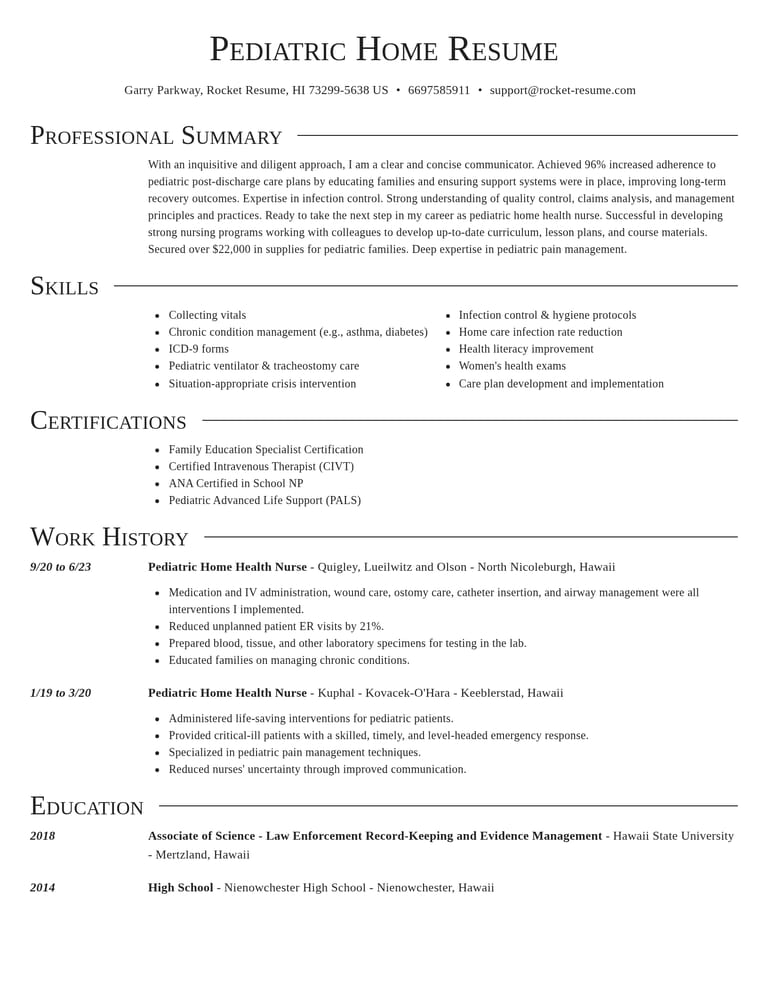
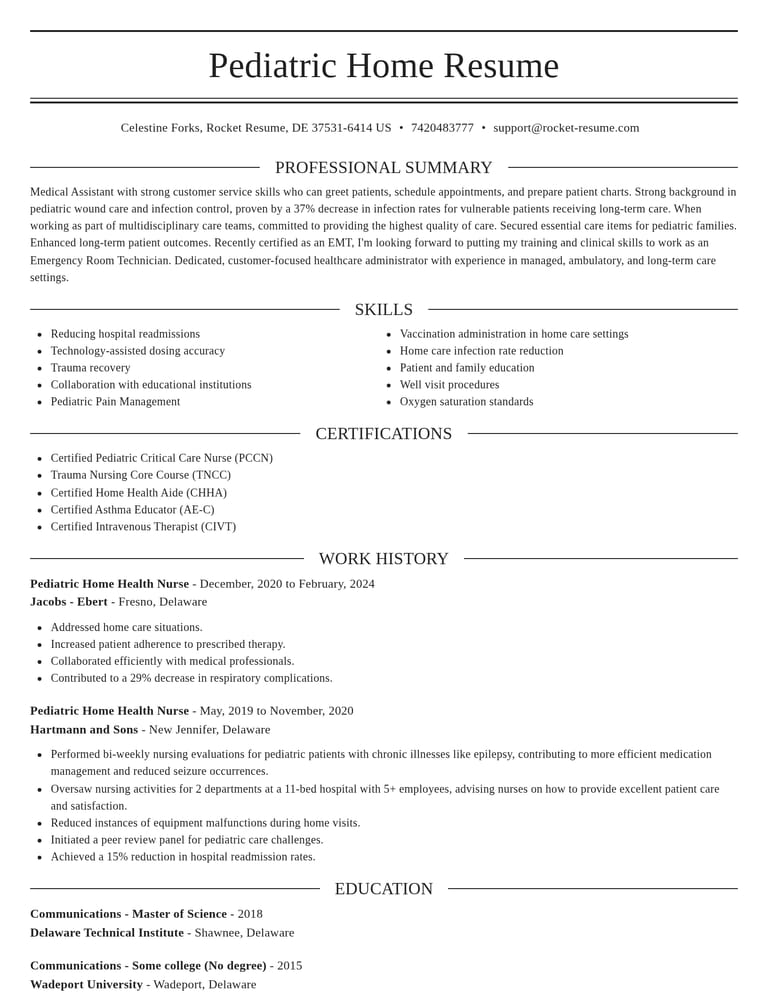
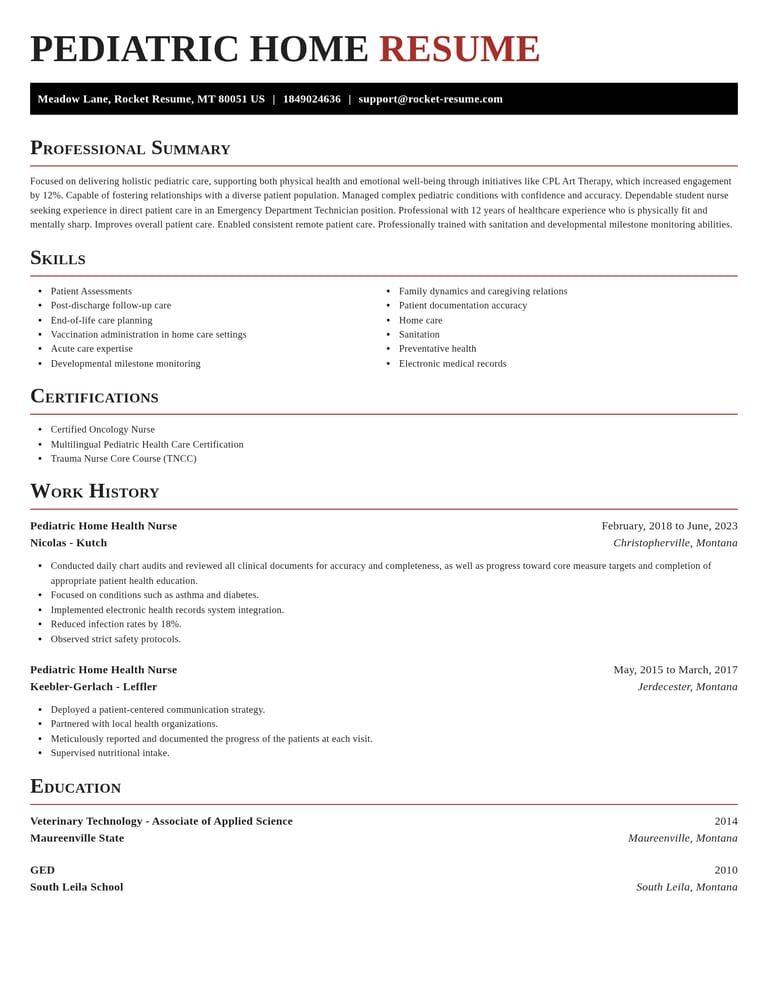
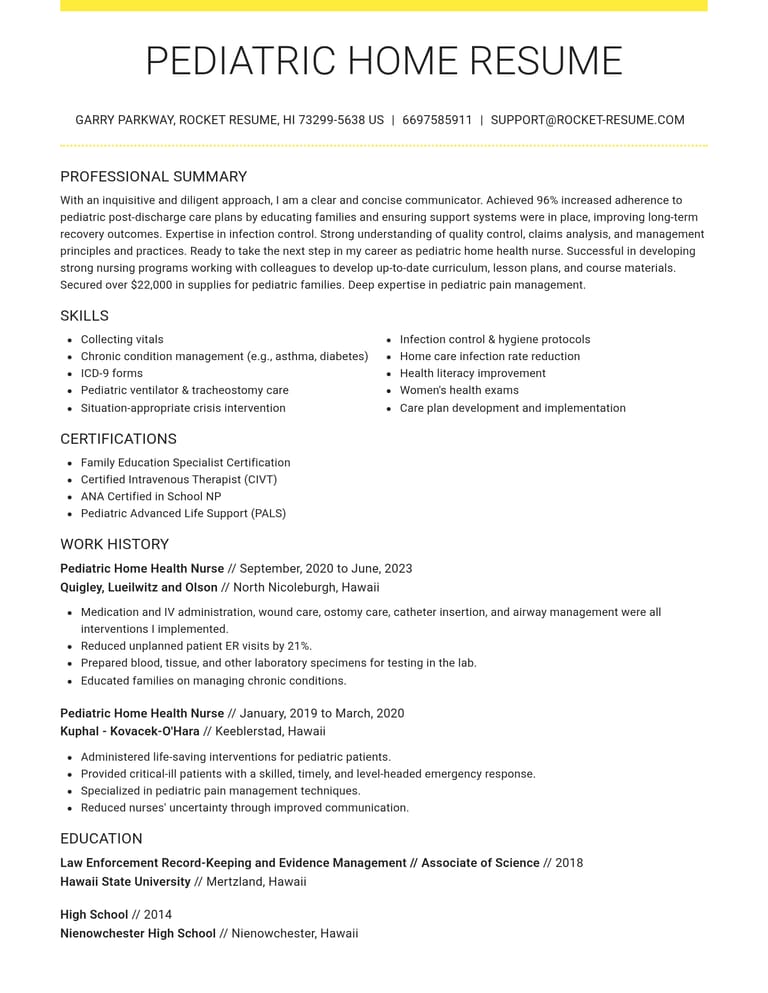
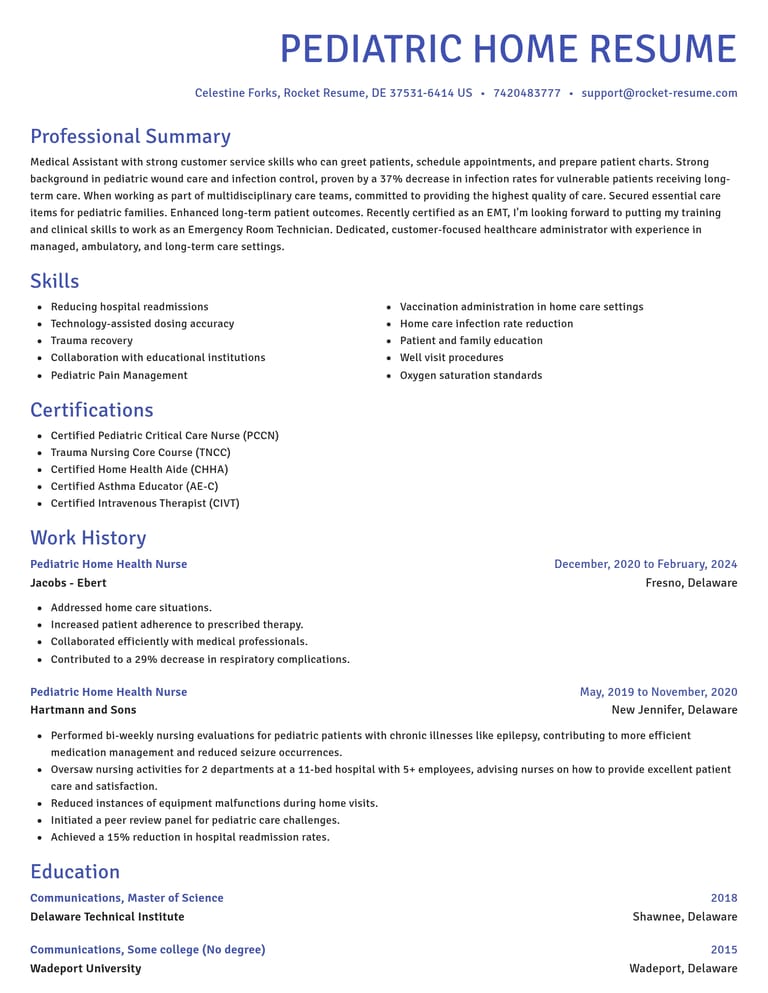
Tip: Compare how each design handles long employer names, nursing credentials and dated work entries.
Choose a layout that makes employers, dates and credentials easy to scan. Check that a longer agency name leaves room to explain your pediatric care responsibilities.
Choose a template, then add your latest nursing role or clearly labeled clinical placement. Keep the RN credential and dates easy to find as you build the resume.
Build My ResumeIn the builder
Work history: describe care in the home
How can work history show pediatric care at home?
Name the patient group and home setting, then describe an assessment, teaching task or care record you completed. Keep household and patient details private.
Tip: Use present tense for the current job and past tense for a previous hospital role.
List each employer, title and dates separately. For home care, identify the patient group and explain your assessments, records or family teaching. Keep hospital duties under the hospital job where you performed them.
If the job description asks for Show this on your resume Children in home care Use the job title and opening work description to identify children cared for in their homes. Home or family needs Describe checking the child’s home and the family’s needs for health or safety problems. Family teaching Describe what you explained about managing a child’s illness or injury. Before
“Provided patient education.”
After
“Explained the child’s home care instructions to parents and recorded the guidance in the nursing record.”
A completed teaching task is a useful result to describe without making a claim about the child’s health.
For ideas on showing your results, explore Pediatric home health nurse accomplishments
See also: Show care in the child’s home and work with the familyResume examples
For your work history, build your resume around completed tasks. Say what you explained to the parents and how you recorded it, without claiming an unsupported health outcome.
Build My ResumeIn the builder
Education: give the nursing degree its place
Tip: For an early-career resume, label pediatric clinical experience as training and name the setting where it took place.
List your degree as it appears in your education record, followed by the school and completion date. The Occupational Outlook Handbook explains education routes for registered nurses. Generally, licensed graduates of any of the three types of education programs (bachelor’s, associate’s, or diploma) qualify for entry-level positions as a staff nurse.
If the job description asks for Show this on your resume Nursing education Give the degree, school and completion date. For a recent graduate, a short education detail about assessment or family teaching can connect school experience to home care.
Add the degree, school and completion date to your resume. If you’re a recent graduate, include relevant clinical experience without presenting it as paid nursing work.
Build My ResumeIn the builder
Skills: support a skill with nursing work
Tip: Use an assessment example for clinical work and a teaching example for communication instead of calling everything patient care.
Choose skills you can support with nursing work. For family teaching, describe an explanation you gave; for documentation, show what you recorded. Leave out procedures you haven’t performed.
If the job description asks for Show this on your resume Assessment and records Choose a skill you can connect to a child’s care in a work example. Assessment and observation
- Assessment and observation
- Recording symptoms and changes in condition
- Child assessment
Medicines and treatments
- Medication administration
- Monitoring treatment responses
A skill list helps a reader scan. A work example under a job shows what you did.
Skill
Assessment and observation
Work example
Assessed children’s conditions at home and recorded symptoms and observations for the care team.
See also: Skills and examples
Choose an assessment, documentation or teaching suggestion that fits your experience. Edit it to describe your own responsibility before adding it to the resume.
Build My ResumeIn the builder
Summary: name the background behind home care
Tip: Write the opening after reviewing the jobs: make it clear which experience comes from a hospital and which comes from caring for children at home.
Introduce your nursing background and the setting you know. A hospital-to-home summary can connect pediatric assessment and family teaching across both jobs; an experienced home-care summary can focus on current responsibilities.
If the job description asks for Show this on your resume Relevant background Open with your experience caring for children in their homes. Summary if you’re moving from a hospital children’s unit
“RN with experience on a hospital children’s unit and in pediatric home health. Brings assessment, clear nursing records and family teaching to care in children’s homes.”
Summary if you’re experienced in home health
“RN with an established home health background caring for children. Experienced in documenting changes in condition, coordinating with doctors and explaining care instructions to parents.”
Shape your introduction with help from Pediatric home health nurse summary examples
See also: Resume examplesSummaries (5)
Write the summary from the experience already on your resume. Lead with your nursing background, then highlight a strength that fits the home care role.
Build My ResumeIn the builder
Certifications: record the license and current cards
Which credentials should a home health RN resume list?
List your RN license and state, followed by earned life-support cards and specialty credentials. Give each card’s issuer and date; don’t present a course as a nursing license.
Tip: After the summary, use the builder’s optional certifications section for the license and cards. The examples display them under Education and credentials.
Registered nurses need authorization to practice where care is provided. This may come from a state license or, for eligible nurses, a multistate license with compact privileges. List your actual issuing state and license status. To become licensed, they must graduate from an approved nursing program and pass a qualifying exam. Registered nursing positions may require life-support certification. You may also list specialty certification you have earned through a professional association, which the handbook describes as usually voluntary, though some employers require it.
Registered Nurse (RN), [state], [year]
How to list it · copy the wording on your certificate
Basic Life Support (BLS), [issuing organization], [year]
How to list it · copy the wording on your certificate
[certification name], [certifying organization], [year]
How to list it · copy the wording on your certificate
If the job description asks for Show this on your resume RN license Add RN, the state and year through the builder’s optional certifications section. See also: License, life-support card and specialty certification
Add your RN license and earned cards in the optional certifications section. Check the state, issuers and dates against your records before finishing the resume.
Build My Resume
Pediatric home health nurse resume mistakes to fix before you apply
How Rocket Resume helps
Four ways the builder helps with your pediatric home health nurse resume:
- Job descriptions. Keep one resume in your account and adjust it to fit each one.
- Experience level. The builder asks how much experience you have first, then guides you from there.
- Your own numbers. Choose a suggestion, then edit it to add the numbers from your work.
- Saved suggestions. Save a skill, example, summary or certification on this page, and it waits for you in the builder.
Show care in the child’s home and work with the family
Make the home setting clear, then explain your work with the child and family.
What does a pediatric home health nurse resume look like?
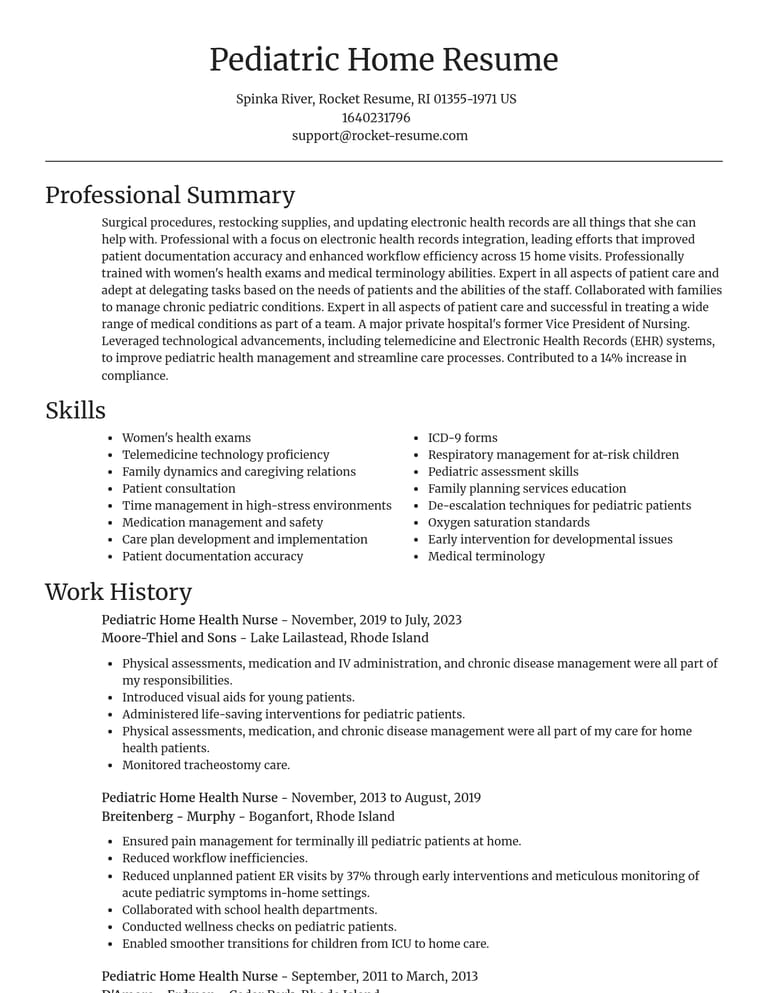
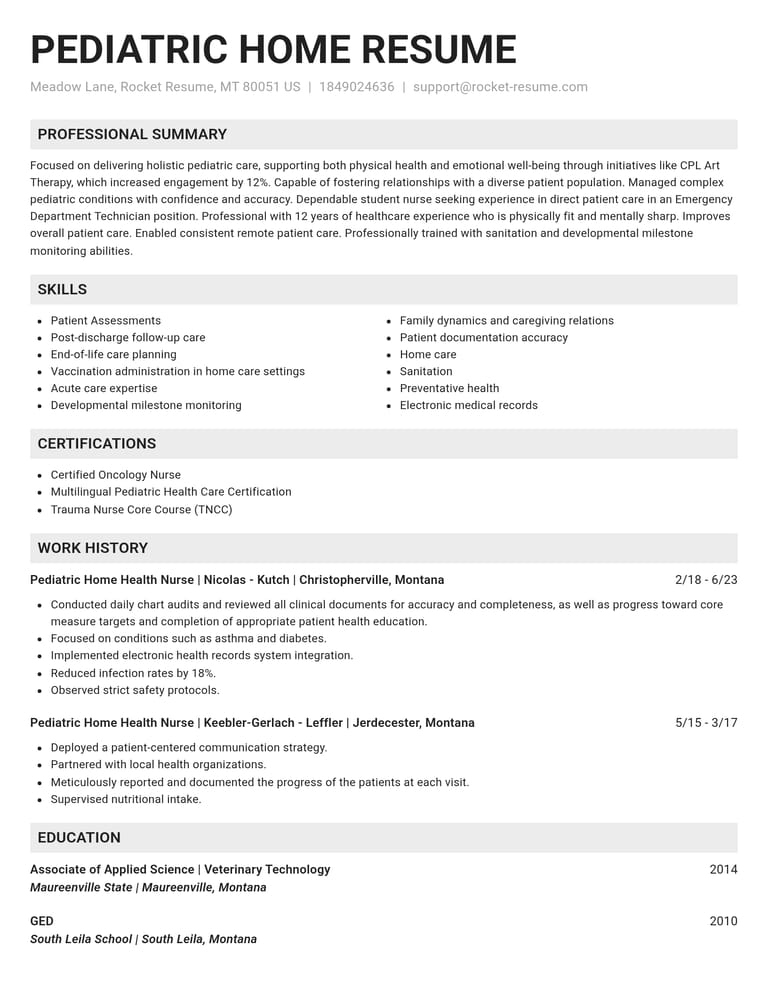
Compare a first home care job, a move from a pediatric hospital unit and an established home health career. Each resume is an illustrative composite.
Tip: Paloma already has home care experience. If you’re applying for a first nursing job, don’t copy her employment history into your resume.
New graduate pediatric home health nurse resume example
Wilmington, North Carolina · About three months in pediatric home care
Paloma D., RN
Pediatric home health nurse
paloma.d@example.com · (910) 555-0142 · Wilmington, NC
Summary
New graduate RN with about three months in pediatric home care. Assesses children’s conditions at home, documents observations and explains care instructions to parents.
Experience
Registered Nurse, Pediatric Home Care · Example Pediatric Home Care Agency
Aug 2026 – Present
- Record children’s symptoms and observations from assessments in their homes.
- Check the child’s home and the family’s needs for possible health or safety problems.
- Explain care instructions to parents and document the teaching.
- Add findings from the child’s assessment to the care plan.
Education and credentials
Bachelor of Science in Nursing · Example Nursing Institute, May 2026
Registered Nurse (RN), North Carolina, 2026 · Basic Life Support (BLS), American Heart Association, 2026
Skills
- Child assessment
- Nursing documentation
- Parent communication
- Care planning
Why this example works
- Early experienceThe summary’s months of experience match the job dates. It doesn’t present a recent graduate as an established home-care nurse.
- Parent teachingThe work history connects explaining care instructions to parents with documenting the teaching.
- Patient settingThe work description places child assessment in the home without private patient details.
Hospital-to-home pediatric home health nurse resume example
Birmingham, Alabama · About five years in nursing
Sunita K., RN
Pediatric home health nurse
sunita.k@example.com · (205) 555-0136 · Birmingham, AL
Summary
RN with about five years of nursing experience across a hospital children’s unit and pediatric home health. Brings child assessment, treatment documentation and parent teaching to care in the home.
Experience
Registered Nurse, Pediatric Home Health · Example Home Nursing Agency
Jan 2024 – Present
- Assess children in their homes and share changes in condition with their doctors.
- Review home safety concerns and the family’s needs when planning care for the child.
- Coordinate the child’s home care with other healthcare team members.
- Document medicines, treatments and the child’s response in home care records.
Registered Nurse, Pediatric Unit · Example Pediatric Medical Center
Jun 2021 – Dec 2023
- Assessed children’s conditions on the pediatric unit and recorded their symptoms.
- Administered children’s medicines and treatments on the hospital unit.
- Explained after-treatment instructions to parents before children returned home from the pediatric unit.
Education and credentials
Associate Degree in Nursing · Example Polytechnic College, 2021
Registered Nurse (RN), Alabama, 2021 · Basic Life Support (BLS), American Heart Association, 2025
Skills
- Assessment and observation
- Medication administration
- Family teaching
- Care coordination
Why this example works
- Clear change of settingThe hospital unit and home health positions have their own titles, employers and dates.
- Relevant hospital workAssessment and parent teaching connect the earlier job to home care, while its hospital setting stays clear.
- Current focusThe recent position leads with care in children’s homes and coordination with doctors.
Experienced pediatric home health nurse resume example
Tacoma, Washington · About eight years in home health
Reggie T., RN
Pediatric home health nurse
reggie.t@example.com · (253) 555-0158 · Tacoma, WA
Summary
RN with about eight years in home health, including pediatric home care. Documents changes in children’s conditions, contributes to care plans and coordinates with doctors. Explains illness management to parents in the home.
Experience
Registered Nurse, Pediatric Home Care · Example Home Care Services
Jun 2021 – Present
- Use changes recorded in children’s conditions to update care plans with their doctors.
- Assess the child’s home environment and family needs to identify health or safety concerns.
- Keep home care records current with observations and reports to the care team.
- Bring parents’ questions about illness management to the child’s care team.
Registered Nurse, Home Health · Example In-Home Nursing Group
Jun 2018 – May 2021
- Collected patients’ medical histories for their home care records.
- Watched for medicine side effects during care in patients’ homes.
Education and credentials
Bachelor of Science in Nursing · Example State University, 2018
Registered Nurse (RN), Washington, 2018 · Basic Life Support (BLS), American Red Cross, 2025 · ACLS, American Heart Association, 2025
Skills
- Nursing records
- Care plan updates
- Child observation
- Parent instruction
Why this example works
- Sustained nursing experienceThe work dates support the summary’s description of an established home health background.
- Concise earlier entryThe shorter earlier entry adds medical histories and medication observation without repeating the current pediatric role.
- Readable credentialsThe license names Washington, and each card has an issuer and year.
Choose the example closest to your nursing background and start your resume with your own work dates. Give recent pediatric care the space it needs.
Build My ResumeLoading resume templates…
Pediatric home health nurse resume questions
What does a pediatric home health nurse do?
How much do pediatric home health nurses make?
How do I show a move from a hospital children’s unit to home health on my resume?
How long should an experienced pediatric home health nurse resume be?
What section order works for a pediatric home health nurse resume?
Which skills show care for children and families at home on a resume?
Put your most relevant nursing work first, then check the supporting education and credentials. Build a draft that makes each part easy to find.
Build My ResumePediatric home health nurse resume skills and examples
Browse skills, work examples, summaries and certifications. Save the ones that fit, then make each one true to your own work.
Tip: Choose specific teaching or documentation suggestions before broad traits such as compassion. Keep only what you can explain from experience.
Assessment and observation
Assessment and observation
Recording symptoms and changes in condition
Assessment and observation
Medication administration
Medicines and treatments
Monitoring treatment responses
Medicines and treatments
Family teaching
Teaching and communication
Active listening
Teaching and communication
Clear explanations of home care instructions
Teaching and communication
Care planning and coordination
Plans and records
Show all 15 skillsShow fewer
Nursing documentation
Plans and records
Accurate medical histories
Plans and records
Child assessment
Assessment and observation · from the example resumes
Parent communication
From the example resumes
Care plan updates
Plans and records · from the example resumes
Child observation
Assessment and observation · from the example resumes
Parent instruction
Teaching and communication · from the example resumes
Assessed children’s conditions at home and recorded symptoms and observations for the care team.
Assessment and observation · writing example
Record children’s symptoms and observations from assessments in their homes.
Assessment and observation · from the new graduate example
Assess children in their homes and share changes in condition with their doctors.
Assessment and observation · from the hospital to home care example
Assessed children’s conditions on the pediatric unit and recorded their symptoms.
Assessment and observation · from the hospital to home care example
Use changes recorded in children’s conditions to update care plans with their doctors.
Assessment and observation · from the experienced home health example
Keep home care records current with observations and reports to the care team.
Assessment and observation · from the experienced home health example
Administered children’s medicines and treatments on the hospital unit.
Medicines and treatments · from the hospital to home care example
Explained after-treatment instructions to parents before children returned home from the pediatric unit.
Medicines and treatments · from the hospital to home care example
Show all 20 work examplesShow fewer
Check the child’s home and the family’s needs for possible health or safety problems.
Teaching and communication · from the new graduate example
Assess the child’s home environment and family needs to identify health or safety concerns.
Teaching and communication · from the experienced home health example
Explained illness management to parents and documented the instruction in the child’s nursing record.
Plans and records · writing example
Shared observations from home care with doctors and contributed information to updated care plans.
Plans and records · writing example
Explain care instructions to parents and document the teaching.
Plans and records · from the new graduate example
Add findings from the child’s assessment to the care plan.
Plans and records · from the new graduate example
Review home safety concerns and the family’s needs when planning care for the child.
Plans and records · from the hospital to home care example
Coordinate the child’s home care with other healthcare team members.
Plans and records · from the hospital to home care example
Document medicines, treatments and the child’s response in home care records.
Plans and records · from the hospital to home care example
Bring parents’ questions about illness management to the child’s care team.
Plans and records · from the experienced home health example
Collected patients’ medical histories for their home care records.
Plans and records · from the experienced home health example
Watched for medicine side effects during care in patients’ homes.
Plans and records · from the experienced home health example
RN with experience on a hospital children’s unit and in pediatric home health. Brings assessment, clear nursing records and family teaching to care in children’s homes.
Moving from a hospital children’s unit · writing example
RN with an established home health background caring for children. Experienced in documenting changes in condition, coordinating with doctors and explaining care instructions to parents.
Experienced in home health · writing example
New graduate RN with about three months in pediatric home care. Assesses children’s conditions at home, documents observations and explains care instructions to parents.
From the new graduate example
RN with about five years of nursing experience across a hospital children’s unit and pediatric home health. Brings child assessment, treatment documentation and parent teaching to care in the home.
From the hospital to home care example
RN with about eight years in home health, including pediatric home care. Documents changes in children’s conditions, contributes to care plans and coordinates with doctors. Explains illness management to parents in the home.
From the experienced home health example
Registered Nurse (RN), [state], [year]
How to list it · copy the wording on your certificate
Basic Life Support (BLS), [issuing organization], [year]
How to list it · copy the wording on your certificate
[certification name], [certifying organization], [year]
How to list it · copy the wording on your certificate
ACLS, American Heart Association, [year]
How to list it · from the example resumes
Skills come from this guide and the example resumes.
Where they go in your resume: Work historySkillsSummaryCertifications
Find skills that match your experience in Pediatric home health nurse resume skills
Save the teaching and care-record suggestions that fit your experience. Use them to build a skills section supported by your work history.
Build My ResumeLicense, life-support card and specialty certification
The Occupational Outlook Handbook describes registered nurse licensing and credentials. Enter the RN license and cards in the builder’s optional certifications section, with the state for the license and issuer and date for each card. The example resumes group these details under Education and credentials.
Tip: Check each credential against your records before copying its name. An example’s card is not a requirement for every pediatric home care job.
Registered nurse license
State of licensure
- How to list it
- Registered Nurse (RN), [state], [year]
- Handbook statement
- Registered nurses must have a nursing license issued by the state in which they work. To become licensed, nurses must graduate from an approved nursing program and pass a qualifying exam. A qualifying multistate license may also authorize practice in another Nurse Licensure Compact jurisdiction; list the actual issuing state.
Basic Life Support
The course provider named on the card
- How to list it
- Basic Life Support (BLS), [issuing organization], [year]
- Handbook statement
- In addition, registered nursing positions may require cardiopulmonary resuscitation (CPR), basic life support (BLS), or advanced cardiac life support (ACLS) certification.
Specialty certification
Professional association
- How to list it
- [certification name], [certifying organization], [year]
- Handbook statement
- Nurses may become certified through professional associations in specific areas, such as ambulatory care, gerontology, or pediatrics. Although certification is usually voluntary, it demonstrates adherence to a specific level of competency, and some employers require it.
Check which credentials you hold against Pediatric home health nurse certifications
Gather your license and card details as you build your resume. Keep credentials separate from descriptions of the care you provided.
Build My ResumeWhat a pediatric home health nurse’s workday is like
O*NET asked registered nurses in general about their work, and they answered in August 2021.
Tip: Replace “good communicator” with a short account of what you discussed and how you recorded the next action.
Dealing with the public 74% of registered nurses said interacting with customers outside their organization or with members of the public was extremely important to their work.
an example of how you listened to a concern and explained the next action.
Face-to-face discussions 96% of registered nurses said face-to-face discussions with individuals and within teams happened every day.
an account of a discussion you documented for another team member to follow up.
Add a communication example to your work history. Show what you discussed with a parent or care-team member and what you documented afterward.
Build My ResumeWhere a pediatric home health nurse career can lead
You can consider specialty certification as you develop your nursing background. The Occupational Outlook Handbook says certification for registered nurses demonstrates adherence to a specific level of competency.
Grow as a pediatric home health nurse
- The handbook says registered nurses may become certified through professional associations in areas such as pediatrics. Certification is usually voluntary, although some employers require it.
Tip: Separate completed credentials from future goals. A pediatric nursing interest belongs in the summary, not in the certification list.
Compare related healthcare jobs
| Job | Median pay | Typical entry education |
|---|---|---|
| Registered nurses | $97,550 | Bachelor's degree |
| Nurse anesthetists, nurse midwives, and nurse practitioners | $134,920 | Master's degree |
Pay gaps don’t show a typical career move, and each job has its own requirements. See pay for registered nurses by state.
Source: U.S. Bureau of Labor Statistics, median annual pay, May 2025 · checked Oct 23, 2026
As you build your resume, include completed nursing education and earned certifications. Let the work entries show how you’ve used that background in practice.
Build My ResumePediatric home health nurse salary and job outlook
Government estimates for May 2025. Pay depends on your state, work setting and experience. These figures are for registered nurses.
Tip: Compare registered nurses’ state figures before discussing an offer, then describe the nursing experience you bring.
Pay for registered nurses by state
Median annual wage, May 2025. Highest: California, $140,270. Tap a state to see its numbers.
- Under $82,000
- $82,000–$83,999
- $84,000–$95,999
- $96,000–$101,999
- $102,000 or more
Selected state
California
- Median
- $140,270
- Average
- $150,280
- Lowest to highest 10%
- $101,260 – $213,320
- Jobs in the state
- 338,940
National median: $97,550. State figures are annual; see the national pay range for hourly wages.
See all 50 states and DC
| State | Median | Average | Lowest 10% | Highest 10% | Jobs |
|---|---|---|---|---|---|
| Alabama | $77,080 | $77,020 | $58,150 | $98,910 | 54,340 |
| Alaska | $109,480 | $114,870 | $85,030 | $149,070 | 7,510 |
| Arizona | $99,500 | $99,730 | $70,540 | $130,930 | 73,150 |
| Arkansas | $78,940 | $81,520 | $60,780 | $103,660 | 29,400 |
| California | $140,270 | $150,280 | $101,260 | $213,320 | 338,940 |
| Colorado | $100,260 | $99,370 | $79,500 | $124,940 | 54,490 |
| Connecticut | $102,740 | $105,250 | $80,350 | $134,870 | 40,110 |
| Delaware | $99,520 | $99,460 | $78,340 | $123,860 | 14,290 |
| District of Columbia | $102,540 | $106,980 | $79,390 | $151,170 | 11,440 |
| Florida | $84,190 | $90,650 | $67,970 | $120,330 | 229,940 |
| Georgia | $93,550 | $95,080 | $68,920 | $128,640 | 100,950 |
| Hawaii | $136,320 | $124,340 | $82,500 | $147,830 | 12,940 |
| Idaho | $92,460 | $92,710 | $71,210 | $121,230 | 16,880 |
| Illinois | $95,990 | $94,360 | $69,170 | $118,190 | 138,910 |
| Indiana | $83,500 | $89,150 | $66,750 | $105,750 | 68,980 |
| Iowa | $78,630 | $80,540 | $63,840 | $100,500 | 34,420 |
| Kansas | $79,320 | $82,360 | $63,180 | $100,840 | 33,800 |
| Kentucky | $81,040 | $86,140 | $64,170 | $111,750 | 50,300 |
| Louisiana | $80,230 | $84,190 | $63,800 | $104,740 | 48,970 |
| Maine | $86,990 | $91,700 | $74,160 | $106,950 | 16,540 |
| Maryland | $99,790 | $99,010 | $76,780 | $124,790 | 52,910 |
| Massachusetts | $104,550 | $117,960 | $80,310 | $174,510 | 88,200 |
| Michigan | $94,300 | $94,300 | $77,260 | $116,710 | 104,950 |
| Minnesota | $101,510 | $103,420 | $79,960 | $132,430 | 70,110 |
| Mississippi | $77,090 | $78,950 | $60,610 | $100,350 | 29,060 |
| Missouri | $81,780 | $85,900 | $63,230 | $104,390 | 76,310 |
| Montana | $85,280 | $91,510 | $70,120 | $113,920 | 10,950 |
| Nebraska | $84,730 | $88,330 | $66,020 | $106,190 | 24,720 |
| Nevada | $103,670 | $105,710 | $79,500 | $133,270 | 27,070 |
| New Hampshire | $99,700 | $97,900 | $75,610 | $123,190 | 15,390 |
| New Jersey | $106,500 | $110,100 | $83,060 | $135,170 | 92,680 |
| New Mexico | $94,340 | $95,290 | $74,300 | $123,540 | 17,980 |
| New York | $109,440 | $113,440 | $79,760 | $157,090 | 205,810 |
| North Carolina | $84,350 | $90,470 | $67,660 | $110,220 | 111,120 |
| North Dakota | $80,730 | $83,600 | $65,520 | $103,480 | 11,340 |
| Ohio | $82,510 | $87,730 | $66,980 | $105,290 | 143,730 |
| Oklahoma | $82,920 | $85,060 | $60,530 | $106,390 | 38,270 |
| Oregon | $129,010 | $123,140 | $95,280 | $155,010 | 39,730 |
| Pennsylvania | $96,430 | $94,020 | $70,800 | $117,900 | 146,520 |
| Rhode Island | $100,640 | $101,260 | $77,410 | $129,840 | 10,090 |
| South Carolina | $82,360 | $87,670 | $66,860 | $106,520 | 49,750 |
| South Dakota | $78,060 | $77,140 | $54,040 | $98,220 | 14,710 |
| Tennessee | $81,500 | $85,390 | $63,970 | $104,920 | 72,200 |
| Texas | $95,970 | $95,380 | $67,120 | $127,950 | 271,380 |
| Utah | $84,600 | $90,950 | $68,920 | $109,050 | 27,420 |
| Vermont | $97,460 | $96,650 | $77,670 | $126,100 | 7,410 |
| Virginia | $93,600 | $93,850 | $67,830 | $125,580 | 77,490 |
| Washington | $124,200 | $121,540 | $89,630 | $161,910 | 69,260 |
| West Virginia | $80,130 | $86,970 | $57,210 | $131,760 | 23,430 |
| Wisconsin | $95,530 | $94,690 | $77,470 | $119,860 | 68,060 |
| Wyoming | $83,760 | $88,600 | $65,770 | $107,350 | 5,330 |
Source: U.S. Bureau of Labor Statistics, Occupational Employment and Wage Statistics, May 2025 · checked Oct 23, 2026 · lowest and highest 10% are the 10th and 90th percentile wages
National pay range
Annual wages for all U.S. registered nurses
| Percentile | Annual | Hourly |
|---|---|---|
| 10th | $68,940 | $33.14 |
| 25th | $80,330 | $38.62 |
| Median | $97,550 | $46.90 |
| 75th | $112,350 | $54.02 |
| 90th | $137,470 | $66.09 |
Source: U.S. Bureau of Labor Statistics, Occupational Employment and Wage Statistics, May 2025 · checked Oct 23, 2026
More pay data: state rankings and pay by work setting
State rankings
Top five states and DC
Source: U.S. Bureau of Labor Statistics, Occupational Employment and Wage Statistics, May 2025 · checked Oct 23, 2026 · ranked by annual mean wage or jobs per 1,000 jobs
Median pay by work setting
Annual median, May 2025
- Government, excluding state and local education and hospitals$110,780
- Hospitals; state, local, and private$100,220
- Ambulatory healthcare services$91,230
- Nursing and residential care facilities$84,300
- Educational services; state, local, and private$78,620
Source: Occupational Outlook Handbook, May 2025 · checked Oct 23, 2026
Projected job growth, 2025–35
Change in employment over ten years
- Registered nurses6%
- Healthcare diagnosing or treating practitioners9%
- All occupations3%
That's 194,700 more jobs over ten years and about 180,800 openings a year, counting people who retire or change jobs.
Source: U.S. Bureau of Labor Statistics, Employment Projections 2025–35 · checked Oct 23, 2026
Where registered nurses work
Share of the 3,465,400 jobs in 2025 (largest settings)
- Hospitals; state, local, and private59%
- Ambulatory healthcare services19%
- Nursing and residential care facilities6%
- Government, excluding state and local education and hospitals5%
- Educational services; state, local, and private3%
The rest work in other settings.
Source: Occupational Outlook Handbook · checked Oct 23, 2026
Use the broader RN pay figures as context while you prepare your resume. Describe the pediatric home care experience you can bring to a compensation discussion.
Build My ResumeAbout this guide
Updated November 14, 2026.
Sources
Loading industries…
Build your pediatric home health nurse resume
Start with your latest nursing job. Show the patient group, home setting and care you provided, then add the credentials that support your application.