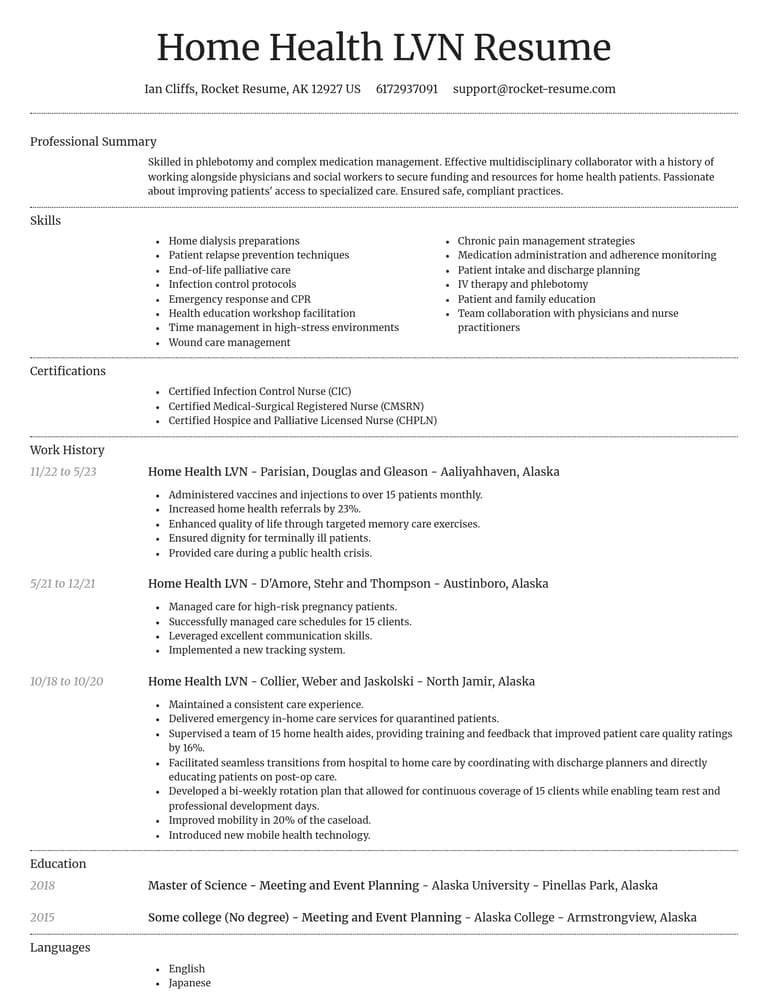
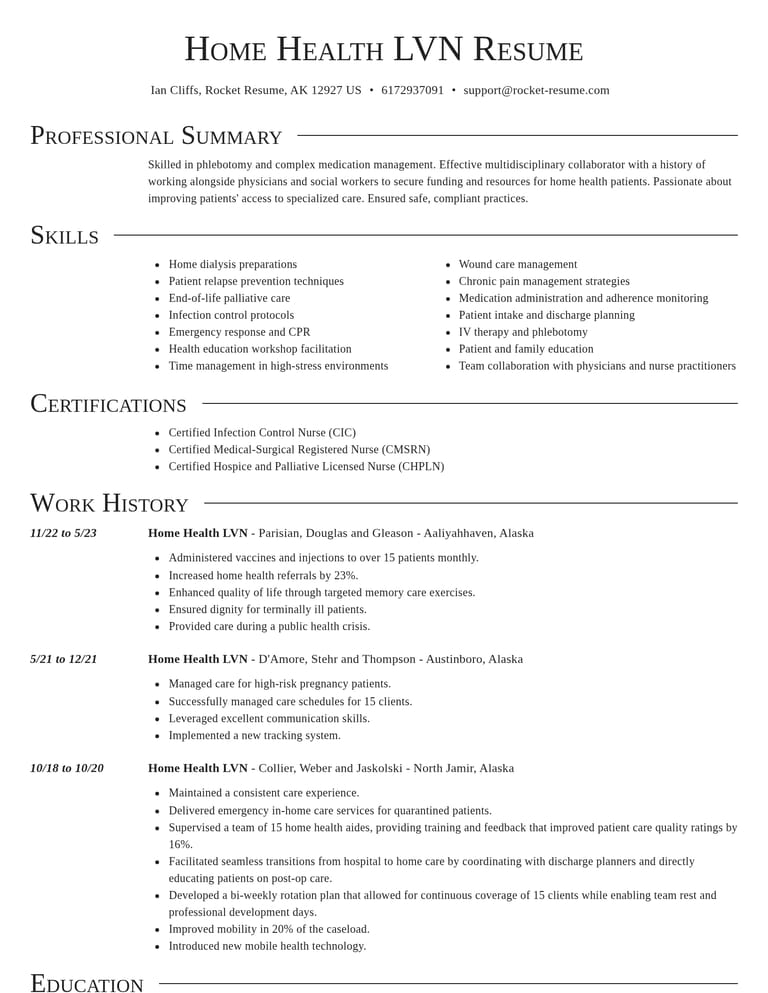
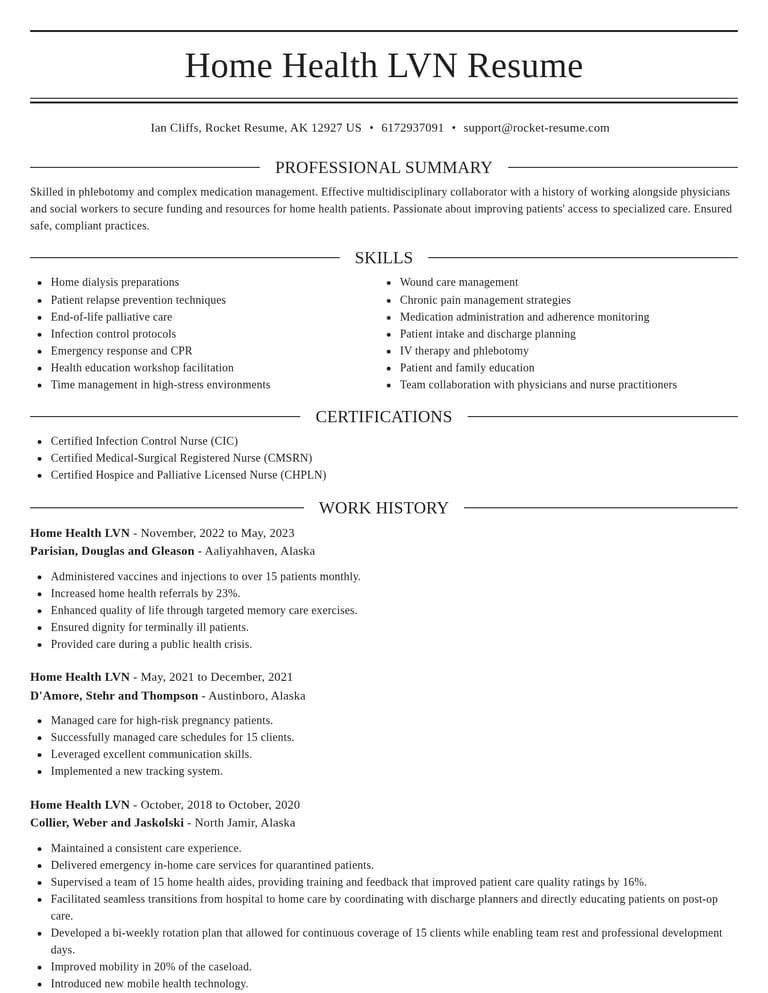
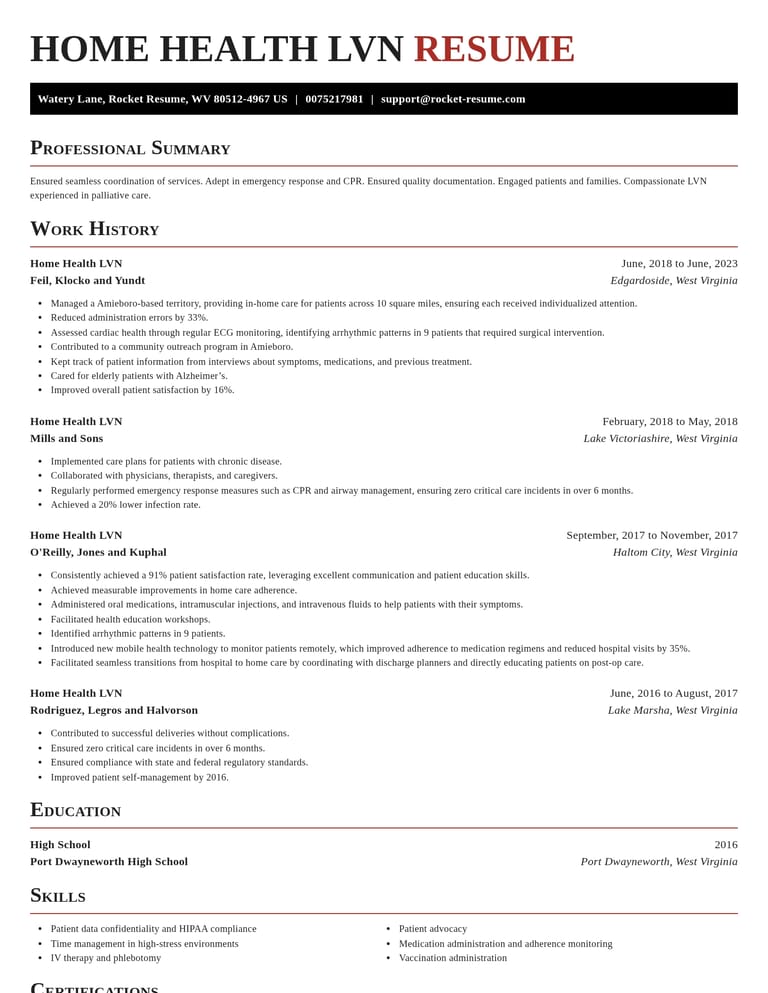
Home health LVN resume examples, templates and tips
Show the care you provided, what you documented and what you reported to the RN. Use LVN examples and tips to keep licensed work, clinical training and earlier caregiving clear.
- Show home visit experience
- Separate training from work
- License listing examples

What home health LVN hiring managers look for
- An LPN or LVN license and the state where it was issued.
- Vital signs measured and recorded accurately.
- Patient concerns discussed and listened to.
- Health records kept complete.
- Medications or IV fluids where the state permits and the nurse has the required training.
- Respiratory-care tasks within state rules, demonstrated competence and required supervision.
How to write a home health LVN resume
Home care experience can span caregiving, clinical rotations and licensed nursing. Give each its own place on the resume so the reader can see what you did as an LVN and what came before licensure. This guide starts with six questions to answer first, then walks through each part of your resume with tips and links to the examples, templates and data on this page.
Six questions to answer first
- What belongs on an LVN resume?
Step 1 connects requirements to concrete resume details.
- How can a new graduate write an LVN resume?
Step 3 orders training and work by experience level.
- How should home health LVN duties read on a resume?
Step 5 turns home duties into specific descriptions.
- Which skills fit an LVN resume?
Step 7 matches skills with work examples.
- What should an LVN summary or objective say?
Step 8 shapes an introduction around licensed experience.
- How should an LVN license appear on a resume?
Step 9 places the licensed title in the certifications section.
What a home health LVN does
A home health LVN provides nursing care in patients’ homes within state rules, demonstrated competence and required clinical supervision. Describe the care you provided and the changes you reported to the supervising clinician.
The Occupational Outlook Handbook from the U.S. Bureau of Labor Statistics describes licensed practical and licensed vocational nurses together. LPNs and LVNs typically work under the supervision of registered nurses and doctors.
The national median annual wage for licensed practical and licensed vocational nurses was $64,400 in May 2025, covering LPNs and LVNs across settings. Employment of LPNs and LVNs is projected to grow 3% from 2025 to 2035.
See also: Where licensed practical and licensed vocational nurses workProjected job growthHome health LVN salary and job outlook
Tip: Name the setting in each job entry so a reader can distinguish home health work from a clinic or nursing facility.
Write your home health LVN resume in nine steps
Do the first two before you open the builder. The other seven follow the builder’s order.
Step 1 of 9
Before you open the builder
Job description: match LVN requirements to work done
What belongs on an LVN resume?
Match the job description with your licensed title, care setting and relevant duties. Back up a skill with what you recorded or reported.
Tip: Keep the job description beside your draft and mark the tasks you can explain with a concrete example.
Make these easy to find
- An LPN or LVN license and the state where it was issued.
- Vital signs measured and recorded accurately.
- Patient concerns discussed and listened to.
- Health records kept complete.
- Medications or IV fluids where the state permits and the nurse has the required training.
- Respiratory-care tasks within state rules, demonstrated competence and required supervision.
- Records changes, responds within the care plan and reports to the supervising clinician.
Prompts adapted from O*NET OnLine and the handbook.
Match each requirement in the job description
Here’s the step where you’ll show each one:
- License step 9
- Vocational nursing education step 6
- Home health experience step 5
- Observation and reporting step 5
- Medication administration step 5
- Equipment use step 7
- Patient communication step 5
- Relevant introduction step 8
Tip: Use the employer’s terms when they describe work you actually did. Keep a clinical rotation clearly identified as training.
See also: Where licensed practical and licensed vocational nurses workLicense and additional credentials
Start building with a duty the employer needs and you can demonstrate. For medication work, describe what you administered and documented within your permitted, trained scope.
Build My Resume
Before you open the builder
Examples: read LVN examples for licensed work
Tip: Notice how the examples distinguish earlier caregiving, clinical rotations and licensed employment.
Rosa separates caregiving from her first LVN role. Terrence connects facility work to home visits, while Camila keeps relevant clinic experience. Use the closest history to decide what deserves space on your resume.
Use an example to organize your resume, not to fill gaps in experience. Keep the training, job titles and responsibilities that belong to your own history.
Build My ResumeIn the builder: experience level
How much experience do you have?
How can a new graduate write an LVN resume?
Lead with your vocational program and supervised clinical experience. List an issued LVN license with credentials, and keep earlier caregiving under its actual job title.
Tip: For a first home-health role, check orientation and clinical supervision. Keep supervised training, licensed employment and earlier caregiving distinct.
Start from Build My Resume and it’s the builder’s first question. The examples below show three starting points: a new graduate entering home health, an LVN with about 7 years of experience and a senior LVN with about 10 years of experience.
Choose an order that fits
- New graduate:
- Summary, Education and clinical rotations, Certifications, Work history, Skills.
- Experienced LVN:
- Summary, Work history, Certifications, Education, Skills.
The builder starts with a standard order, and you can move sections into the one you choose.
Give recent licensed work more space than an older job with little connection to the role.
See also: Resume examplesTemplates
Build your resume from a clear timeline of training and work. Count LVN employment from licensure onward, keeping earlier caregiving under its own title.
Build My ResumeIn the builder
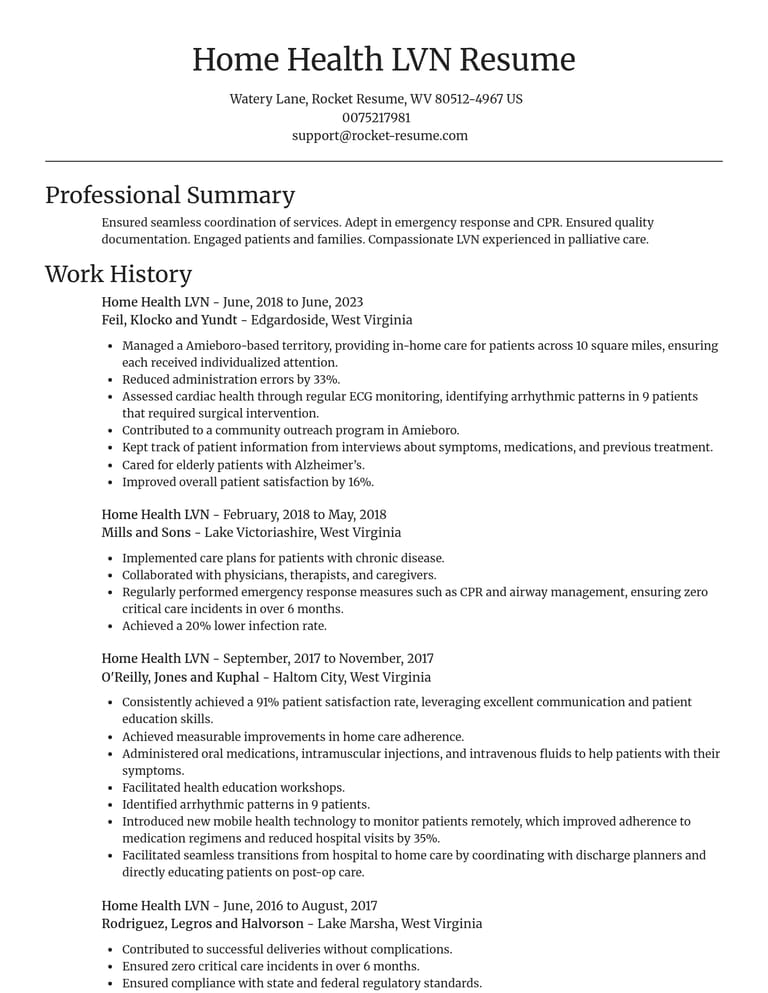
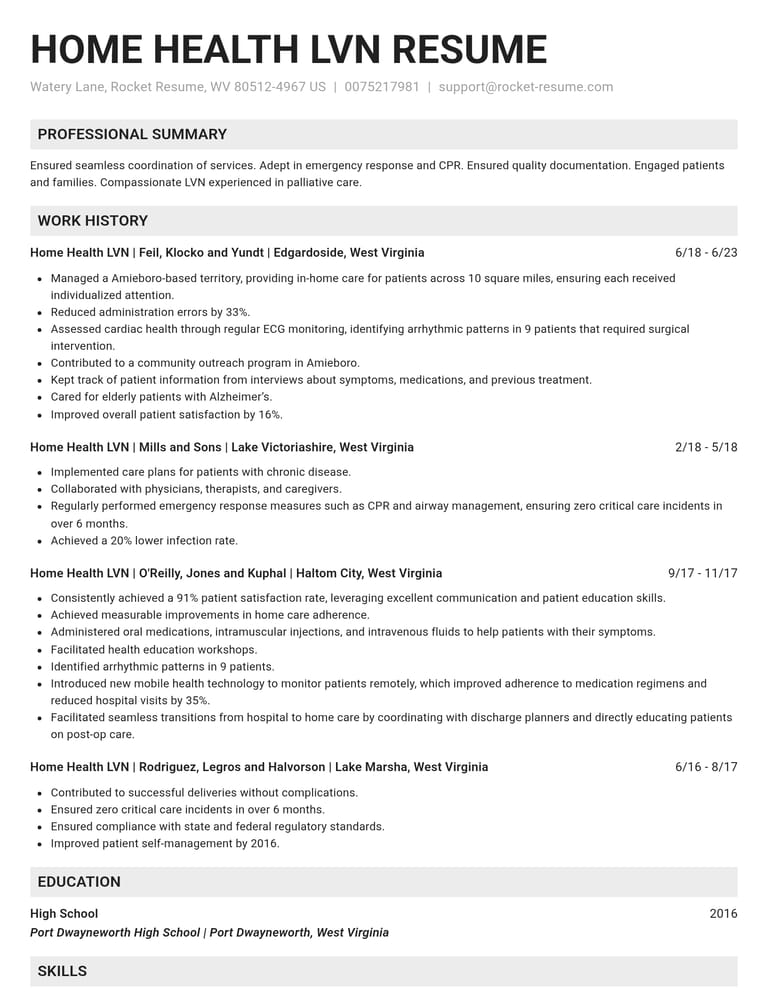
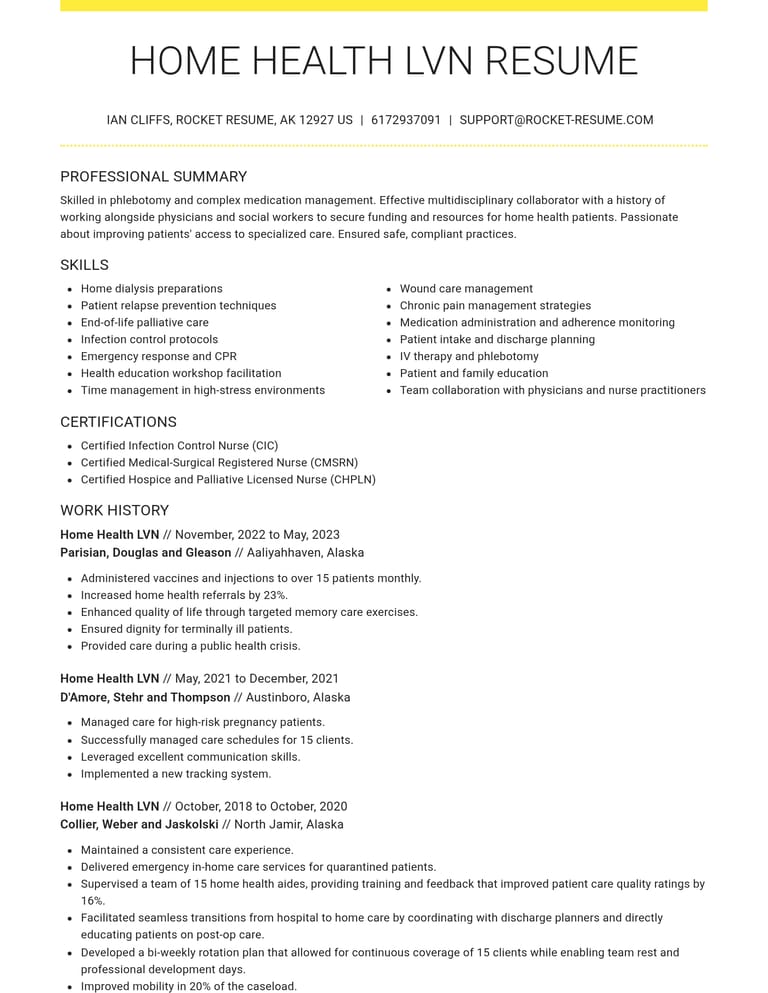
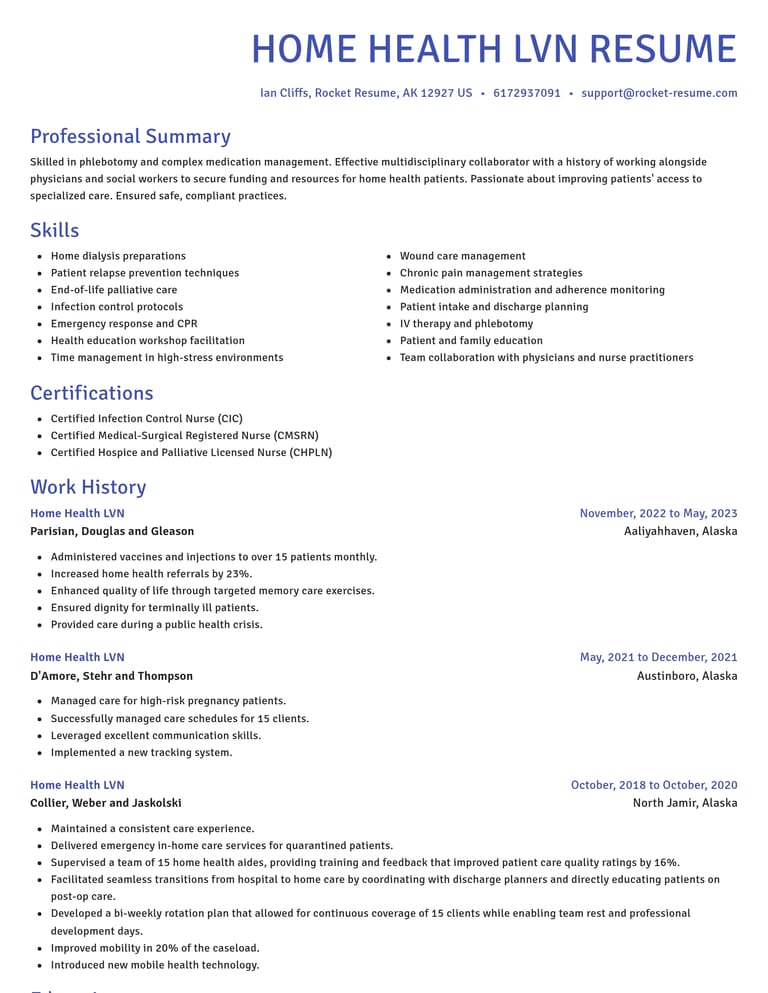
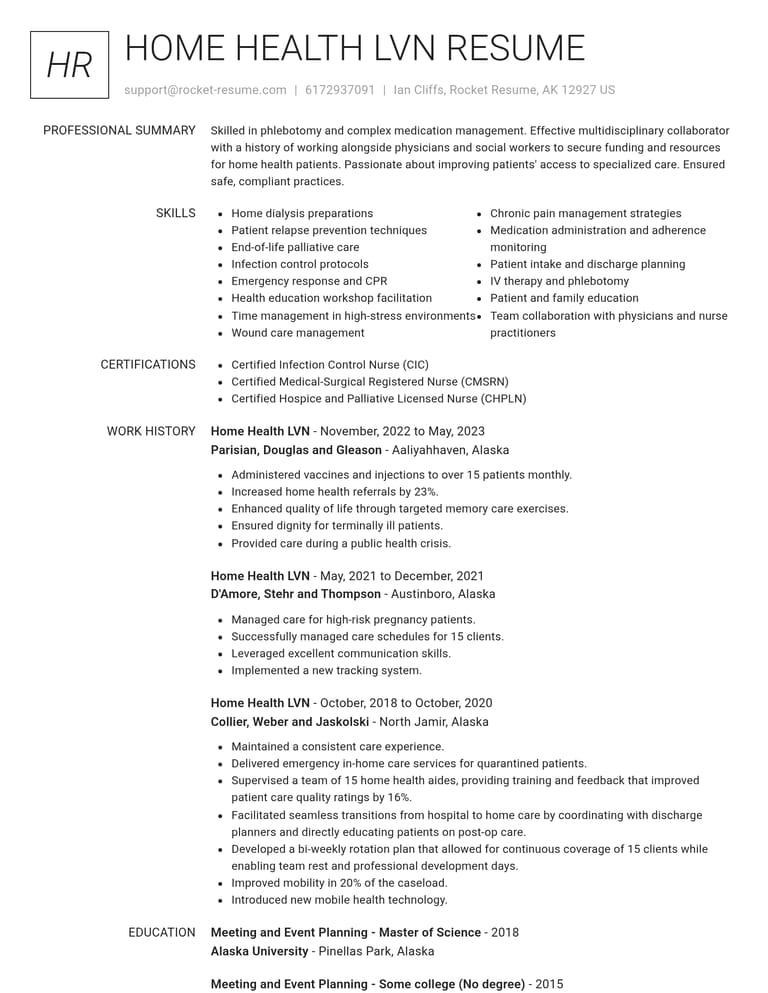
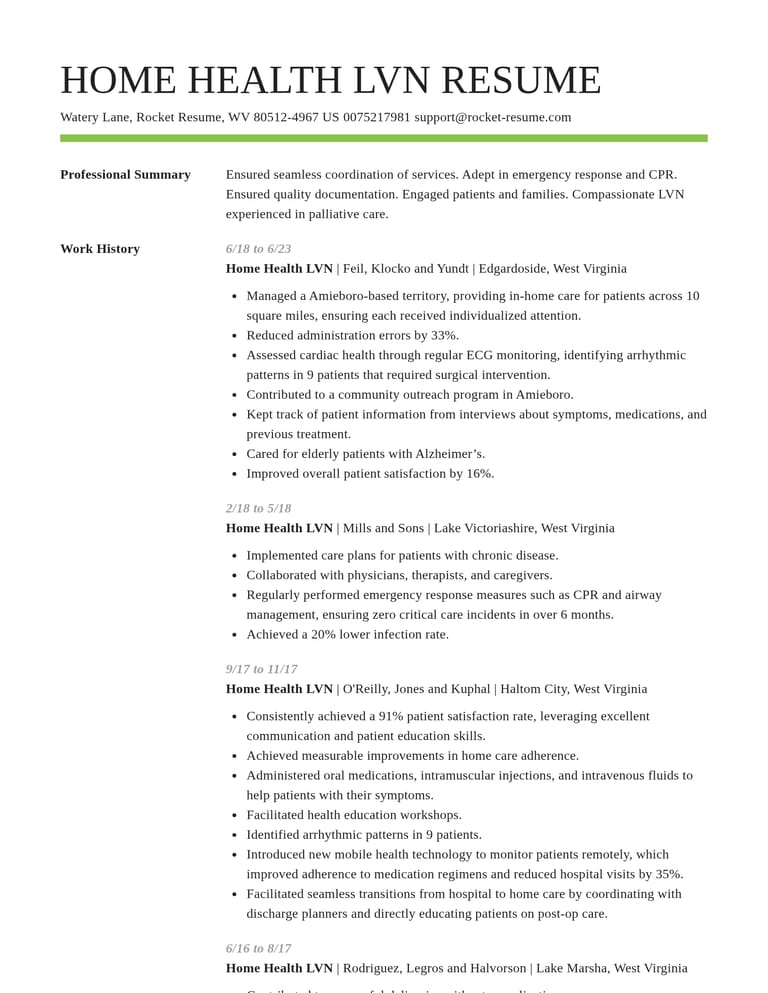
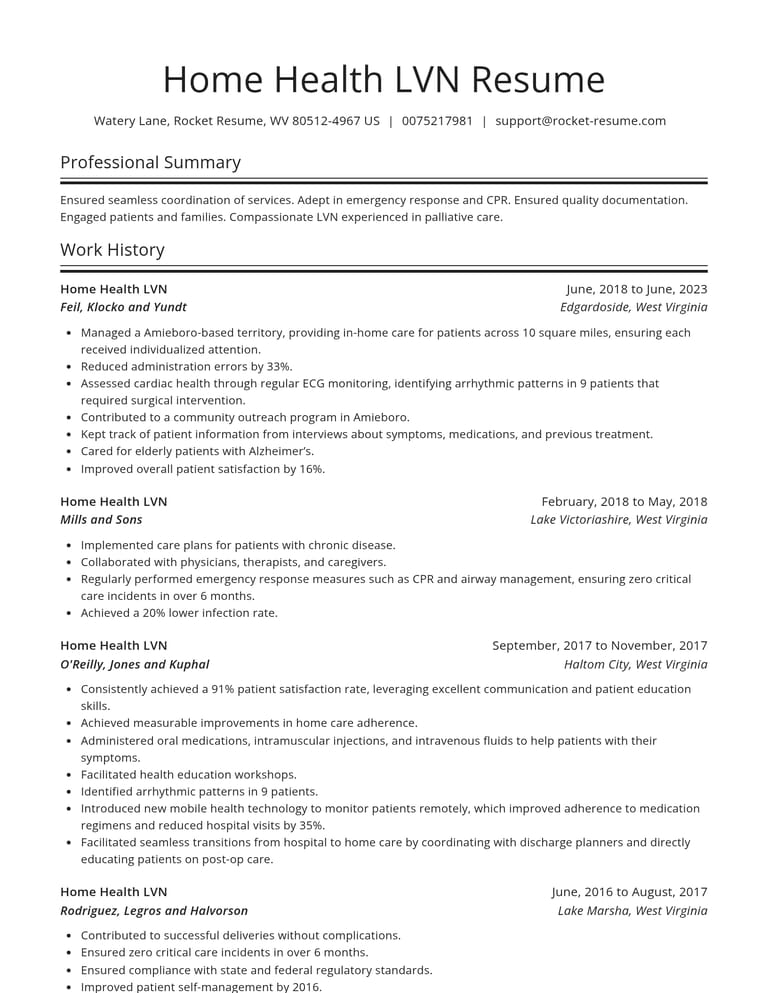
Template: make LVN credentials and experience easy to scan
Tip: Check that a design gives education, work history and certifications clear headings.
Check how the layout handles your nursing program, license and recent work. Keep employers and dates easy to scan, with enough space to explain home visit duties.
Choose a template, then build your resume with a recent home health entry. Check that its duties, dates and credentials are easy to find.
Build My ResumeIn the builder
Work history: describe licensed work at the residence
How should home health LVN duties read on a resume?
Show the treatment, record and report to the RN. Medication or IV examples should describe tasks your state permitted and you had the training to perform.
Tip: Keep patient identifiers out of examples. Describe the nursing action and record without copying private details from a chart.
Describe only medication, IV or respiratory tasks you performed within state rules, your demonstrated competence and required supervision. Name the task and what you documented; a license alone does not establish permission for every procedure.
If the job description asks for Show this on your resume Home health experience LVN work at patients’ residences and the licensed tasks performed. Observation and reporting LVN charts reactions, acts as needed and reports status to the registered nurse. Medication administration What the LVN administered and charted, where permitted by the state and the LVN's training. Patient communication A work example of listening to concerns and discussing care. Before
“Cared for patients at home. Handled changes in condition.”
After
“Administered prescribed medications or started prescribed IV fluids within validated competencies, agency policy and required clinical supervision, recording times and amounts. Charted a reaction to medication, responded within the care plan and reported the change to the registered nurse.”
For a change in condition, keep the observation, charting, necessary action and report to the registered nurse together as work covered by the LVN license.
For ideas on showing your results, explore Home health LVN accomplishments
For each home visit duty, build a resume entry around the treatment, record or report you completed. Replace “helped patients” with work you can explain.
Build My ResumeIn the builder
Education: record the program and clinical rotations
Tip: Give clinical rotations their setting and tasks, and identify them as part of the program.
Include the program even if you have no paid LVN experience. Certificate and diploma programs are commonly found in community colleges and technical schools, including some high schools, and typically take about 1 year to complete. List the award, school and completion date, then the clinical rotations you completed. A state-approved program followed by an exam is the licensing path for this occupation; the title on the resulting license belongs in certifications. The handbook’s typical entry-level education category is “Postsecondary nondegree award.”
If the job description asks for Show this on your resume Vocational nursing education Program award, school, dates and clinical rotations completed. Keep the program entry in education and the awarded license in certifications.
Add your program to the resume’s education section, then describe relevant clinical rotations. Label the training clearly so it isn’t mistaken for licensed employment.
Build My ResumeIn the builder
Skills: support LVN skills with a work example
Which skills fit an LVN resume?
Choose skills you used in licensed work, including equipment you actually handled. Medication and IV skills must match your state’s rules and your training.
Tip: A clinic or facility role may call for different priorities from a home health role. Reorder skills to fit the work described.
Choose clinical tasks you can explain from experience, then support communication or attention to detail with a work example. Medication and IV duties depend on state permission and the required training; keep those limits in view.
If the job description asks for Show this on your resume Equipment use The specific respiratory-care task performed, with its setting and required supervision. Licensed treatment and equipment
- Medication administration
- IV fluid administration
- Respiratory-care observation and reporting
Observation and records
- Patient observation
- Health record documentation
- Fluid intake and output recording
A skill list helps a reader scan. A work example under a job shows what you did.
Skill
IV fluid administration
Work example
Started prescribed IV fluids within validated competencies, agency policy and required clinical supervision, documenting times and amounts.
See also: Skills (17)Work examples (17)
Build a skills section around the home care tasks you know. Use a work entry to explain how you applied the most relevant skill.
Build My ResumeIn the builder
Summary: write a summary or objective with detail
What should an LVN summary or objective say?
Connect your licensed background to the target setting. A graduate can lead with clinical training; an experienced LVN can highlight relevant home visits, records and reporting.
Tip: Check any years-of-experience claim against the licensed jobs, not the full timeline of caregiving and school.
A new graduate can connect clinical training to a home health goal. An experienced LVN can name the settings worked in and highlight relevant records, treatments or reports to the RN. Keep the summary consistent with the history below it.
If the job description asks for Show this on your resume Relevant introduction Licensed background connected to the target setting. Summary if you’re newly licensed
“Newly licensed LVN with clinical rotations in a vocational program and earlier caregiving experience. Seeking home health work that draws on accurate records, patient communication and attention to changes in condition.”
Summary if you’re experienced in home health
“LVN with about 7 years in nursing facilities and home health. Charts reactions to medication, takes necessary action and reports changes to the registered nurse. Discusses care with patients and listens to their concerns.”
Shape your introduction with help from Home health LVN summary examples
See also: Summaries (5)Resume examples
Write the summary after your detailed resume sections. Choose the licensed experience or clinical preparation that explains your fit for the home health role.
Build My ResumeIn the builder
Certifications: use the licensed title and credential details
How should an LVN license appear on a resume?
Use the title on your license, its state and year. Keep that entry separate from a life-support card or optional certification; LPN and LVN name the same occupation.
Tip: Add certifications through the builder’s optional sections after the summary. Put any optional subject certification here with its issuing association.
Check spelling and abbreviations against the license itself. The handbook names LPNs and LVNs together, so an LPN reader can use the same credential guidance. Licensed practical nurses (LPNs) and licensed vocational nurses (LVNs) provide basic medical care to ill, injured, or convalescing patients or to persons with disabilities. For a life-support card, copy the course provider’s name. The LVN resume examples show completed license and card entries.
[Licensed Vocational Nurse (LVN) or Licensed Practical Nurse (LPN)], [state], [year]
How to list it · copy the wording on your certificate
Basic Life Support (BLS), [course provider], [year]
How to list it · copy the wording on your certificate
[certification name], [professional association], [year]
How to list it · copy the wording on your certificate
Licensed Vocational Nurse (LVN), [state], [year]
How to list it · from the example resumes
If the job description asks for Show this on your resume License Licensed title, state and year in certifications. See also: Certifications (4)License and additional credentials
Finish building with the license and cards you hold. Copy their identifying details carefully so the resume distinguishes licensure from additional training.
Build My Resume
Home health LVN resume mistakes to fix before you apply
How Rocket Resume helps
Four ways the builder helps with your home health LVN resume:
- Job descriptions. Keep one resume in your account and adjust it to fit each one.
- Experience level. The builder asks how much experience you have first, then guides you from there.
- Your own numbers. Choose a suggestion, then edit it to add the numbers from your work.
- Saved suggestions. Save a skill, example, summary or certification on this page, and it waits for you in the builder.
Make licensed work at home visible
What does a home health LVN resume look like?
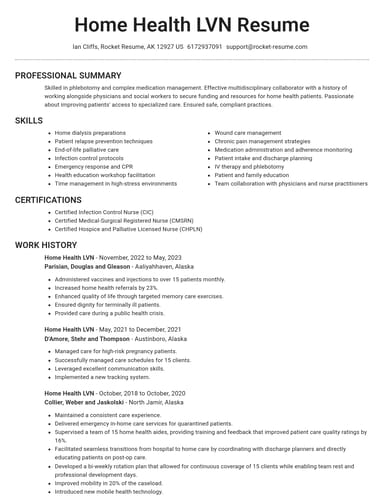
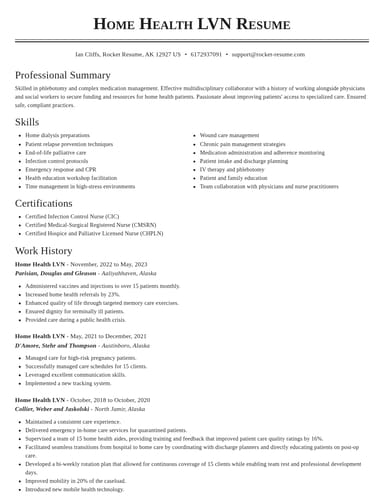
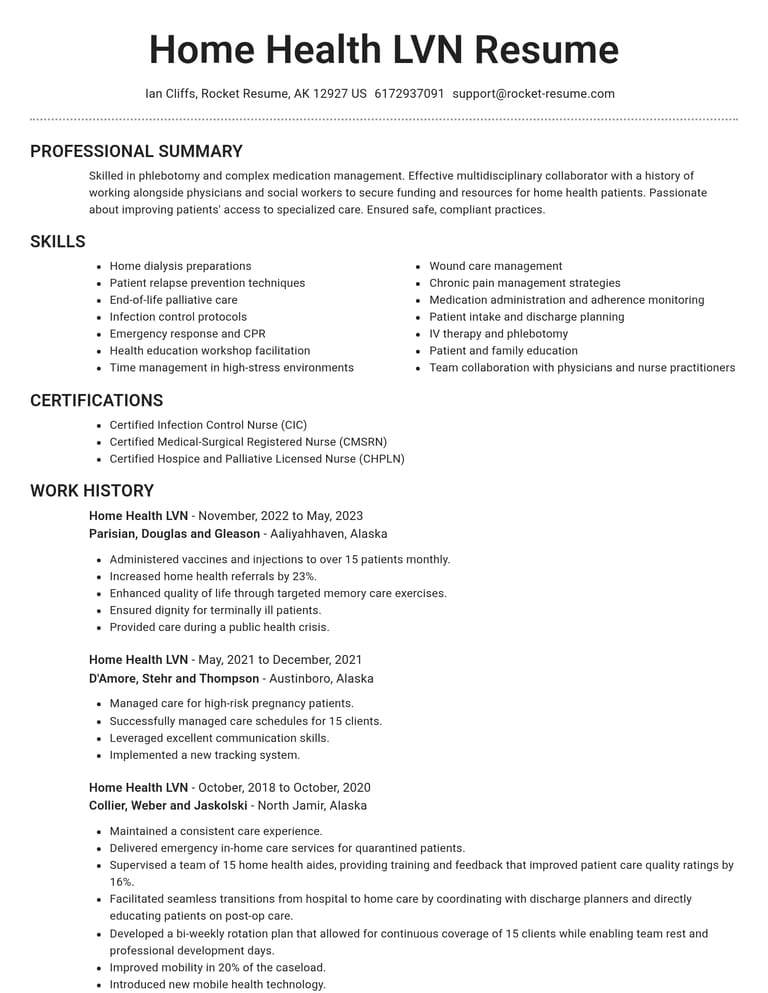
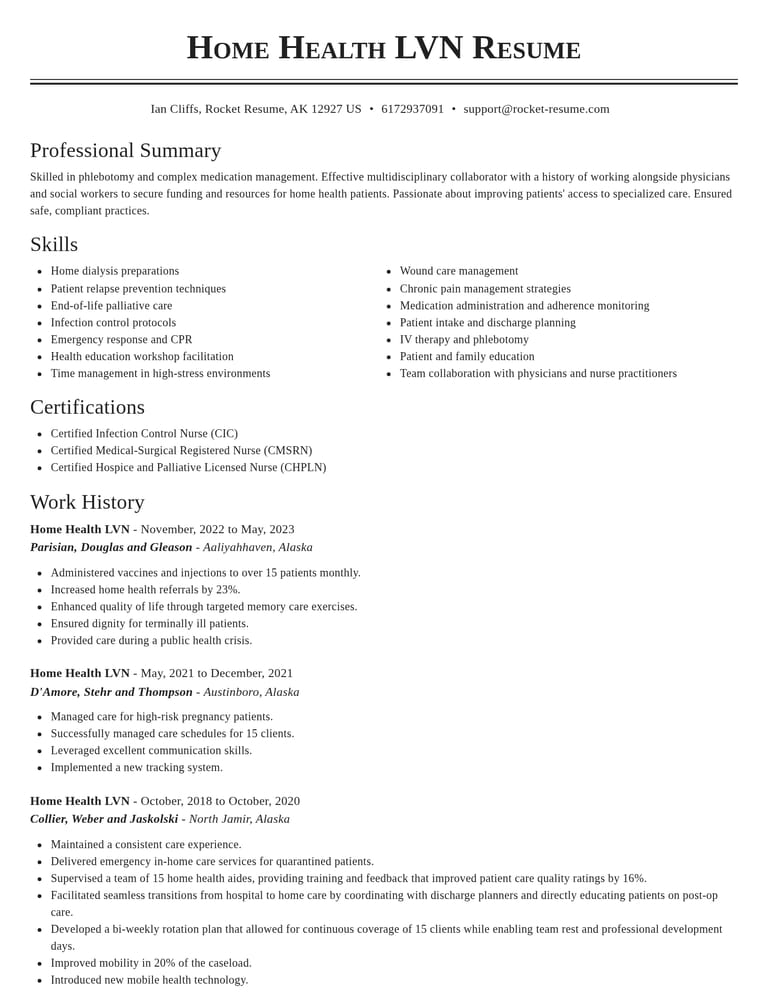
Compare a new LVN’s first job, a move from facility care and a longer clinic-to-home-health career. Each resume is an illustrative composite.
Tip: Rosa’s caregiving supports her background, but it does not count toward her LVN experience. Check the same distinction in your draft.
New graduate home health LVN resume example
Bakersfield, CA · New graduate · First months as an LVN
Rosa M.
Home health LVN
rosa.m@example.com · (661) 555-0134 · Bakersfield, CA
Summary
Newly licensed LVN beginning home health work after a vocational program and about 2 years of caregiving. Measured and recorded vital signs, discussed care and documented observations during clinical rotations.
Experience
Home health LVN · Example Home Health Agency
2026 – Present
- Record blood pressure, temperature and pulse during visits.
- Listen to patients’ concerns and discuss their care during home visits.
Caregiver · Example Home Care Agency
2022 – 2024
- Supported 3 people through scheduled caregiving assignments.
- Kept assignment notes organized for the agency.
Education and credentials
Vocational nursing program with clinical rotations · Example County Community College, 2024–2025
Licensed Vocational Nurse (LVN), California, 2026 · Basic Life Support (BLS), American Heart Association, 2025
Skills
- Vital signs measurement
- Patient communication
- Health record documentation
- Active listening
Why this example works
- Visible progressionThe timeline keeps earlier caregiving separate from nursing school and the first licensed job.
- Useful training detailThe summary draws on clinical rotations without presenting that training as LVN employment.
- Clear qualificationsThe credential entries distinguish the license from the life-support card.
Experienced home health LVN resume example
El Paso, TX · About 7 years as an LVN · Facility and home health
Terrence W.
Home health LVN
terrence.w@example.com · (915) 555-0172 · El Paso, TX
Summary
LVN with about 7 years across a nursing facility and home health. Provides prescribed medication and IV care within validated competencies and required clinical supervision, documenting each treatment. Charts reactions, takes necessary action and reports changes to the registered nurse.
Experience
Home health LVN · Example Regional Home Health
2021 – Present
- Administer prescribed medications and start prescribed IV fluids within validated competencies, agency policy and required clinical supervision; document administration times, doses and fluid volumes.
- Chart reactions to medication, take necessary action and report changes to the registered nurse.
- Contribute observations to care discussions with 3 healthcare team members.
LVN · Example Nursing and Rehabilitation Center
2019 – 2021
- Completed medication passes and charted each dose and administration time.
- Supervised 4 nursing assistants and maintained care records.
Education and credentials
Vocational nursing program · Example Technical Institute, 2018–2019
Licensed Vocational Nurse (LVN), Texas, 2019 · Basic Life Support (BLS), American Red Cross, 2025
Skills
- Medication administration
- IV fluid administration
- Health record documentation
- Nurses’ aide supervision
Why this example works
- Setting change explainedSeparate entries show which duties belong to home visits and which came from facility work.
- Complete responseA reaction, the necessary action and the report to the registered nurse stay together.
- Licensed treatment detailTreatment descriptions identify both the administration and the record. They give the reader more than a broad medication skill.
Senior home health LVN resume example
Fresno, CA · About 10 years as an LVN · Clinic and home health
Camila S.
Home health LVN
camila.s@example.com · (559) 555-0158 · Fresno, CA
Summary
LVN with about 10 years in clinic and home health settings. Documents observations and reports changes during home visits. Contributes patient observations to care planning with the healthcare team.
Experience
Home health LVN · Example Home Health Services
2019 – Present
- Document observations during home visits and report changes to the supervising registered nurse.
- Review the registered nurse’s care instructions with 2 family caregivers during home visits.
- Share changes in patients’ needs with 3 healthcare team members and help update care plans.
LVN · Example Family Medicine Clinic
2016 – 2019
- Prepared patients for examinations, tests and treatments, explaining procedures.
- Made appointments and maintained records in the clinic.
Education and credentials
Vocational nursing program · Example Vocational School, 2015–2016
Licensed Vocational Nurse (LVN), California, 2016 · Basic Life Support (BLS), American Red Cross, 2025
Skills
- Observation and reporting
- Care planning teamwork
- Patient preparation
- Health record documentation
Why this example works
- Senior work made concreteObservation, reporting and contributions to care planning explain the nursing responsibilities.
- Earlier clinic experience retainedThe clinic entry adds patient preparation and scheduling experience without repeating the home visit duties.
- Home visits identifiedThe home visit entry connects observations with reporting to the supervising registered nurse.
Begin building with the example closest to your career stage. Use your own dates to separate caregiving, training and licensed employment on the resume.
Build My ResumeLoading resume templates…
Home health LVN resume questions
How long should an LVN resume be, and how should it look?
Are LVN and LPN the same, and which title should I use?
How much do LVNs make nationally and in home health?
Where do LVNs work?
How can earlier aide work fit an LVN resume?
How can a home health LVN apply to a clinic or hospital?
Should an LVN resume include CPR or Basic Life Support?
Are LPN and LVN jobs projected to grow?
Clarify your timeline as you build your resume. Give earlier aide work its actual title and show when licensed LVN employment began.
Build My ResumeHome health LVN resume skills and examples
Browse skills, work examples, summaries and certifications. Save the ones that fit, then make each one true to your own work.
Tip: A list of equipment is useful only if you’ve used it. Choose the relevant suggestion and support it with your own work example.
Medication administration
Licensed treatment and equipment
IV fluid administration
Licensed treatment and equipment
Respiratory-care observation and reporting
Licensed treatment and equipment
Vital signs measurement
Licensed treatment and equipment
Patient observation
Observation and records
Health record documentation
Observation and records
Fluid intake and output recording
Observation and records
Active listening
Communication and teaching
Show all 17 skillsShow fewer
Patient communication
Communication and teaching
Family caregiver instruction
Communication and teaching
Care planning teamwork
Teamwork and judgment
Critical thinking
Teamwork and judgment
Nurses’ aide supervision
Teamwork and judgment
Adaptability
Working habits
Interpersonal skills
Working habits
Attention to detail
Working habits
Patient preparation
From the example resumes
Recorded observations during assigned respiratory care and reported changes to the supervising clinician.
Licensed treatment and equipment · writing example
Administer prescribed medications and start prescribed IV fluids within validated competencies, agency policy and required clinical supervision; document administration times, doses and fluid volumes.
Licensed treatment and equipment · from the experienced example
Chart reactions to medication, take necessary action and report changes to the registered nurse.
Licensed treatment and equipment · from the experienced example
Completed medication passes and charted each dose and administration time.
Licensed treatment and equipment · from the experienced example
Record blood pressure, temperature and pulse during visits.
Observation and records · from the new graduate example
Made appointments and maintained records in the clinic.
Observation and records · from the senior example
Supported 3 people through scheduled caregiving assignments.
Communication and teaching · transferable, from the new graduate example · use your own numbers
Review the registered nurse’s care instructions with 2 family caregivers during home visits.
Communication and teaching · from the senior example · use your own numbers
Show all 17 work examplesShow fewer
Listened to concerns during care and documented information for the healthcare team.
Teamwork and judgment · writing example
Contribute observations to care discussions with 3 healthcare team members.
Teamwork and judgment · from the experienced example · use your own numbers
Supervised 4 nursing assistants and maintained care records.
Teamwork and judgment · from the experienced example · use your own numbers
Document observations during home visits and report changes to the supervising registered nurse.
Teamwork and judgment · from the senior example
Share changes in patients’ needs with 3 healthcare team members and help update care plans.
Teamwork and judgment · from the senior example · use your own numbers
Started prescribed IV fluids within validated competencies, agency policy and required clinical supervision, documenting times and amounts.
Writing example
Listen to patients’ concerns and discuss their care during home visits.
From the new graduate example
Kept assignment notes organized for the agency.
Transferable, from the new graduate example
Prepared patients for examinations, tests and treatments, explaining procedures.
From the senior example
Newly licensed LVN with clinical rotations in a vocational program and earlier caregiving experience. Seeking home health work that draws on accurate records, patient communication and attention to changes in condition.
Newly licensed · writing example
LVN with about 7 years in nursing facilities and home health. Charts reactions to medication, takes necessary action and reports changes to the registered nurse. Discusses care with patients and listens to their concerns.
Experienced in home health · writing example · use your own numbers
Newly licensed LVN beginning home health work after a vocational program and about 2 years of caregiving. Measured and recorded vital signs, discussed care and documented observations during clinical rotations.
From the new graduate example · use your own numbers
LVN with about 7 years across a nursing facility and home health. Provides prescribed medication and IV care within validated competencies and required clinical supervision, documenting each treatment. Charts reactions, takes necessary action and reports changes to the registered nurse.
From the experienced example · use your own numbers
LVN with about 10 years in clinic and home health settings. Documents observations and reports changes during home visits. Contributes patient observations to care planning with the healthcare team.
From the senior example · use your own numbers
[Licensed Vocational Nurse (LVN) or Licensed Practical Nurse (LPN)], [state], [year]
How to list it · copy the wording on your certificate
Basic Life Support (BLS), [course provider], [year]
How to list it · copy the wording on your certificate
[certification name], [professional association], [year]
How to list it · copy the wording on your certificate
Licensed Vocational Nurse (LVN), [state], [year]
How to list it · from the example resumes
Skills come from this guide and the example resumes.
Where they go in your resume: Work historySkillsSummaryCertifications
Find skills that match your experience in Home health LVN resume skills
Save relevant nursing suggestions, then build your resume with tasks you’ve performed. Connect treatment and equipment skills to the jobs where you used them.
Build My ResumeLicense and additional credentials
The Occupational Outlook Handbook says LPNs and LVNs need a license after completing a state-approved program and passing an exam. Certificate and diploma programs are commonly available at community colleges and technical schools, including some high schools, and typically take about a year.
Tip: Use the issuer printed on a card. Don’t copy an example’s provider unless it matches your own credential.
LPN or LVN license
State licensing board
- How to list it
- [Licensed Vocational Nurse (LVN) or Licensed Practical Nurse (LPN)], [state], [year]
- Qualification and resume entry
- After completing a state-approved educational program, prospective LPNs and LVNs must pass an exam to become licensed and enter the occupation. Use the full licensed title, state and year on the resume.
Basic Life Support
Course provider named on the card
- How to list it
- Basic Life Support (BLS), [course provider], [year]
- Qualification and resume entry
- Some employers require or prefer that candidates have cardiopulmonary resuscitation (CPR) or basic life support (BLS) certification. Record the full card name, provider and year.
Optional certification
Professional association
- How to list it
- [certification name], [professional association], [year]
- Qualification and resume entry
- Optional certifications for LPNs and LVNs are available through professional associations in areas such as gerontology, wound care, and intravenous (IV) therapy. Certifications show that an LPN or LVN has an advanced level of knowledge about a specific subject.
Program status and credential details
Check which credentials you hold against Home health LVN certifications
Gather your license and life-support card before building the certifications section. Enter the licensed title and state separately from each card’s provider and year.
Build My ResumeWhat a home health LVN’s workday is like
O*NET asked workers employed as licensed practical and licensed vocational nurses about their work in August 2021. The answers cover LPNs and LVNs across settings, rather than home health nurses as a group.
Tip: Bring a concrete question about accuracy or infection exposure to an interview, then listen for how that workplace handles it.
84% of LPNs and LVNs answered that being exact or accurate was extremely important.
Ask: How does the team check documentation for accuracy?
84% of LPNs and LVNs reported telephone conversations every day.
Ask: What kinds of telephone conversations are part of this role?
83% of LPNs and LVNs reported constant contact with others.
Ask: Who would I be in contact with through the working day?
80% of LPNs and LVNs reported exposure to disease or infections every day.
Ask: How does the workplace address exposure to disease or infections?
Source: O*NET OnLine, licensed practical and licensed vocational nurses.
Think of a time accurate records or a clear report mattered in your work. Add that example as you build your LVN resume.
Build My ResumeWhere a home health LVN career can lead
Put completed LVN responsibilities in work history and career goals in the summary. When changing settings, show the relevant work you’ve already done.
Grow as a home health LVN
- If you supervised nurses’ aides or assistants, name the work and setting in that job entry. The Occupational Outlook Handbook notes that permission for oversight depends on the state. Some states allow experienced LPNs and LVNs to oversee other LPNs and LVNs or unlicensed medical staff.
- Record how you worked with the healthcare team to assess needs, plan and change care, and implement interventions.
- Consider optional subject certification through a professional association in areas such as gerontology, wound care or IV therapy. The handbook describes it as demonstrating advanced knowledge in a specific subject.
- For a move between settings, start with the work you have done and compare it with the target job description. Responsibilities vary by setting; home healthcare services accounted for 12% of LPN and LVN jobs.
- Treat registered nursing as a different occupation. The handbook’s typical entry-level education category for registered nurses is “Bachelor's degree.”
- Explore the registered nurse resume examples, charge nurse resume examples and related healthcare resume examples when considering another job title.
Tip: When moving to a clinic or facility, keep home health as the previous setting and emphasize duties that match the new role.
Compare related healthcare jobs
| Job | Median pay |
|---|---|
| Licensed practical and licensed vocational nurses | $64,400 |
| Surgical assistants and technologists | $64,700 |
| Occupational therapy assistants and aides | $70,800 |
| Registered nurses | $97,550 |
Pay gaps don’t show a typical career move, and each job has its own requirements. See pay for licensed practical and licensed vocational nurses by state.
Source: U.S. Bureau of Labor Statistics, median annual pay, May 2025 · checked Nov 14, 2026
For a change of setting, build your resume around relevant LVN work. Keep clinic, facility and home health entries distinct so the experience stays clear.
Build My ResumeHome health LVN salary and job outlook
Government estimates for May 2025. Pay depends on your state, work setting and experience. These figures are for licensed practical and licensed vocational nurses.
Tip: Use the hourly median alongside the annual median when discussing wages, then compare the home healthcare industry median.
Pay for licensed practical and licensed vocational nurses by state
Median annual wage, May 2025. Highest: Washington, $83,150. Tap a state to see its numbers.
- Under $62,000
- $62,000–$62,999
- $63,000–$65,999
- $66,000–$74,999
- $75,000 or more
Selected state
California
- Median
- $79,750
- Average
- $82,340
- Lowest to highest 10%
- $64,390 – $100,450
- Jobs in the state
- 82,850
National median: $64,400. State figures are annual; see the national pay range for hourly wages.
See all 50 states and DC
| State | Median | Average | Lowest 10% | Highest 10% | Jobs |
|---|---|---|---|---|---|
| Alabama | $57,030 | $55,310 | $39,880 | $69,120 | 11,580 |
| Alaska | $80,800 | $80,000 | $62,400 | $96,700 | 290 |
| Arizona | $77,070 | $76,120 | $61,050 | $89,850 | 6,530 |
| Arkansas | $56,620 | $55,690 | $44,670 | $65,020 | 10,010 |
| California | $79,750 | $82,340 | $64,390 | $100,450 | 82,850 |
| Colorado | $73,880 | $70,820 | $50,820 | $84,440 | 4,920 |
| Connecticut | $73,690 | $72,580 | $62,610 | $81,060 | 8,540 |
| Delaware | $68,710 | $69,500 | $59,210 | $77,580 | 2,240 |
| District of Columbia | $75,740 | $74,030 | $62,880 | $87,470 | 1,040 |
| Florida | $61,770 | $62,150 | $50,450 | $74,320 | 38,620 |
| Georgia | $62,030 | $61,640 | $46,010 | $76,690 | 21,060 |
| Hawaii | $71,140 | $71,560 | $59,620 | $88,340 | 840 |
| Idaho | $63,800 | $63,860 | $47,890 | $77,850 | 1,880 |
| Illinois | $75,000 | $73,430 | $58,880 | $89,810 | 17,440 |
| Indiana | $65,720 | $65,840 | $50,550 | $77,220 | 14,480 |
| Iowa | $62,630 | $63,420 | $50,550 | $77,710 | 5,510 |
| Kansas | $61,760 | $62,660 | $49,780 | $77,290 | 7,530 |
| Kentucky | $60,460 | $60,460 | $48,420 | $73,220 | 8,570 |
| Louisiana | $57,470 | $56,590 | $45,810 | $66,150 | 17,600 |
| Maine | $73,200 | $72,110 | $56,160 | $82,600 | 760 |
| Maryland | $74,660 | $74,170 | $60,720 | $90,010 | 9,560 |
| Massachusetts | $80,220 | $79,270 | $61,690 | $93,980 | 13,210 |
| Michigan | $65,460 | $67,340 | $56,160 | $77,780 | 10,880 |
| Minnesota | $63,750 | $64,900 | $51,700 | $77,380 | 12,840 |
| Mississippi | $50,220 | $51,450 | $39,320 | $60,910 | 9,850 |
| Missouri | $61,530 | $62,410 | $48,580 | $77,120 | 14,700 |
| Montana | $62,210 | $62,350 | $49,230 | $74,330 | 1,620 |
| Nebraska | $62,660 | $64,560 | $50,890 | $77,940 | 4,580 |
| Nevada | $76,160 | $74,470 | $61,750 | $89,420 | 3,350 |
| New Hampshire | $77,110 | $76,570 | $59,860 | $93,660 | 2,220 |
| New Jersey | $75,160 | $74,600 | $63,210 | $85,400 | 17,410 |
| New Mexico | $59,330 | $58,630 | $38,090 | $78,110 | 2,460 |
| New York | $67,180 | $69,170 | $54,480 | $81,530 | 39,400 |
| North Carolina | $63,270 | $63,720 | $50,480 | $74,730 | 18,010 |
| North Dakota | $62,300 | $62,230 | $50,950 | $74,130 | 1,920 |
| Ohio | $61,950 | $62,020 | $50,030 | $74,120 | 39,900 |
| Oklahoma | $58,320 | $56,800 | $45,440 | $66,410 | 11,540 |
| Oregon | $80,470 | $81,420 | $64,000 | $98,990 | 4,260 |
| Pennsylvania | $63,940 | $65,930 | $51,500 | $77,750 | 38,260 |
| Rhode Island | $80,090 | $80,120 | $65,650 | $94,540 | 1,290 |
| South Carolina | $61,820 | $63,170 | $50,370 | $76,420 | 9,400 |
| South Dakota | $52,750 | $54,990 | $40,770 | $67,700 | 2,050 |
| Tennessee | $58,870 | $56,470 | $41,110 | $67,540 | 20,830 |
| Texas | $62,240 | $62,770 | $48,910 | $76,140 | 57,560 |
| Utah | $63,230 | $62,110 | $37,480 | $77,540 | 1,680 |
| Vermont | $69,930 | $70,110 | $50,230 | $84,710 | 1,130 |
| Virginia | $64,920 | $66,300 | $50,580 | $79,170 | 15,550 |
| Washington | $83,150 | $83,900 | $64,230 | $100,950 | 6,780 |
| West Virginia | $55,360 | $56,190 | $45,690 | $70,960 | 6,050 |
| Wisconsin | $63,760 | $65,870 | $51,820 | $78,490 | 7,390 |
| Wyoming | $63,460 | $63,300 | $46,700 | $77,000 | 480 |
Source: U.S. Bureau of Labor Statistics, Occupational Employment and Wage Statistics, May 2025 · checked Oct 23, 2026 · lowest and highest 10% are the 10th and 90th percentile wages
National pay range
Annual wages for all U.S. licensed practical and licensed vocational nurses
| Percentile | Annual | Hourly |
|---|---|---|
| 10th | $49,740 | $23.91 |
| 25th | $59,000 | $28.37 |
| Median | $64,400 | $30.96 |
| 75th | $76,030 | $36.55 |
| 90th | $83,440 | $40.12 |
Source: U.S. Bureau of Labor Statistics, Occupational Employment and Wage Statistics, May 2025 · checked Oct 23, 2026
More pay data: state rankings and pay by work setting
State rankings
Top five states and DC
Source: U.S. Bureau of Labor Statistics, Occupational Employment and Wage Statistics, May 2025 · checked Oct 23, 2026 · ranked by annual mean wage or jobs per 1,000 jobs
Median pay by work setting
Annual median, May 2025
- Government, excluding state and local education and hospitals$68,970
- Nursing and residential care facilities$68,020
- Home healthcare services$63,580
- Hospitals; state, local, and private$61,160
- Offices of physicians$59,520
Source: Occupational Outlook Handbook, May 2025 · checked Nov 14, 2026
Projected job growth, 2025–35
Change in employment over ten years
- Licensed practical and licensed vocational nurses3%
- Health technologists and technicians7%
- All occupations3%
That's 19,700 more jobs over ten years and about 51,800 openings a year, counting people who retire or change jobs.
Source: U.S. Bureau of Labor Statistics, Employment Projections 2025–35 · checked Nov 14, 2026
Where licensed practical and licensed vocational nurses work
Share of the 666,900 jobs in 2025 (largest settings)
- Nursing and residential care facilities37%
- Hospitals; state, local, and private16%
- Home healthcare services12%
- Offices of physicians11%
- Government, excluding state and local education and hospitals6%
The rest work in other settings.
Source: Occupational Outlook Handbook · checked Nov 14, 2026
Compare the occupation and work-setting figures, then build your resume around the experience you bring. Use concrete responsibilities to prepare for a pay discussion.
Build My ResumeAbout this guide
Updated November 14, 2026.
Sources
Loading industries…
Build your home health LVN resume
Bring together your licensed work, clinical training and credentials. Start with a home visit responsibility you can explain, then build the history around it.