Librarian resume examples, templates and tips
Show the readers you helped, the research you supported and the degree you earned. Use librarian resume examples and tips to connect that experience to your next library role.
- Show reference and teaching work
- Keep library degrees clear
- Examples for different libraries

What librarian hiring managers look for
- Answering reference questions with online and print sources.
- Clarifying what a patron needs before beginning a search.
- Planning and teaching information literacy classes.
- Coding, classifying and cataloging materials.
- Choosing new materials after assessing collections and reading reviews.
- Planning story times or programs for a particular audience.
How to write a librarian resume
Start with the library you want to serve. A school role calls for teaching examples; a special library calls for subject knowledge and research experience. This guide starts with six questions to answer first, then walks through each part of your resume with tips and links to the examples, templates and data on this page.
Six questions to answer first
- What should I include for the library I want to serve?
Step 1 matches reference and collection experience to the role.
- How do I show library work before my master's degree?
Step 3 keeps earlier library experience visible.
- How do I name my target library role?
Step 5 connects the title to the library and service.
- Where should the library master's degree go?
Step 6 puts the degree and its school together.
- Which librarian skills should I include?
Step 7 ties a skill to an example of its use.
- What does a school librarian list besides the degree?
Step 9 shows where to record the teaching credential.
What a librarian does
Librarians and library media specialists help people find information for personal and professional research. According to the Occupational Outlook Handbook from the U.S. Bureau of Labor Statistics, they typically organize materials, teach research skills and plan programs. The pay and job figures are the Bureau’s for librarians and media collections specialists.
The median annual wage for librarians and media collections specialists was $68,270 in May 2025.
Employment of librarians and media collections specialists is projected to grow 3% from 2025 to 2035.
See also: Librarian salary and job outlookWhere a librarian career can lead
Tip: Keep notes on a reference request while the search is fresh: the question, sources you tried and how you helped the reader.
Write your librarian resume in nine steps
Do the first two before you open the builder. The other seven follow the builder’s order.
Step 1 of 9
Before you open the builder
Job description: find the service behind the title
What should I include for the library I want to serve?
Include your degree and examples of the service the library needs: research help, instruction, programs or collection work.
Tip: Underline the audience and service in the job description, then find an example from your experience for each match.
Make these easy to find
- Answering reference questions with online and print sources.
- Clarifying what a patron needs before beginning a search.
- Planning and teaching information literacy classes.
- Coding, classifying and cataloging materials.
- Choosing new materials after assessing collections and reading reviews.
- Planning story times or programs for a particular audience.
- Preparing budgets and supervising library operations.
Adapted from tasks recorded by O*NET OnLine and duties in the Occupational Outlook Handbook.
Match each requirement in the job description
Here’s the step where you’ll show each one:
- Library type and service step 8
- Reference work step 5
- Library degree step 6
- Teaching preparation step 6
- Teaching credential step 9
- Subject background step 6
- Practical skills step 7
Tip: Keep a short record of the request, your action and the outcome before you turn it into a resume entry.
See also: Skills and examplesKeep each degree’s awarded nameTeaching credentials and completed courses
Choose a reference, teaching or collection task from the job description. Build your experience entry around a time you did that work.
Build My Resume
Before you open the builder
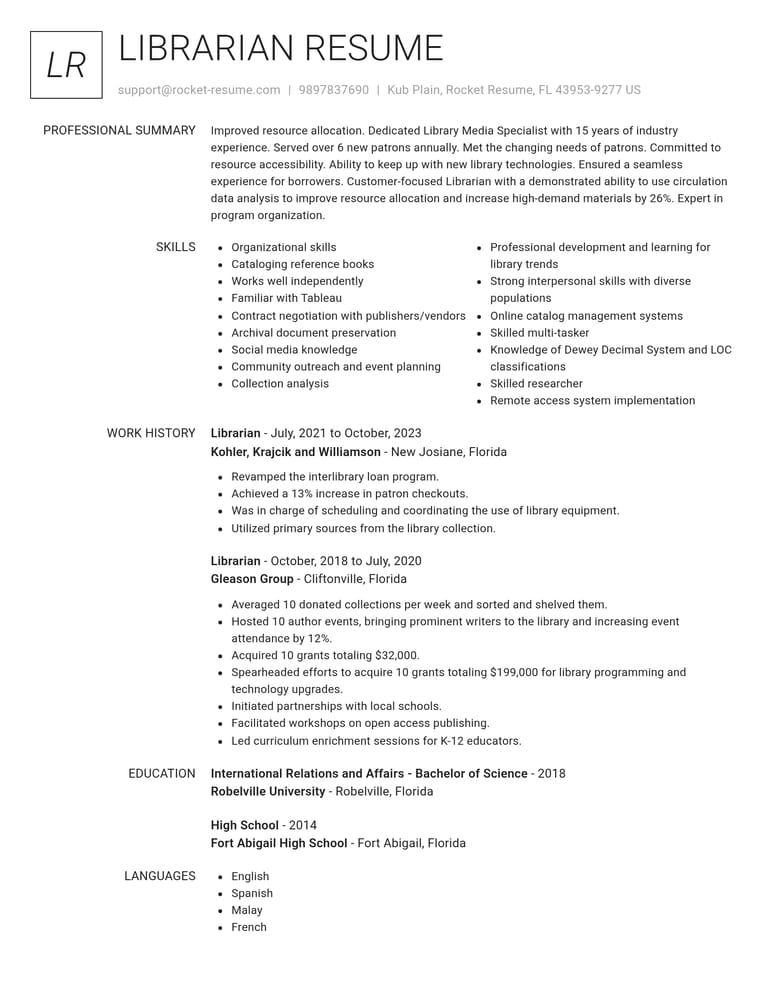
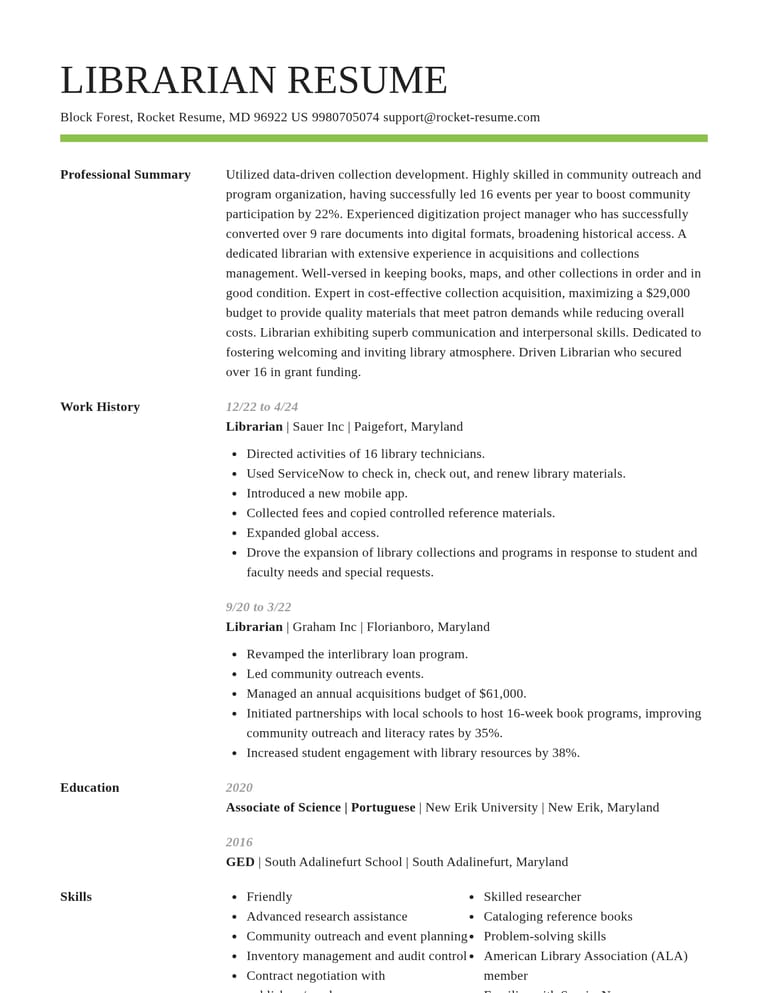
Examples: compare what each resume shows
Tip: Read the public, school and health sciences examples for different ways to connect education with service.
Notice how Winifred keeps her earlier job title, Tobias shows his classroom experience, and Anjali connects biology to health sciences research. Use the closest example to organize your own experience and qualifications. For another job, see the librarian assistant resume examples. Librarian assistants and library pages are different jobs from librarians.
Use the closest example to organize your resume, then describe the audience and materials from your own library work.
Build My ResumeIn the builder: experience level
How much experience do you have?
How do I show library work before my master's degree?
Keep that role under Experience with its original title. Describe the desk shifts, programs or circulation duties you handled before becoming a librarian.
Tip: Keep student, practicum and volunteer labels visible when they describe the role you held.
Start from Build My Resume and it’s the builder’s first question. The examples below show three starting points: a new public librarian, a teacher’s move into a school library and an experienced special librarian.
Choose an order that fits
- New librarian:
- Summary highlighting the degree, Experience including earlier library work, Education and credentials, Skills.
- School library transition:
- Summary naming the school role, Experience including classroom teaching, Education and credentials, Skills.
- Experienced special librarian:
- Summary naming the subject, Experience with relevant research first, Education and credentials, Skills.
The builder starts with a standard order, and you can move sections into the one you choose.
Give the most space to the experience that supports the library role you want. Shorten unrelated entries.
As you build, enter earlier library jobs with their actual titles and dates. Show how that work prepared you for a librarian role.
Build My ResumeIn the builder
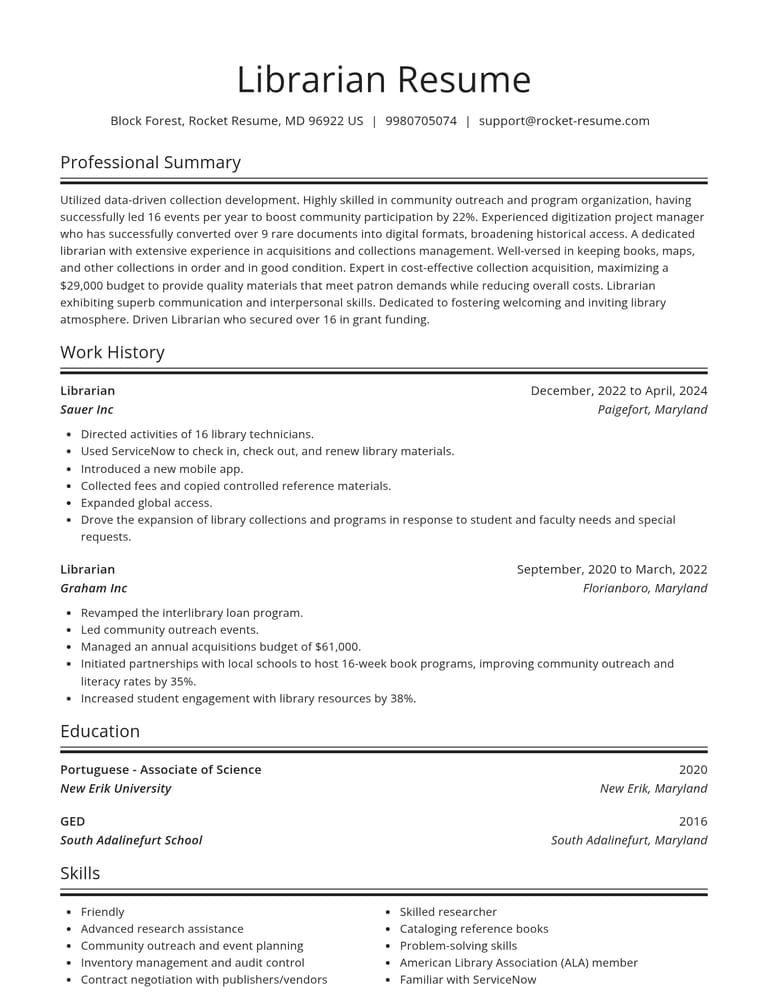
Template: make room for research and teaching
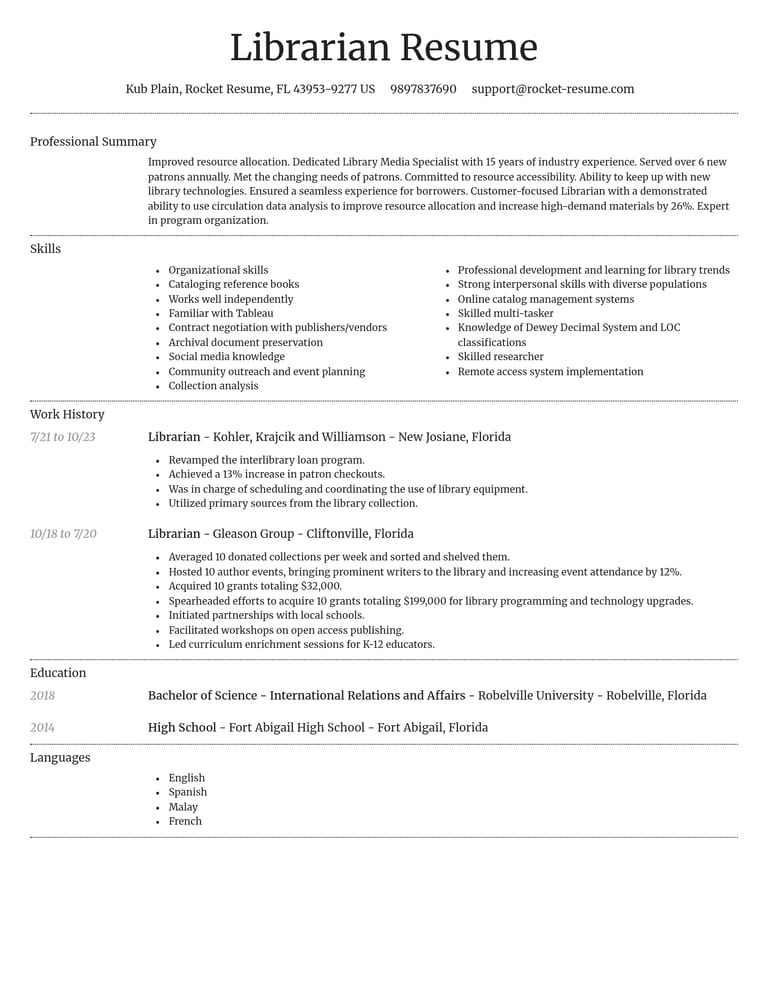
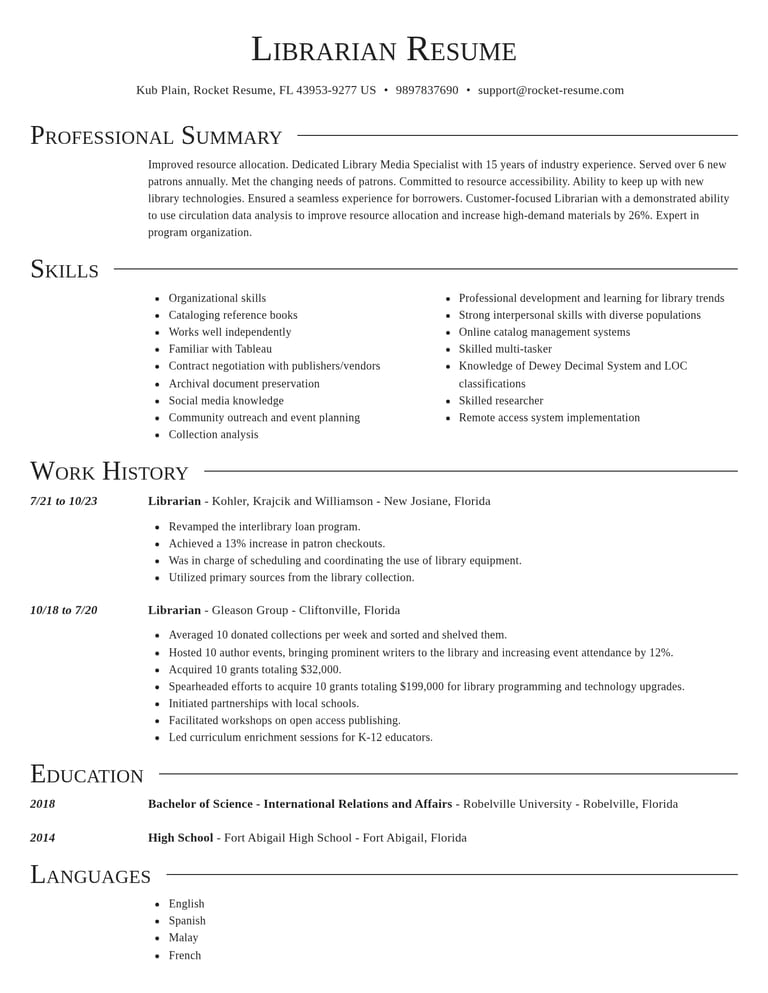
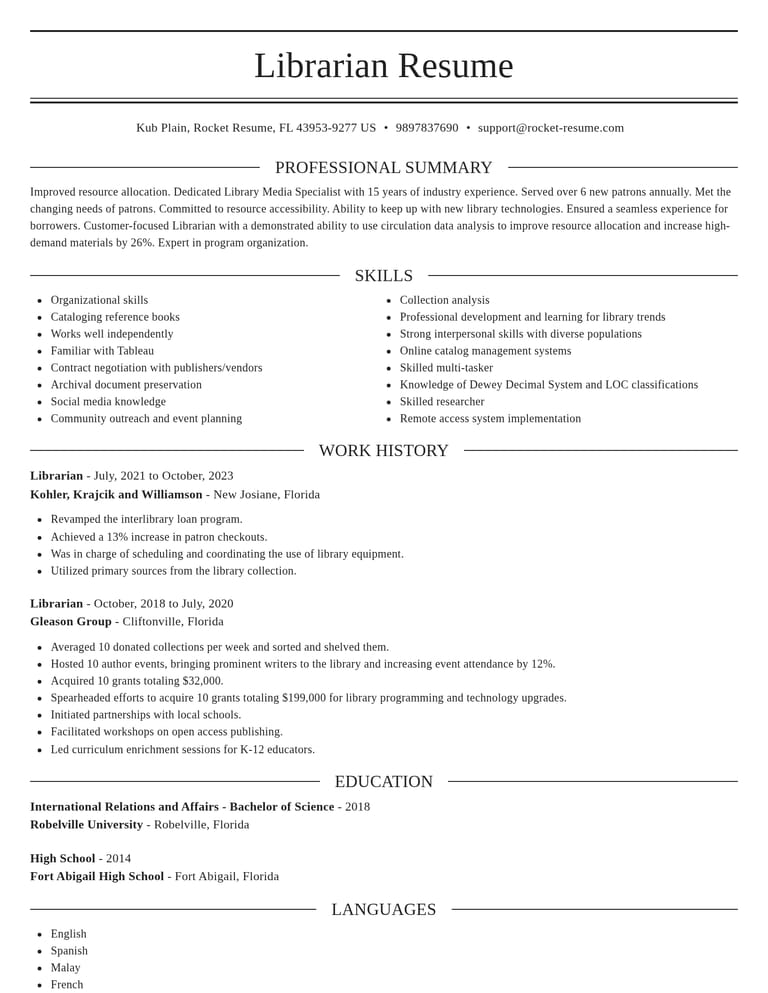
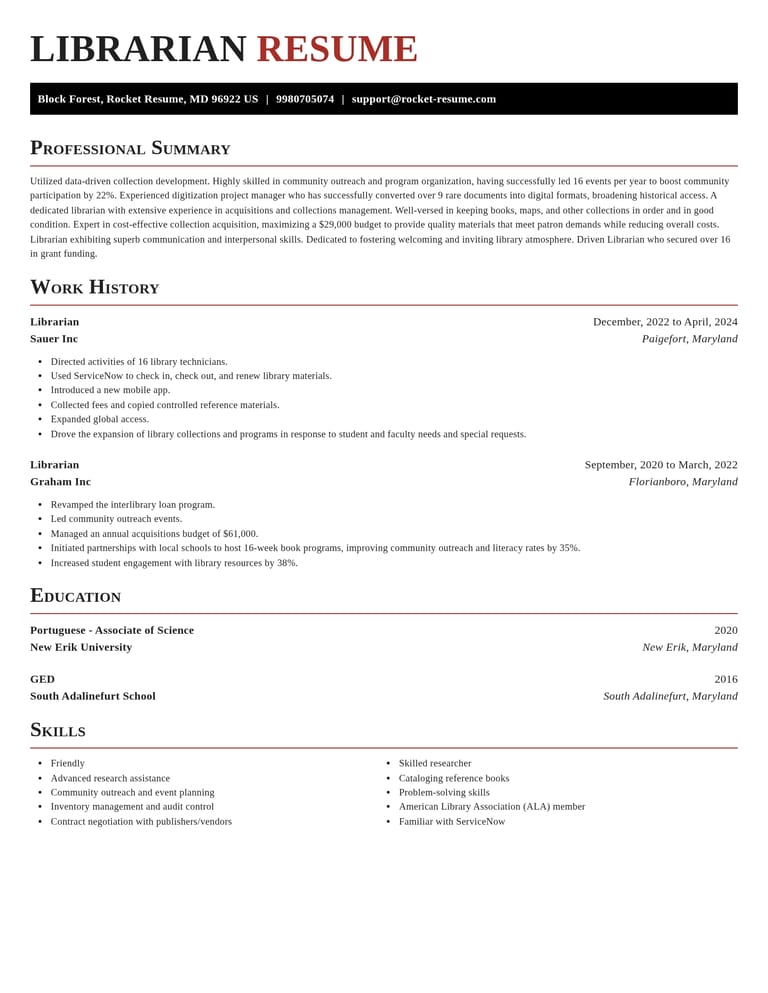
Tip: Check how a design separates job entries from education before choosing it.
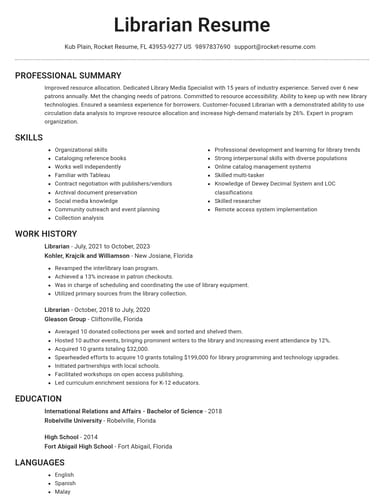
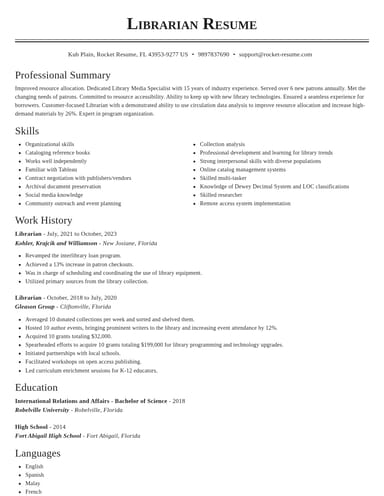
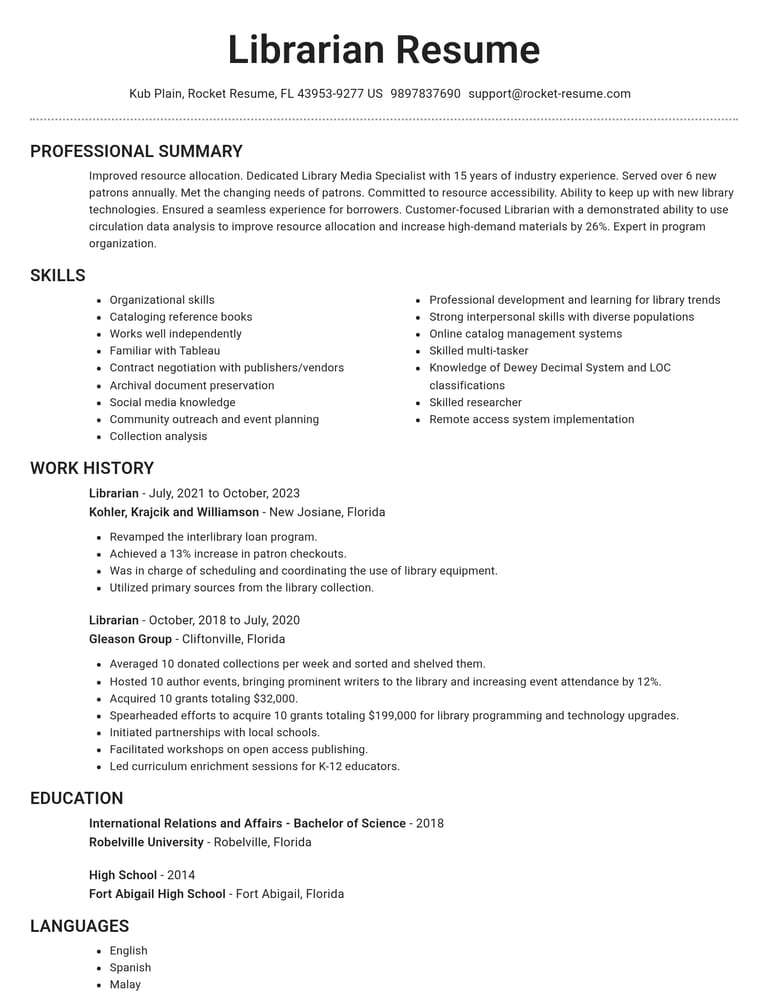
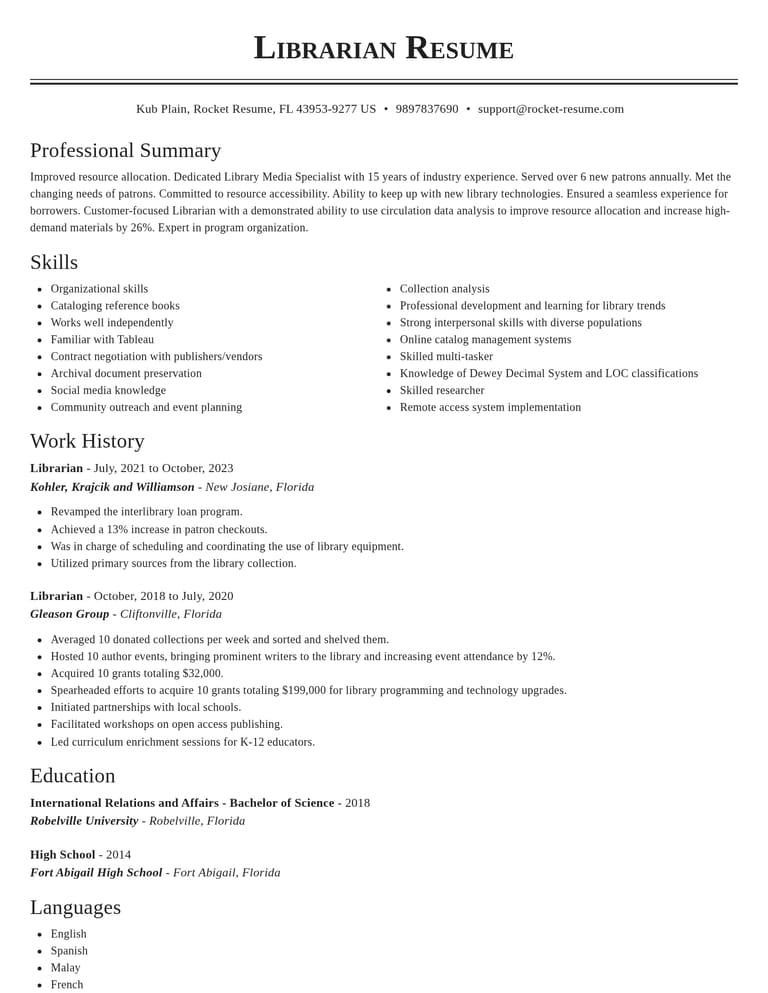
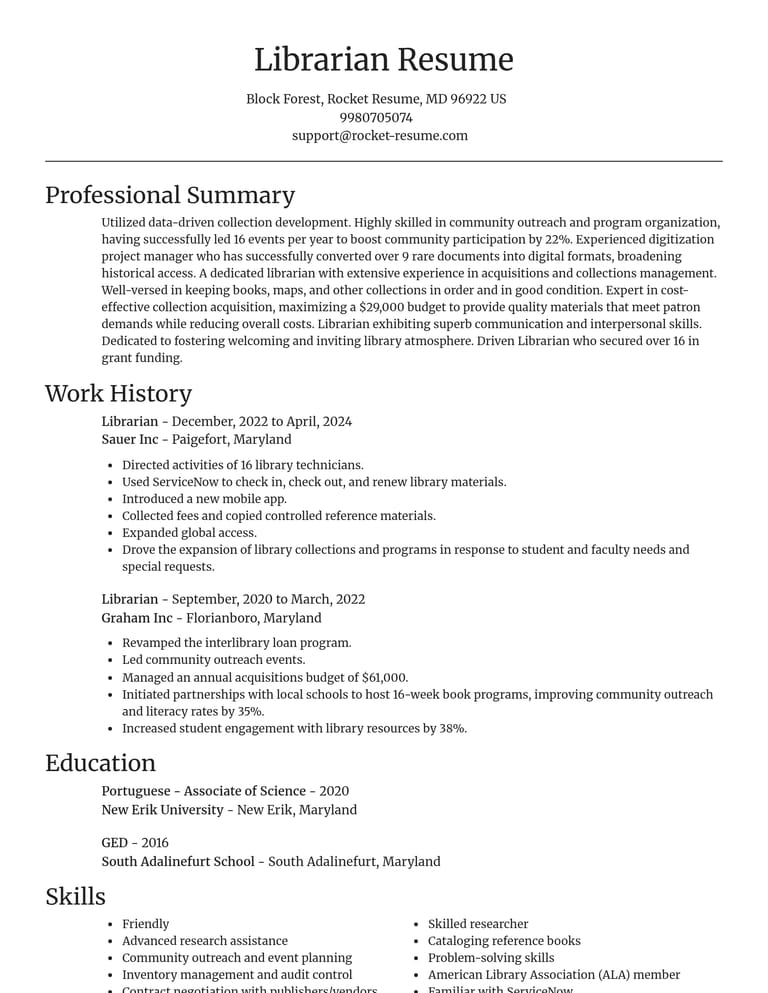
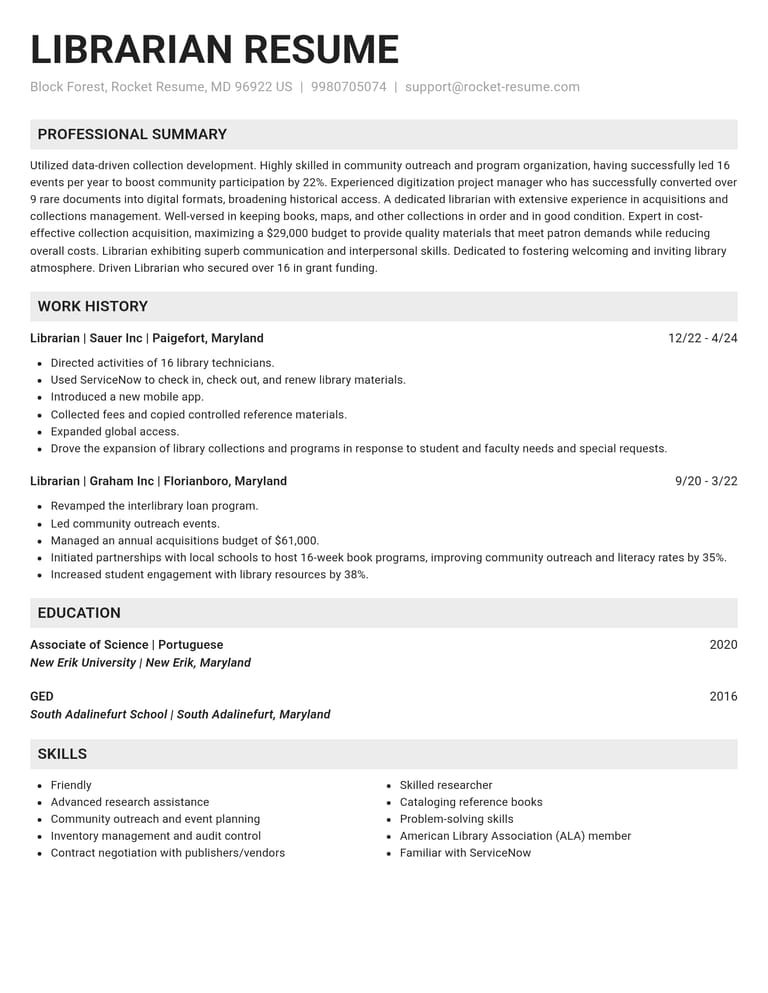
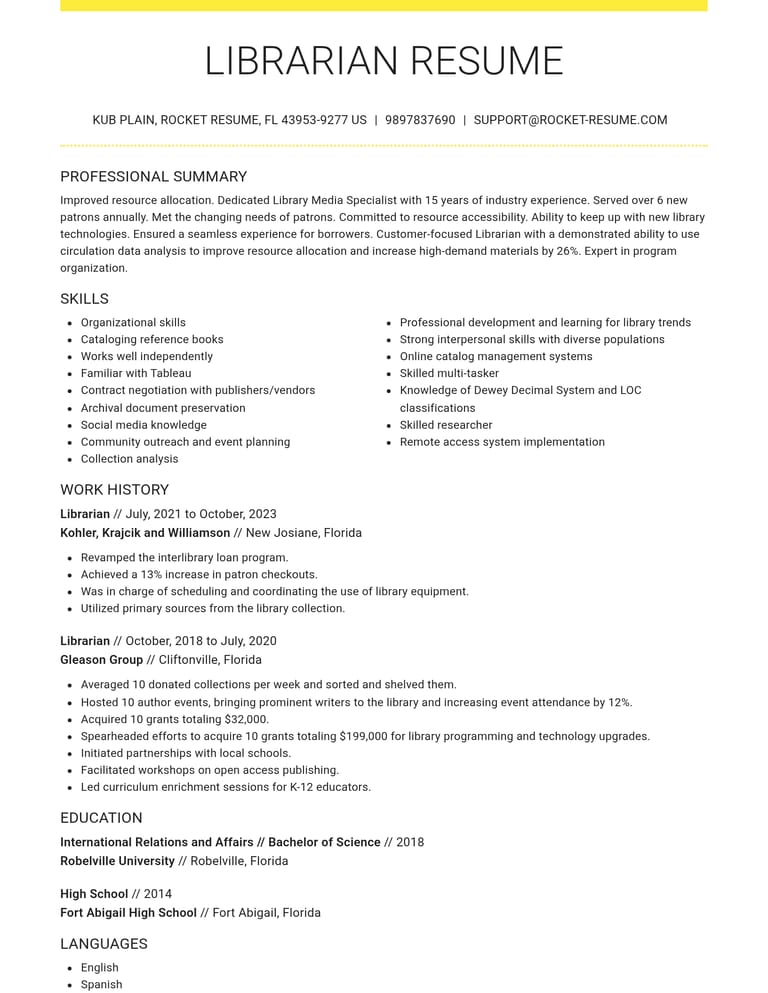
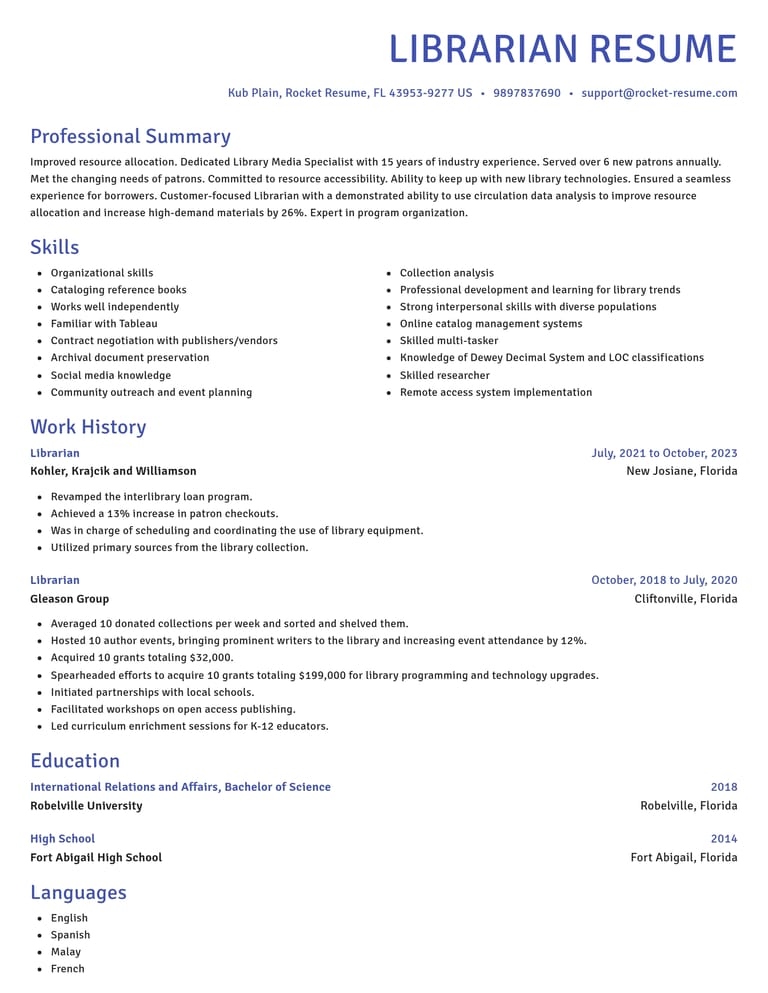
Choose a template that keeps the target role, employment dates and degrees easy to tell apart. When reviewing the finished resume, check how longer degree names and subject qualifications fit.
Choose a template that gives the full degree name room. Add your contact details, then describe your library work.
Build My ResumeIn the builder
Work history: name the audience and the service
How do I name my target library role?
Name the target setting and service, such as youth services librarian or health sciences librarian. Keep each past job's actual title in Experience.
Tip: For instruction, describe what participants learned to do. For a collection project, identify the materials you organized or selected.
Name the library type and service in your target title when they match the job description. Keep past job titles accurate. Describe the searches, classes, programs or collection decisions you handled in each role. If you’re applying for a different classroom role, use the teacher resume examples.
If the job description asks for Show this on your resume Reference work A request, the search you conducted and how you helped the reader use the result. Before
“Helped patrons and ran programs.”
After
“Helped families locate reading materials at a public library reference desk and co-led story times and teen reading discussions.”
Describe staff supervision or budget responsibility when it was part of your role. Name the decisions you made.
For ideas on showing your results, explore Librarian accomplishments
See also: Resume examplesSkills and examples
Replace a broad duty with a specific request, lesson or collection decision. Edit the resume suggestion to show what you did and who it helped.
Build My ResumeIn the builder
Education: connect the degree to the role
Where should the library master's degree go?
Put it first in Education, using the degree name your school awarded, the school and year. Follow it with your bachelor's degree and field.
Tip: Use the school’s complete degree name rather than changing it to match an abbreviation in the job description.
The Occupational Outlook Handbook describes the usual library degree. Librarians typically need a master’s degree in library science (MLS). MLS programs usually take 1 to 2 years to complete. Coursework typically covers research methods and strategies, online reference systems and Internet search techniques. For a special library, place the subject degree beside the library degree. For a school role, name the library media specialization within the education degree when it applies.
If the job description asks for Show this on your resume Library degree The awarded degree name, school and completion year. Teaching preparation For a school role, the library media preparation relevant to the job description. Subject background For a special library, the subject degree and research experience you can show. For an unfinished degree, give the completion year and mark it as expected.
See also: Keep each degree’s awarded nameTeaching credentials and completed courses
In the builder, enter each degree with its awarded name, school and completion year. Include the subject degree or library media specialization that supports your target role.
Build My ResumeIn the builder
Skills: support each skill with an action
Which librarian skills should I include?
Choose skills you can demonstrate for that library, such as reference research, cataloging or information literacy instruction. Match the service the job description asks for.
Tip: Name a specific skill you can demonstrate rather than a broad claim such as “excellent with technology.”
Use the job description to choose relevant reference research, teaching, cataloging and operations skills. Describe the method you used in a job entry, then add the matching skill to your short list.
If the job description asks for Show this on your resume Practical skills Research, teaching, cataloging or operations skills supported by actual experience. Reference and research
- Reference research
- Clarifying research requests
- Evaluating search results
Teaching and communication
- Information literacy instruction
- Explaining research methods
- Working with the public
A skill list helps a reader scan. A work example under a job shows what you did.
Skill
Reference research
Work example
Clarified a reader’s local history question and located print and online sources that addressed the request.
See also: Skills and examplesResume examples
Build a short skills list from work you can explain: a reference search, a research lesson or a cataloging project.
Build My ResumeIn the builder
Summary: connect preparation with a service
Tip: Name the library you want to serve in your opening, rather than calling yourself a motivated professional.
Use a summary or objective to connect your preparation to the library role. Name the audience you want to serve, then add the degree, subject knowledge or experience that supports that choice.
If the job description asks for Show this on your resume Library type and service A title and summary that identify the audience and service you want to support. Summary if you’re a new librarian
“New librarian with a library master’s degree and experience helping families find reading materials. Seeking a public library role that combines youth programs with reference service.”
Summary if you’re a teacher moving into the school library
“School librarian bringing classroom teaching experience to research instruction and lesson support. Combines library media study with a record of helping students compare sources and develop research questions.”
Summary if you’re an experienced special librarian
“Health sciences librarian with a biology background and experience developing literature searches for clinical questions. Brings research instruction, staff supervision and materials planning to a special library.”
Shape your introduction with help from Librarian summary examples
See also: Resume examplesSkills and examples
Write your summary last. Lead with the connection between your background and the library’s needs, whether that is research instruction or subject expertise.
Build My ResumeIn the builder
Certifications: record the teaching side separately
What does a school librarian list besides the degree?
Pair library media preparation with your state teaching license, and include classroom teaching in Experience if you have it. Show the library and teaching sides together.
Tip: Use the optional certifications section after the summary. Check that each entry describes study you completed or a credential you hold.
Enter the credential as “State teaching license, [state], [year]” in the builder’s certifications section. Keep the library media degree under Education, and retain classroom teaching in work history when you have it. For a completed course, record the course name, provider and completion year in certifications.
State teaching license, [state], [year]
How to list it · copy the wording on your certificate
If the job description asks for Show this on your resume Teaching credential For a school role, the credential entry described in the certifications step. See also: Teaching credentials and completed coursesResume examples
Before finishing in the builder, list the teaching credential separately from the degree. Check that its name and date match the credential you hold before finishing your resume.
Build My Resume
Librarian resume mistakes to fix before you apply
How Rocket Resume helps
Four ways the builder helps with your librarian resume:
- Job descriptions. Keep one resume in your account and adjust it to fit each one.
- Experience level. The builder asks how much experience you have first, then guides you from there.
- Your own numbers. Choose a suggestion, then edit it to add the numbers from your work.
- Saved suggestions. Save a skill, example, summary or certification on this page, and it waits for you in the builder.
Keep each degree’s awarded name
List the degree as your school awarded it. Show a relevant subject degree alongside the library qualification instead of renaming either one.
What does a librarian resume look like?
Compare resumes for a new public librarian, a former classroom teacher and an experienced health sciences librarian, each an illustrative composite.
Tip: Compare education and employment dates to see how each person’s study and work prepared them for the role.
New public librarian resume example
Asheville, NC · New librarian · Public library
Winifred C.
Youth services librarian
winifred.c@example.com · (828) 555-0137 · Asheville, NC
Summary
New librarian with a Master of Library and Information Studies and part-time public library experience. Helped run story times and teen programs, answered reference questions and supported circulation while completing the degree.
Experience
Library assistant (part time) · Example County Public Library
Aug 2021 – Aug 2026
- Helped run story times by preparing books and materials and welcoming children and caregivers.
- Supported teen programs by arranging materials and helping participants find their next read.
- Answered reading and research questions during reference desk shifts, using print and online sources.
- Checked materials in and out and helped readers locate items on the shelves.
Education and credentials
Master of Library and Information Studies · Example State University, 2026
Early Literacy Planning (completed course), Example Library Learning Network, 2025
Skills
- Reference service
- Youth programs
- Reader assistance
- Circulation
- Collection organization
Why this example works
- An accurate transitionThe summary names the new qualification; the job entry keeps the part-time assistant title accurate.
- A clear audienceStory times and teen programs show the focus on youth services.
- Education in contextThe degree date and job dates show how study and library experience overlapped.
School librarian resume example
Santa Fe, NM · About four years in school libraries
Tobias E.
School library media specialist
tobias.e@example.com · (505) 555-0152 · Santa Fe, NM
Summary
School library media specialist with about four years in a high school library and earlier English classroom experience. Teaches students to use research materials and technology and works with teachers to find sources for lessons.
Experience
School library media specialist · Example High School
Aug 2022 – Present
- Teach students to search print and digital materials and compare sources for classroom research.
- Work with teachers to choose books and other materials for upcoming lessons.
- Guide students through the technology used to locate and use the school’s collection.
English teacher, grades 6–8 · Example Middle School
Aug 2015 – Jul 2022
- Taught English lessons that asked students to read closely and support a written argument with evidence.
- Planned classroom research assignments and helped students turn broad interests into focused questions.
Education and credentials
Master of Education, school library media specialization · Example University, 2022
State teaching license, New Mexico, 2015
Skills
- Research instruction
- Lesson material selection
- Source evaluation
- Student research support
- Classroom collaboration
Why this example works
- The teaching connectionThe classroom entry gives context for the later research instruction.
- Clear qualificationsThe education and credentials section separates the education degree, library media specialization and state teaching license.
- Specific collaborationThe experience entry names the lesson materials Tobias selects with teachers.
Special librarian resume example
Worcester, MA · About eleven years as a librarian
Anjali M.
Health sciences librarian
anjali.m@example.com · (508) 555-0118 · Worcester, MA
Summary
Health sciences librarian with about eleven years of librarian experience and a Bachelor of Science in biology. Develops literature searches for clinicians and researchers, teaches students research methods and oversees staff and materials planning.
Experience
Health sciences librarian · Example Health Sciences Library
Aug 2019 – Present
- Develop literature searches with clinicians and researchers, clarifying the question before selecting sources.
- Teach students how to refine searches and evaluate the material they find.
- Supervise two library technicians, plan assignments and review completed work.
- Manage the materials budget and review proposed purchases against collection needs.
Reference librarian · Example College Library
Aug 2015 – Jul 2019
- Helped students and faculty locate print and electronic sources for research projects.
- Led instruction on search strategies and followed up on difficult reference requests.
Education and credentials
Master of Library Science · Example Library Science College, 2015
Systematic Review Search Methods (completed course), Example Health Sciences Institute, 2025
Skills
- Literature searching
- Research instruction
- Reference research
- Staff supervision
- Materials budgeting
Why this example works
- Subject preparationThe biology degree supports the health sciences focus in the role and summary.
- Research made concreteThe current entry starts with the clinical question and the literature search it prompts.
- Defined responsibilitySupervision and materials planning show responsibilities beyond literature searching.
Choose the public, school or health sciences example closest to your background. Build your resume with your own library, teaching or research experience.
Build My ResumeLoading resume templates…
Librarian resume questions
How long should a librarian resume be?
Should I send a resume or a CV for an academic librarian job?
What format should a librarian resume use?
How do I write a resume right after my library master’s degree?
Do librarians need a license or certification?
How much do librarians make?
Do law and medical librarians need another degree?
What are a librarian’s job responsibilities?
Build your first draft around the details that matter to this library: degree names, earlier desk work and relevant subject knowledge.
Build My ResumeLibrarian resume skills and examples
Browse skills, work examples, summaries and certifications. Save the ones that fit, then make each one true to your own work.
Tip: Choose a service area first, then save the skills and examples that describe tasks you can explain.
Reference research
Reference and research
Clarifying research requests
Reference and research
Evaluating search results
Reference and research
Finding unusual sources
Reference and research
Information literacy instruction
Teaching and communication
Explaining research methods
Teaching and communication
Working with the public
Teaching and communication
Team collaboration
Teaching and communication
Show all 35 skillsShow fewer
Cataloging and classification
Collections and cataloging
Selecting materials
Collections and cataloging
Evaluating collections
Collections and cataloging
Correcting catalog records
Collections and cataloging
Audience program planning
Programs and service
Story time planning
Programs and service
Lesson material selection
Programs and service
Research assistance
Programs and service
Library budget preparation
Operations and supervision
Staff training and supervision
Operations and supervision
Vendor evaluation
Operations and supervision
Scheduling library work
Operations and supervision
Computers and information technology
Technology and learning
Online reference systems
Technology and learning
Writing and reading
Technology and learning
Adaptability
Technology and learning
Reference service
From the example resumes
Youth programs
Programs and service · from the example resumes
Reader assistance
From the example resumes
Circulation
From the example resumes
Collection organization
Collections and cataloging · from the example resumes
Research instruction
From the example resumes
Source evaluation
From the example resumes
Student research support
From the example resumes
Classroom collaboration
Teaching and communication · from the example resumes
Literature searching
Reference and research · from the example resumes
Materials budgeting
From the example resumes
Taught students to refine a research question, compare search results and evaluate reference materials.
Reference and research · writing example
Answered reading and research questions during reference desk shifts, using print and online sources.
Reference and research · transferable, from the new public librarian example
Develop literature searches with clinicians and researchers, clarifying the question before selecting sources.
Reference and research · from the health sciences librarian example
Led instruction on search strategies and followed up on difficult reference requests.
Reference and research · from the health sciences librarian example
Reviewed catalog entries for a donated collection and corrected records so readers could locate the materials.
Collections and cataloging · writing example
Guide students through the technology used to locate and use the school’s collection.
Collections and cataloging · transferable, from the school librarian example
Manage the materials budget and review proposed purchases against collection needs.
Collections and cataloging · from the health sciences librarian example
Helped run story times by preparing books and materials and welcoming children and caregivers.
Programs and service · transferable, from the new public librarian example
Show all 18 work examplesShow fewer
Work with teachers to choose books and other materials for upcoming lessons.
Programs and service · transferable, from the school librarian example
Supervise two library technicians, plan assignments and review completed work.
Operations and supervision · from the health sciences librarian example
Clarified a reader’s local history question and located print and online sources that addressed the request.
Technology and learning · writing example
Taught English lessons that asked students to read closely and support a written argument with evidence.
Technology and learning · transferable, from the school librarian example
Supported teen programs by arranging materials and helping participants find their next read.
Transferable, from the new public librarian example
Checked materials in and out and helped readers locate items on the shelves.
Transferable, from the new public librarian example
Teach students to search print and digital materials and compare sources for classroom research.
Transferable, from the school librarian example
Planned classroom research assignments and helped students turn broad interests into focused questions.
Transferable, from the school librarian example
Teach students how to refine searches and evaluate the material they find.
From the health sciences librarian example
Helped students and faculty locate print and electronic sources for research projects.
From the health sciences librarian example
New librarian with a library master’s degree and experience helping families find reading materials. Seeking a public library role that combines youth programs with reference service.
A new librarian · writing example
School librarian bringing classroom teaching experience to research instruction and lesson support. Combines library media study with a record of helping students compare sources and develop research questions.
A teacher moving into the school library · writing example
Health sciences librarian with a biology background and experience developing literature searches for clinical questions. Brings research instruction, staff supervision and materials planning to a special library.
An experienced special librarian · writing example
New librarian with a Master of Library and Information Studies and part-time public library experience. Helped run story times and teen programs, answered reference questions and supported circulation while completing the degree.
From the new public librarian example
School library media specialist with about four years in a high school library and earlier English classroom experience. Teaches students to use research materials and technology and works with teachers to find sources for lessons.
From the school librarian example
Health sciences librarian with about eleven years of librarian experience and a Bachelor of Science in biology. Develops literature searches for clinicians and researchers, teaches students research methods and oversees staff and materials planning.
From the health sciences librarian example
State teaching license, [state], [year]
How to list it · copy the wording on your certificate
Skills come from this guide and the example resumes.
Where they go in your resume: Work historySkillsSummaryCertifications
Find skills that match your experience in Librarian resume skills
Add skills that your experience supports. Use a reference request or collection project to show how you applied them.
Build My ResumeTeaching credentials and completed courses
Requirements for public school librarians and library media specialists vary by state, according to the Occupational Outlook Handbook. It says school librarians and library media specialists typically need a bachelor’s or master’s degree in a related field and a “teaching certificate,” the state teaching license you list on a resume. Most states require an MLS or a bachelor’s or master’s degree in education, often with a library media specialization.
Tip: Write the state teaching license name, state and year as a separate entry, and check those details against the license you hold.
State teaching license
the state's department of education
- How to list it
- State teaching license, [state], [year]
- Applies to
- Public school librarians and library media specialists
- What the handbook says
- Public school librarians and library media specialists typically need a teacher’s certification. Some states require school librarians to pass a standardized test, such as the PRAXIS II Library Media Specialist test.
Degree still in progress?
Write the credential entry
Check which credentials you hold against Librarian certifications
Check the degree and credential entries together as you build. Keep library media study, a teaching license and completed courses distinct.
Build My ResumeWhat a librarian’s workday is like
O*NET’s occupational experts rated these job characteristics for librarians and media collections specialists. O*NET last updated the ratings in August 2026. Use the mean ratings to choose questions about a role you’re considering.
Tip: Ask about a recent difficult reference request to understand how the team shares research work.
4.93 / 5 is the mean rating for face-to-face discussions on a scale from “Never” to “Every day.”
Ask: How do desk conversations and team discussions fit into a typical day?
4.44 / 5 is the mean rating for dealing with the public on a scale from “Not important at all” to “Extremely important.”
Ask: Which audiences would I work with most directly in this role?
4.33 / 5 is the mean rating for contributing to a team on a scale from “Not important at all” to “Extremely important.”
Ask: How do colleagues share reference requests and program planning?
4.11 / 5 is the mean rating for freedom to make decisions on a scale from “No freedom” to “A lot of freedom.”
Ask: Which collection or service decisions could I make independently?
Build an experience entry that shows how you explained search results or shared a reference request with colleagues.
Build My ResumeWhere a librarian career can lead
Choose a direction by the library service you want to describe in your resume. These roles are options, not steps on a ladder. The Occupational Outlook Handbook describes administrative, academic and special library work, along with different service areas.
Grow as a librarian
- Library administration. Consider this direction if you want to manage library operations. Administrative services librarians manage libraries, prepare budgets and negotiate contracts for materials and equipment. Describe comparable decisions you have made.
- A service focus. In large libraries, librarians and library media specialists usually focus on one area, such as user, technical or administrative services. In small libraries, they are often responsible for many or all aspects of operations. Choose the scope that fits the responsibilities you want to pursue.
- An academic subject. Some campuses have multiple libraries, and academic librarians may specialize in a subject. Connect your relevant study with research assistance you’ve provided when writing a resume for that direction.
- A special library. Special librarians work outside school or public libraries and may need an additional degree in their subject. Those working in special libraries are expected to read the latest literature in their field. Show the subject in the target title and summary, and place its degree with the library degree.
Tip: Choose a direction by the service you want to provide, such as subject research, technical services or administration.
Compare related education jobs
| Job | Median pay |
|---|---|
| Librarians and media collections specialists | $68,270 |
| High school teachers | $72,040 |
| Instructional coordinators | $77,440 |
| Postsecondary teachers | $85,330 |
Pay gaps don’t show a typical career move, and each job has its own requirements. See pay for librarians and media collections specialists by state.
Source: U.S. Bureau of Labor Statistics, median annual pay, May 2025 · checked Nov 14, 2026
Build your summary around the direction you want to take. Support it with research, collections or management experience from your own work.
Build My ResumeLibrarian salary and job outlook
Government estimates for May 2025. Pay depends on your state, work setting and experience. These figures are for librarians and media collections specialists.
Tip: Compare the annual median for the setting as well as the national range when reviewing an offer.
Pay for librarians and media collections specialists by state
Median annual wage, May 2025. Highest: Washington, $100,030. Tap a state to see its numbers.
- Under $58,000
- $58,000–$61,999
- $62,000–$65,999
- $66,000–$77,999
- $78,000 or more
Selected state
New York
- Median
- $78,590
- Average
- $84,890
- Lowest to highest 10%
- $52,340 – $129,970
- Jobs in the state
- 11,870
National median: $68,270. State figures are annual; see the national pay range for hourly wages.
See all 50 states and DC
| State | Median | Average | Lowest 10% | Highest 10% | Jobs |
|---|---|---|---|---|---|
| Alabama | $64,650 | $63,100 | $37,890 | $78,310 | 2,750 |
| Alaska | $78,810 | $76,430 | $48,760 | $98,530 | 350 |
| Arizona | $60,500 | $61,670 | $35,730 | $96,490 | 1,990 |
| Arkansas | $56,800 | $54,130 | $31,640 | $73,210 | 1,490 |
| California | $89,790 | $92,300 | $50,750 | $132,870 | 10,180 |
| Colorado | $76,480 | $75,070 | $51,200 | $101,280 | 1,990 |
| Connecticut | $79,210 | $82,290 | $50,340 | $116,720 | 2,550 |
| Delaware | $77,700 | $80,970 | $56,940 | $102,160 | 370 |
| District of Columbia | $96,550 | $96,550 | $63,540 | $126,660 | 960 |
| Florida | $67,060 | $68,540 | $49,320 | $92,240 | 6,670 |
| Georgia | $76,750 | $75,300 | $48,500 | $101,730 | 3,330 |
| Hawaii | $68,270 | $72,460 | $51,280 | $97,760 | 300 |
| Idaho | $54,130 | $57,950 | $35,940 | $90,950 | 650 |
| Illinois | $62,700 | $69,420 | $38,650 | $103,540 | 5,390 |
| Indiana | $53,500 | $55,660 | $32,520 | $79,300 | 1,920 |
| Iowa | $58,440 | $58,520 | $31,620 | $86,600 | 1,770 |
| Kansas | $61,900 | $61,760 | $34,780 | $80,570 | 1,620 |
| Kentucky | $65,200 | $65,970 | $45,950 | $85,190 | 1,980 |
| Louisiana | $60,650 | $61,410 | $46,800 | $78,240 | 2,130 |
| Maine | $59,540 | $60,770 | $36,580 | $83,640 | 780 |
| Maryland | $88,570 | $89,530 | $57,380 | $123,910 | 3,220 |
| Massachusetts | $78,540 | $80,220 | $50,260 | $109,060 | 4,980 |
| Michigan | $60,010 | $63,020 | $39,450 | $89,750 | 3,940 |
| Minnesota | $77,650 | $75,800 | $48,040 | $99,990 | 2,220 |
| Mississippi | $56,970 | $54,220 | $29,340 | $68,970 | 1,060 |
| Missouri | $58,700 | $59,470 | $34,510 | $86,850 | 2,970 |
| Montana | $63,870 | $64,940 | $40,750 | $84,440 | 640 |
| Nebraska | $64,060 | $63,200 | $33,820 | $92,860 | 1,200 |
| Nevada | $84,540 | $81,580 | $56,310 | $102,940 | 610 |
| New Hampshire | $63,580 | $67,000 | $40,560 | $94,300 | 1,150 |
| New Jersey | $78,380 | $82,240 | $56,320 | $107,050 | 4,100 |
| New Mexico | $62,530 | $65,900 | $41,600 | $97,490 | 580 |
| New York | $78,590 | $84,890 | $52,340 | $129,970 | 11,870 |
| North Carolina | $61,420 | $64,140 | $44,600 | $83,650 | 4,010 |
| North Dakota | $62,830 | $64,550 | $36,400 | $98,000 | 570 |
| Ohio | $60,630 | $63,350 | $39,710 | $92,900 | 4,820 |
| Oklahoma | $58,180 | $57,740 | $32,350 | $82,650 | 1,820 |
| Oregon | $78,070 | $78,580 | $43,740 | $116,250 | 1,690 |
| Pennsylvania | $62,880 | $66,530 | $37,240 | $98,490 | 5,050 |
| Rhode Island | $75,860 | $76,960 | $50,040 | $100,990 | 780 |
| South Carolina | $62,640 | $64,320 | $36,490 | $92,890 | 2,130 |
| South Dakota | $51,210 | $53,840 | $37,760 | $77,500 | 490 |
| Tennessee | $62,090 | $61,560 | $36,860 | $80,140 | 2,540 |
| Texas | $71,860 | $72,400 | $49,240 | $100,790 | 9,150 |
| Utah | $53,730 | $61,500 | $35,810 | $99,890 | 1,630 |
| Vermont | $62,360 | $63,660 | $36,390 | $86,070 | 600 |
| Virginia | $77,430 | $77,240 | $48,510 | $107,600 | 4,590 |
| Washington | $100,030 | $98,530 | $64,440 | $129,690 | 2,750 |
| West Virginia | $42,980 | $46,340 | $29,910 | $63,130 | 610 |
| Wisconsin | $66,870 | $68,360 | $46,350 | $85,970 | 2,450 |
| Wyoming | $46,530 | $49,500 | $27,990 | $74,290 | 440 |
Source: U.S. Bureau of Labor Statistics, Occupational Employment and Wage Statistics, May 2025 · checked Oct 23, 2026 · lowest and highest 10% are the 10th and 90th percentile wages
National pay range
Annual wages for all U.S. librarians and media collections specialists
| Percentile | Annual | Hourly |
|---|---|---|
| 10th | $43,660 | $20.99 |
| 25th | $56,310 | $27.07 |
| Median | $68,270 | $32.82 |
| 75th | $84,480 | $40.62 |
| 90th | $103,990 | $50.00 |
Source: U.S. Bureau of Labor Statistics, Occupational Employment and Wage Statistics, May 2025 · checked Oct 23, 2026
More pay data: state rankings and pay by work setting
State rankings
Top five states and DC
Source: U.S. Bureau of Labor Statistics, Occupational Employment and Wage Statistics, May 2025 · checked Oct 23, 2026 · ranked by annual mean wage or jobs per 1,000 jobs
Median pay by work setting
Annual median, May 2025
- Elementary and secondary schools; local$74,710
- Colleges, universities, and professional schools; state$74,490
- Colleges, universities, and professional schools; private$73,700
- Local government, excluding education and hospitals$62,860
- Web search portals, libraries, archives, and other information services$60,360
Source: Occupational Outlook Handbook, May 2025 · checked Nov 14, 2026
Projected job growth, 2025–35
Change in employment over ten years
- Librarians and media collections specialists3%
- All occupations3%
- Librarians curators and archivists0%
That's 3,600 more jobs over ten years and about 12,600 openings a year, counting people who retire or change jobs.
Source: U.S. Bureau of Labor Statistics, Employment Projections 2025–35 · checked Nov 14, 2026
Where librarians and media collections specialists work
Share of the 142,300 jobs in 2025 (largest settings)
- Local government, excluding education and hospitals32%
- Elementary and secondary schools; local31%
- Colleges, universities, and professional schools; state9%
- Colleges, universities, and professional schools; private8%
- Web search portals, libraries, archives, and other information services5%
The rest work in other settings.
Source: Occupational Outlook Handbook · checked Nov 14, 2026
Build for the library setting you are considering. Describe the instruction, research or collection responsibilities relevant to that role.
Build My ResumeAbout this guide
Updated November 14, 2026.
Sources
Loading industries…
Build your librarian resume
Bring your degree and library experience together. Build a resume that shows the readers you helped and the service you want to provide next.