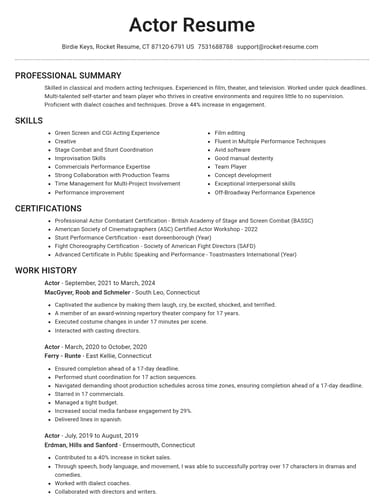
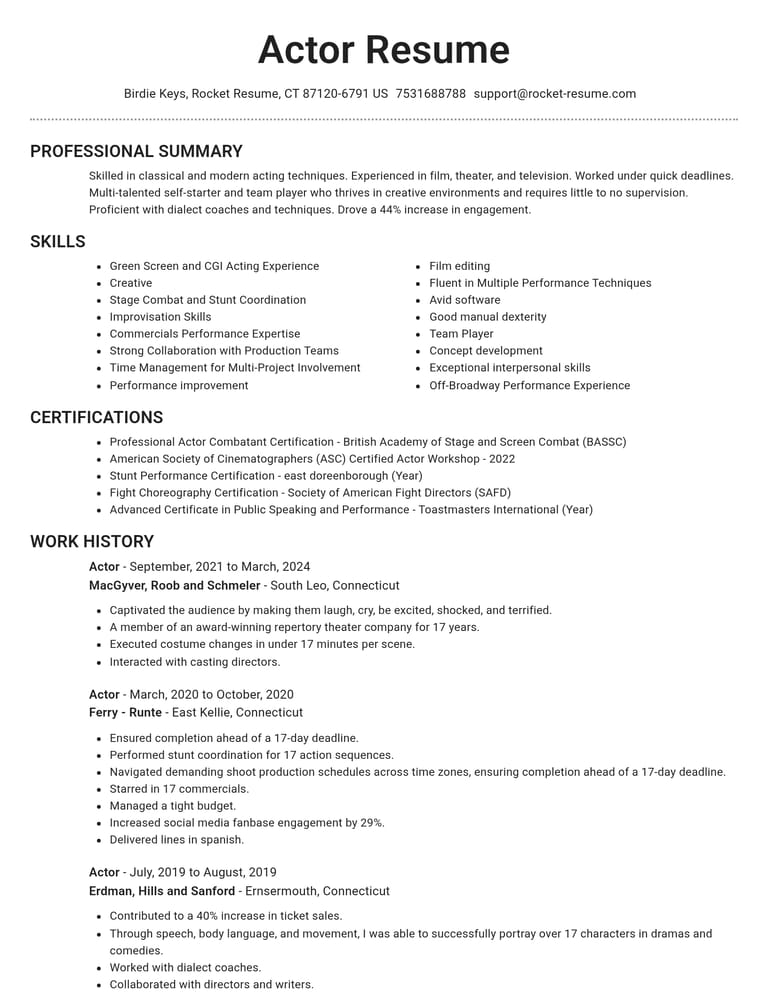
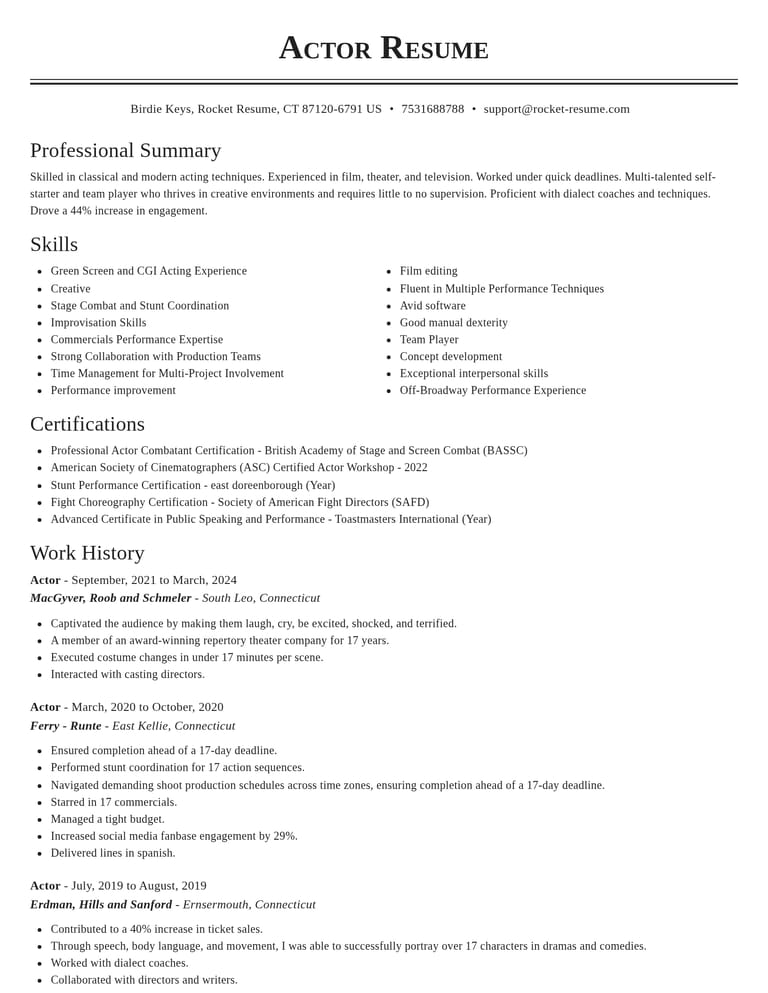
Actor resume examples, templates and tips
Start with acting resume examples, then build your own to show your credits, training and special skills.
- Beginner, screen/voice, touring
- List extras and voiceover work
- Choose your special skills
- Where to put acting classes

What actor hiring managers look for
- Audition preparation and performance.
- Script study and rehearsal.
- Developing an interpretation with the director.
- Portraying a character through speech and movement.
- Collaboration within an ensemble.
- Narration from scripts or books.
How to write an actor resume
Your acting resume may cover short productions rather than one employer, training from classes, workshops and coaching, and skills learned for a part. As you build, fit these details into Experience, education and the other sections. This guide starts with four questions to answer first, then walks through each part of your resume with tips and links to the examples, templates and data on this page.
Four questions to answer first
- How do I make an acting resume with no experience?
Step 3 helps you turn early performances into Experience entries.
- How do I list commercials and background appearances?
Step 5 helps you describe your part in each production.
- Where do acting classes go on my resume?
Step 6 separates your education entry from completed classes.
- Which special skills belong on an acting resume?
Step 7 helps you connect a skill to a performance.
What an actor does
O*NET describes actors as playing parts in stage, television, radio, video or film productions and interpreting a role by speech, gesture and body movement. Your resume shows the parts you played, the kind of production and where you performed.
According to the U.S. Bureau of Labor Statistics, median pay for actors was $29.05 an hour in May 2025. The Occupational Outlook Handbook from the U.S. Bureau of Labor Statistics projects 0% job change for actors from 2025 to 2035, categorized as “Little or no change.”
See also: Actor pay and job outlookList work beyond leading rolesWhat an actor’s workday is like
Tip: Save a copy of each acting resume under the part’s name so you can find it before an audition.
Write your actor resume in nine steps
Do the first two before you open the builder. The other seven follow the builder’s order.
Step 1 of 9
Before you open the builder
Job description: find what the part calls for
Tip: Separate what the description asks you to perform from the story’s setting. The setting alone does not tell you which skill to list.
Make these easy to find
- Audition preparation and performance.
- Script study and rehearsal.
- Developing an interpretation with the director.
- Portraying a character through speech and movement.
- Collaboration within an ensemble.
- Narration from scripts or books.
- Coordination with lighting, costume and props crews.
The strengths and requirement list draw on O*NET’s tasks for actors and the Occupational Outlook Handbook.
Match each requirement in the job description
Here’s the step where you’ll show each one:
- Production medium step 5
- Singing or dancing step 7
- Accent for the part step 7
- Riding or stage fighting step 7
- Musical instrument step 7
- Ensemble collaboration step 8
Tip: If the description offers alternatives for a part, choose the one you have practiced rather than claiming them all.
Identify the production medium and what the part asks you to perform, then build your resume around matching experience.
Build My Resume
Before you open the builder
Examples: compare the performances in each resume
Tip: Notice how a supporting part, an understudy assignment and a lead read differently in Experience.
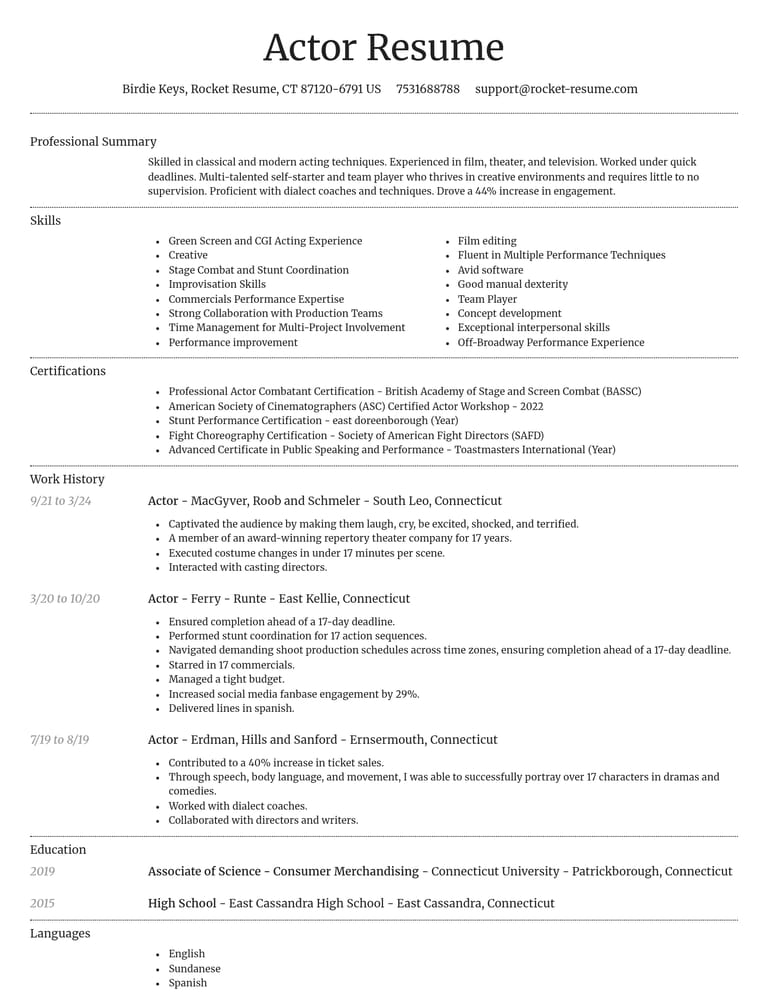
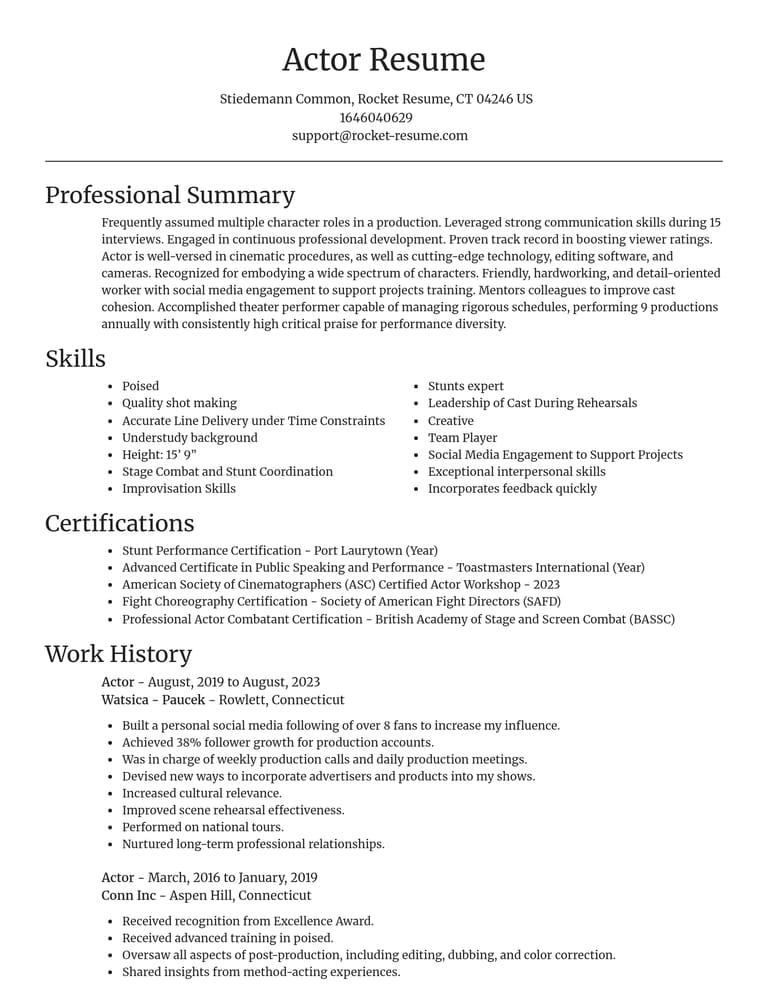
The beginner shows student films, community theater and school plays. The screen and voice example includes audiobook narration, an animated short, background appearances and repertory theater. The stage example combines touring, summer theater, teaching and a performing arts degree.
Read for details you recognize from your own productions, then build an entry around a scene you remember clearly.
Build My ResumeIn the builder: experience level
How much experience do you have?
How do I make an acting resume with no experience?
Use school plays, community-theater productions, student films and class showcases as entries.
Tip: Use one entry per production or ongoing engagement, such as a company season. Name the productions within that entry.
Start from Build My Resume and it’s the builder’s first question. The examples below show three starting points: a performer starting out in community theater, a screen and voice actor with about nine years of credits and a touring stage actor with a performing arts degree.
Choose an order that fits
- Starting out:
- Summary, Experience with student films before community theater, Education and credentials, Skills.
- Screen and voice:
- Summary, Experience with current narration before background appearances, Education and credentials, Skills.
- Touring stage:
- Summary, Experience with the touring company first, Education and credentials, Skills.
The builder starts with a standard order, and you can move sections into the one you choose.
Keep each entry short enough to scan while still explaining what you did.
See also: Acting beginnings and training
Arrange your work history with current or most recent entries first. If two entries are current, put the later start date first. Then enter your experience level to begin building.
Build My ResumeIn the builder
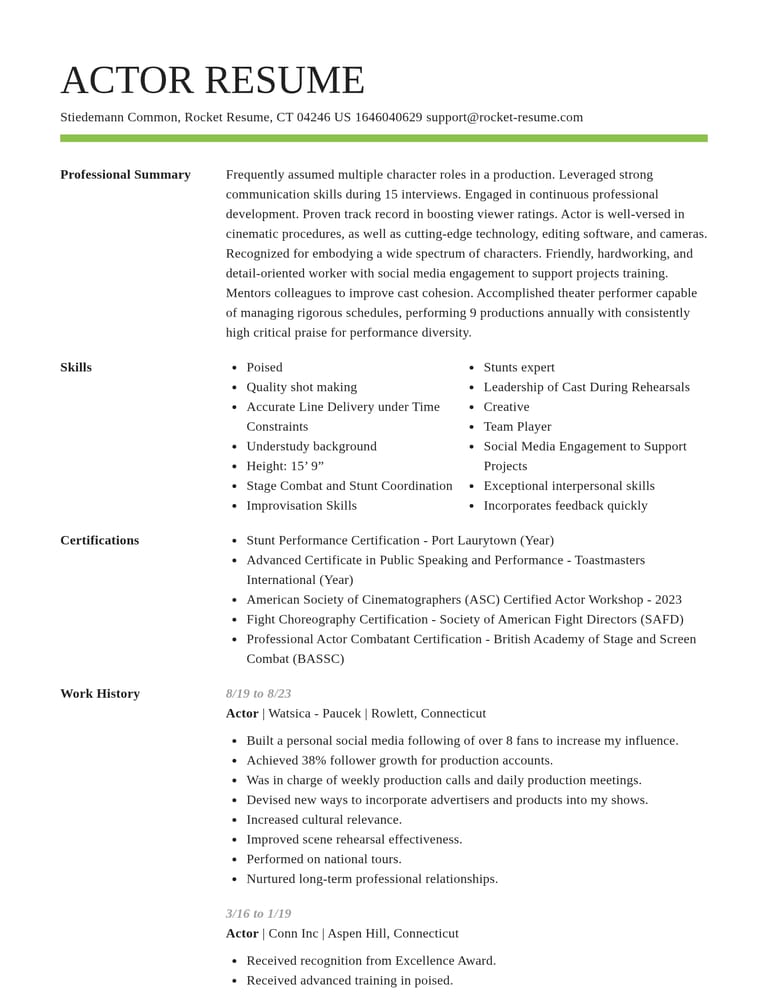
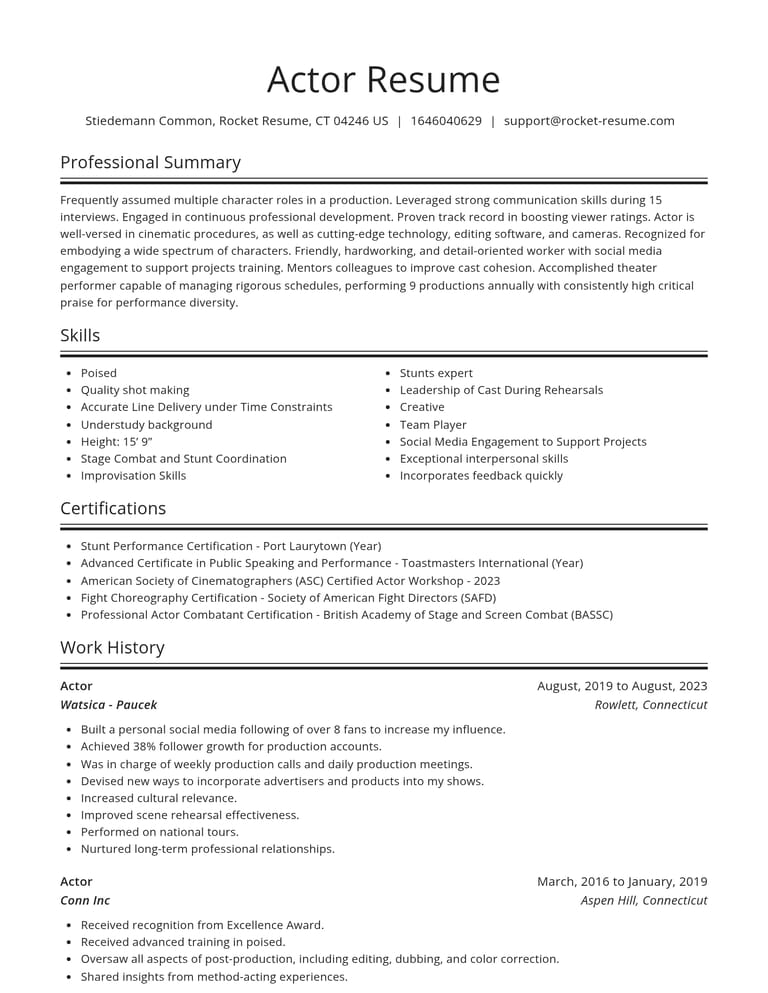
Template: give short production entries space
Tip: Compare the spacing between job titles and entries before choosing a design.
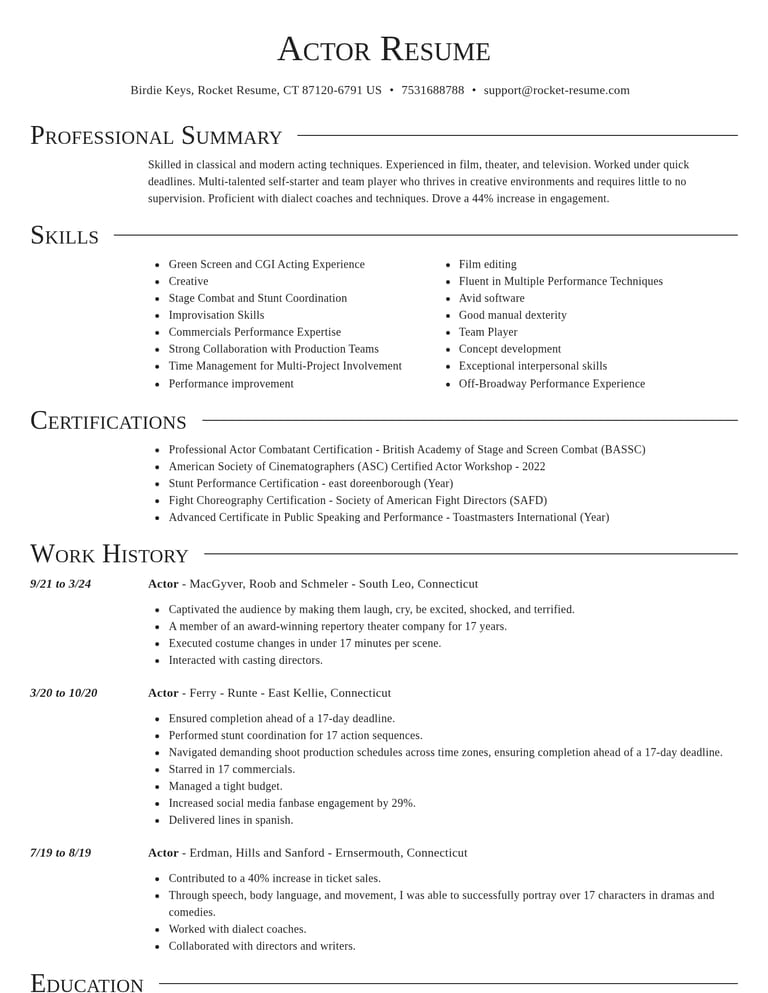
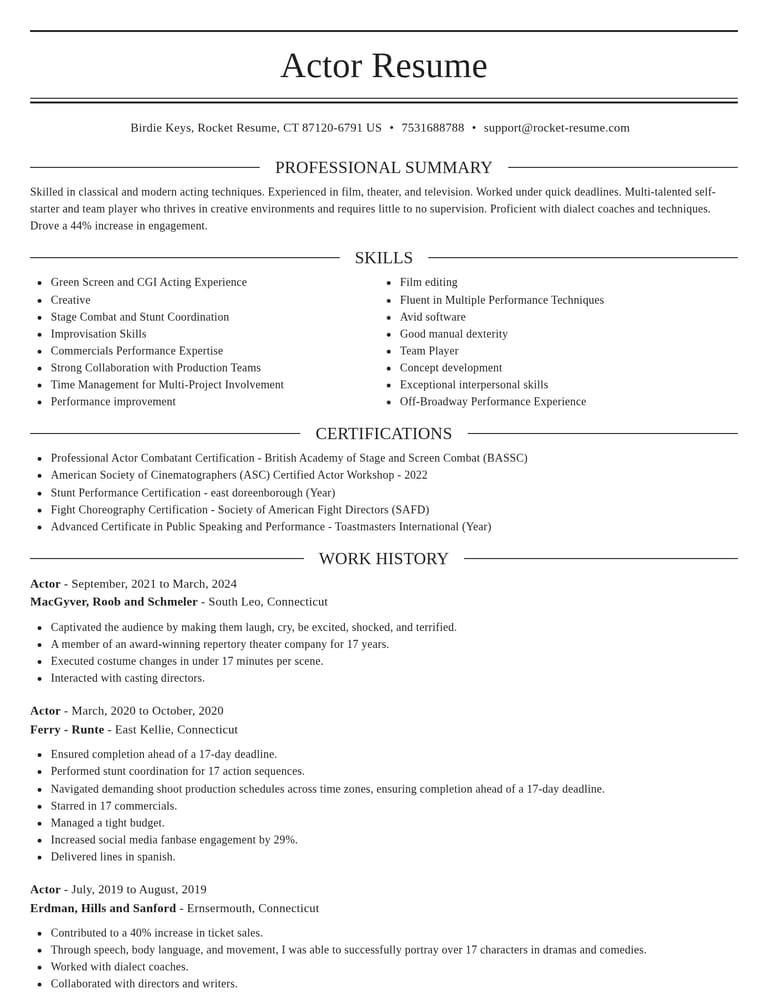
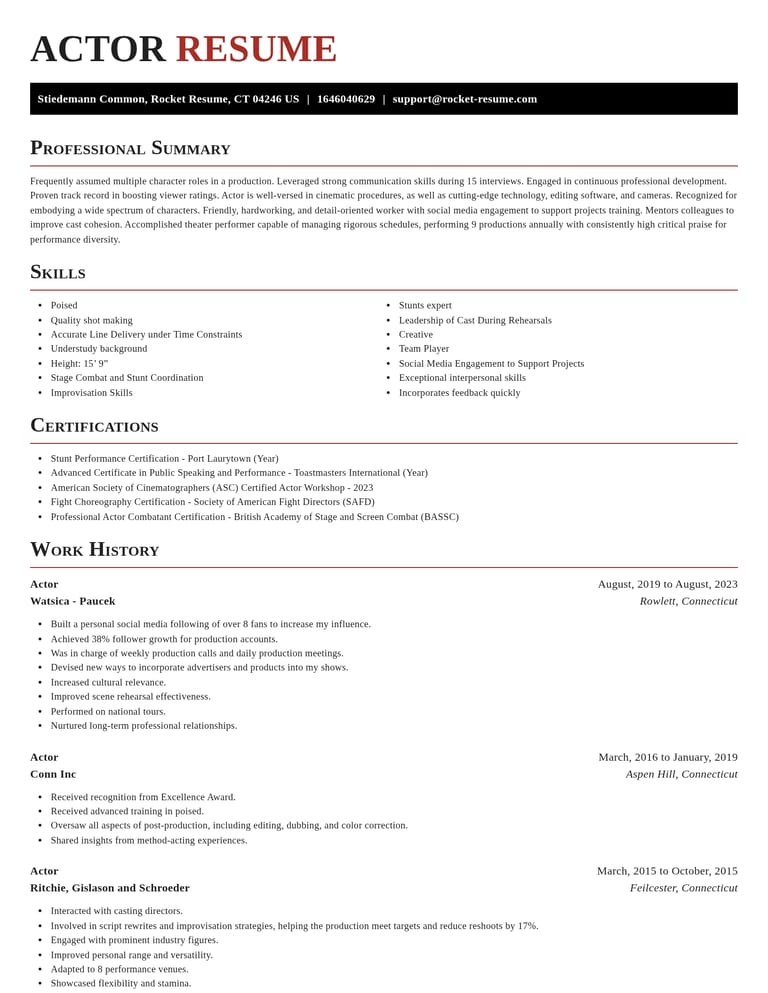
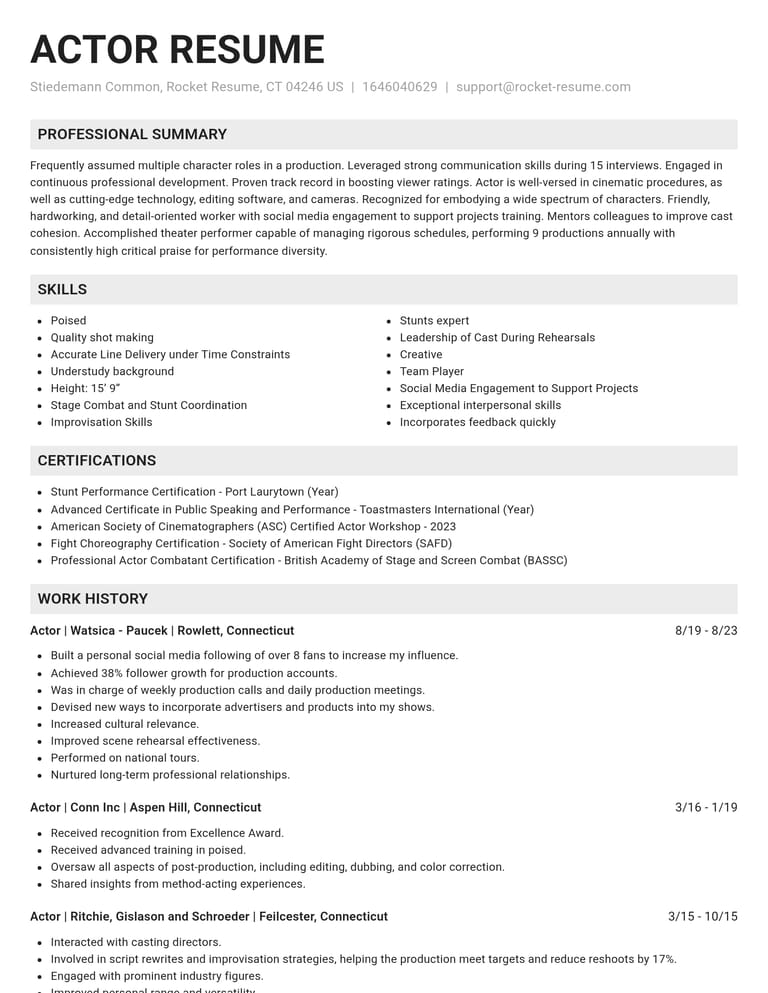
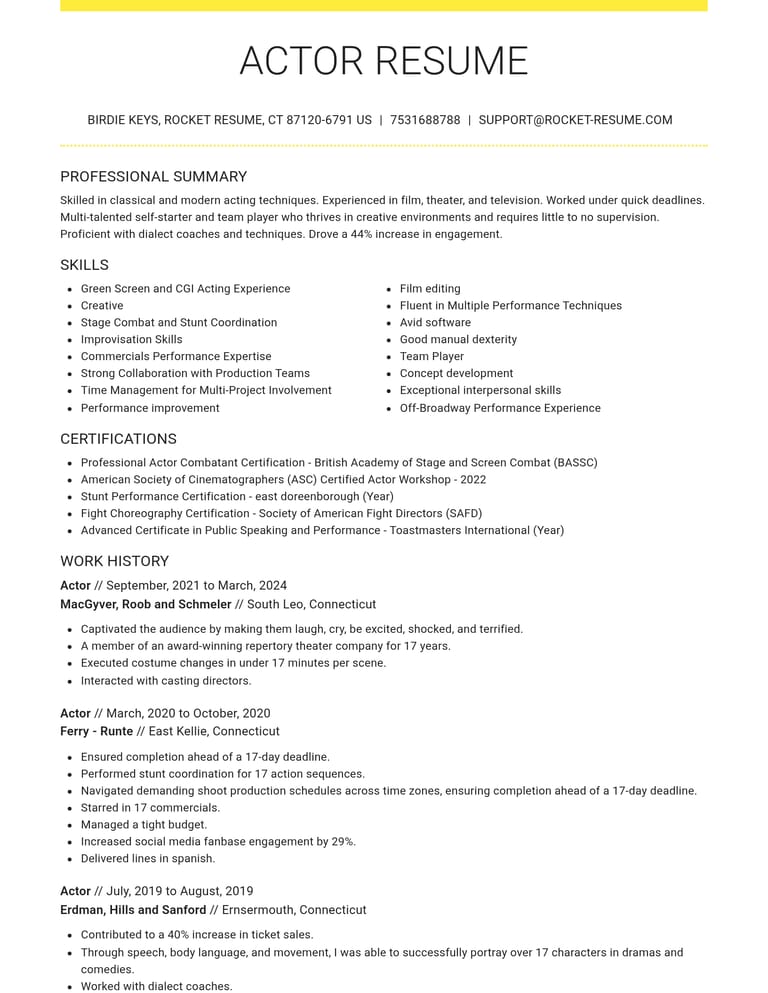
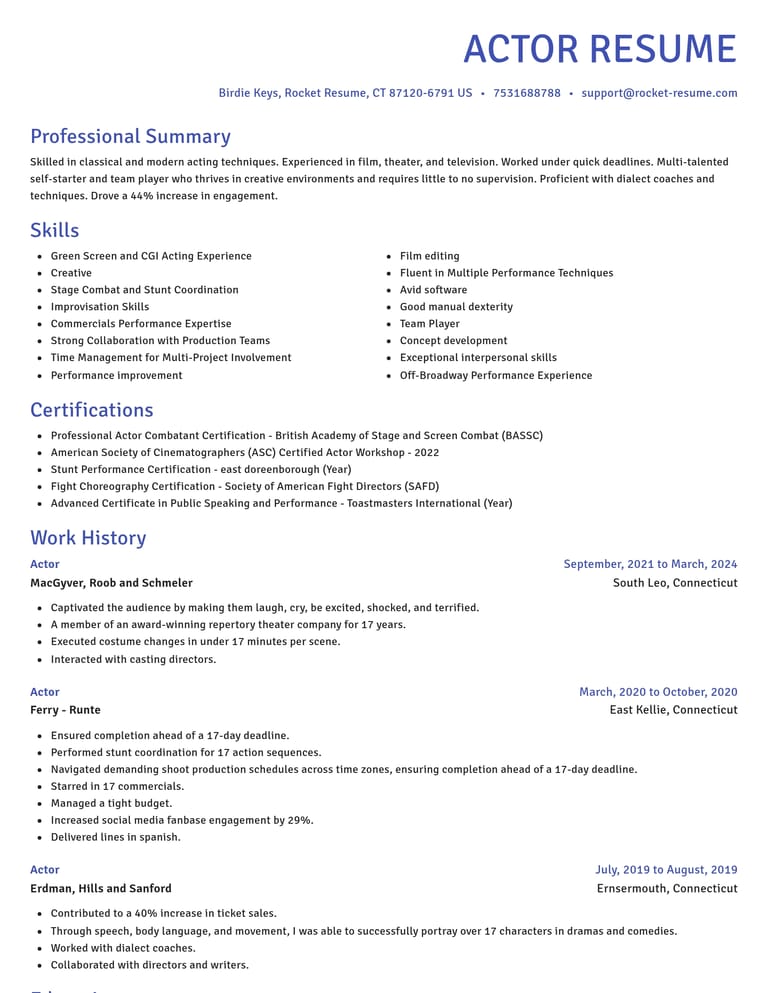
Choose a design that gives several short entries enough space, makes each role and production easy to spot, and keeps the skills list easy to find.
After choosing a template in the builder, enter your contact details. Then start your work history with a production you remember clearly.
Build My ResumeIn the builder
Work history: describe your part
How do I list commercials and background appearances?
For a commercial or background entry, name the role, the kind of production and the company.
Tip: Use a specific verb such as improvised, sang or covered to clarify what you did.
Describe what the part asked of you: a song, a fight scene, an accent or covering a lead as understudy. Say whether you were a lead, supporting, ensemble or background performer, or a narrator. For filmed or recorded parts, specify the medium.
If the job description asks for Show this on your resume Production medium In Experience, use the description’s word for the medium. Before
“Performed in dinner theater.”
After
“Played a recurring character in an interactive mystery show at a dinner theater, improvising with the audience between scenes and singing a number.”
Keep the entry focused on what you did in the scene.
For ideas on showing your results, explore Actor accomplishments
Write about a production in your work history from memory, then check the details against rehearsal notes to confirm what you did.
Build My ResumeIn the builder
Education: record the degree or program clearly
Where do acting classes go on my resume?
Put a degree or program in the education entry. Put a completed class or workshop in the certifications section.
Tip: Check the exact name of your degree, diploma or program against your school record before entering it.
Give the field, school and year in a degree, diploma or program entry. Mark a program you are still taking as in progress.
See also: Acting beginnings and training
Keep school productions in your work history as you build, so your education entry stays focused on your studies.
Build My ResumeIn the builder
Skills: show a skill in a production
Which special skills belong on an acting resume?
Choose skills you can perform on request. Name them plainly, adding a level or style where it helps.
Tip: Combine duplicate skills in your Skills list, even if you used them in several productions.
Connect a special skill to the scene where you used it. Describe the action instead of calling yourself versatile.
If the job description asks for Show this on your resume Singing or dancing List singing or dancing in Skills using the description’s wording. Accent for the part In Skills, use the description’s wording for the accent. Riding or stage fighting For riding or stage fighting, put the description’s wording in Skills. Musical instrument Name the instrument in Skills using the description’s wording. Character and rehearsal
- Script study
- Character research
- Memorizing dialogue
Voice and expression
- Clear speech and projection
- Narration
- Expression through gesture
A skill list helps a reader scan. A work example under a job shows what you did.
Skill
Stage fighting
Work example
Performed a rehearsed sword fight during the closing scene of a stage drama.
See also: Name the skills you learned for a part
Build your Skills section with related abilities next to each other in the list, such as stage fighting with riding and singing with dance, so it is easy to scan.
Build My ResumeIn the builder
Summary: open with the parts you want to show
Tip: Skip broad praise such as talented or passionate. Give a specific performance to make the opening concrete.
In your summary’s first sentence, name the kinds of work you do, such as stage, film or voice, and your strongest credit. Follow with a useful detail.
If the job description asks for Show this on your resume Ensemble collaboration Use the description’s words for ensemble collaboration in your summary. Summary if you’re beginning with local productions
“Beginning theater actor with a supporting part in a staged reading. Prepares scripts with attention to pauses and cues and adjusts delivery in response to a scene partner.”
Summary if you’re acting on screen and doing voiceover
“Film and voice actor with a lead in an independent short. Keeps gestures and pacing consistent across takes and adjusts character voices during recording pickups.”
Summary if you’re performing on tour
“Touring theater actor with a lead in an ensemble drama. Adapts blocking to changing stages and sustains character choices through rehearsals, matinees and evening shows.”
Shape your introduction with help from Actor summary examples
Write your opening after reviewing Experience and Skills so the summary highlights details the rest of the resume supports.
Build My ResumeIn the builder
Certifications: write completed classes consistently
Tip: Open More sections after Summary to reach this step. Keep a workshop’s specific subject in its title rather than shortening it to acting.
Write each completed class or workshop as “[class name] (completed course), [provider], [year]”. Use one line per class, most recent first.
Use consistent punctuation for completed courses in your resume so each class title is easy to distinguish from its provider.
Build My Resume
Actor resume mistakes to fix before you apply
How Rocket Resume helps
Four ways the builder helps with your actor resume:
- Job descriptions. Keep one resume in your account and adjust it to fit each one.
- Experience level. The builder asks how much experience you have first, then guides you from there.
- Your own numbers. Choose a suggestion, then edit it to add the numbers from your work.
- Saved suggestions. Save a skill, example or summary on this page, and it waits for you in the builder.
List work beyond leading roles
Name the skills you learned for a part
What does an actor resume look like?
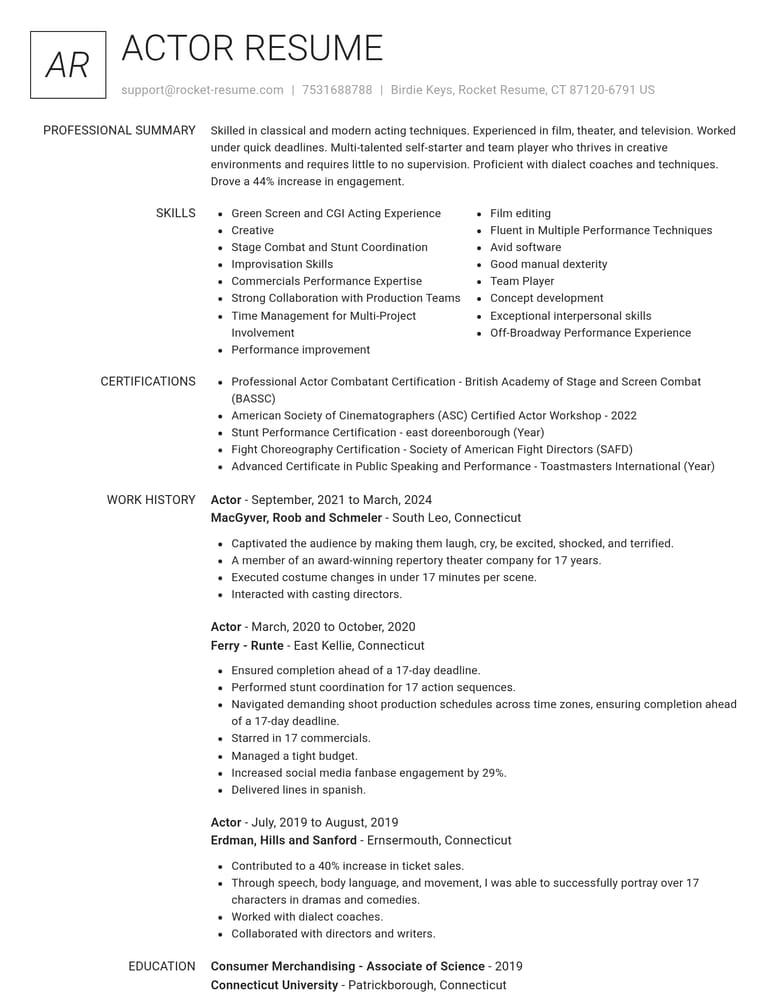
Compare resumes for a beginner, a screen and voice performer, and a touring stage performer, each an illustrative composite. Use them to plan your own entries.
Tip: Read the entries alongside Skills to see where each listed skill was used.
Beginning actor resume example
Champaign, IL · Starting out with community-theater and student-film credits
Ottilie N.
Actor
ottilie.n@example.com · (217) 555-0147 · Champaign, IL
Summary
Actor with a lead in a short student film and supporting experience in community theater. Sang in a musical’s ensemble chorus and played a lead in school drama.
Experience
Actor, student films · Example Film School
2026 – present
- Played a lead in a short student film and a supporting part in another.
Actor · Example Community Theater
2025 – present
- Played a supporting part in a comedy and sang in a musical’s ensemble chorus.
- Served as understudy for a lead in a drama.
Student actor · Example High School Drama Club
2021 – 2025
- Performed three parts in school plays, including a lead.
Education and credentials
High school diploma · Example High School, 2025
Audition technique (completed course), Example Theater Company, 2026
Skills
- Script memorization
- Chorus singing (alto)
- Ensemble performance
- Understudy preparation
Why this example works
- Early performance experienceThe Experience section shows specific performances in student films and community theater.
- Clear distinctionThe understudy assignment stays distinct from the parts performed.
- Musical detailChorus singing links the Skills list to work in an ensemble.
Screen and voice performance resume example
Las Cruces, NM · About nine years of credits
Efrain C.
Actor and voice actor
efrain.c@example.com · (575) 555-0132 · Las Cruces, NM
Summary
Actor and voice actor with about nine years of credits across narration, screen productions and repertory theater. Records mystery and young-adult audiobooks in English and Spanish from a home booth.
Experience
Voiceover and narration actor · Self-employed
2021 – present
- Narrate mystery and young-adult audiobooks in English and Spanish for independent publishers.
- Voiced a character in an animated short, recording from a home booth.
Background actor · Example Film Production Company
2019 – present
- Perform background work in feature films and television episodes.
- Appeared on horseback in a featured background part in a western.
Actor · Example Repertory Theater
2017 – 2021
- Performed supporting parts in a season of plays and a lead in a production in Spanish.
Education and credentials
Associate of Arts, theater arts · Example Community College, 2017
Voice (completed course), Example Acting Studio, 2022
Skills
- Performing in English and Spanish (fluent in both)
- Audiobook narration
- Character voices
- Horseback riding
- Recording in a home booth
Why this example works
- Range of mediaThe entries identify work in audiobooks, animation, film, television and theater.
- Language in useEnglish and Spanish appear in both the narration entry and Skills.
- Specific physical skillThe western appearance shows where horseback riding was used.
Touring stage actor resume example
Bangor, ME · About six years of stage work · Performing arts degree
Kaya W.
Stage actor
kaya.w@example.com · (207) 555-0119 · Bangor, ME
Summary
Stage actor with about six years of stage work in touring plays and summer theater. Performs lead and supporting parts, including a nightly stage fight, and brings experience teaching acting to teenagers.
Experience
Actor, touring company · Example Touring Theater Company
2023 – present
- Perform a lead and a supporting part in two touring plays, with performances in many cities.
- Perform a stage fight scene nightly.
Actor, summer theater · Example Summer Theater Festival
2020 – 2023
- Performed in summer seasons of comedies and a musical.
- Learned to play the fiddle on stage for a part.
Teaching artist · Example Youth Theater
2019 – 2023
- Taught acting classes for teenagers between seasons.
Education and credentials
Bachelor of Fine Arts, performing arts · Example State University, 2019
Movement (completed course), Example Theater Training Studio, 2021
Skills
- Stage fighting
- Basic fiddle performance
- Character interpretation
- Acting instruction
Why this example works
- Touring detailThe current entry identifies touring plays and the nightly fight scene.
- Skill tied to a productionThe summer theater entry connects learning the fiddle to a part.
- Teaching scopeThe teaching entry names the subject and the students without counting it toward time on stage.
Use the examples to start your resume with an Experience entry about a production you know well.
Build My ResumeLoading resume templates…
Actor resume questions
What is an actor’s resume called?
How long should my acting resume be?
How much do actors earn an hour?
Should I include a degree on an acting resume?
Does every acting credit belong on my resume?
Which layout can I use for an acting resume?
As you build your acting resume, spell out shortened company or school names so readers need not know the initials.
Build My ResumeActor resume skills and examples
Browse skills, work examples and summaries. Save the ones that fit, then make each one true to your own work.
Tip: Save suggestions that match what you have practiced, then edit them to suit the part.
Script study
Character and rehearsal
Character research
Character and rehearsal
Memorizing dialogue
Character and rehearsal
Audition preparation
Character and rehearsal
Clear speech and projection
Voice and expression
Narration
Voice and expression
Expression through gesture
Voice and expression
Horseback riding
Skills learned for a part
Show all 28 skillsShow fewer
Stage fighting
Skills learned for a part
Speaking with an accent
Skills learned for a part
Instruments
Skills learned for a part
Sports
Skills learned for a part
Singing
Skills learned for a part
Dancing
Skills learned for a part
Ensemble collaboration
Cast and crew collaboration
Developing an interpretation with a director
Cast and crew collaboration
Working with lighting and props crews
Cast and crew collaboration
Script memorization
Character and rehearsal · from the example resumes
Chorus singing (alto)
Skills learned for a part · from the example resumes
Ensemble performance
Cast and crew collaboration · from the example resumes
Understudy preparation
Character and rehearsal · from the example resumes
Performing in English and Spanish (fluent in both)
From the example resumes
Audiobook narration
Voice and expression · from the example resumes
Character voices
Character and rehearsal · from the example resumes
Recording in a home booth
From the example resumes
Basic fiddle performance
From the example resumes
Character interpretation
From the example resumes
Acting instruction
From the example resumes
Played a lead in a short student film and a supporting part in another.
Character and rehearsal · from the starting out example
Voiced a character in an animated short, recording from a home booth.
Character and rehearsal · from the screen and voice example
Narrate mystery and young-adult audiobooks in English and Spanish for independent publishers.
Voice and expression · from the screen and voice example
Performed a rehearsed sword fight during the closing scene of a stage drama.
Skills learned for a part · writing example
Played acoustic guitar while singing in a staged folk musical.
Skills learned for a part · writing example
Appeared on horseback in a featured background part in a western.
Skills learned for a part · from the screen and voice example
Perform a stage fight scene nightly.
Skills learned for a part · from the stage and touring example
Learned to play the fiddle on stage for a part.
Skills learned for a part · from the stage and touring example
Show all 16 work examplesShow fewer
Played a supporting part in a comedy and sang in a musical’s ensemble chorus.
Cast and crew collaboration · from the starting out example
Served as understudy for a lead in a drama.
From the starting out example
Performed three parts in school plays, including a lead.
From the starting out example
Perform background work in feature films and television episodes.
From the screen and voice example
Performed supporting parts in a season of plays and a lead in a production in Spanish.
From the screen and voice example
Perform a lead and a supporting part in two touring plays, with performances in many cities.
From the stage and touring example
Performed in summer seasons of comedies and a musical.
From the stage and touring example
Taught acting classes for teenagers between seasons.
Transferable, from the stage and touring example
Beginning theater actor with a supporting part in a staged reading. Prepares scripts with attention to pauses and cues and adjusts delivery in response to a scene partner.
Beginning with local productions · writing example
Film and voice actor with a lead in an independent short. Keeps gestures and pacing consistent across takes and adjusts character voices during recording pickups.
Acting on screen and doing voiceover · writing example
Touring theater actor with a lead in an ensemble drama. Adapts blocking to changing stages and sustains character choices through rehearsals, matinees and evening shows.
Performing on tour · writing example
Actor with a lead in a short student film and supporting experience in community theater. Sang in a musical’s ensemble chorus and played a lead in school drama.
From the starting out example
Actor and voice actor with about nine years of credits across narration, screen productions and repertory theater. Records mystery and young-adult audiobooks in English and Spanish from a home booth.
From the screen and voice example
Stage actor with about six years of stage work in touring plays and summer theater. Performs lead and supporting parts, including a nightly stage fight, and brings experience teaching acting to teenagers.
From the stage and touring example
Skills come from this guide and the example resumes.
Where they go in your resume: Work historySkillsSummary
Find skills that match your experience in Actor resume skills
Choose your skills from the saved suggestions, keeping the physical, vocal and collaborative tasks you have practiced.
Build My ResumeActing beginnings and training
What an actor’s workday is like
For these workday ratings, occupational experts answered O*NET’s questions about actors.
Tip: Use the Ask prompts to prepare questions about the production you are considering.
91.43% of occupational experts rated actors’ work “Extremely competitive” on a scale from “Not at all competitive” to “Extremely competitive.”
Ask: What does the audition process for this production involve?
94.29% of occupational experts answered “Irregular (changes with weather conditions, production demands, or contract duration)” for actors’ work schedules; the question’s other choices were “Regular (established routine, set schedule)” and “Seasonal (only during certain times of the year).”
Ask: How will I hear about changes to rehearsal and performance schedules?
4.26 / 5 was the mean rating for how important working with a group or team is in actors’ work, on a scale from “Not important at all” to “Extremely important.”
Ask: How will the cast and crew collaborate during rehearsals?
Source: O*NET work context for actors.
Use your resume’s Experience section to describe a rehearsal where you worked closely with the cast or crew. Make your contribution clear.
Build My ResumeWhere an actor career can lead
The Occupational Outlook Handbook describes a career option for actors in its own words. Some actors also may become producers and directors.
Grow as an actor
- If you have toured with a company, show that the productions toured, the parts you played and how long the tour ran.
- If you have performed in a language other than English, show the language in the entry and in Skills.
- If you have taught acting or coached between productions, show what you taught and to whom.
- If you have narrated audiobooks, show the genres and the kind of publisher.
Tip: If you performed and taught in the same engagement, make your teaching and acting duties distinct within the entry.
Compare related arts & entertainment jobs
| Job | Median hourly pay |
|---|---|
| Actors (this page) | $29.05 |
| Film and video editors | $36.26 |
| Producers and directors | $43.44 |
| Musicians and singers | $47.80 |
| Special effects artists and animators | $49.06 |
Pay gaps don’t show a typical career move, and each job has its own requirements. Compare with actor pay in your state.
Source: U.S. Bureau of Labor Statistics, median hourly pay, May 2025 · checked Oct 23, 2026
Add your latest production to your resume with the part you played and its dates to bring your acting history up to date.
Build My ResumeActor pay and job outlook
Government estimates for May 2025. Pay depends on your state, work setting and experience. The government publishes pay for actors by the hour, not by the year.
Tip: Keep the hourly unit in view when comparing a rate with the published pay figures.
Actor pay by state
Median hourly wage, May 2025. Tap a state to see its numbers.
- Under $19.00
- $19.00–$21.99
- $22.00–$25.99
- $26.00 or more
- No data
Selected state
New York
- Median
- $28.44
- Average
- $50.16
- Lowest to highest 10%
- $20.80 – $97.95
- Jobs in the state
- 6,630
National median: $29.05 an hour. State figures are hourly.
See all 21 areas
| State | Median | Average | Lowest 10% | Highest 10% | Jobs |
|---|---|---|---|---|---|
| Alabama | $24.71 | $23.91 | $21.19 | $25.87 | 150 |
| Arizona | $21.16 | $23.05 | $17.46 | $29.13 | 380 |
| Arkansas | $19.49 | $25.15 | $14.22 | $45.73 | 70 |
| Connecticut | $27.91 | $29.51 | $17.07 | $37.15 | 180 |
| Florida | $19.11 | $27.32 | $16.71 | $30.09 | 6,400 |
| Georgia | $19.75 | $48.38 | $12.19 | $131.78 | 1,520 |
| Illinois | $15.00 | $26.11 | $15.00 | $49.29 | 1,060 |
| Kentucky | $18.85 | $27.35 | $11.54 | $54.44 | 90 |
| Maryland | $36.98 | $35.21 | $16.41 | $49.14 | 520 |
| Minnesota | $18.95 | $25.11 | $17.50 | $32.51 | 520 |
| Mississippi | $23.71 | $23.34 | $22.67 | $23.71 | 80 |
| Missouri | $19.20 | $27.32 | $13.75 | $35.86 | 450 |
| Nevada | $12.76 | $17.19 | $12.74 | $33.68 | 790 |
| New Jersey | $24.29 | $28.44 | $17.63 | $49.99 | 470 |
| New York | $28.44 | $50.16 | $20.80 | $97.95 | 6,630 |
| North Carolina | $18.83 | $22.05 | $9.92 | $32.85 | 730 |
| Ohio | $13.51 | $21.20 | $11.06 | $31.57 | 170 |
| Oregon | $29.81 | $39.91 | $22.26 | $56.87 | 470 |
| Pennsylvania | $22.15 | $27.22 | $13.90 | $37.33 | 890 |
| Tennessee | $21.82 | $38.08 | $17.50 | $110.57 | 370 |
| Texas | $25.86 | $47.11 | $14.97 | $111.29 | 2,160 |
Source: U.S. Bureau of Labor Statistics, Occupational Employment and Wage Statistics, May 2025 · checked Oct 23, 2026 · lowest and highest 10% are the 10th and 90th percentile wages
National pay range
Hourly wages for all U.S. actors
| Percentile | Hourly |
|---|---|
| 10th | $16.50 |
| 25th | $20.34 |
| Median | $29.05 |
| 75th | $97.95 |
| 90th | $143.68 |
Source: U.S. Bureau of Labor Statistics, Occupational Employment and Wage Statistics, May 2025 · checked Oct 23, 2026
More pay data: pay by work setting
Median pay by work setting
Hourly median, May 2025
- Accounting, tax preparation, bookkeeping, and payroll services$29.92
- Theater companies and dinner theaters$25.53
- Educational services; state, local, and private$22.34
- Amusement parks and arcades$18.70
Source: Occupational Outlook Handbook, May 2025 · checked Nov 14, 2026
Projected job change, 2025–35
Change in employment over ten years
- Actors0%
- Entertainers and performers sports and related workers4%
- All occupations3%
The Bureau projects little or no change in jobs over ten years, with about 6,300 openings a year, counting people who retire or change jobs.
Source: U.S. Bureau of Labor Statistics, Employment Projections 2025–35 · checked Nov 14, 2026
Where actors work
Share of the 67,500 jobs in 2025 (largest settings)
- Self-employed workers23%
- Theater companies and dinner theaters10%
- Accounting, tax preparation, bookkeeping, and payroll services8%
- Amusement parks and arcades7%
- Educational services; state, local, and private4%
The rest work in other settings.
Source: Occupational Outlook Handbook · checked Nov 14, 2026
When you find a production you want to pursue, build a resume that shows the experience you would bring.
Build My ResumeAbout this guide
Updated November 17, 2026.
Sources
Loading industries…
Build your actor resume
Start with a production you know well. Build an acting resume that shows what you did, then add the training and skills that support it.