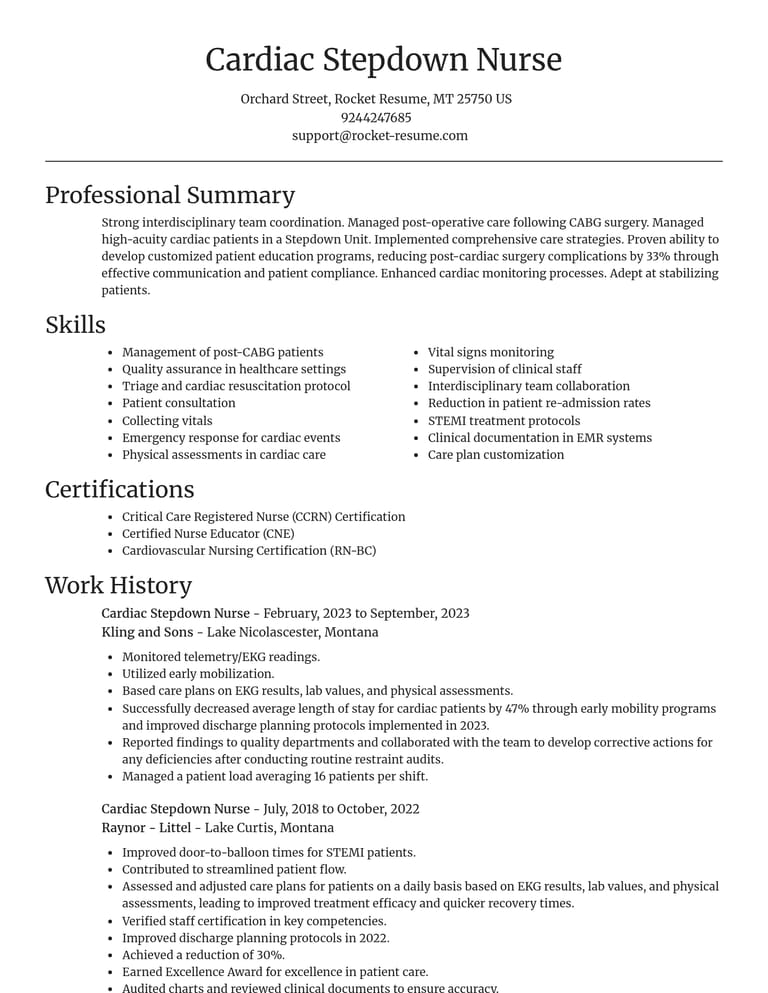
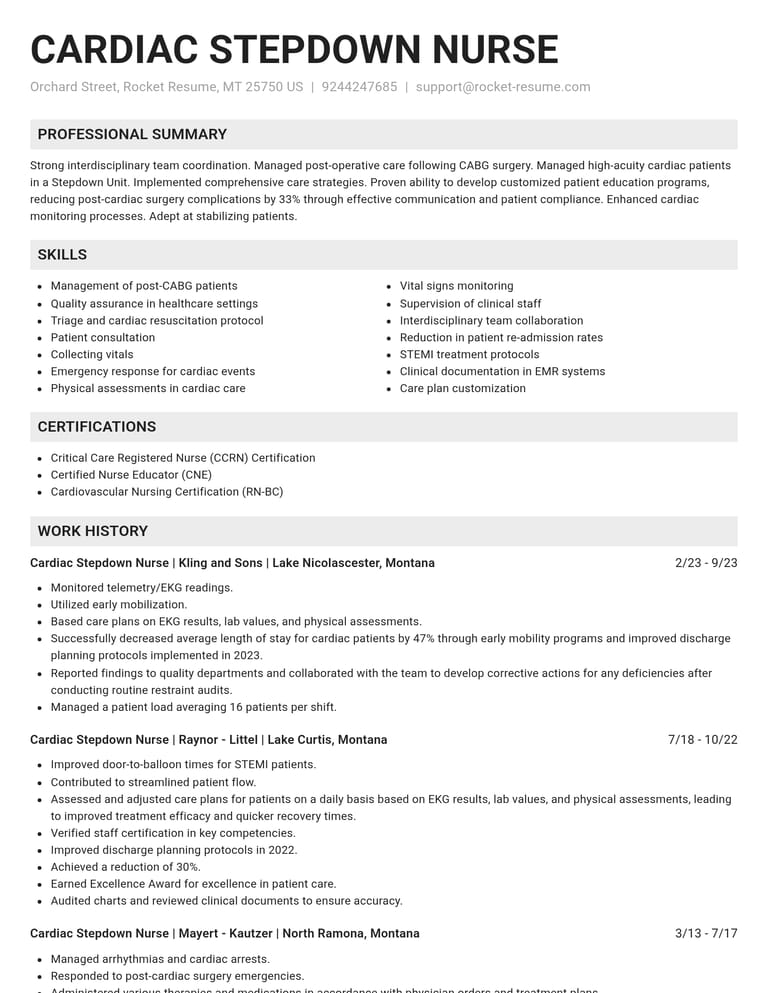
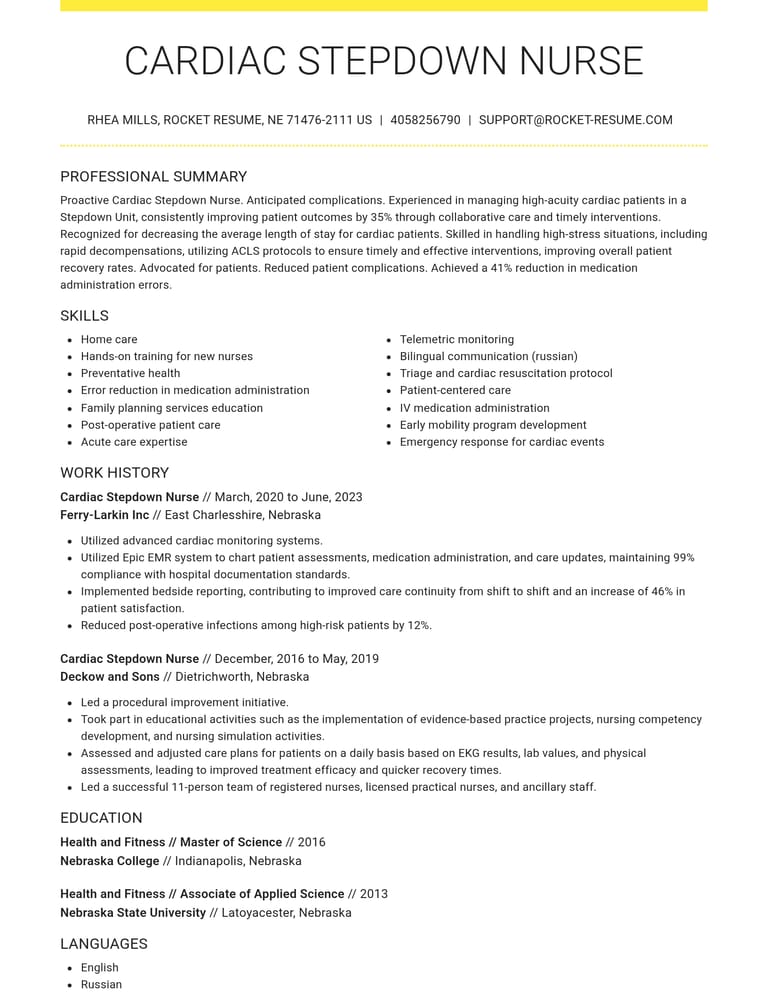
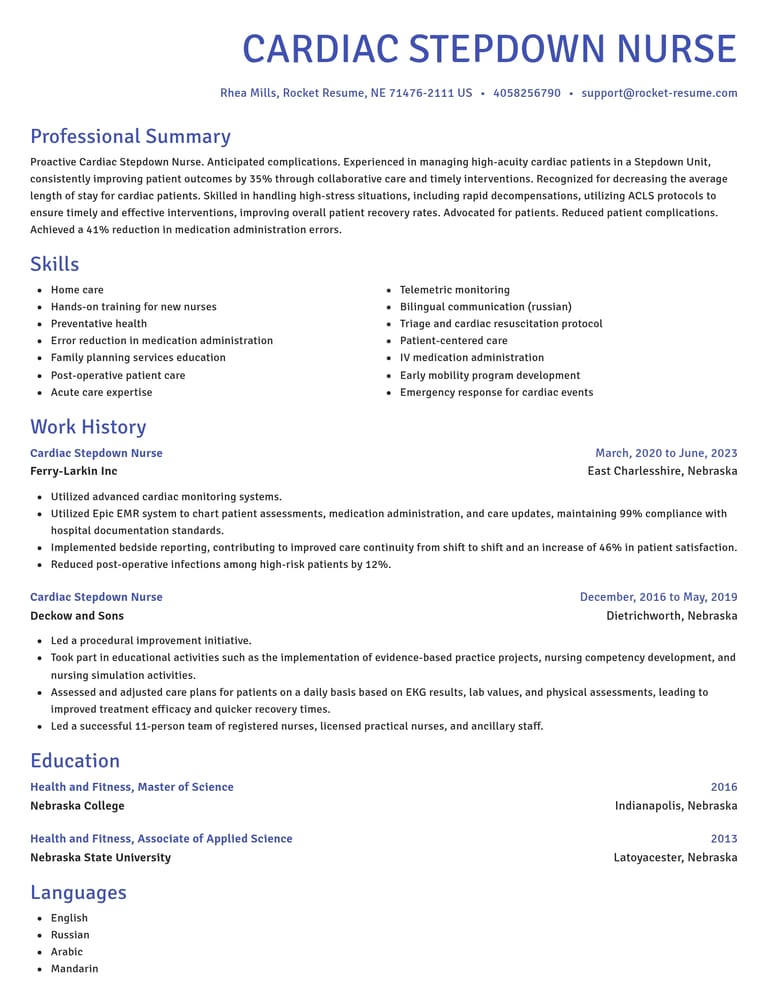
Cardiac stepdown nurse resume examples, templates and tips
Show the monitoring, recovery care and discharge teaching you bring to a cardiac unit. Compare first-job, clinic-transfer and preceptor examples, then start your resume.
- Show cardiac monitoring work
- Explain a clinic-to-unit move
- Make discharge teaching concrete

What cardiac stepdown nurse hiring managers look for
- Assessment of patients with heart conditions
- Recording symptoms and vital signs
- Giving medicines and watching for reactions
- Care plan coordination
- Preparation for examinations and treatments
- Teaching families about care after discharge
How to write a cardiac stepdown nurse resume
Your unit name gives the reader context. Explain who you cared for and what you did, from monitoring rhythm changes to preparing patients for home. This guide starts with six questions to answer first, then walks through each part of your resume with tips and links to the examples, templates and data on this page.
Six questions to answer first
- What should a cardiac stepdown resume lead with?
Step 1 connects the unit name with the work you describe.
- Which experience should lead at each nursing level?
Step 3 matches each starting point to an example.
- Which duties show care on a cardiac stepdown unit?
Step 5 turns general duties into specific nursing descriptions.
- Which skills show cardiac stepdown nursing experience?
Step 7 pairs a clinical skill with its use at work.
- What belongs in a cardiac stepdown nurse summary?
Step 8 offers summaries for different nursing backgrounds.
- How should nursing credentials appear on the resume?
Step 9 shows the listing pattern for licenses and cards.
What a cardiac stepdown nurse does
A cardiac stepdown nurse is a registered nurse on a cardiac stepdown unit caring for heart patients. For a description of cardiovascular nurses, see the Occupational Outlook Handbook from the U.S. Bureau of Labor Statistics. Cardiovascular nurses care for patients who have heart disease or heart conditions and people who have had heart surgery.
A cardiac stepdown unit is a hospital unit for heart patients needing closer watching than a general floor provides but not intensive care, such as people leaving intensive care or recovering from a heart procedure.
The work includes assessing and recording conditions, giving medicines and watching for reactions, coordinating care plans, and teaching heart surgery patients and families what to do at home. The median annual wage for registered nurses was $97,550 in May 2025. Employment of registered nurses is projected to grow 6% from 2025 to 2035.
See also: What does a cardiac stepdown nurse do?
Tip: Describe how your discharge teaching helped heart patients and their families prepare to go home.
Write your cardiac stepdown nurse resume in nine steps
Do the first two before you open the builder. The other seven follow the builder’s order.
Step 1 of 9
Before you open the builder
Job description: name the unit and the patients
What should a cardiac stepdown resume lead with?
Keep each job entry’s title and unit as its employer named them. Use “progressive care unit” or “PCU” from the job description in your summary and skills when they fit your work with heart patients.
Tip: Check the title against the job description before shortening it. Keep a unit name that explains your experience.
Adapted from registered nurse duties in the Occupational Outlook Handbook and tasks in the O*NET database by the U.S. Department of Labor. Registered nurse sources
Match each requirement in the job description
Here’s the step where you’ll show each one:
- Unit name step 5
- Heart patients step 5
- Patient observation step 7
- Discharge teaching step 5
- Nursing education step 6
- Summary focus step 8
- License and cards step 9
Tip: Use the job description’s terms for work you can support with a specific example.
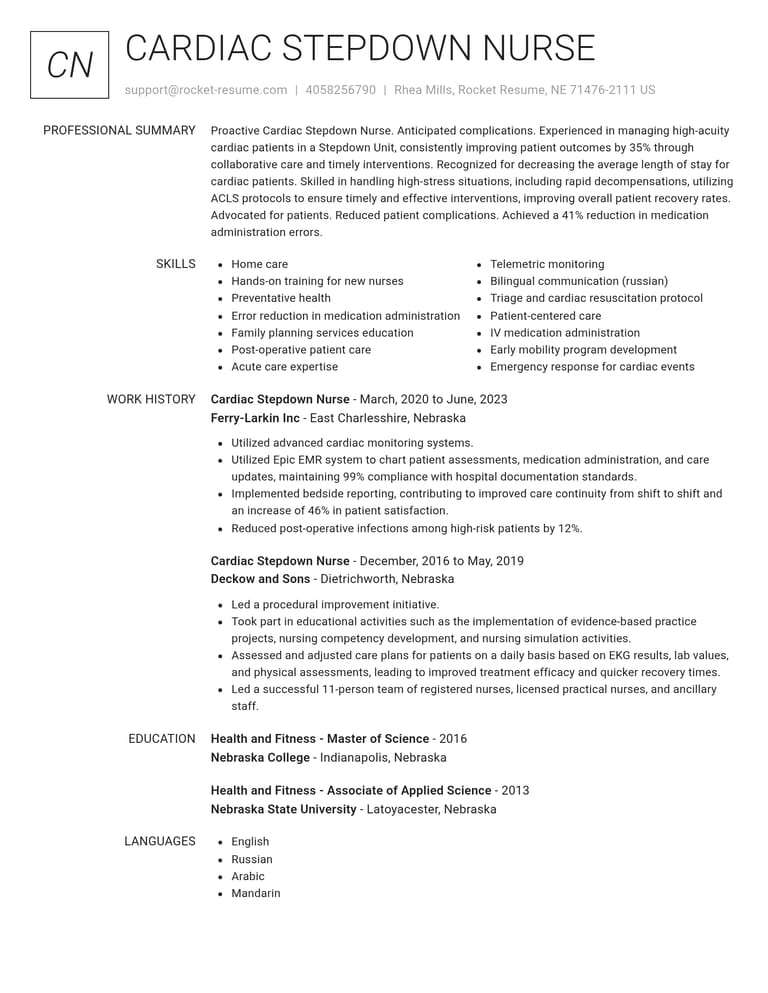
Start your resume with the unit's actual name, then describe your monitoring and patient-care responsibilities.
Build My Resume
Before you open the builder
Examples: see what each cardiac setting adds
Tip: Compare how the examples describe monitoring, procedure recovery and teaching in their own settings.
Look at Imani’s first job, Callum’s clinic-to-hospital experience and Xiomara’s precepting work. Keep the approach that helps you describe your own care of heart patients.
In the builder, turn a nursing duty into a specific work-history example using your own unit experience.
Build My ResumeIn the builder: experience level
How much experience do you have?
Which experience should lead at each nursing level?
Lead with your current cardiac stepdown work, a move from another setting, or your first nursing job. Keep earlier health care work visible when it helps explain your experience.
Tip: List dates for each employer so a move between settings is clear.
Start from Build My Resume and it’s the builder’s first question. The examples below show three starting points: A first cardiac stepdown job, A clinic-to-hospital move and An experienced nurse and preceptor.
Choose an order that fits
- New graduate:
- Summary, Experience with the first nursing job and health care work during nursing school, Education and credentials, Skills.
- Changing settings:
- Summary, Experience with the hospital unit before the cardiology clinic, Education and credentials, Skills.
- Experienced:
- Summary, Experience with surgical care and precepting before earlier nursing work, Education and credentials, Skills.
The builder starts with a standard order, and you can move sections into the one you choose.
Aim for one page when it gives you enough room. Use a second page if relevant cardiac care and teaching experience would otherwise be lost.
See also: Resume examples
Start your work history with your recent nursing role. Keep clinic, hospital and supervised training experience clearly distinguished.
Build My ResumeIn the builder
Template: leave space for the full unit name
Tip: Preview the role line and the longest job title before settling on the design.
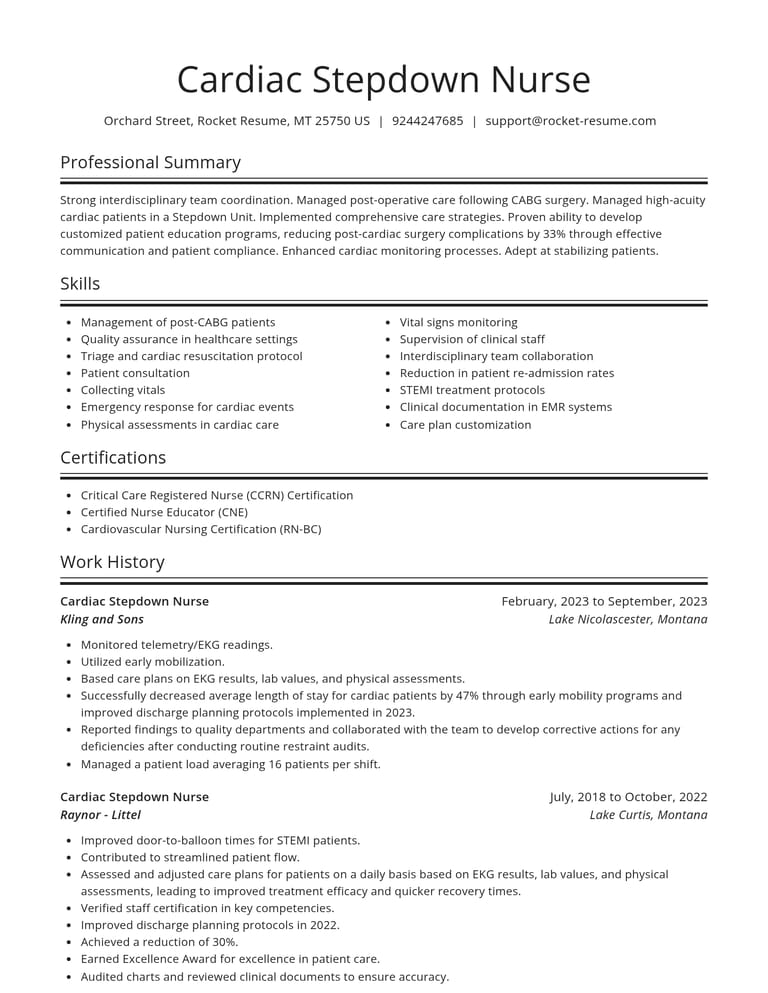
Use a layout that lets you separate the employer from the unit and dates. Keep the summary, experience, education and credentials, and skills easy to scan in that order.
Choose a template, add contact details, then enter your nursing work with the unit names and dates.
Build My ResumeIn the builder
Work history: describe care on a cardiac unit
Which duties show care on a cardiac stepdown unit?
In each cardiac unit entry, describe monitoring, medicines, care plans or teaching and the heart patients you cared for.
Tip: Use a separate entry for each employer, with the title, location and dates.
Use the employer's unit name and describe the patients you cared for there. For a discharge-teaching example, explain what you taught and how you involved the family.
If the job description asks for Show this on your resume Unit name Use the employer’s wording, including progressive care unit or PCU when that is its name. Heart patients Name the actual patient group in each role; highlight cardiac experience where it applies. Discharge teaching Explain discharge teaching you provided to patients and families. Before
“Provided patient care and education.”
After
“On the cardiac surgical stepdown unit, taught patients going home after heart surgery and their families how to manage care after treatment.”
Other duties can be just as specific: describe telemetry monitoring for heart patients, or the changes you reported while caring for people recovering from a heart procedure.
For ideas on showing your results, explore Cardiac stepdown nurse accomplishments
See also: Skills and examples
Add a discharge-teaching example to your work history, including what you explained and who you involved.
Build My ResumeIn the builder
Education: list nursing education after stepdown work
Tip: Keep an expected graduation year clearly marked if you are still studying.
The Occupational Outlook Handbook describes nursing education. Registered nurses usually take one of three education paths: a bachelor's degree in nursing (BSN), an associate's degree in nursing (ADN or ASN), or a diploma from an approved nursing program. All programs include supervised clinical experience. Generally, licensed graduates of any of the three program types qualify for entry-level staff nurse positions, but employers, particularly hospitals, may require a bachelor's degree. Nurses with an ADN, ASN or diploma can earn a bachelor's through an RN-to-BSN program.
If the job description asks for Show this on your resume Nursing education Give the nursing degree or diploma, school and year. List the degree or diploma with the school and year, separately from the nursing license.
Enter your nursing school, degree or diploma and graduation year in the builder. List your license separately.
Build My ResumeIn the builder
Skills: connect skills with patient care
Which skills show cardiac stepdown nursing experience?
Choose skills you can explain through care of heart patients, such as telemetry monitoring or discharge teaching. Give a work example for the strongest match.
Tip: Choose a skill you can explain through a patient-care responsibility.
If you list cardiac drip management, describe it in the relevant hospital entry. Show how you used observation, documentation and communication skills in patient care instead of relying on broad adjectives.
If the job description asks for Show this on your resume Patient observation Describe symptoms or changes you recorded and reported. Assessment and observation
- Patient assessment
- Telemetry monitoring
- Heart-rhythm recognition
Medicines and treatments
- Medication administration
- Monitoring medication reactions
- Cardiac drip management
A skill list helps a reader scan. A work example under a job shows what you did.
Skill
Telemetry monitoring
Work example
Monitored telemetry for heart patients on the cardiac stepdown unit and reported changes to the care team.
See also: Skills and examples
Build your skills section around monitoring, medication or teaching responsibilities your work history can demonstrate.
Build My ResumeIn the builder
Summary: identify the patients from the start
What belongs in a cardiac stepdown nurse summary?
Name the unit, the heart patients and the work you can contribute. A short summary can distinguish a first nursing job from experience with heart procedures or precepting.
Tip: Let the summary introduce the work history rather than list every skill again.
Write the summary after your work history. Name the unit and patient group, then choose a detail your job entries explain, such as monitoring, heart procedures or precepting.
If the job description asks for Show this on your resume Summary focus Combine the experience and skills most relevant to the job description in a short opening summary. Summary if you’re in a first nursing job
“Registered nurse in a first job on a cardiac stepdown unit, caring for heart patients moving out of intensive care. Experience with telemetry monitoring and reporting changes to the care team.”
Summary if you’re experienced in hospital care
“Registered nurse on a cardiac surgical stepdown unit, caring for people after heart surgery. Experience precepting new nurses and preparing patients and families for care at home.”
Shape your introduction with help from Cardiac stepdown nurse summary examples
See also: Resume examples
Write your summary around the unit, patient group and responsibility that match the next role.
Build My ResumeIn the builder
Certifications: separate the license from life-support cards
How should nursing credentials appear on the resume?
Include your RN license, plus any cards you hold for Basic Life Support (BLS) and for advanced cardiac life support (ACLS). Use certifications to record who issued each credential and when.
Tip: Copy the issuer from the license or card rather than guessing a provider name.
Add the certifications section through More sections after the summary. Put the RN license there with its state and year, then list Basic Life Support (BLS) and advanced cardiac life support (ACLS) with the course provider and year. List a specialty certification you have by its name, professional association and year.
Registered Nurse (RN), [state], [year]
How to list it · copy the wording on your certificate
Basic Life Support (BLS), [course provider], [year]
How to list it · copy the wording on your certificate
ACLS, [course provider], [year]
How to list it · copy the wording on your certificate
If the job description asks for Show this on your resume License and cards Record the credential name, issuer and year in certifications. Add your RN license and life-support credentials in the builder, checking each issuer and date against your records.
Build My Resume
Cardiac stepdown nurse resume mistakes to fix before you apply
How Rocket Resume helps
Four ways the builder helps with your cardiac stepdown nurse resume:
- Job descriptions. Keep one resume in your account and adjust it to fit each one.
- Experience level. The builder asks how much experience you have first, then guides you from there.
- Your own numbers. Choose a suggestion, then edit it to add the numbers from your work.
- Saved suggestions. Save a skill, example, summary or certification on this page, and it waits for you in the builder.
What does a cardiac stepdown nurse resume look like?
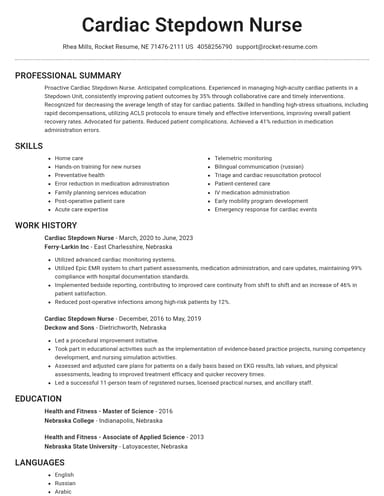
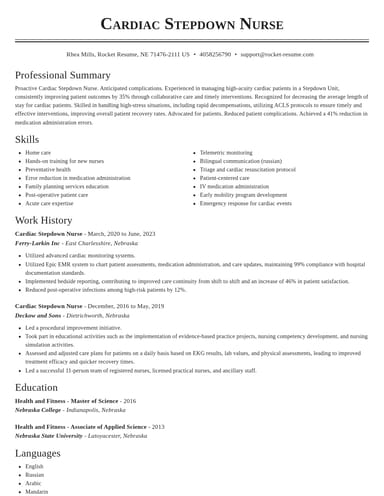
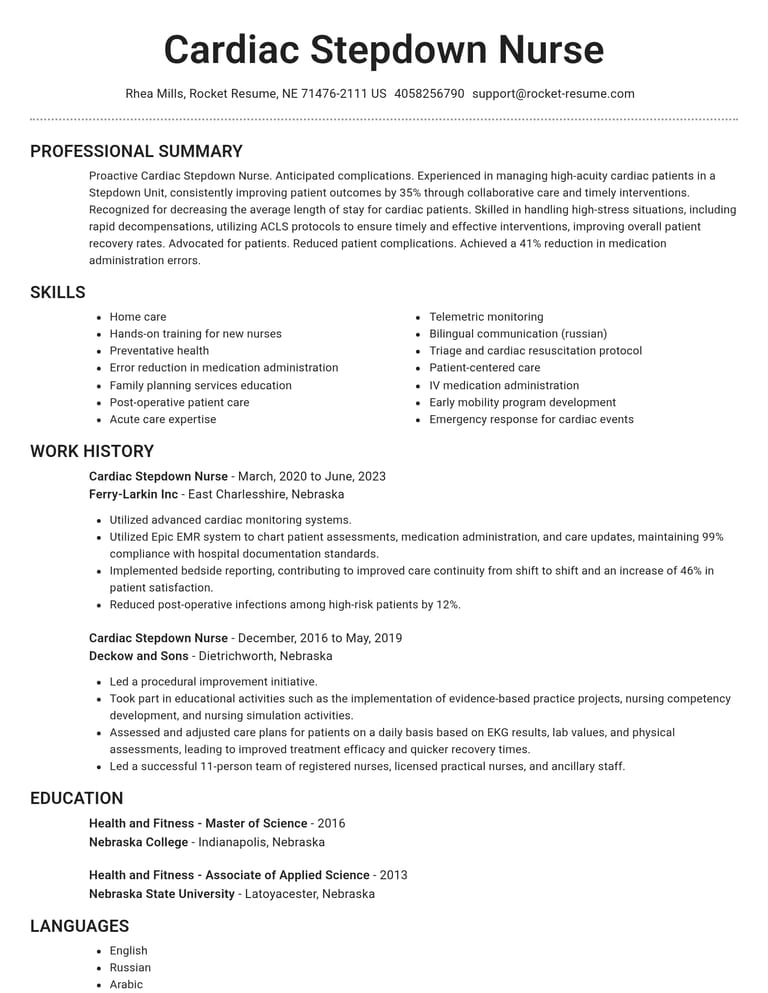
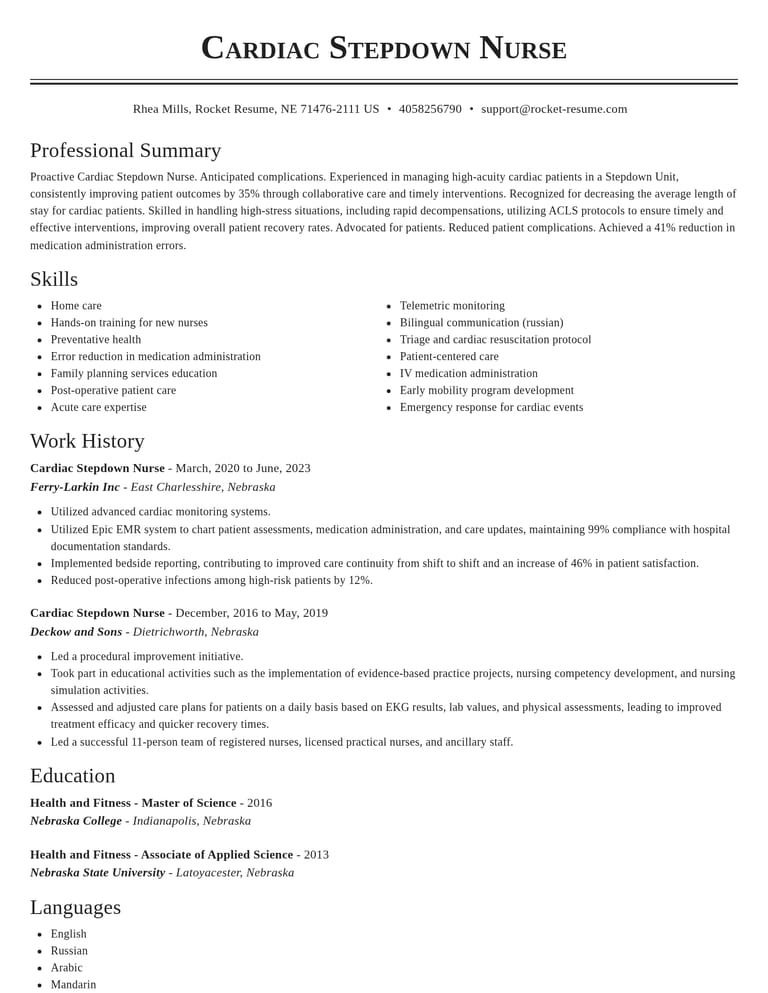
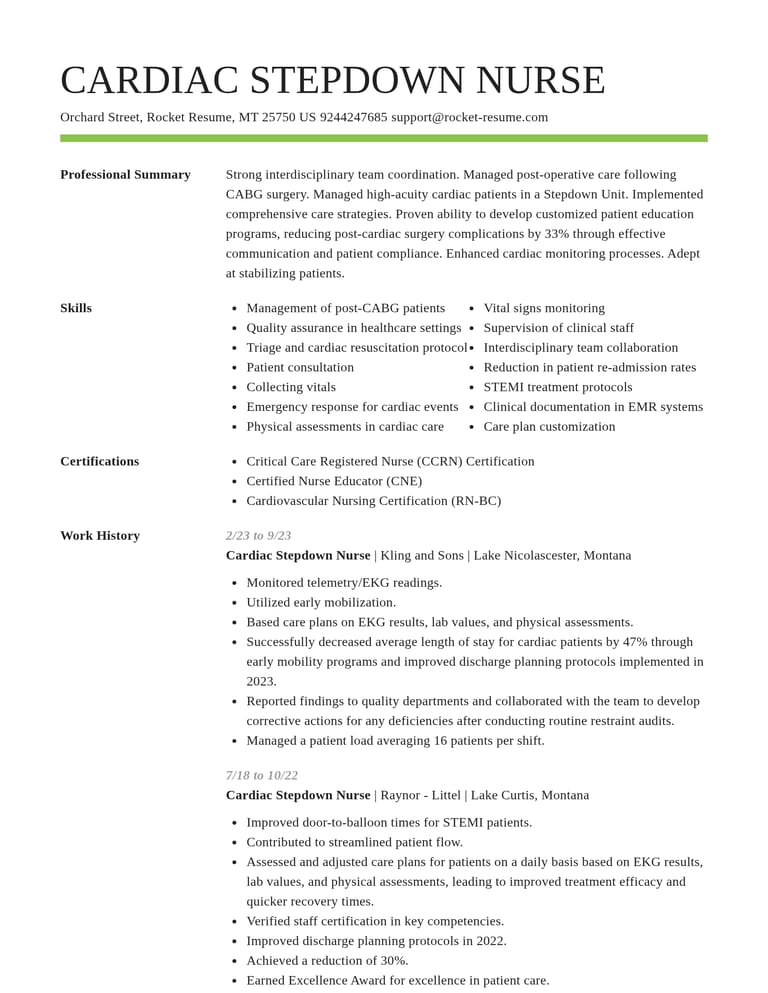
See how a first nursing job, a clinic-to-hospital move and precepting highlight different work with heart patients. Each illustrative composite connects the unit and its patients in work history.
Tip: Read each employer’s unit name alongside its patient group to understand the work described.
First-job cardiac stepdown nurse resume example
St. Louis, MO · About 1 year in a first nursing job
Imani W.
Cardiac stepdown nurse
imani.w@example.com · (314) 555-0146 · St. Louis, MO
Summary
Registered nurse with about one year on a cardiac stepdown unit caring for heart patients who have stepped down from intensive care. Experience with telemetry monitoring and reporting changes in patients’ conditions. Earlier patient care technician work while completing a nursing degree.
Experience
Registered nurse, cardiac stepdown unit · Example Teaching Hospital
Jun 2025 – Present
- Care for heart patients on the cardiac stepdown unit after they leave intensive care.
- Monitor telemetry and record observations in patient records.
- Report changes in patients’ conditions to the care team.
Patient care technician · Example Rehabilitation Hospital
Jun 2022 – May 2025
- Supported care for heart patients on the rehabilitation unit while in nursing school.
- Recorded patient observations and reported changes to nursing staff.
Education and credentials
Bachelor of Science in Nursing · Example State University, 2025
Registered Nurse (RN), Missouri, 2025 · BLS, American Heart Association, 2025 · ACLS, American Heart Association, 2026
Skills
- Telemetry monitoring
- Patient observation
- Vital signs documentation
- Care team communication
Why this example works
- First-job contextThe current entry connects the named unit with patients moving out of intensive care.
- Relevant earlier workThe technician position explains health care experience during nursing school.
- Specific observationsMonitoring telemetry and reporting changes make the first nursing job’s duties specific.
Outpatient cardiology clinic to cardiac stepdown nurse resume example
Portland, ME · About 9 years as an RN · 5 on the hospital unit
Callum R.
Cardiac nurse
callum.r@example.com · (207) 555-0172 · Portland, ME
Summary
Registered nurse with about nine years in nursing, including five on a cardiac progressive care unit (PCU). Care for patients after cardiac catheterization and other heart procedures, with experience managing cardiac drips and escalating heart-rhythm changes. Earlier outpatient cardiology work informs patient communication.
Experience
Registered nurse, cardiac progressive care unit (PCU) · Example Regional Medical Center
Jun 2021 – Present
- Care for patients recovering from cardiac catheterization and other heart procedures on the cardiac progressive care unit (PCU).
- Manage cardiac drips and monitor patients for medication reactions.
- Recognize heart-rhythm changes and escalate concerns to the care team.
Registered nurse, outpatient cardiology clinic · Example Medical Group
Jun 2017 – May 2021
- Assessed patients with heart disease or heart conditions in the outpatient cardiology clinic.
- Recorded medical histories and prepared patients for examinations.
Education and credentials
Diploma in Nursing · Example Hospital School of Nursing, 2017
Registered Nurse (RN), Maine, 2017 · BLS, American Heart Association, 2026 · ACLS, American Heart Association, 2026
Skills
- Cardiac drip management
- Heart-rhythm recognition
- Medication monitoring
- Patient assessment
Why this example works
- A clear moveThe work dates show the clinic years before hospital care.
- Procedure recoveryThe hospital entry identifies the patients and describes cardiac drips.
- Employer wordingThe title preserves the hospital’s progressive care unit name.
Experienced cardiac stepdown nurse resume example
Newark, NJ · About 12 years as an RN · 10 on the surgical unit
Xiomara G.
Cardiac stepdown nurse and preceptor
xiomara.g@example.com · (973) 555-0118 · Newark, NJ
Summary
Registered nurse with about twelve years in nursing and ten on a cardiac surgical stepdown unit caring for people after heart surgery. Precept new nurses and teach patients and families how to manage care at home after treatment.
Experience
Registered nurse and preceptor, cardiac surgical stepdown unit · Example General Hospital
Jun 2016 – Present
- Care for people after heart surgery on the cardiac surgical stepdown unit.
- Train new nurses in patient observation, documentation and care coordination.
- Teach patients going home after heart surgery and their families how to manage care after treatment.
Registered nurse, medical-surgical unit · Example Community Hospital
Jun 2014 – May 2016
- Cared for patients with heart conditions on the medical-surgical unit.
- Contributed patient observations to care plans and coordinated with the healthcare team.
Education and credentials
Bachelor of Science in Nursing · Example College of Nursing, 2014
Registered Nurse (RN), New Jersey, 2014 · BLS, American Heart Association, 2026 · ACLS, American Heart Association, 2026 · PCCN, American Association of Critical-Care Nurses, 2023
Skills
- Precepting new nurses
- Discharge teaching
- Care plan coordination
- Patient documentation
Why this example works
- Teaching at workPrecepting appears as a responsibility in the surgical unit entry.
- Preparing for homeThe teaching example names the patients going home after heart surgery and the families involved.
- Sustained experienceThe dates on the current unit support the years of experience stated in the summary.
Choose the example that fits your nursing background, then build with your own unit names and dates.
Build My ResumeLoading resume templates…
Cardiac stepdown nurse resume questions
What salary can a cardiac stepdown nurse expect?
What is a cardiac stepdown unit?
What does a cardiac stepdown nurse do?
How long should a cardiac stepdown nurse resume be?
What do you need to become a cardiac stepdown nurse?
Does a cardiac stepdown nurse need certification?
What goes on a new graduate’s cardiac stepdown nurse resume?
Is nursing a growing field?
Ready to write? Open the builder and return to these questions as you work.
Build My ResumeCardiac stepdown nurse resume skills and examples
Browse skills, work examples, summaries and certifications. Save the ones that fit, then make each one true to your own work.
Tip: Save suggestions for work you can discuss, then adapt them to your cardiac setting.
Patient assessment
Assessment and observation
Telemetry monitoring
Assessment and observation
Heart-rhythm recognition
Assessment and observation
Reporting changes in condition
Assessment and observation
Medication administration
Medicines and treatments
Monitoring medication reactions
Medicines and treatments
Cardiac drip management
Medicines and treatments
Preparation for examinations
Medicines and treatments
Show all 19 skillsShow fewer
Care plan coordination
Care plans and teamwork
Care team communication
Care plans and teamwork
Adaptability
Care plans and teamwork
Attention to detail
Care plans and teamwork
Discharge teaching
Teaching and records
Patient and family education
Teaching and records
Patient documentation
Teaching and records
Health education
Teaching and records
Patient observation
From the example resumes
Vital signs documentation
Teaching and records · from the example resumes
Precepting new nurses
From the example resumes
Monitored telemetry for heart patients on the cardiac stepdown unit and reported changes to the care team.
Assessment and observation · writing example
Monitor telemetry and record observations in patient records.
Assessment and observation · from the first nursing job example
Report changes in patients’ conditions to the care team.
Assessment and observation · from the first nursing job example
Recorded patient observations and reported changes to nursing staff.
Assessment and observation · transferable, from the first nursing job example
Assessed patients with heart disease or heart conditions in the outpatient cardiology clinic.
Assessment and observation · from the changing settings example
Manage cardiac drips and monitor patients for medication reactions.
Medicines and treatments · from the changing settings example
Recorded medical histories and prepared patients for examinations.
Medicines and treatments · from the changing settings example
Contributed patient observations to care plans and coordinated with the healthcare team.
Care plans and teamwork · from the experienced example
Show all 17 work examplesShow fewer
Explained care at home to patients leaving the cardiac surgical stepdown unit after heart surgery and included their families in teaching.
Teaching and records · writing example
Train new nurses in patient observation, documentation and care coordination.
Teaching and records · from the experienced example
Teach patients going home after heart surgery and their families how to manage care after treatment.
Teaching and records · from the experienced example
Care for heart patients on the cardiac stepdown unit after they leave intensive care.
From the first nursing job example
Supported care for heart patients on the rehabilitation unit while in nursing school.
Transferable, from the first nursing job example
Care for patients recovering from cardiac catheterization and other heart procedures on the cardiac progressive care unit (PCU).
From the changing settings example
Recognize heart-rhythm changes and escalate concerns to the care team.
From the changing settings example
Care for people after heart surgery on the cardiac surgical stepdown unit.
From the experienced example
Cared for patients with heart conditions on the medical-surgical unit.
From the experienced example
Registered nurse in a first job on a cardiac stepdown unit, caring for heart patients moving out of intensive care. Experience with telemetry monitoring and reporting changes to the care team.
In a first nursing job · writing example
Registered nurse on a cardiac surgical stepdown unit, caring for people after heart surgery. Experience precepting new nurses and preparing patients and families for care at home.
Experienced in hospital care · writing example
Registered nurse with about one year on a cardiac stepdown unit caring for heart patients who have stepped down from intensive care. Experience with telemetry monitoring and reporting changes in patients’ conditions. Earlier patient care technician work while completing a nursing degree.
From the first nursing job example
Registered nurse with about nine years in nursing, including five on a cardiac progressive care unit (PCU). Care for patients after cardiac catheterization and other heart procedures, with experience managing cardiac drips and escalating heart-rhythm changes. Earlier outpatient cardiology work informs patient communication.
From the changing settings example
Registered nurse with about twelve years in nursing and ten on a cardiac surgical stepdown unit caring for people after heart surgery. Precept new nurses and teach patients and families how to manage care at home after treatment.
From the experienced example
Registered Nurse (RN), [state], [year]
How to list it · copy the wording on your certificate
Basic Life Support (BLS), [course provider], [year]
How to list it · copy the wording on your certificate
ACLS, [course provider], [year]
How to list it · copy the wording on your certificate
PCCN, American Association of Critical-Care Nurses, [year]
How to list it · from the example resumes
Skills come from this guide and the example resumes.
Where they go in your resume: Work historySkillsSummaryCertifications
Find skills that match your experience in Cardiac stepdown nurse resume skills
Build a skills section that connects telemetry, medication monitoring or teaching with your actual nursing work.
Build My ResumeNursing license and certification listings
The Occupational Outlook Handbook says registered nurses must have a nursing license from the state where they work. A nurse graduates from an approved nursing program and passes a qualifying exam to be licensed, with other requirements varying by state.
Tip: The provider and year help distinguish a life-support card from a nursing license.
Registered nurse license
Issuing state board of nursing
- How to list it
- Registered Nurse (RN), [state], [year]
- What the Occupational Outlook Handbook says
- Registered nurses must hold a nursing license issued by the state where they work. To be licensed, a nurse graduates from an approved nursing program and passes a qualifying exam; other requirements, such as a criminal background check, vary by state.
BLS
The course provider for Basic Life Support
- How to list it
- Basic Life Support (BLS), [course provider], [year]
- What the Occupational Outlook Handbook says
- Registered nursing positions may require cardiopulmonary resuscitation (CPR), basic life support (BLS) or advanced cardiac life support (ACLS) certification.
ACLS
The training provider for advanced cardiac life support
- How to list it
- ACLS, [course provider], [year]
- What the Occupational Outlook Handbook says
- Registered nursing positions may require advanced cardiac life support (ACLS) certification.
Nursing education in progress
Check which credentials you hold against Cardiac stepdown nurse certifications
Have your license and life-support cards ready as you build the credentials section.
Build My ResumeWhat a cardiac stepdown nurse’s workday is like
Registered nurses surveyed by O*NET answered questions about their work in August 2021. These mean ratings describe importance, frequency or closeness at work on a scale of five, with five the highest.
Tip: Bring a question about the cardiac unit’s communication and documentation routines to the interview.
4.45 / 5 importance of being exact or accurate
Ask: How does the cardiac unit check the accuracy of patient records?
4.29 / 5 impact of decisions on co-workers or results
Ask: How does the team share changes in a heart patient’s condition?
4.24 / 5 frequency of exposure to disease or infections
Ask: What infection prevention routines should I be ready to discuss?
4.11 / 5 closeness to other people at work
Explain how you communicate with patients and colleagues while providing care.
Build your resume around a patient-care example you can also explain in an interview.
Build My ResumeWhere a cardiac stepdown nurse career can lead
Consider the responsibilities you want to develop in cardiac care, such as training colleagues or teaching families. O*NET includes staff instruction and patient education among registered nurse tasks. The Occupational Outlook Handbook also describes further education and related occupations.
Grow as a cardiac stepdown nurse
- Teach other staff or students, drawing on a precepting example from your cardiac care work.
- Develop your teaching about health and disease prevention for patients and families, building on what you’ve explained to heart patients.
- Explore supervising nursing staff on a unit. See charge nurse resume examples.
- Consider a bachelor’s degree through an RN-to-BSN program if you have an associate’s degree or nursing diploma, as the Occupational Outlook Handbook describes.
- Explore the Occupational Outlook Handbook’s combined profile for nurse anesthetists, nurse midwives, and nurse practitioners. Its typical entry education category is “Master's degree.”
Tip: As you consider your next direction, distinguish teaching you’ve done from education you want to pursue.
Compare related healthcare jobs
| Job | Median pay | Typical entry education |
|---|---|---|
| Registered nurses | $97,550 | Bachelor's degree |
| Nurse anesthetists, nurse midwives, and nurse practitioners | $134,920 | Master's degree |
| Physician assistants | $135,880 | Master's degree |
Pay gaps don’t show a typical career move, and each job has its own requirements. See pay for registered nurses by state.
Source: U.S. Bureau of Labor Statistics, median annual pay, May 2025 · checked Oct 23, 2026
Add precepting or teaching work to your resume when you've done it. Keep future education plans separate.
Build My ResumeCardiac stepdown nurse salary and job outlook
Government estimates for May 2025. Pay depends on your state, work setting and experience. These figures are for registered nurses.
Tip: Compare registered nurse wages in the states where you might work.
Pay for registered nurses by state
Median annual wage, May 2025. Highest: California, $140,270. Tap a state to see its numbers.
- Under $82,000
- $82,000–$83,999
- $84,000–$95,999
- $96,000–$101,999
- $102,000 or more
Selected state
California
- Median
- $140,270
- Average
- $150,280
- Lowest to highest 10%
- $101,260 – $213,320
- Jobs in the state
- 338,940
National median: $97,550. State figures are annual; see the national pay range for hourly wages.
See all 50 states and DC
| State | Median | Average | Lowest 10% | Highest 10% | Jobs |
|---|---|---|---|---|---|
| Alabama | $77,080 | $77,020 | $58,150 | $98,910 | 54,340 |
| Alaska | $109,480 | $114,870 | $85,030 | $149,070 | 7,510 |
| Arizona | $99,500 | $99,730 | $70,540 | $130,930 | 73,150 |
| Arkansas | $78,940 | $81,520 | $60,780 | $103,660 | 29,400 |
| California | $140,270 | $150,280 | $101,260 | $213,320 | 338,940 |
| Colorado | $100,260 | $99,370 | $79,500 | $124,940 | 54,490 |
| Connecticut | $102,740 | $105,250 | $80,350 | $134,870 | 40,110 |
| Delaware | $99,520 | $99,460 | $78,340 | $123,860 | 14,290 |
| District of Columbia | $102,540 | $106,980 | $79,390 | $151,170 | 11,440 |
| Florida | $84,190 | $90,650 | $67,970 | $120,330 | 229,940 |
| Georgia | $93,550 | $95,080 | $68,920 | $128,640 | 100,950 |
| Hawaii | $136,320 | $124,340 | $82,500 | $147,830 | 12,940 |
| Idaho | $92,460 | $92,710 | $71,210 | $121,230 | 16,880 |
| Illinois | $95,990 | $94,360 | $69,170 | $118,190 | 138,910 |
| Indiana | $83,500 | $89,150 | $66,750 | $105,750 | 68,980 |
| Iowa | $78,630 | $80,540 | $63,840 | $100,500 | 34,420 |
| Kansas | $79,320 | $82,360 | $63,180 | $100,840 | 33,800 |
| Kentucky | $81,040 | $86,140 | $64,170 | $111,750 | 50,300 |
| Louisiana | $80,230 | $84,190 | $63,800 | $104,740 | 48,970 |
| Maine | $86,990 | $91,700 | $74,160 | $106,950 | 16,540 |
| Maryland | $99,790 | $99,010 | $76,780 | $124,790 | 52,910 |
| Massachusetts | $104,550 | $117,960 | $80,310 | $174,510 | 88,200 |
| Michigan | $94,300 | $94,300 | $77,260 | $116,710 | 104,950 |
| Minnesota | $101,510 | $103,420 | $79,960 | $132,430 | 70,110 |
| Mississippi | $77,090 | $78,950 | $60,610 | $100,350 | 29,060 |
| Missouri | $81,780 | $85,900 | $63,230 | $104,390 | 76,310 |
| Montana | $85,280 | $91,510 | $70,120 | $113,920 | 10,950 |
| Nebraska | $84,730 | $88,330 | $66,020 | $106,190 | 24,720 |
| Nevada | $103,670 | $105,710 | $79,500 | $133,270 | 27,070 |
| New Hampshire | $99,700 | $97,900 | $75,610 | $123,190 | 15,390 |
| New Jersey | $106,500 | $110,100 | $83,060 | $135,170 | 92,680 |
| New Mexico | $94,340 | $95,290 | $74,300 | $123,540 | 17,980 |
| New York | $109,440 | $113,440 | $79,760 | $157,090 | 205,810 |
| North Carolina | $84,350 | $90,470 | $67,660 | $110,220 | 111,120 |
| North Dakota | $80,730 | $83,600 | $65,520 | $103,480 | 11,340 |
| Ohio | $82,510 | $87,730 | $66,980 | $105,290 | 143,730 |
| Oklahoma | $82,920 | $85,060 | $60,530 | $106,390 | 38,270 |
| Oregon | $129,010 | $123,140 | $95,280 | $155,010 | 39,730 |
| Pennsylvania | $96,430 | $94,020 | $70,800 | $117,900 | 146,520 |
| Rhode Island | $100,640 | $101,260 | $77,410 | $129,840 | 10,090 |
| South Carolina | $82,360 | $87,670 | $66,860 | $106,520 | 49,750 |
| South Dakota | $78,060 | $77,140 | $54,040 | $98,220 | 14,710 |
| Tennessee | $81,500 | $85,390 | $63,970 | $104,920 | 72,200 |
| Texas | $95,970 | $95,380 | $67,120 | $127,950 | 271,380 |
| Utah | $84,600 | $90,950 | $68,920 | $109,050 | 27,420 |
| Vermont | $97,460 | $96,650 | $77,670 | $126,100 | 7,410 |
| Virginia | $93,600 | $93,850 | $67,830 | $125,580 | 77,490 |
| Washington | $124,200 | $121,540 | $89,630 | $161,910 | 69,260 |
| West Virginia | $80,130 | $86,970 | $57,210 | $131,760 | 23,430 |
| Wisconsin | $95,530 | $94,690 | $77,470 | $119,860 | 68,060 |
| Wyoming | $83,760 | $88,600 | $65,770 | $107,350 | 5,330 |
Source: U.S. Bureau of Labor Statistics, Occupational Employment and Wage Statistics, May 2025 · checked Oct 23, 2026 · lowest and highest 10% are the 10th and 90th percentile wages
National pay range
Annual wages for all U.S. registered nurses
| Percentile | Annual | Hourly |
|---|---|---|
| 10th | $68,940 | $33.14 |
| 25th | $80,330 | $38.62 |
| Median | $97,550 | $46.90 |
| 75th | $112,350 | $54.02 |
| 90th | $137,470 | $66.09 |
Source: U.S. Bureau of Labor Statistics, Occupational Employment and Wage Statistics, May 2025 · checked Oct 23, 2026
More pay data: state rankings and pay by work setting
State rankings
Top five states and DC
Source: U.S. Bureau of Labor Statistics, Occupational Employment and Wage Statistics, May 2025 · checked Oct 23, 2026 · ranked by annual mean wage or jobs per 1,000 jobs
Median pay by work setting
Annual median, May 2025
- Government, excluding state and local education and hospitals$110,780
- Hospitals; state, local, and private$100,220
- Ambulatory healthcare services$91,230
- Nursing and residential care facilities$84,300
- Educational services; state, local, and private$78,620
Source: Occupational Outlook Handbook, May 2025 · checked Oct 23, 2026
Projected job growth, 2025–35
Change in employment over ten years
- Registered nurses6%
- Healthcare diagnosing or treating practitioners9%
- All occupations3%
That's 194,700 more jobs over ten years and about 180,800 openings a year, counting people who retire or change jobs.
Source: U.S. Bureau of Labor Statistics, Employment Projections 2025–35 · checked Oct 23, 2026
Where registered nurses work
Share of the 3,465,400 jobs in 2025 (largest settings)
- Hospitals; state, local, and private59%
- Ambulatory healthcare services19%
- Nursing and residential care facilities6%
- Government, excluding state and local education and hospitals5%
- Educational services; state, local, and private3%
The rest work in other settings.
Source: Occupational Outlook Handbook · checked Oct 23, 2026
Compare registered nurse pay, then build a resume for the cardiac unit you're applying to.
Build My ResumeAbout this guide
Updated November 14, 2026.
Sources
Loading industries…
Build your cardiac stepdown nurse resume
Name the unit, describe your work with heart patients and add your nursing credentials. Use the examples to build a resume that shows the experience you bring to a cardiac stepdown unit.