How to Become an Accountant
What becoming an accountant involves, from degree and CPA or CA licensure requirements to salary expectations across industries, plus how the two elite credentials compare worldwide.


Being an accountant is a career path that opens the doors to multiple industries. Although your primary duties don’t vary very much regardless of the institution you work within, the job comes with many perks and isn’t as cut and dry as it seems.
If you want to know how to become an accountant but aren’t sure if this career is right for you, read on. We cover all the basics you need to know – including accountant salary expectations – to help you make a sound career decision for the future. Many people start out by becoming a bookkeeper before moving into full accountant roles.
Navigating the Elite World of Professional Accountancy: From CA to CPA
Introduction
A career in accountancy is often seen as a cornerstone of the global economy, offering stability, high earning potential, and intellectual challenge. This comprehensive article explores the rigorous path to becoming a top-tier financial professional, focusing on the highly respected designations of Chartered Accountant (CA) and Certified Public Accountant (CPA). We will compare these credentials, detail the critical roles they play in business and society, and outline the necessary steps—from education to examination—to achieve professional licensure.
Theme 1: Defining the Professional Accountant (CA vs. CPA)
The titles CA and CPA represent the pinnacle of professional accounting expertise, yet their primary distinction is geographical. While a general accountant handles day-to-day financial tasks, CAs and CPAs are licensed experts responsible for specialized, legally binding functions like auditing and attest services.
Why is a Designation Important?
The designation (CA or CPA) is essential because it signifies that the professional has met stringent educational, examination, and ethical standards set by a national or regional body. This credential grants the holder the authority to perform legally required tasks, such as signing off on audited financial statements, instilling public trust and establishing professional credibility that non-certified accountants do not possess.
How are CA and CPA Established?
These certifications are established through professional bodies that govern the accounting practice in their respective regions. In the United States, the CPA is the designation, licensed by state boards after passing the Uniform CPA Examination. Internationally, the Chartered Accountant (CA) designation is granted in many countries (such as India, the UK, Canada, and Australia) by institutions like the Institute of Chartered Accountants of India (ICAI) or Chartered Accountants Australia and New Zealand (CA ANZ). Though the name differs, they perform very similar high-level functions.
Example: Geographic Equivalence
- A financial professional working in New York must be a Certified Public Accountant (CPA) to sign an audit report for a public company.
- A financial professional working in Mumbai or Toronto would typically hold the equivalent Chartered Accountant (CA) designation to perform the same audit function. In many cases, CAs from certain international bodies can qualify to work as CPAs in the U.S. by passing a specific examination.
Key Takeaway
Key Takeaway: The CA and CPA designations are international equivalents, both representing the highest level of accounting expertise, with the primary difference being the geographical region in which the license is granted.
Theme 2: The Essential Role and Duties of an Accountant
Professional accountants—CA or CPA—function as the financial backbone of organizations, ensuring integrity and guiding strategic decisions across four main areas: auditing, financial accounting, management accounting, and taxation.
Why are These Duties Critical?
These functions are critical for maintaining financial integrity and compliance. Accountants ensure that businesses adhere to regulatory standards like GAAP or IFRS, preventing fraud and mismanagement. Their work helps stakeholders, including investors and regulators, trust the financial health of an entity, which is vital for a functioning market economy.
How Do They Execute Their Duties?
Accountants execute their roles by applying advanced analytical and technical skills. They use standardized accounting principles to meticulously record, classify, and summarize financial transactions (bookkeeping/accounting). For auditing, they conduct independent examinations of a company's financial statements and internal controls to offer an opinion on their fairness and accuracy. For tax, they advise on minimizing tax liability while ensuring strict compliance with complex tax laws.
Example: Auditing Financial Statements
A CA or CPA working in public practice might lead an audit engagement for a multinational corporation. This involves reviewing thousands of transactions, interviewing management, and testing internal controls. The outcome is an audit opinion, a formal statement that verifies the accuracy of the company’s financial reports, which is a legally required document for publicly traded companies.
Key Takeaway
Key Takeaway: Professional accountants provide essential services like auditing, tax planning, and strategic consulting, ensuring compliance, managing risk, and informing high-level financial decisions for businesses and individuals.
Theme 3: The Path to Licensure/Certification
Earning either the CA or CPA designation is a rigorous, multi-step process often summarized by the "Three E's": Education, Examination, and Experience.
Why is a Rigorous Path Necessary?
The path is designed to be rigorous to protect the public interest. The high barriers to entry, including extensive education and a difficult examination, ensure that only individuals with a deep and comprehensive understanding of financial laws, ethics, and accounting principles are granted the license to practice at this elite level, whether the goal is a CPA license or a Chartered Accountant designation.
How to Achieve the Designation
The general path involves:
- Education: Obtaining a bachelor's degree in accounting, finance, or a related field. For the CPA in the U.S., this often means completing a total of 150 credit hours (more than a typical four-year degree). For the CA, a university degree is often a prerequisite before enrolling in the professional program.
- Experience: Completing a mandated period of supervised practical work. For the CPA, this is often at least 2,000 hours of professional experience under a licensed CPA. For the CA, this is often a structured Articleship or training program lasting several years.
- Examination: Passing a comprehensive professional examination, such as the four-section Uniform CPA Examination in the U.S. or the multi-level CA Foundation, Intermediate, and Final Exams internationally.
Example: The 150-Credit Requirement
A common scenario for a prospective U.S. CPA candidate is to obtain a four-year Bachelor of Science in Accounting (120 credits) and then pursue a one-year Master's degree in Accountancy (30 credits) to meet the required 150 credit hours necessary for CPA licensure. Simultaneously, a prospective CA in India must pass the three levels of ICAI exams while completing a three-year mandatory Articleship training period.
Key Takeaway
Key Takeaway: Becoming a certified professional accountant requires a mandatory combination of a high-level educational commitment (often 150 credit hours), rigorous work experience (e.g., Articleship), and passing a comprehensive standardized examination.
A Day in the Life of an Accountant

Your day involves checking financial records and statements to ensure accuracy. This involves reconciling discrepancies, analyzing financial transactions, and adjusting entries.
You may also be responsible for preparing financial reports like income and cash flow statements. This process requires compiling and analyzing data, ensuring that the information adheres to Generally Accepted Accounting Principles (GAAP). Depending on your role, you may also participate in budgeting, forecasting, and financial planning processes, which involve analyzing data and trends to make informed projections.
Another essential aspect of your day is communicating with colleagues and clients. You must provide clear explanations of complex financial information and address concerns or inquiries raised by internal or external stakeholders.
Accountant Salary: How Much Does an Accountant Make?
The average accountant salary is $60,181. However, the average accountant salary does not factor individual roles, which we cover below. For official national benchmarks, the Bureau of Labor Statistics tracks accountant and auditor pay and outlook.
- Entry Level Accountant Salary: An entry-level accountant salary is $50,351 annually.
- Junior Accountant Salary: A Junior Accountant salary in the US is $55,000 a year.
- Staff Accountant Salary: A staff accountant salary is $52,980 a year on average.
- Senior Accountant Salary: A senior accountant salary is $71,000 - $100,000 a year.
- Tax Accountant Salary: A tax accountant salary ranges between $56,001 and $69,388.
Accountant salary ranges are between $43,000 - $73,000 a year. However, keep in mind that these averages vary depending on your educational experience, certifications, the industry you’re in, and your state.

How to Apply for Accountant Jobs
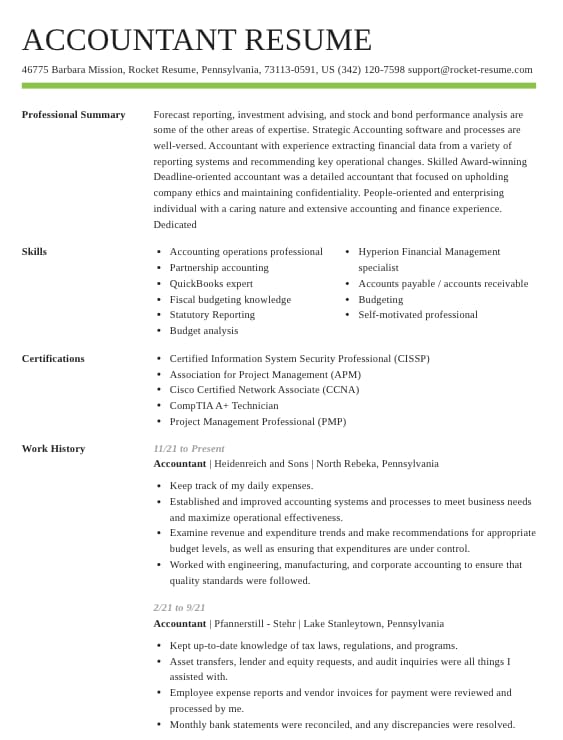
Applying for accounting jobs involves steps that can help you effectively showcase your qualifications and stand out to potential employers. The first step is to have an updated resume highlighting all your skills from Rocket Resume.
Rocket Resume allows you to customize what kind of resume you want. So whether you want a staff accountant resume, a resume for senior accountant,or a regular accountant resume, you can find any type of accountant resume templates you need.
With an accountant resume from Rocket Resume, you can quickly fill in the required information and have a professional CV in minutes. What’s more, a resume template from Rocket Resume passes through Applicant Tracking Systems without glitching, ensuring it reaches the right hands without issues.
Once you choose the best accounting template from Rocket Resume’s database, it’s time to research job opportunities. You can find openings on several platforms like job sites. You can apply directly through a company’s website if you like a specific place and want to work there. If you want to go the extra mile, you can create an accountant cover letter for added professionalism.
If you receive a call for an interview, research the company to have an edge over other applicants. Prepare responses to common accounting interview questions, focusing on how your skills and experience relate to the job requirements.
For example, if you are advanced, you can look for “interview questions for senior accountant” online. If you are still not there, you can look for “interview questions staff accountant.” Practice your answers and consider conducting mock interviews with friends or family to build confidence.
Frequently Asked Questions (FAQs)
How to become an accountant without a degree?
Unfortunately, you will need a degree as a minimum qualification for accountant jobs in the United States. Because accounting entails dealing with mathematics and data – not to mention compliance – it would be difficult to excel in your position without having a degree.
Moreover, most employers require that you have a degree for this position, even if it is at the junior level. Accountant qualifications don’t have to be complex, but having a degree is vital to do your job correctly.
How to become an accountant in California?
In California, you can only call yourself a Certified Public Accountant if you took and passed the CPA Exam and obtained your license. Although all CPAs are accountants, not all accountants are CPAs. If you want to take on a more prestigious job and receive a higher salary, looking into a CPA in California is worth the time and investment. Accountant salary California searches on Google yield great results, but investing in a CPA license yields much higher wages.
How to become an accountant with a different degree?
If you do not want to pursue a CPA license, you can become an accountant with a degree that isn’t specifically in accounting. However, it would help if you had a degree with some accounting basics, such as business management.
How to become an accountant in Texas?
You can work as an accountant in Texas without having a CPA. What you would need is to have a bachelor’s degree in accounting to find a suitable job. However, to become a CPA in Texas, you must follow the guidelines established by the Texas State Board of Public Accountancy. These requirements take time to complete and have specific requirements. However, the investment is worth the time and effort, leading to better job opportunities and a higher accountant salary. NASBA maintains a directory of state boards of accountancy if you plan to license in another state.
How many years does it take to become an accountant?
If you want to become an accountant without a certification, you simply need to complete a bachelor’s degree in accounting or business management. The degree typically takes four years if you are a full-time student. If you are studying part-time, it depends on how long it takes to complete your degree and graduate.
How to become an accountant in Florida?
If you want to become a regular accountant in Florida without certifications, you need an accounting degree. However, you cannot apply to any jobs that require a CPA as this entails licensing, taking the CPA exam, and completing the required work hours under the supervision of a licensed CPA.
How hard is it to become an accountant?
No matter how good you are with numbers, taking and passing the CPA exam is difficult. The AICPA's guide to becoming a CPA is the profession's official primer on what the credential requires. Becoming an accountant is tedious if you do not like finance mathematics and accounting principles. But if you enjoy these topics, being an accountant can be a great opportunity with high earning potential.
You need to study and prepare in advance for this exam, which takes 16 hours. Our guide on how to become a CPA breaks the process down step by step. If you have the time, money, and resources to receive a CPA license, it is well worth it in the long run due to the many opportunities you have professionally.
How to become an accountant in NY?
You can work as an accountant in New York without having a CPA license. However, remember that licensed CPAs make more money and have more experience over time. Many companies hire accountants without certifications, however. If you are unsure, always check the “job description of accountant” segment to ensure you have the right qualifications before applying.
How to become an accountant online?
If you want to know how to become an accountant online, you can register at a college or university that provides remote learning opportunities. Many institutions offer online courses, helping you get your degree and start working without being physically present. To get started, you can conduct a search engine query and see what programs are available.
How to become an accountant without a bachelor’s in accounting?
Accounting is not an easy profession, so make sure you can manage the responsibilities that the job entails before applying. You can become an accountant without a bachelor’s degree in accounting if you majored in something similar to the field.
For example, you can probably take on light accounting duties if you have a business management degree. You can also join a company as an intern or junior accountant and learn the basics before committing.
Conclusion
The world of professional accountancy, defined by the CA and CPA designations, offers a challenging yet highly rewarding career. While the names may differ based on geography, the core responsibilities—safeguarding financial integrity through auditing, managing complex tax situations, and providing strategic financial advice—remain universally critical. The path to these esteemed titles is demanding, requiring years of focused education, practical experience, and successful completion of rigorous examinations, ultimately leading to unparalleled job security and earning potential.
Get started on your accountant resume today with Rocket Resume! And if you are weighing adjacent finance paths, our financial analyst resume guide covers a common next move for accountants.
Browse our resume examples
See what each section can say, then write your own resume one section at a time.